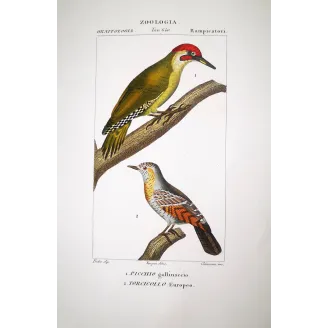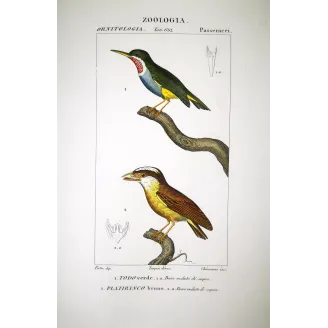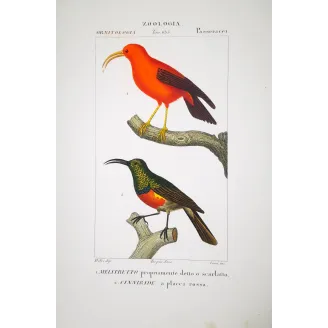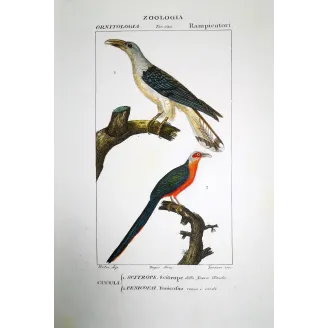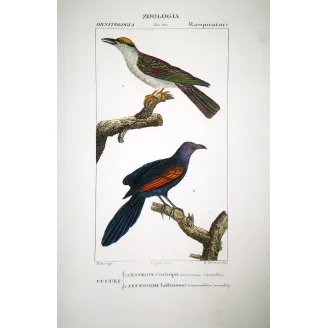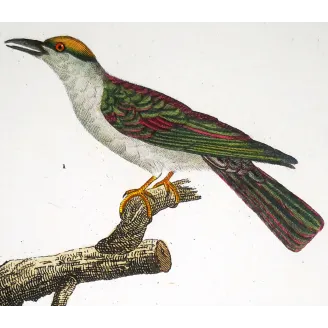
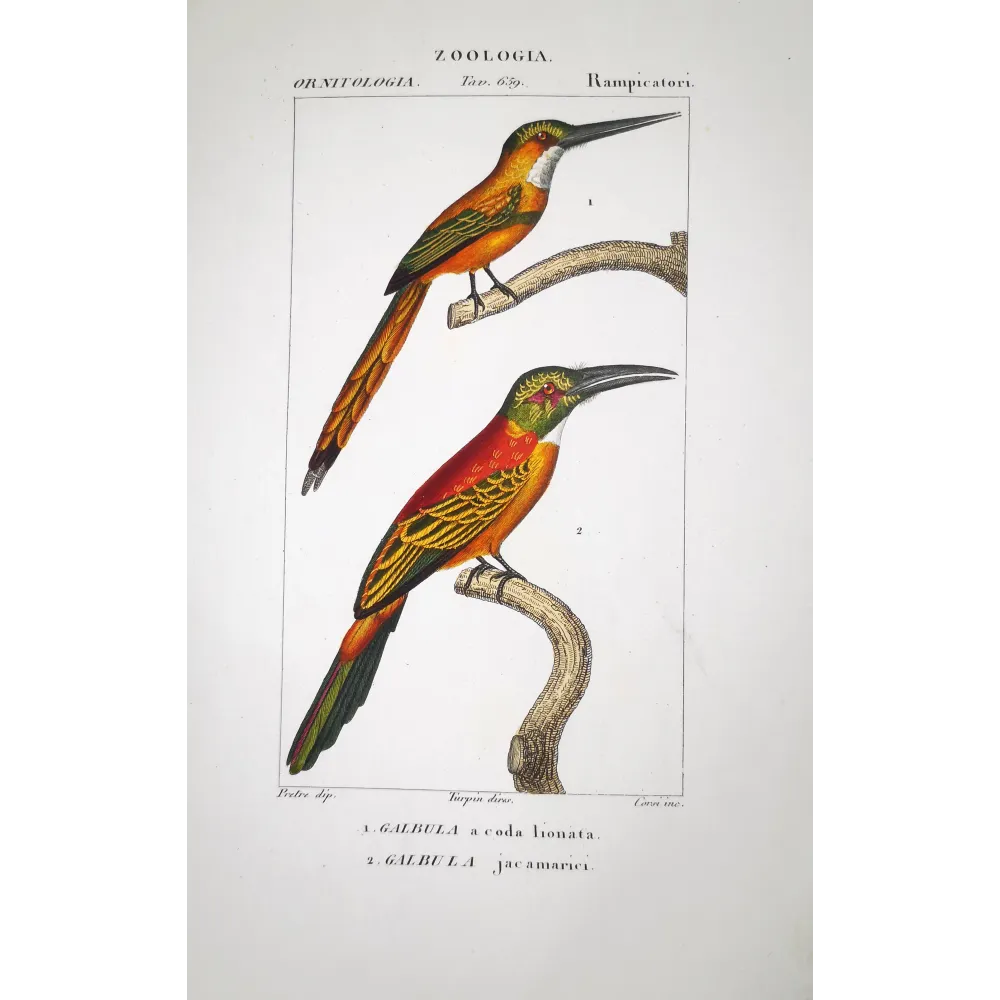
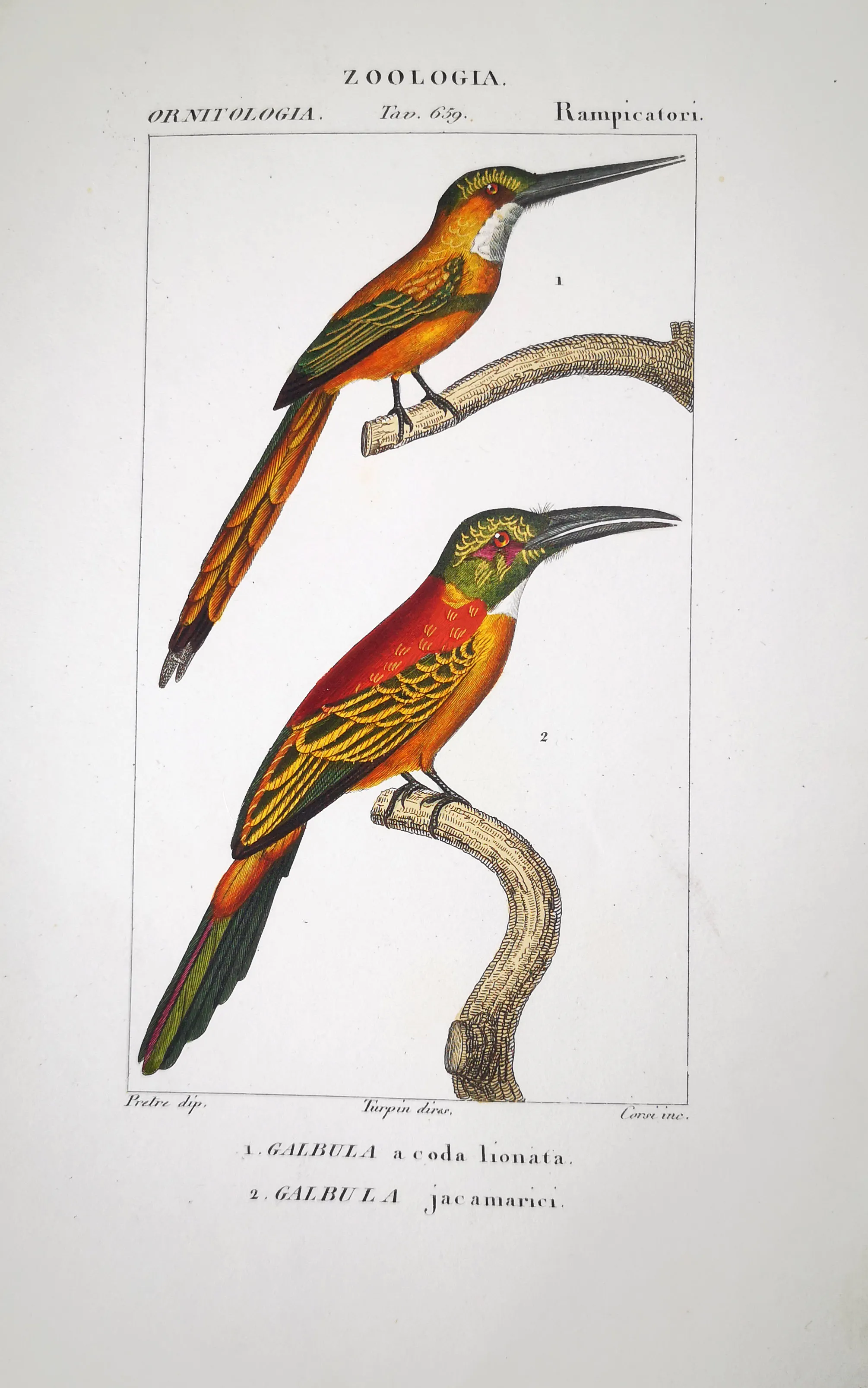
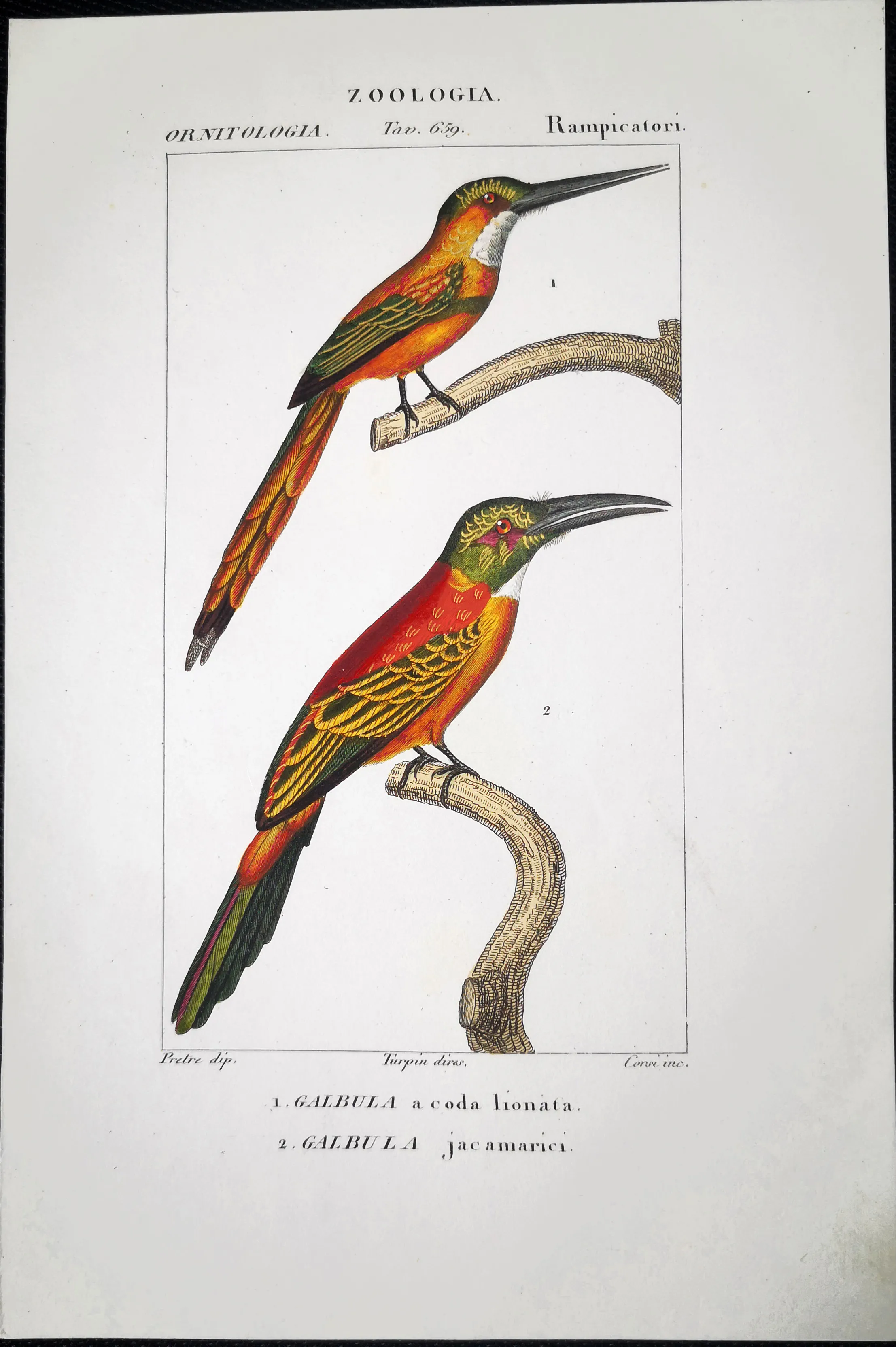



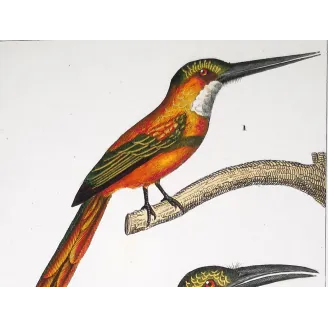
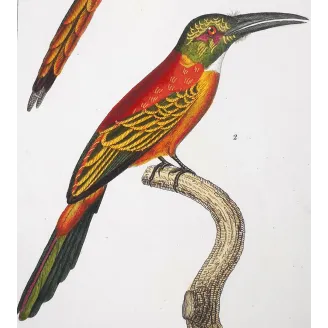
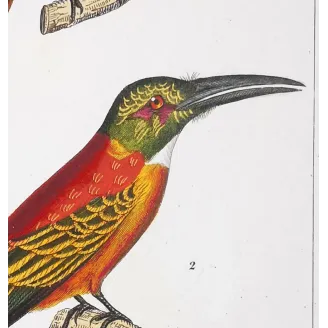
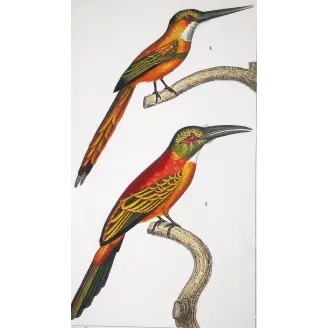
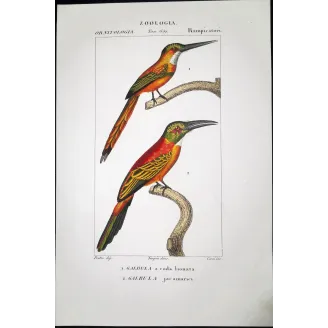

Two vibrant Jacamar birds with metallic plumage and long sharp beaks on stylized branches.
 Delivery policy
Your print will be carefully prepared and shipped worldwide via trusted couriers (UPS or similar).
 Authentic antique prints
Original engravings from the 17th–19th century.
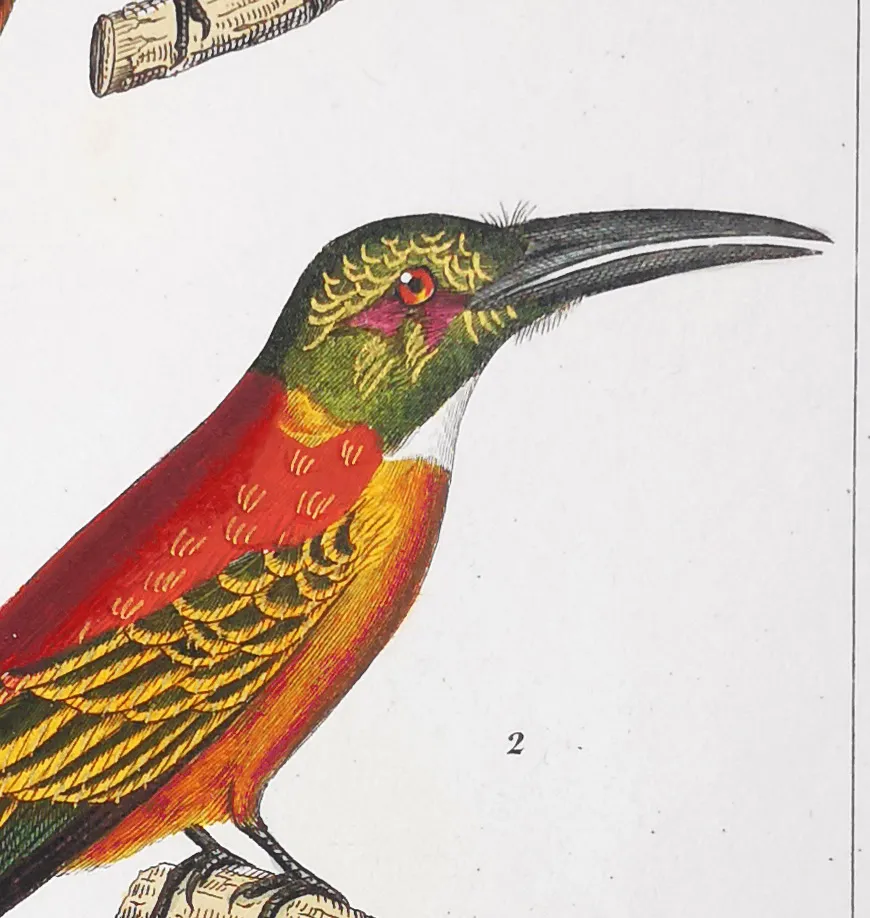
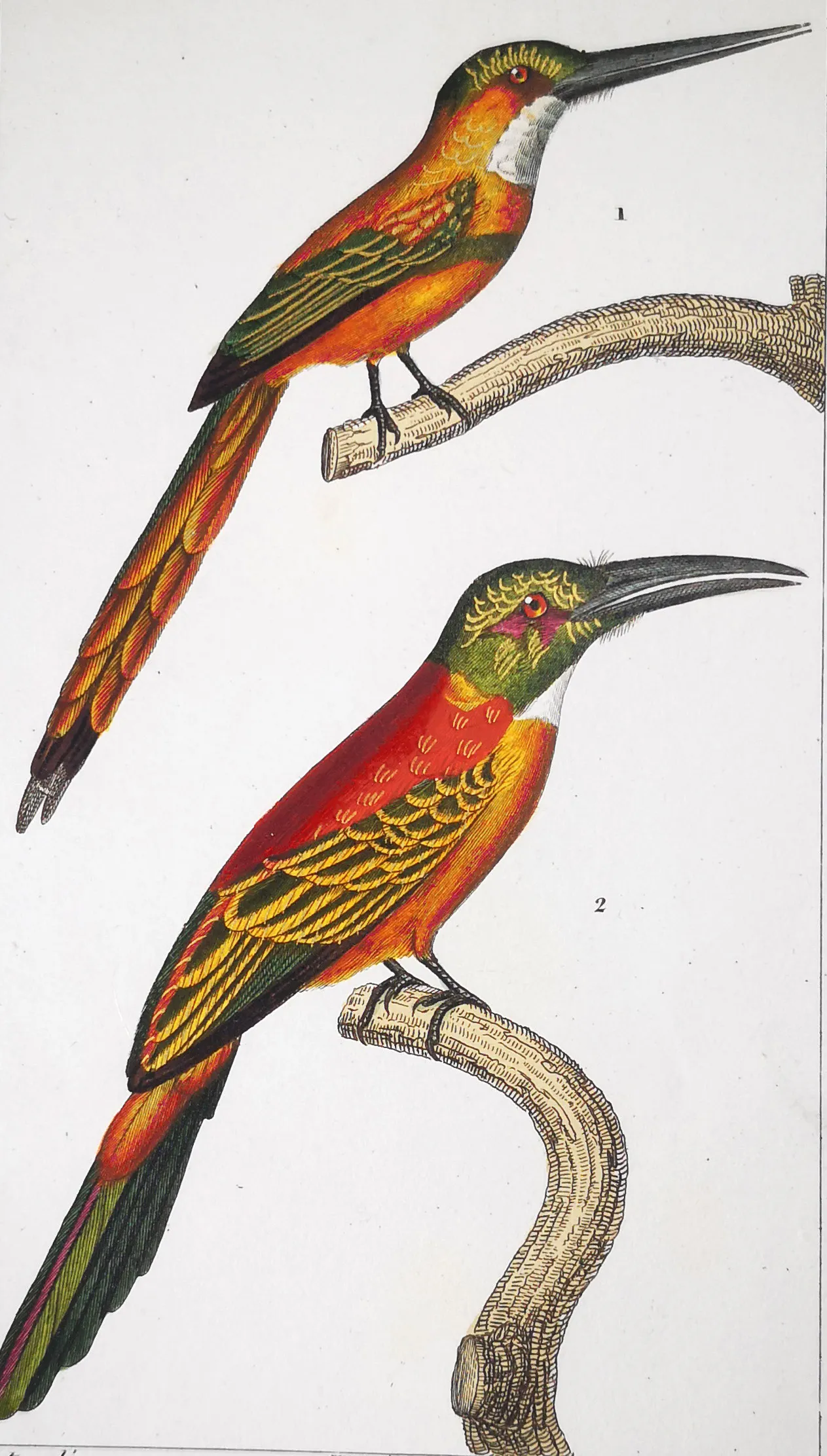
This radiant ornithological engraving presents two South American jacamars under the genus name printed on the plate: Galbula. The subjects are titled “Galbula a coda lionata” and “Galbula jacamarici”, shown in a refined comparative arrangement that highlights bill architecture, tail length, and plumage structure with cabinet-like clarity. The birds are staged on clean, natural branches against a pale field—an encyclopedic presentation designed to make colour, morphology, and proportion immediately legible.
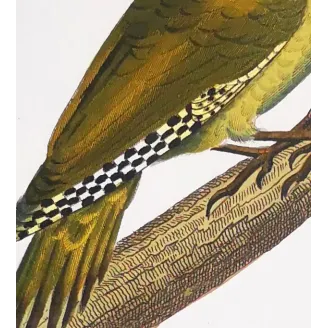
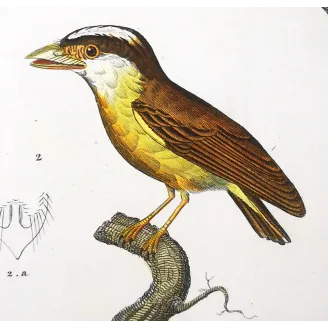
What elevates this sheet into true top-tier collecting territory is its true gold enhancement, applied extensively across both figures—most visibly on the head and wing areas—creating a luminous, almost “woven” brilliance when the engraving catches light. The effect is unusually rich: gold is not a minor accent here, but a defining material presence that amplifies the plate’s decorative authority without compromising its scientific discipline.
The engraving belongs to the Italian edition of the Dizionario di Scienze Naturali (Florence, Battelli press), one of the most ambitious encyclopedic scientific enterprises of its time, for which Pierre Antoine Prêtre produced some of the most accomplished zoological illustrations of the early nineteenth century.
— • —
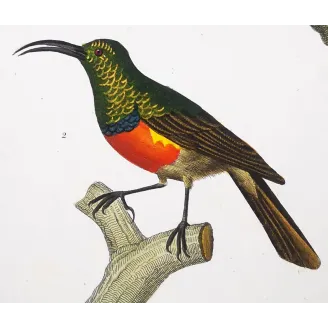
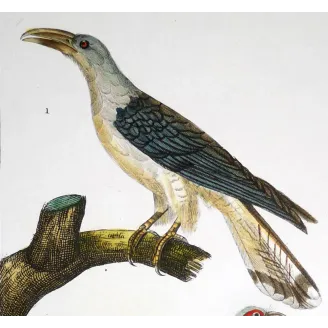
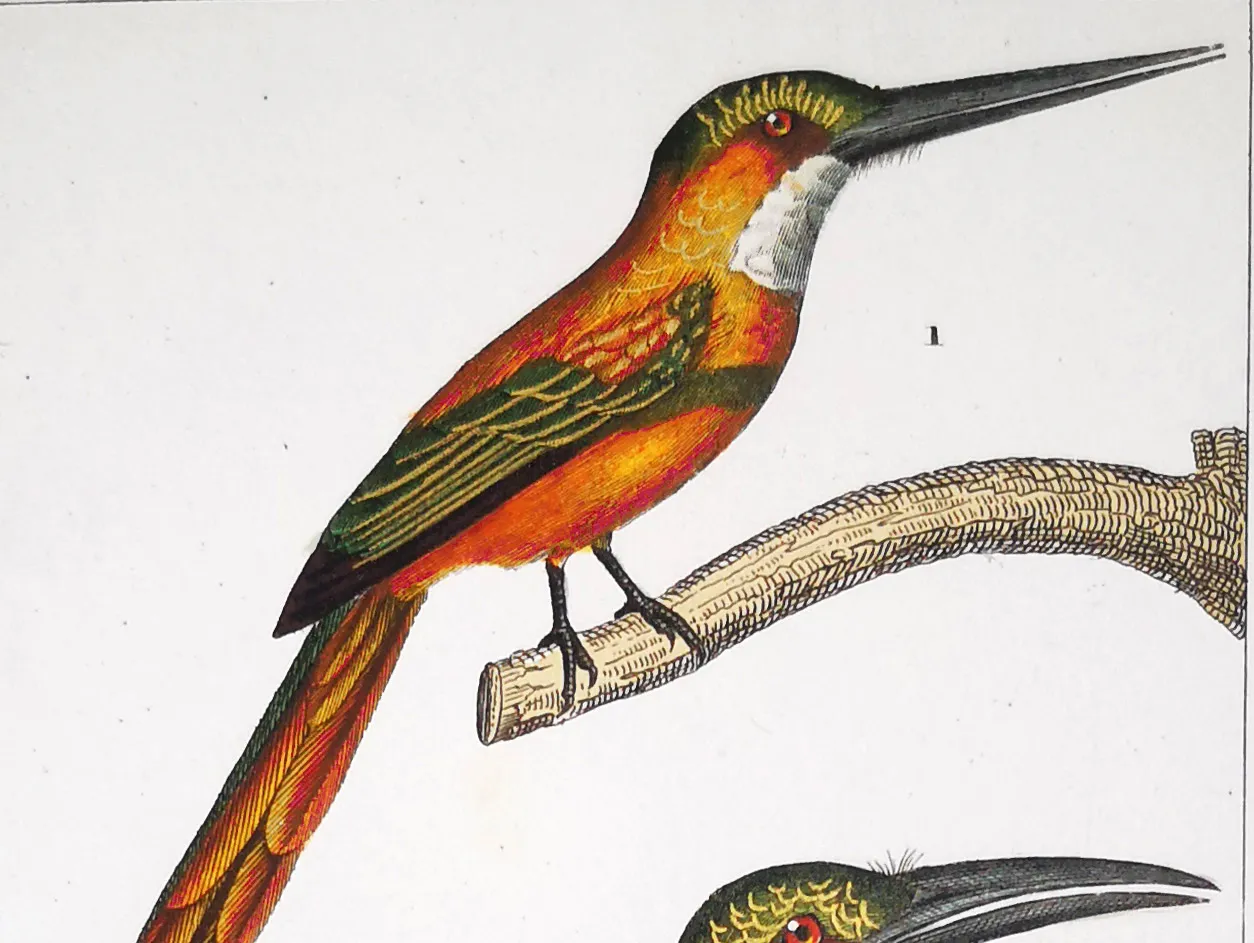
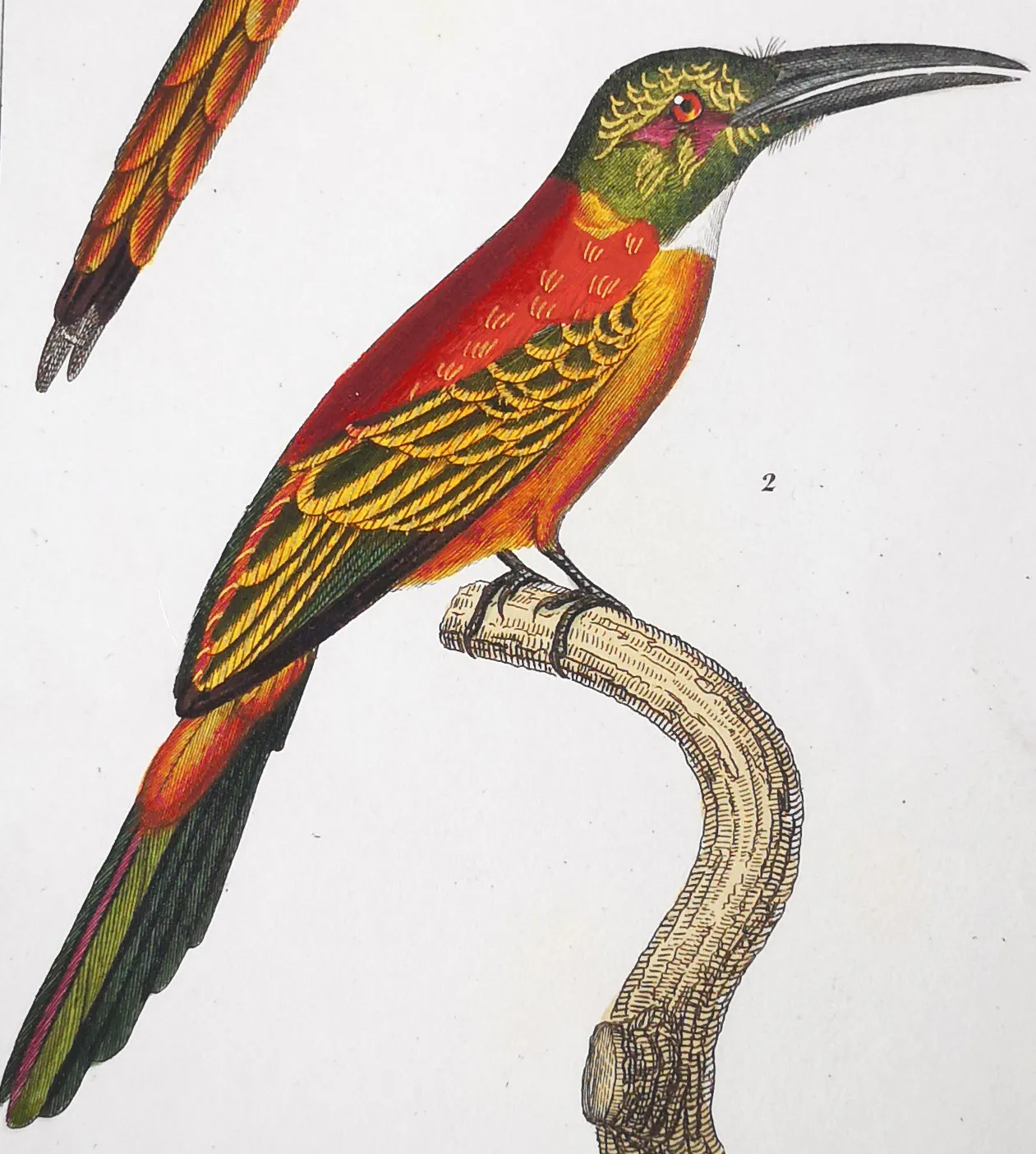
The composition is built as a poised duet. The upper jacamar reads as lighter and more agile, with warm cinnamon-to-amber tonalities and a long tail that introduces vertical elegance. The lower bird carries greater chromatic weight: a deeper red body, stronger green-gold patterning, and a bill rendered with clean, decisive contour. Both figures are placed with generous white space, allowing each to appear as an individual “object” rather than a crowded taxonomy.
Chromatically, the plate is extraordinary for its controlled richness. Warm reds and oranges are balanced by cooler olive-greens, while the true gold enhancement creates a refined metallic vibration over the plumage—especially across wing coverts and crown areas. The result is a rare intersection of scientific illustration and luxury material effect, ideally suited to curated interiors where a single artwork is meant to carry the wall.
Jacamars (genus Galbula and related groups) are slender, tropical birds native to the forests of Central and South America, admired for their long bills, iridescent plumage, and dart-like hunting behavior. They are primarily insectivorous, often taking prey in swift sallies from a perch—an ecology that favors streamlined bodies and precise bill proportions. For nineteenth-century naturalists, jacamars were exemplary comparative subjects: bill length, tail shape, and plumage logic offered clear visual markers for classification.
This plate captures that comparative method beautifully: two related forms, isolated and readable, presented as if within a natural history cabinet. The unusually extensive gold enhancement adds an additional layer of rarity—turning a scientifically disciplined engraving into a statement work with genuine material luxury.
This plate forms part of the historic Dizionario di Scienze Naturali, a monumental early nineteenth-century encyclopedic enterprise once preserved within a noble library and today housed in the Sacchetti Collection. Each engraving reflects a period in which scientific ambition was matched by exceptional artisanal execution — from the disciplined copperplate line to the luminous hand-colouring applied individually to every impression.
The result is not merely zoological documentation, but a refined synthesis of scholarship and craftsmanship. To discover the full story behind these rare prints and their noble provenance, we invite you to read our editorial feature “Not Just Another Print”.
The engraving is in excellent antique condition. The impression is clean and well-preserved, with strong definition and carefully retained hand-colouring. The sheet features true gold enhancement across both jacamar figures—particularly visible on the wings and head—creating a pronounced metallic brilliance under light. The paper is smooth early nineteenth-century wove paper (non-laid), consistent with Italian scientific editions of the period. No watermark has been observed. Any minor age toning is consistent with antique paper and does not affect the plate’s visual impact.
For further context on Pierre Antoine Prêtre and his contribution to nineteenth-century zoological illustration, see our editorial feature:
Pierre Antoine Prêtre – Illustrator of Natural Science and Marine Life
Specific References
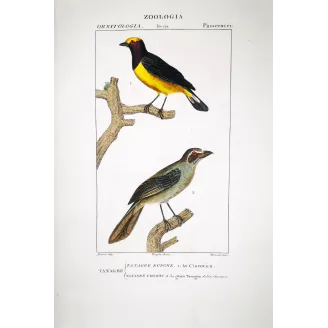
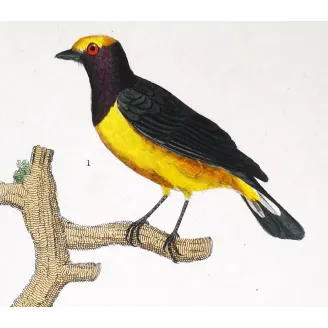
Graceful composition of a Yellow Tanager and a more subtly colored species from the Guyana region.
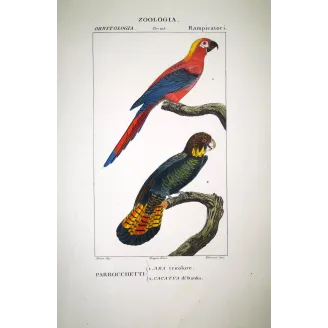
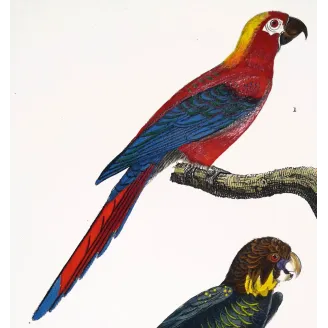
Vibrant parakeets perched on branches: a scarlet macaw and a black cockatoo with yellow and red highlights.
Two striking hawks from Australia, finely illustrated with warm natural tones.
Exquisite depiction of the ornate Greater Bird-of-Paradise alongside the striking Common Hill Myna.
Delicate birds from the New World: the vibrant Green Todus and a brown Platyrinchus with unique beak features.
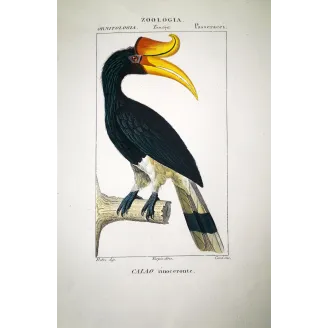
Beautiful 19th century illustration of the Buceros rhinoceros, commonly known as the Rhinoceros Hornbill.
Brilliantly colored honeycreeper and sunbird illustration with tropical vibrancy, captured by Prêtre.
Elegant depiction of a Scythrope and a vividly colored red-and-green Trogon perched on branches.
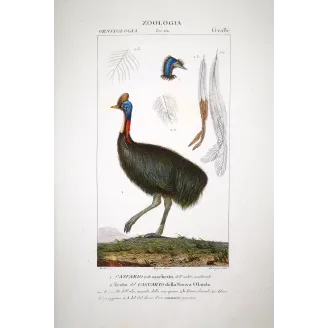
Impressive antique engraving of the Southern Cassowary, a striking flightless bird from New Guinea and northern Australia.
Two exotic birds from Australia, depicted with vivid hand-coloring.
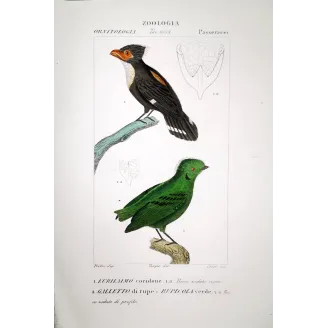
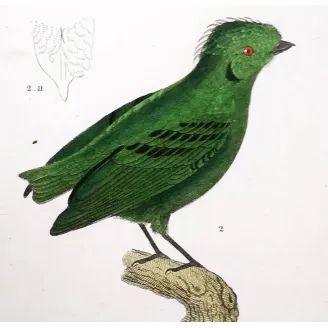
Rare birds of the jungle: the crest-faced Corydon and a luminous green Rupicola.
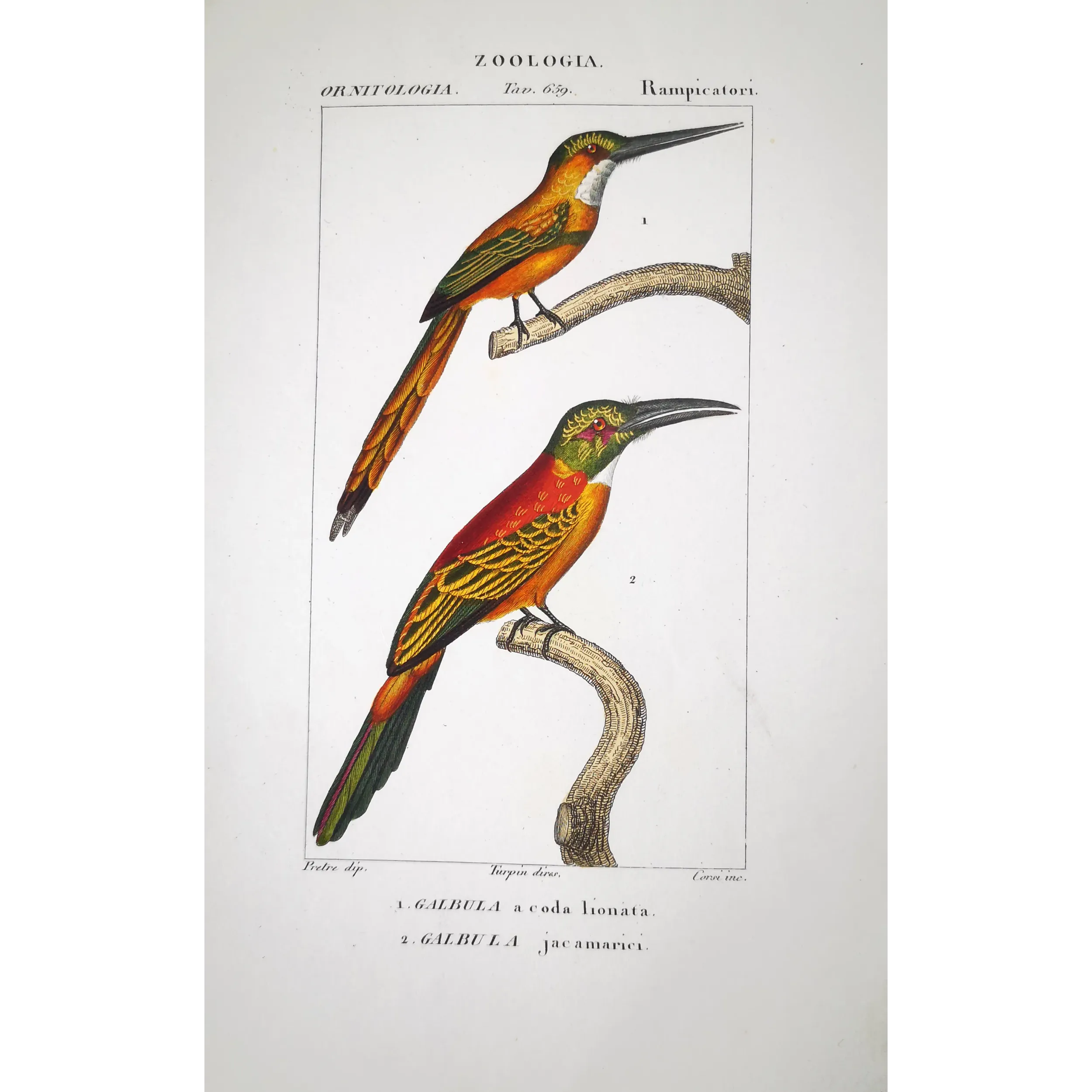
Two vibrant Jacamar birds with metallic plumage and long sharp beaks on stylized branches.