
Elisabeth Blackwell: One Hand, One Vision, One Extraordinary Herbal
In early eighteenth-century London, there was little space for women in scientific publishing—let alone in the demanding world of copperplate engraving. Yet Elisabeth Blackwell undertook one of the most ambitious botanical projects of her time almost entirely on her own.
A Curious Herbal (1737–1739) was conceived as a practical medical reference for apothecaries and physicians: a work meant to support reliable identification of medicinal plants in everyday practice. What makes it extraordinary, however, lies not only in its scientific intent, but in the rare unity of authorship visible on the sheets themselves.
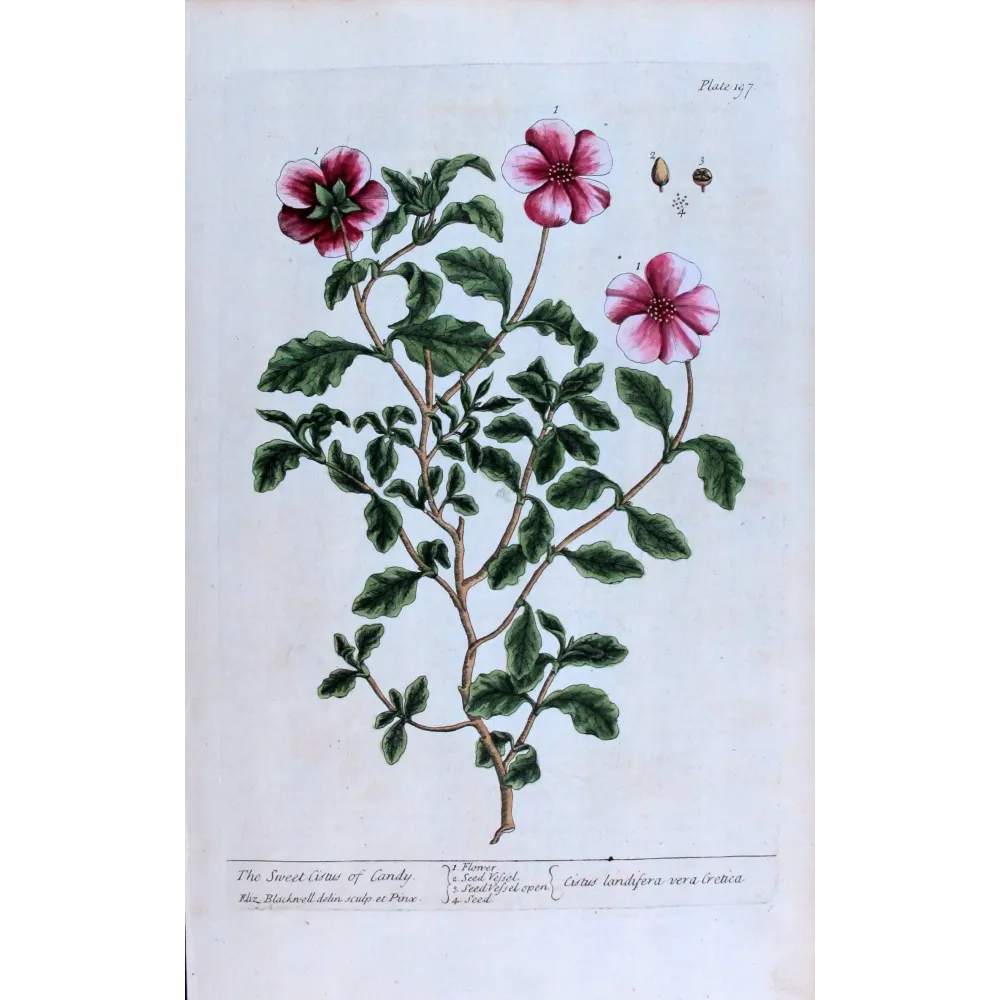
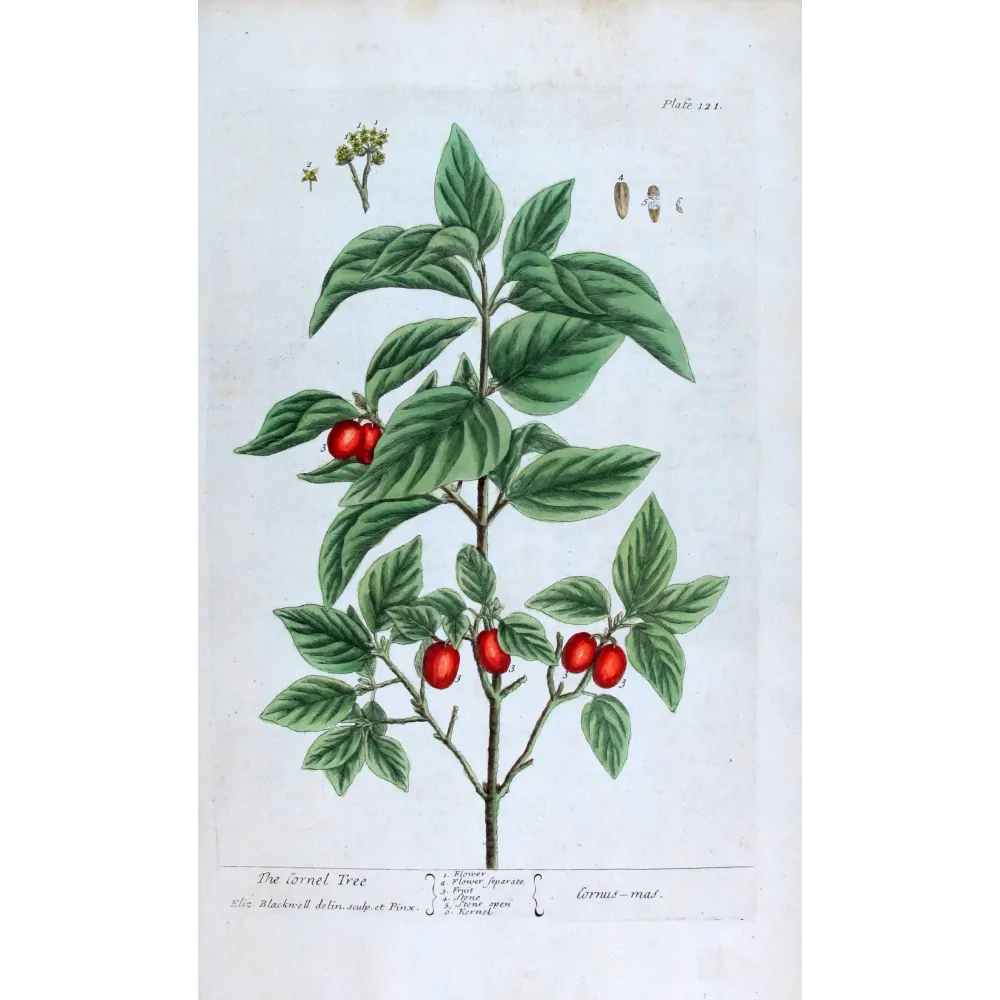
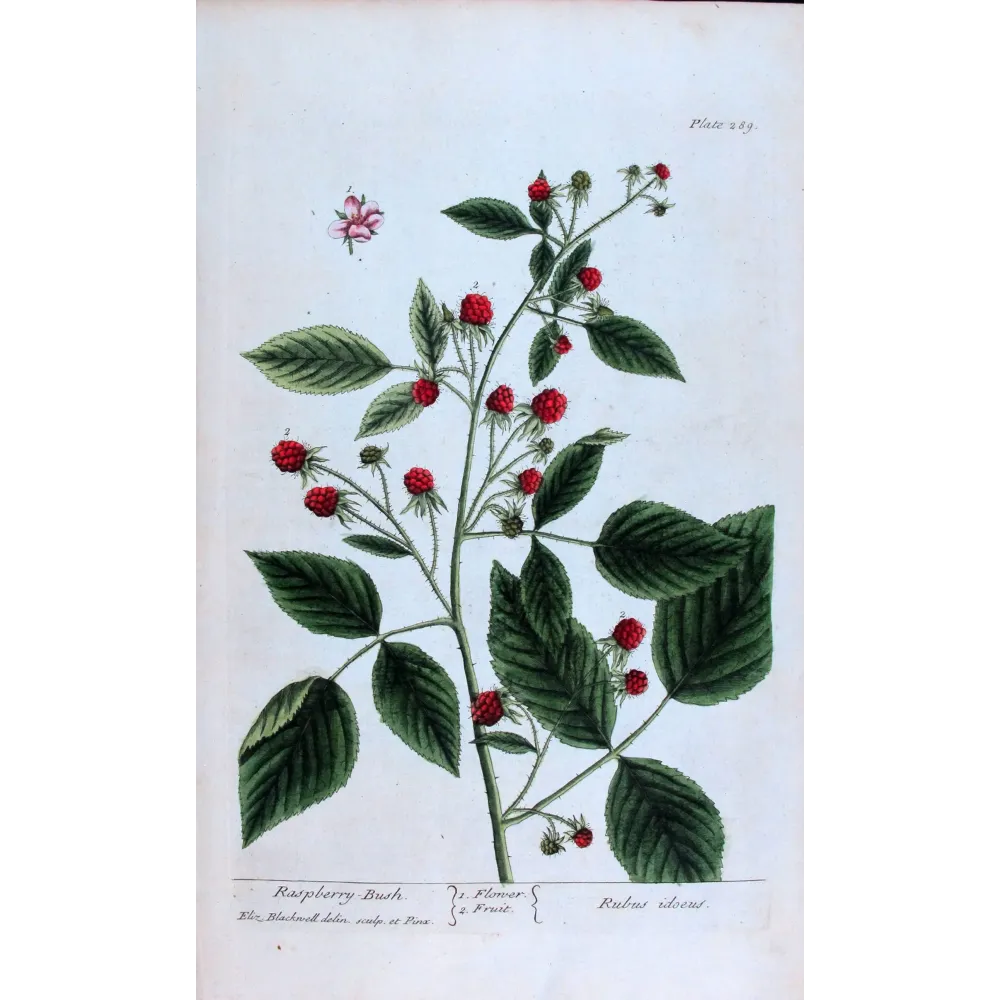
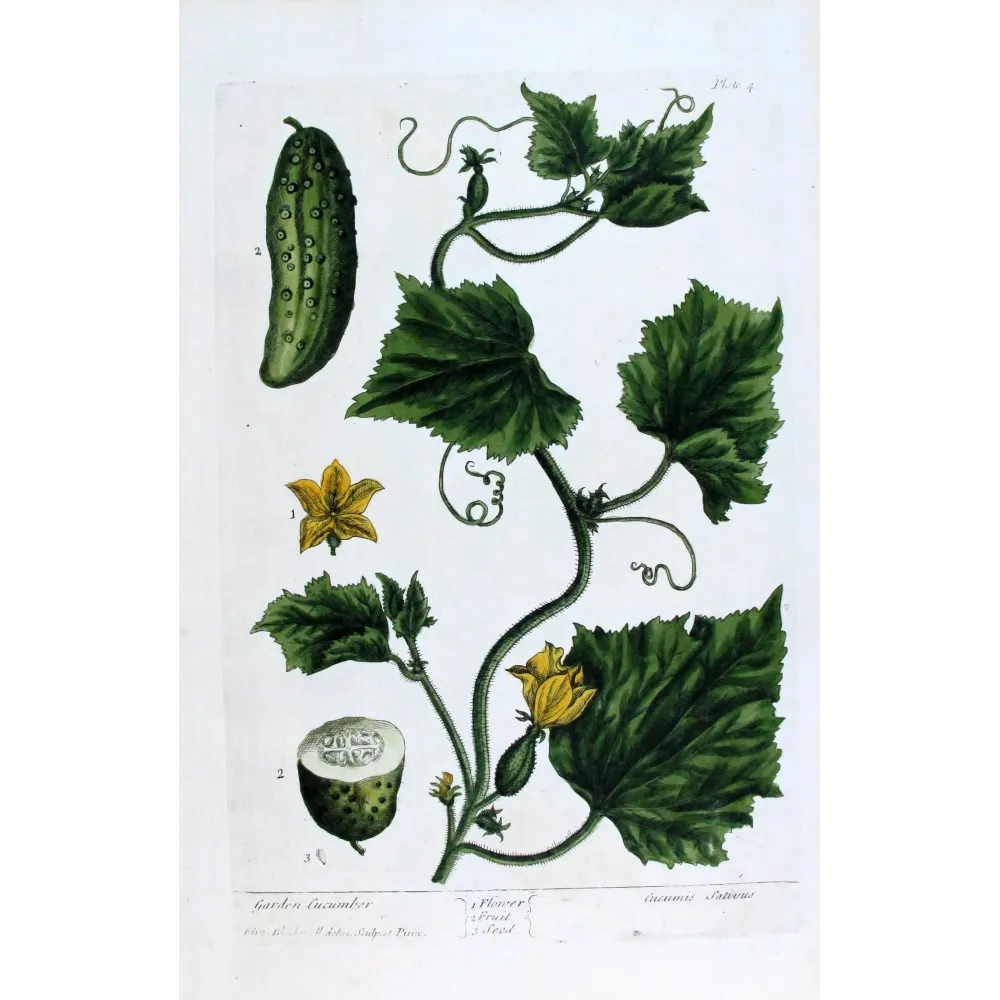
Blackwell did not merely illustrate this monumental herbal. The plates bear the credit “delin. sculp. et pinx.”—a concise declaration that the drawing, copper engraving, and hand-colouring were executed by the same hand. In an age built on the division of labour, this is exceptional; for a woman working outside formal academic structures, it is nothing short of remarkable.
Blackwell’s achievement was not born of privilege or institutional support. Copperplate engraving required physical endurance, precision, and long hours of concentrated labour; hand-colouring demanded patience, control, and consistency across hundreds of impressions. A Curious Herbal was not assembled by a workshop. It was built plate by plate through direct, repeated engagement with both nature and the printing process.
That unity leaves a visible trace—one that modern viewers can still perceive. These sheets do not feel anonymous. They carry the quiet evidence of a sustained, individual effort: decisions repeated, refined, and held to a consistent standard across the whole series.
The hand-colouring of Blackwell’s engravings possesses a restraint that feels deeply personal. The washes are light and measured, never ornamental for their own sake. Colour is used to clarify structure, to differentiate botanical elements, and to guide the eye gently across the image.
This is where the rarity of one hand behind every stage becomes most tangible. Line and wash respond to one another with an intimacy that workshop-produced images rarely achieve. The result is a visual calm—balanced, legible, and quietly confident—whose grace feels inseparable from the artist’s presence.
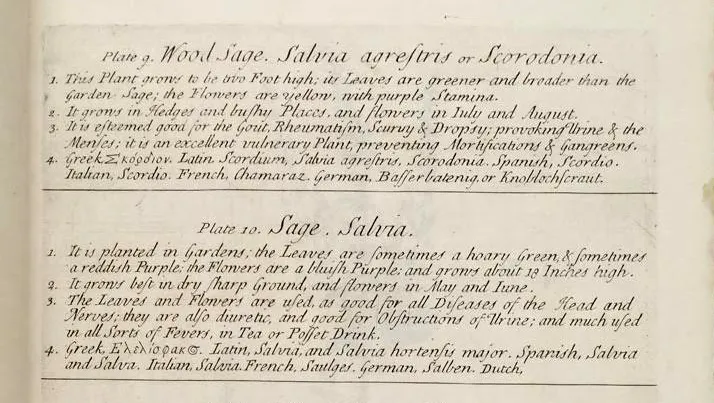
A further, rarely discussed detail deepens the sense of unity in Blackwell’s project. In the copy preserved in the Prantique archive, the written pages are printed from engraved plates rather than movable type. The rectangular plate mark remains visible on the paper, a physical signature of intaglio printing.
The text appears in a lively, handwritten-style script, carrying the rhythm and variation of a human hand rather than mechanical uniformity. Knowledge here is not merely transmitted, but materially engraved—pressed into paper through line, pressure, and time.
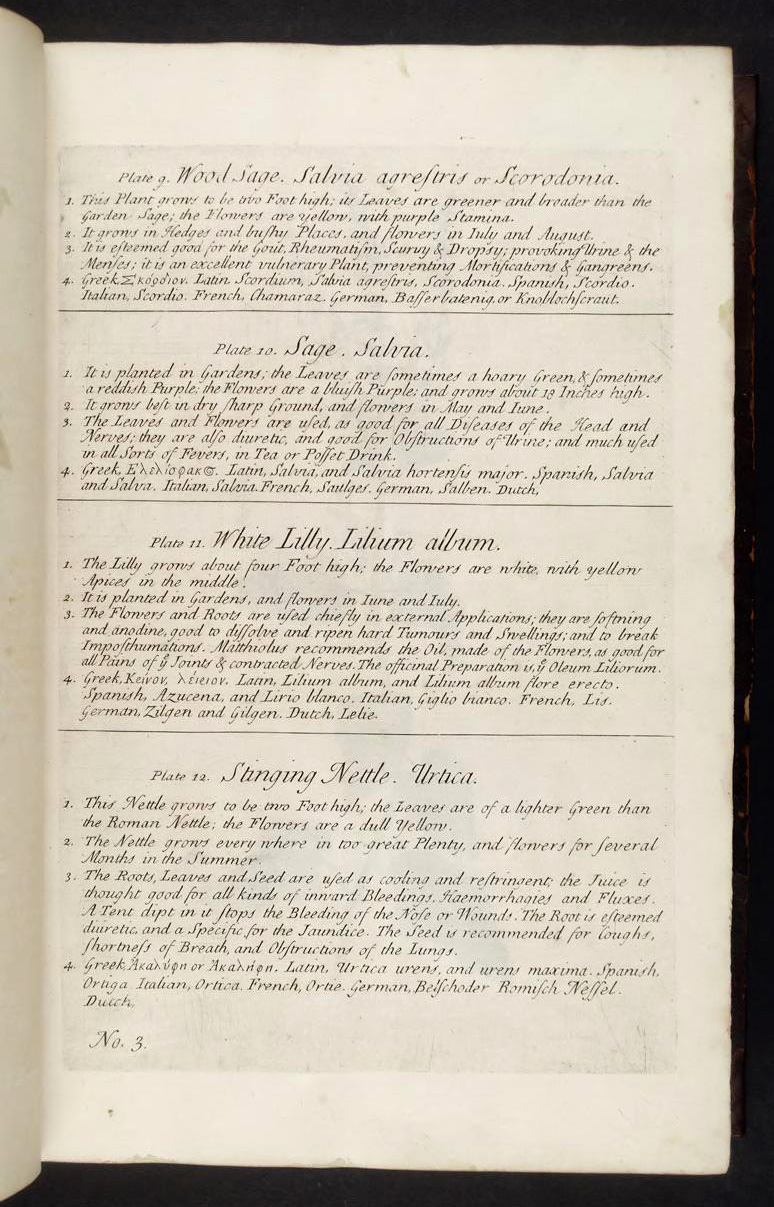
Engraved text leaf from the Prantique archive. The rectangular plate mark, the cursive handwritten-style script, and the blank reverse clearly indicate intaglio printing from an engraved plate rather than movable type.
Blackwell did not frame her work as a manifesto. The act itself was sufficient. At a time when women were largely excluded from scientific authorship, she demonstrated competence at every technical stage of production—drawing, engraving, colouring, and the disciplined repetition required to complete a monumental publication.
There is no rhetoric embedded in A Curious Herbal. Its authority is carried through accuracy, endurance, and clarity of execution. The work asserts itself quietly—through the visible presence of a single guiding hand and the consistent intelligence of its visual decisions.
Nearly three centuries later, Blackwell’s prints continue to resonate not only for their botanical value, but for their human presence. Each sheet carries the quiet evidence of effort, skill, and resolve—qualities that remain visible to the eye, even before one knows the story behind the name.
|
|
|
|
Related posts
-
 Ernst Haeckel and the Sublime Art of Das System der Medusen
A scientific monograph that became a gallery of natural elegance. The German biologist Ernst Haeckel was fascinated...Read more
Ernst Haeckel and the Sublime Art of Das System der Medusen
A scientific monograph that became a gallery of natural elegance. The German biologist Ernst Haeckel was fascinated...Read more -
 Eugène Grasset and the Art of Nature: The Origins of Modern Floral Design
In the heart of the Art Nouveau movement, Eugène Grasset stood out as one of the first artists to merge scientific...Read more
Eugène Grasset and the Art of Nature: The Origins of Modern Floral Design
In the heart of the Art Nouveau movement, Eugène Grasset stood out as one of the first artists to merge scientific...Read more -
 Émile-Allain Séguy: Nature, Color, and the Decorative Avant-Garde
A Life Between Science and Style. Séguy’s art is more than decoration. It is a reminder that even in the age of...Read more
Émile-Allain Séguy: Nature, Color, and the Decorative Avant-Garde
A Life Between Science and Style. Séguy’s art is more than decoration. It is a reminder that even in the age of...Read more -
 Émile-Allain Séguy and Prismes: Art Deco Geometry in Full Color
At the intersection of biology, modernism, and decorative arts, Émile-Allain Séguy occupies a singular place. Best...Read more
Émile-Allain Séguy and Prismes: Art Deco Geometry in Full Color
At the intersection of biology, modernism, and decorative arts, Émile-Allain Séguy occupies a singular place. Best...Read more -
 La Plante et ses Applications Ornementales: Eugène Grasset and the Birth of Modern Botanical Design
In the golden age of Art Nouveau, few works embody the marriage between art and nature as perfectly as La Plante et...Read more
La Plante et ses Applications Ornementales: Eugène Grasset and the Birth of Modern Botanical Design
In the golden age of Art Nouveau, few works embody the marriage between art and nature as perfectly as La Plante et...Read more
Leave a comment