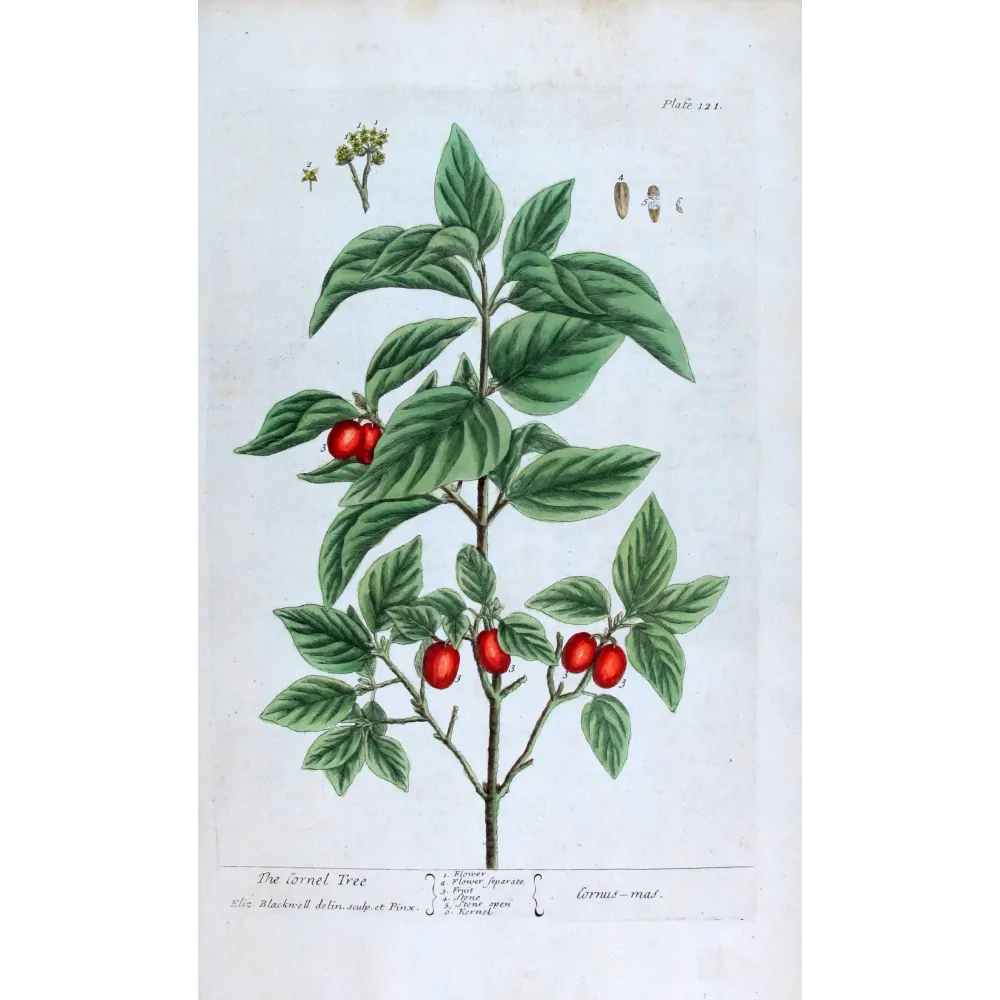
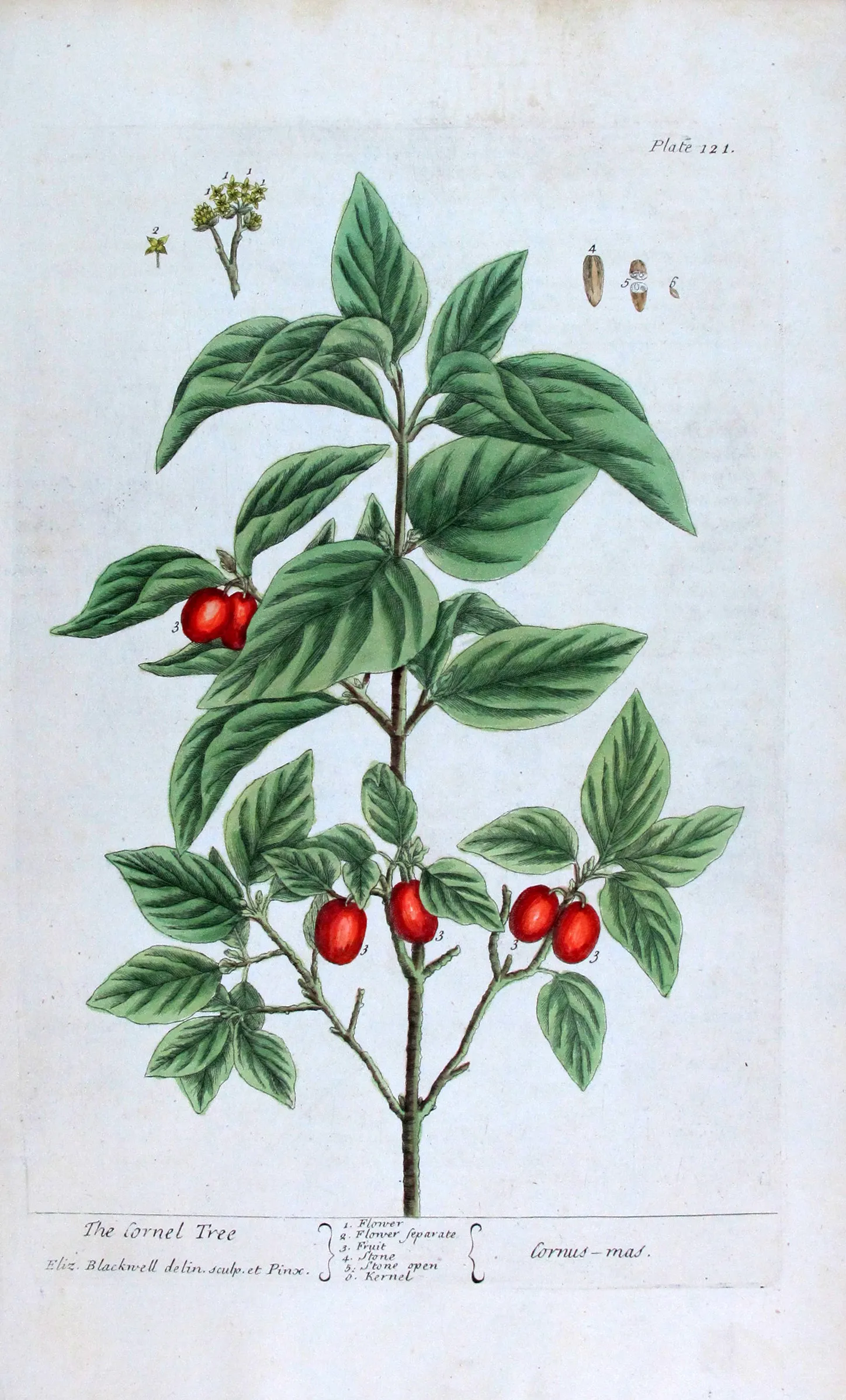
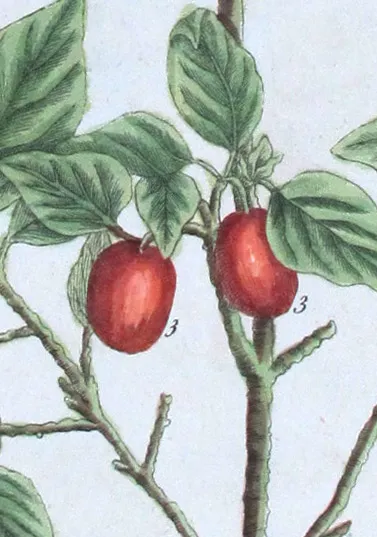
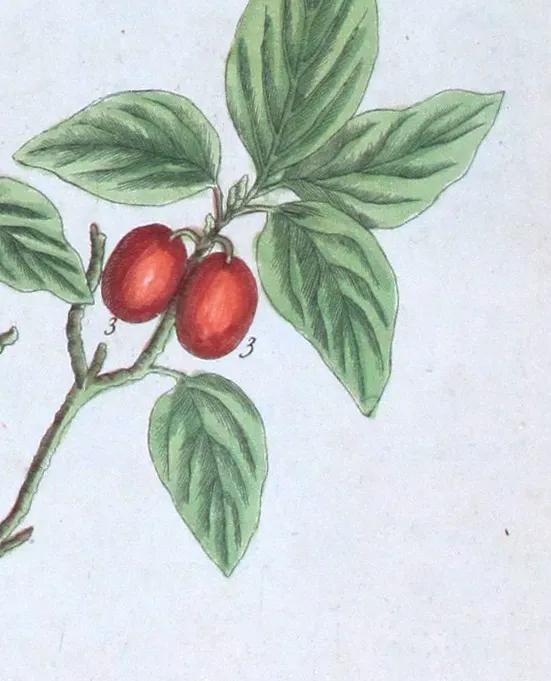
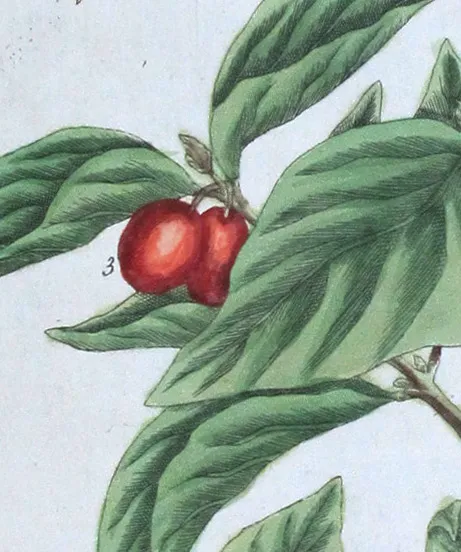
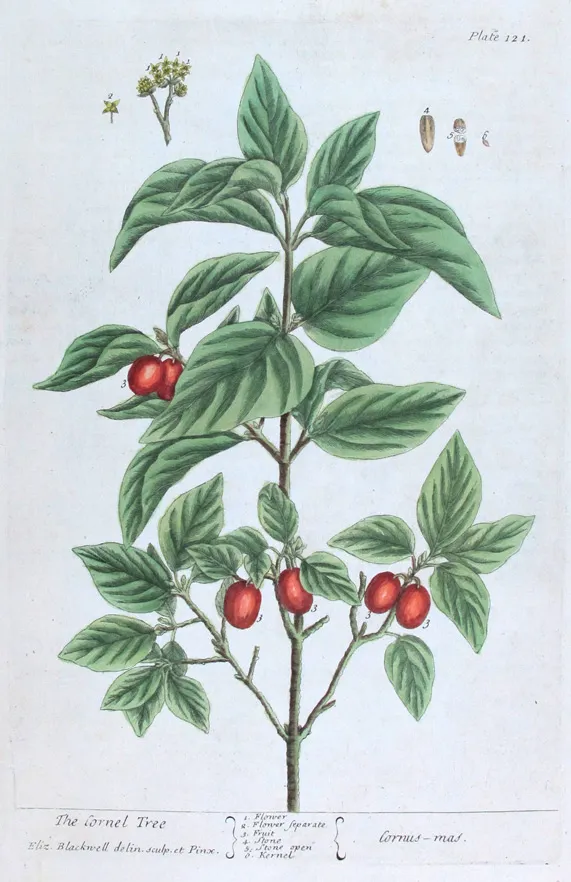


Fine 18th-century engraving of the Cornel Tree by Elisabeth Blackwell, with red fruit and delicate foliage.
 Delivery policy
Your print will be carefully prepared and shipped worldwide via trusted couriers (UPS or similar).
 Authentic antique prints
Original engravings from the 17th–19th century.
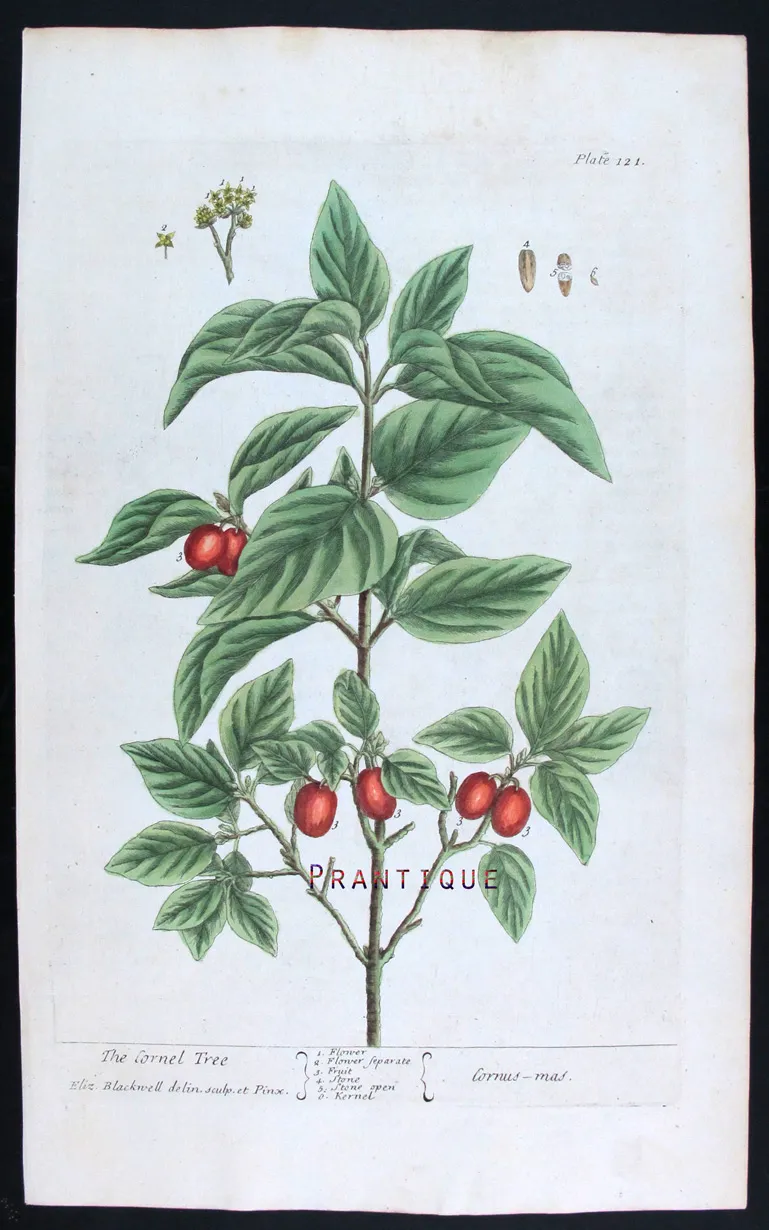
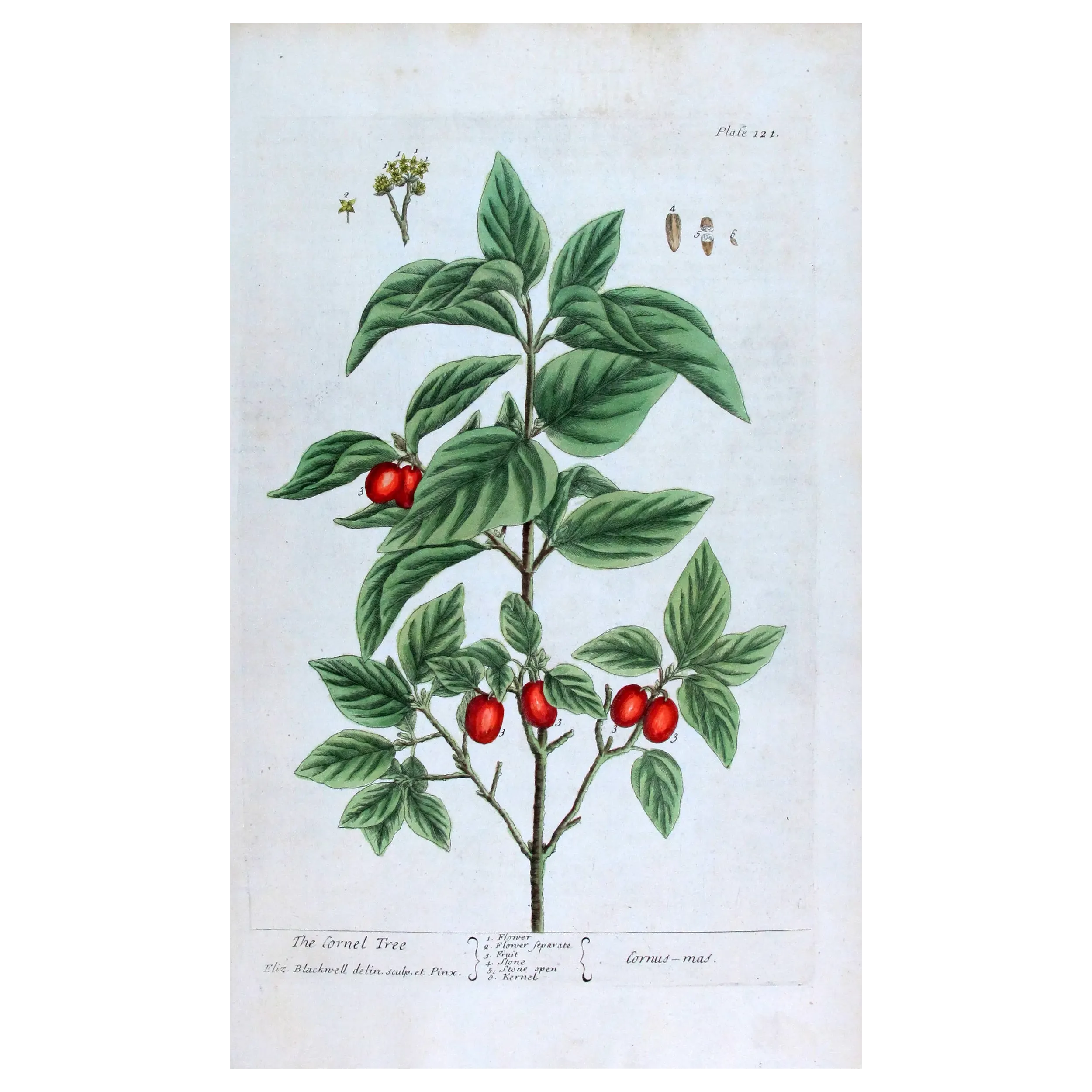
This refined botanical engraving depicts The Cornel Tree, presenting a fruiting branch with measured balance and clear botanical definition, rendered with an emphasis on legibility and compositional restraint.
The plant is organized around a calm vertical structure, its broad, softly veined leaves framing clusters of ripening red fruits. Elisabeth Blackwell’s approach privileges proportion and clarity, allowing the botanical characteristics to be read with ease while maintaining a composed visual harmony.
Created in the early eighteenth century, this plate belongs to A Curious Herbal, a foundational medical and botanical work distinguished by the unity of its production, in which drawing, copper engraving, and hand-colouring were executed by the same hand.
— • —
The composition develops along a central stem, branching gently to support both foliage and fruit. The rounded berries introduce points of visual emphasis, contrasting with the elongated leaves and creating a steady, rhythmic progression through the image.
Subtle tonal transitions model the leaves with depth, while the restrained hand-colouring of the fruit provides a controlled chromatic accent. The overall palette remains balanced, reinforcing the engraving’s analytical clarity and calm visual presence.
The cornel tree (Cornus mas) was well known in early European medicine and domestic practice, valued for its firm, acidic fruits and recorded for both culinary and medicinal uses. Cornelian cherries were commonly associated with preserves, syrups, and astringent preparations, making accurate identification of the fruiting stage particularly important. In herbal literature, the contrast between foliage and vividly colored berries served as a practical visual cue, reinforcing the plant’s inclusion in medical reference works such as A Curious Herbal, where usefulness depended on recognizing distinctive seasonal characteristics.
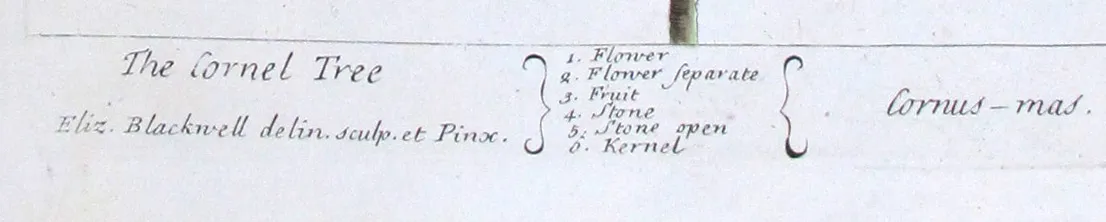
The engraving is in exceptionally fine antique condition, printed on original handmade laid paper typical of early 18th-century botanical publications. No watermark has been observed. The sheet remains fresh and clean, with a stable surface and no notable defects. The original hand-colouring is well preserved, and the impression is crisp and legible throughout. These qualities correspond to a “like brand new” state of preservation and confirm the authenticity of the print as an original production from A Curious Herbal. The engraved credit “Eliz. Blackwell delin. sculp. et pinx.” is present and fully legible, attesting that the drawing, engraving, and hand-colouring were executed by Elisabeth Blackwell herself.
For further context on Elisabeth Blackwell and the singular unity of authorship behind A Curious Herbal, see our editorial feature:
Specific References
18th-century hand-colored engraving of the Almond Tree by Elisabeth Blackwell, with blossom, fruit and kernel beautifully rendered.
Elegant botanical engraving of the Bean plant with pods and seed details.
Elegant 18th-century hand-colored engraving of a Raspberry Bush by Elisabeth Blackwell, with ripe fruit and soft blossom.
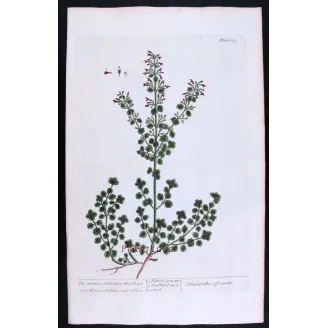
Refined 18th-century engraving of Mountain Calamint by Elizabeth Blackwell, with upright stems and pink blossoms, ideal for calm, herbal or cottage-inspired interiors.
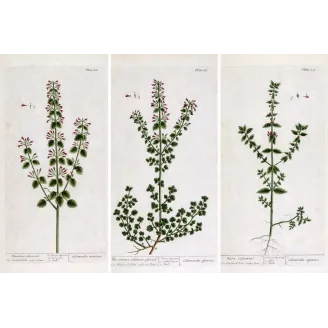
A curated botanical trio illustrating three closely related Calamintha species — officinalis, montana, and aquatica — as engraved and hand-colored by Elisabeth Blackwell for A Curious Herbal (1737–1739). Presented together, these plates offer a rare comparative view of medicinal, habitat-specific, and morphological variation within a single genus, reflecting early modern botanical practice and apothecary knowledge.
Original 18th-century engraving of the Wild Cucumber by Elisabeth Blackwell, with spined fruit and yellow flowers.
Charming study with pink blossoms and vivid red rosehips, a classic countryside motif.
Hand-colored botanical engraving of the Common Calamint, with dense foliage and soft pink-purple florets.
Elegant botanical engraving of Great Figwort (Scrophularia major) with branching stems, clustered flowers and root detail.
Fine 18th-century botanical of the Wild Pine, with graceful hanging cones and delicate needles ideal for woodland-themed interiors and natural history walls.
Charming 18th-century engraving of Sage by Elizabeth Blackwell, with blue-green leaves and delicate flowers, perfect for kitchen walls or herb-themed gallery displays.
Hand-colored engraving of Water Figwort (Scrophularia aquatica), featuring vertical stems, red blossoms and a caterpillar study.
Fine engraving of Black Alder with berries and elegant branching, ideal for natural interiors.
Fine engraving of Great Centaury (Centaurium majus) with pinkish florets, slender stems, and a butterfly study.
Hand-colored 18th-century engraving of Yellow Asphodel, a vivid botanical composition from Elisabeth Blackwells A Curious Herbal.
Fine 18th-century hand-colored engraving of Euphorbium by Elisabeth Blackwell, a striking botanical study ideal for collectors.
Fine 18th-century engraving of the Cornel Tree by Elisabeth Blackwell, with red fruit and delicate foliage.