
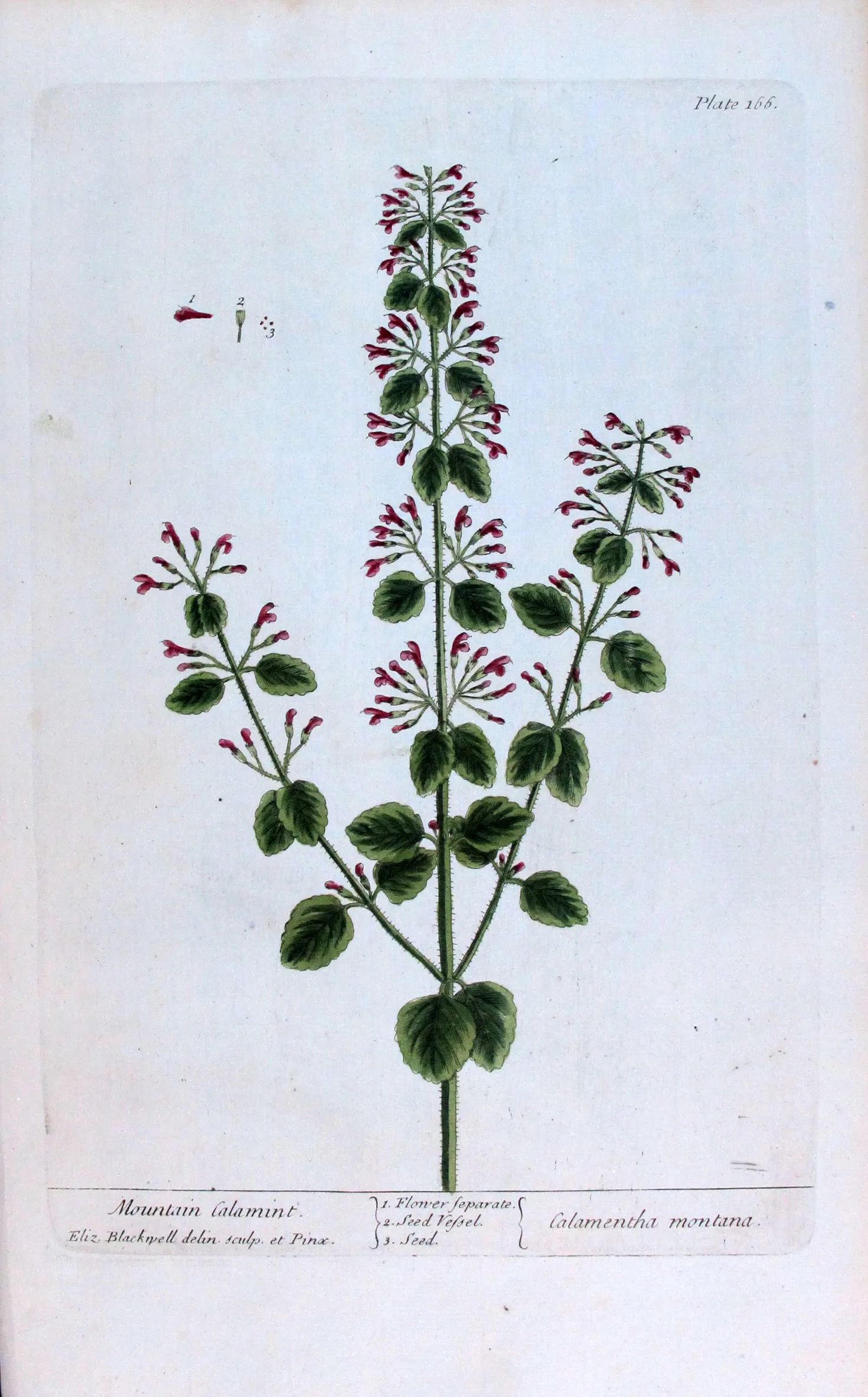
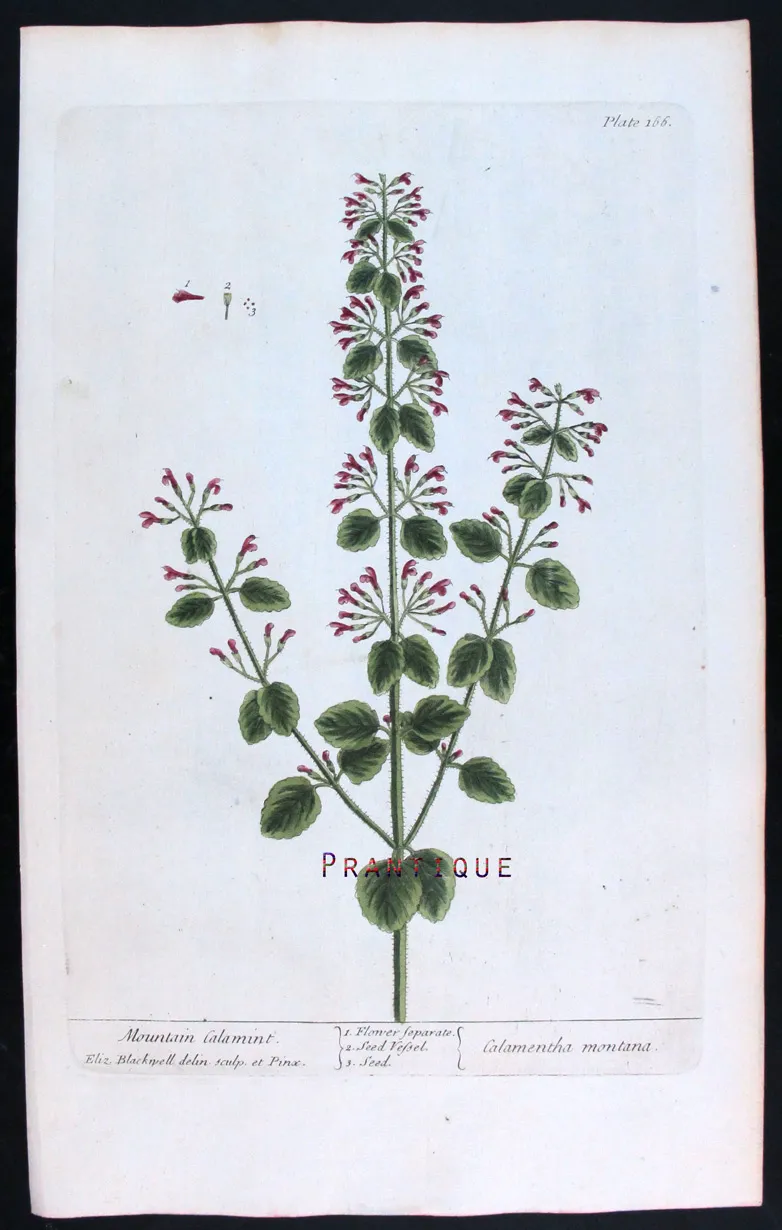


Refined 18th-century engraving of Mountain Calamint by Elizabeth Blackwell, with upright stems and pink blossoms, ideal for calm, herbal or cottage-inspired interiors.
 Delivery policy
Your print will be carefully prepared and shipped worldwide via trusted couriers (UPS or similar).
 Authentic antique prints
Original engravings from the 17th–19th century.
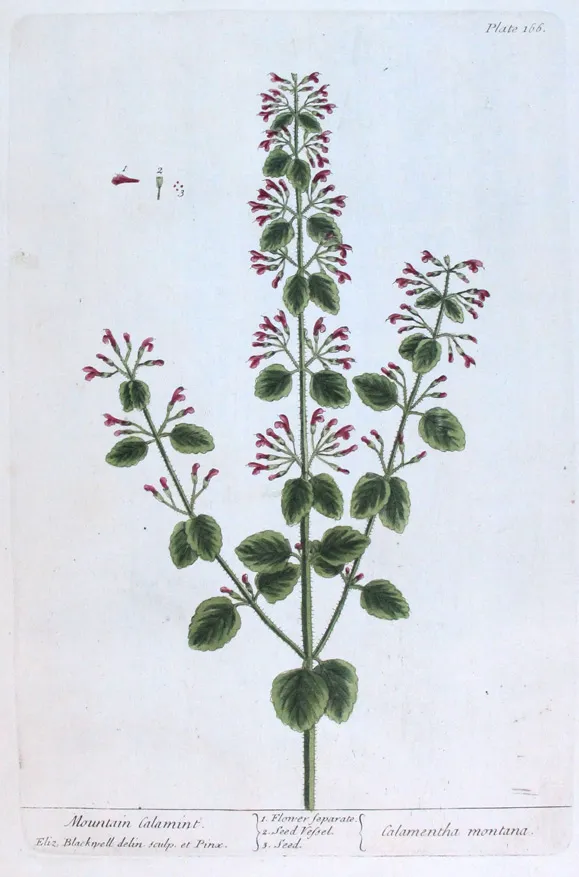
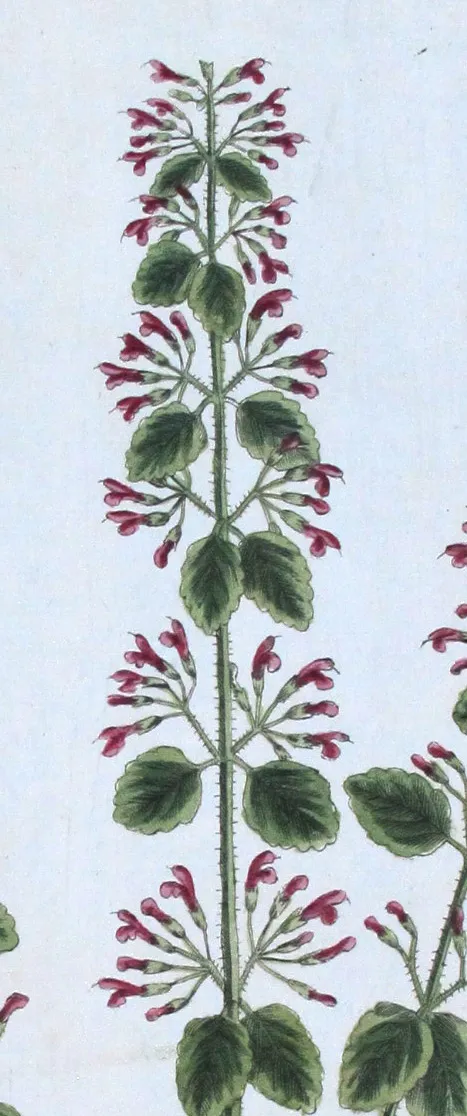
This refined botanical engraving depicts Mountain Calamint (Calamintha montana), presenting an upright flowering stem with regularly spaced whorls of small tubular blossoms and opposite, softly textured leaves arranged for clear botanical identification.
The composition is organized along a strong vertical axis, with lateral branches creating a balanced, symmetrical rhythm. Elisabeth Blackwell enhances legibility by isolating individual floral components—flower, calyx, and seed—allowing the plant’s structure and reproductive features to be read with precision.
Produced in the early eighteenth century, this plate forms part of A Curious Herbal, a work that sought to document plants of medicinal relevance through accurate observation and practical visual reference.
— • —
The plant’s evenly spaced flower whorls establish a measured upward rhythm, giving the composition clarity and calm order. Rounded leaf forms soften the structure, balancing the linearity of the stem and reinforcing the plant’s aromatic, herbaceous character.
Restrained hand-colouring highlights subtle contrasts between foliage and blossoms without decorative excess. Muted greens and soft reddish tones preserve botanical clarity while lending the image a quiet elegance.
Mountain calamint (Calamintha montana) belonged to a group of aromatic herbs closely associated with digestive and calming remedies in early European medicine. Its leaves and flowering tops were commonly used in infusions and preparations valued for their warming and carminative properties. Because several related species shared similar scents and appearances, accurate visual distinction was essential in apothecary practice. Blackwell’s plate reflects this practical need, emphasizing floral arrangement, leaf form, and seed structure to support reliable identification.
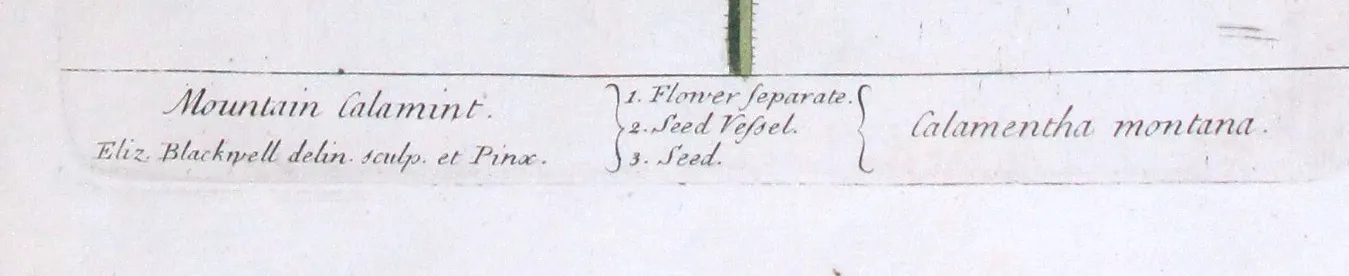
The engraving is in exceptionally fine antique condition, printed on original handmade laid paper typical of early 18th-century botanical publications. A period watermark is visible on the sheet, consistent with contemporary papermaking practices. The surface remains fresh and stable, with light, even age-related toning. The impression is crisp and well defined, with well-preserved hand-colouring and intact engraved inscriptions, including the artist’s credit “Eliz. Blackwell delin. sculp. et pinx.”
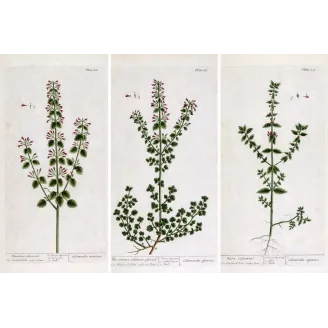
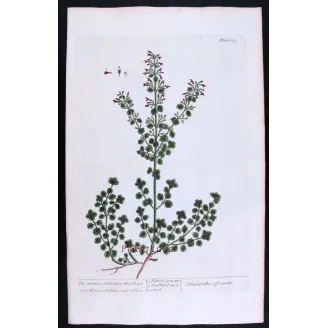
This engraving forms part of a rare botanical group depicting three closely related Calamintha species, as illustrated by Elisabeth Blackwell in A Curious Herbal. While Calamintha montana documents a habitat-specific mountain form, the complete group offers a broader comparative view of medicinal use, morphology, and early apothecary practice.
Collectors and scholars interested in the full botanical narrative may explore the complete curated trio here:
Three Calamints – Botanical Trio from A Curious Herbal
For further context on Elisabeth Blackwell and the medicinal herbs documented in A Curious Herbal, see our editorial feature:
Specific References
A graceful hand-colored engraving of Marshmallow (Althaea officinalis) with soft pink flowers and expressive root study.
Elegant pink-white blossoms with upright stems and finely shaped leaves, a graceful 18th?century botanical.
Hand-colored engraving of Water Figwort (Scrophularia aquatica), featuring vertical stems, red blossoms and a caterpillar study.
Elegant 18th-century hand-colored engraving of the Male Fern by Elizabeth Blackwell, with finely shaded fronds ideal for nature-inspired walls or botanical galleries.
Elegant botanical engraving of the Bean plant with pods and seed details.
Elegant 18th-century hand-colored engraving of a Raspberry Bush by Elisabeth Blackwell, with ripe fruit and soft blossom.
Elegant olive branches with vivid green leaves and fruit in subtle yellow tones.
Elegant botanical engraving of Great Figwort (Scrophularia major) with branching stems, clustered flowers and root detail.
Charming 18th-century engraving of Sage by Elizabeth Blackwell, with blue-green leaves and delicate flowers, perfect for kitchen walls or herb-themed gallery displays.
Fine 18th-century engraving of the Cornel Tree by Elisabeth Blackwell, with red fruit and delicate foliage.
Striking palm fronds paired with warm golden dates, a highly decorative composition.
Fine 18th-century engraving of the Medlar Tree by Elisabeth Blackwell, featuring fruit, blossom, and botanical detail.
Lively Hawthorn branch with crisp green leaves and clusters of rich red berries, a classic countryside motif for warm, welcoming interiors.
A curated botanical trio illustrating three closely related Calamintha species — officinalis, montana, and aquatica — as engraved and hand-colored by Elisabeth Blackwell for A Curious Herbal (1737–1739). Presented together, these plates offer a rare comparative view of medicinal, habitat-specific, and morphological variation within a single genus, reflecting early modern botanical practice and apothecary knowledge.
Broad heart-shaped leaves with yellow tubular blooms, beautifully rendered in subtle tones.
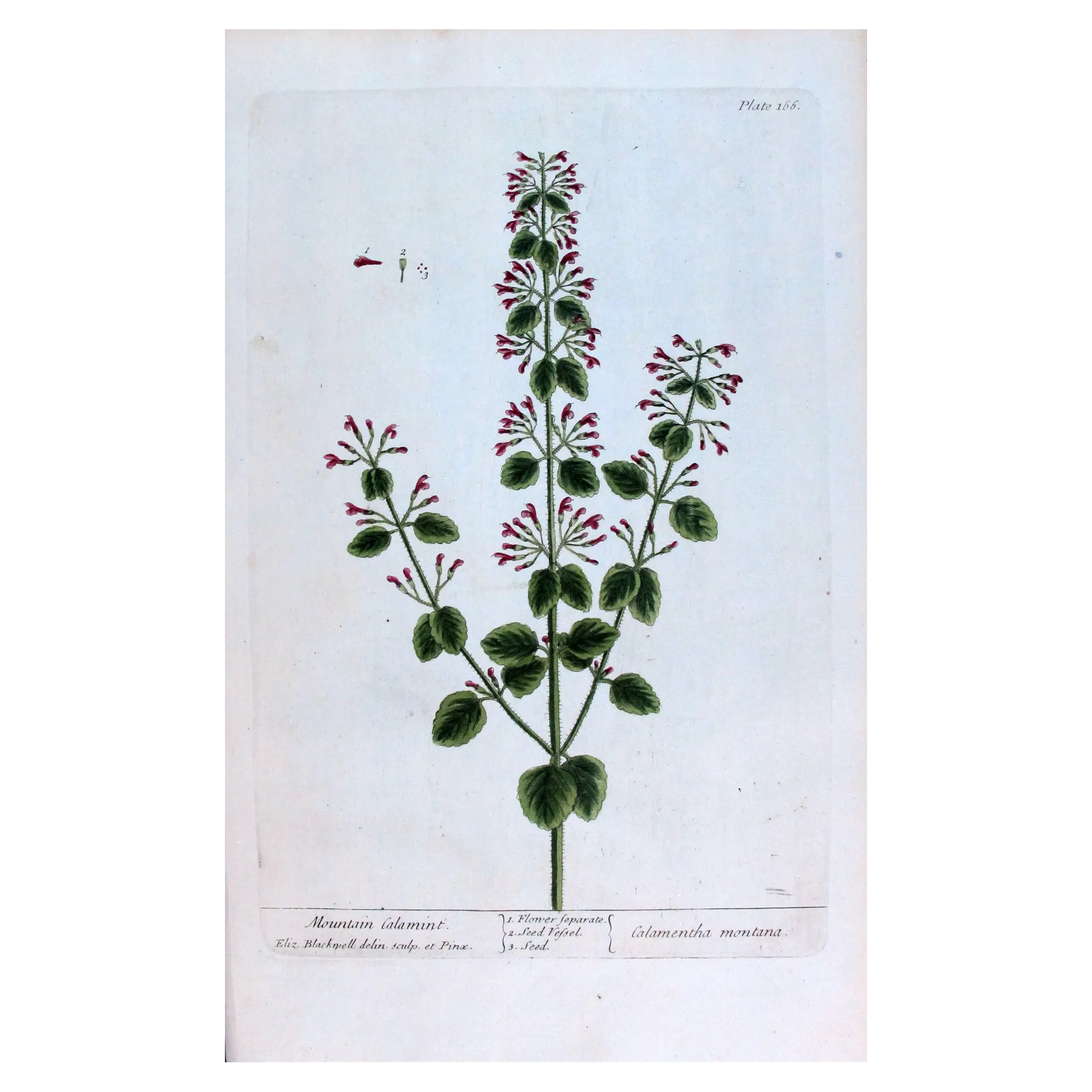
Refined 18th-century engraving of Mountain Calamint by Elizabeth Blackwell, with upright stems and pink blossoms, ideal for calm, herbal or cottage-inspired interiors.