
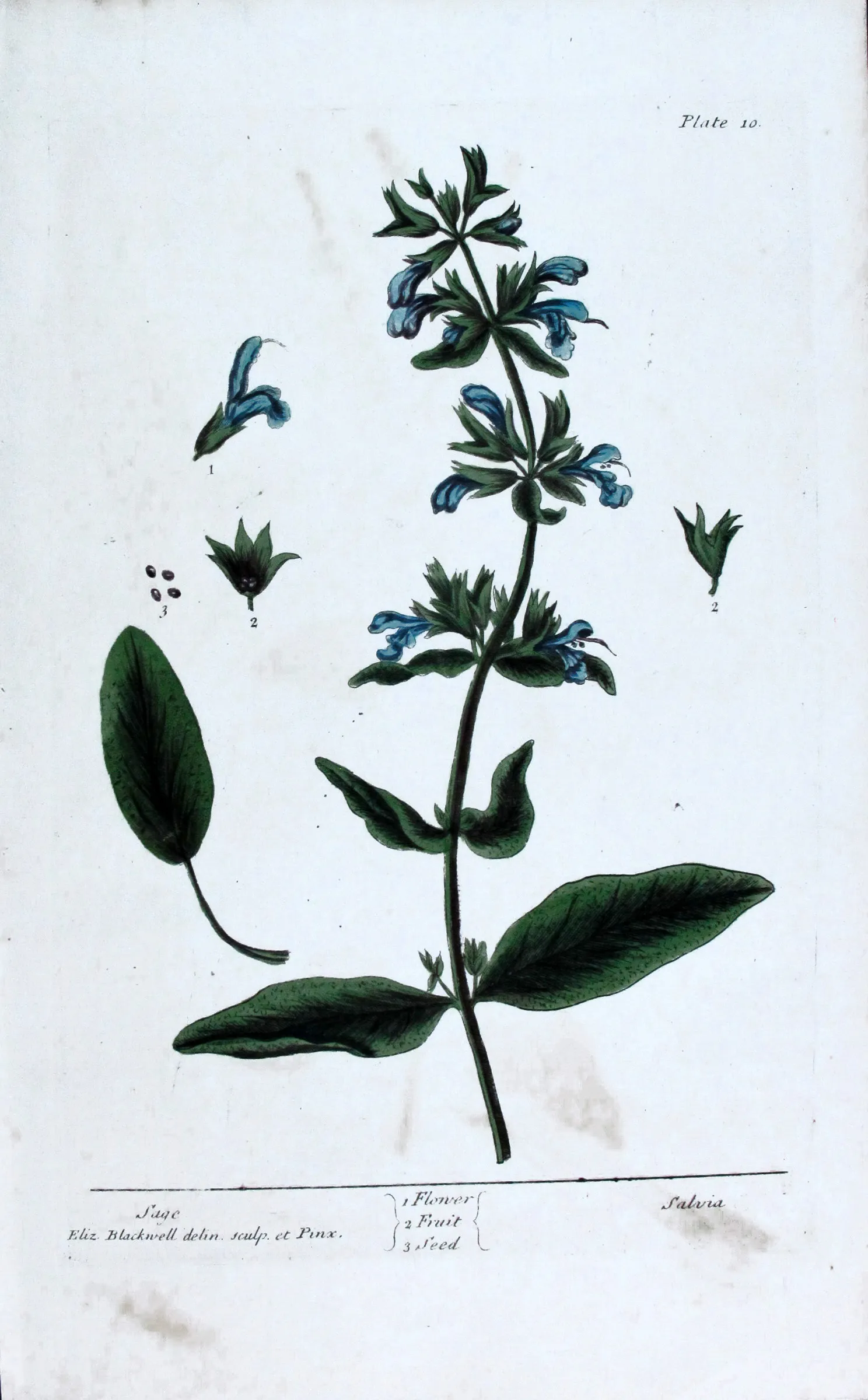

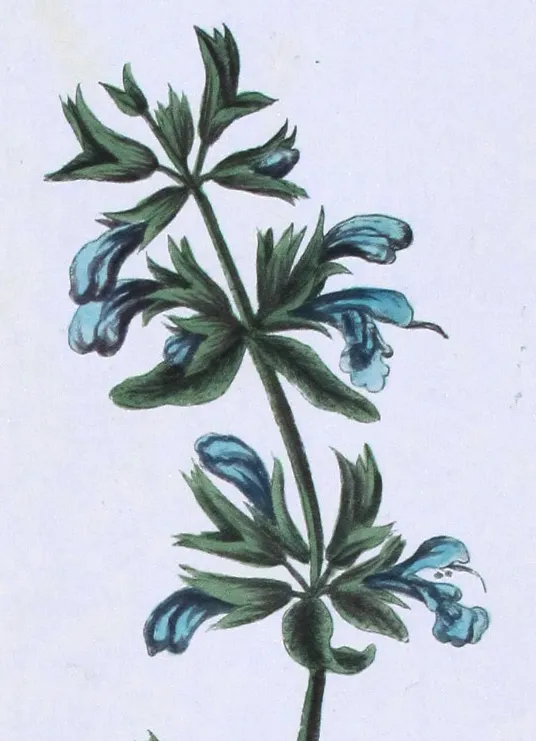
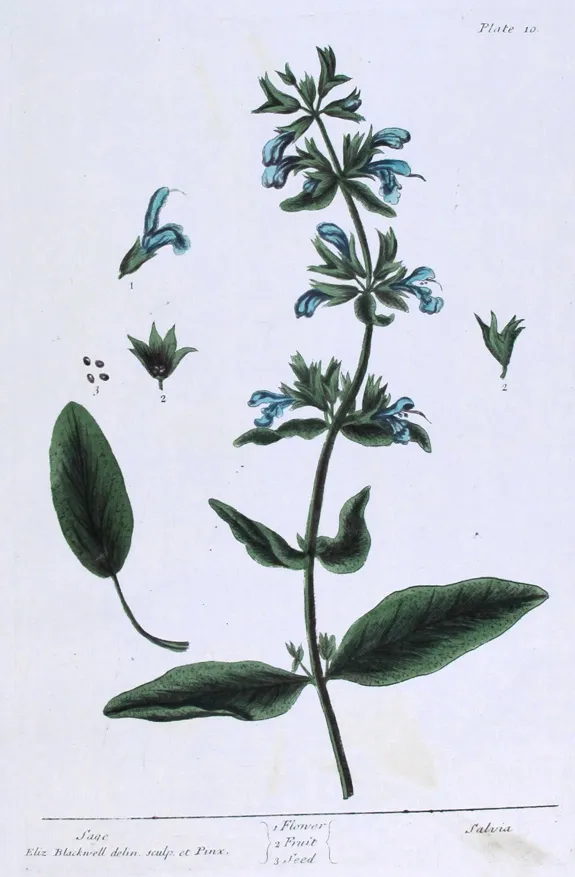
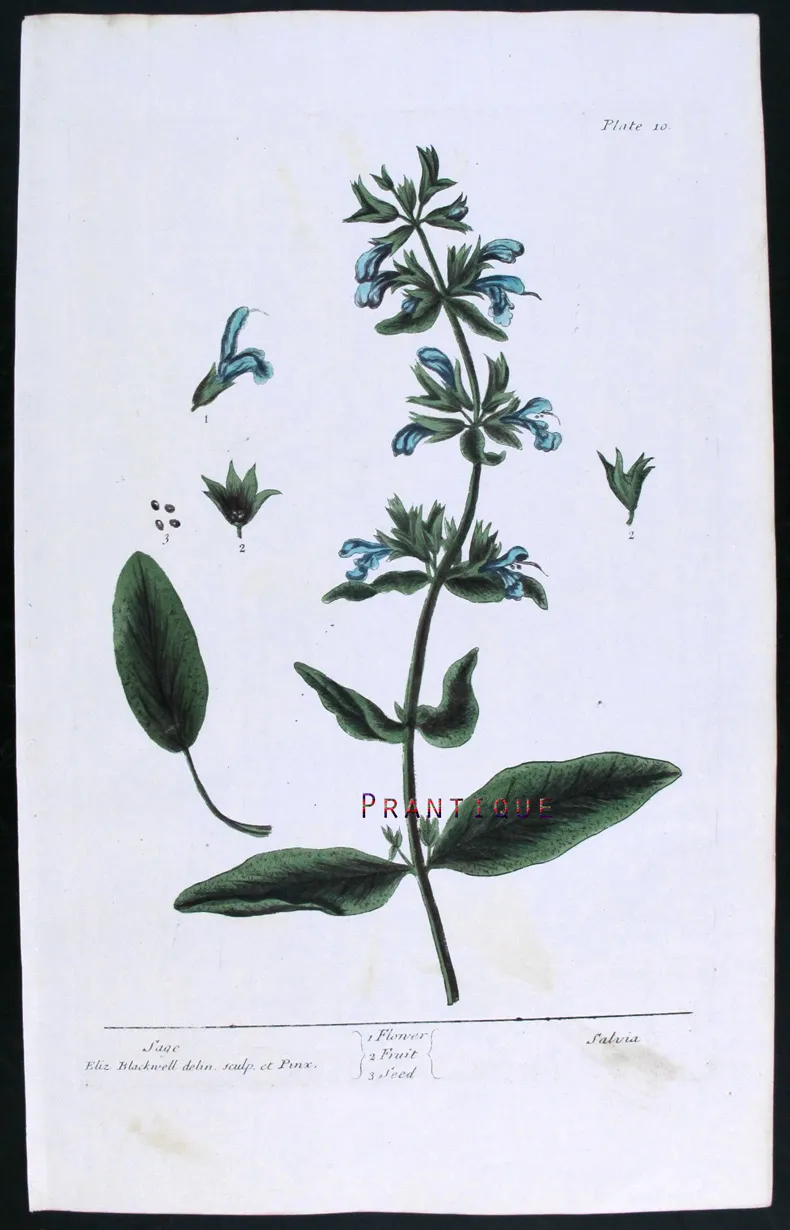


Charming 18th-century engraving of Sage by Elizabeth Blackwell, with blue-green leaves and delicate flowers, perfect for kitchen walls or herb-themed gallery displays.
 Delivery policy
Your print will be carefully prepared and shipped worldwide via trusted couriers (UPS or similar).
 Authentic antique prints
Original engravings from the 17th–19th century.
This refined botanical engraving depicts Sage (Salvia officinalis), presenting an upright flowering stem with characteristic bluish bilabiate blossoms, broad textured leaves, and separate details of flower, fruit, and seed for accurate botanical reference.
The composition balances clarity and elegance: the vertical stem organizes the plant’s structure, while the large, softly modelled leaves provide visual weight and contrast to the lighter floral elements. Elisabeth Blackwell’s careful observation allows each botanical component to be read distinctly, reinforcing both scientific and medicinal intent.
Produced in the early eighteenth century, this plate forms part of A Curious Herbal, a work that sought to document plants of everyday medical importance through precise illustration and practical detail.
— • —
The plant is structured along a strong central axis, punctuated by regularly spaced flower whorls that introduce rhythm and upward movement. The broad basal leaves anchor the composition, contrasting with the more delicate upper foliage and blossoms.
Restrained hand-colouring enhances natural tonal variation without excessive contrast. Soft greens and muted blues preserve botanical clarity while lending the image a calm, balanced presence.
Sage (Salvia officinalis) was among the most valued medicinal and culinary plants in early European tradition. Renowned for its aromatic leaves, it was used in remedies associated with digestion, inflammation, and memory, and held a symbolic reputation for promoting longevity and wisdom. Its frequent appearance in herbals reflects its central role in household medicine and apothecary practice. Blackwell’s inclusion of floral and seed details underscores the importance of accurate identification for a plant so widely employed in daily life.
The engraving is in very good antique condition, printed on original handmade laid paper typical of early 18th-century botanical publications. A period watermark is visible on the sheet, consistent with contemporary papermaking practices. Very light offsetting is present in a few areas, unobtrusive and consistent with historical printing or storage. The surface remains stable, with light age-related toning, and the impression is clear with well-preserved hand-colouring and intact engraved inscriptions, including the artist’s credit “Eliz. Blackwell delin. sculp. et pinx.”
For further context on Elisabeth Blackwell and the medicinal plants documented in A Curious Herbal, see our editorial feature:
Specific References
Dramatic lichen plate with sculptural fronds and rocky support, perfect for collectors who love unusual, textural natural history subjects.
Elegant Silver Fir with upright cones and finely spaced needles, a refined forest motif for sophisticated interiors and collectors of conifer imagery.
Hand-colored 18th-century engraving of Yellow Asphodel, a vivid botanical composition from Elisabeth Blackwells A Curious Herbal.
Original 18th-century engraving of the Wild Cucumber by Elisabeth Blackwell, with spined fruit and yellow flowers.
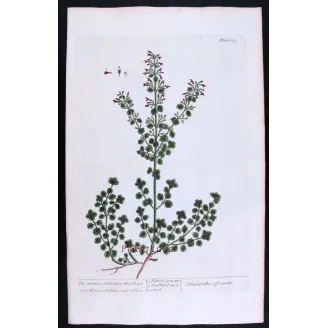
Hand-colored botanical engraving of the Common Calamint, with dense foliage and soft pink-purple florets.
Fine engraving of Black Alder with berries and elegant branching, ideal for natural interiors.
18th-century hand-colored engraving of the Almond Tree by Elisabeth Blackwell, with blossom, fruit and kernel beautifully rendered.
18th-century hand-colored engraving of the Wilding or Crab Tree by Elisabeth Blackwell, with blossom and fruit details.
A graceful hand-colored engraving of Marshmallow (Althaea officinalis) with soft pink flowers and expressive root study.
Striking palm fronds paired with warm golden dates, a highly decorative composition.
Fine 18th-century engraving of the Cornel Tree by Elisabeth Blackwell, with red fruit and delicate foliage.
Delicate pea stems with curling tendrils and soft green pods, elegantly hand-colored.
Refined 18th-century engraving of Mountain Calamint by Elizabeth Blackwell, with upright stems and pink blossoms, ideal for calm, herbal or cottage-inspired interiors.
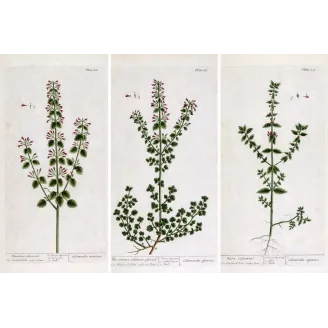
A curated botanical trio illustrating three closely related Calamintha species — officinalis, montana, and aquatica — as engraved and hand-colored by Elisabeth Blackwell for A Curious Herbal (1737–1739). Presented together, these plates offer a rare comparative view of medicinal, habitat-specific, and morphological variation within a single genus, reflecting early modern botanical practice and apothecary knowledge.
Elegant olive branches with vivid green leaves and fruit in subtle yellow tones.
18th-century hand-colored engraving of a Garden Cucumber by Elisabeth Blackwell, with curling tendrils and yellow blossoms.
Fine 18th-century botanical of the Wild Pine, with graceful hanging cones and delicate needles ideal for woodland-themed interiors and natural history walls.
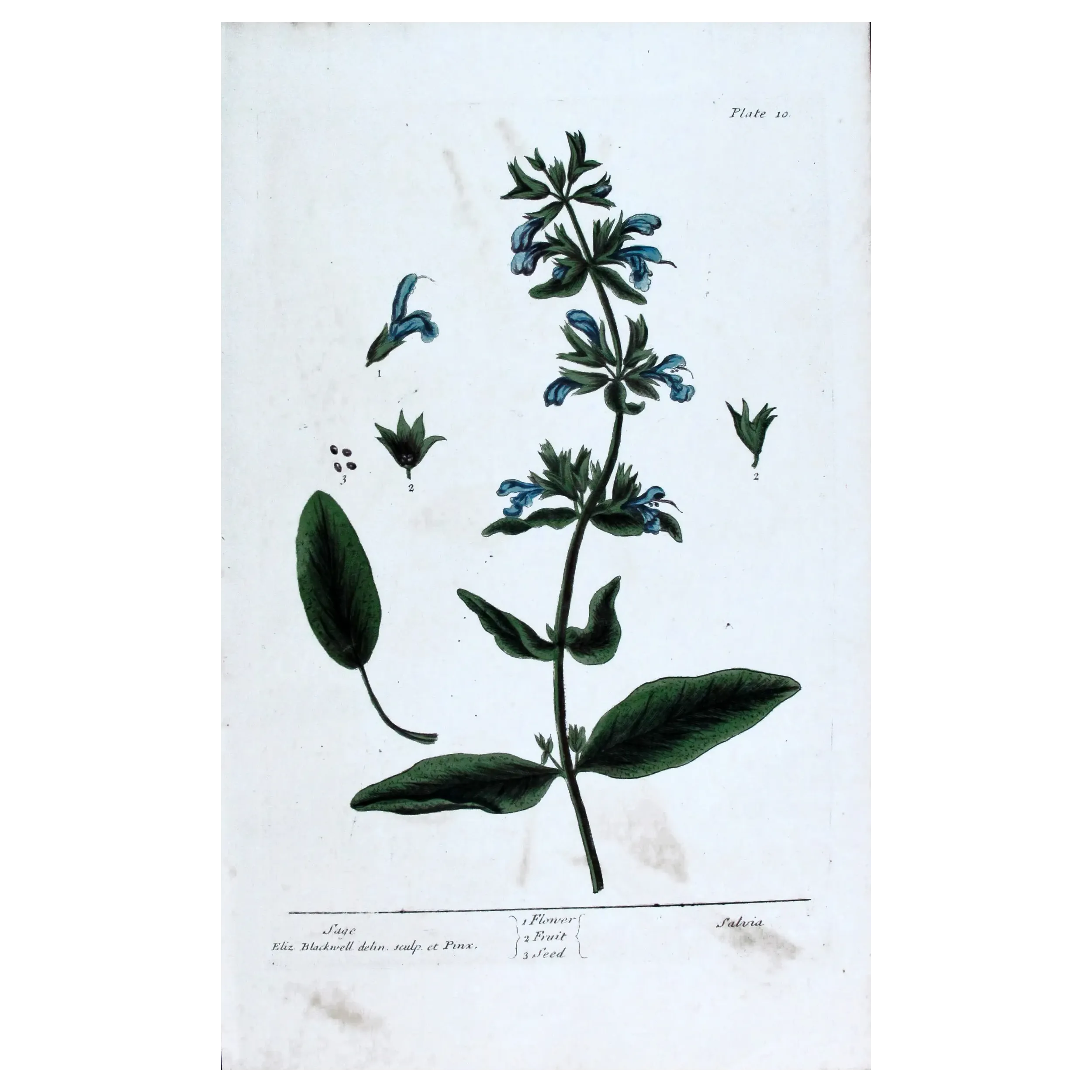
Charming 18th-century engraving of Sage by Elizabeth Blackwell, with blue-green leaves and delicate flowers, perfect for kitchen walls or herb-themed gallery displays.