

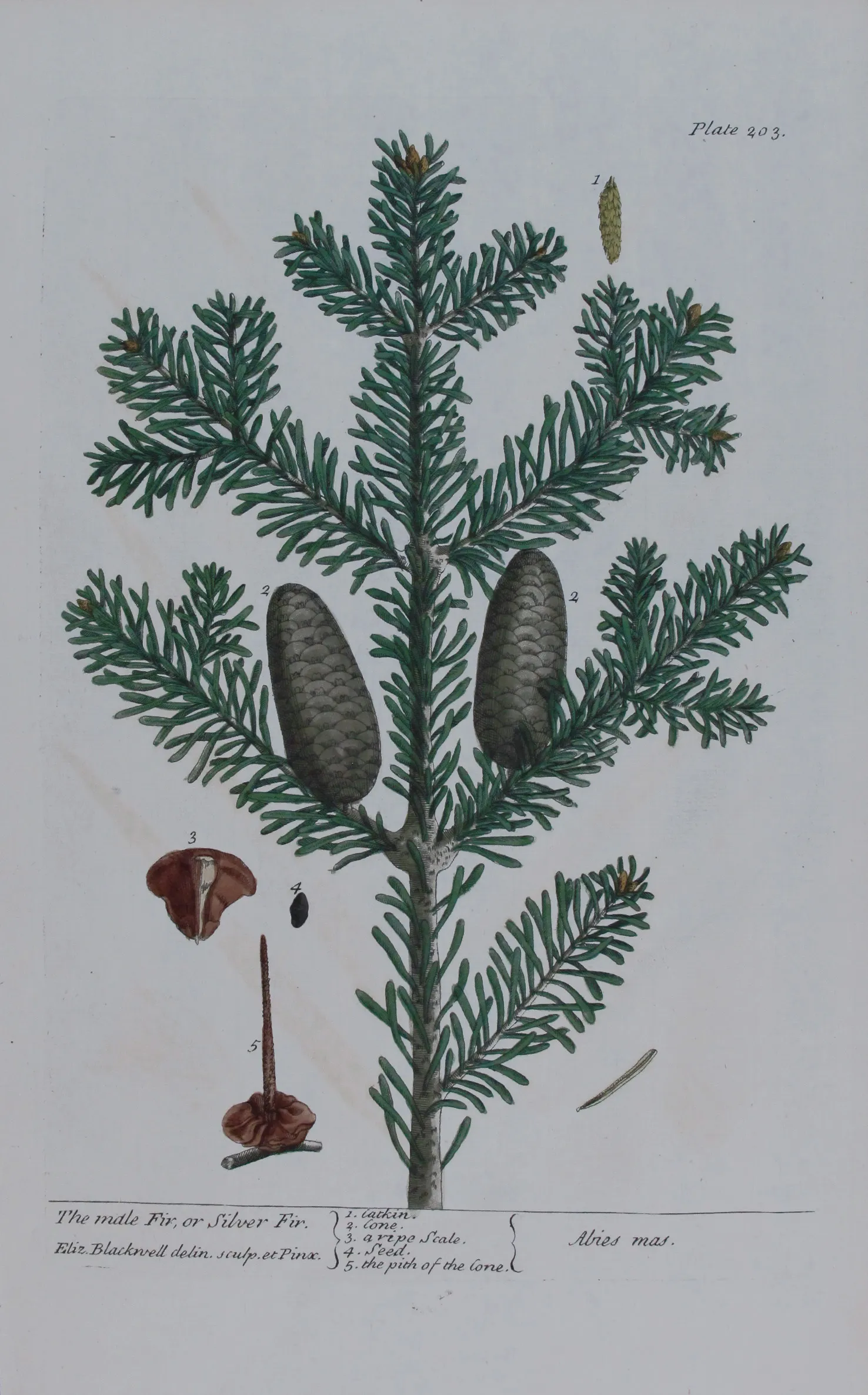
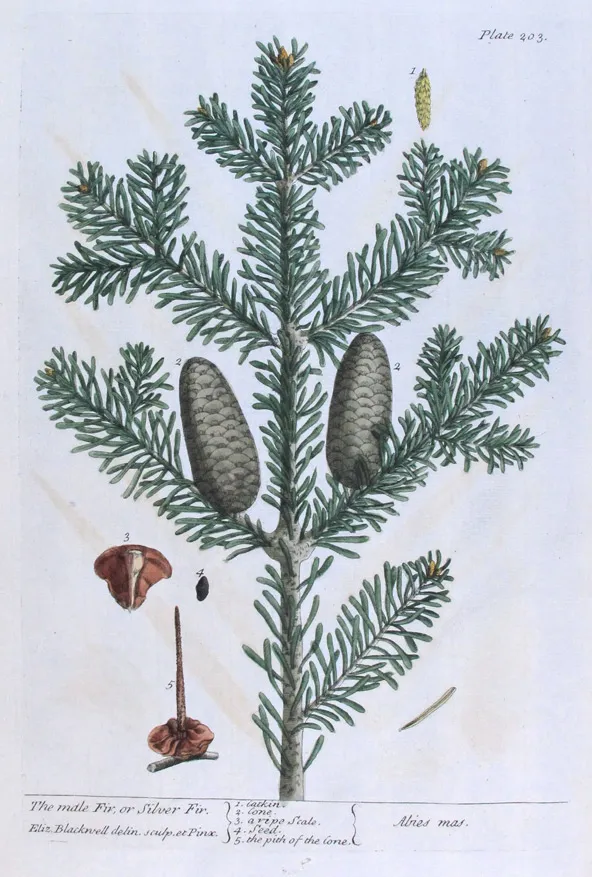


Elegant Silver Fir with upright cones and finely spaced needles, a refined forest motif for sophisticated interiors and collectors of conifer imagery.
 Delivery policy
Your print will be carefully prepared and shipped worldwide via trusted couriers (UPS or similar).
 Authentic antique prints
Original engravings from the 17th–19th century.
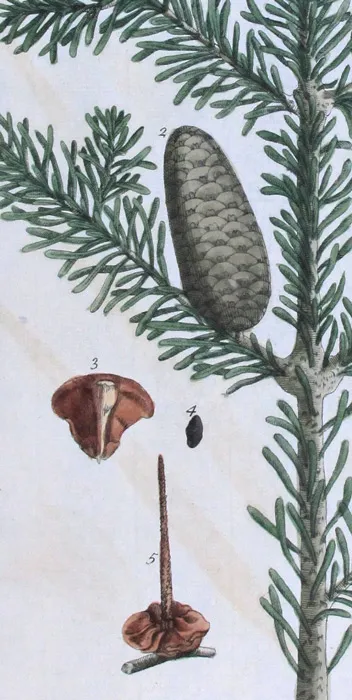
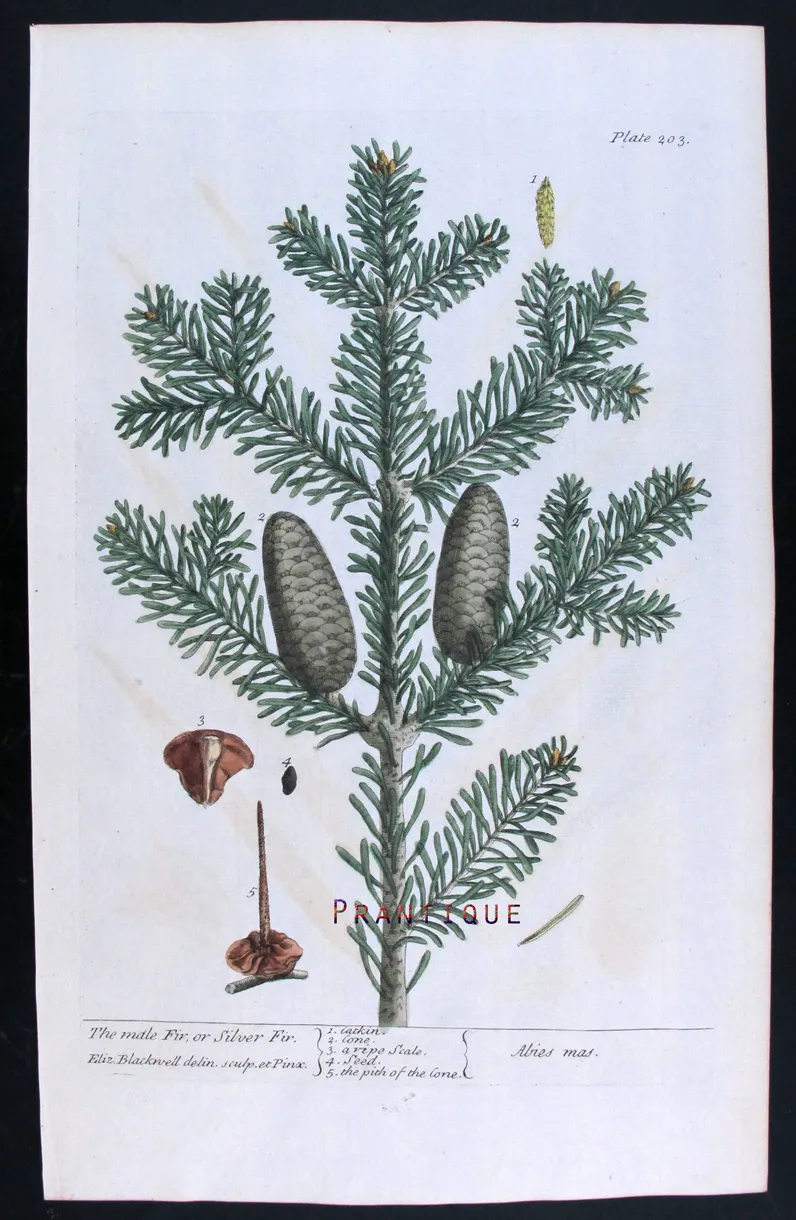
This refined botanical engraving depicts the Male Fir, or Silver Fir (Abies alba), presenting a branch with needles, upright cones, and detailed seed elements arranged for accurate botanical study.
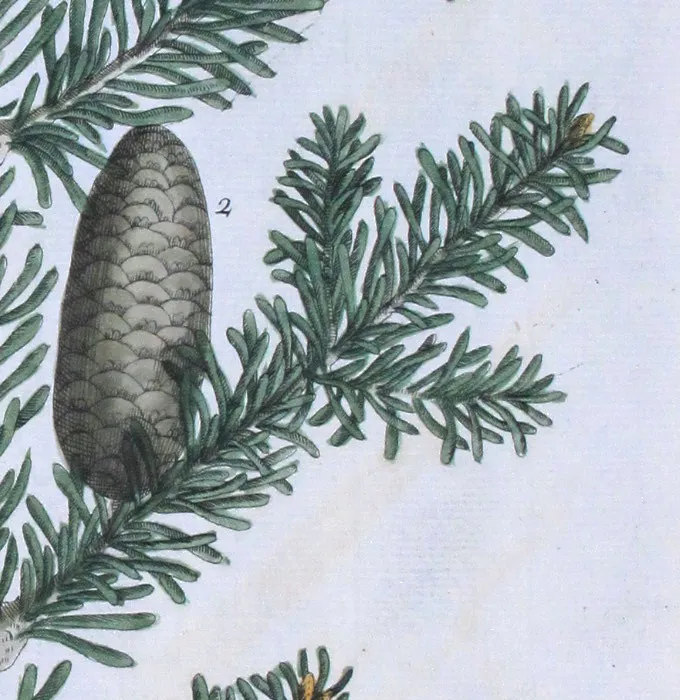
The composition is organized around a straight central axis, from which horizontal branches extend with regular symmetry. The short, evenly spaced needles create a dense yet orderly texture, while the upright cones introduce a vertical counterpoint that distinguishes this species from other conifers illustrated in the work.
Created in the early eighteenth century, this plate belongs to A Curious Herbal, a foundational medical and botanical work distinguished by the unity of its production, in which drawing, copper engraving, and hand-colouring were executed by the same hand.
— • —
The upright habit of the cones establishes a clear visual identity, contrasting with the drooping or pendant forms seen in other fir and spruce species. This structural clarity gives the composition a calm, architectural quality, reinforced by the balanced spacing of the branches.
Soft tonal transitions model the needles with depth while maintaining sharp definition, and the muted browns of the cones provide subtle emphasis without overwhelming the palette. The overall effect is one of restraint and botanical authority.
The male or silver fir (Abies alba) was distinguished in early botanical and medical literature for its upright cones, resin, and aromatic young shoots. Its resin was generally regarded as milder and more refined than that of other conifers, and was commonly used in soothing balms, plasters, and external preparations. Because fir species could differ significantly in resin quality and medicinal application, accurate visual identification was essential. Blackwell’s emphasis on cone orientation, needle arrangement, and seed structure reflects this practical need, presenting the tree as a specific medicinal resource rather than a generic conifer.
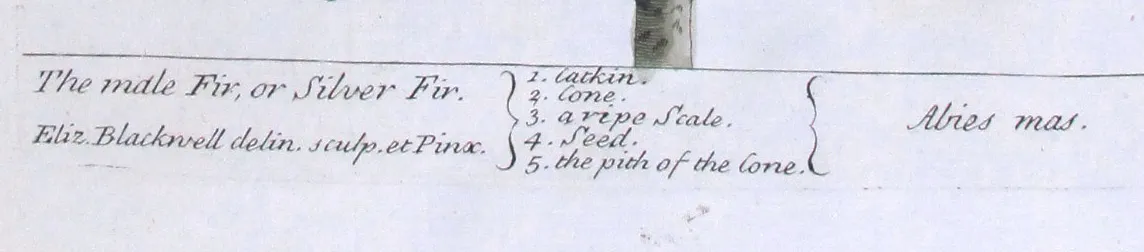
The engraving is in very good antique condition, printed on original handmade laid paper typical of early 18th-century botanical publications. A period watermark is visible on the sheet, consistent with contemporary papermaking practices. The surface remains stable and clean, with light, even age-related toning. Very light offsetting is visible across the sheet, particularly within the area occupied by the subject, unobtrusive and consistent with historical printing or storage practices. The impression remains clear and legible, with well-preserved margins. The engraved credit “Eliz. Blackwell delin. sculp. et pinx.” is present and fully legible, confirming the unified authorship of the plate.
For further context on Elisabeth Blackwell and the unified authorship behind A Curious Herbal, see our editorial feature:
Specific References
Fine 18th-century engraving of the Medlar Tree by Elisabeth Blackwell, featuring fruit, blossom, and botanical detail.
Refined 18th-century engraving of Mountain Calamint by Elizabeth Blackwell, with upright stems and pink blossoms, ideal for calm, herbal or cottage-inspired interiors.
Broad heart-shaped leaves with yellow tubular blooms, beautifully rendered in subtle tones.
Elegant olive branches with vivid green leaves and fruit in subtle yellow tones.
Elegant botanical engraving of Great Figwort (Scrophularia major) with branching stems, clustered flowers and root detail.
Fine 18th-century hand-colored engraving of Euphorbium by Elisabeth Blackwell, a striking botanical study ideal for collectors.
Hand-colored 18th-century engraving of Yellow Asphodel, a vivid botanical composition from Elisabeth Blackwells A Curious Herbal.
Graceful engraving of Wheat varieties with seed details, ideal for rustic décor.
Hand-colored botanical engraving of the Common Calamint, with dense foliage and soft pink-purple florets.
Charming study with pink blossoms and vivid red rosehips, a classic countryside motif.
Fine engraving of Black Alder with berries and elegant branching, ideal for natural interiors.
Hand-colored 18th-century engraving of the Sweet Cistus of Candy, a graceful botanical plate by Elisabeth Blackwell.
18th-century hand-colored engraving of the Wilding or Crab Tree by Elisabeth Blackwell, with blossom and fruit details.
18th-century hand-colored engraving of Rhapontic with broad leaves and sculptural root, ideal for botanical décor.
Delicate engraving of Madder with berries and exposed roots, ideal for refined botanical décor.
18th-century hand-colored engraving of the Almond Tree by Elisabeth Blackwell, with blossom, fruit and kernel beautifully rendered.
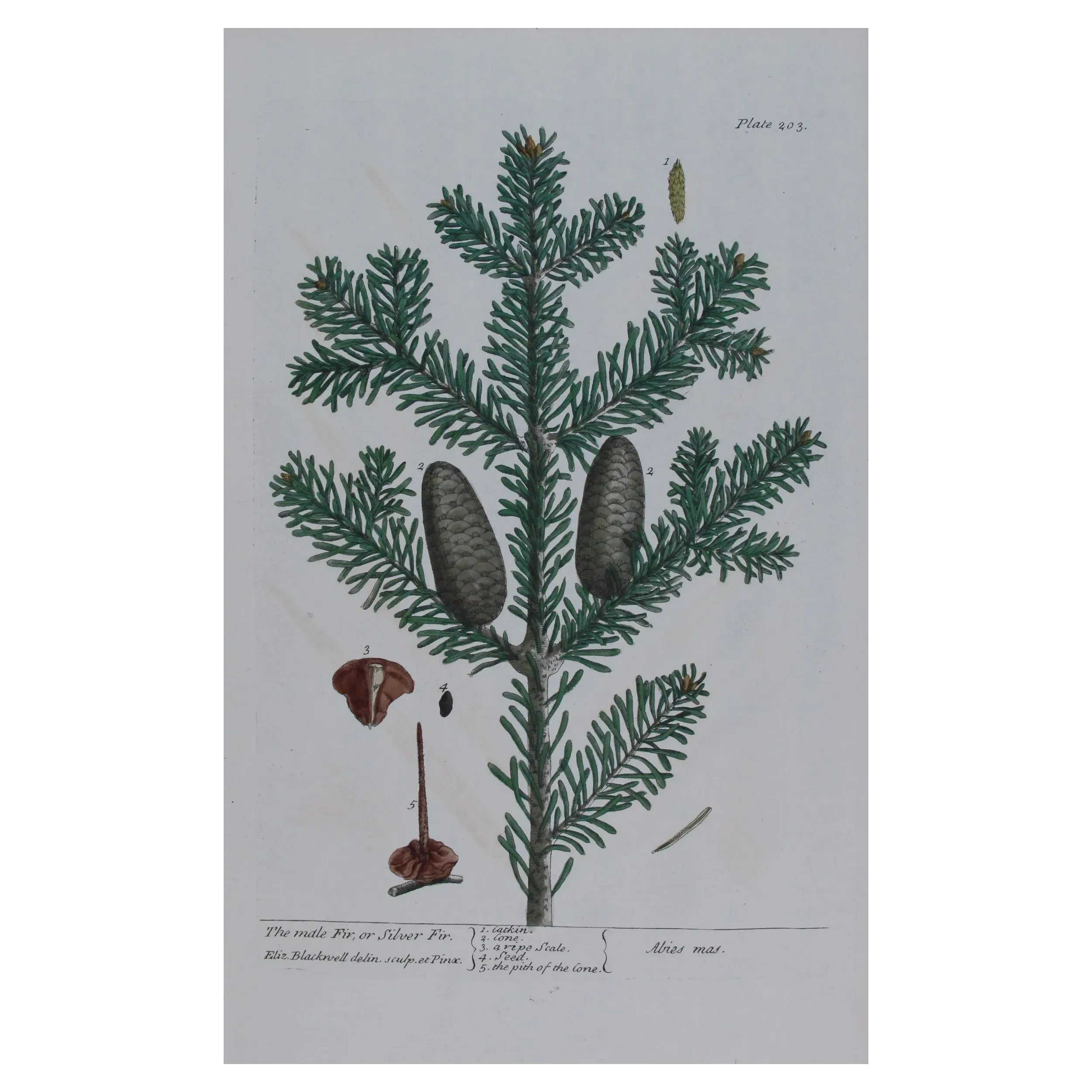
Elegant Silver Fir with upright cones and finely spaced needles, a refined forest motif for sophisticated interiors and collectors of conifer imagery.


