
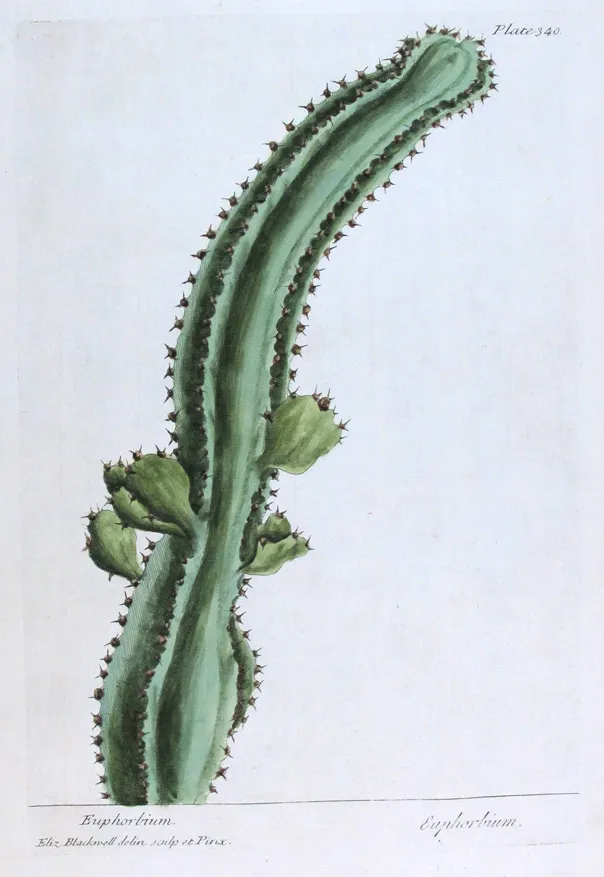
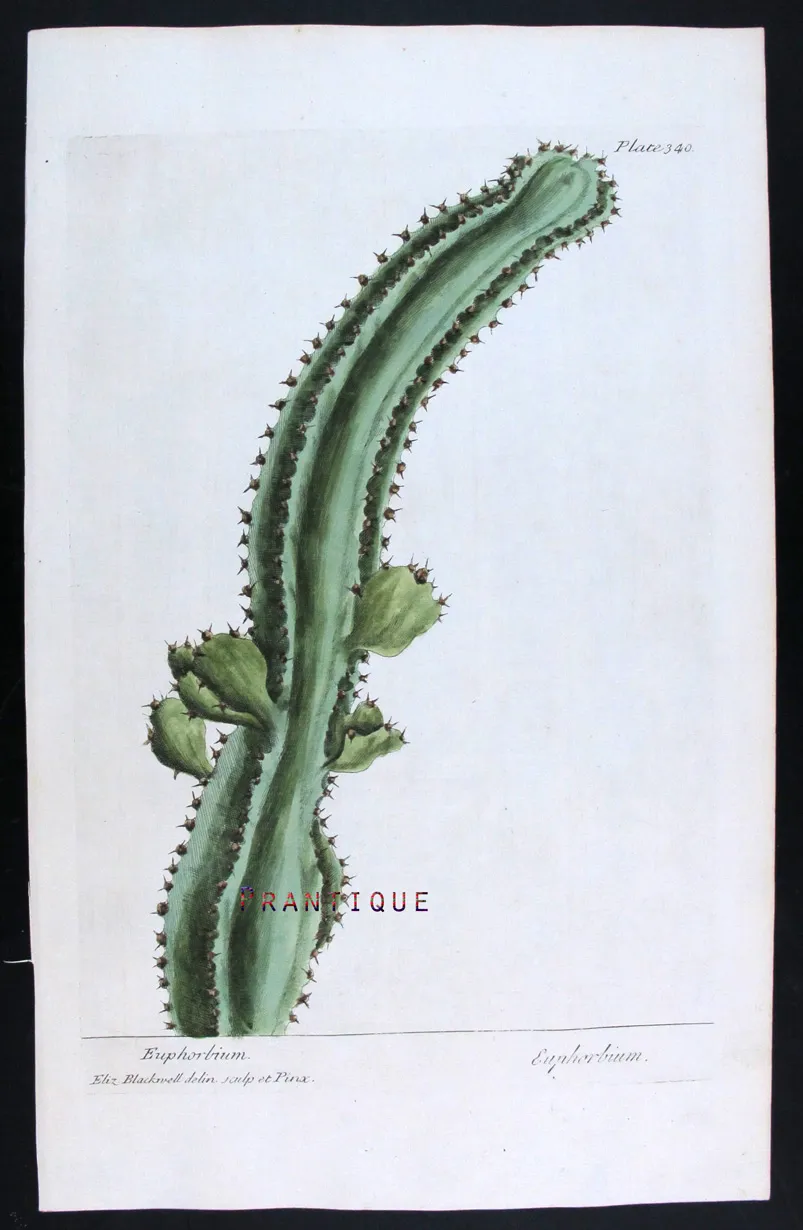


Fine 18th-century hand-colored engraving of Euphorbium by Elisabeth Blackwell, a striking botanical study ideal for collectors.
 Delivery policy
Your print will be carefully prepared and shipped worldwide via trusted couriers (UPS or similar).
 Authentic antique prints
Original engravings from the 17th–19th century.
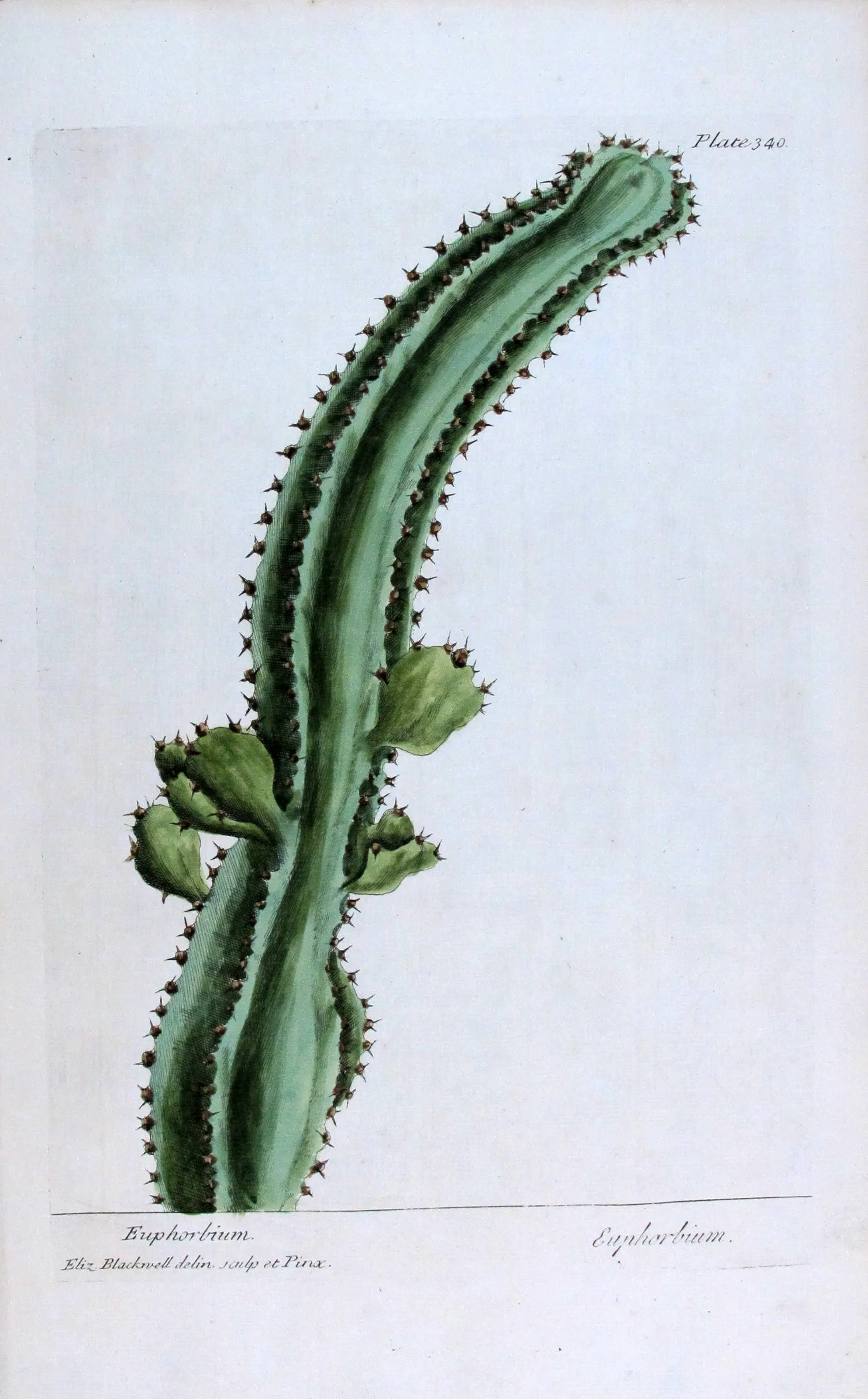
This refined botanical engraving presents Euphorbium with a striking sense of sculptural clarity, transforming a medicinal plant into a composition of quiet strength and balance.
The subject is rendered with scientific restraint and visual precision, allowing the plant’s structure and distinctive form to be read effortlessly. Elisabeth Blackwell’s approach emphasizes accuracy and legibility, while maintaining an understated aesthetic elegance rooted in direct observation.
Created during the early eighteenth century, this plate belongs to A Curious Herbal, a work conceived as a practical medical reference and executed through an unusually unified process, in which drawing, engraving, and hand-colouring were carried out by the same hand.
— • —
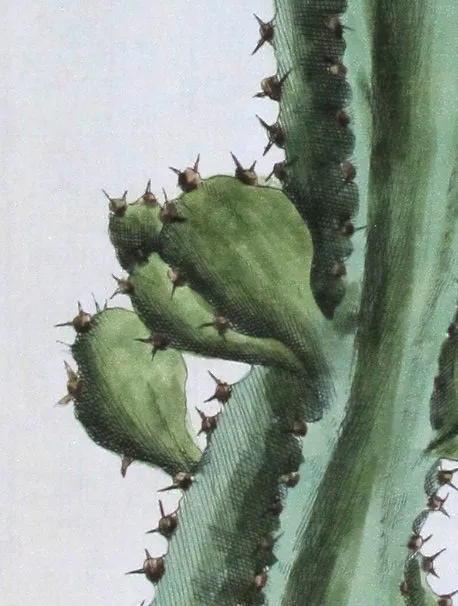
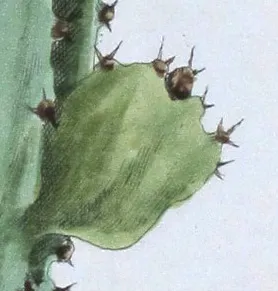
The composition is organized around a stable vertical axis, gently bending as it rises and creating a measured, rhythmic movement through the image. Small lateral offshoots provide visual balance, preventing rigidity while reinforcing the plant’s natural growth pattern.
Subtle tonal transitions model the surface with depth, while the repeated spines define the silhouette with precision. The restrained palette and controlled hand-colouring result in a graphic, almost architectural presence, combining softness and structure in equal measure.
In early medical botany, “Euphorbium” referred to resin-bearing species of Euphorbia, valued not as ornament but as a potent substance in the apothecary’s materia medica. The hardened latex (often collected as a resin) was treated as an active ingredient and therefore handled with caution, which made accurate identification essential. Blackwell’s plate emphasizes the plant’s unmistakable structure—its segmented growth and defensive spines—reflecting the practical purpose of A Curious Herbal: to provide reliable visual references for plants whose therapeutic use depended on correct recognition.
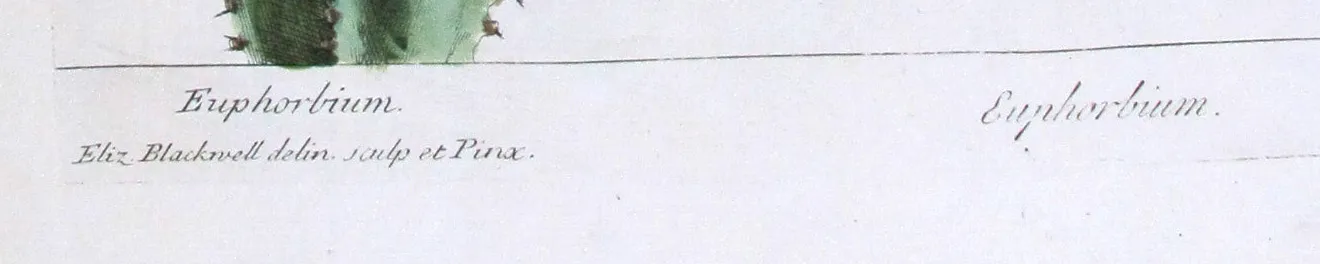
The engraving is in very good antique condition, printed on original handmade laid paper typical of early 18th-century botanical publications. No watermark has been observed. The sheet is exceptionally fresh and clean, with a stable surface and no notable defects. The original hand-coloring remains well preserved, and the impression is crisp and legible throughout. These natural qualities confirm the authenticity of the print as an original production from A Curious Herbal. The original engraved inscriptions are present and fully legible, including “Euphorbium” and the credit “Eliz. Blackwell delin. sculp. et pinx.”, confirming that the drawing, copper engraving, and hand-colouring were executed by Elisabeth Blackwell herself.
For further context on Elisabeth Blackwell and the singular unity of authorship behind A Curious Herbal, see our editorial feature:
Specific References
Charming study with pink blossoms and vivid red rosehips, a classic countryside motif.
Broad heart-shaped leaves with yellow tubular blooms, beautifully rendered in subtle tones.
18th-century hand-colored engraving of a Garden Cucumber by Elisabeth Blackwell, with curling tendrils and yellow blossoms.
Elegant pink-white blossoms with upright stems and finely shaped leaves, a graceful 18th?century botanical.
19th-century hand-colored engraving of Water Pepper (Hydropiper), a graceful botanical with slender leaves and pink florets.
18th-century hand-colored engraving of the Wilding or Crab Tree by Elisabeth Blackwell, with blossom and fruit details.
Dramatic lichen plate with sculptural fronds and rocky support, perfect for collectors who love unusual, textural natural history subjects.
Lively 18th-century engraving of Polypody of the Oak by Elizabeth Blackwell, showing rhythmic fern fronds and creeping rhizomes, perfect for naturalist or woodland-themed decor.
Fine engraving of Black Alder with berries and elegant branching, ideal for natural interiors.
Elegant 18th-century hand-colored engraving of a Raspberry Bush by Elisabeth Blackwell, with ripe fruit and soft blossom.
Fine 18th-century botanical of the Wild Pine, with graceful hanging cones and delicate needles ideal for woodland-themed interiors and natural history walls.
Hand-colored 18th-century engraving of Yellow Asphodel, a vivid botanical composition from Elisabeth Blackwells A Curious Herbal.
Striking palm fronds paired with warm golden dates, a highly decorative composition.
Graceful 18th-century botanical engraving of the Female Fern by Elizabeth Blackwell, with airy fronds and exposed root, beautiful in minimalist or nature-focused spaces.
Refined 18th-century engraving of Mountain Calamint by Elizabeth Blackwell, with upright stems and pink blossoms, ideal for calm, herbal or cottage-inspired interiors.
Delicate pea stems with curling tendrils and soft green pods, elegantly hand-colored.
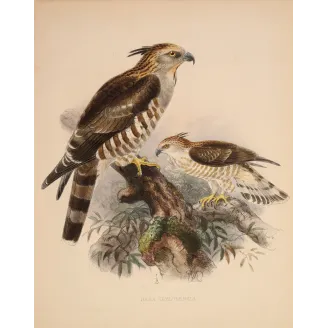
Original antique bird print depicting Baza ceylonensis (Ceylon Hawk-Eagle), illustrated by J.G. Keulemans for A History of the Birds of Ceylon. A striking Victorian ornithological lithograph featuring a refined pair of raptors with strong decorative presence.
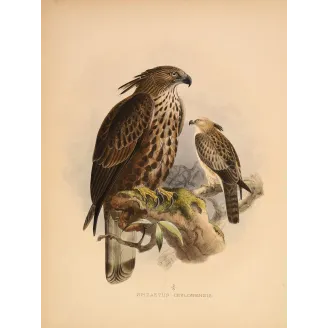
Original antique bird print depicting Spizaëtus ceylonensis (Ceylon Hawk-Eagle), illustrated by J.G. Keulemans for A History of the Birds of Ceylon. A refined Victorian ornithological lithograph featuring an elegant pair of raptors with remarkable decorative presence.
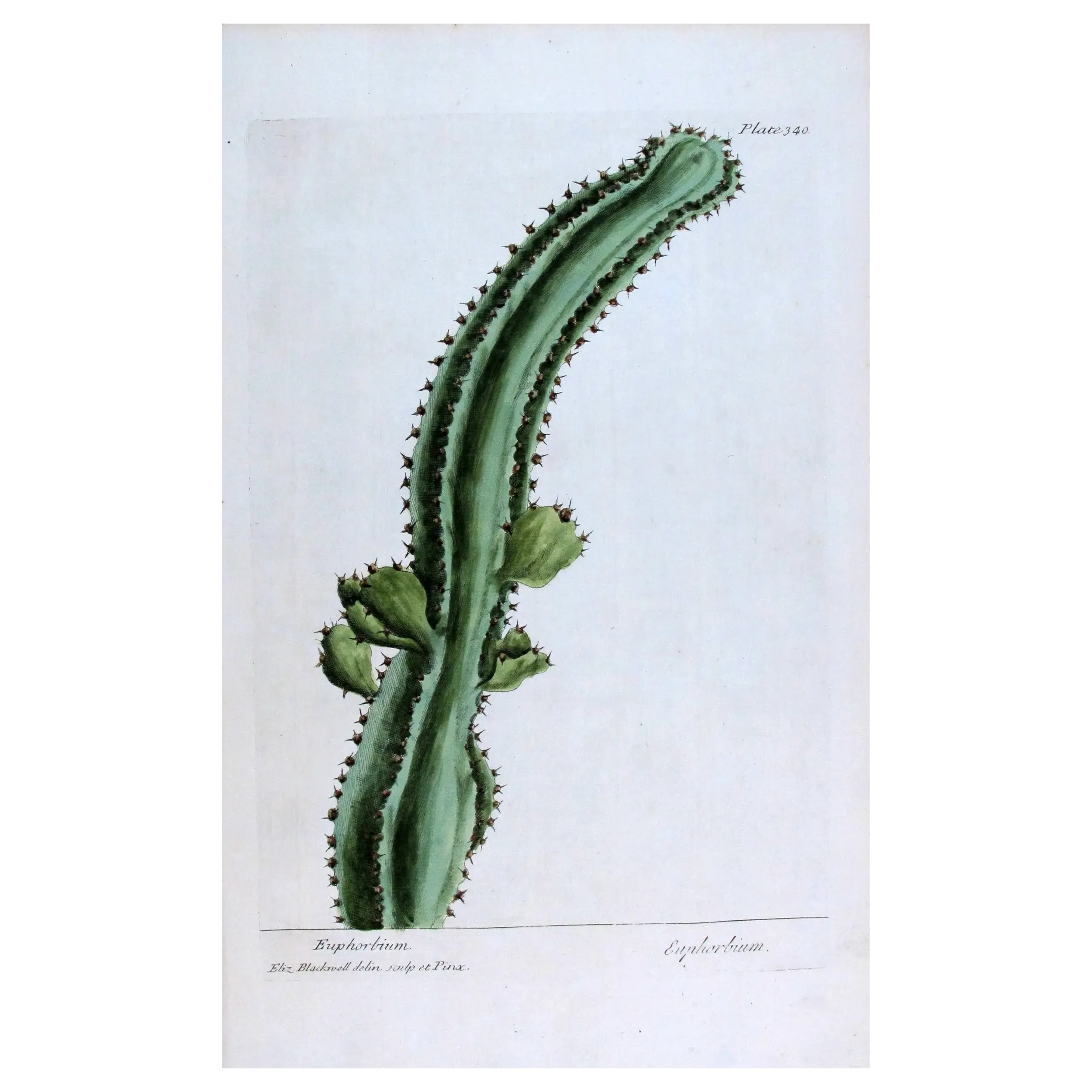
Fine 18th-century hand-colored engraving of Euphorbium by Elisabeth Blackwell, a striking botanical study ideal for collectors.