

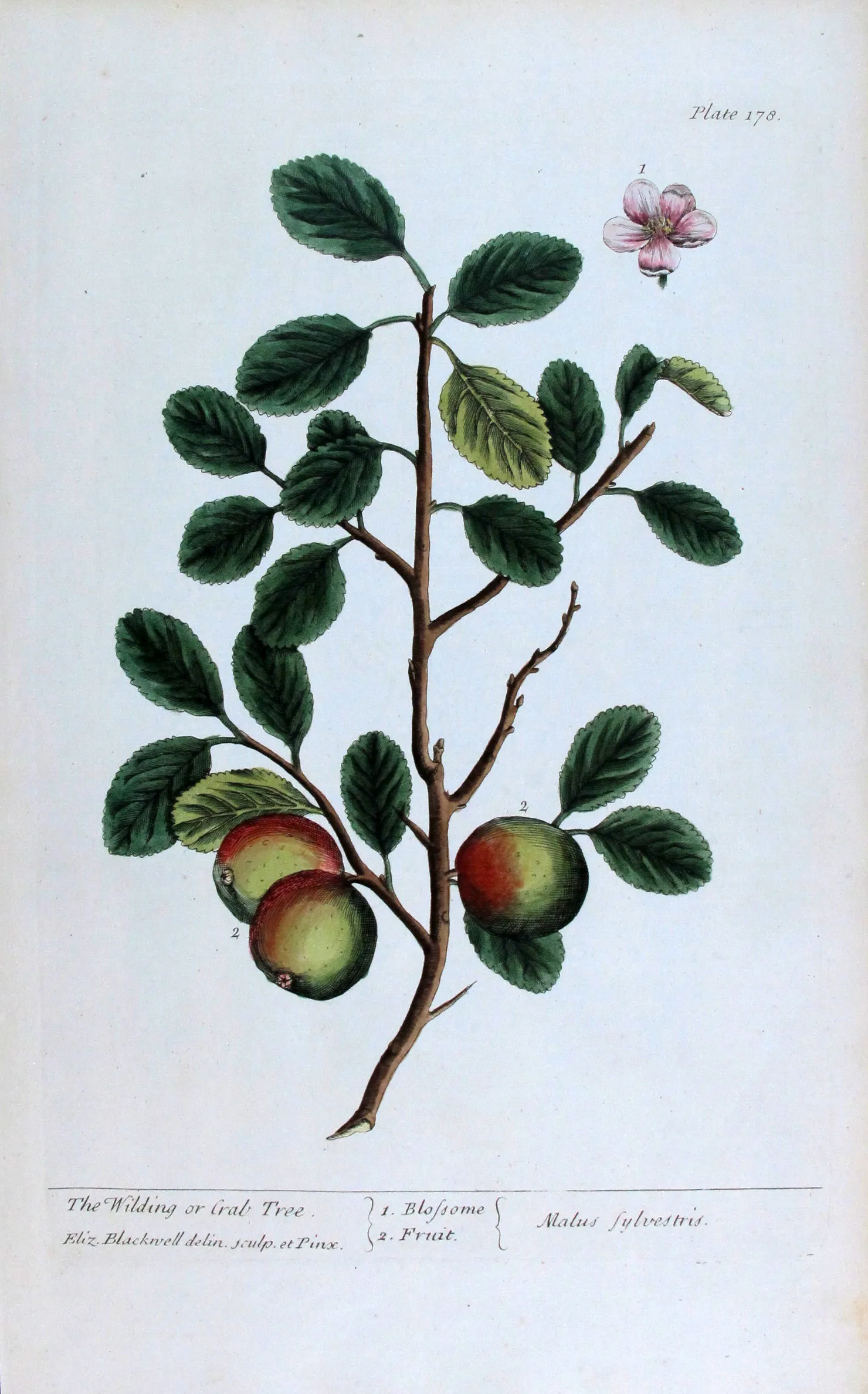
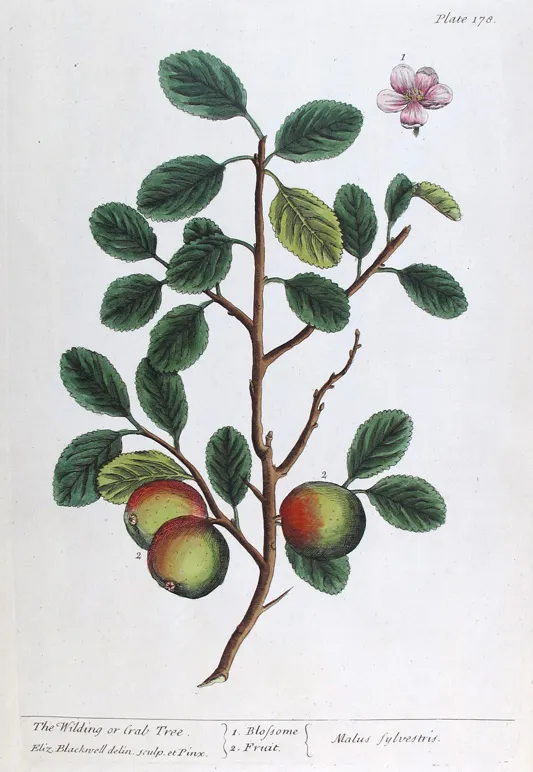
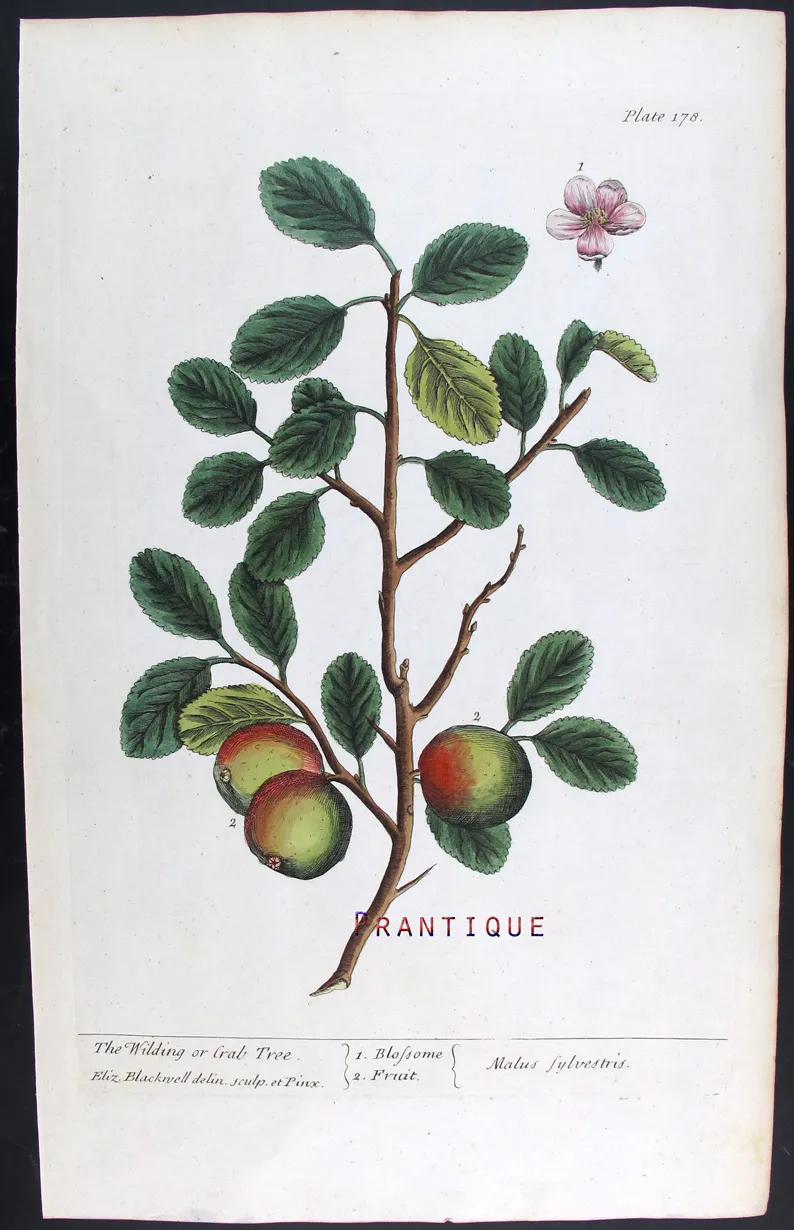


18th-century hand-colored engraving of the Wilding or Crab Tree by Elisabeth Blackwell, with blossom and fruit details.
 Delivery policy
Your print will be carefully prepared and shipped worldwide via trusted couriers (UPS or similar).
 Authentic antique prints
Original engravings from the 17th–19th century.
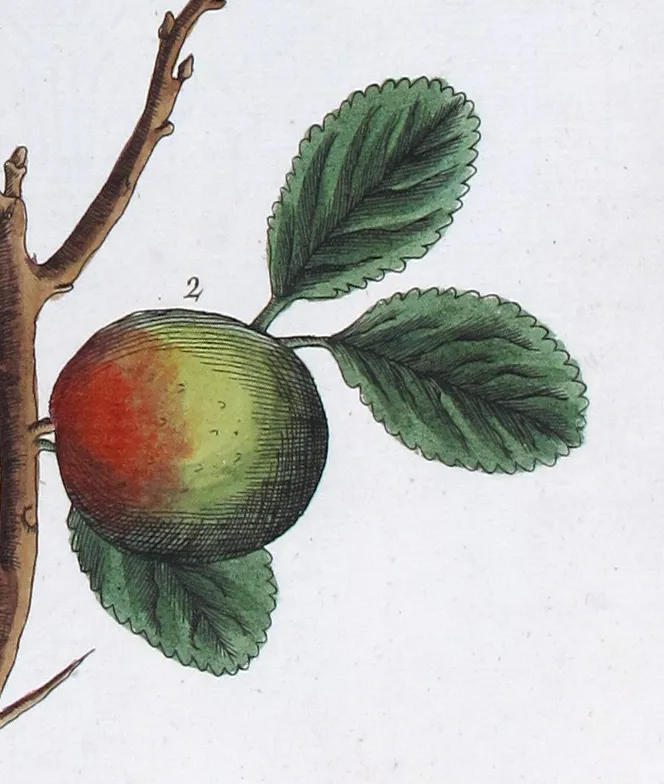
This refined botanical engraving depicts The Wilding or Crab Tree, presenting a fruit-bearing branch with balanced structure and natural clarity, rendered with an emphasis on legibility and compositional restraint.
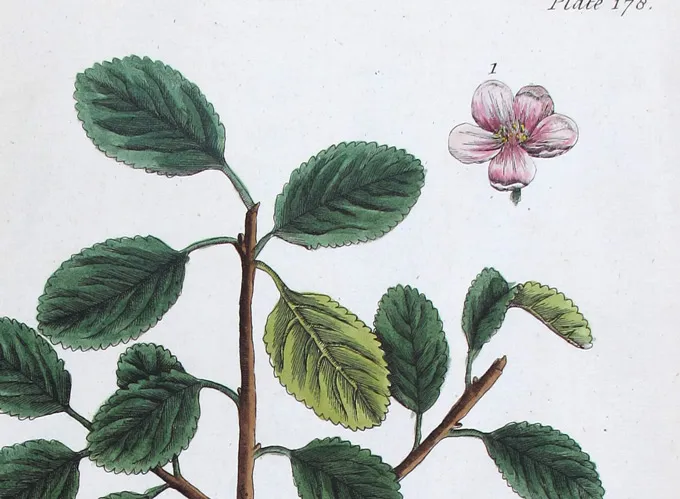
The composition is articulated through a slender central stem, from which rounded leaves and developing fruits emerge with measured spacing. Elisabeth Blackwell’s rendering allows each element—foliage, blossom, and fruit—to be read distinctly, while maintaining a harmonious visual flow grounded in direct observation.
Created in the early eighteenth century, this plate belongs to A Curious Herbal, a foundational medical and botanical reference distinguished by the unity of its production, in which drawing, copper engraving, and hand-colouring were executed by the same hand.
— • —
The vertical composition is gently punctuated by lateral branches, creating a calm rhythm that guides the eye upward. The rounded forms of the fruits introduce points of visual weight, counterbalancing the finer articulation of leaves and stem.
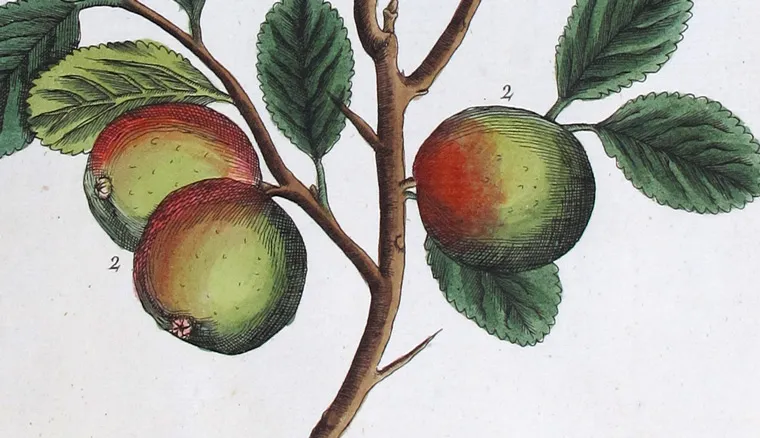
Subtle tonal transitions model the apples with restrained depth, while the foliage is rendered in layered greens that enhance volume without excess contrast. The controlled palette reinforces the engraving’s documentary intent while preserving a composed and harmonious presence.
The wilding or crab tree (Malus sylvestris) was a familiar presence in early European herbals, documented both for its fruit and for its broader medicinal and symbolic associations. Unlike cultivated apple varieties, the crab apple was valued for its hardy nature and distinctive fruit, which featured in remedies, preserves, and household preparations. Accurate depiction of flowering and fruiting stages was therefore essential for practical identification, making such plates particularly important in medical reference works. Its inclusion in A Curious Herbal reflects the need to record fruit-bearing trees whose usefulness depended on recognizing specific stages of growth and maturation.
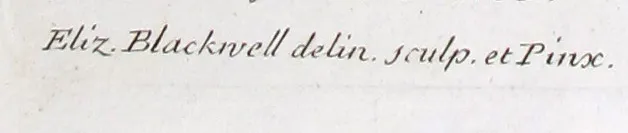
The engraving is in exceptionally fine antique condition, printed on original handmade laid paper typical of early 18th-century botanical publications. A period watermark is visible on the sheet, consistent with contemporary papermaking practices. The surface remains fresh and stable, with no notable defects. The original hand-colouring is well preserved, and the impression is crisp and legible throughout. These qualities correspond to a “like brand new” state of preservation and confirm the authenticity of the print as an original production from A Curious Herbal. The engraved credit “Eliz. Blackwell delin. sculp. et pinx.” is present and fully legible, attesting that the drawing, engraving, and hand-colouring were executed by Elisabeth Blackwell herself.
For further context on Elisabeth Blackwell and the singular unity of authorship behind A Curious Herbal, see our editorial feature:
Specific References
A dynamic pine composition with cones, needles, and golden pollen clusters.
Refined 18th-century engraving of Mountain Calamint by Elizabeth Blackwell, with upright stems and pink blossoms, ideal for calm, herbal or cottage-inspired interiors.
Fine engraving of Great Centaury (Centaurium majus) with pinkish florets, slender stems, and a butterfly study.
Elegant pink-white blossoms with upright stems and finely shaped leaves, a graceful 18th?century botanical.
Elegant 18th-century hand-colored engraving of the Male Fern by Elizabeth Blackwell, with finely shaded fronds ideal for nature-inspired walls or botanical galleries.
Elegant Silver Fir with upright cones and finely spaced needles, a refined forest motif for sophisticated interiors and collectors of conifer imagery.
18th-century hand-colored engraving of the Almond Tree by Elisabeth Blackwell, with blossom, fruit and kernel beautifully rendered.
Fine 18th-century hand-colored engraving of Euphorbium by Elisabeth Blackwell, a striking botanical study ideal for collectors.
Fine 18th-century engraving of the Cornel Tree by Elisabeth Blackwell, with red fruit and delicate foliage.
Striking palm fronds paired with warm golden dates, a highly decorative composition.
Delicate pea stems with curling tendrils and soft green pods, elegantly hand-colored.
Fine engraving of Black Alder with berries and elegant branching, ideal for natural interiors.
Fine 18th-century botanical of the Wild Pine, with graceful hanging cones and delicate needles ideal for woodland-themed interiors and natural history walls.
Graceful 18th-century botanical engraving of the Female Fern by Elizabeth Blackwell, with airy fronds and exposed root, beautiful in minimalist or nature-focused spaces.
Original 18th-century engraving of the Wild Cucumber by Elisabeth Blackwell, with spined fruit and yellow flowers.
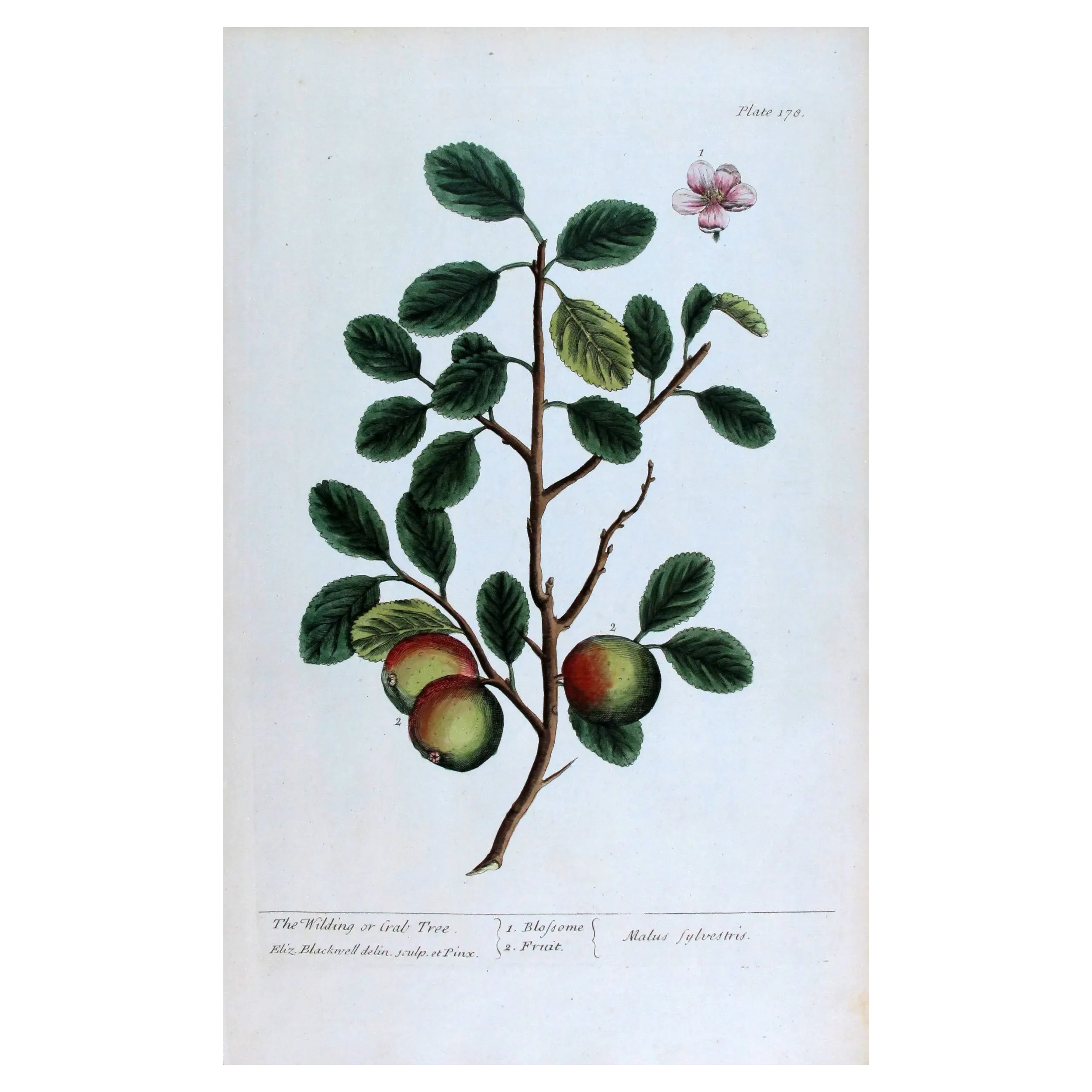
18th-century hand-colored engraving of the Wilding or Crab Tree by Elisabeth Blackwell, with blossom and fruit details.


