

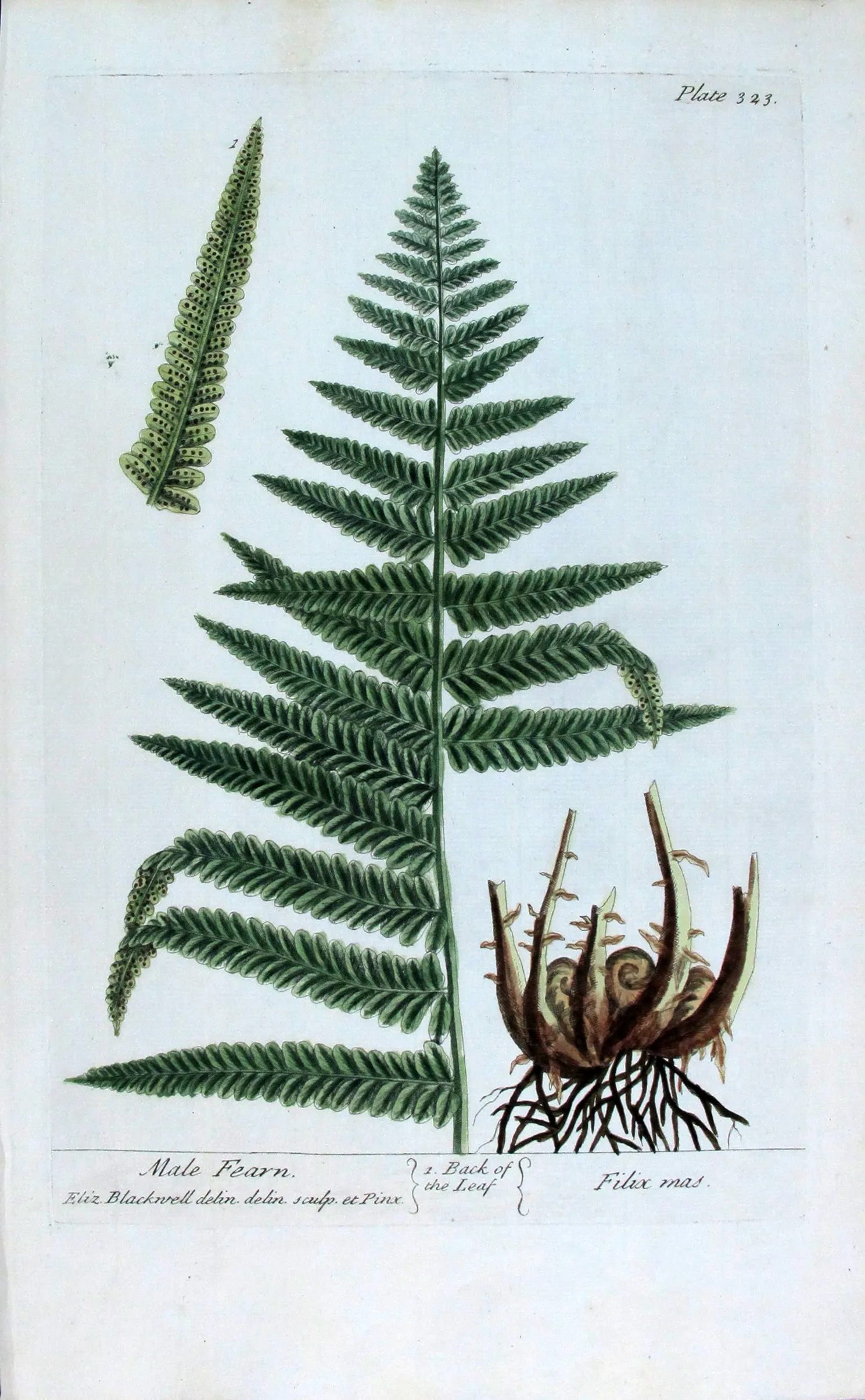

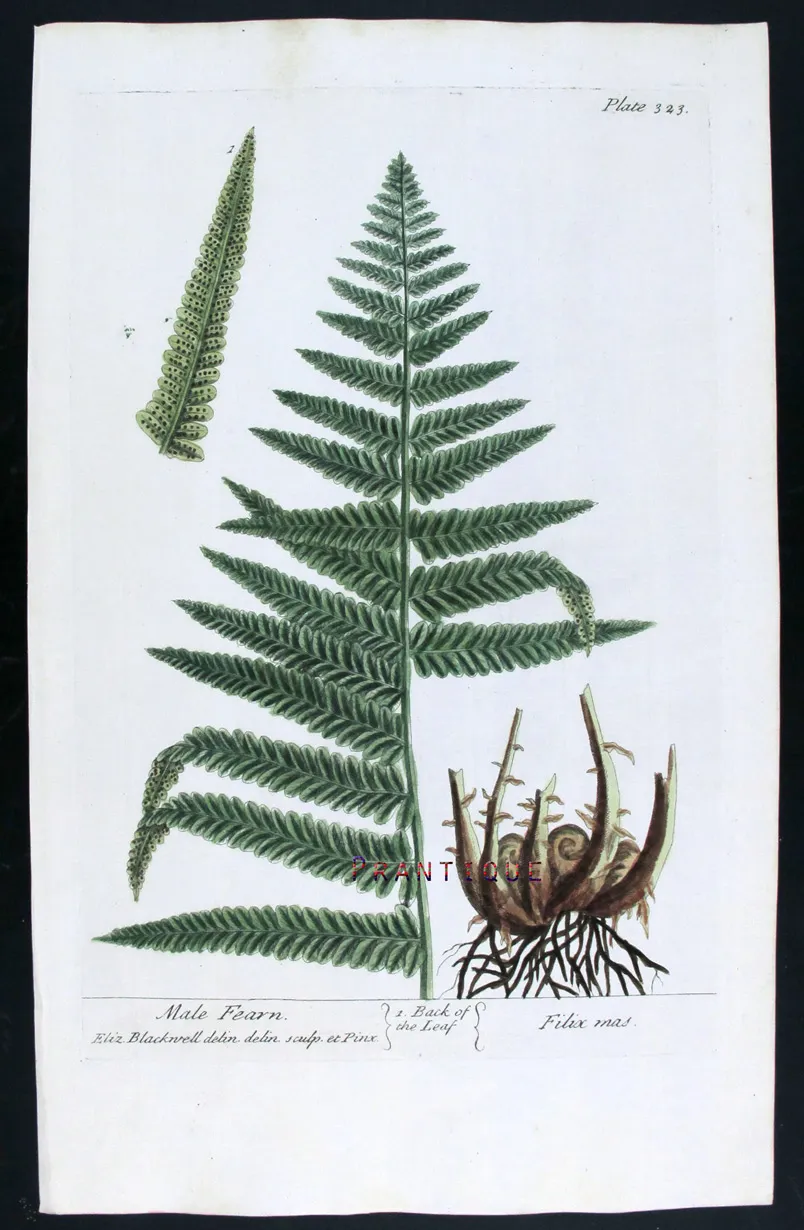
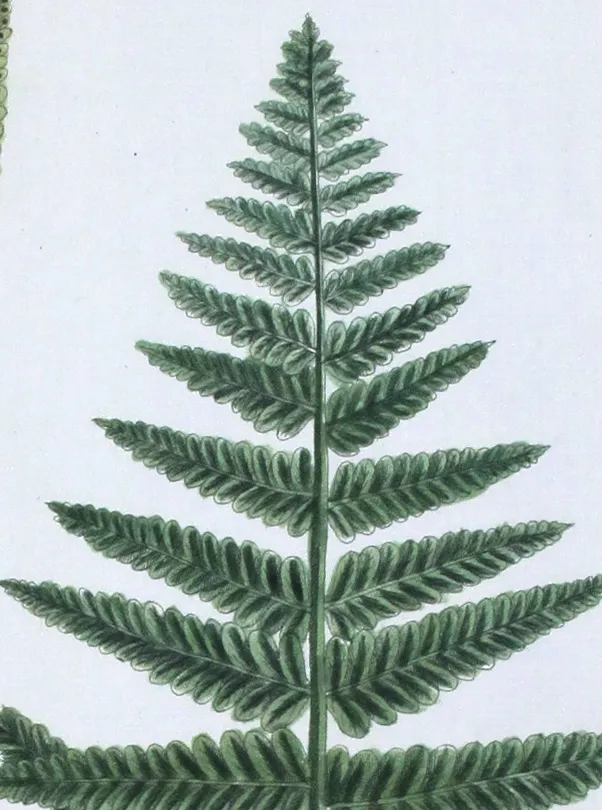
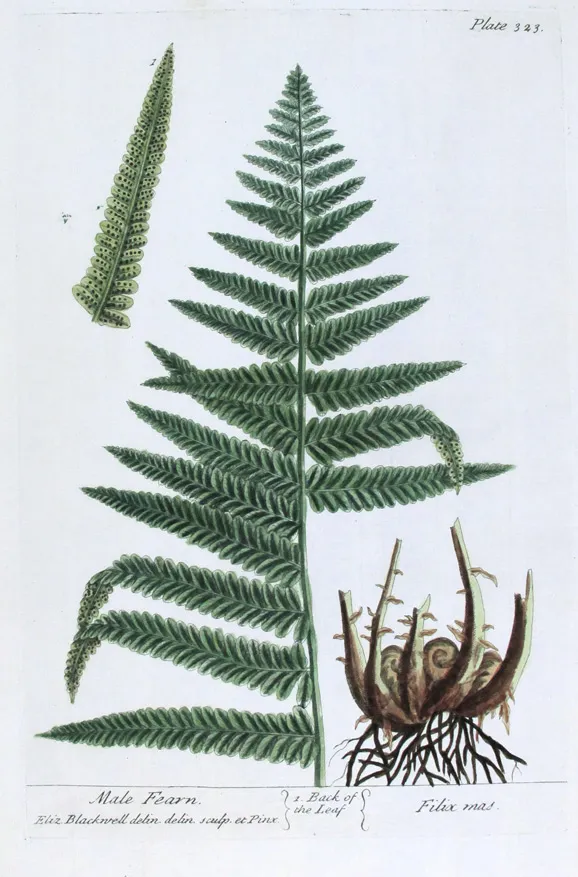


Elegant 18th-century hand-colored engraving of the Male Fern by Elizabeth Blackwell, with finely shaded fronds ideal for nature-inspired walls or botanical galleries.
 Delivery policy
Your print will be carefully prepared and shipped worldwide via trusted couriers (UPS or similar).
 Authentic antique prints
Original engravings from the 17th–19th century.
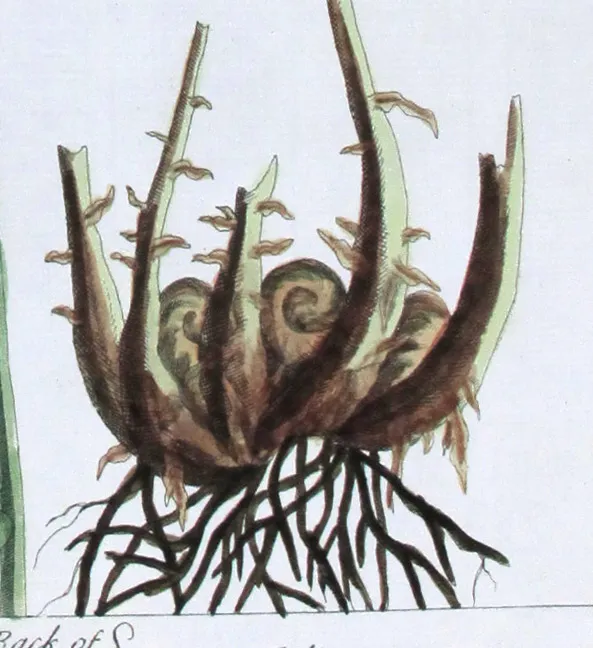
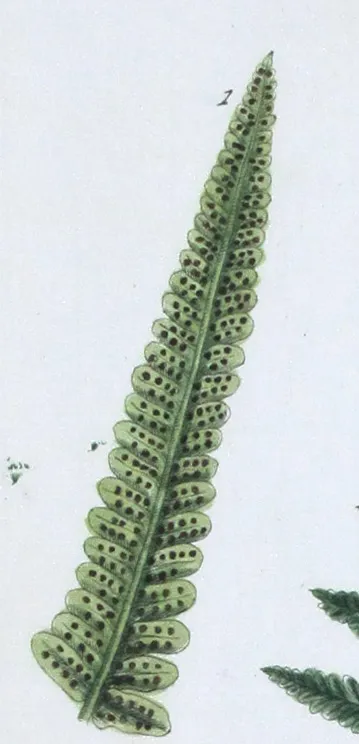
This refined botanical engraving depicts the Male Fern (Dryopteris filix-mas), presenting a complete frond with finely divided leaflets, accompanied by detailed views of the underside of the leaf and the rootstock for accurate botanical identification.
The frond is rendered with strong vertical symmetry, its evenly spaced pinnae creating a structured, rhythmic form. Elisabeth Blackwell enhances clarity by isolating diagnostic elements: the sori on the reverse of the leaf and the robust rhizome with emerging curled fronds, allowing the plant’s full life structure to be read with precision.
Produced in the early eighteenth century, this plate forms part of A Curious Herbal, a work notable for its systematic inclusion of ferns and cryptogams—organisms of significant medicinal importance despite their reproductive complexity and limited flowering characteristics.
— • —
The composition is dominated by a tall, triangular frond whose tapering form guides the eye upward. The repetitive geometry of the leaflets establishes visual order, while the supplementary details introduce variation and instructional depth.
Restrained hand-colouring emphasizes texture and structure rather than decorative effect. Subtle green tonalities articulate the leaf surface, while the darker browns of the rhizome anchor the composition and convey physical weight and permanence.
The male fern—historically known as Filix mas—was one of the most important medicinal ferns in early European medicine. Its rootstock was widely used as a vermifuge, particularly in treatments against intestinal parasites, and was a standard component of pharmacopoeias well into the eighteenth century. Because ferns lack flowers and reproduce through spores, accurate identification relied heavily on leaf structure, sori placement, and root form. Blackwell’s detailed presentation reflects this necessity, documenting the plant in a manner suited to practical medical use rather than ornamental display.
The engraving is in exceptionally fine antique condition, printed on original handmade laid paper typical of early 18th-century botanical publications. No watermark has been observed. The surface remains fresh and stable, with light, even age-related toning consistent with period paper. The impression is crisp and well defined, with clear hand-colouring and intact engraved inscriptions, including the artist’s credit “Eliz. Blackwell delin. sculp. et pinx.”
For further context on Elisabeth Blackwell and the medical significance of ferns in A Curious Herbal, see our editorial feature:
Specific References
Fine engraving of Great Centaury (Centaurium majus) with pinkish florets, slender stems, and a butterfly study.
18th-century hand-colored engraving of the Almond Tree by Elisabeth Blackwell, with blossom, fruit and kernel beautifully rendered.
Delicate engraving of Madder with berries and exposed roots, ideal for refined botanical décor.
Elegant botanical engraving of Great Figwort (Scrophularia major) with branching stems, clustered flowers and root detail.
18th-century hand-colored engraving of a Garden Cucumber by Elisabeth Blackwell, with curling tendrils and yellow blossoms.
Graceful engraving of Wheat varieties with seed details, ideal for rustic décor.
18th-century hand-colored engraving of the Wilding or Crab Tree by Elisabeth Blackwell, with blossom and fruit details.
Dramatic lichen plate with sculptural fronds and rocky support, perfect for collectors who love unusual, textural natural history subjects.
Fine 18th-century hand-colored engraving of Euphorbium by Elisabeth Blackwell, a striking botanical study ideal for collectors.
Graceful 18th-century botanical engraving of the Female Fern by Elizabeth Blackwell, with airy fronds and exposed root, beautiful in minimalist or nature-focused spaces.
Fine engraving of Black Alder with berries and elegant branching, ideal for natural interiors.
19th-century hand-colored engraving of Water Pepper (Hydropiper), a graceful botanical with slender leaves and pink florets.
18th-century hand-colored engraving of Rhapontic with broad leaves and sculptural root, ideal for botanical décor.
Hand-colored botanical engraving of the Common Calamint, with dense foliage and soft pink-purple florets.
19th-century hand-colored engraving of Water Calamint, with delicate pink blooms and fine botanical details.
Elegant botanical engraving of the Bean plant with pods and seed details.
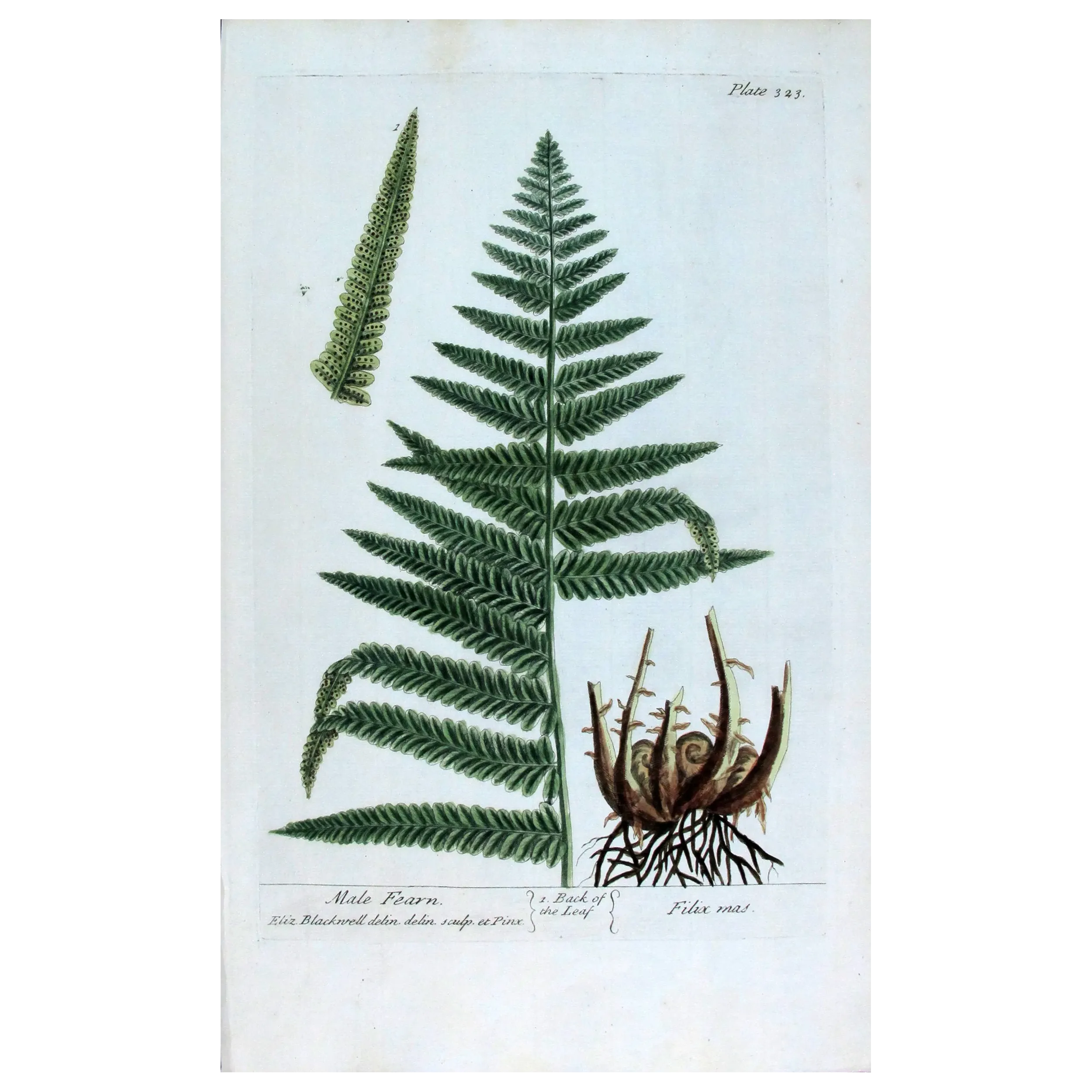
Elegant 18th-century hand-colored engraving of the Male Fern by Elizabeth Blackwell, with finely shaded fronds ideal for nature-inspired walls or botanical galleries.


