

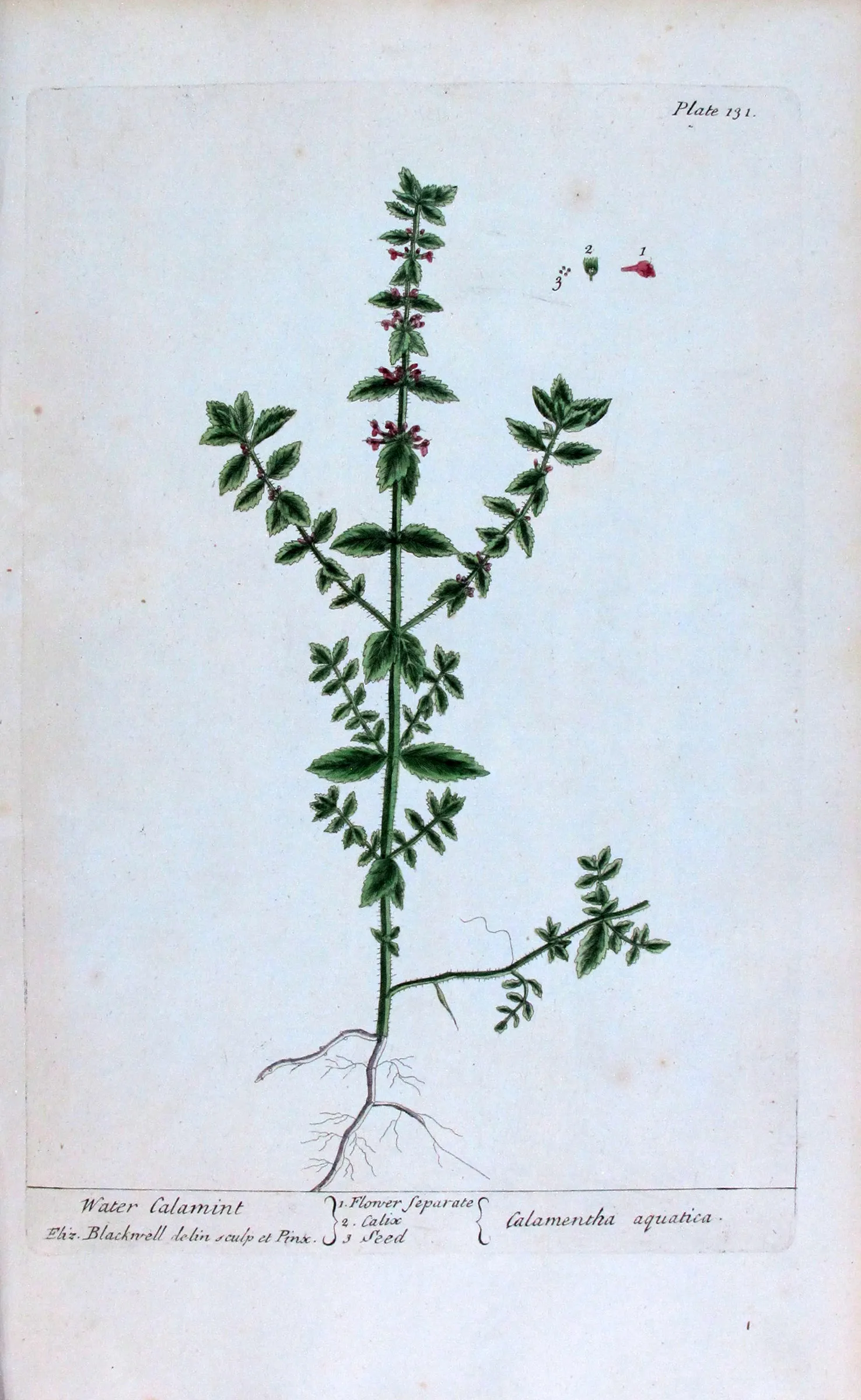


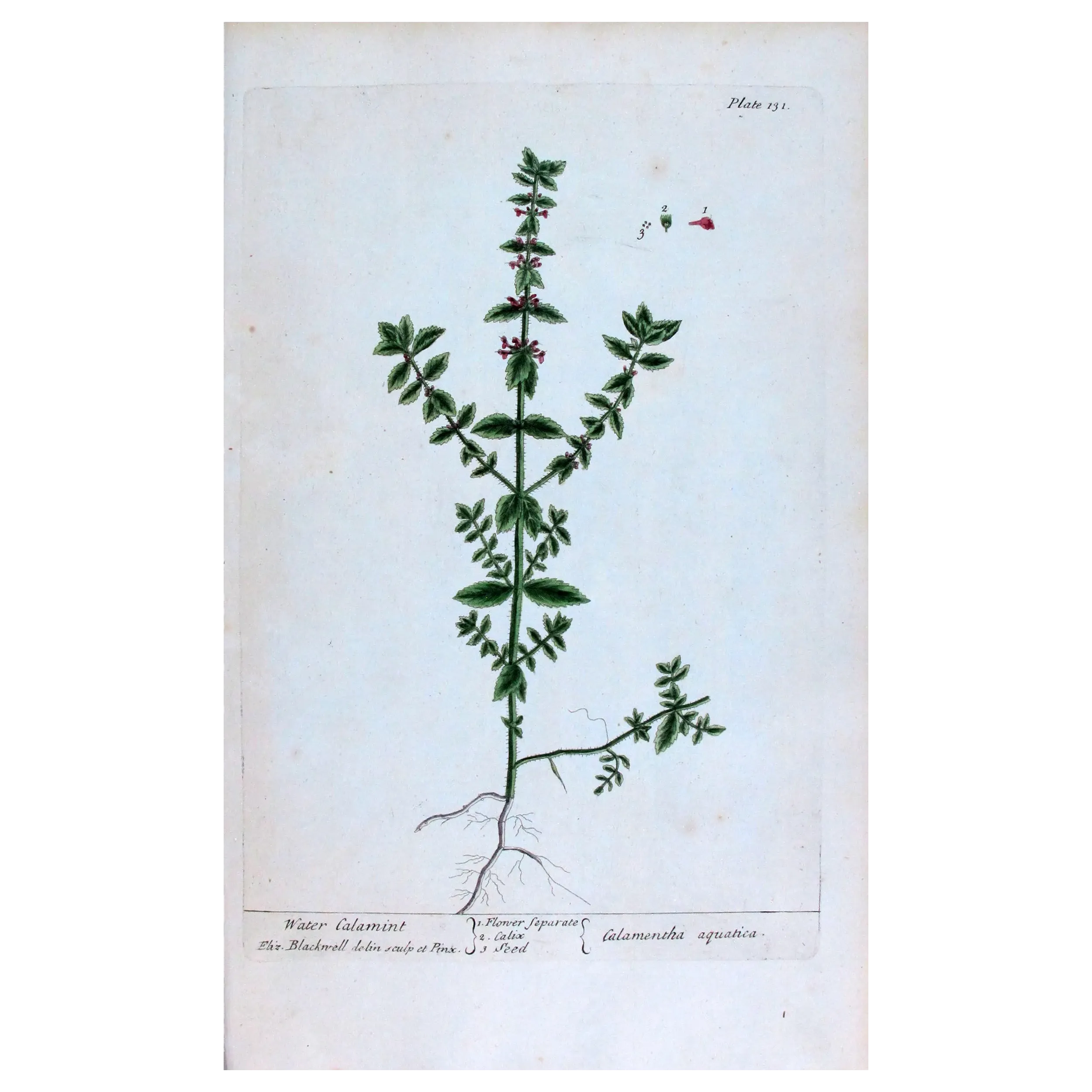
19th-century hand-colored engraving of Water Calamint, with delicate pink blooms and fine botanical details.
 Delivery policy
Your print will be carefully prepared and shipped worldwide via trusted couriers (UPS or similar).
 Authentic antique prints
Original engravings from the 17th–19th century.
This refined botanical engraving depicts Water Calamint (Calamintha aquatica), presenting an upright herb with opposite leaves and small pinkish blossoms arranged in whorls, accompanied by separate details of flower, calyx, and seed for accurate botanical reference.
The composition is slender and clearly structured: a central stem rises with measured branching, while the repeated leaf pairs create a steady visual rhythm. Elisabeth Blackwell’s careful observation keeps the plant readable at a glance, and the isolated anatomical details reinforce the plate’s practical, medicinal intent.
Produced in the early eighteenth century, this plate forms part of A Curious Herbal, a work designed to support medical and apothecary practice through reliable visual identification of useful plants.
— • —
The plant’s vertical habit and evenly spaced leaf nodes create an airy, architectural composition. Delicate flower clusters punctuate the stem with understated colour, balancing the graphic simplicity of the foliage.
Restrained hand-colouring emphasizes structure over ornament. Soft greens and muted pink tones preserve botanical clarity, while the minimal background space enhances the specimen’s quiet elegance.
Water calamint—recorded here as Calamintha aquatica—was valued among aromatic herbs used in early European medicine for digestive and calming preparations. Associated with damp habitats and waterways, it was often gathered for infusions and household remedies, where its scent and warming character were considered beneficial. Because calamints and related mints could be easily confused in the field, accurate depiction of leaf arrangement, flower whorls, and calyx form was essential. Blackwell’s plate reflects this practical need, providing a clear reference suited to everyday apothecary use.
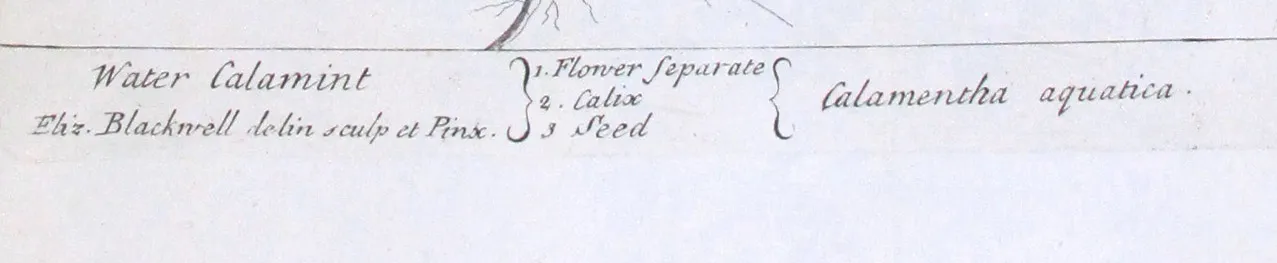
The engraving is in exceptionally fine antique condition, printed on original handmade laid paper typical of early 18th-century botanical publications. No watermark has been observed. The surface remains fresh and stable, with light, even age-related toning. A tiny paper impurity is present in the upper right area, creating a very slight localized toning; it is minor and unobtrusive. The impression is crisp and well defined, with well-preserved hand-colouring and intact engraved inscriptions, including the artist’s credit “Eliz. Blackwell delin. sculp. et pinx.”
This engraving forms part of a rare botanical group depicting three closely related Calamintha species, as illustrated by Elisabeth Blackwell in A Curious Herbal. While Calamintha aquatica documents a moisture-associated form gathered near waterways, the complete group offers a broader comparative view of habitat, morphology, and medicinal application within the genus.
Collectors and scholars interested in the full botanical narrative may explore the complete curated trio here:
Three Calamints – Botanical Trio from A Curious Herbal
For further context on Elisabeth Blackwell and the medicinal herbs documented in A Curious Herbal, see our editorial feature:
Specific References
19th-century hand-colored engraving of Water Pepper (Hydropiper), a graceful botanical with slender leaves and pink florets.
Delicate pea stems with curling tendrils and soft green pods, elegantly hand-colored.
Elegant olive branches with vivid green leaves and fruit in subtle yellow tones.
Charming 18th-century engraving of Sage by Elizabeth Blackwell, with blue-green leaves and delicate flowers, perfect for kitchen walls or herb-themed gallery displays.
Graceful vertical stem with rounded leaves and yellow blossoms, paired with a prominent root study.
Lively 18th-century engraving of Polypody of the Oak by Elizabeth Blackwell, showing rhythmic fern fronds and creeping rhizomes, perfect for naturalist or woodland-themed decor.
Fine 18th-century botanical of the Wild Pine, with graceful hanging cones and delicate needles ideal for woodland-themed interiors and natural history walls.
A dynamic pine composition with cones, needles, and golden pollen clusters.
Striking composition of the Pitch Tree with tall central stem and large cones, bringing strong graphic presence to botanical displays or rustic interiors.
A graceful hand-colored engraving of Marshmallow (Althaea officinalis) with soft pink flowers and expressive root study.
Fine engraving of Great Centaury (Centaurium majus) with pinkish florets, slender stems, and a butterfly study.
18th-century hand-colored engraving of the Almond Tree by Elisabeth Blackwell, with blossom, fruit and kernel beautifully rendered.
18th-century hand-colored engraving of Rhapontic with broad leaves and sculptural root, ideal for botanical décor.
Elegant botanical engraving of Great Figwort (Scrophularia major) with branching stems, clustered flowers and root detail.
Fine 18th-century engraving of the Medlar Tree by Elisabeth Blackwell, featuring fruit, blossom, and botanical detail.
19th-century hand-colored engraving of Water Calamint, with delicate pink blooms and fine botanical details.


