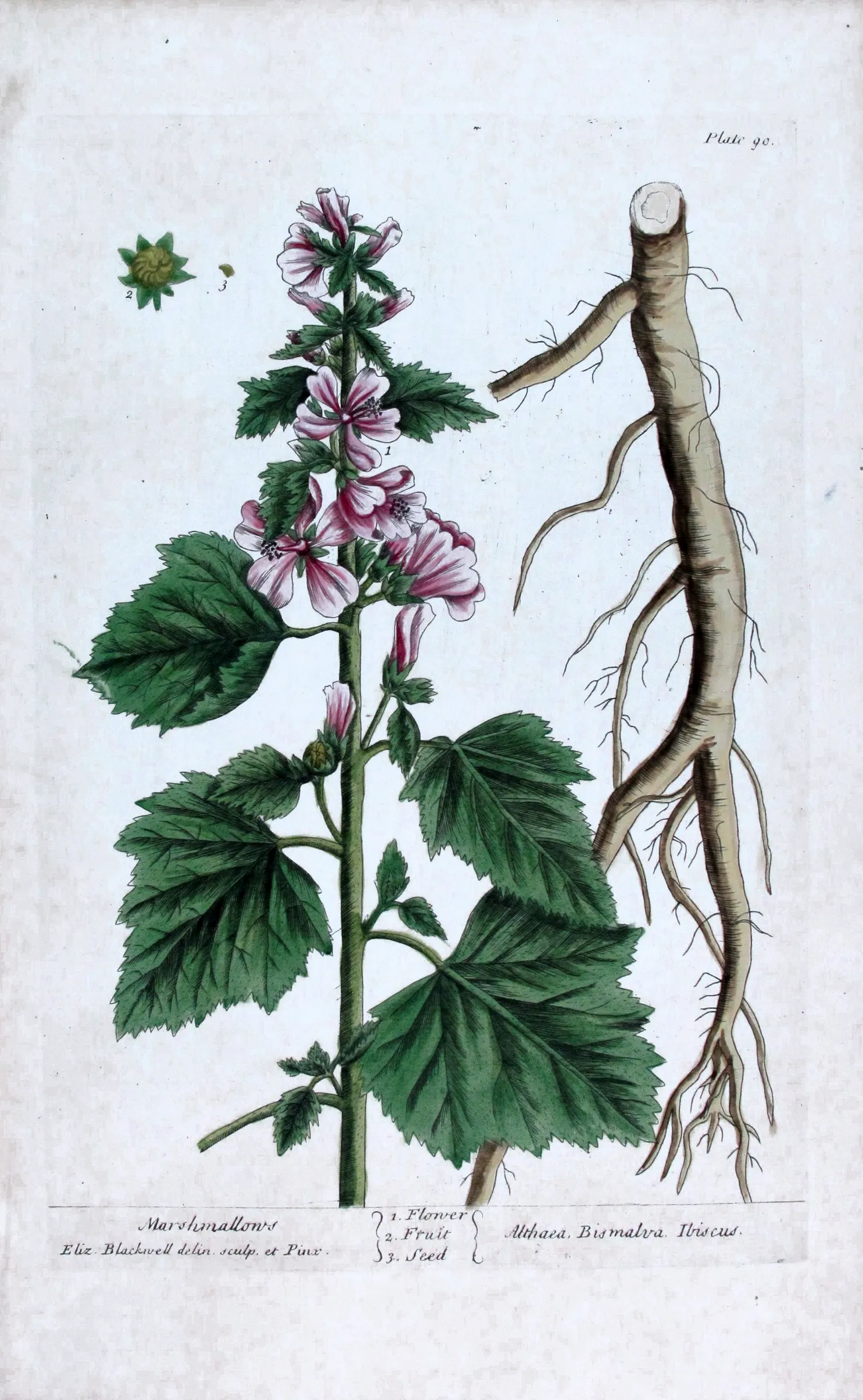

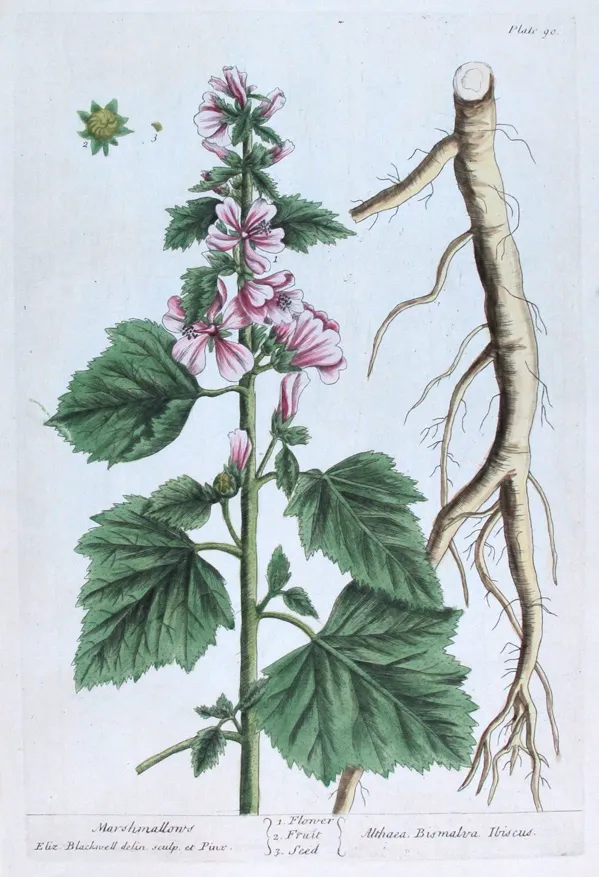
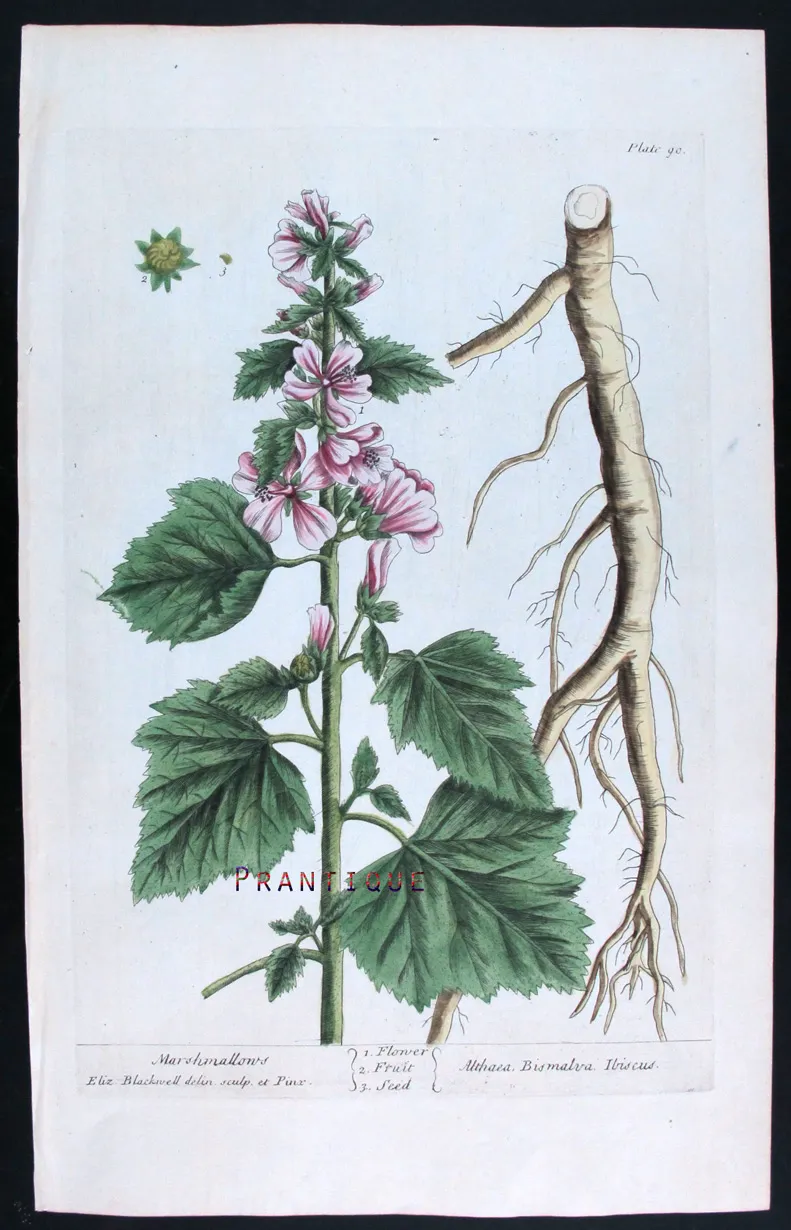


A graceful hand-colored engraving of Marshmallow (Althaea officinalis) with soft pink flowers and expressive root study.
 Delivery policy
Your print will be carefully prepared and shipped worldwide via trusted couriers (UPS or similar).
 Authentic antique prints
Original engravings from the 17th–19th century.
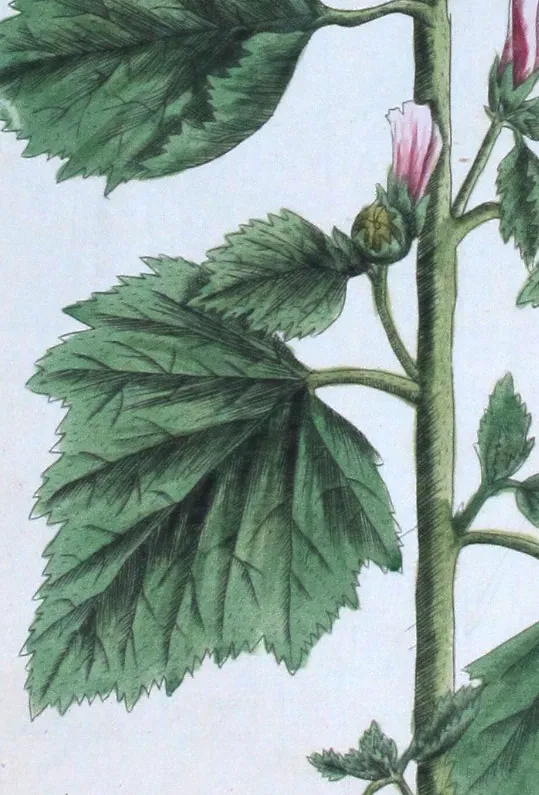
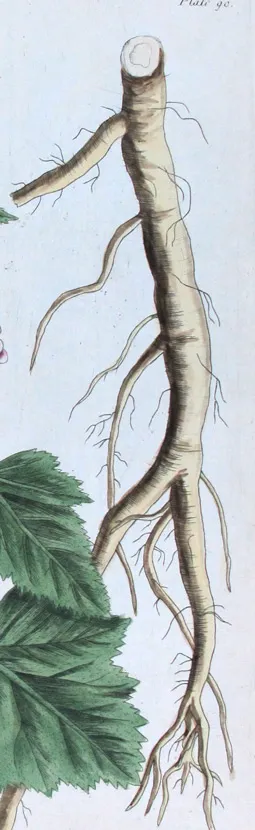
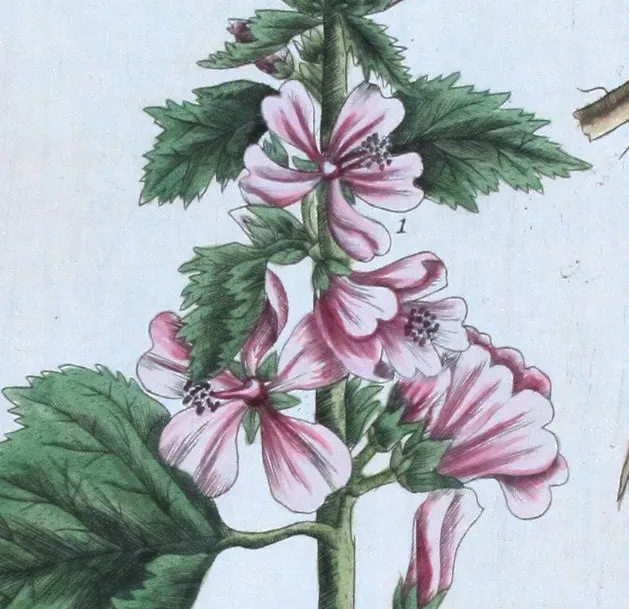
This elegant botanical engraving depicts Marshmallow (Althaea officinalis), a plant long valued for its medicinal properties and gentle character. The composition presents the flowering stem in full development, accompanied by a large and carefully rendered root study that underscores the plant’s historical importance in apothecary practice.
Soft pink blossoms rise along a sturdy central stem, framed by broad, textured leaves rendered with confident shading and botanical clarity. The palette remains harmonious and restrained, allowing the natural grace of the plant to emerge without decorative excess. The prominent root, shown separately, adds sculptural weight and visual balance to the plate.
Produced in the early eighteenth century, this engraving forms part of A Curious Herbal (1737–1739), a foundational botanical and medical work distinguished by the rare unity of authorship in which drawing, copper engraving, and hand-colouring were executed by Elisabeth Blackwell herself.
— • —
The composition is organized along a calm vertical axis, with alternating leaves and blossoms creating a measured rhythm from base to crown. The softly coloured flowers introduce warmth and approachability, while the foliage provides visual grounding and depth.
The root study functions as a powerful counterpoint to the aerial portion of the plant, adding both scale and historical resonance. Its inclusion enhances the plate’s decorative appeal while reinforcing the engraving’s practical intent, resulting in a composition that feels both informative and visually complete.
Althaea officinalis, commonly known as marshmallow, was widely used in early modern medicine for its soothing and emollient qualities. The plant’s root, in particular, was valued in preparations intended to calm irritation and inflammation, making accurate identification essential. Blackwell’s engraving reflects this importance by presenting both the flowering habit and the substantial root system with equal care. Within A Curious Herbal, marshmallow exemplifies the work’s guiding purpose: to provide clear, trustworthy botanical references for plants used in everyday medical and household contexts, grounded in direct observation rather than idealized form.
The engraving is preserved in like brand new antique condition, printed on original handmade laid paper typical of early eighteenth-century botanical publications. A period watermark is visible on the sheet, consistent with contemporary papermaking practices. The surface remains clean and stable, with a crisp impression and fresh original hand-colouring throughout. No notable defects are present. The engraved credit “Eliz. Blackwell delin. sculp. et pinx.” is fully legible, confirming that the drawing, engraving, and hand-colouring were executed by Elisabeth Blackwell herself.
For further context on Elisabeth Blackwell and the singular unity of authorship behind A Curious Herbal, see our editorial feature:
Specific References
Fine 18th-century botanical of the Wild Pine, with graceful hanging cones and delicate needles ideal for woodland-themed interiors and natural history walls.
Hand-colored 18th-century engraving of the Sweet Cistus of Candy, a graceful botanical plate by Elisabeth Blackwell.
Hand-colored 18th-century engraving of Yellow Asphodel, a vivid botanical composition from Elisabeth Blackwells A Curious Herbal.
Elegant 18th-century hand-colored engraving of a Raspberry Bush by Elisabeth Blackwell, with ripe fruit and soft blossom.
18th-century hand-colored engraving of the Wilding or Crab Tree by Elisabeth Blackwell, with blossom and fruit details.
Fine 18th-century engraving of the Cornel Tree by Elisabeth Blackwell, with red fruit and delicate foliage.
18th-century hand-colored engraving of a Garden Cucumber by Elisabeth Blackwell, with curling tendrils and yellow blossoms.
Delicate engraving of Madder with berries and exposed roots, ideal for refined botanical décor.
18th-century hand-colored engraving of Rhapontic with broad leaves and sculptural root, ideal for botanical décor.
Fine 18th-century hand-colored engraving of Euphorbium by Elisabeth Blackwell, a striking botanical study ideal for collectors.
Delicate pea stems with curling tendrils and soft green pods, elegantly hand-colored.
Elegant botanical engraving of Great Figwort (Scrophularia major) with branching stems, clustered flowers and root detail.
Graceful 18th-century botanical engraving of the Female Fern by Elizabeth Blackwell, with airy fronds and exposed root, beautiful in minimalist or nature-focused spaces.
Hand-colored engraving of Water Figwort (Scrophularia aquatica), featuring vertical stems, red blossoms and a caterpillar study.
Elegant Silver Fir with upright cones and finely spaced needles, a refined forest motif for sophisticated interiors and collectors of conifer imagery.
Original lithograph of the Green Goose Teal by Henrik Grønvold (Nettapus pulchellus)
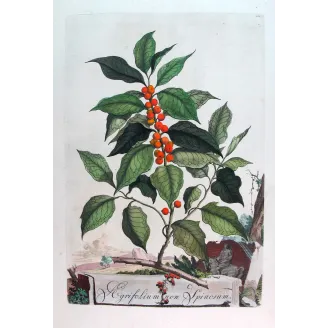
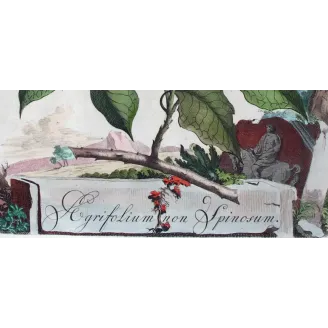
A refined 17th-century botanical engraving depicting non-spiny holly, notable for its elegant foliage and vivid berries. A balanced composition combining natural observation with early decorative botanical art.
19th-century hand-colored engraving of Water Pepper (Hydropiper), a graceful botanical with slender leaves and pink florets.
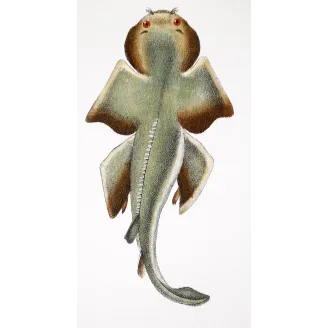
Graceful 19th-century engraving of the Angelshark by Pierre Antoine Prêtre, rich in soft tones and fine anatomical accuracy.
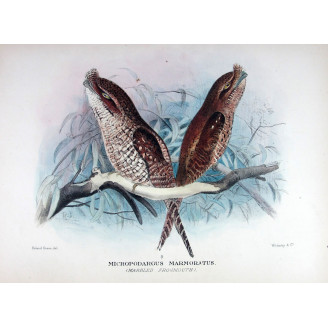
Original lithograph of the Marbled Frogmouth by Roland Green from Mathews' Birds of Australia.
An original botanical engraving from Henry Andrews' celebrated The Botanist's Repository, depicting Geranium quinquevulnerum with richly coloured velvety flowers, transparent hand colouring and refined eighteenth-century botanical craftsmanship.
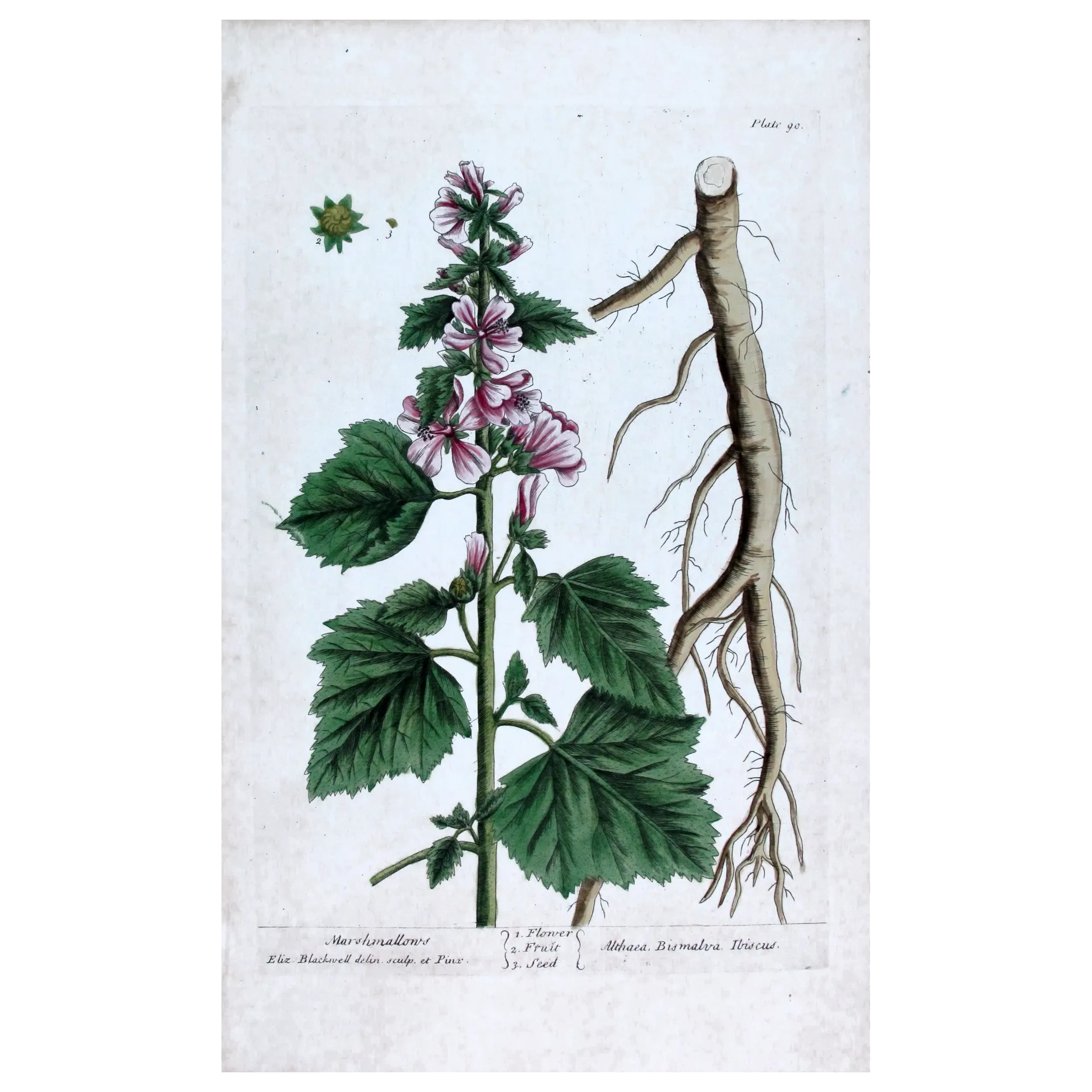
A graceful hand-colored engraving of Marshmallow (Althaea officinalis) with soft pink flowers and expressive root study.