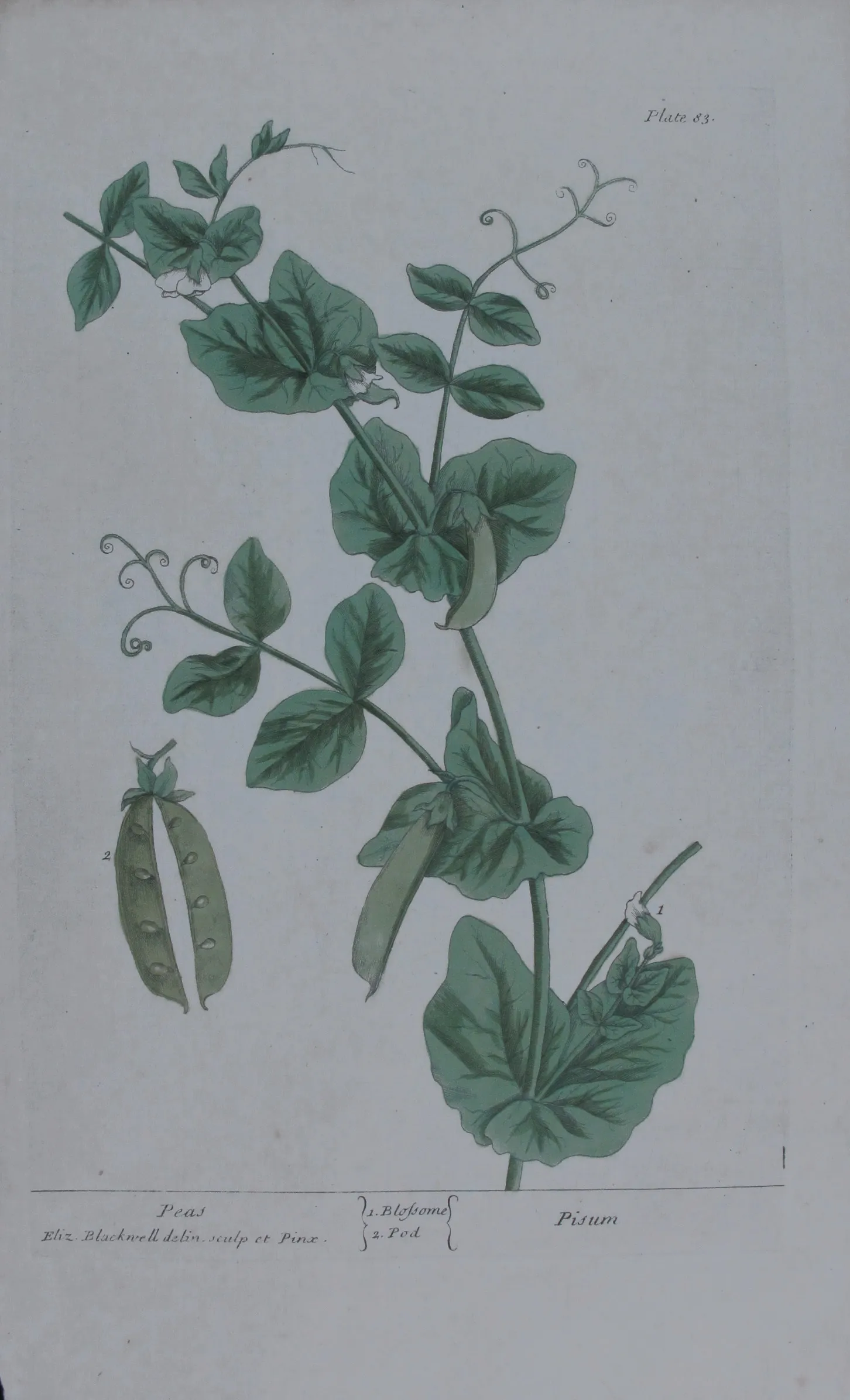
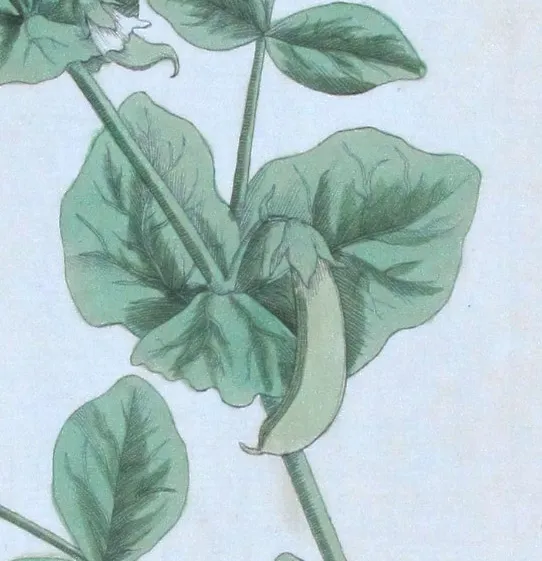

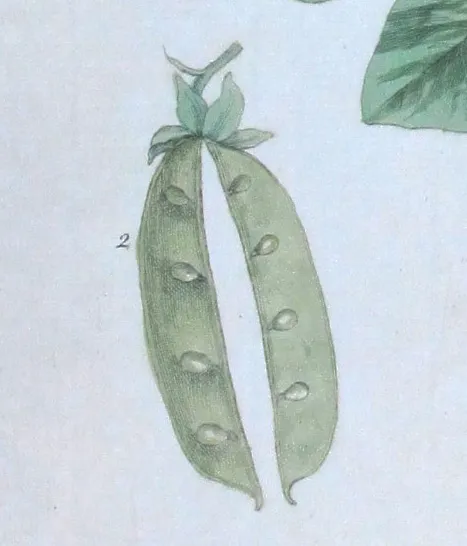
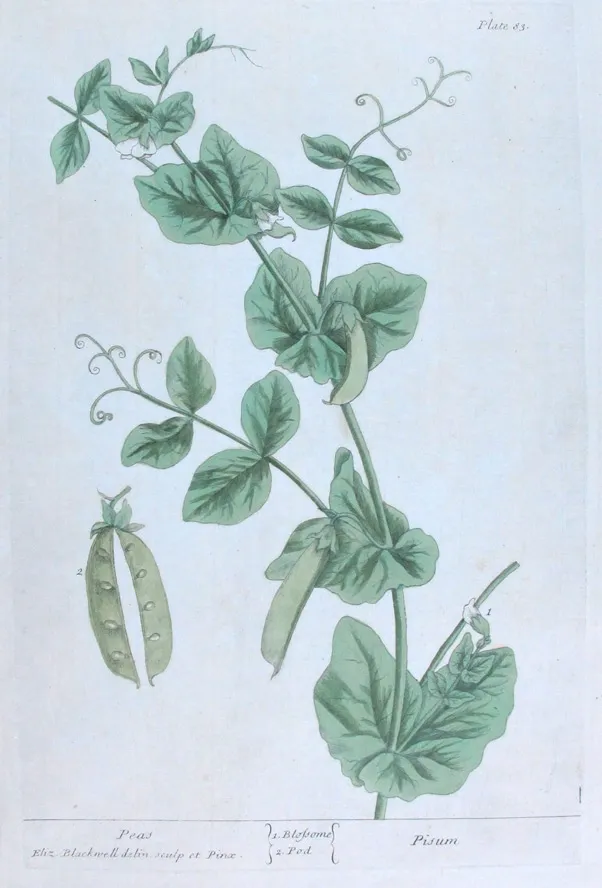
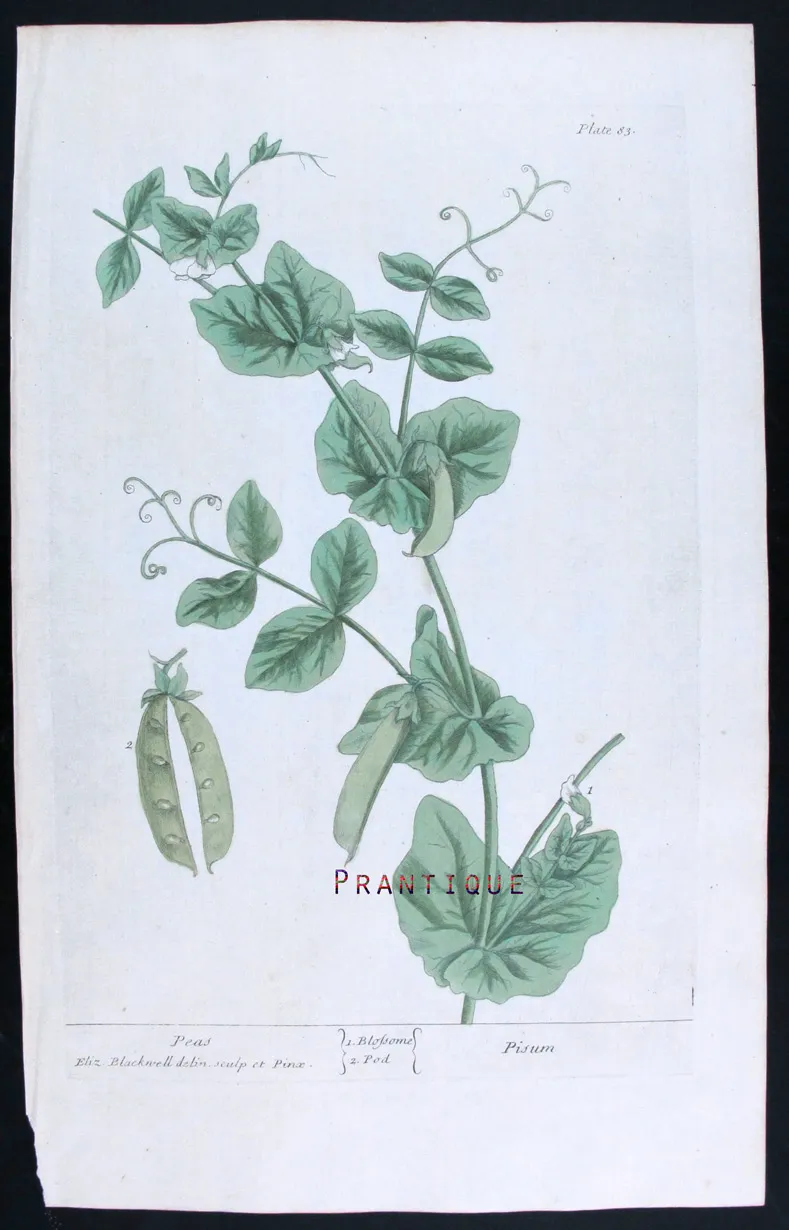


Delicate pea stems with curling tendrils and soft green pods, elegantly hand-colored.
 Delivery policy
Your print will be carefully prepared and shipped worldwide via trusted couriers (UPS or similar).
 Authentic antique prints
Original engravings from the 17th–19th century.
This refined botanical engraving depicts Peas (Pisum sativum), presenting the plant with clear emphasis on flowering, pod formation, and overall growth habit.
Rendered with careful restraint, its slender stems and curling tendrils create a light, ascending structure. Broad, softly modelled leaves frame the developing pods, while Elisabeth Blackwell’s precise observation allows each botanical element to remain distinct and easily legible.
Created in the early eighteenth century, this plate belongs to A Curious Herbal, a foundational medical and botanical work distinguished by the unity of its production, in which drawing, copper engraving, and hand-colouring were executed by the same hand.
— • —
The composition unfolds vertically with gentle lateral movement, guided by tendrils that introduce rhythm and visual continuity. The elongated pods act as focal elements, balancing the broader leaf surfaces and anchoring the composition.
Subtle tonal gradations give volume to the leaves and pods without heavy contrast, resulting in a calm, coherent palette. The restrained hand-colouring reinforces botanical clarity while preserving a quiet decorative elegance.
Peas (Pisum sativum) were widely cultivated and carefully documented in early European herbals for both dietary use and medicinal associations. Their inclusion reflects the importance of accurately representing common food plants, whose flowers, pods, and growth stages needed to be clearly distinguished from related legumes for reliable identification in domestic and apothecary contexts. Blackwell’s plate fulfils this practical purpose while maintaining an understated visual harmony.
The engraving is in exceptionally fine antique condition, printed on original handmade laid paper typical of early 18th-century botanical publications. No watermark has been observed. The surface remains fresh and stable, with light, even age-related toning consistent with period paper. A small loss is visible at the lower left corner, confined to the margin and unobtrusive, without affecting the botanical image or engraved text. The impression is crisp and legible throughout. The engraved credit “Eliz. Blackwell delin. sculp. et pinx.” is present and fully legible, confirming the unified authorship of the plate.
For further context on Elisabeth Blackwell and the unified authorship behind A Curious Herbal, see our editorial feature:
Specific References
Charming study with pink blossoms and vivid red rosehips, a classic countryside motif.
Hand-colored 18th-century engraving of the Sweet Cistus of Candy, a graceful botanical plate by Elisabeth Blackwell.
Hand-colored engraving of Water Figwort (Scrophularia aquatica), featuring vertical stems, red blossoms and a caterpillar study.
Refined 18th-century engraving of Mountain Calamint by Elizabeth Blackwell, with upright stems and pink blossoms, ideal for calm, herbal or cottage-inspired interiors.
Hand-colored botanical engraving of the Common Calamint, with dense foliage and soft pink-purple florets.
A graceful hand-colored engraving of Marshmallow (Althaea officinalis) with soft pink flowers and expressive root study.
18th-century hand-colored engraving of a Garden Cucumber by Elisabeth Blackwell, with curling tendrils and yellow blossoms.
Delicate engraving of Madder with berries and exposed roots, ideal for refined botanical décor.
Elegant botanical engraving of the Bean plant with pods and seed details.
Elegant 18th-century hand-colored engraving of the Male Fern by Elizabeth Blackwell, with finely shaded fronds ideal for nature-inspired walls or botanical galleries.
Dramatic lichen plate with sculptural fronds and rocky support, perfect for collectors who love unusual, textural natural history subjects.
Graceful 18th-century botanical engraving of the Female Fern by Elizabeth Blackwell, with airy fronds and exposed root, beautiful in minimalist or nature-focused spaces.
Fine engraving of Black Alder with berries and elegant branching, ideal for natural interiors.
18th-century hand-colored engraving of the Almond Tree by Elisabeth Blackwell, with blossom, fruit and kernel beautifully rendered.
Hand-colored 18th-century engraving of Yellow Asphodel, a vivid botanical composition from Elisabeth Blackwells A Curious Herbal.
Elegant pink-white blossoms with upright stems and finely shaped leaves, a graceful 18th?century botanical.
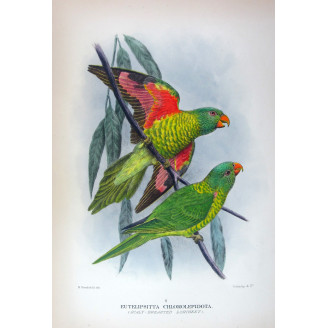
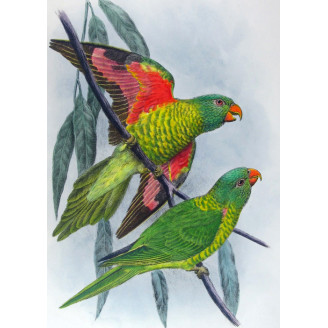
Gold-breasted Lorikeet lithograph by Henrik Grønvold, dynamic dual composition.
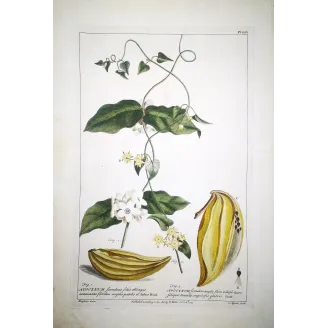
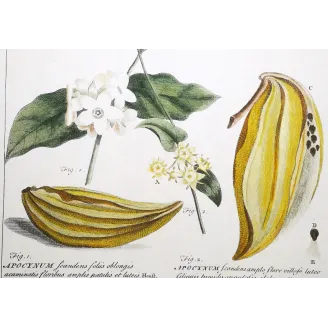
An original 18th-century hand-colored engraving depicting Apocynum scandens, published in Philip Miller’s Figures of the Most Beautiful, Useful, and Uncommon Plants. The composition combines delicate star-shaped flowers, elegant climbing stems, and striking striped seed pods, uniting botanical precision with refined decorative presence.
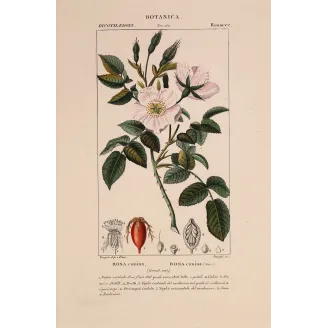
Delicate dog rose flower with soft pink petals and fine botanical details.
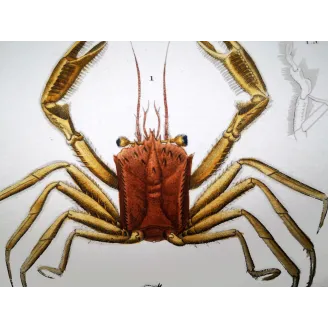
Refined 19th-century engraving of *Omola frontespinosa*, a rare crab with slender claws and delicate yellow-orange tones.
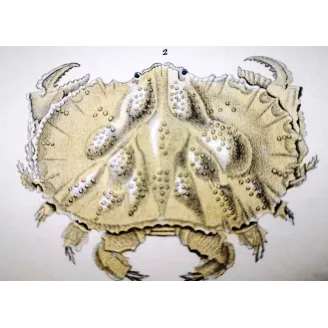
Fine 19th-century engraving of *Calappa tuberculata*, a beautifully armored crab with ornate textures and yellow tones.
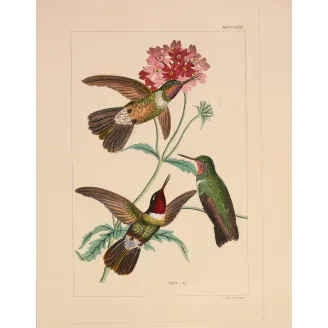
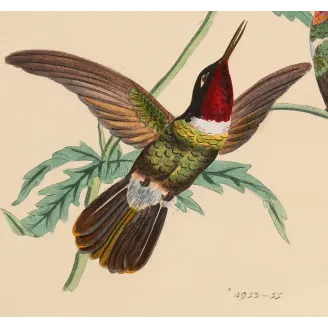
Original nineteenth-century hand-colored engraving by Ludwig Reichenbach, depicting three hummingbirds among pink blossoms. A rare later plate from the Trochilinarum Enumeratio corpus, not fully documented in the principal published index.
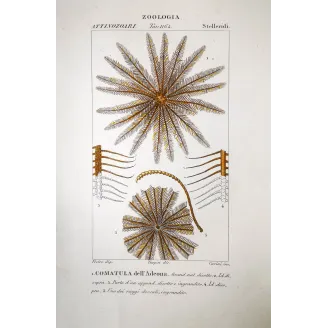
Rare 19th-century print of the feather star Comatula of the Adeona, with anatomical details.
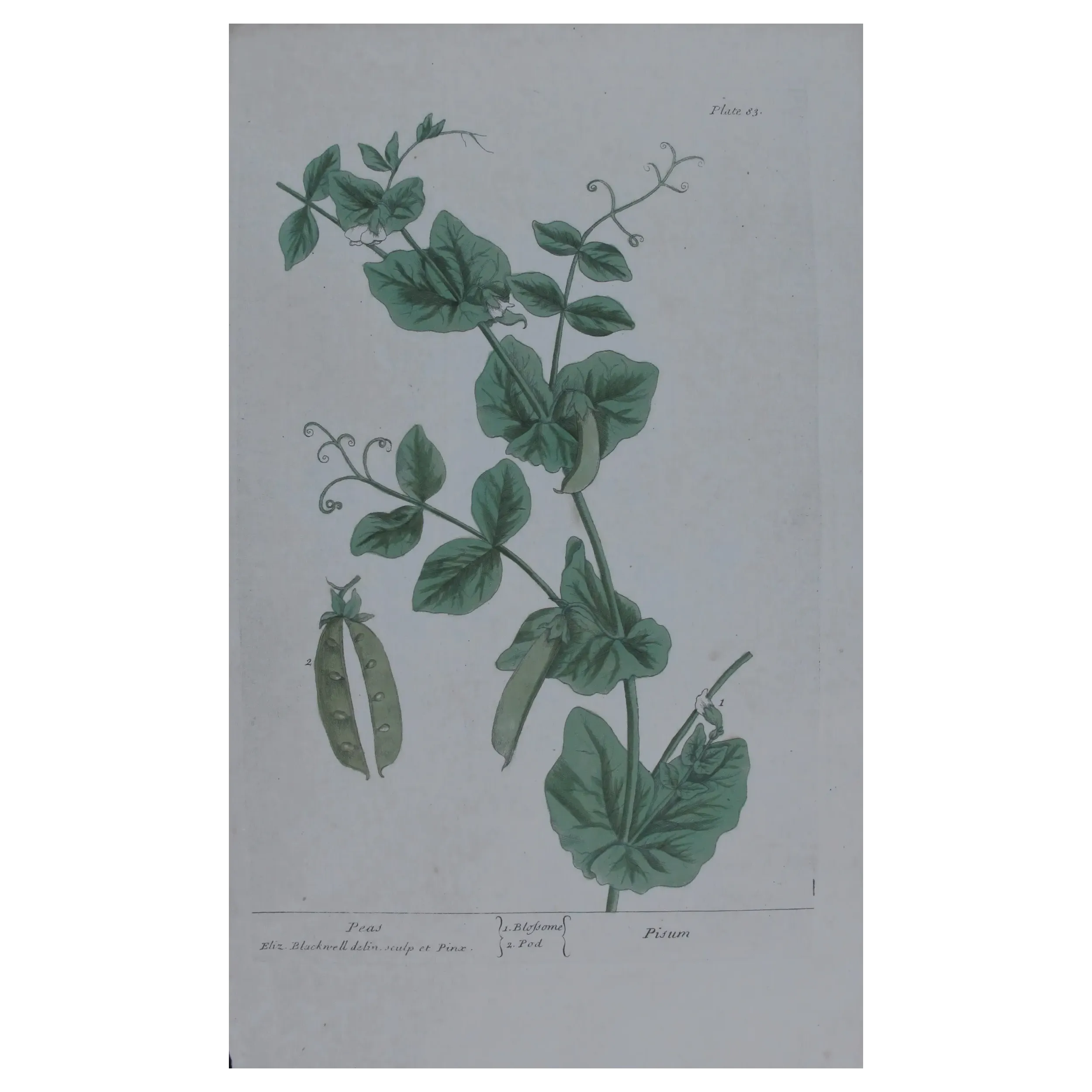
Delicate pea stems with curling tendrils and soft green pods, elegantly hand-colored.