

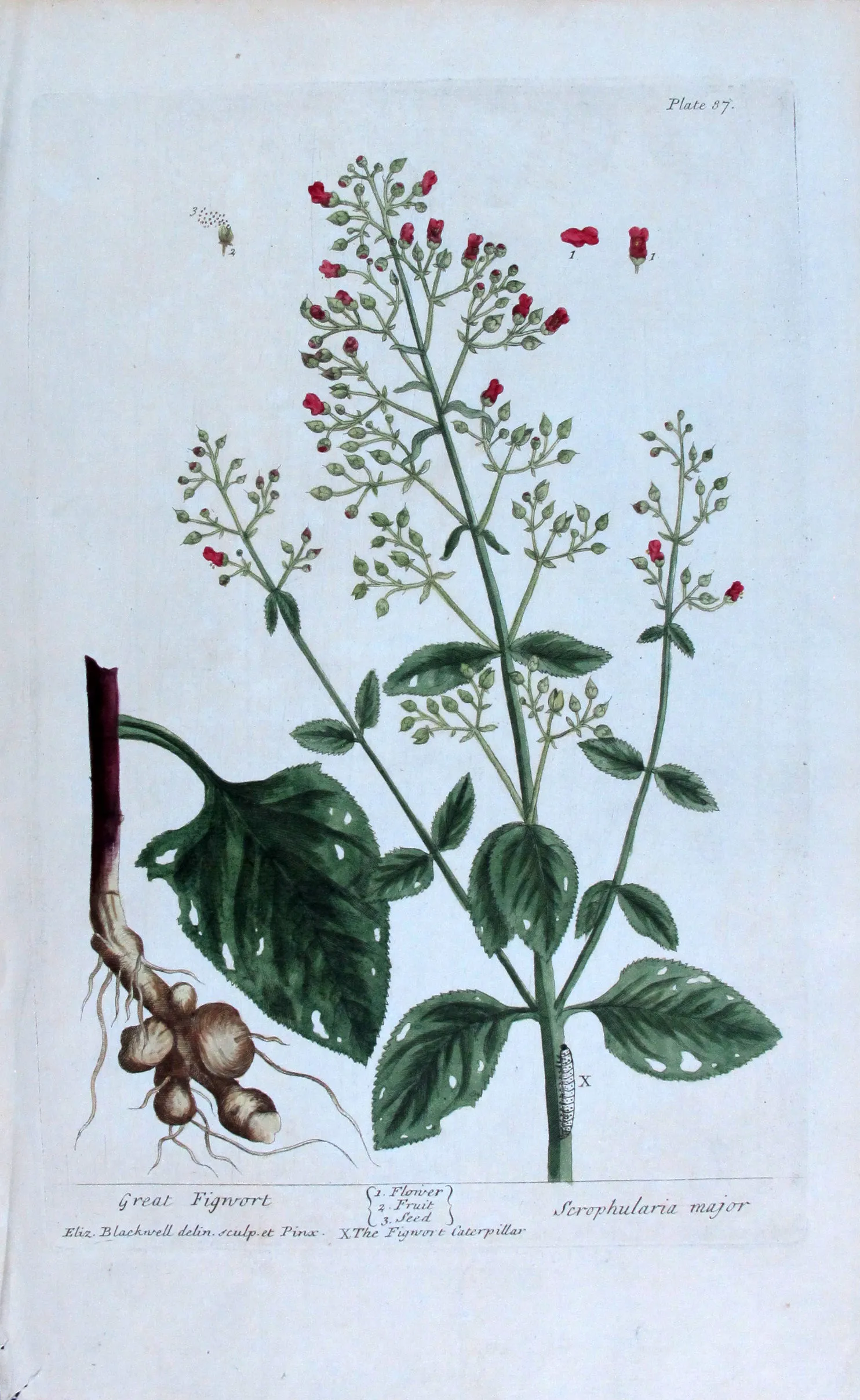

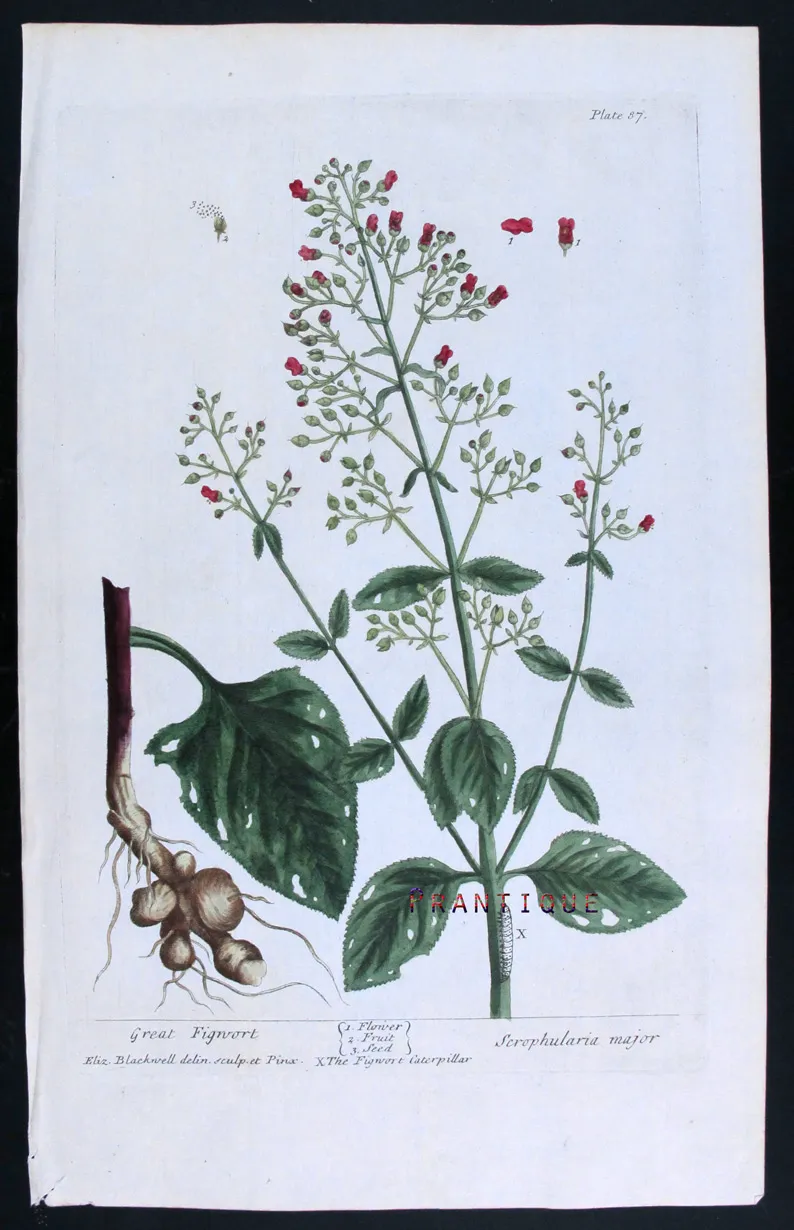


Elegant botanical engraving of Great Figwort (Scrophularia major) with branching stems, clustered flowers and root detail.
 Delivery policy
Your print will be carefully prepared and shipped worldwide via trusted couriers (UPS or similar).
 Authentic antique prints
Original engravings from the 17th–19th century.
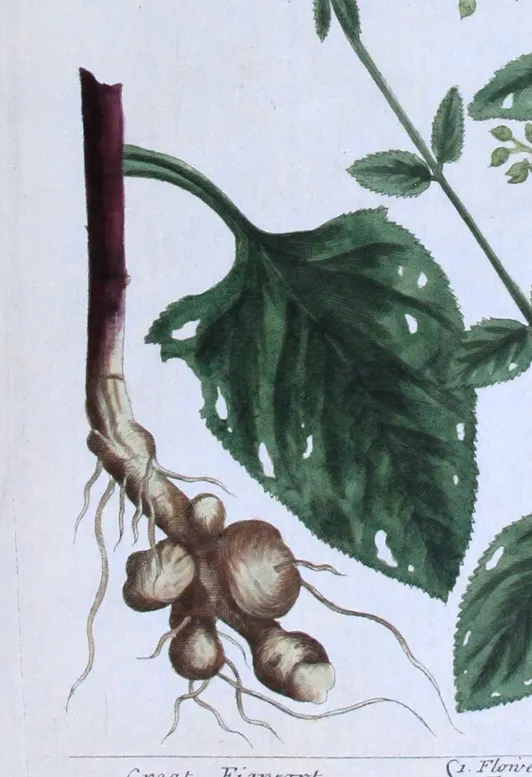
This finely observed botanical engraving depicts the Great Figwort (Scrophularia major), presented with a composed vertical structure and clear emphasis on flowering habit, foliage, and diagnostic detail. The plant is shown in full development, accompanied by an enlarged view of the root, reinforcing the practical and medical intent of the original publication.
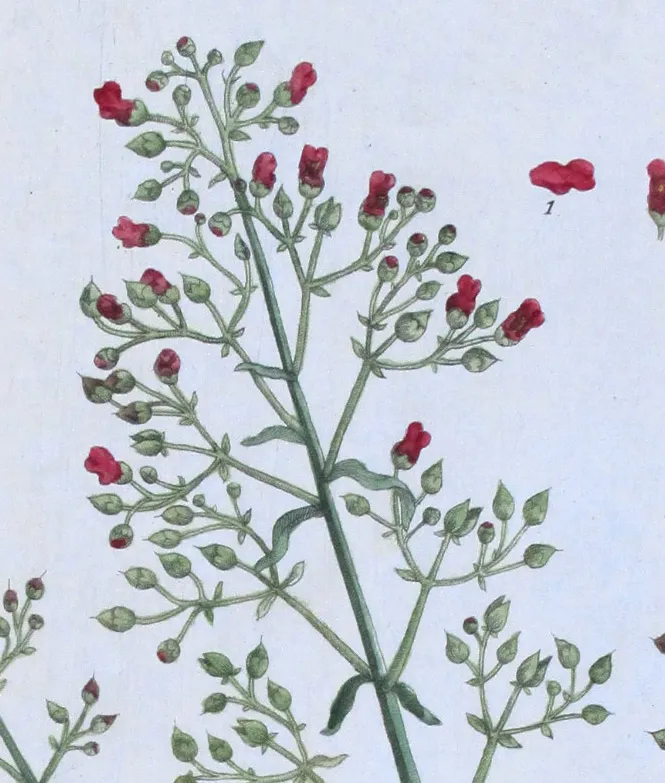
Blackwell’s confident line work and restrained colouring give the plate a calm authority: slender branching stems carry clustered red blossoms, while the broad green leaves provide visual weight and anchoring planes. A small caterpillar is illustrated on the stem, a vivid observational element that suggests the plant’s real-life environment and the natural interactions surrounding it.
Produced in the early eighteenth century, this engraving forms part of A Curious Herbal (1737–1739), a landmark botanical and medical work distinguished by the rare unity of authorship in which drawing, copper engraving, and hand-colouring were executed by Elisabeth Blackwell herself.
— • —
The composition is structured around a strong upright axis, with branching flower heads creating a balanced, airy crown. The foliage introduces a measured rhythm of overlapping forms, and the plate’s generous negative space amplifies the sense of refinement and clarity.
The enlarged root detail at the side adds sculptural contrast and historical character, recalling the practical needs of early herbal readers who relied on whole-plant recognition. The small caterpillar—placed directly on the stem—functions as a subtle narrative accent, enhancing the plate’s authenticity and quietly modern naturalism.
In early modern herbal medicine, figworts (Scrophularia) were widely recorded for their perceived usefulness in traditional remedies, particularly in contexts associated with external applications and “cooling” preparations. The name “figwort” itself reflects historical associations with swellings and skin-related conditions, and accurate identification mattered because several related plants could present similar leaves and growth habits. Blackwell’s illustration emphasizes key markers—upright branching stems, clustered tubular flowers, and characteristic foliage—offering a dependable visual reference for readers navigating a pharmacopeia grounded in observation. The inclusion of the root detail further reinforces this practical purpose, aligning the plate with the book’s guiding ambition: clarity, reliability, and real-world usability.
The engraving is preserved in like brand new antique condition, printed on original handmade laid paper typical of early eighteenth-century botanical publications. No watermark is visible on the sheet. The surface remains clean and stable, with a crisp impression and fresh original hand-colouring throughout. No notable defects are present. The engraved credit “Eliz. Blackwell delin. sculp. et pinx.” is fully legible, confirming that the drawing, engraving, and hand-colouring were executed by Elisabeth Blackwell herself.
For further context on Elisabeth Blackwell and the singular unity of authorship behind A Curious Herbal, see our editorial feature:
Specific References
19th-century hand-colored engraving of Water Calamint, with delicate pink blooms and fine botanical details.
Fine 18th-century engraving of the Cornel Tree by Elisabeth Blackwell, with red fruit and delicate foliage.
Elegant botanical engraving of the Bean plant with pods and seed details.
Elegant pink-white blossoms with upright stems and finely shaped leaves, a graceful 18th?century botanical.
Lively Hawthorn branch with crisp green leaves and clusters of rich red berries, a classic countryside motif for warm, welcoming interiors.
Fine 18th-century hand-colored engraving of Euphorbium by Elisabeth Blackwell, a striking botanical study ideal for collectors.
Fine engraving of Black Alder with berries and elegant branching, ideal for natural interiors.
Elegant 18th-century hand-colored engraving of the Male Fern by Elizabeth Blackwell, with finely shaded fronds ideal for nature-inspired walls or botanical galleries.
Striking palm fronds paired with warm golden dates, a highly decorative composition.
Graceful 18th-century botanical engraving of the Female Fern by Elizabeth Blackwell, with airy fronds and exposed root, beautiful in minimalist or nature-focused spaces.
Elegant Silver Fir with upright cones and finely spaced needles, a refined forest motif for sophisticated interiors and collectors of conifer imagery.
A graceful hand-colored engraving of Marshmallow (Althaea officinalis) with soft pink flowers and expressive root study.
Delicate engraving of Madder with berries and exposed roots, ideal for refined botanical décor.
Fine 18th-century botanical of the Wild Pine, with graceful hanging cones and delicate needles ideal for woodland-themed interiors and natural history walls.
Lively 18th-century engraving of Polypody of the Oak by Elizabeth Blackwell, showing rhythmic fern fronds and creeping rhizomes, perfect for naturalist or woodland-themed decor.
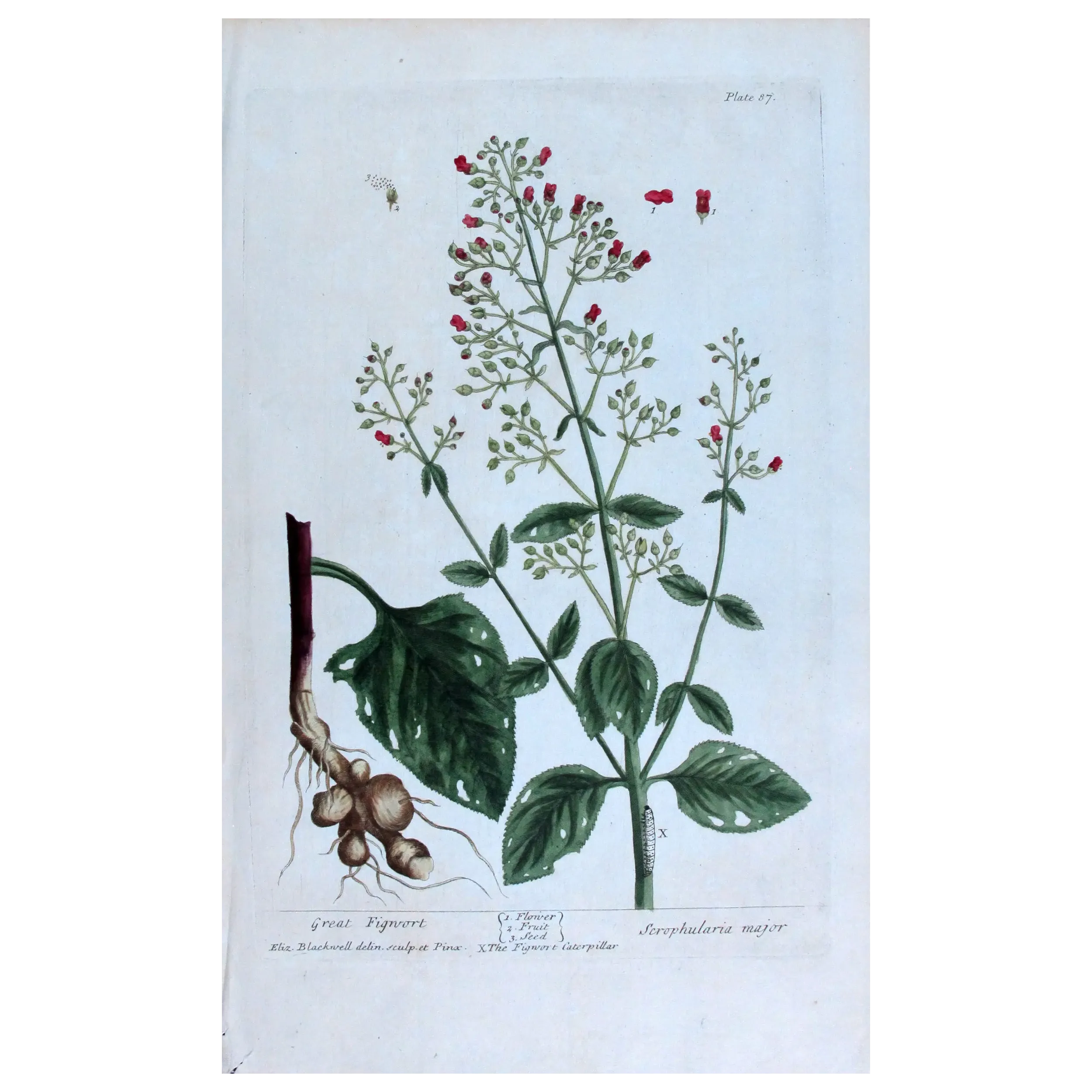
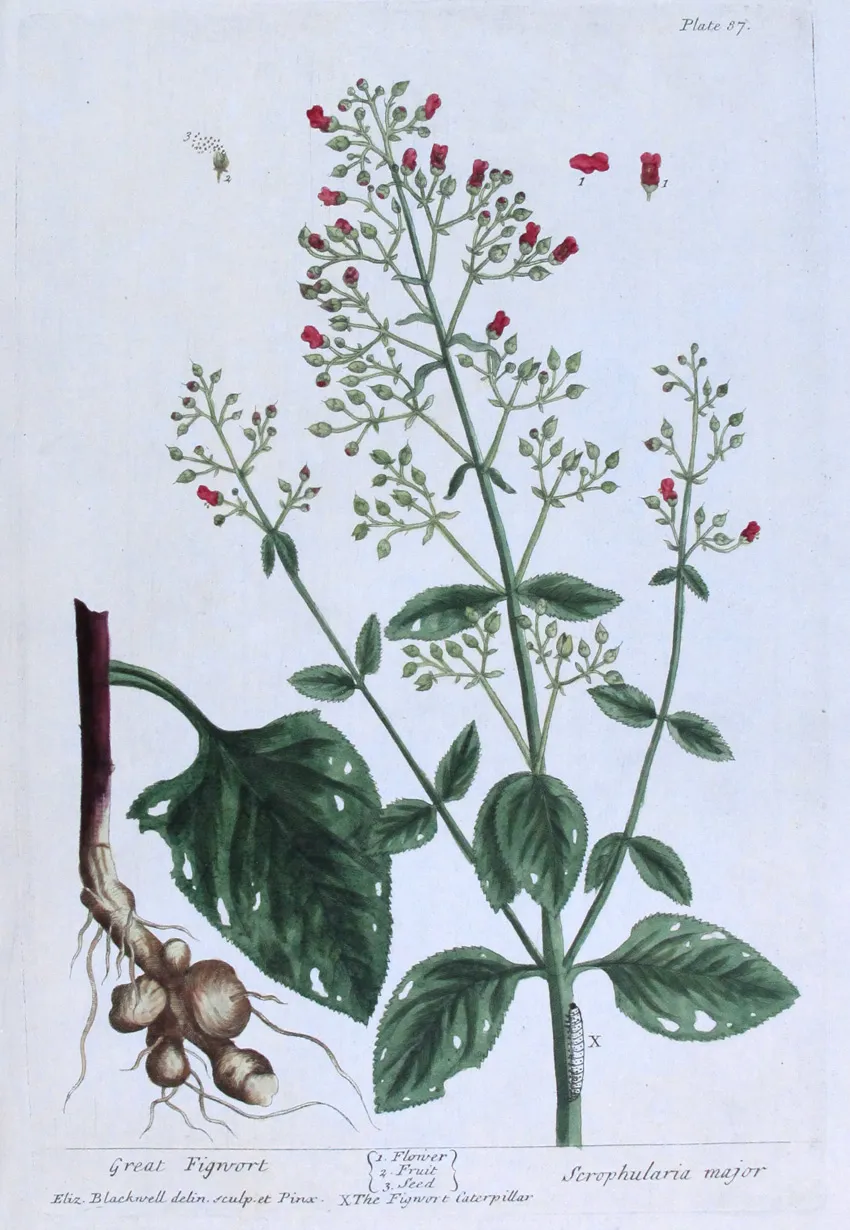
Elegant botanical engraving of Great Figwort (Scrophularia major) with branching stems, clustered flowers and root detail.


