
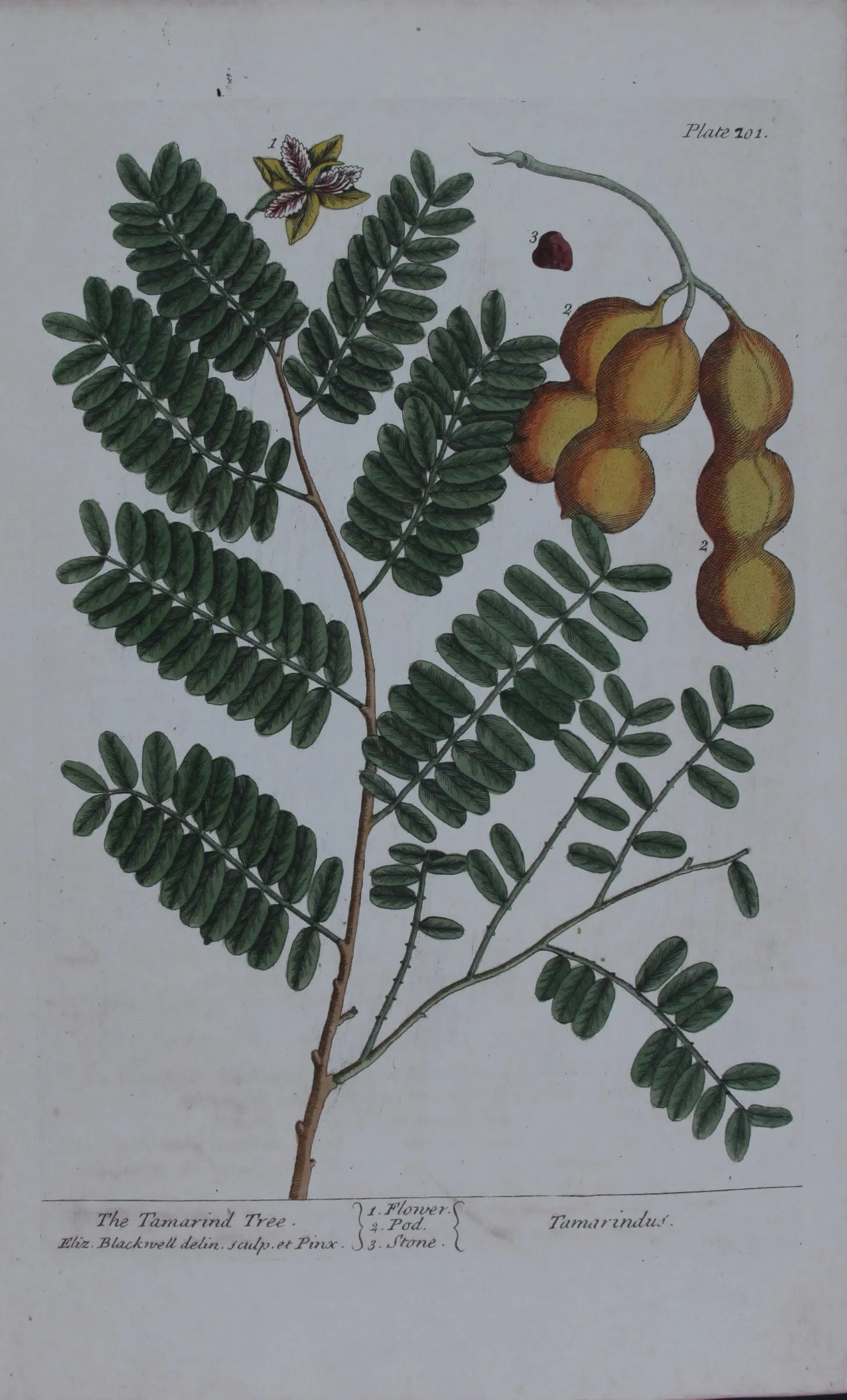
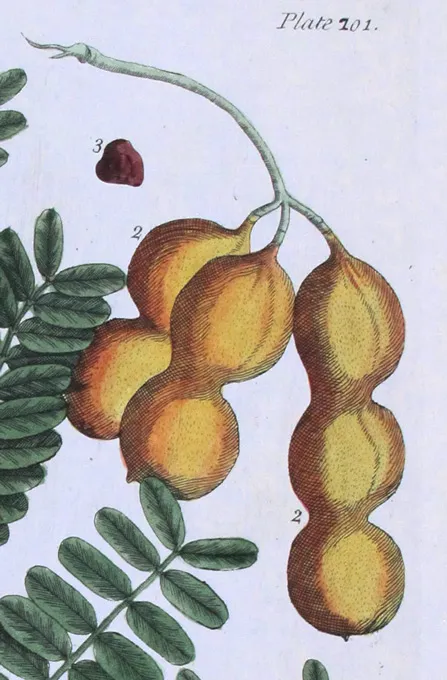



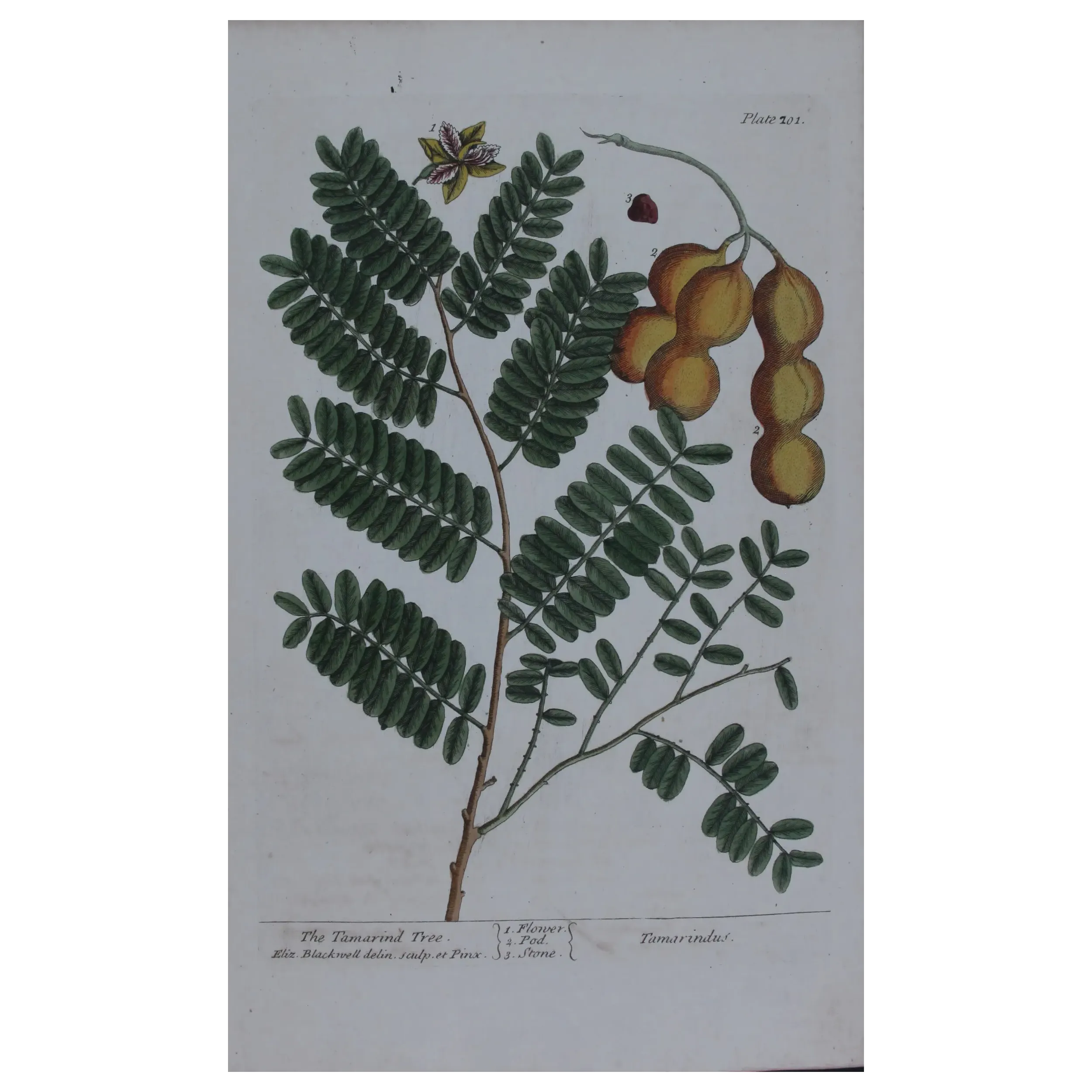
A rich botanical plate showing feathery leaves and warm golden seed pods.
 Delivery policy
Your print will be carefully prepared and shipped worldwide via trusted couriers (UPS or similar).
 Authentic antique prints
Original engravings from the 17th–19th century.
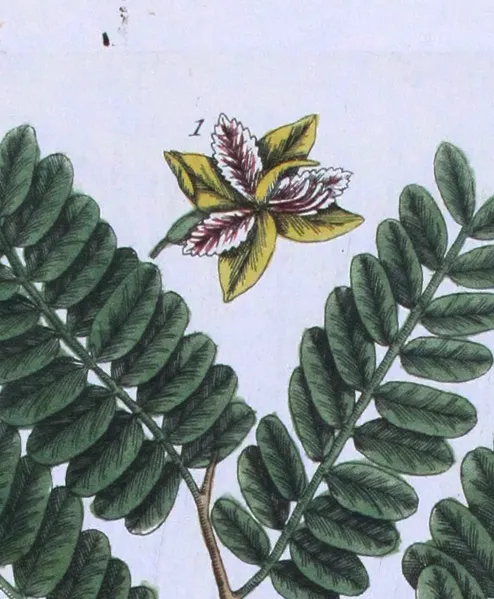
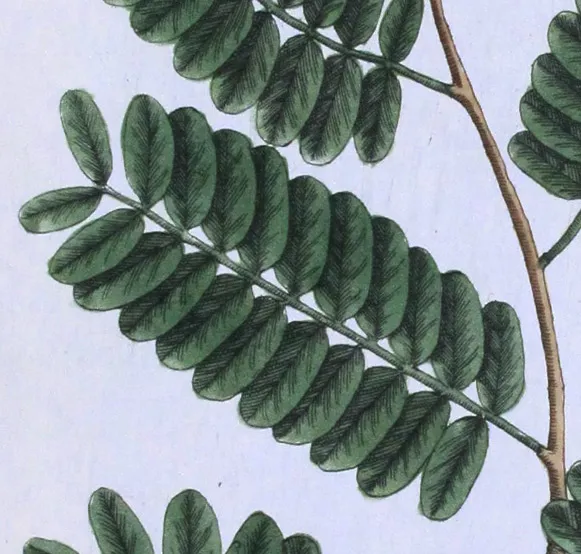
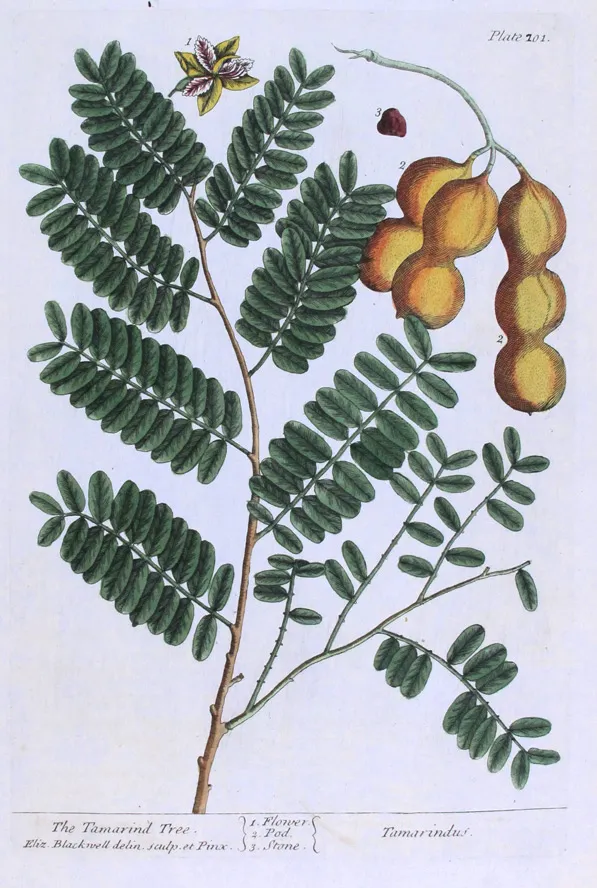
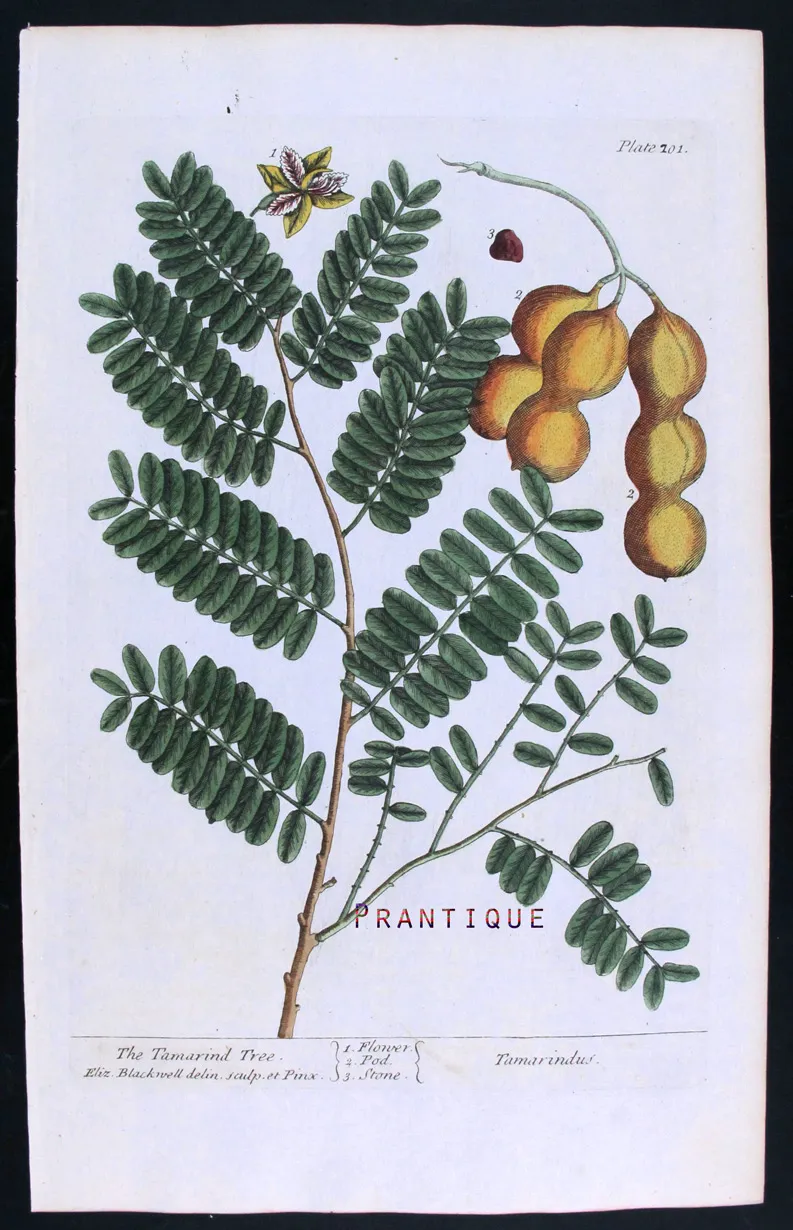
This refined botanical engraving depicts the Tamarind Tree (Tamarindus indica), presenting a branching specimen with characteristic compound leaves and distinctive podded fruit.
Rendered with careful balance, its feathery foliage is arranged rhythmically along the stem, while the hanging pods introduce visual weight and contrast. Elisabeth Blackwell’s approach emphasizes structural clarity, allowing leaf, flower, and fruit to be read distinctly within a composed and orderly image.
Created in the early eighteenth century, this plate belongs to A Curious Herbal, a foundational medical and botanical work distinguished by the unity of its production, in which drawing, copper engraving, and hand-colouring were executed by the same hand.
— • —
The composition develops along a central vertical axis, from which lateral branches extend with measured regularity. The finely divided leaves create a light, textural surface, while the curved pods provide a strong counterpoint through form and colour.
Subtle tonal variations model the foliage with depth and softness, while the warmer colouring of the fruit introduces emphasis without overwhelming the palette. The result is a balanced image that combines analytical clarity with restrained decorative presence.
The tamarind tree (Tamarindus indica) was known in early European medicine as an imported medicinal plant, introduced through expanding trade networks linking Europe with Africa and Asia. The acidic pulp of its pods was widely valued for cooling, laxative, and digestive preparations, frequently appearing in apothecary recipes and pharmacopoeias. Because tamarind was unfamiliar to many European practitioners, accurate visual representation was essential to distinguish it from other pod-bearing trees and to ensure correct identification of the medicinal fruit. Its inclusion in A Curious Herbal reflects the growing importance of exotic materia medica in early eighteenth-century medical practice, as well as the need to integrate newly imported species into established systems of botanical knowledge.
The engraving is in exceptionally fine antique condition, printed on original handmade laid paper typical of early 18th-century botanical publications. No watermark has been observed. The surface remains fresh and stable, with light, even age-related toning consistent with period paper. The impression is crisp and legible throughout, with well-preserved margins. The engraved credit “Eliz. Blackwell delin. sculp. et pinx.” is present and fully legible, confirming the unified authorship of the plate.
For further context on Elisabeth Blackwell and the unified authorship behind A Curious Herbal, see our editorial feature:
Specific References
Fine engraving of Great Centaury (Centaurium majus) with pinkish florets, slender stems, and a butterfly study.
Elegant 18th-century hand-colored engraving of the Male Fern by Elizabeth Blackwell, with finely shaded fronds ideal for nature-inspired walls or botanical galleries.
Fine 18th-century botanical of the Wild Pine, with graceful hanging cones and delicate needles ideal for woodland-themed interiors and natural history walls.
Hand-colored engraving of Water Figwort (Scrophularia aquatica), featuring vertical stems, red blossoms and a caterpillar study.
Elegant botanical engraving of the Bean plant with pods and seed details.
A dynamic pine composition with cones, needles, and golden pollen clusters.
18th-century hand-colored engraving of Rhapontic with broad leaves and sculptural root, ideal for botanical décor.
Fine 18th-century engraving of the Medlar Tree by Elisabeth Blackwell, featuring fruit, blossom, and botanical detail.
Fine engraving of Black Alder with berries and elegant branching, ideal for natural interiors.
Striking palm fronds paired with warm golden dates, a highly decorative composition.
Delicate pea stems with curling tendrils and soft green pods, elegantly hand-colored.
Refined 18th-century engraving of Mountain Calamint by Elizabeth Blackwell, with upright stems and pink blossoms, ideal for calm, herbal or cottage-inspired interiors.
Hand-colored 18th-century engraving of Yellow Asphodel, a vivid botanical composition from Elisabeth Blackwells A Curious Herbal.
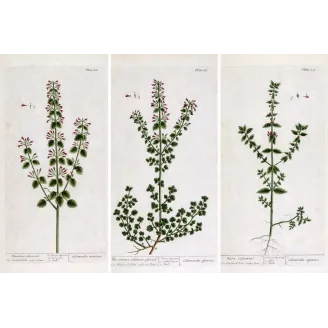
A curated botanical trio illustrating three closely related Calamintha species — officinalis, montana, and aquatica — as engraved and hand-colored by Elisabeth Blackwell for A Curious Herbal (1737–1739). Presented together, these plates offer a rare comparative view of medicinal, habitat-specific, and morphological variation within a single genus, reflecting early modern botanical practice and apothecary knowledge.
Graceful engraving of Wheat varieties with seed details, ideal for rustic décor.
Broad heart-shaped leaves with yellow tubular blooms, beautifully rendered in subtle tones.
A rich botanical plate showing feathery leaves and warm golden seed pods.