

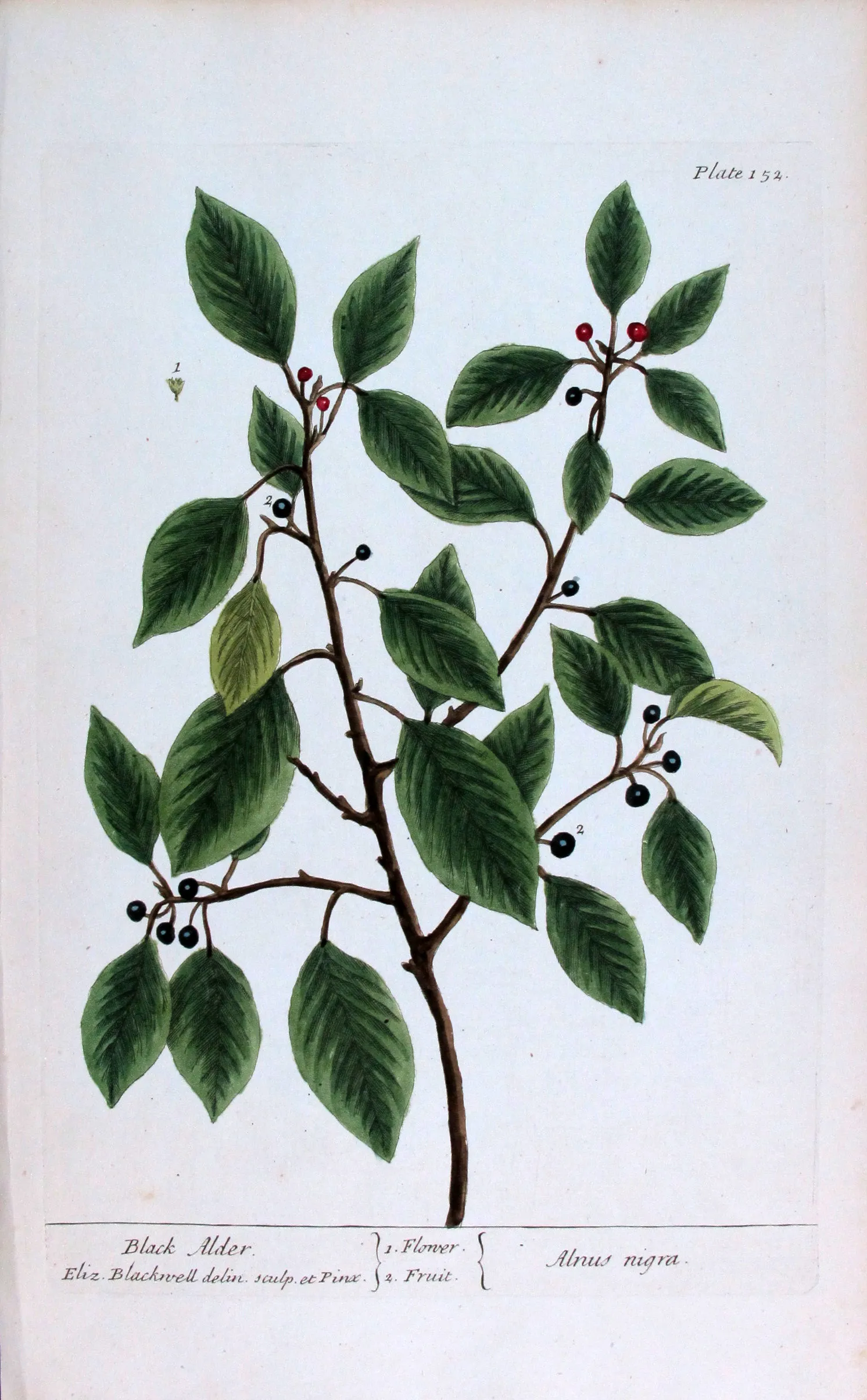

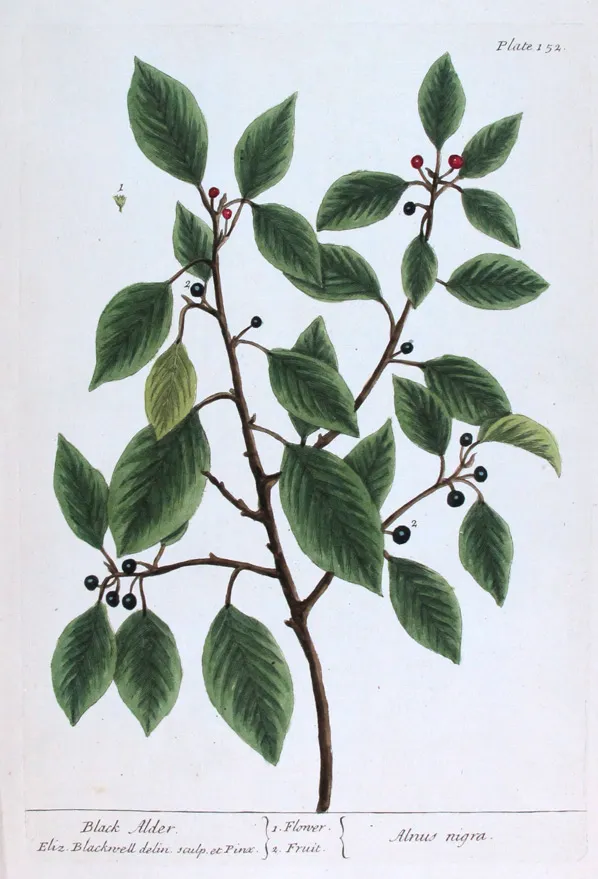
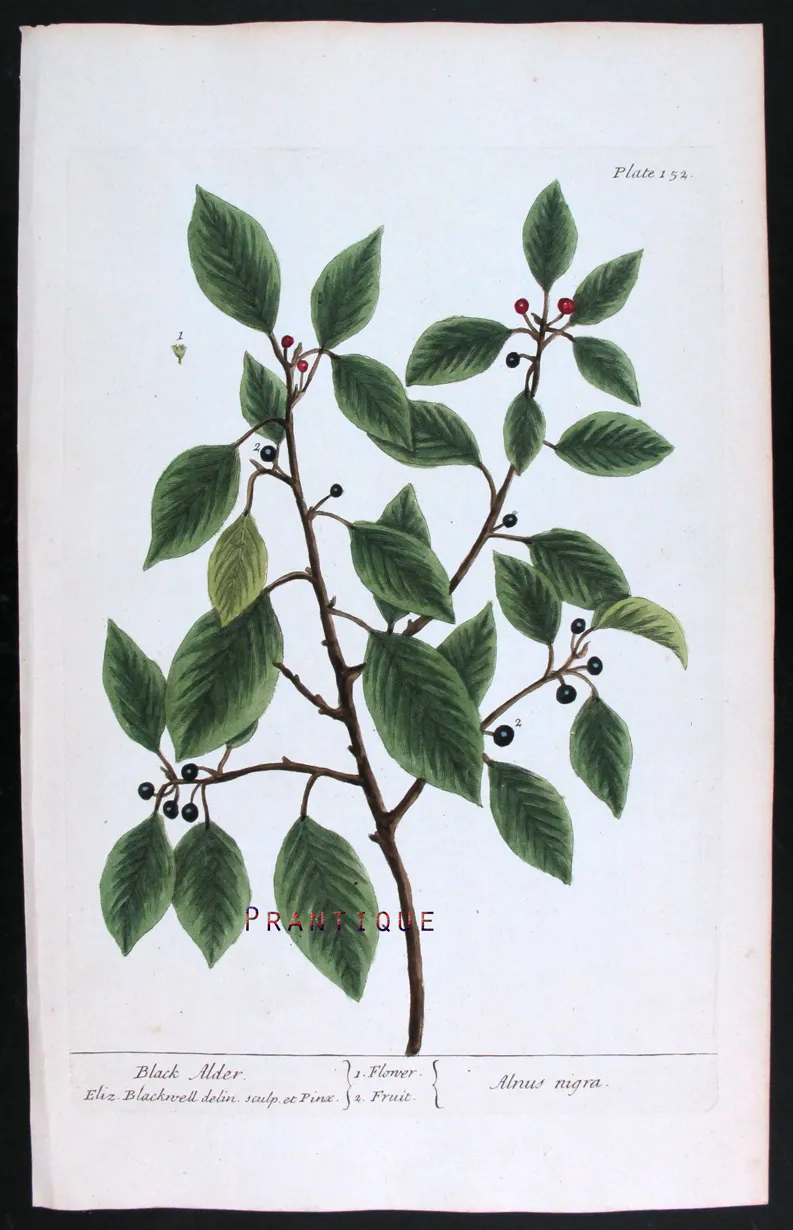


Fine engraving of Black Alder with berries and elegant branching, ideal for natural interiors.
 Delivery policy
Your print will be carefully prepared and shipped worldwide via trusted couriers (UPS or similar).
 Authentic antique prints
Original engravings from the 17th–19th century.
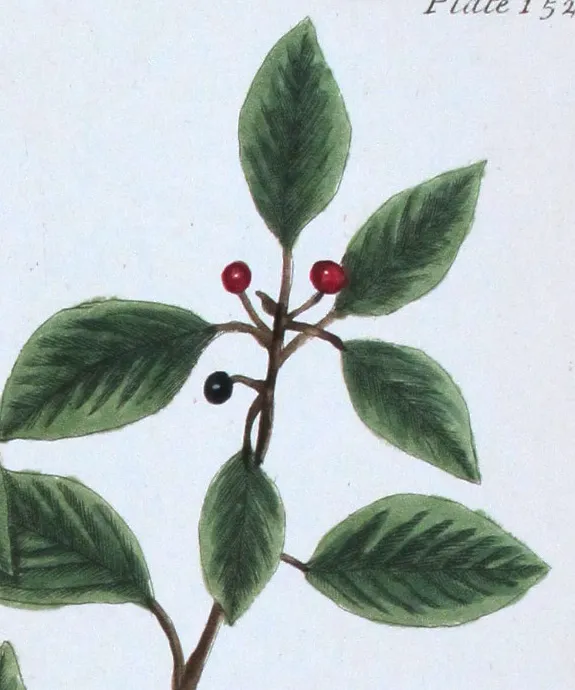
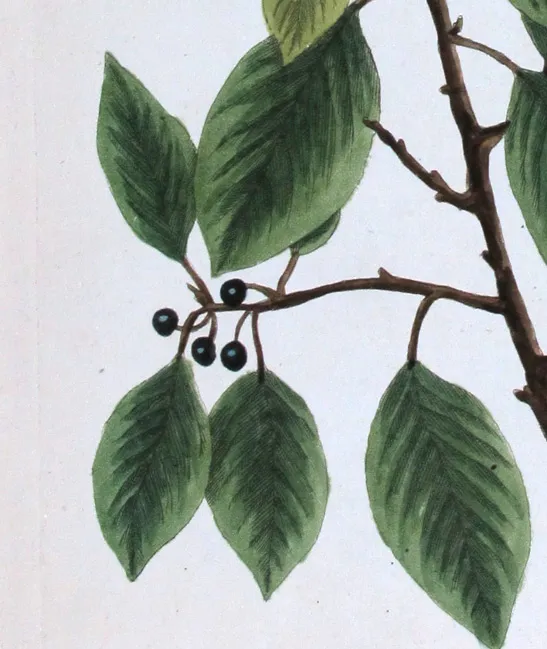
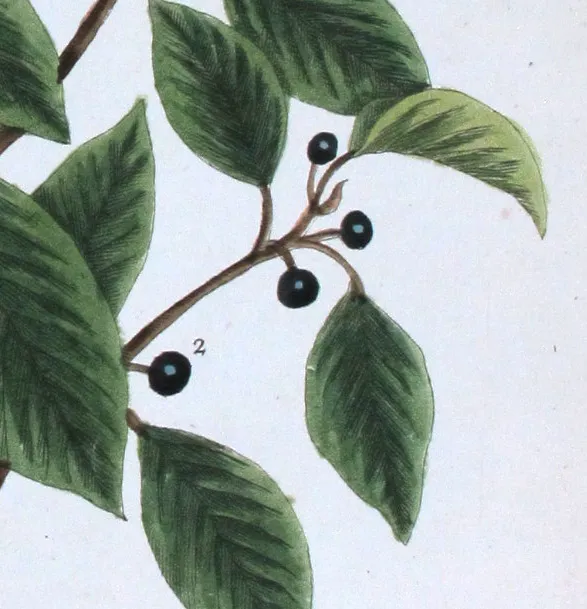
This refined botanical engraving depicts Black Alder (Alnus nigra, as recorded in the plate), presented with an elegant simplicity that highlights both botanical structure and decorative balance. A branching stem carries a rhythm of softly shaded leaves and small dark fruits, offering a clear visual account of the plant’s habit and seasonal character.
Blackwell’s hand-colouring is notably restrained and sophisticated: deep greens model the leaves with gentle tonal depth, while the dark berries punctuate the composition with measured contrast. The overall effect is calm, architectural, and remarkably modern in its minimal use of space.
Produced in the early eighteenth century, this engraving forms part of A Curious Herbal (1737–1739), a landmark botanical and medical work distinguished by the rare unity of authorship in which drawing, copper engraving, and hand-colouring were executed by Elisabeth Blackwell herself.
— • —
The composition is built around a branching, upward gesture that feels both natural and curated. Leaves are distributed in a measured cadence, creating visual fullness without heaviness, while the fruit clusters act as dark accents that sharpen the plate’s rhythm and refine its overall balance.
The generous negative space is an integral part of the aesthetic: it isolates the subject like a botanical portrait and allows each element—leaf, stem, and fruit—to remain legible at a glance. This quiet clarity gives the engraving a strong contemporary presence, particularly suited to refined interior settings.
“Black alder” appears in historic herbal literature in connection with practical household and apothecary traditions, where bark and related plant materials were frequently described for their astringent associations and everyday utility. In the world of early modern medicine, reliable identification mattered: foliage and fruiting habit could help distinguish plants that might otherwise appear similar in the landscape. Blackwell’s plate emphasizes these defining markers—leaf form, branching structure, and the presence of small dark fruits—aligning with the purpose of A Curious Herbal: to offer clear, trustworthy visual references grounded in observation and usable knowledge.
The engraving is preserved in like brand new antique condition, printed on original handmade laid paper typical of early eighteenth-century botanical publications. A period watermark is visible on the sheet, consistent with contemporary papermaking practices. The surface remains clean and stable, with a crisp impression and fresh original hand-colouring throughout. No notable defects are present. The engraved credit “Eliz. Blackwell delin. sculp. et pinx.” is fully legible, confirming that the drawing, engraving, and hand-colouring were executed by Elisabeth Blackwell herself.
For further context on Elisabeth Blackwell and the singular unity of authorship behind A Curious Herbal, see our editorial feature:
Specific References
18th-century hand-colored engraving of a Garden Cucumber by Elisabeth Blackwell, with curling tendrils and yellow blossoms.
Delicate engraving of Madder with berries and exposed roots, ideal for refined botanical décor.
Lively Hawthorn branch with crisp green leaves and clusters of rich red berries, a classic countryside motif for warm, welcoming interiors.
Fine 18th-century hand-colored engraving of Euphorbium by Elisabeth Blackwell, a striking botanical study ideal for collectors.
A graceful hand-colored engraving of Marshmallow (Althaea officinalis) with soft pink flowers and expressive root study.
Fine 18th-century engraving of the Medlar Tree by Elisabeth Blackwell, featuring fruit, blossom, and botanical detail.
Elegant olive branches with vivid green leaves and fruit in subtle yellow tones.
Fine 18th-century botanical of the Wild Pine, with graceful hanging cones and delicate needles ideal for woodland-themed interiors and natural history walls.
Dramatic lichen plate with sculptural fronds and rocky support, perfect for collectors who love unusual, textural natural history subjects.
A dynamic pine composition with cones, needles, and golden pollen clusters.
Elegant pink-white blossoms with upright stems and finely shaped leaves, a graceful 18th?century botanical.
Hand-colored 18th-century engraving of Yellow Asphodel, a vivid botanical composition from Elisabeth Blackwells A Curious Herbal.
19th-century hand-colored engraving of Water Calamint, with delicate pink blooms and fine botanical details.
Elegant botanical engraving of the Bean plant with pods and seed details.
Hand-colored 18th-century engraving of the Sweet Cistus of Candy, a graceful botanical plate by Elisabeth Blackwell.
18th-century hand-colored engraving of the Wilding or Crab Tree by Elisabeth Blackwell, with blossom and fruit details.
Graceful vertical stem with rounded leaves and yellow blossoms, paired with a prominent root study.
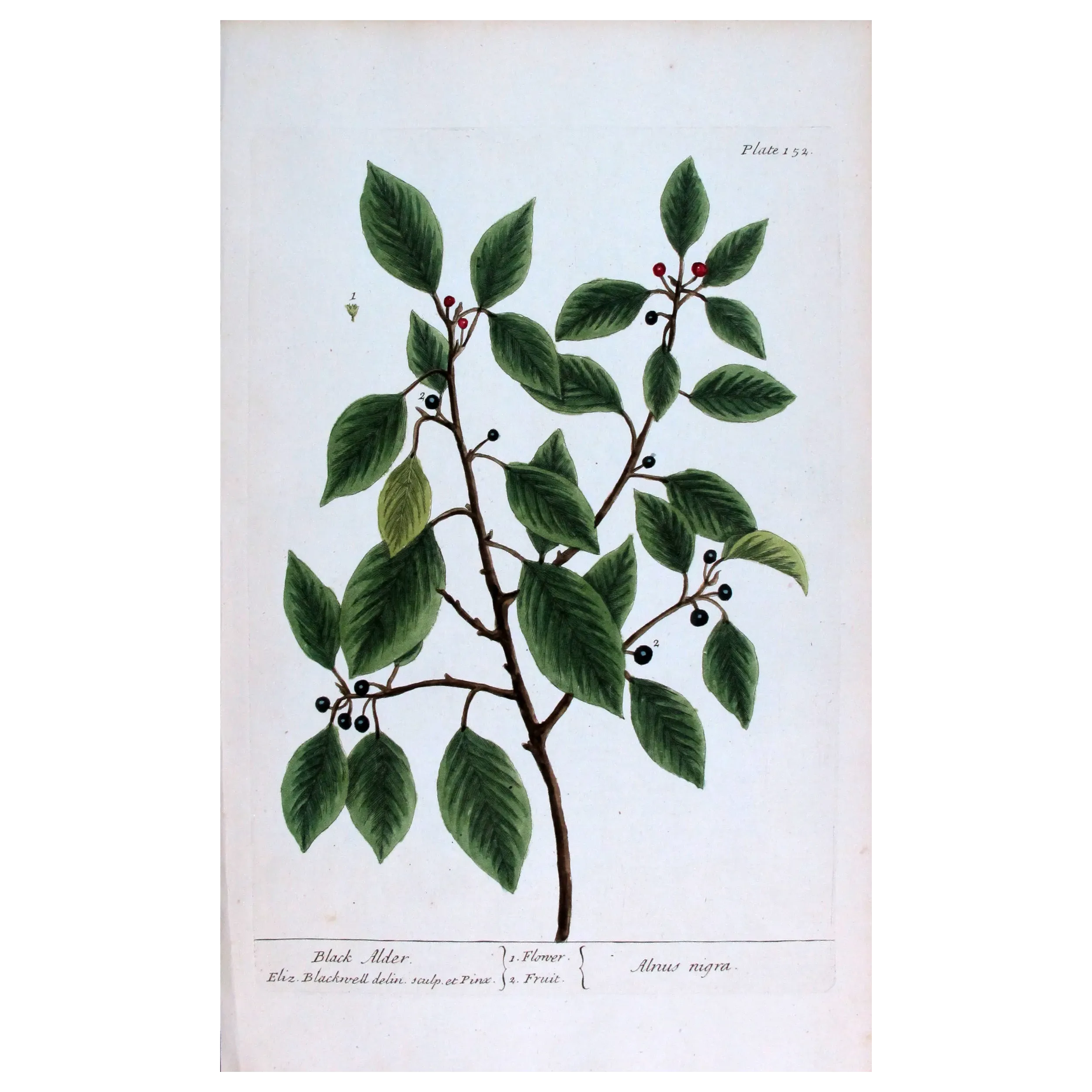
Fine engraving of Black Alder with berries and elegant branching, ideal for natural interiors.


