

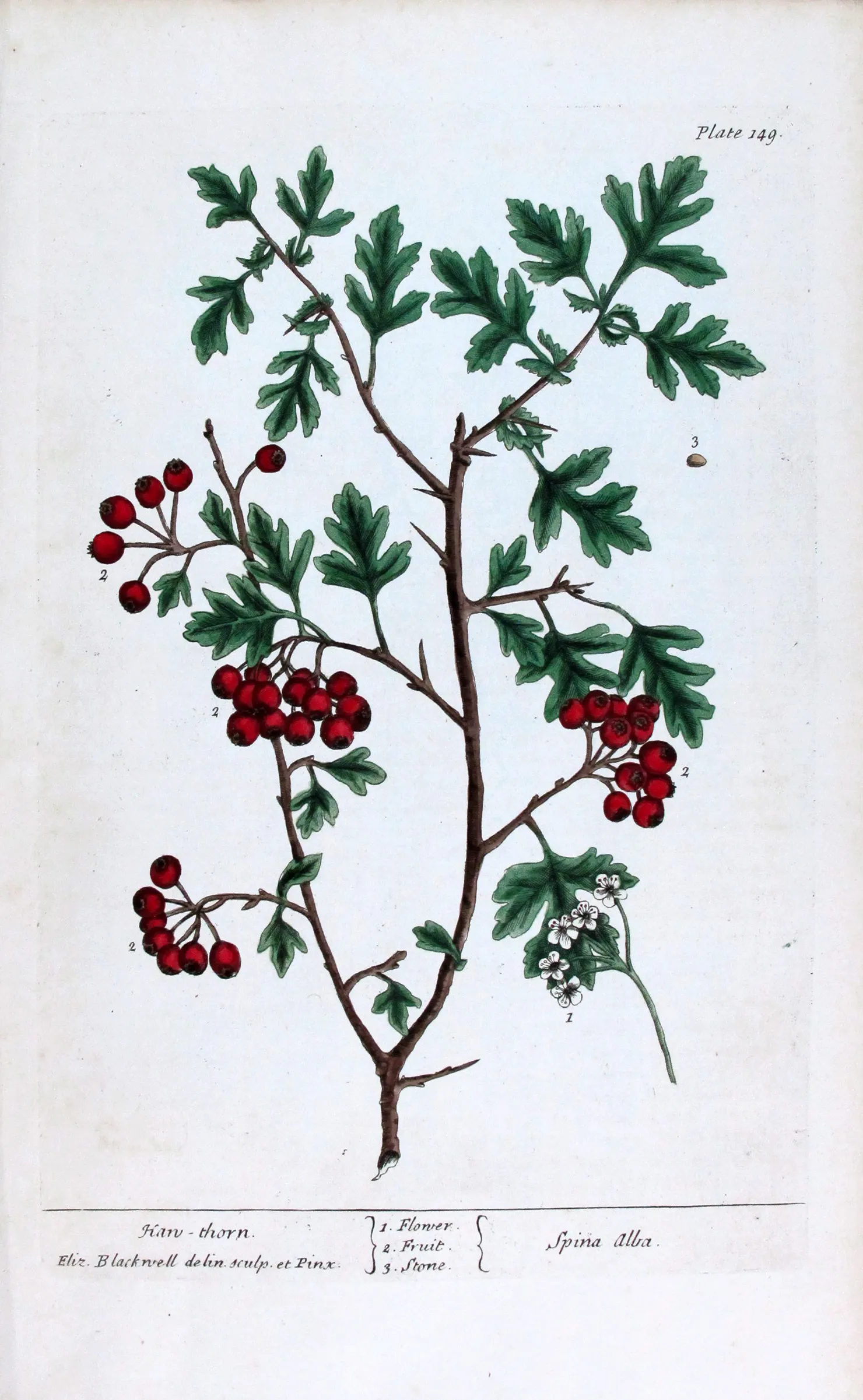
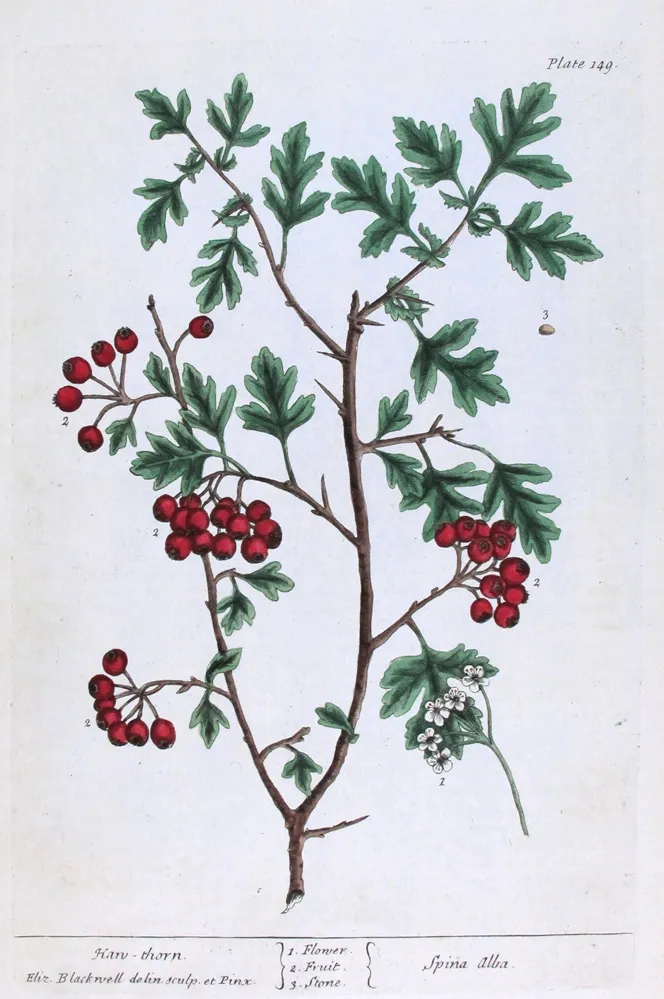
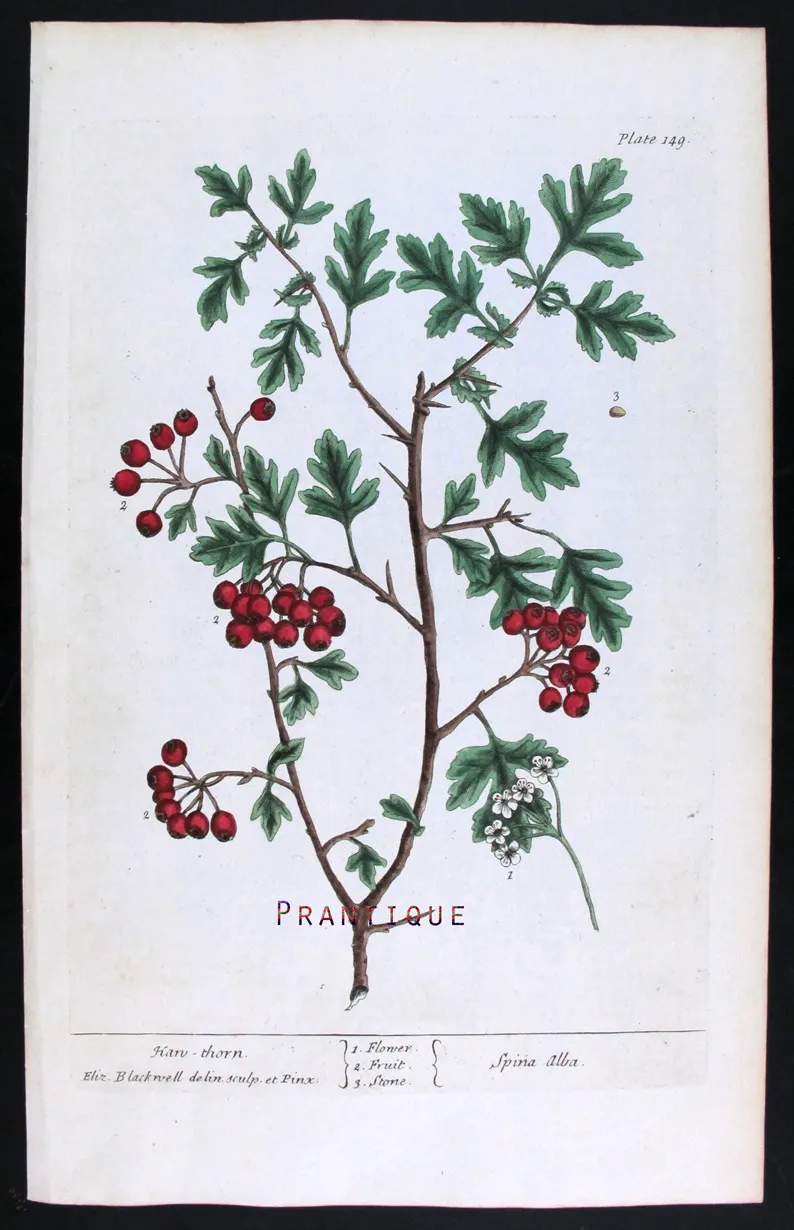


Lively Hawthorn branch with crisp green leaves and clusters of rich red berries, a classic countryside motif for warm, welcoming interiors.
 Delivery policy
Your print will be carefully prepared and shipped worldwide via trusted couriers (UPS or similar).
 Authentic antique prints
Original engravings from the 17th–19th century.
This refined botanical engraving depicts Hawthorn (Crataegus monogyna), presenting a branching specimen with lobed leaves, clustered fruit, and flowering details arranged for clear botanical identification.
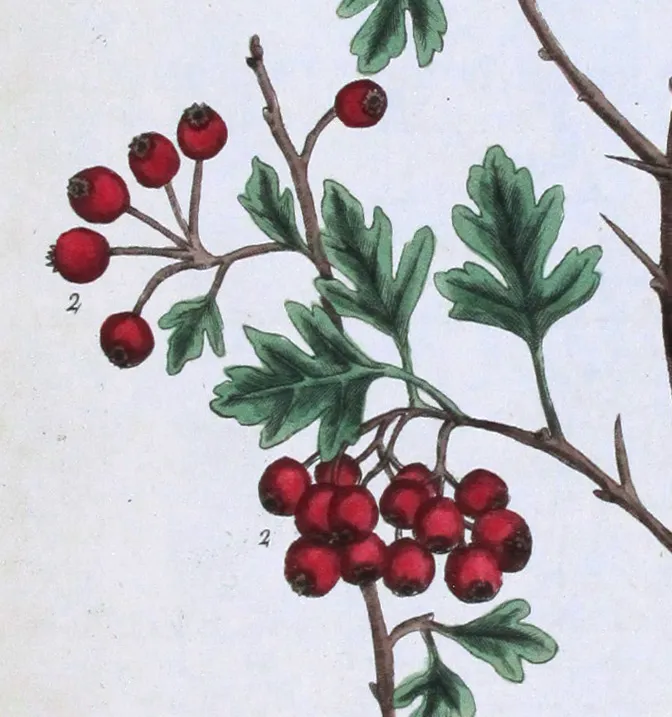
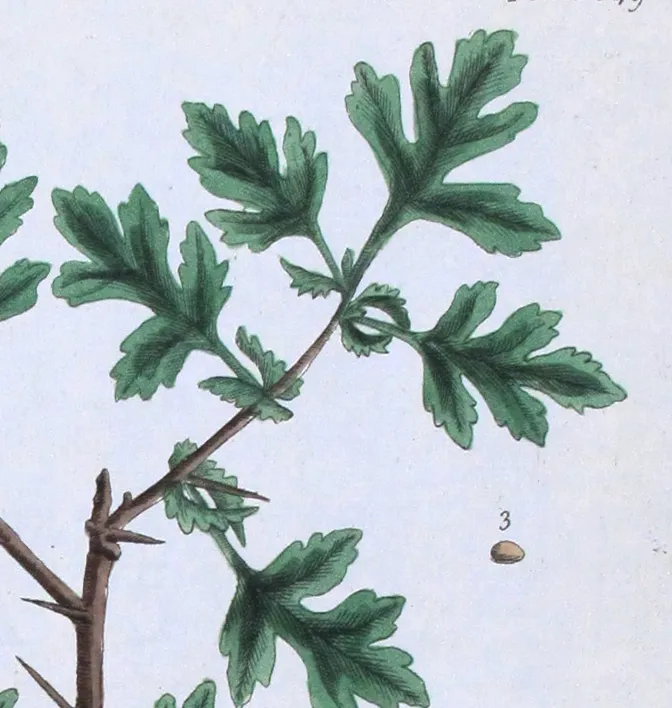
The plant is rendered with a natural, slightly irregular structure, its thorny branches supporting dense clusters of bright red fruit. Elisabeth Blackwell’s careful observation emphasizes both leaf form and berry structure, allowing the species to be recognized at a glance while maintaining compositional balance.
Created in the early eighteenth century, this plate belongs to A Curious Herbal, a foundational medical and botanical work distinguished by the unity of its production, in which drawing, copper engraving, and hand-colouring were executed by the same hand.
— • —
The composition develops through an upright central branch, from which secondary stems extend with gentle asymmetry. Rounded clusters of fruit act as visual anchors, contrasting with the angular rhythm of the lobed leaves and the linear tension introduced by the thorns.
A restrained palette of greens and reds introduces clarity without excess ornament. Subtle tonal variation models the leaves and berries with depth, reinforcing the engraving’s balance between scientific description and quiet decorative restraint.
Hawthorn—often referred to in early herbals as Spina alba—was a familiar native plant across much of Europe, commonly forming hedgerows and boundary markers. In medical tradition it was valued for the flowers and fruit, which were associated with strengthening and regulating properties, particularly in relation to the heart and circulation. Because hawthorn’s therapeutic use depended on the correct stage of harvest, accurate visual recognition of leaves, blossoms, and berries was essential. Its inclusion in A Curious Herbal reflects the importance of documenting everyday medicinal plants whose value lay not in rarity, but in reliable seasonal identification and practical domestic use.
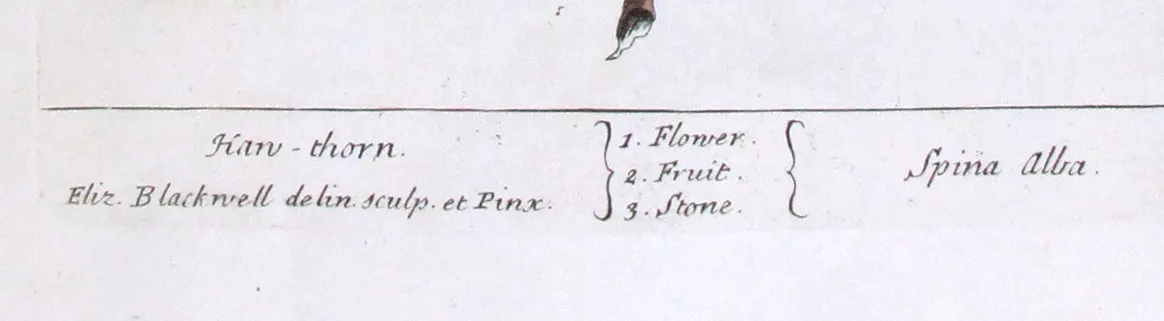
The engraving is in exceptionally fine antique condition, printed on original handmade laid paper typical of early 18th-century botanical publications. A period watermark is visible on the sheet, consistent with contemporary papermaking practices. The surface remains fresh and stable, with light, even age-related toning consistent with period paper. The impression is crisp and legible throughout, with well-preserved margins. The engraved credit “Eliz. Blackwell delin. sculp. et pinx.” is present and fully legible, confirming the unified authorship of the plate.
For further context on Elisabeth Blackwell and the unified authorship behind A Curious Herbal, see our editorial feature:
Specific References
Delicate pea stems with curling tendrils and soft green pods, elegantly hand-colored.
Elegant botanical engraving of Great Figwort (Scrophularia major) with branching stems, clustered flowers and root detail.
Light, airy branching with soft yellow flowers and delicately cut bluish-green foliage.
Elegant olive branches with vivid green leaves and fruit in subtle yellow tones.
18th-century hand-colored engraving of Rhapontic with broad leaves and sculptural root, ideal for botanical décor.
Lively 18th-century engraving of Polypody of the Oak by Elizabeth Blackwell, showing rhythmic fern fronds and creeping rhizomes, perfect for naturalist or woodland-themed decor.
Dramatic lichen plate with sculptural fronds and rocky support, perfect for collectors who love unusual, textural natural history subjects.
Elegant Silver Fir with upright cones and finely spaced needles, a refined forest motif for sophisticated interiors and collectors of conifer imagery.
19th-century hand-colored engraving of Water Calamint, with delicate pink blooms and fine botanical details.
Elegant 18th-century hand-colored engraving of the Male Fern by Elizabeth Blackwell, with finely shaded fronds ideal for nature-inspired walls or botanical galleries.
Hand-colored 18th-century engraving of the Sweet Cistus of Candy, a graceful botanical plate by Elisabeth Blackwell.
Elegant pink-white blossoms with upright stems and finely shaped leaves, a graceful 18th?century botanical.
Graceful engraving of Wheat varieties with seed details, ideal for rustic décor.
Fine 18th-century hand-colored engraving of Euphorbium by Elisabeth Blackwell, a striking botanical study ideal for collectors.
Refined 18th-century engraving of Mountain Calamint by Elizabeth Blackwell, with upright stems and pink blossoms, ideal for calm, herbal or cottage-inspired interiors.
Graceful vertical stem with rounded leaves and yellow blossoms, paired with a prominent root study.
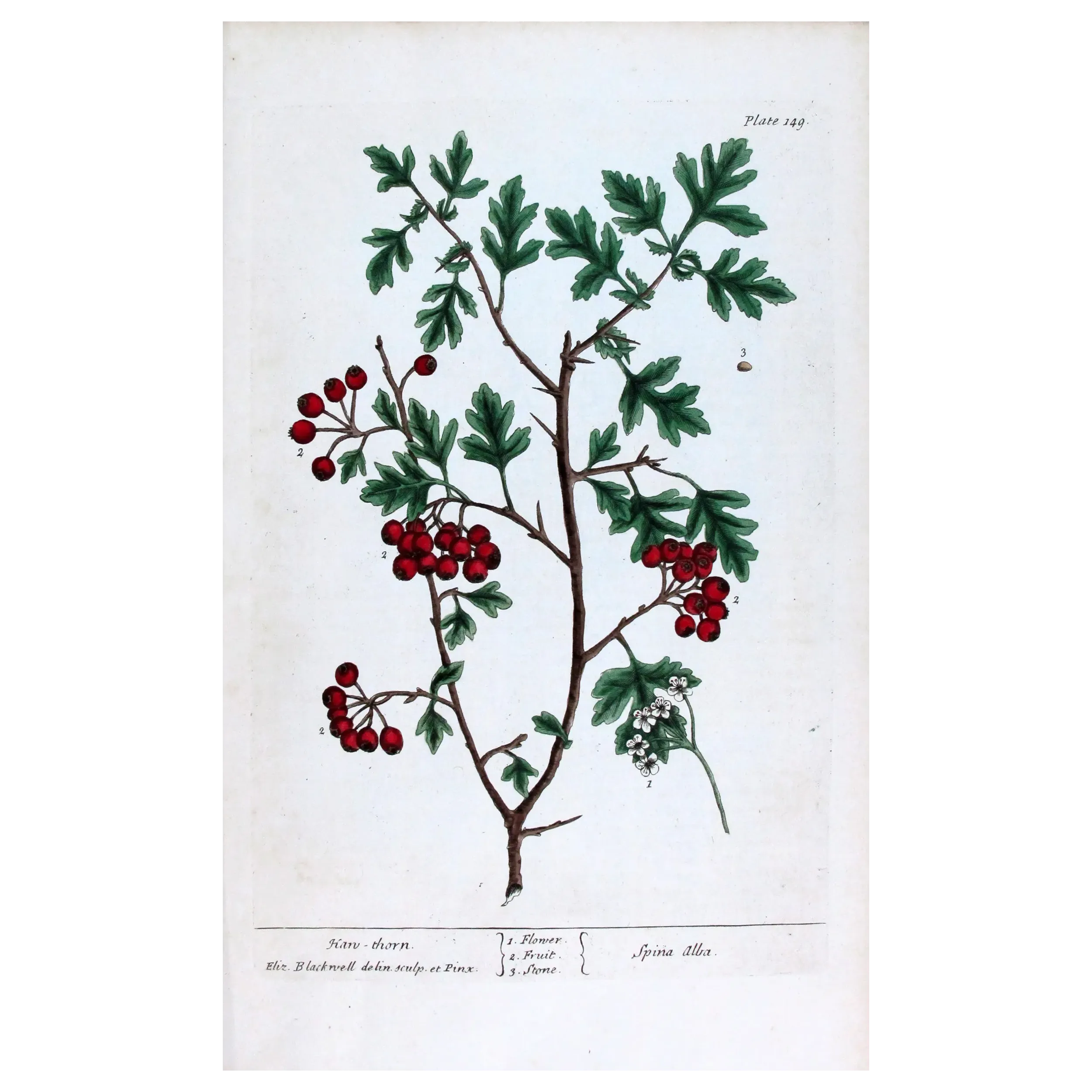
Lively Hawthorn branch with crisp green leaves and clusters of rich red berries, a classic countryside motif for warm, welcoming interiors.


