

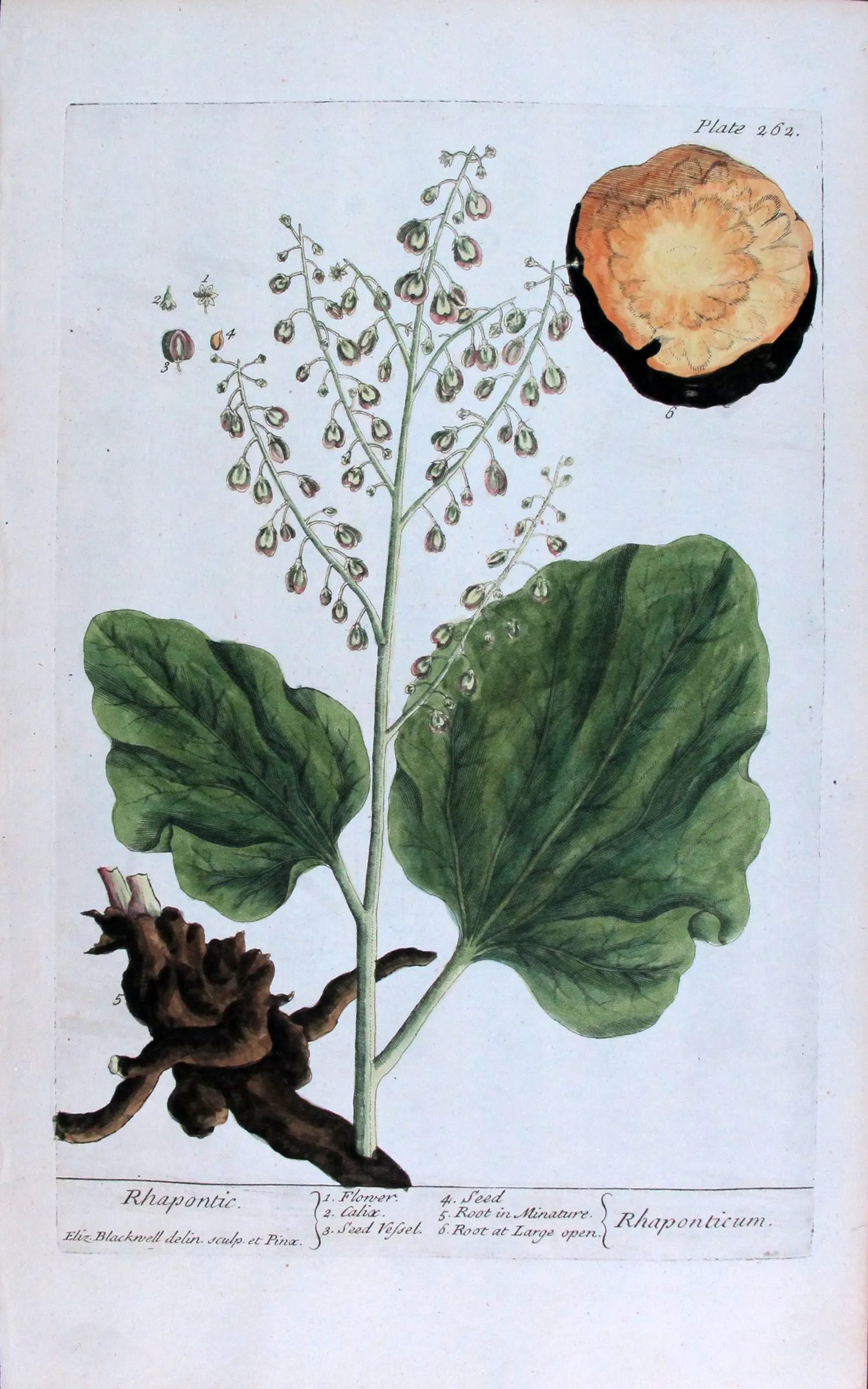

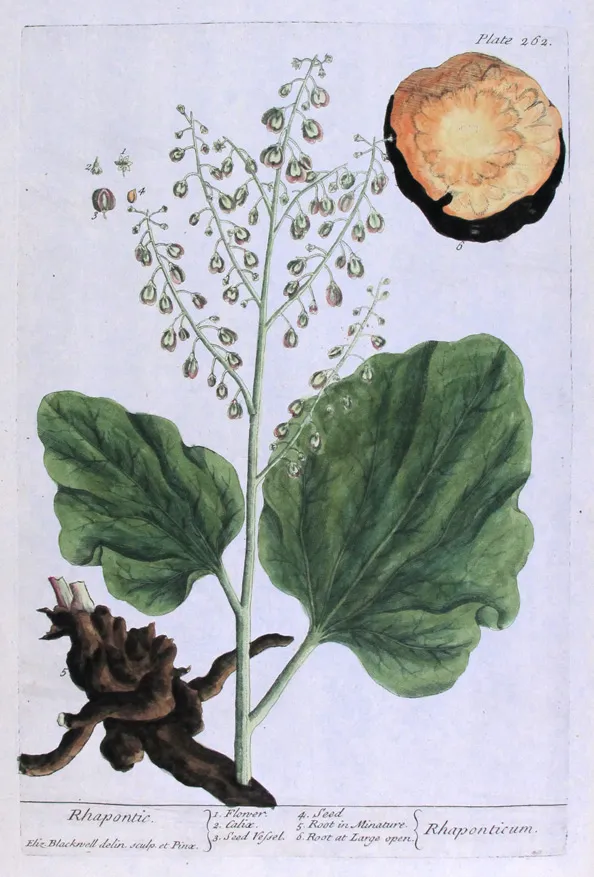
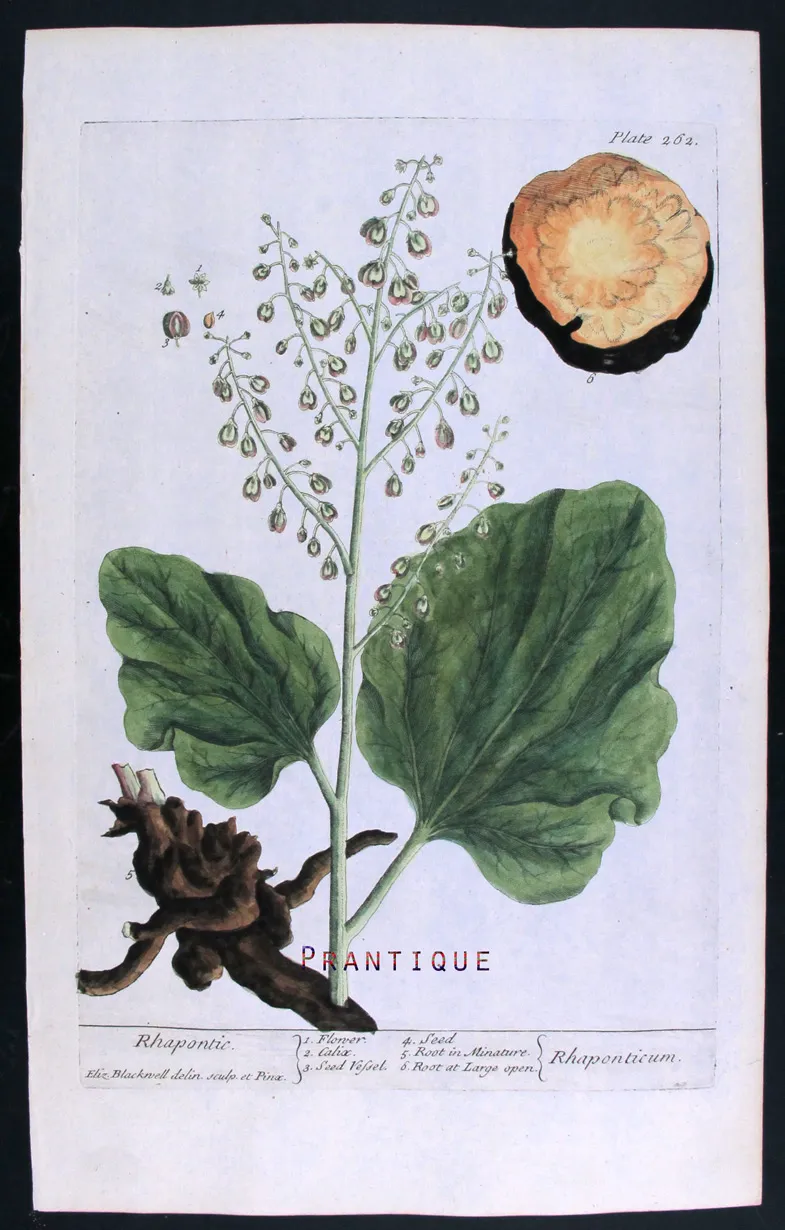


18th-century hand-colored engraving of Rhapontic with broad leaves and sculptural root, ideal for botanical décor.
 Delivery policy
Your print will be carefully prepared and shipped worldwide via trusted couriers (UPS or similar).
 Authentic antique prints
Original engravings from the 17th–19th century.
This powerful botanical engraving depicts Rhapontic (Rheum rhaponticum), presented with exceptional clarity and dramatic presence. The plate combines the plant’s broad leaf structure, fine flowering stems, and an imposing root study, offering a complete and authoritative portrait of a historically significant medicinal botanical.
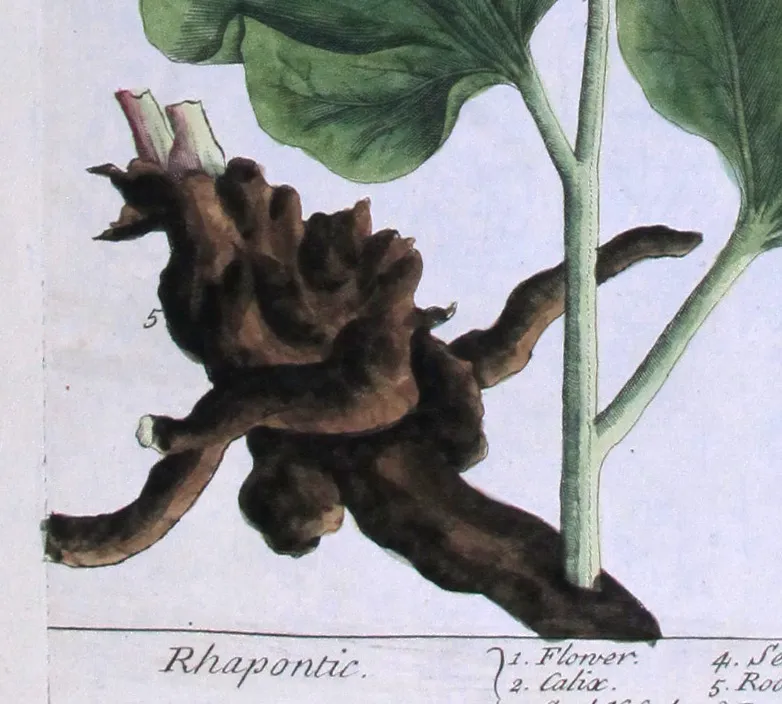
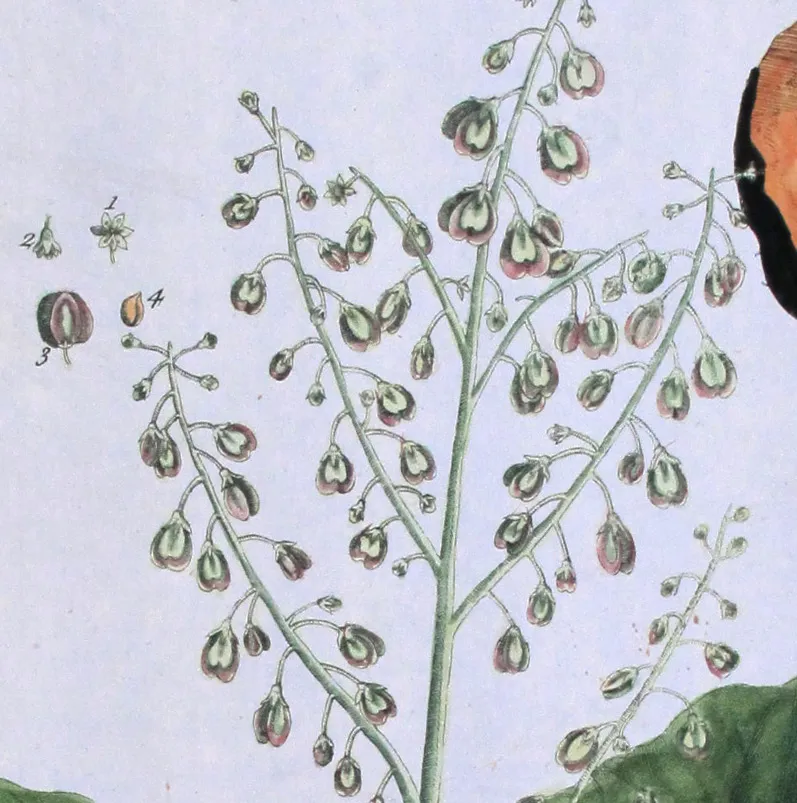
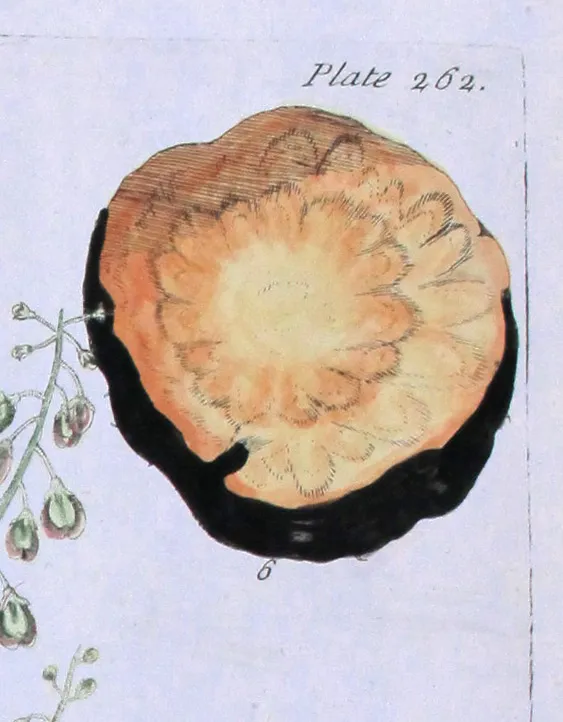
Two expansive, richly shaded leaves establish the composition’s sculptural weight, while the tall central stem carries delicate branching clusters of small pendulous blossoms. At the base, the root is rendered with striking realism, and an additional cross-sectional view reveals the interior structure—an analytical detail that signals the plate’s practical purpose and elevates its visual narrative.
Produced in the early eighteenth century, this engraving forms part of A Curious Herbal (1737–1739), a landmark botanical and medical work distinguished by the rare unity of authorship in which drawing, copper engraving, and hand-colouring were executed by Elisabeth Blackwell herself.
— • —
The composition is built around a calm vertical axis that rises from a grounded base into an airy floral crown. The enlarged leaves introduce monumental scale and a deep tonal range, creating a refined interplay of mass and negative space. Their broad planes read almost like drapery, giving the plate a distinctly architectural elegance.
The root element provides dramatic counterbalance and historical gravitas: its dark, sculptural form anchors the lower register, while the separate cut view adds a striking focal accent. Together, these features create an engraving that feels both scientifically purposeful and visually commanding—an object that holds its presence in a room as much as it informs.
Rhapontic, associated with the rhubarb family (Rheum), held an important place in early modern pharmacopeias, where roots were often treated as key medicinal materials. In eighteenth-century household and apothecary practice, correct identification of roots mattered as much as the above-ground habit, because preparation and dosage relied on reliable botanical recognition. Blackwell’s emphasis on the root—shown both as a complete form and in cross-section—reflects this practical need and signals the engraving’s function as a trustworthy reference. Within A Curious Herbal, subjects like rhapontic embody the book’s distinctive ambition: to document plants not as idealized ornaments, but as usable, observable materials within the medical culture of its time.
The engraving is preserved in like brand new antique condition, printed on original handmade laid paper typical of early eighteenth-century botanical publications. A period watermark is visible on the sheet, consistent with contemporary papermaking practices. The surface remains clean and stable, with a crisp impression and fresh original hand-colouring throughout. No notable defects are present. The engraved credit “Eliz. Blackwell delin. sculp. et pinx.” is fully legible, confirming that the drawing, engraving, and hand-colouring were executed by Elisabeth Blackwell herself.
For further context on Elisabeth Blackwell and the singular unity of authorship behind A Curious Herbal, see our editorial feature:
Specific References
Striking palm fronds paired with warm golden dates, a highly decorative composition.
Elegant olive branches with vivid green leaves and fruit in subtle yellow tones.
Hand-colored 18th-century engraving of the Sweet Cistus of Candy, a graceful botanical plate by Elisabeth Blackwell.
Graceful 18th-century botanical engraving of the Female Fern by Elizabeth Blackwell, with airy fronds and exposed root, beautiful in minimalist or nature-focused spaces.
Elegant botanical engraving of the Bean plant with pods and seed details.
Fine 18th-century botanical of the Wild Pine, with graceful hanging cones and delicate needles ideal for woodland-themed interiors and natural history walls.
Dramatic lichen plate with sculptural fronds and rocky support, perfect for collectors who love unusual, textural natural history subjects.
Fine engraving of Black Alder with berries and elegant branching, ideal for natural interiors.
Refined 18th-century engraving of Mountain Calamint by Elizabeth Blackwell, with upright stems and pink blossoms, ideal for calm, herbal or cottage-inspired interiors.
Delicate pea stems with curling tendrils and soft green pods, elegantly hand-colored.
Original 18th-century engraving of the Wild Cucumber by Elisabeth Blackwell, with spined fruit and yellow flowers.
Fine 18th-century engraving of the Medlar Tree by Elisabeth Blackwell, featuring fruit, blossom, and botanical detail.
Broad heart-shaped leaves with yellow tubular blooms, beautifully rendered in subtle tones.
Elegant 18th-century hand-colored engraving of the Male Fern by Elizabeth Blackwell, with finely shaded fronds ideal for nature-inspired walls or botanical galleries.
Light, airy branching with soft yellow flowers and delicately cut bluish-green foliage.
Charming 18th-century engraving of Sage by Elizabeth Blackwell, with blue-green leaves and delicate flowers, perfect for kitchen walls or herb-themed gallery displays.
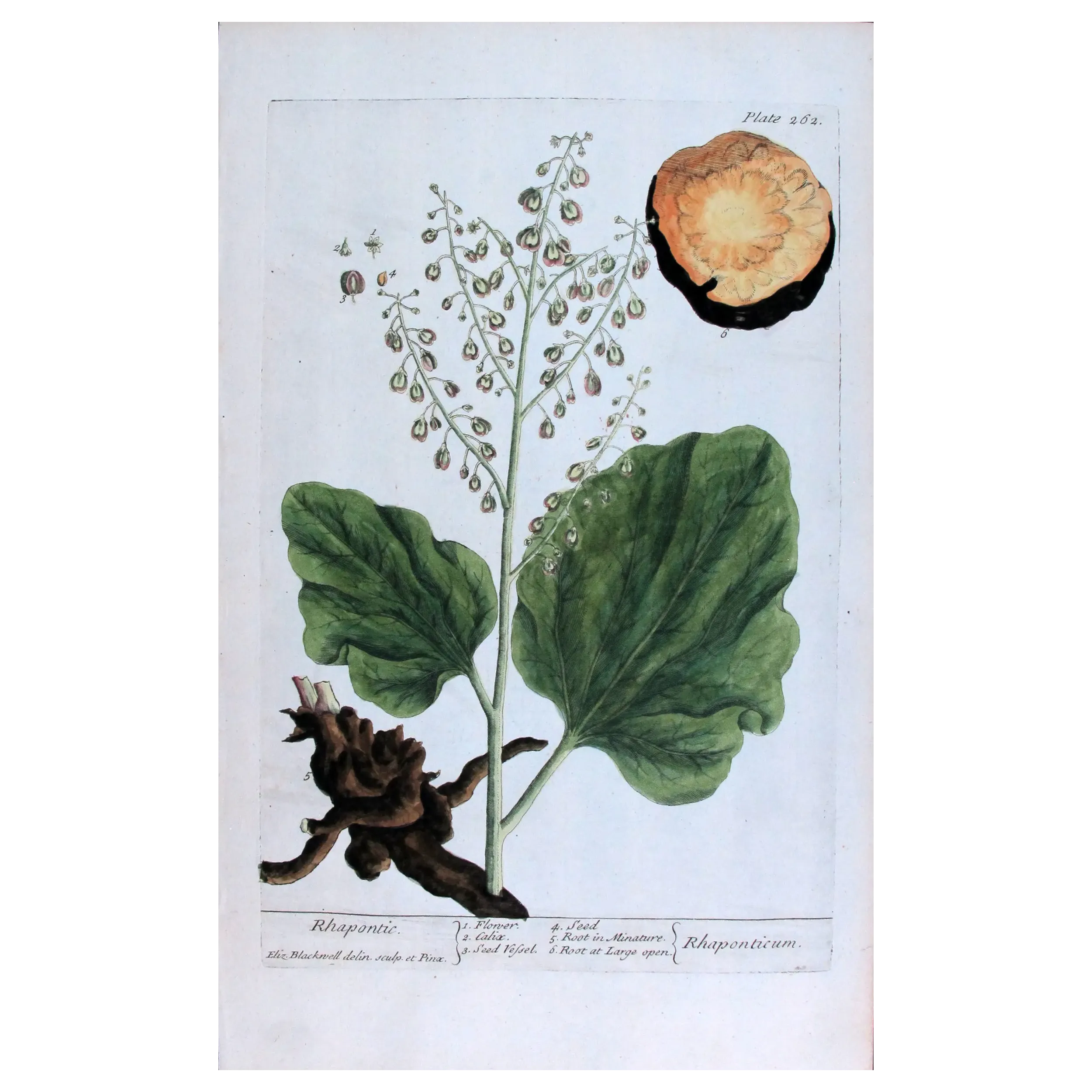
18th-century hand-colored engraving of Rhapontic with broad leaves and sculptural root, ideal for botanical décor.


