

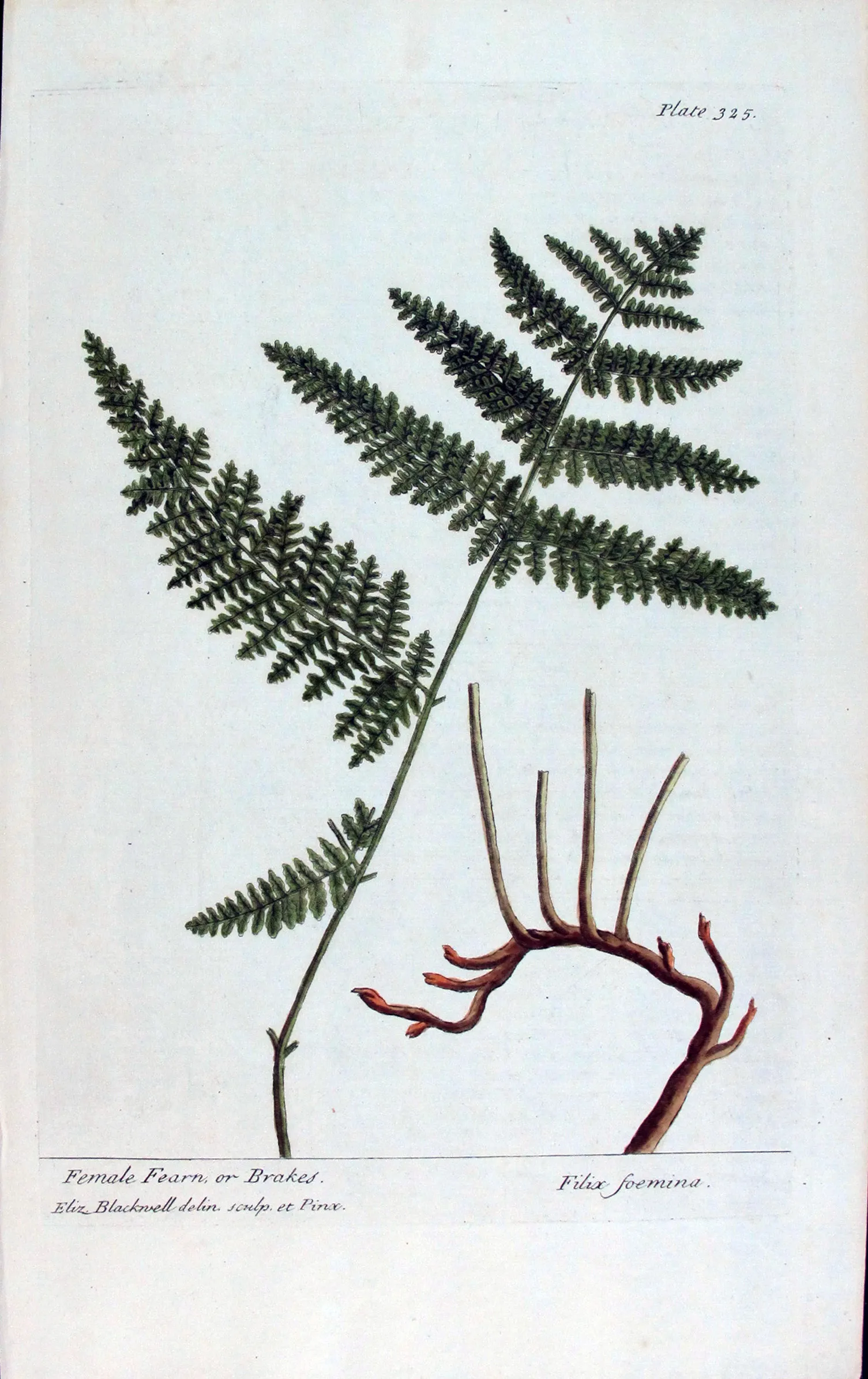
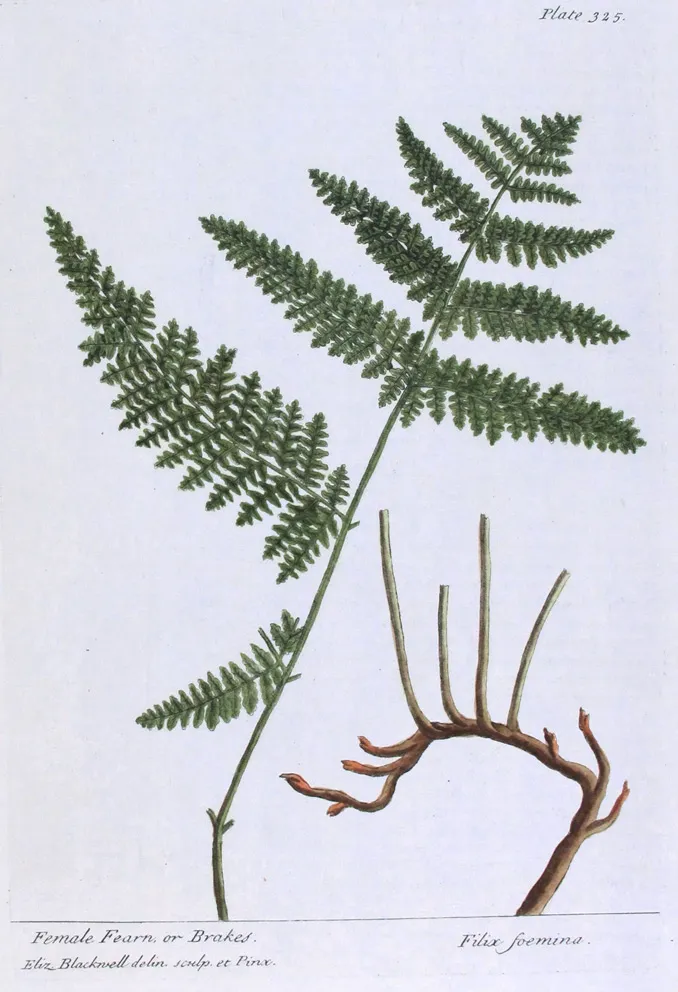

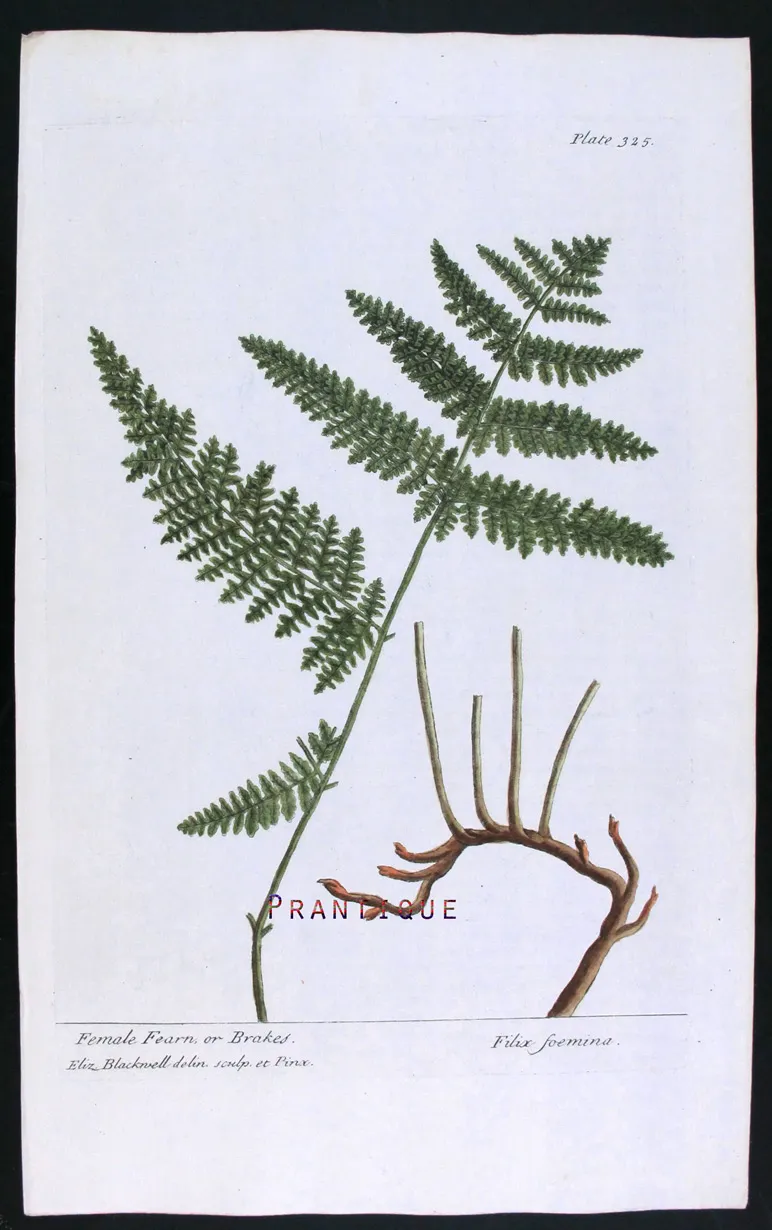


Graceful 18th-century botanical engraving of the Female Fern by Elizabeth Blackwell, with airy fronds and exposed root, beautiful in minimalist or nature-focused spaces.
 Delivery policy
Your print will be carefully prepared and shipped worldwide via trusted couriers (UPS or similar).
 Authentic antique prints
Original engravings from the 17th–19th century.
This refined botanical engraving depicts the Female Fern, also known as Brakes (Athyrium filix-femina), presenting a mature frond accompanied by a detailed view of the rootstock for accurate botanical identification.
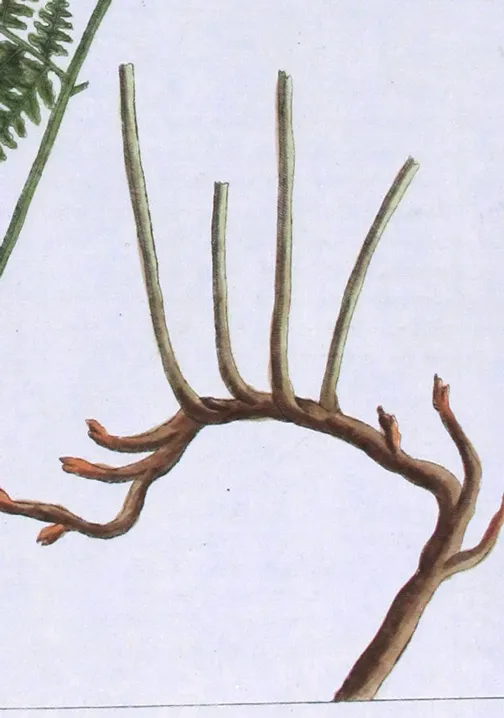
The frond is rendered with a lighter, more delicate structure than that of the male fern, its finely divided leaflets arranged along a gently arching stem. Elisabeth Blackwell emphasizes contrast between foliage and root by isolating the rhizome, allowing the plant’s full form and growth habit to be read with clarity.
Produced in the early eighteenth century, this plate forms part of A Curious Herbal, a work that systematically documented medicinal plants and ferns at a time when accurate visual representation was essential for practical medical use.
— • —
The composition is structured around a tall, tapering frond whose finely cut pinnae create a sense of lightness and movement. Compared to other fern species, the overall effect is softer and more open, with less visual density and a more graceful rhythm.
Restrained hand-colouring highlights texture and form rather than decorative colour. Subtle green tonal shifts articulate the leaf surfaces, while the warmer browns of the rhizome provide contrast and visual grounding.
The female fern—historically referred to as Filix foemina—was distinguished from the male fern in early European medicine by both its appearance and its perceived medicinal properties. While generally considered milder, it was employed in preparations associated with cleansing and digestive regulation. As with other ferns, correct identification relied on frond structure, division of the leaflets, and root form rather than flowers. Blackwell’s plate reflects this diagnostic approach, presenting the plant in a manner suited to comparison and practical reference within medical herbals.
The engraving is in exceptionally fine antique condition, printed on original handmade laid paper typical of early 18th-century botanical publications. A period watermark is visible on the sheet, consistent with contemporary papermaking practices. The surface remains fresh and stable, with light, even age-related toning. The impression is crisp and well defined, with clear hand-colouring and intact engraved inscriptions, including the artist’s credit “Eliz. Blackwell delin. sculp. et pinx.”
For further context on Elisabeth Blackwell and the medical role of ferns in A Curious Herbal, see our editorial feature:
Specific References
Hand-colored engraving of Water Figwort (Scrophularia aquatica), featuring vertical stems, red blossoms and a caterpillar study.
Charming 18th-century engraving of Sage by Elizabeth Blackwell, with blue-green leaves and delicate flowers, perfect for kitchen walls or herb-themed gallery displays.
Striking composition of the Pitch Tree with tall central stem and large cones, bringing strong graphic presence to botanical displays or rustic interiors.
Broad heart-shaped leaves with yellow tubular blooms, beautifully rendered in subtle tones.
18th-century hand-colored engraving of the Wilding or Crab Tree by Elisabeth Blackwell, with blossom and fruit details.
Hand-colored 18th-century engraving of Yellow Asphodel, a vivid botanical composition from Elisabeth Blackwells A Curious Herbal.
Fine 18th-century botanical of the Wild Pine, with graceful hanging cones and delicate needles ideal for woodland-themed interiors and natural history walls.
Hand-colored 18th-century engraving of the Sweet Cistus of Candy, a graceful botanical plate by Elisabeth Blackwell.
Graceful vertical stem with rounded leaves and yellow blossoms, paired with a prominent root study.
Elegant botanical engraving of Great Figwort (Scrophularia major) with branching stems, clustered flowers and root detail.
18th-century hand-colored engraving of the Almond Tree by Elisabeth Blackwell, with blossom, fruit and kernel beautifully rendered.
18th-century hand-colored engraving of a Garden Cucumber by Elisabeth Blackwell, with curling tendrils and yellow blossoms.
Fine engraving of Great Centaury (Centaurium majus) with pinkish florets, slender stems, and a butterfly study.
Delicate engraving of Madder with berries and exposed roots, ideal for refined botanical décor.
A dynamic pine composition with cones, needles, and golden pollen clusters.
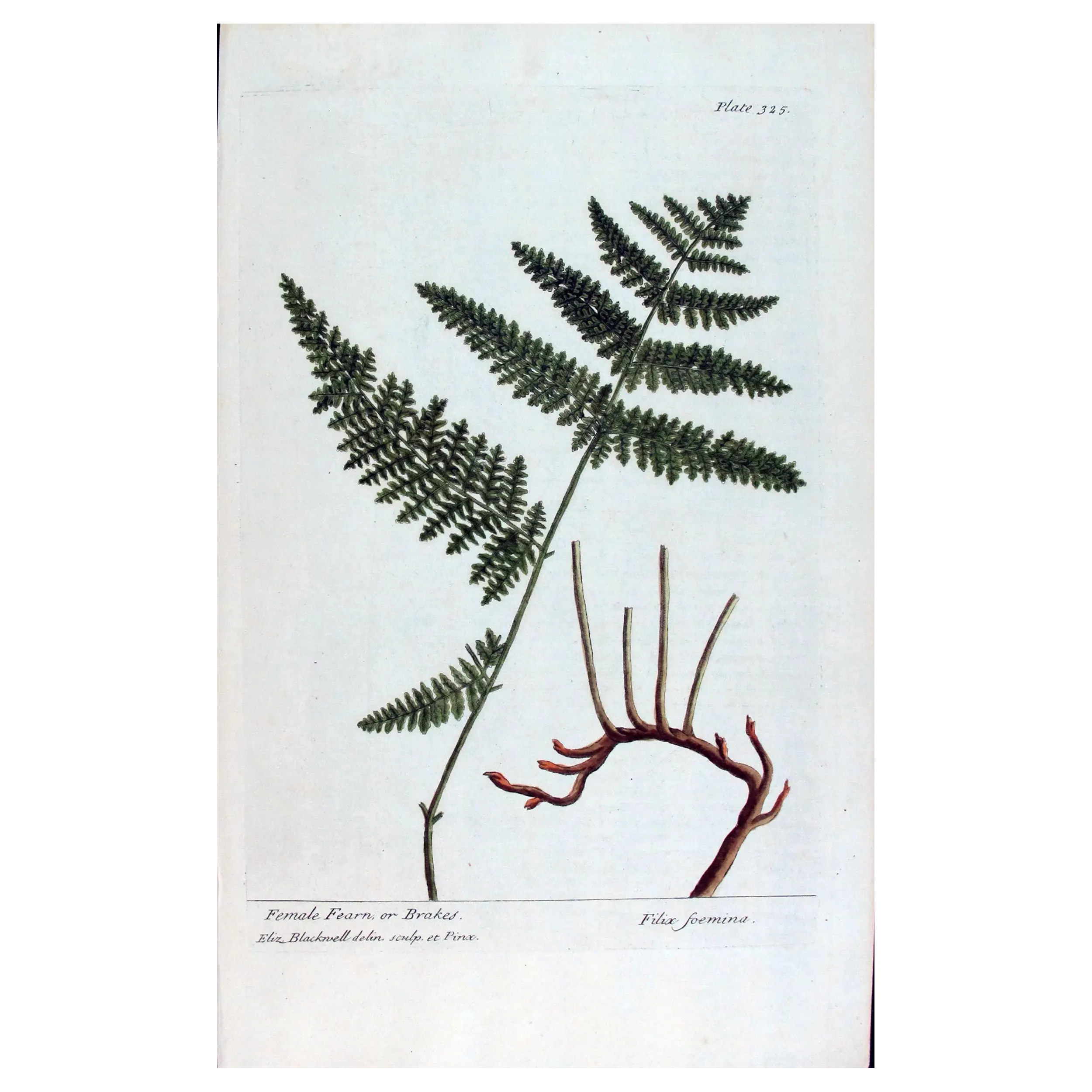
Graceful 18th-century botanical engraving of the Female Fern by Elizabeth Blackwell, with airy fronds and exposed root, beautiful in minimalist or nature-focused spaces.


