

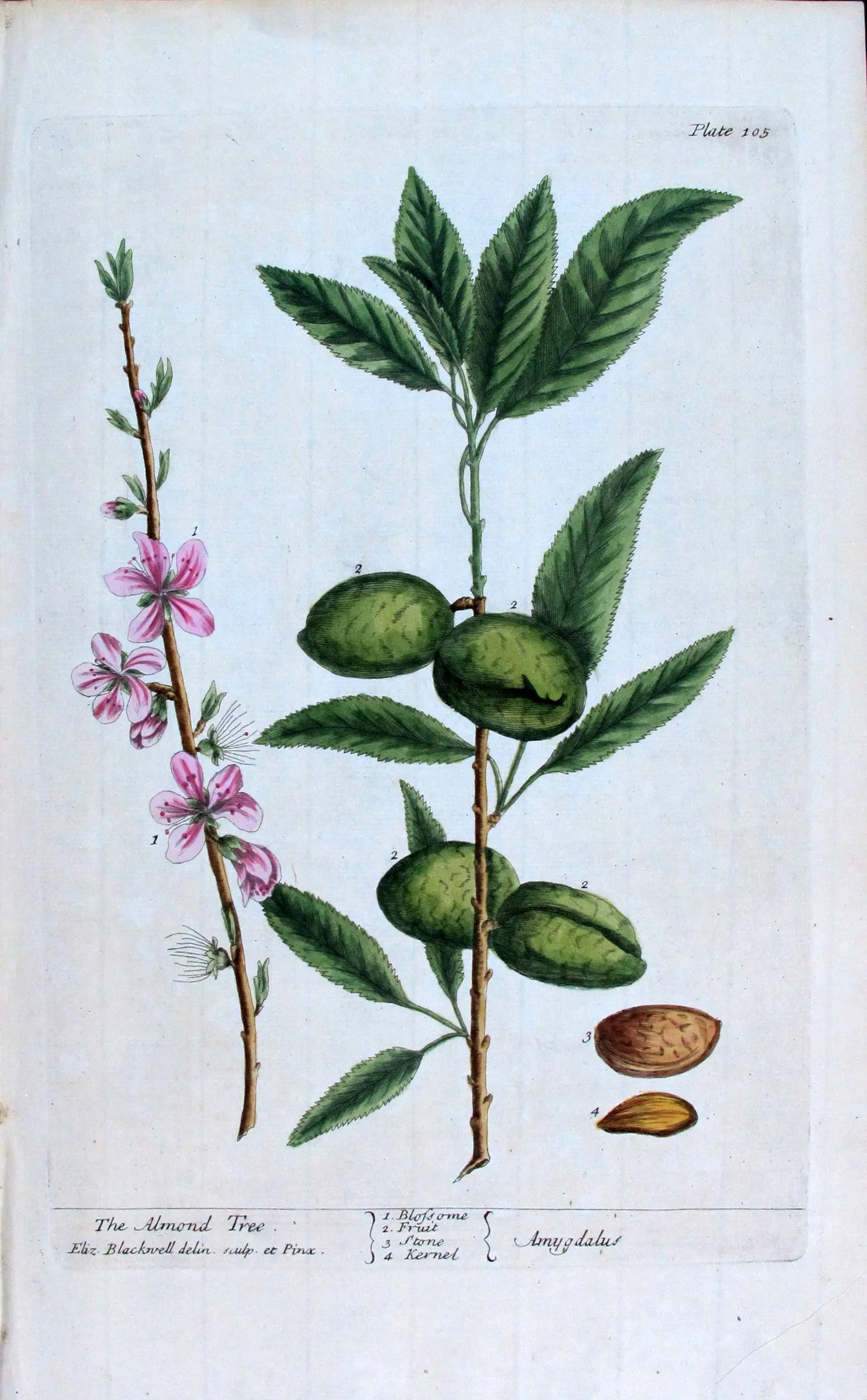

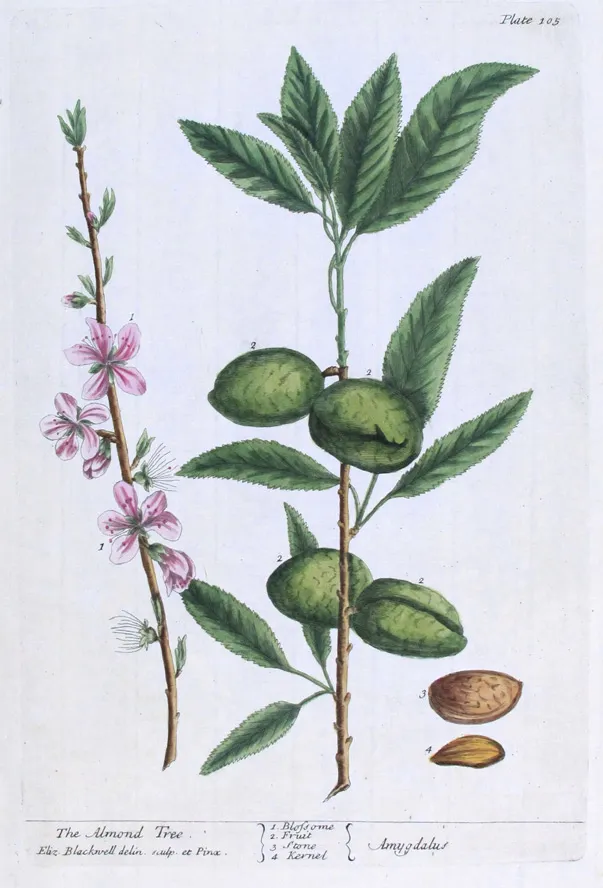
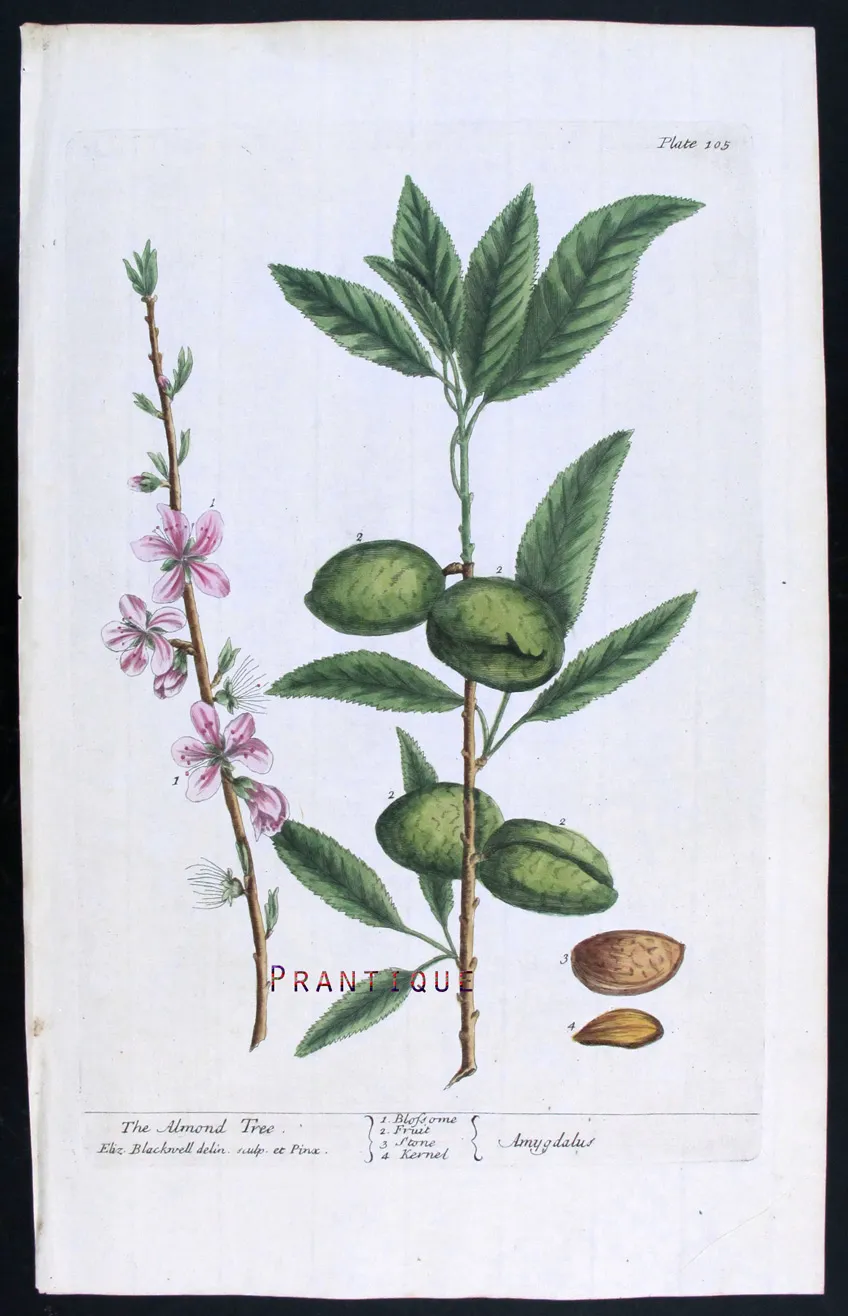


18th-century hand-colored engraving of the Almond Tree by Elisabeth Blackwell, with blossom, fruit and kernel beautifully rendered.
 Delivery policy
Your print will be carefully prepared and shipped worldwide via trusted couriers (UPS or similar).
 Authentic antique prints
Original engravings from the 17th–19th century.
This refined botanical engraving depicts The Almond Tree, presenting both flowering and fruiting stages with clear structural balance and botanical precision, allowing the plant’s development to be read through successive phases.
The composition is divided into distinct vertical elements, enabling blossoms, developing fruit, and foliage to be observed independently while remaining visually connected. Elisabeth Blackwell’s approach emphasizes clarity and legibility, offering a faithful record of morphology grounded in direct observation rather than decorative effect.
Created in the early eighteenth century, this plate belongs to A Curious Herbal, a foundational medical and botanical work distinguished by the unity of its production, in which drawing, copper engraving, and hand-colouring were executed by the same hand.
— • —
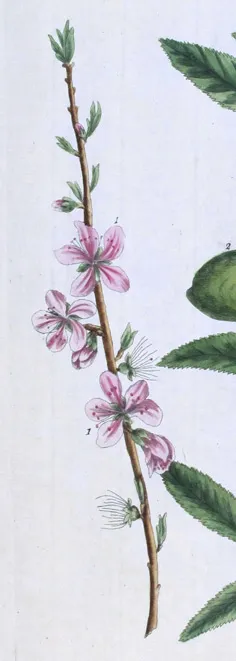
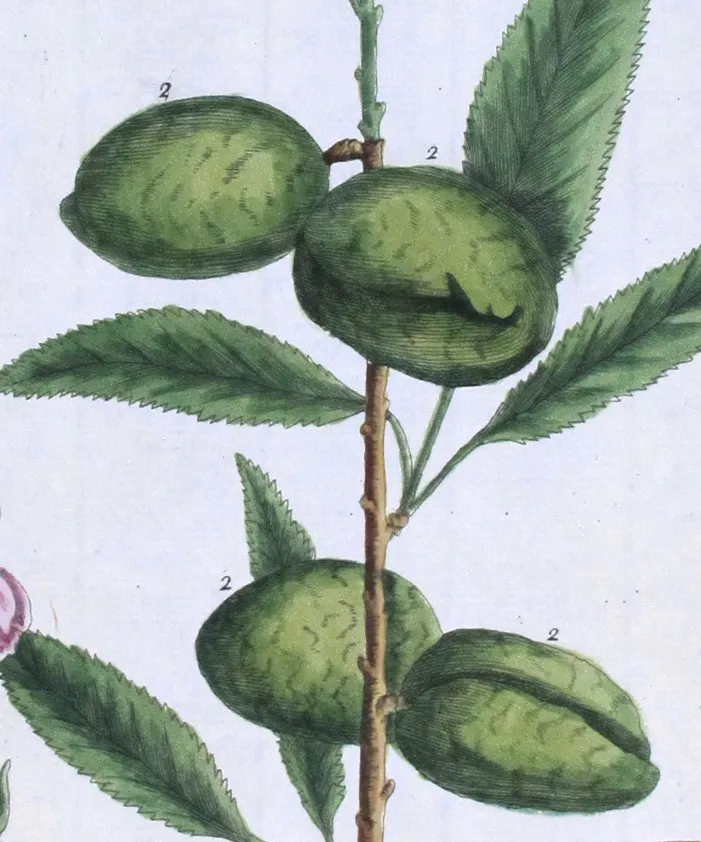
The composition juxtaposes flowering branches with fruit-bearing stems, creating a measured visual dialogue between delicacy and solidity. The blossoms introduce lightness and rhythmic variation, while the heavier forms of the developing almonds anchor the image and guide the eye through the sheet.
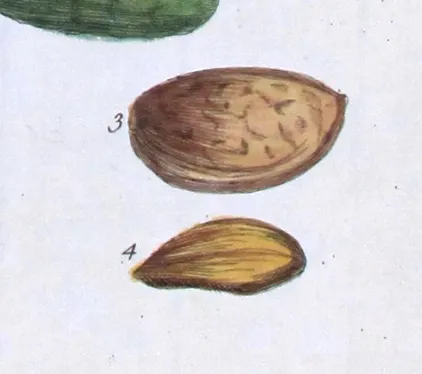
Subtle tonal gradations define leaves and fruit with restrained depth, while the controlled palette preserves botanical clarity. The isolated depiction of the nut and kernel further reinforces the engraving’s analytical intent without disrupting the overall visual harmony.
The almond tree (Amygdalus) held a prominent place in early medicine and domestic practice, valued both for its nourishing kernel and for the oil extracted from its seeds. Its notably early and delicate flowering made it a distinctive subject in European herbals, often associated with seasonal change and agricultural knowledge. Accurate depiction of blossoms, fruit, and kernel was essential for practical identification, particularly for physicians and apothecaries who relied on visual references when distinguishing edible, medicinal, and oil-producing species. Its inclusion in A Curious Herbal reflects the importance of documenting plants whose usefulness depended on recognizing multiple stages of growth.
The engraving is in exceptionally fine antique condition, printed on original handmade laid paper typical of early 18th-century botanical publications. No watermark has been observed. The sheet remains fresh and clean, with a stable surface and no notable defects. The original hand-colouring is well preserved, and the impression is crisp and legible throughout. These qualities correspond to a “like brand new” state of preservation and confirm the authenticity of the print as an original production from A Curious Herbal. The engraved credit “Eliz. Blackwell delin. sculp. et pinx.” is present and fully legible, attesting that the drawing, engraving, and hand-colouring were executed by Elisabeth Blackwell herself.
For further context on Elisabeth Blackwell and the singular unity of authorship behind A Curious Herbal, see our editorial feature:
Specific References
Hand-colored botanical engraving of the Common Calamint, with dense foliage and soft pink-purple florets.
19th-century hand-colored engraving of Water Calamint, with delicate pink blooms and fine botanical details.
Elegant olive branches with vivid green leaves and fruit in subtle yellow tones.
Dramatic lichen plate with sculptural fronds and rocky support, perfect for collectors who love unusual, textural natural history subjects.
Striking palm fronds paired with warm golden dates, a highly decorative composition.
Elegant botanical engraving of the Bean plant with pods and seed details.
Elegant 18th-century hand-colored engraving of a Raspberry Bush by Elisabeth Blackwell, with ripe fruit and soft blossom.
Elegant Silver Fir with upright cones and finely spaced needles, a refined forest motif for sophisticated interiors and collectors of conifer imagery.
Hand-colored 18th-century engraving of Yellow Asphodel, a vivid botanical composition from Elisabeth Blackwells A Curious Herbal.
A graceful hand-colored engraving of Marshmallow (Althaea officinalis) with soft pink flowers and expressive root study.
Lively 18th-century engraving of Polypody of the Oak by Elizabeth Blackwell, showing rhythmic fern fronds and creeping rhizomes, perfect for naturalist or woodland-themed decor.
Striking composition of the Pitch Tree with tall central stem and large cones, bringing strong graphic presence to botanical displays or rustic interiors.
A dynamic pine composition with cones, needles, and golden pollen clusters.
18th-century hand-colored engraving of a Garden Cucumber by Elisabeth Blackwell, with curling tendrils and yellow blossoms.
Charming 18th-century engraving of Sage by Elizabeth Blackwell, with blue-green leaves and delicate flowers, perfect for kitchen walls or herb-themed gallery displays.
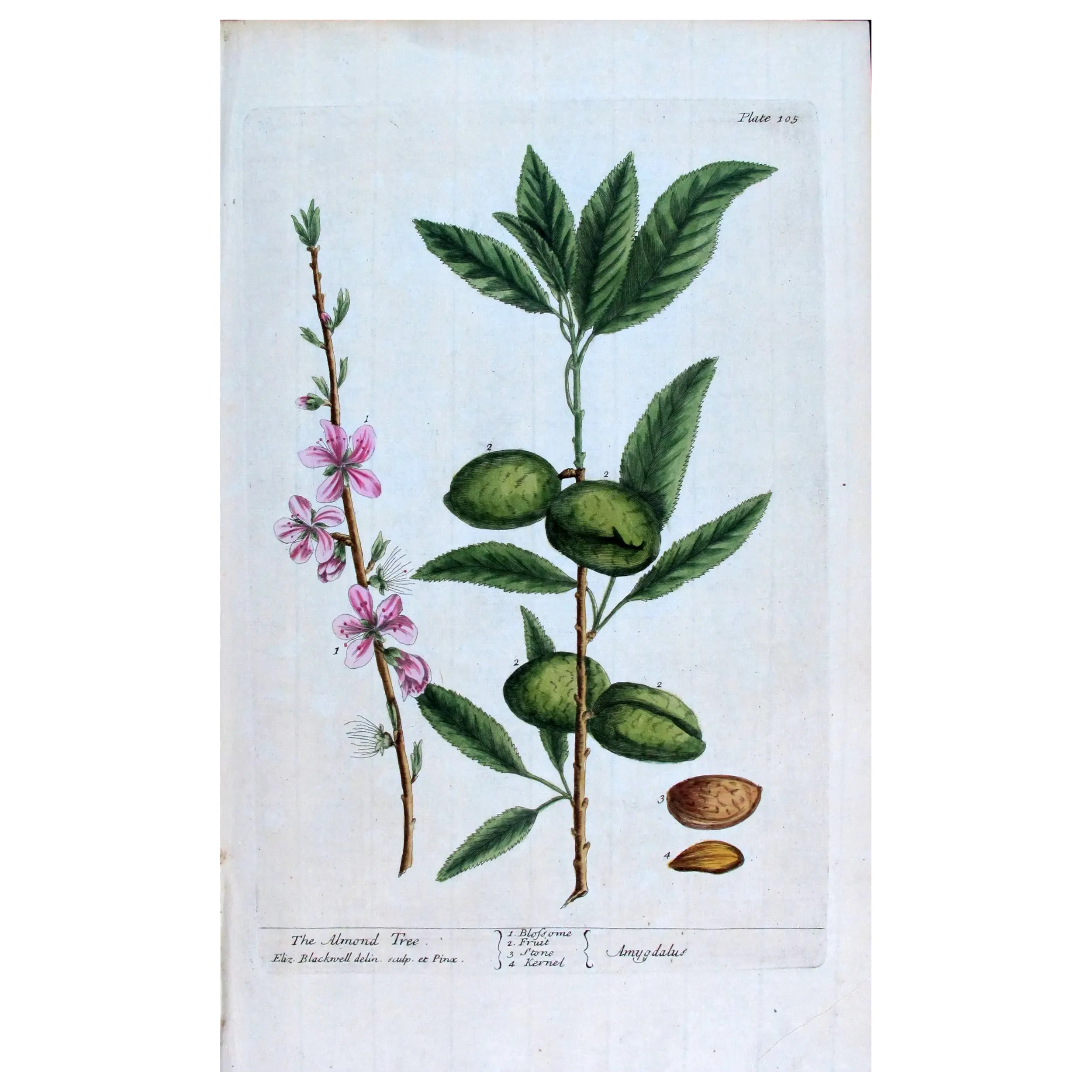
18th-century hand-colored engraving of the Almond Tree by Elisabeth Blackwell, with blossom, fruit and kernel beautifully rendered.


