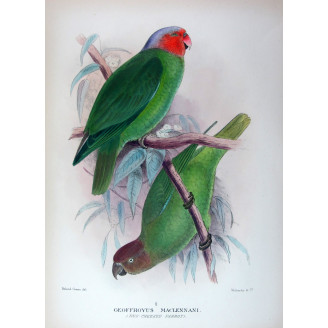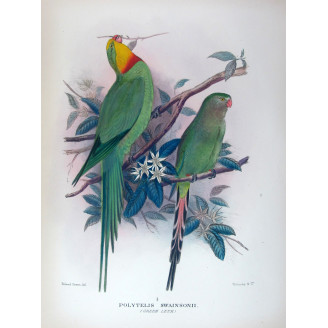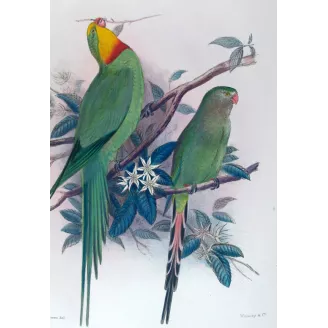
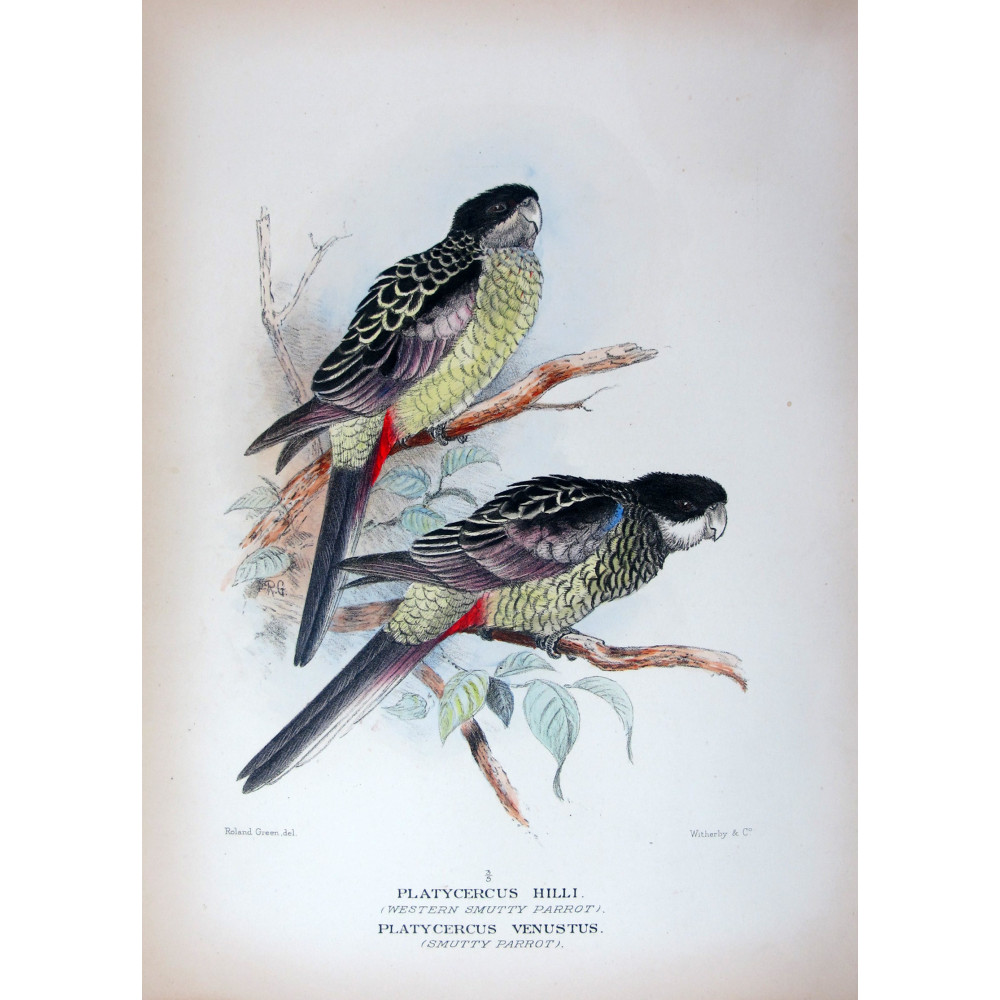
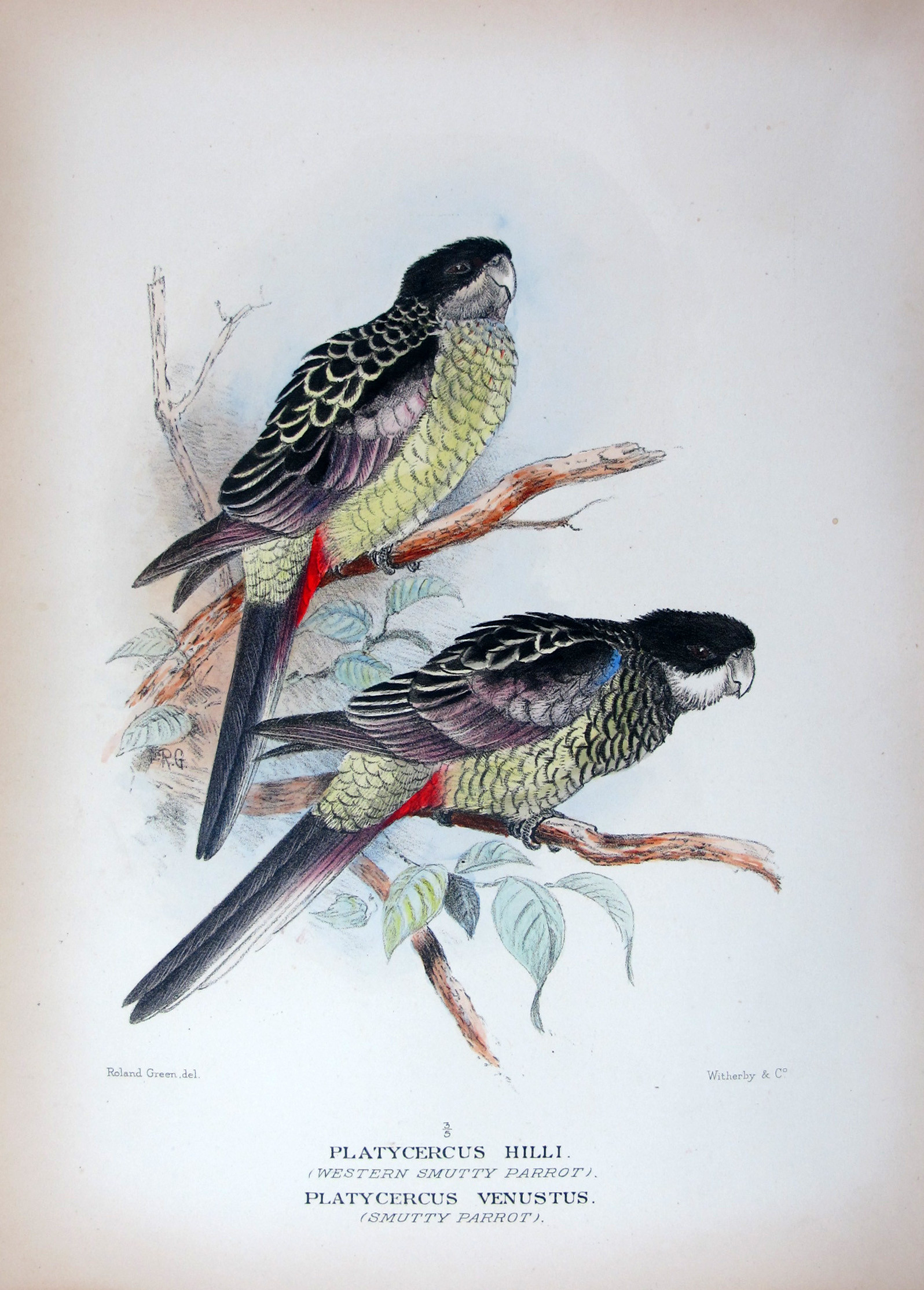
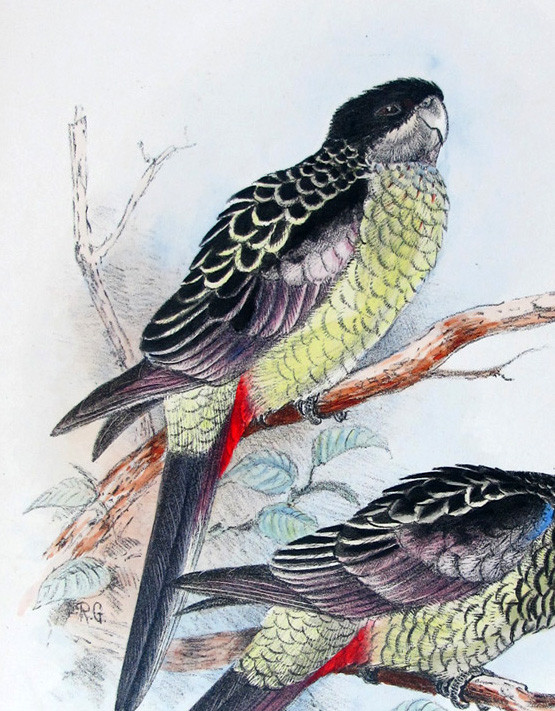
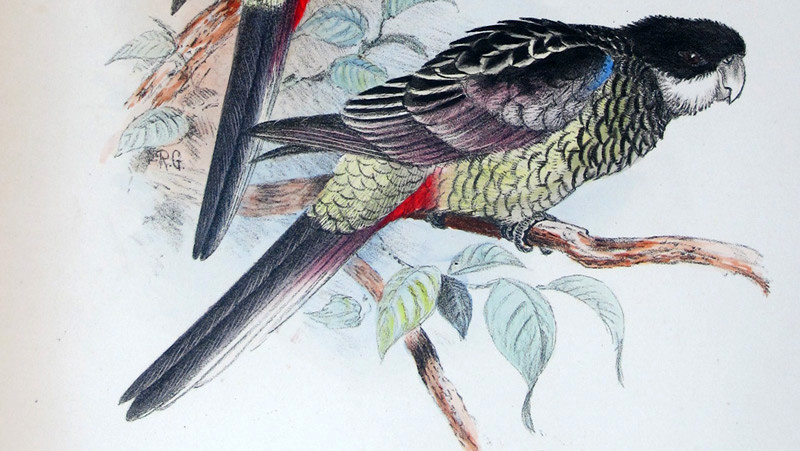
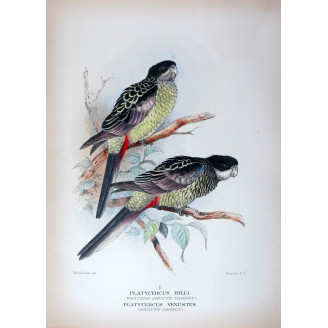
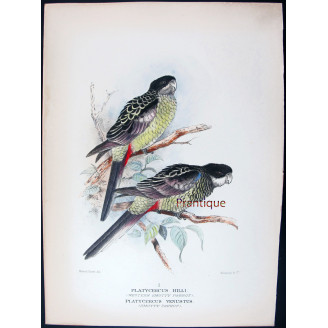
Antique lithograph of the Western Smutty Parrot & Smutty Parrot by Roland Green.
 Delivery policy
Your print will be carefully prepared and shipped worldwide via trusted couriers (UPS or similar).
 Authentic antique prints
Original engravings from the 17th–19th century.
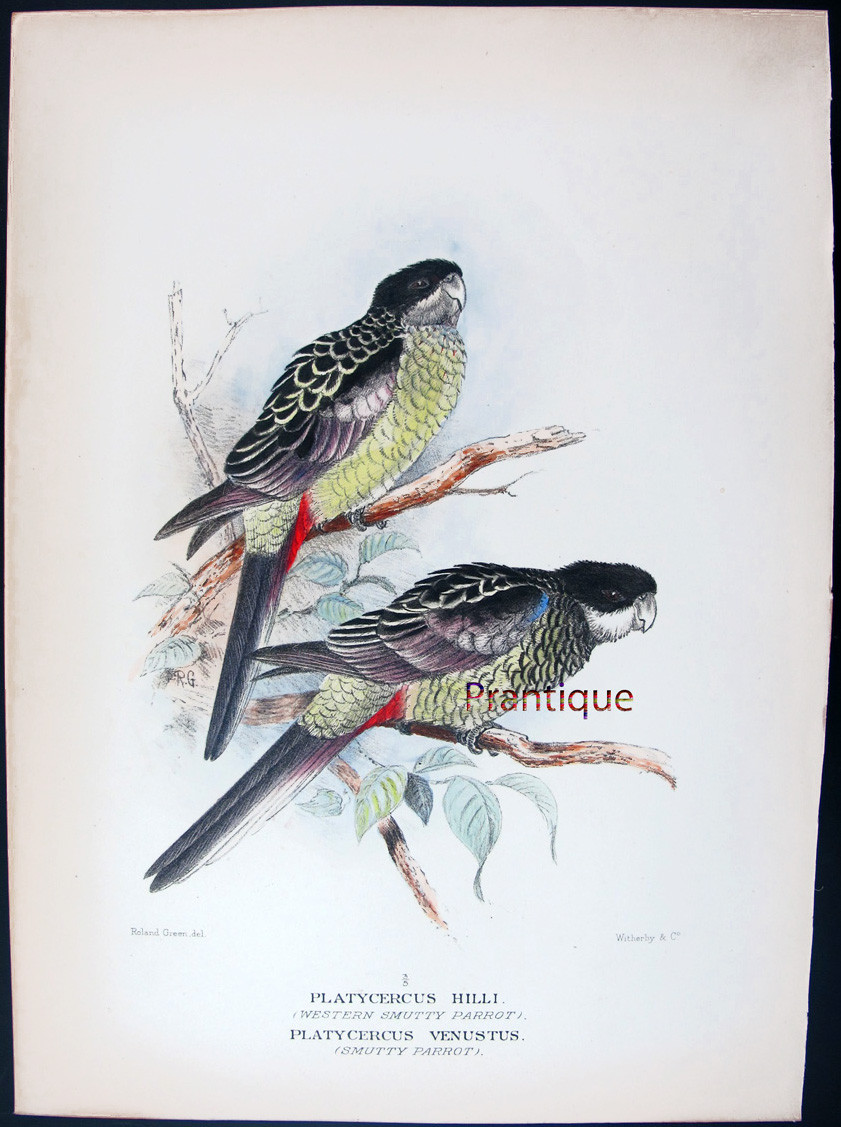
This original early twentieth-century hand-colored lithograph depicts Platycercus hilli (Western Smutty Parrot) and Platycercus venustus (Smutty Parrot), as titled on the plate. The sheet forms part of Gregory M. Mathews’ monumental publication The Birds of Australia, illustrated by Roland Green and issued by Witherby & Co.
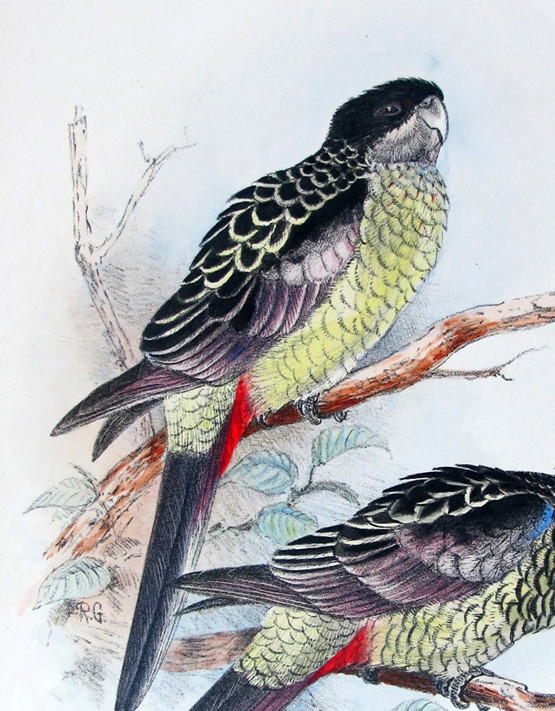
Two birds are arranged diagonally upon branching foliage, their bodies slightly offset in posture, creating a measured rhythm across the composition. Unlike the brighter grass-parrots of the series, these species are rendered in a darker, more complex tonal register—black scalloped upperparts, olive-scaled breast, violet wing shading, and a decisive flash of red beneath the tail.
— • —
Roland Green approaches this plate with structural precision. The upper bird, upright and alert, balances the lower bird’s slightly more horizontal stance. This mirrored opposition gives the sheet architectural coherence. The dark scalloped patterning across the back and wings is carefully layered, producing depth and tactile richness rarely found in more brightly colored plates.
The restrained background foliage prevents visual competition, allowing the birds’ complex feather articulation to dominate. The restrained palette—black, olive, muted purple, and red—creates a sophisticated decorative presence. This is a plate that rewards close study, revealing subtle tonal transitions within what at first appears a dark chromatic field.
The Smutty Parrots inhabit northern regions of Australia and are distinguished by their darker plumage and scaled feather structure. Unlike the flamboyant reds and yellows of other parrots, these birds embody a more subdued elegance—an evolutionary adaptation rendered here with scientific fidelity.
In Mathews’ survey, such species broaden the visual narrative of Australian avifauna, demonstrating that ornithological beauty extends beyond brilliance into complexity and tonal sophistication.
This lithograph originates from The Birds of Australia, Gregory M. Mathews’ ambitious early twentieth-century ornithological enterprise. Conceived as a definitive scientific record, the work united rigorous taxonomy with the refined artistry of leading wildlife illustrators, producing one of the most authoritative visual catalogues of Australian birdlife. Explore the broader historical scope in our editorial feature: Gregory M. Mathews and The Birds of Australia .
Plates featuring paired subjects such as this one reflect Green’s ability to balance naturalistic accuracy with compositional symmetry—an equilibrium central to the enduring appeal of the Mathews series.
Very good antique condition. Fresh original hand-coloring with strong lithographic impression. Printed on fine early twentieth-century wove paper. Minor age toning slightly more visible along the outer margins, consistent with age.
For further insight into Roland Green’s contribution to ornithological illustration: Roland Green – Dynamic Vision and Field-Born Precision in Bird Art
Specific References
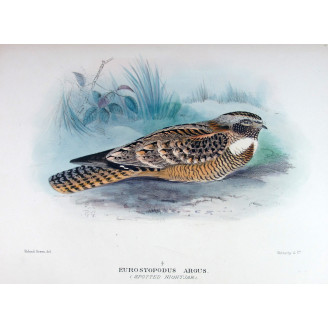
Original lithograph of the Spotted Nightjar by Roland Green from Mathews' Birds of Australia.
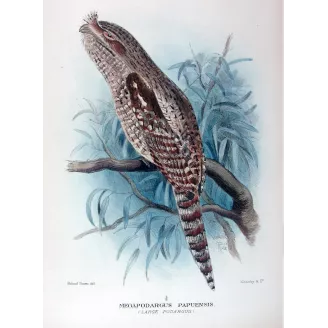
Original lithograph of the Large Podargus by Roland Green from Mathews' Birds of Australia.
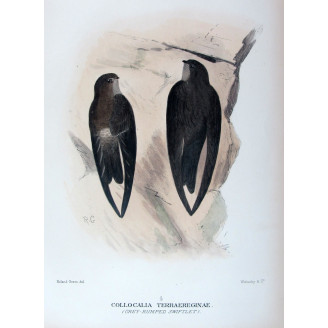
Original lithograph of the Grey-rumped Swiftlet by Roland Green from Mathews' Birds of Australia.
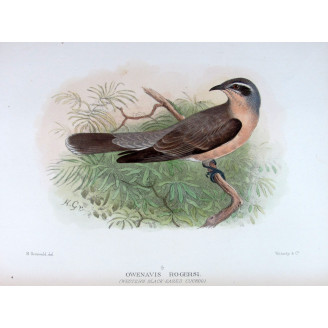
Western Black-eared Cuckoo (Owenavis rogersi) – Original lithograph by Henrik Grønvold.
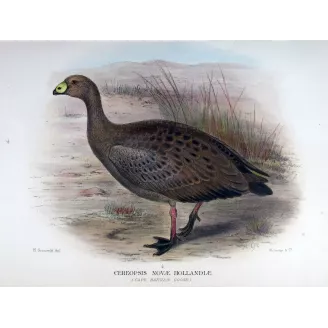
Original lithograph of the Cape Barren Goose by Henrik Grønvold (Cereopsis novæ hollandiae).
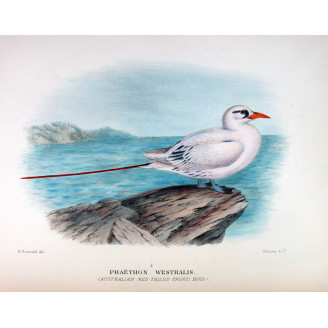
Australian Red-Tailed Tropic Bird (Phaëthon westralis), original Mathews lithograph.
Original lithograph of the Sacred Kingfisher (Sauropatis sancta) by Roland Green
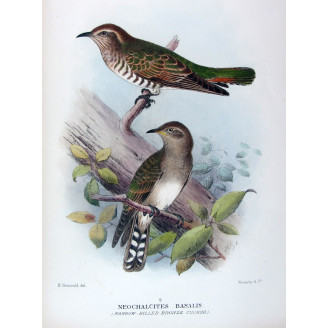
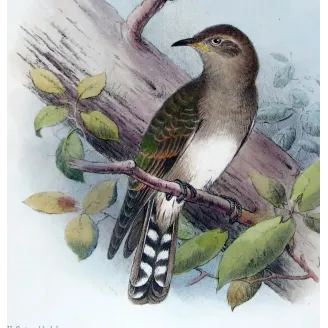
Narrow-billed Bronze Cuckoo (Neochalcites basalis) – Original lithograph by Henrik Grønvold.
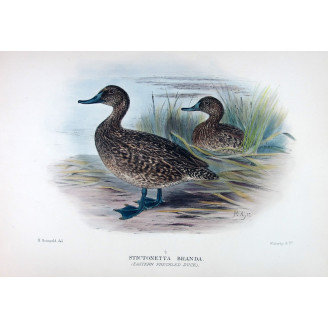
Eastern Freckled Duck (Stictonetta naevosa) – Original antique bird print by H. Grønvold.
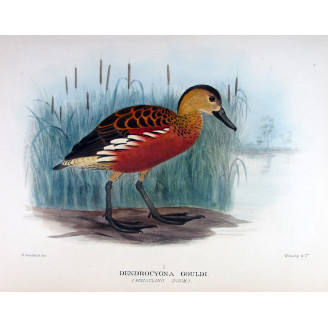
Original lithograph of the Whistling Duck by H. Goodchild (Dendrocygna gouldi).
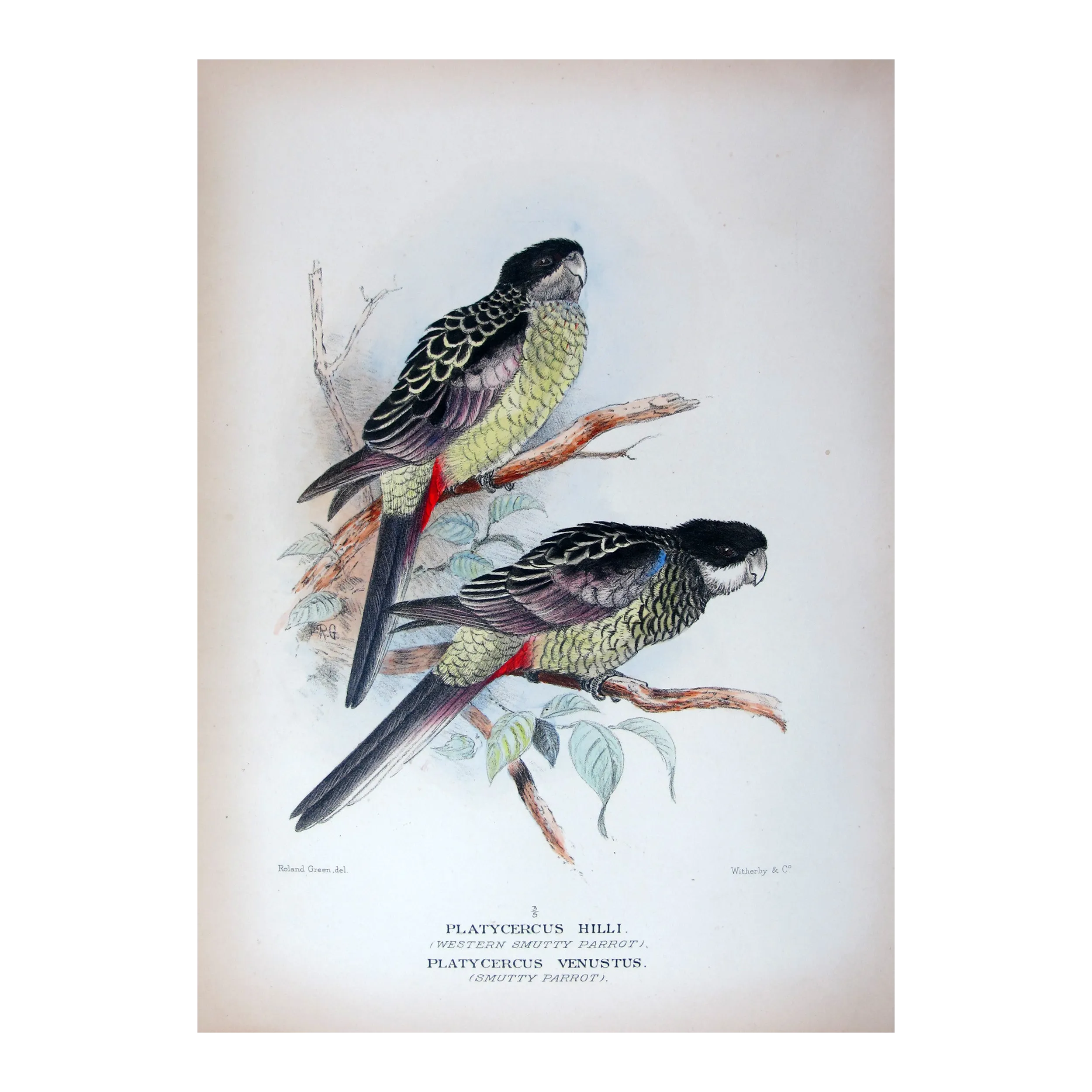
Antique lithograph of the Western Smutty Parrot & Smutty Parrot by Roland Green.