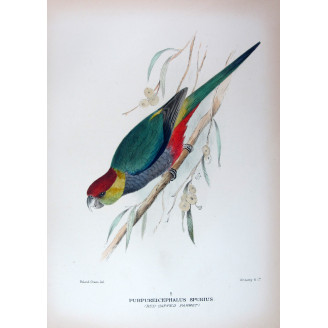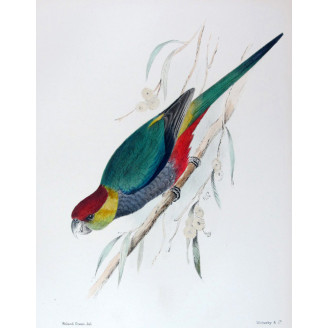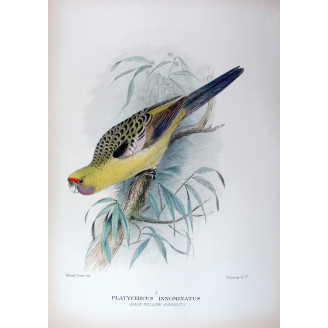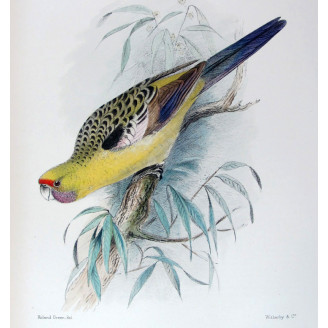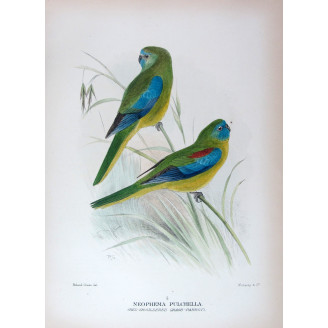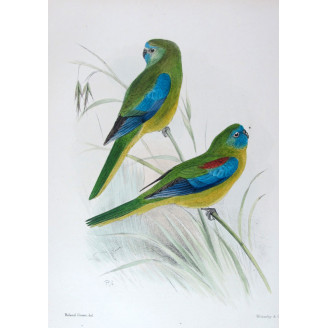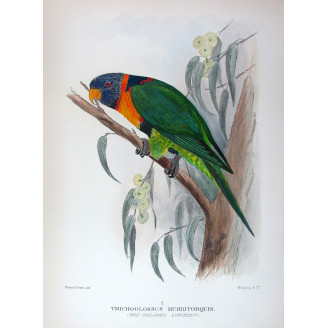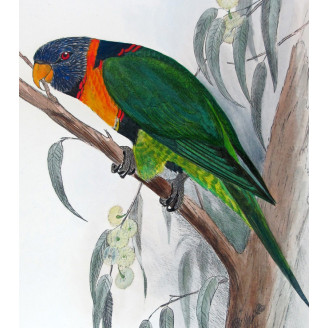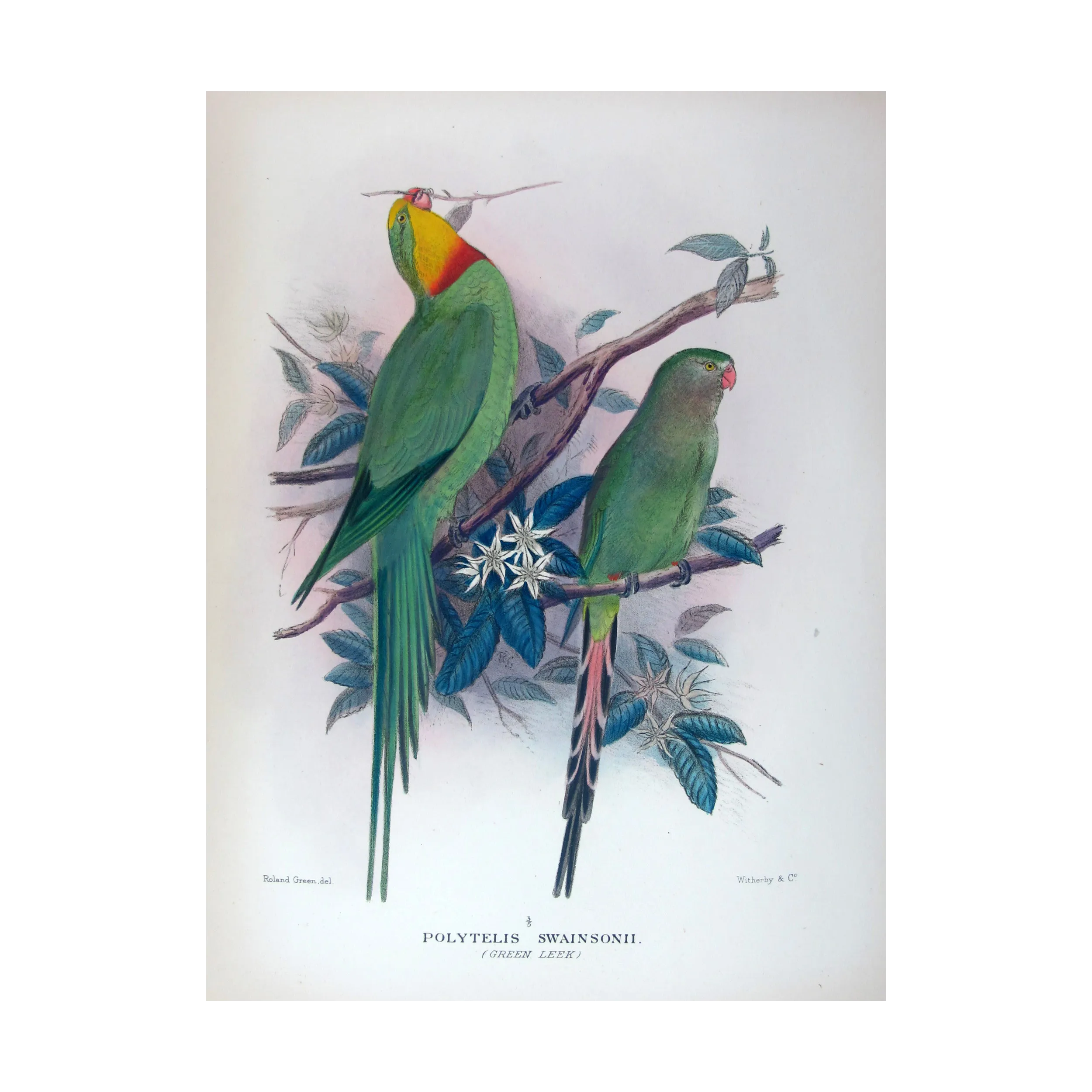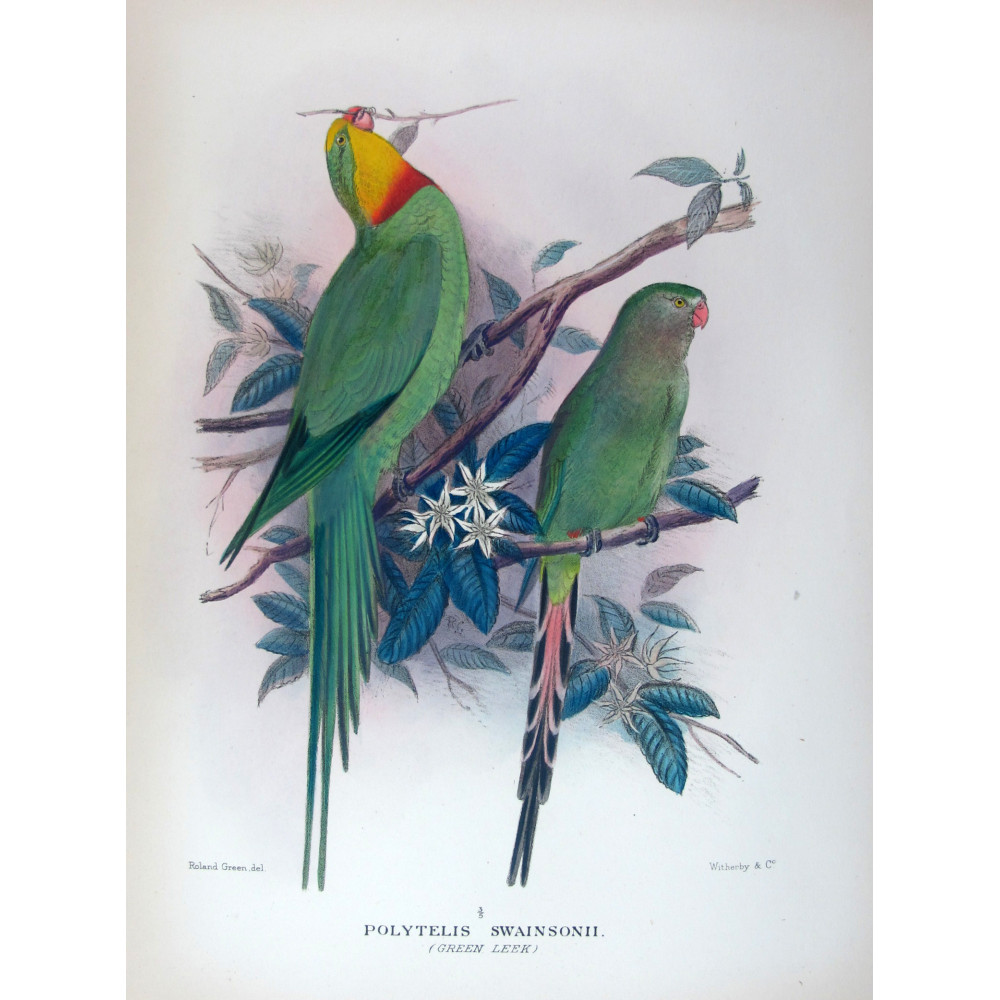
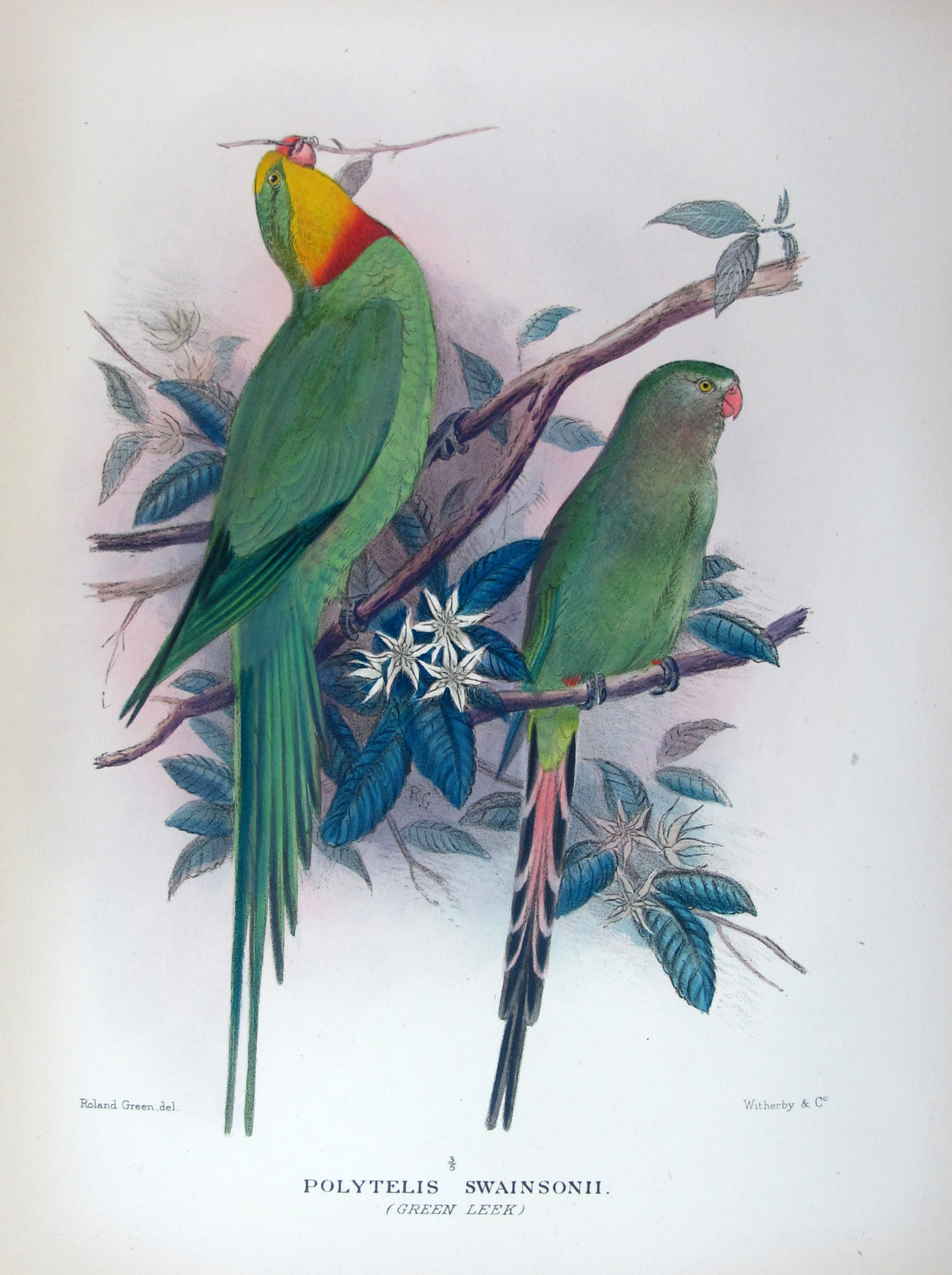
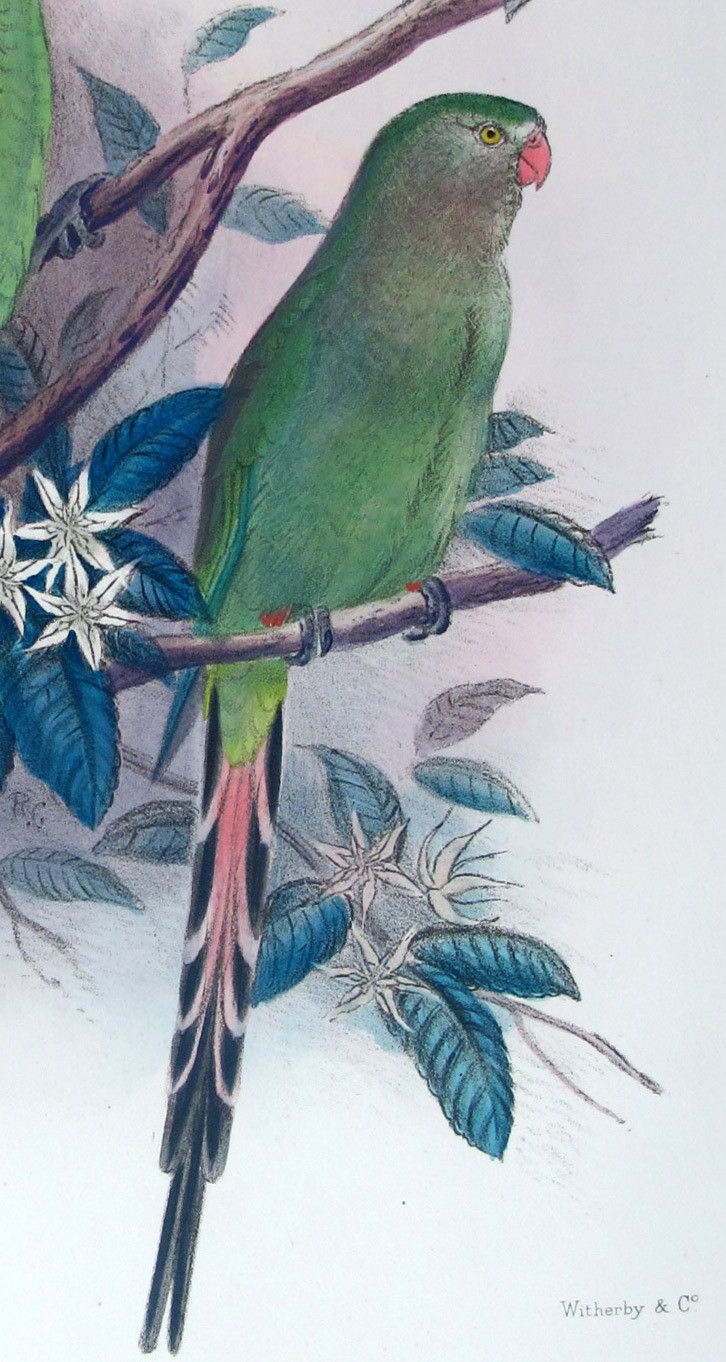

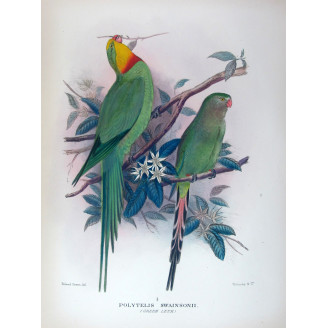
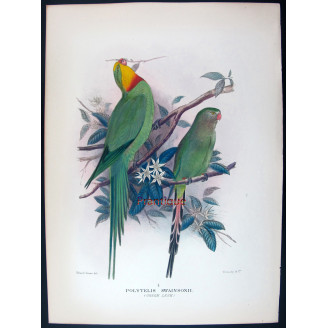
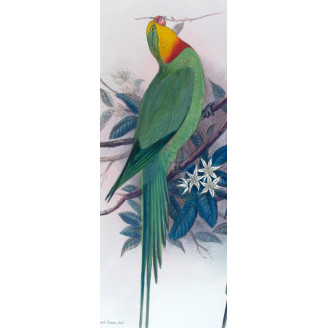
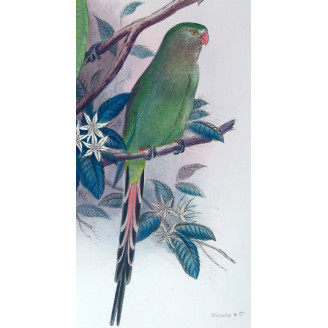

This original early twentieth-century hand-colored lithograph depicts Polytelis swainsonii, commonly known as the Green Parrot. The plate forms part of The Birds of Australia, Gregory M. Mathews’ landmark ornithological work, illustrated here by Roland Green.
Two individuals are arranged across intersecting branches, their elongated tails and streamlined bodies introducing refined linear movement within a carefully balanced botanical setting.
— • —
Green constructs the composition around tonal harmony rather than chromatic contrast. The dominant greens are layered in subtle gradations, from soft leaf-green to deeper emerald along the wings and tail. A restrained flash of yellow and warm red around the crown and nape provides the principal accent, carefully controlled to avoid overwhelming the composition.
The surrounding foliage, rendered in cool blue-green tones, enhances spatial depth while echoing the birds’ plumage. The long, tapering tails create elegant diagonals that guide the eye across the sheet, lending the plate both decorative fluidity and structural discipline.
Native to southeastern Australia, Polytelis swainsonii inhabits open woodland and riverine forests. It is admired for its elongated silhouette and subtle yet refined coloration.
Within Mathews’ comprehensive ornithological survey, such species provided a study in elegance and proportion, contrasting with the more flamboyant parrots of northern regions while enriching the visual diversity of the series.
This lithograph originates from The Birds of Australia, Gregory M. Mathews’ ambitious early twentieth-century ornithological enterprise. Conceived as a definitive scientific record, the publication combined taxonomic rigor with the artistic excellence of leading wildlife illustrators. Explore the broader historical context in our editorial feature: Gregory M. Mathews and The Birds of Australia .
The plate was illustrated by Roland Green, whose compositional clarity and refined handling of avian structure are particularly evident in elongated parrot species such as this.
Very good antique condition. Fresh original hand-coloring with strong lithographic impression. Printed on fine early twentieth-century wove paper. Minor age toning slightly more visible along the outer margins, consistent with age.
For further insight into Roland Green’s contribution to ornithological illustration: Roland Green – Dynamic Vision and Field-Born Precision in Bird Art
Specific References
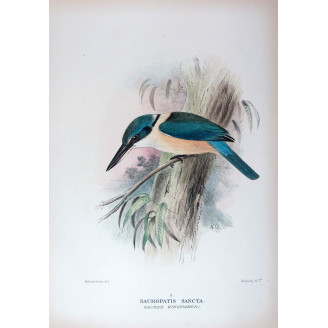
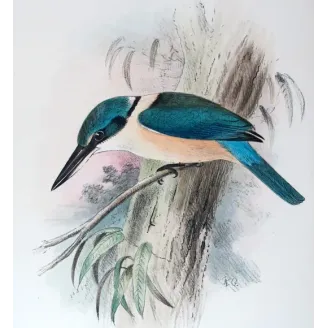
Original lithograph of the Sacred Kingfisher (Sauropatis sancta) by Roland Green
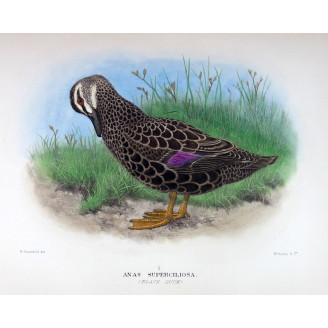
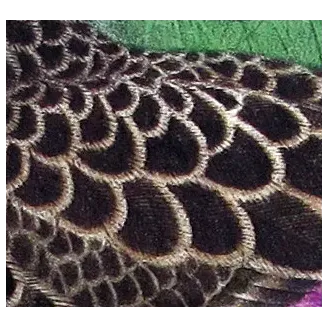
Original lithograph of the Black Duck by H. Goodchild (Anas superciliosa).
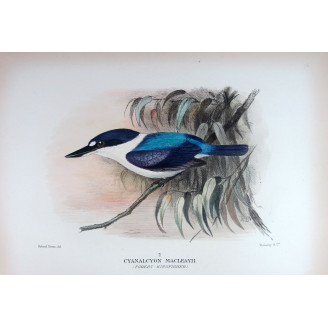
Original lithograph of the Forest Kingfisher (Cyanalcyon macleayii) by Roland Green
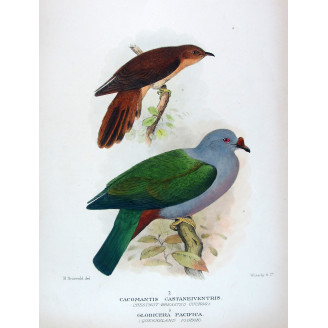
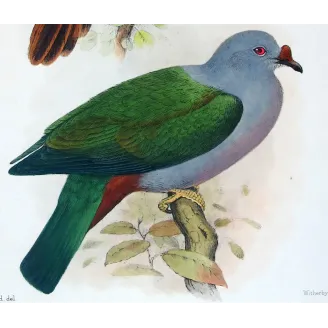
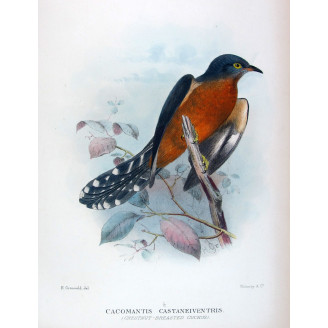
Chestnut-breasted Cuckoo & Queensland Pigeon illustrated by Henrik Grønvold.
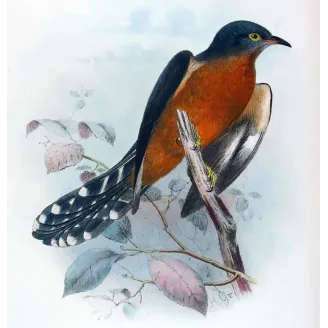
Chestnut-breasted Cuckoo (Cacomantis castaneiventris) – Original lithograph by Henrik Grønvold.
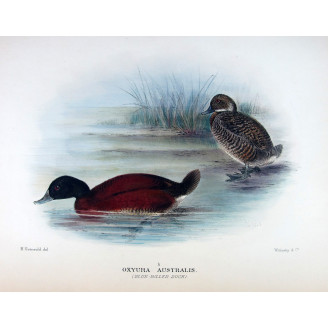
Blue-billed Duck (Oxyura australis) – Original antique bird print by H. Grønvold.
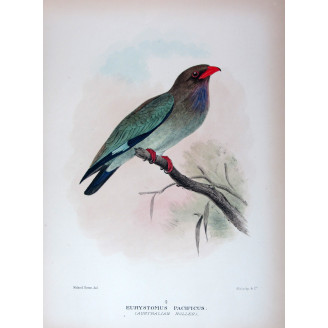
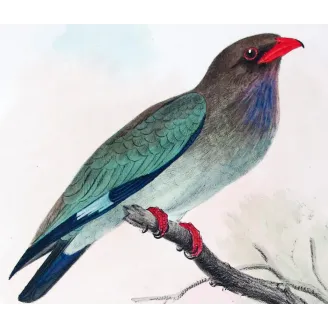
Original lithograph of the Australian Roller (Eurystomus pacificus) by Roland Green
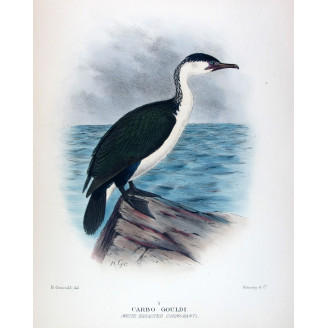
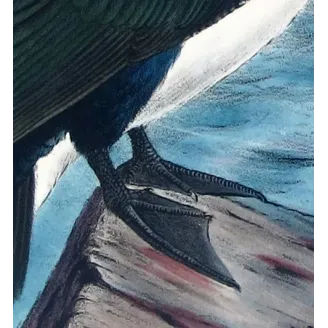
White-breasted Cormorant from Mathews' Birds of Australia, drawn by Grönvold.
Antique lithograph of the Red-shouldered Grass Parrot by Roland Green.
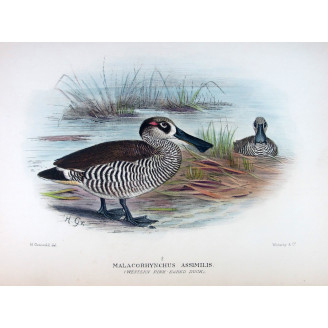
Western Pink-eared Duck (Malacorhynchus assimilis) – Original antique bird print by H. Grønvold.
Colorful print of the Red-collared Lorikeet by Roland Green, original hand-color.
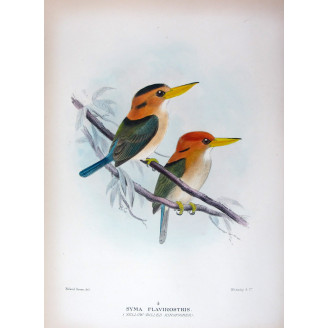
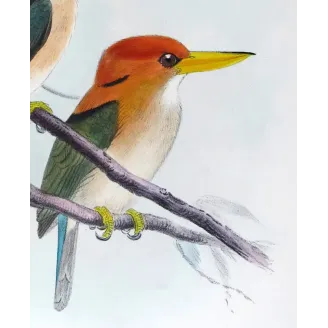
Original lithograph of the Yellow-billed Kingfisher (Syma flavirostris) by Roland Green
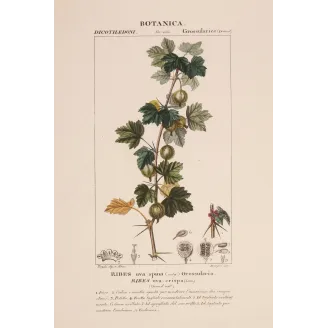
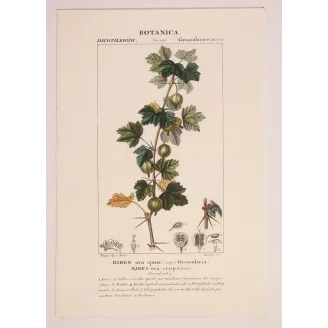
A charming depiction of *Ribes uva-crispa*, the gooseberry plant, detailed with its spiny stems and translucent green fruits.
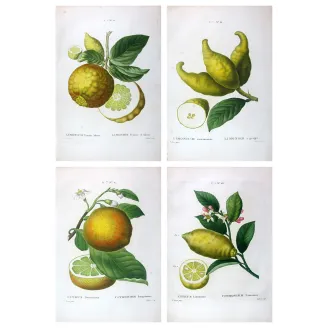
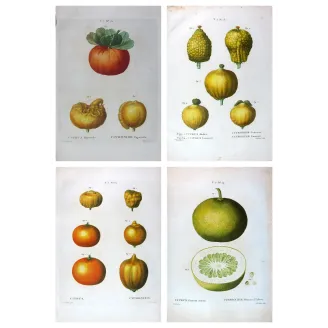
Nine original citrus engravings by Pancrace Bessa, uniting rare cedrats, sculptural lemons, and monumental Pomme d’Adam varieties into a coherent Napoleonic-era ensemble. Botanical study and refined color harmonize in a portfolio conceived to be read as a whole.
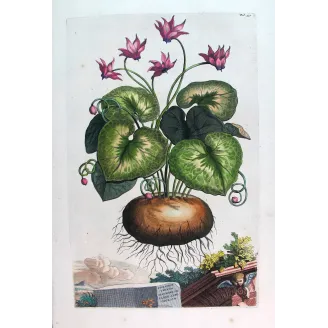
A rare 17th-century botanical engraving from Abraham Munting’s Nauwkeurige Beschryving der Aardgewassen - Phytographia Curiosa, depicting a cyclamen plant with exposed tuber, delicate pink flowers and richly patterned leaves. An expressive example of early botanical art combining scientific curiosity with striking decorative presence.
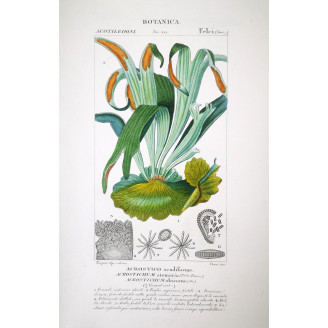
A complete set of 22 original hand-colored Engravings of ferns by Turpin, from the Dizionario di Scienze Naturali (c. 1830).
Original 1774 engraving by Jacob L'Admiral: Early Moth Stage among Willow Leaves.
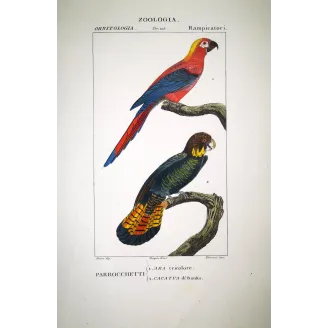
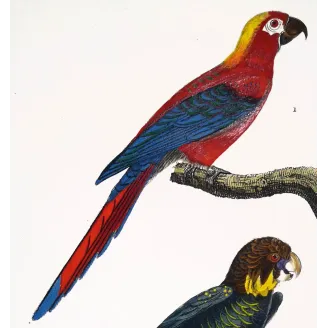
Vibrant parakeets perched on branches: a scarlet macaw and a black cockatoo with yellow and red highlights.
This vivid 19th-century engraving depicts two exotic aracaris, showcasing striking contrasts of green, red and yellow plumage. A highly decorative composition combining scientific observation with strong visual appeal, ideal for collectors of tropical ornithology and refined interior spaces.
Fine 18th-century engraving of the Medlar Tree by Elisabeth Blackwell, featuring fruit, blossom, and botanical detail.