- New
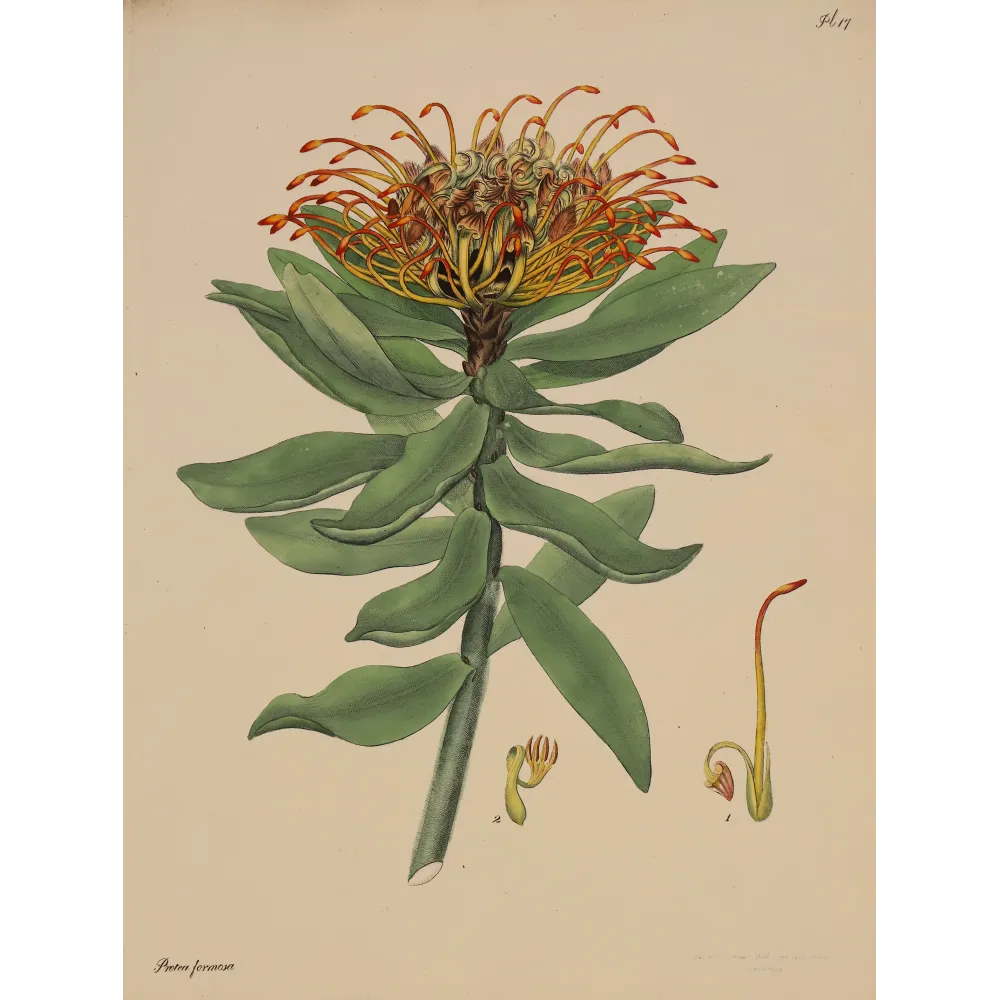
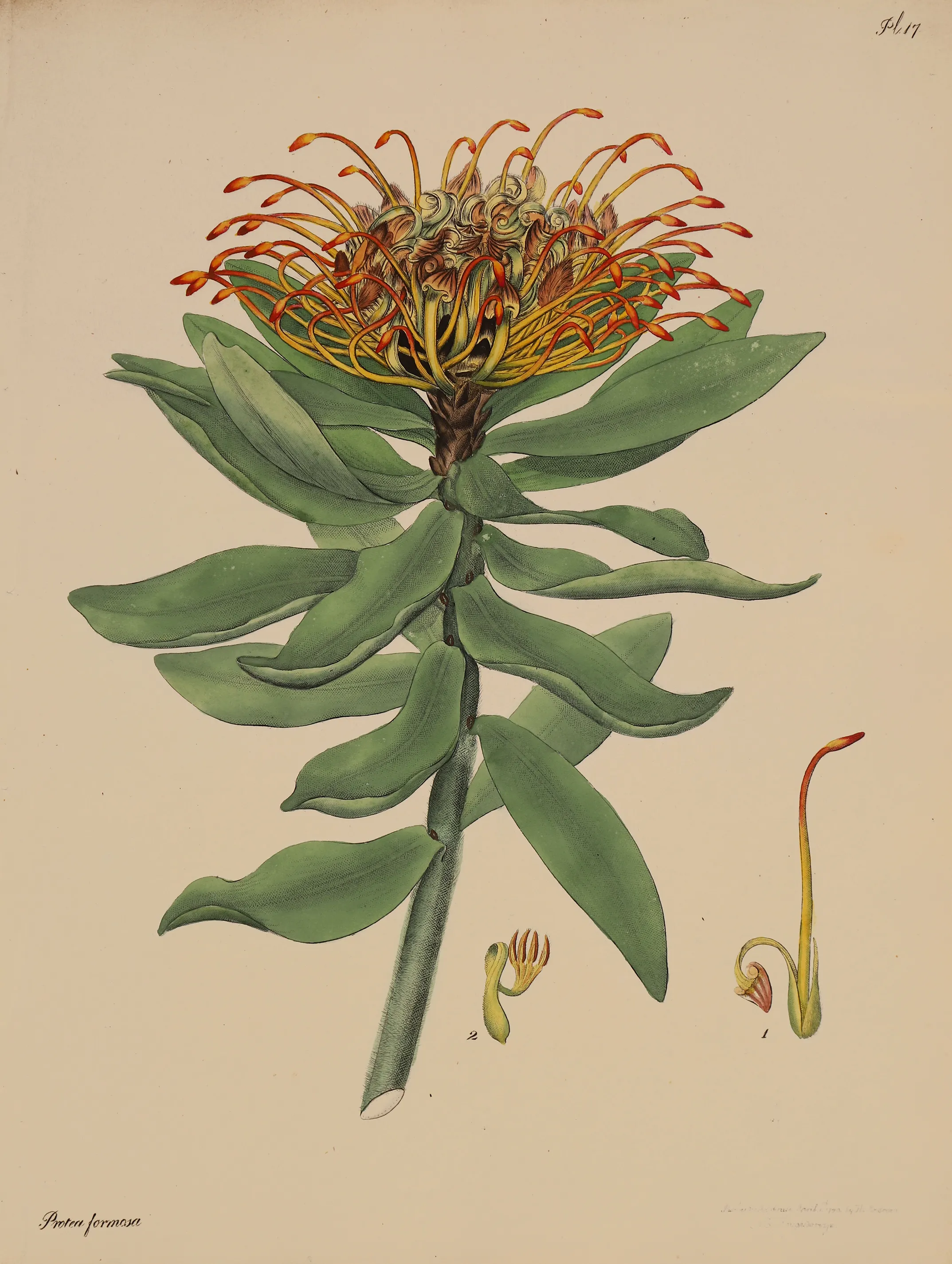
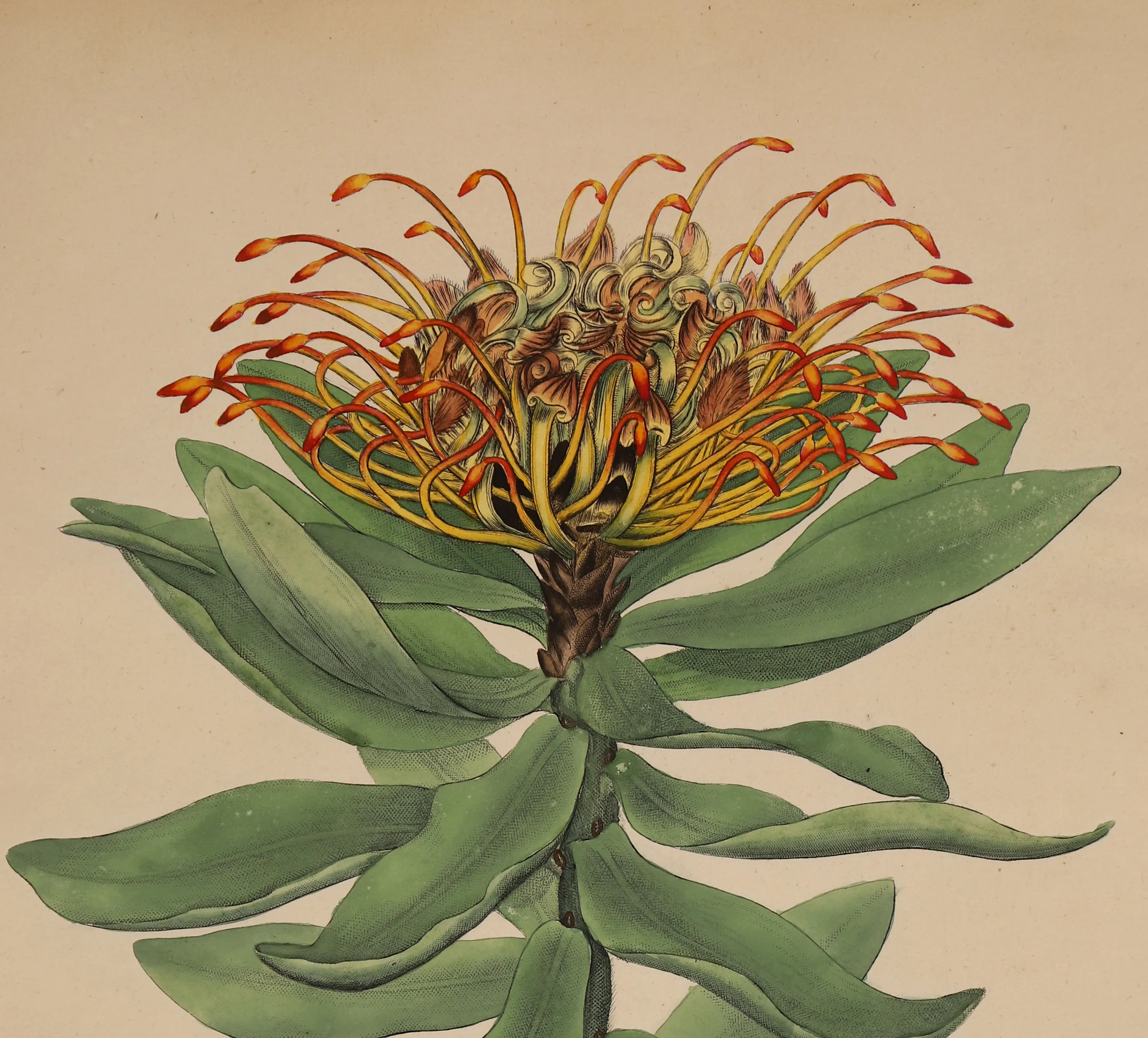
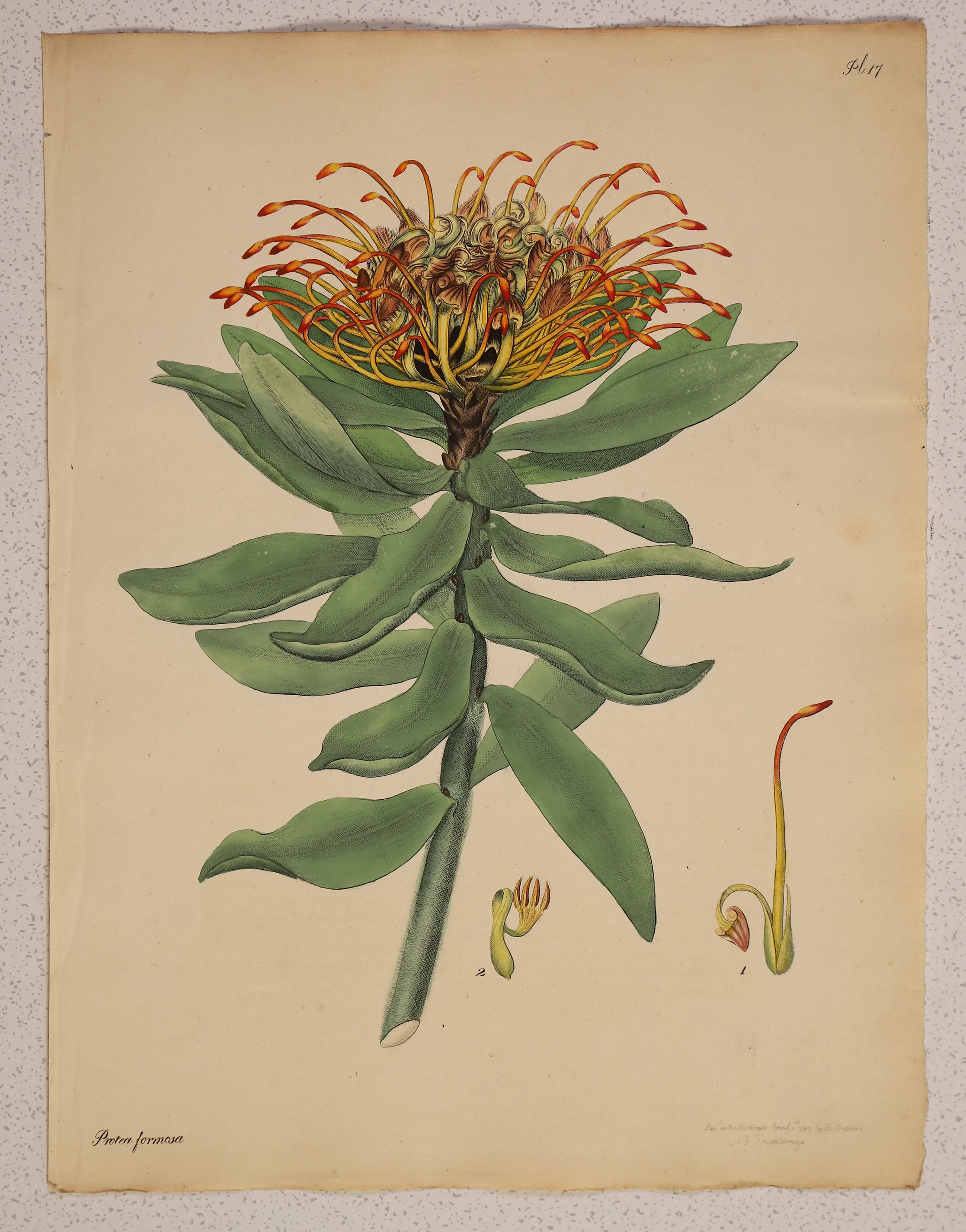
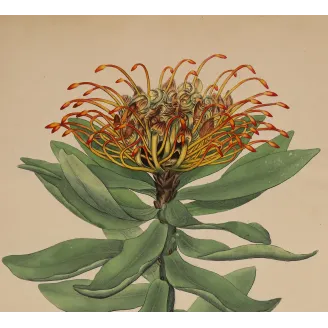
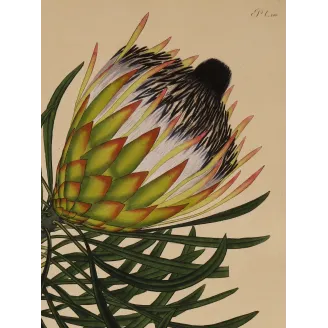
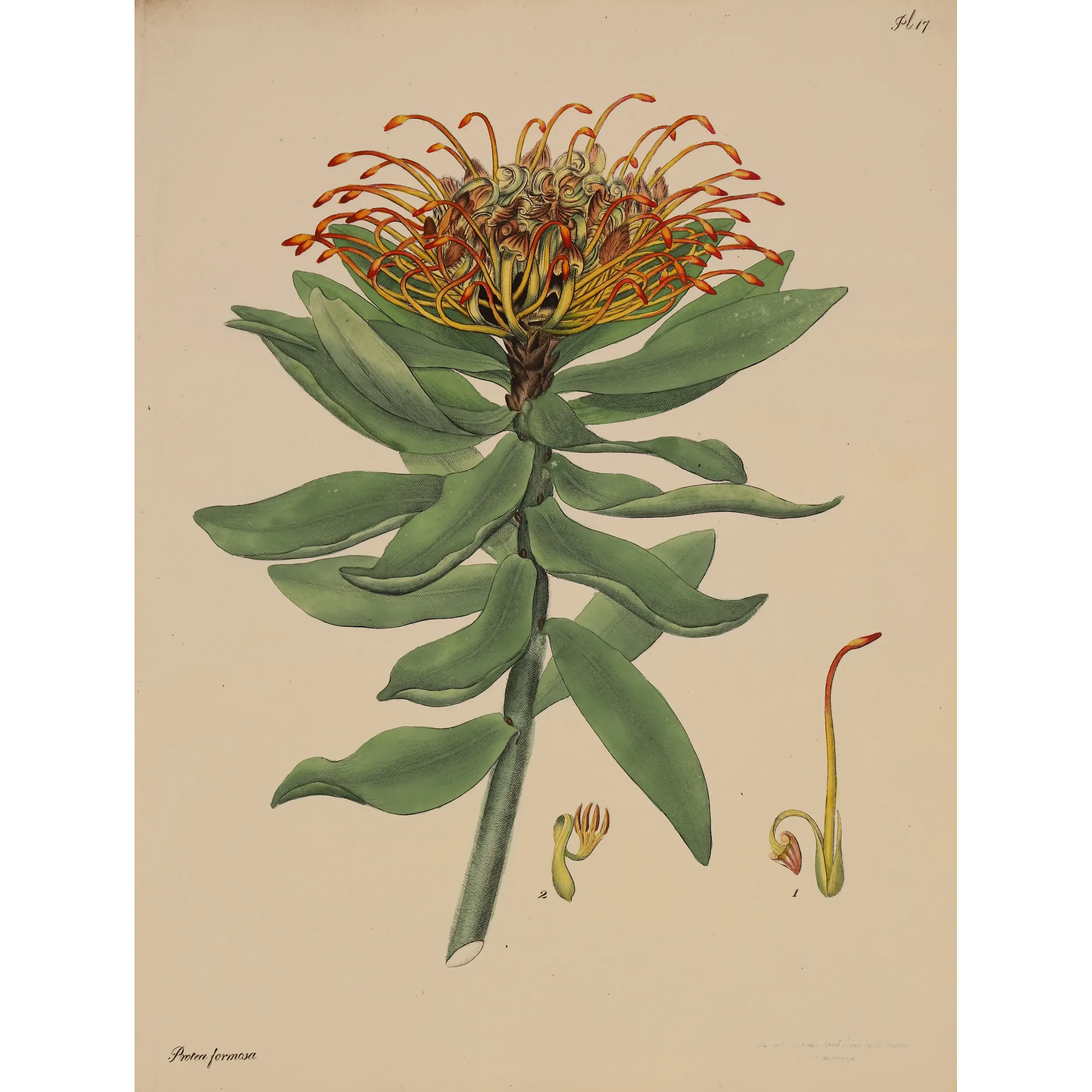
An original hand-coloured copper engraving of Protea formosa, published by Henry Charles Andrews in The Botanist's Repository (1799). Distinguished by its spectacular upward flowering styles, exceptionally delicate watercolour and refined botanical execution, this plate represents one of the most elegant Protea engravings of the series.
 Delivery policy
Your print will be carefully prepared and shipped worldwide via trusted couriers (UPS or similar).
 Authentic antique prints
Original engravings from the 17th–19th century.
This exceptional original hand-coloured engraving from Henry Charles Andrews’ The Botanist’s Repository depicts Protea formosa, a remarkable South African plant whose historical name evokes the beauty and distinction of its form. Published during the opening phase of Andrews’ ambitious botanical work, the plate combines scientific observation with an extraordinary sense of movement and artistic refinement.
The plant rises vertically across the sheet before opening into a spectacular crown of orange and yellow flowering styles. These slender structures curve, overlap and extend into the surrounding space, transforming the inflorescence into a living architecture. Their upward energy is balanced by the softly modelled green foliage, whose broad, gently turning leaves anchor the composition without diminishing its remarkable visual lightness.
The composition is governed by a strong vertical movement. Andrews presents the plant as a complete flowering stem, allowing the eye to travel upward from the softly cut base, through the successive layers of foliage and towards the extraordinary inflorescence that dominates the upper part of the sheet.
The leaves develop rhythmically around the central stem. Some project laterally, while others turn towards or away from the viewer, producing a continuous alternation of broad surfaces, narrow profiles and overlapping planes. This carefully controlled arrangement gives the plant both structural solidity and natural movement.
Their muted green colouring creates a calm and stable foundation for the flowering crown. Subtle tonal variations describe the curvature of each leaf without hardening its form, producing a soft, almost satin-like surface that contrasts with the brilliance and animated linearity of the inflorescence above.
At the summit of the plant, the flower head opens into an extraordinary network of elongated orange and yellow styles. These slender botanical structures rise, bend and radiate outward like jets of living colour, forming a visual rhythm that is at once botanical, calligraphic and almost sculptural.
The flowering styles do not form a compact mass. They occupy the surrounding air, crossing one another and extending beyond the denser centre of the inflorescence. Their movement gives the plate an exceptional sense of expansion, as though the flower were actively unfolding before the viewer.
The deep orange tips create a sequence of luminous accents around the crown. Their repetition guides the eye across the entire flower head and establishes a vivid chromatic dialogue with the warmer red and brown passages concentrated within its central structures.
The isolated botanical details placed at the lower right provide a quieter analytical counterpoint to the main composition. By separating individual reproductive structures from the flower head, Andrews allows the viewer to examine the botanical construction underlying the plate’s spectacular visual effect.
Protea formosa belongs to the Proteaceae, a diverse family of flowering plants strongly associated with the Cape region of South Africa. The genus includes species celebrated for their durable foliage, complex inflorescences and extraordinary variety of architectural forms.
The plant represented here is distinguished by its elongated flowering styles, which emerge from the central inflorescence and curve outward in a vivid display of orange, yellow and red. These are not conventional petals, but specialised reproductive structures whose unusual form contributes decisively to the visual identity of the flower.
The name Protea refers to Proteus, the shape-changing figure of Greek mythology, and reflects the remarkable morphological variety found within the genus. The specific epithet formosa, meaning beautiful or finely formed, is particularly appropriate for a plant whose elegance derives from the relationship between structural strength and animated botanical movement.
Proteas fascinated European botanists and collectors during the late eighteenth century because they differed so dramatically from familiar northern European flowers. Their distant geographical origin and unconventional structures made them emblematic of the rare plants cultivated in specialist nurseries and private collections during Britain’s expanding age of botanical exploration.
Among the Andrews Protea plates examined by Prantique, this impression demonstrates particularly clearly how the engraved framework can withdraw behind colour. The copperplate establishes only the essential botanical structure, allowing transparent hand-applied watercolour to create almost the entire visual experience.
The engraved marks are exceptionally light and rarefied. Andrews avoids the dense engraved shading traditionally used to construct volume, employing the burin instead as a precise but subordinate instrument. Contours, structural divisions and selected surface details are recorded without disturbing the softness of the final image.
This restrained use of engraving is especially evident along the stem. Here, minute engraved strokes describe the plant’s fine surface hairs with remarkable precision. These almost microscopic marks contribute essential botanical information while remaining visually integrated into the delicate layers of colour.
The leaves and stem appear to have been deliberately left without gum arabic. Their softly textured character is created instead through exceptionally fine transparent watercolour, applied in carefully controlled layers that produce a subtle satin-like surface rather than a reflective gloss.
The colouring of the foliage is remarkably nuanced. Fine transitions between pale and deeper greens establish curvature, depth and overlap, while allowing the white paper beneath to preserve a sense of luminosity. The leaves appear soft and substantial without becoming heavy or opaque.
Selective applications of gum arabic appear to be concentrated upon the vivid orange and yellow flowering styles. Their discreet reflective surface catches the light, intensifies the brilliance of the colour and reinforces the extraordinary visual energy of the inflorescence.
Rather than applying gum arabic according to a fixed decorative formula, Andrews seems to reserve it for the botanical surfaces whose natural optical qualities could be strengthened by reflection. In this plate, the contrast between satin-like foliage and luminous flowering styles becomes an integral part of the representation.
The result depends upon a sophisticated interaction between three materials: the nearly invisible engraved framework provides botanical precision; transparent watercolour creates softness, depth and chromatic modelling; and selective gum arabic introduces concentrated points of reflected light within the flowering crown.
Produced during the opening phase of The Botanist’s Repository, this impression displays a degree of technical refinement consistent with the establishment of the publication’s visual identity. The almost imperceptible engraving, exceptionally delicate colouring and carefully controlled surface effects combine to make it one of the most accomplished early Protea plates in the series.
At the lower right, the sheet preserves Andrews’ characteristic handwritten publication inscription. Unlike the exceptionally faint notation observed on certain other impressions, the inscription on this plate remains legible and forms an important element of its original publication history.
The inscription records the legal and commercial publication of the engraving and commonly includes the wording “Published as the Act directs”, together with the date, Andrews’ name and his address at 5 Knightsbridge, London.
This wording referred to the British Engravers’ Copyright Act of 1735, widely known as Hogarth’s Act. Created to protect engravers and graphic artists against unauthorised copying, the legislation required publication information that helped establish ownership of the design. The handwritten inscription is therefore not a later annotation but an original and historically significant component of the impression.
The plate mark is not visible on this individual sheet. The impression nevertheless retains generous margins, indicating that its absence should not be interpreted as evidence of severe trimming. The visibility of a copperplate impression may vary according to printing pressure, binding and the subsequent material history of the sheet.
No watermark has been observed on this individual impression. Examination of another original sheet belonging to this Prantique group of Andrews engravings, however, revealed a clearly legible J. Whatman 1794 watermark, documenting the use of fine English Whatman paper within the publication.
Although the watermark represents a collection-level observation rather than a feature recorded on this sheet, it provides valuable context for the materials used in the production of The Botanist’s Repository. Together with the engraved structure, original hand colouring, selective gum arabic and surviving publication inscription, it helps reconstruct the sophisticated artisanal character of Andrews’ work.
Henry Charles Andrews was unusual among botanical artists because he maintained close control over almost every stage of production. He drew from living plants, engraved the copperplates, supervised or executed the colouring and published the work himself. This integration of observation, engraving, painting and publishing gives his plates their remarkable technical consistency while allowing each species to retain a distinct visual identity.
This engraving belongs to Henry Charles Andrews’ extraordinary world of new and rare plants, created during Britain’s great age of botanical exploration. Discover Andrews’ unusual working method and the material evidence preserved within original impressions, including hand colouring, engraved structure, handwritten publication inscriptions, selective applications of gum arabic and historical Whatman paper.
Henry Charles Andrews and Britain’s Passion for Exotic Plants →
Excellent condition. Exceptionally clean original late eighteenth-century paper with remarkably fresh and finely preserved hand colouring. No visible stains, foxing or signs of use are present, and the sheet retains generous margins. The extremely delicate engraved details, including the minute hairs along the stem, remain beautifully defined. Selective gum arabic highlighting the orange and yellow flowering styles is also well preserved, while the original handwritten publication inscription remains clearly legible. Please examine the professional high-resolution photographs for a complete visual assessment.
Historical botanical name: Protea formosa
Accepted botanical name: Protea formosa Andrews
Common name: Beautiful Protea
Work: The Botanist’s Repository, for New, and Rare Plants
Author, artist and engraver: Henry Charles Andrews
Publisher: Henry Charles Andrews, 5 Knightsbridge, London
Date: 1799
Technique: Original copper engraving with hand-applied watercolour and selective gum arabic finishing
Surface finishing: Selective gum arabic apparently concentrated upon the orange and yellow flowering styles; absent from the satin-like foliage and stem
Publication inscription: Original handwritten publication inscription present and legible at the lower right
Plate mark: Not visible on this impression
Watermark: Not observed on this individual impression
Plate: XVII (17)
Plant family: Proteaceae
Native region: South Africa, Cape region
Sheet size: approx. 28 × 22 cm
Specific References
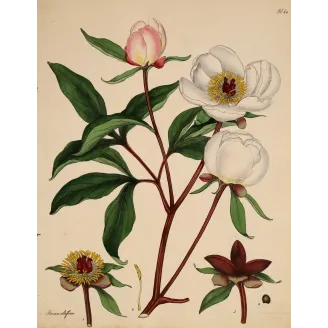
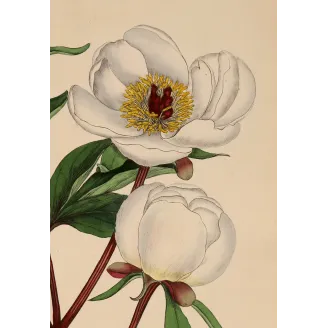
An exceptionally refined original hand-coloured engraving depicting the White Peony, published by Henry Charles Andrews in The Botanist's Repository in 1799. Delicate grey modelling, luminous white petals and beautifully preserved gum arabic finishing make this one of the finest botanical plates of the series.
An original hand-coloured copper engraving depicting the Long-Leaved Protea (Protea longifolia), published by Henry Charles Andrews in The Botanist's Repository in 1801. Elegant linear foliage, a dramatic emerging flower head and exceptionally refined hand colouring distinguish one of the most dynamic Protea compositions of the series.
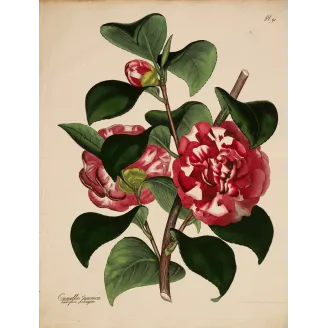
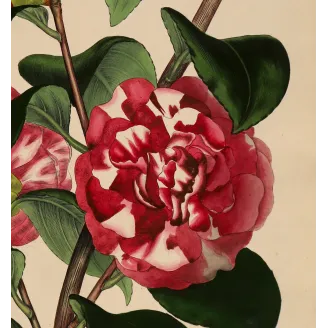
An original hand-coloured engraving of Camellia japonica from Henry Charles Andrews' celebrated The Botanist's Repository. Published around 1799, this elegant botanical print combines exceptionally refined hand colouring, selective gum arabic finishing on the foliage and Andrews' characteristic handwritten publication inscription.
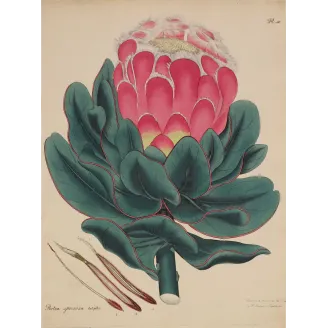
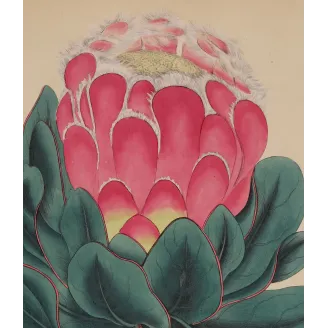
Monumental original hand-coloured engraving of the Broad-Leaved Showy Protea, published as Plate 110 in Henry Charles Andrews’ The Botanist’s Repository. Its sculptural blue-green foliage and extraordinary rose-pink flower make this one of the most iconic botanical images in the collection.
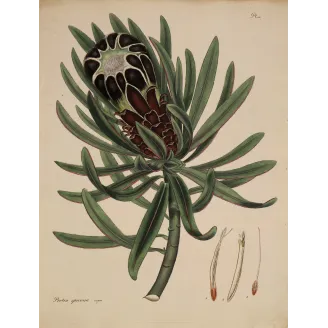
A striking original hand-coloured engraving depicting the Black-Flowered Showy Protea, published by Henry Charles Andrews in The Botanist's Repository in 1799. Monumental foliage, sculptural flower structure and beautifully preserved hand colouring make this one of the most architecturally impressive plates of the series.
An original hand-coloured copper engraving of Protea formosa, published by Henry Charles Andrews in The Botanist's Repository (1799). Distinguished by its spectacular upward flowering styles, exceptionally delicate watercolour and refined botanical execution, this plate represents one of the most elegant Protea engravings of the series.