- New
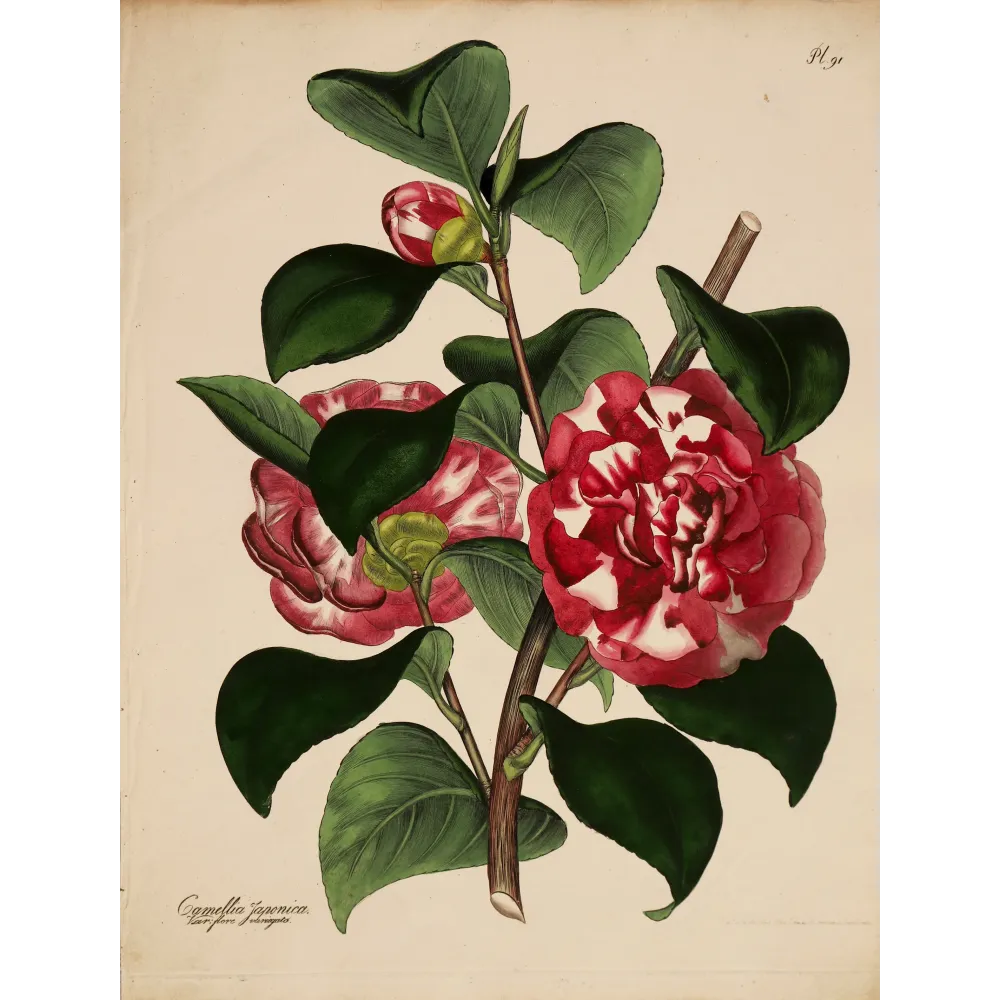
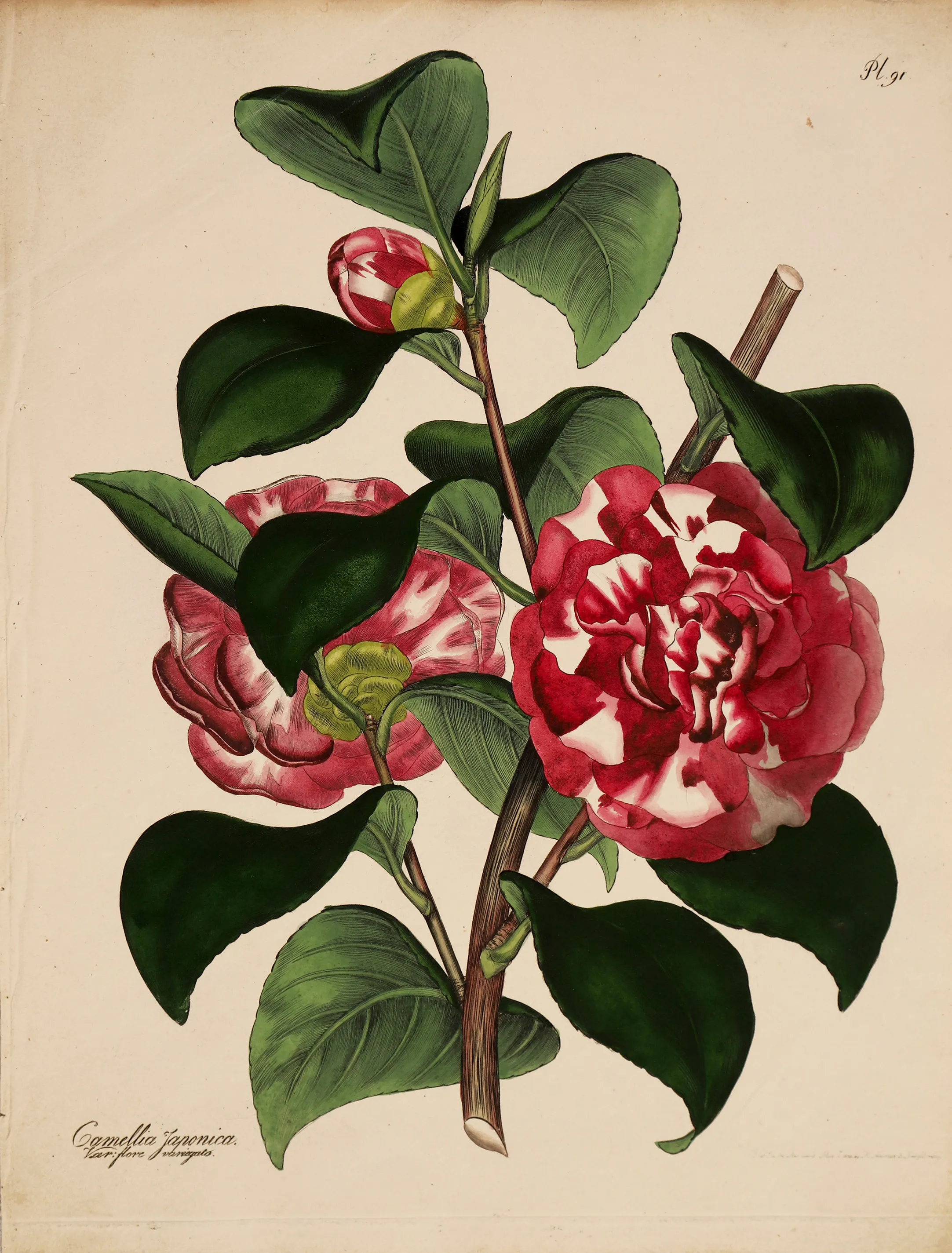
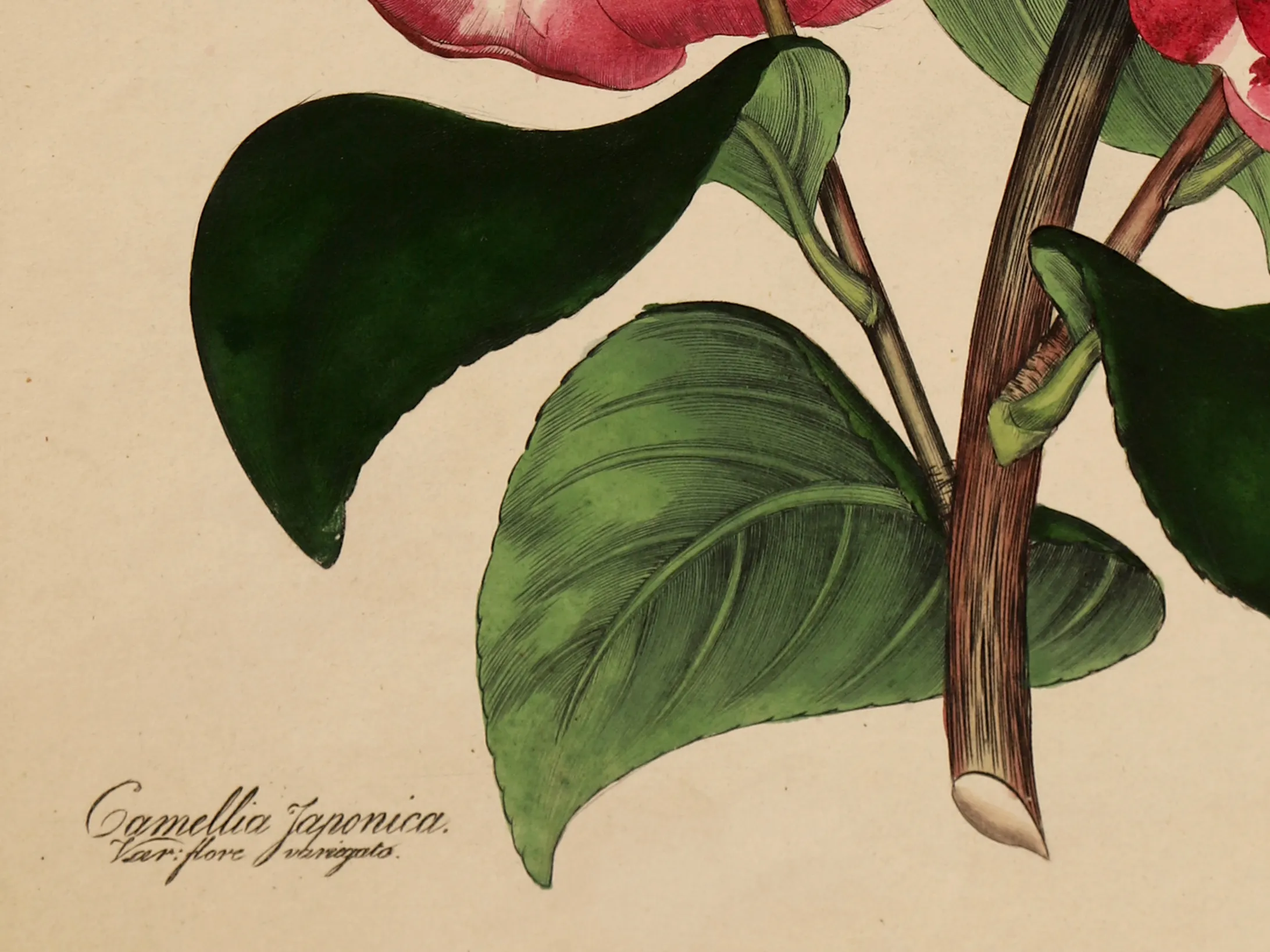
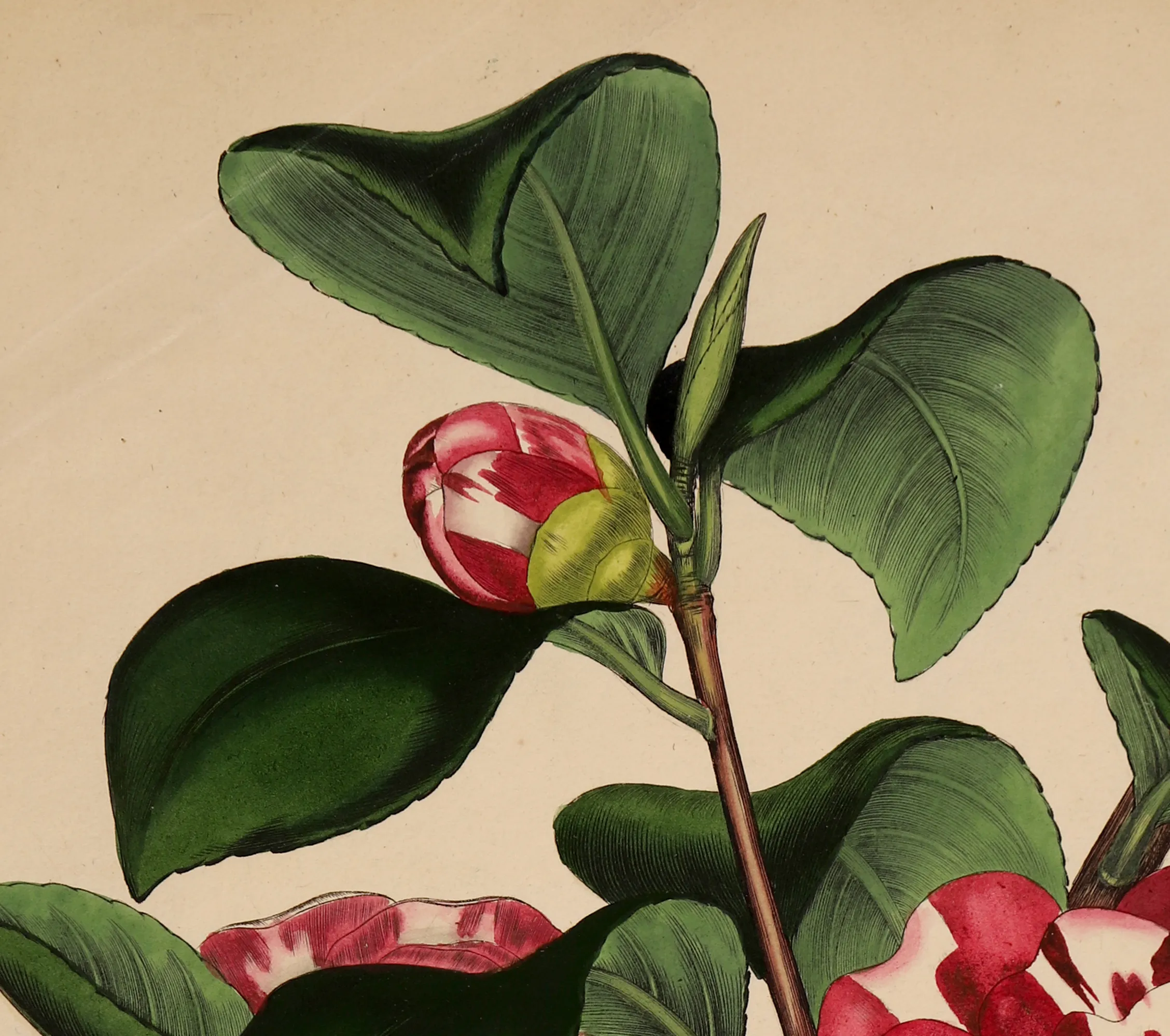
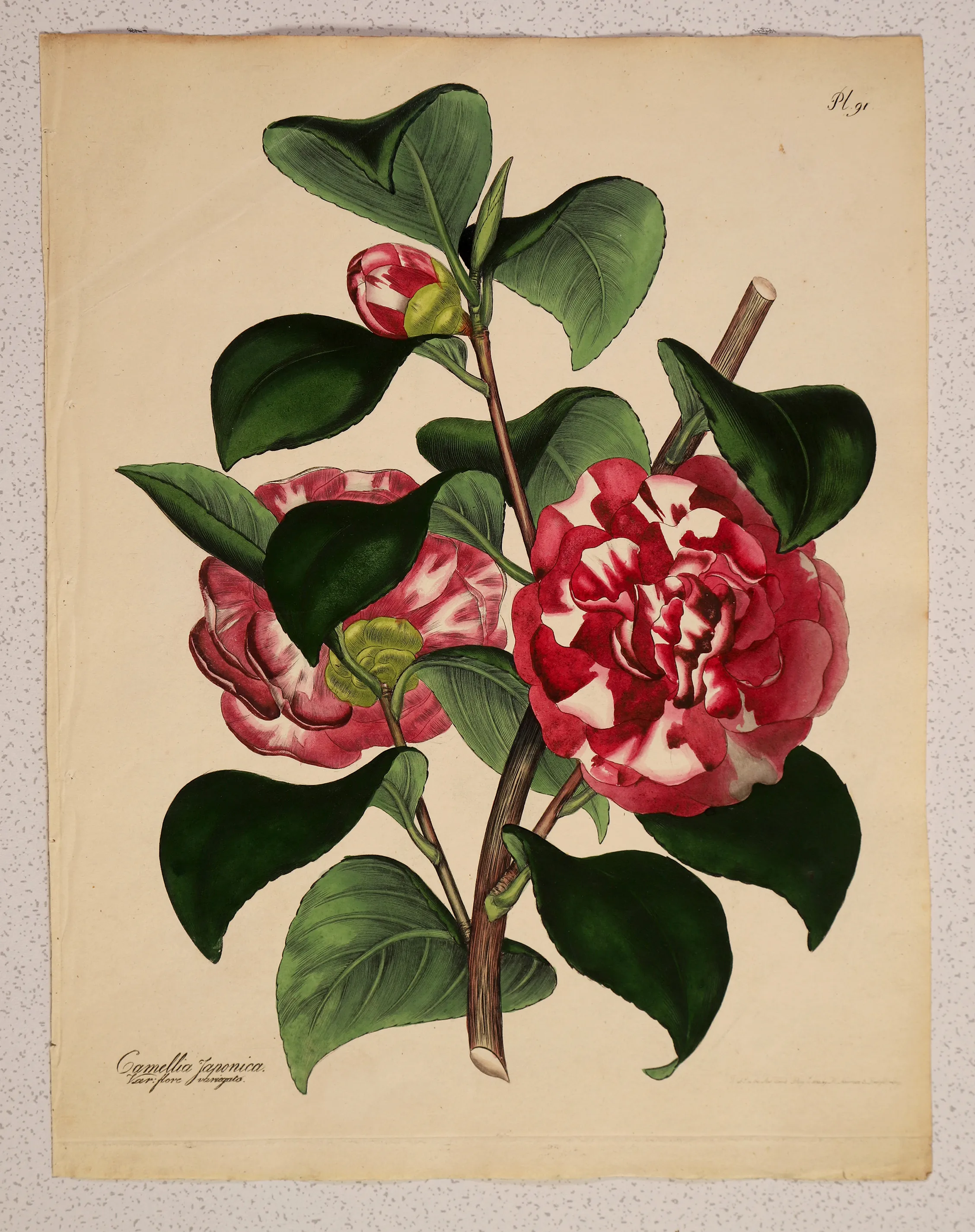
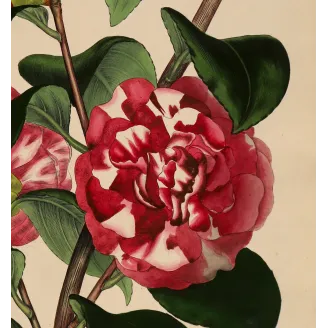
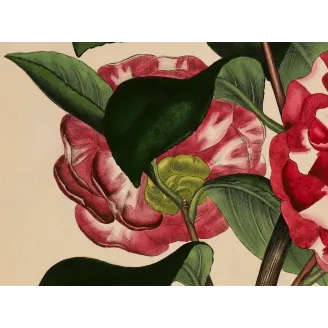
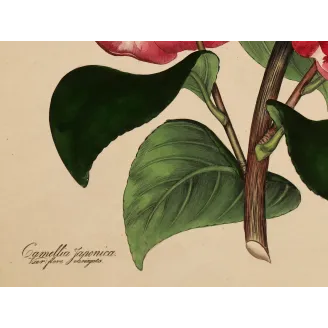
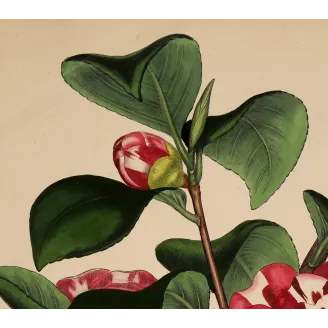
An original hand-coloured engraving of Camellia japonica from Henry Charles Andrews' celebrated The Botanist's Repository. Published around 1799, this elegant botanical print combines exceptionally refined hand colouring, selective gum arabic finishing on the foliage and Andrews' characteristic handwritten publication inscription.
 Delivery policy
Your print will be carefully prepared and shipped worldwide via trusted couriers (UPS or similar).
 Authentic antique prints
Original engravings from the 17th–19th century.
This beautiful original hand-coloured engraving from Henry Charles Andrews’ The Botanist’s Repository depicts the Japanese Camellia, Camellia japonica. Published in 1799 as Plate XCI (91), the print combines botanical precision with the delicacy and luminous freshness that distinguish Andrews’ finest representations of flowering plants.
Opening buds, fully expanded blossoms and mature evergreen leaves coexist naturally along the same branch. Rather than isolating a single flower, Andrews presents the plant as a living organism observed during successive stages of flowering, creating an image filled with vitality, renewal and the light of spring.
The composition develops around a gently curving branch whose rhythm is established by the alternating arrangement of blossoms, buds and leaves. Two fully opened flowers form the visual centre of the plate, while the smaller buds extend the movement of the branch and introduce successive moments in the plant’s natural flowering cycle.
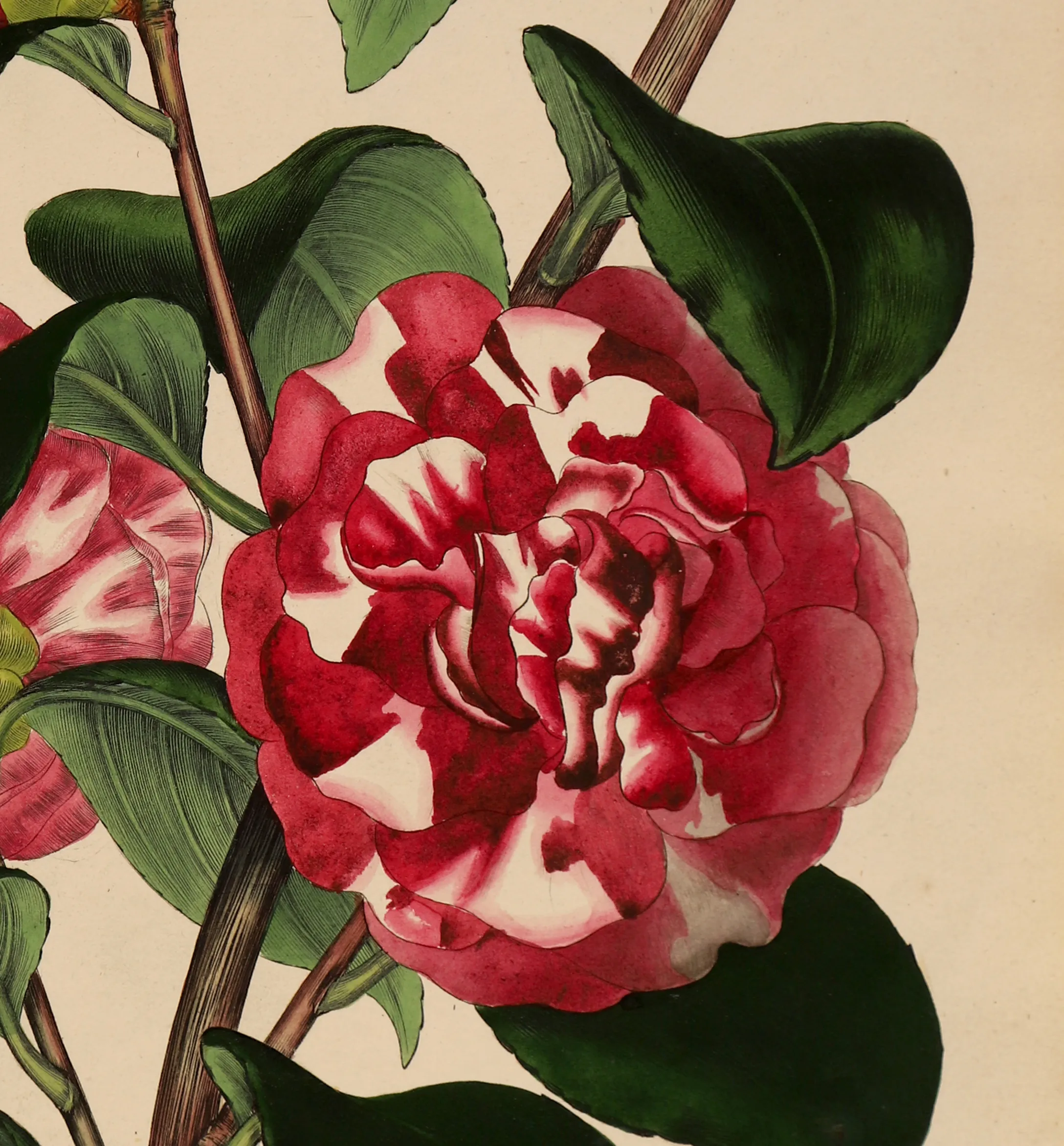
Andrews uses the white surface of the paper as an active source of light. Pale areas of the petals remain open and luminous, while delicate pink and crimson washes define their folds, edges and softly overlapping forms. The colouring is transparent and finely layered, giving the blossoms an almost translucent appearance.
The dark evergreen foliage provides structure and visual depth without overwhelming the flowers. Its richer green tones intensify the luminosity of the blossoms, creating a balanced dialogue between the permanence of the leaves and the fleeting freshness of the flowering season.
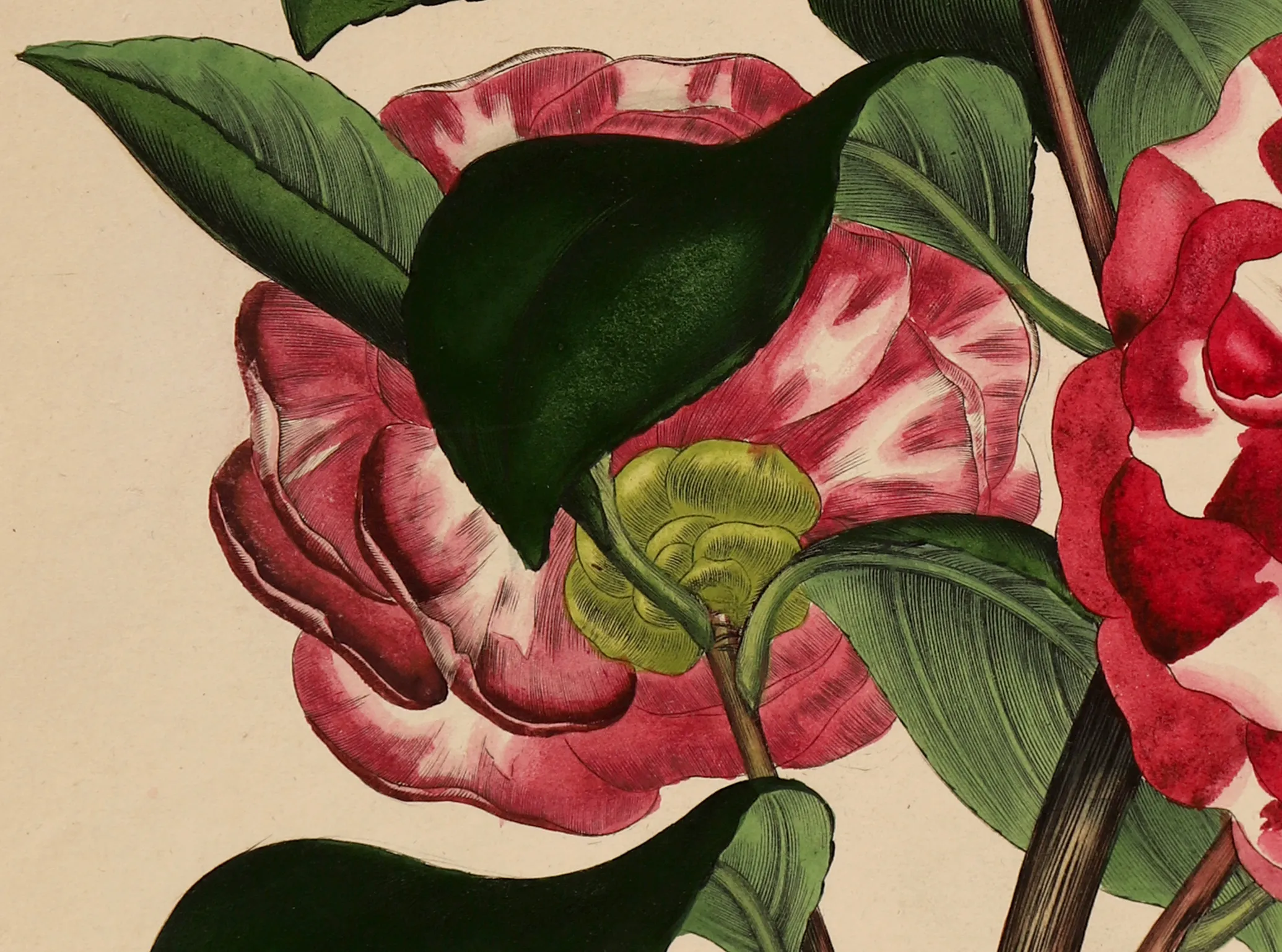
The engraved structure is deliberately restrained throughout the flowers. Fine engraved lines establish the essential framework of the image, but much of the modelling, volume and botanical character is created through transparent applications of hand-applied watercolour. The resulting effect is more painterly than that of a conventionally hand-coloured engraving and approaches the delicacy of an original botanical watercolour.
Camellia japonica is an evergreen flowering shrub native to East Asia and admired for its glossy foliage and elegant winter and spring blossoms. Its cultivation in European gardens became closely associated with the growing fascination for rare and newly introduced plants during the late eighteenth and early nineteenth centuries.
The contrast between durable evergreen leaves and delicate seasonal flowers made the camellia especially appealing to botanical artists. In this plate, Andrews records both characteristics with unusual sensitivity, preserving the botanical identity of the plant while also conveying its ornamental beauty.
To Georgian viewers, the Japanese Camellia represented more than an attractive garden flower. Its distant geographical origin, evergreen character and refined blossoms connected it with the expanding culture of botanical collecting, specialist nurseries and private horticultural collections that transformed British gardens during the period.
Close examination reveals the refinement of Andrews’ working method. The image was printed from a delicately engraved copperplate and subsequently brought to life through transparent layers of hand-applied watercolour.
The engraved framework remains intentionally restrained throughout the flowers. Rather than relying upon dense hatching or strongly defined engraved modelling, Andrews used the copperplate to establish a delicate underlying structure and allowed colour itself to describe volume, light and the soft construction of the petals.
This subtle relationship between printed line and hand colouring gives the finished impression a distinctly painterly character. The flowers capture light through finely layered transparent watercolour, producing a luminous, almost translucent quality that approaches the appearance of an original botanical watercolour.
By contrast, the selective application of gum arabic across the foliage creates gentle reflections that evoke the naturally glossy surface of living evergreen leaves. The finish is not distributed uniformly across the composition but is concentrated where it supports the material character of the plant.
Andrews therefore adapted his materials to the contrasting botanical qualities represented within the image. The petals softly diffuse light through transparent layers of colour, while the foliage reflects it with the restrained lustre characteristic of healthy evergreen leaves. The material qualities of the print closely echo those of the living plant.
At the lower right, the sheet preserves Andrews’ characteristic handwritten publication inscription rather than an engraved publication line. This minute notation originally recorded the publication details, commonly including the wording “Published as the Act directs”, the date, Andrews’ name and his address at 5 Knightsbridge, London.
The wording referred to the British Engravers’ Copyright Act of 1735, widely known as Hogarth’s Act. The legislation was created to protect engravers and graphic artists against unauthorised copying. Although discreet, the surviving handwritten inscription forms an integral part of the publication history and material identity of this original impression and should not be mistaken for a later annotation.
Examination of another original sheet belonging to this Prantique group of Andrews engravings revealed a clearly legible J. Whatman 1794 watermark. The discovery documents the use within the group of fine English paper associated with the celebrated Whatman mill, renowned for producing high-quality papers for artists, engravers and publishers.
The watermark is a collection-level observation and has not been recorded as visible on this individual sheet. Nevertheless, together with the surviving copperplate impression, original hand colouring, selective gum arabic finishing and handwritten publication inscription, it provides valuable material context for the production of The Botanist’s Repository.
Andrews was unusual among botanical illustrators because he maintained close control over almost every stage of production. He drew from living plants, engraved the copperplates, prepared the impressions, coloured the plates and published the work himself. This integration of observation, engraving, colour and publishing gives his botanical images their extraordinary consistency and distinctive visual identity.
This engraving belongs to Henry Charles Andrews’ extraordinary world of new and rare plants, created during Britain’s great age of botanical exploration. Discover Andrews’ unusual working method and the material evidence preserved within original impressions, including hand colouring, engraved structure, publication inscriptions, historical trimming, selected applications of gum arabic and Whatman paper.
Henry Charles Andrews and Britain’s Passion for Exotic Plants →
Very Good condition. Exceptionally clean original late eighteenth-century paper with remarkably fresh hand colouring and beautifully preserved selective gum arabic finishing on the foliage. The sheet displays only minimal signs of age and handling, entirely consistent with its authenticity and remarkable state of preservation. The delicate handwritten publication inscription remains visible at the lower right. Please examine the professional high-resolution photographs for a complete visual assessment.
Historical and accepted botanical name: Camellia japonica L.
Common name: Japanese Camellia
Work: The Botanist’s Repository, for New, and Rare Plants
Author, artist and engraver: Henry Charles Andrews
Publisher: Henry Charles Andrews, 5 Knightsbridge, London
Date: 1799
Technique: Original copper engraving with hand-applied watercolour and selective gum arabic finishing
Surface finishing: Selective gum arabic applied to the foliage
Publication inscription: Handwritten publication inscription at the lower right
Watermark: Not observed on this individual impression
Plate: XCI (91)
Plant family: Theaceae
Native region: East Asia
Sheet size: approx. 28 × 22 cm
Specific References
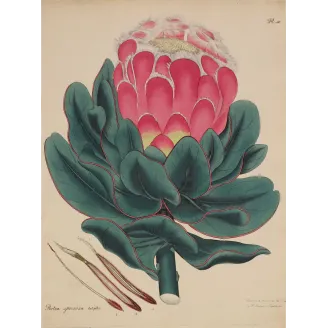
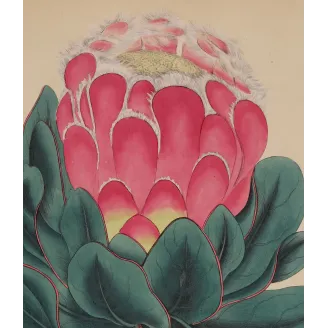
Monumental original hand-coloured engraving of the Broad-Leaved Showy Protea, published as Plate 110 in Henry Charles Andrews’ The Botanist’s Repository. Its sculptural blue-green foliage and extraordinary rose-pink flower make this one of the most iconic botanical images in the collection.
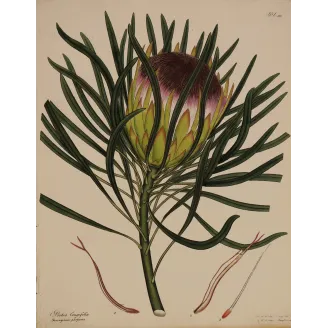
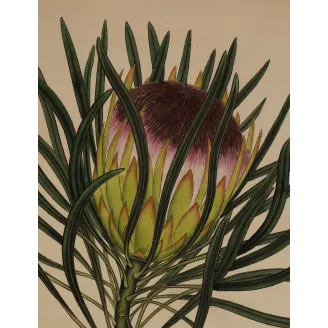
An original hand-coloured copper engraving depicting Protea longifolia (Rusty-purple Flower), published by Henry Charles Andrews in The Botanist's Repository in 1801. Distinguished by its protective arrangement of evergreen foliage, subtle engraved structure and exceptionally refined transparent watercolour.
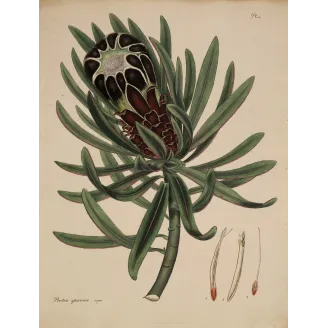
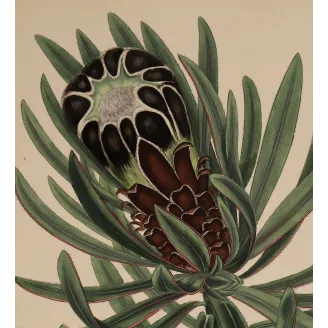
A striking original hand-coloured engraving depicting the Black-Flowered Showy Protea, published by Henry Charles Andrews in The Botanist's Repository in 1799. Monumental foliage, sculptural flower structure and beautifully preserved hand colouring make this one of the most architecturally impressive plates of the series.
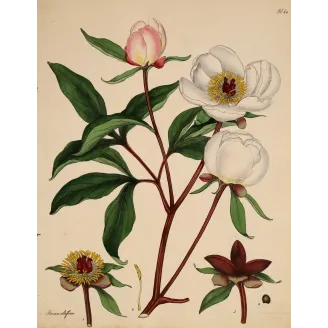
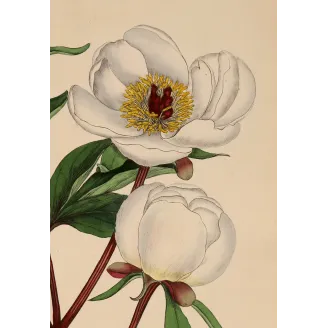
An exceptionally refined original hand-coloured engraving depicting the White Peony, published by Henry Charles Andrews in The Botanist's Repository in 1799. Delicate grey modelling, luminous white petals and beautifully preserved gum arabic finishing make this one of the finest botanical plates of the series.
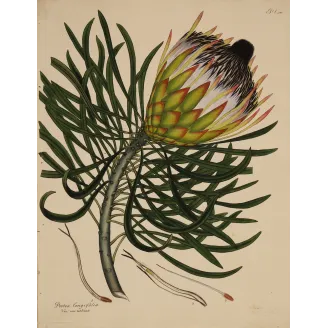
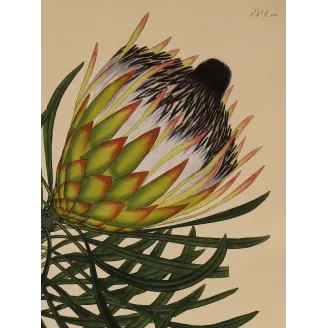
An original hand-coloured copper engraving depicting the Long-Leaved Protea (Protea longifolia), published by Henry Charles Andrews in The Botanist's Repository in 1801. Elegant linear foliage, a dramatic emerging flower head and exceptionally refined hand colouring distinguish one of the most dynamic Protea compositions of the series.
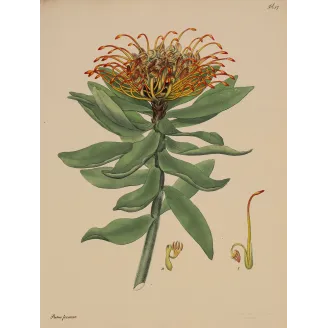
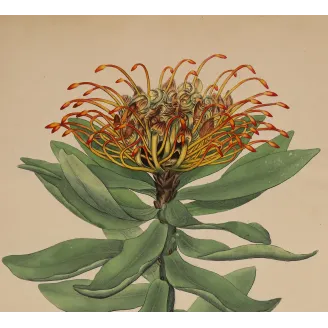
An original hand-coloured copper engraving of Protea formosa, published by Henry Charles Andrews in The Botanist's Repository (1799). Distinguished by its spectacular upward flowering styles, exceptionally delicate watercolour and refined botanical execution, this plate represents one of the most elegant Protea engravings of the series.
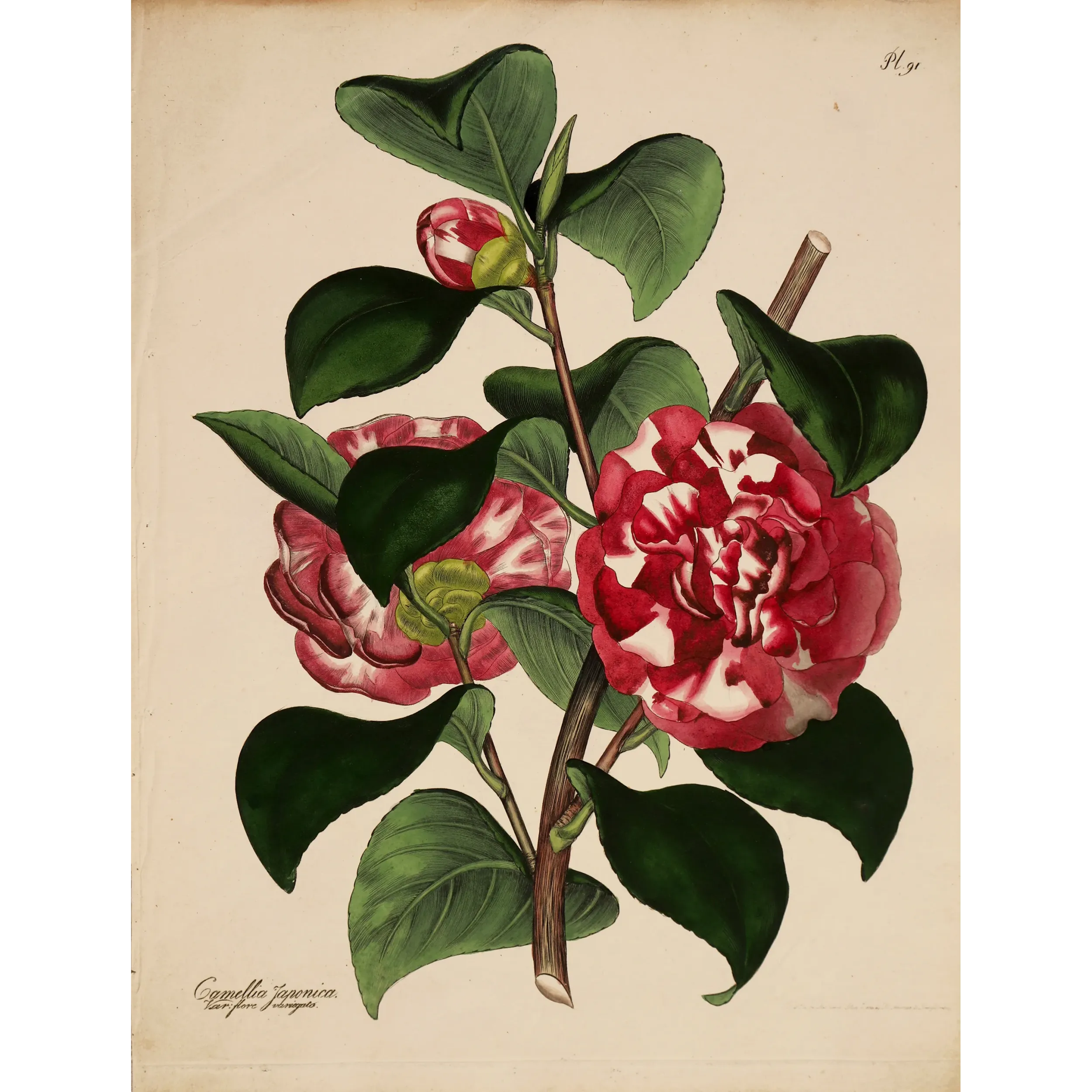
An original hand-coloured engraving of Camellia japonica from Henry Charles Andrews' celebrated The Botanist's Repository. Published around 1799, this elegant botanical print combines exceptionally refined hand colouring, selective gum arabic finishing on the foliage and Andrews' characteristic handwritten publication inscription.