- New
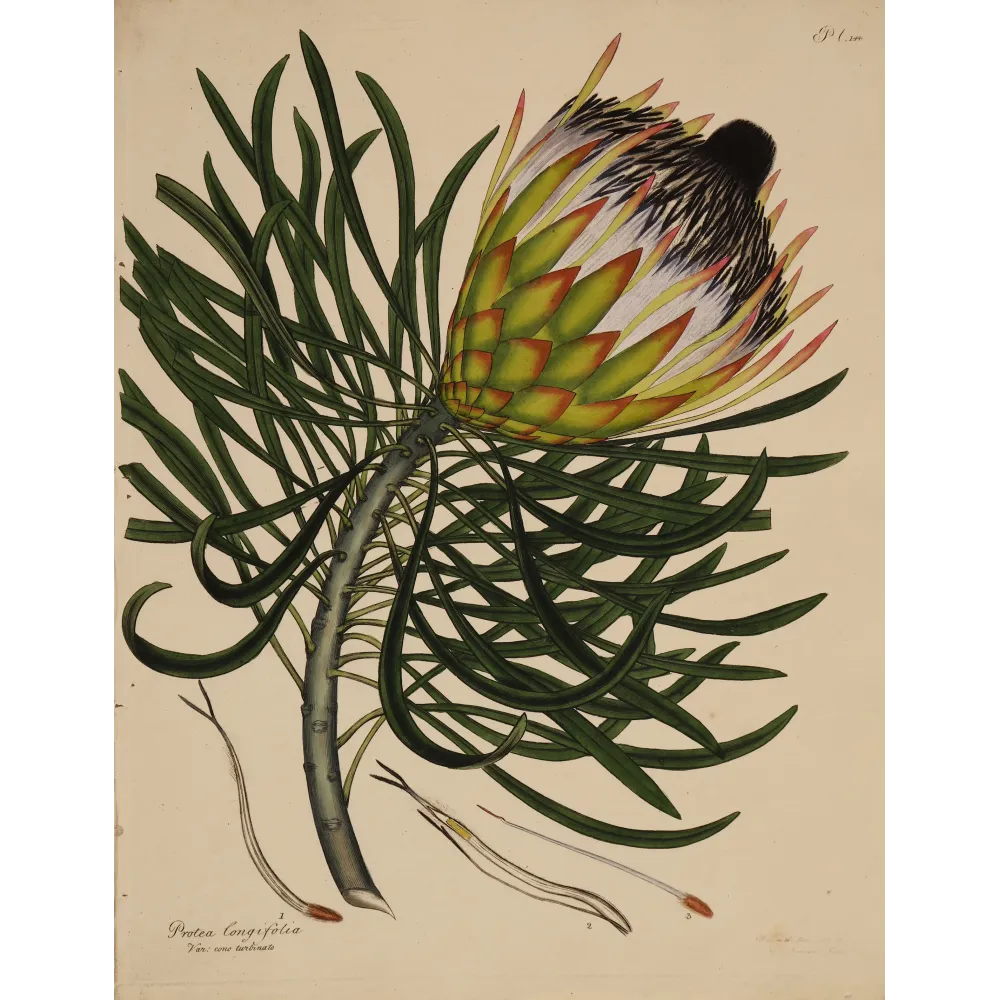
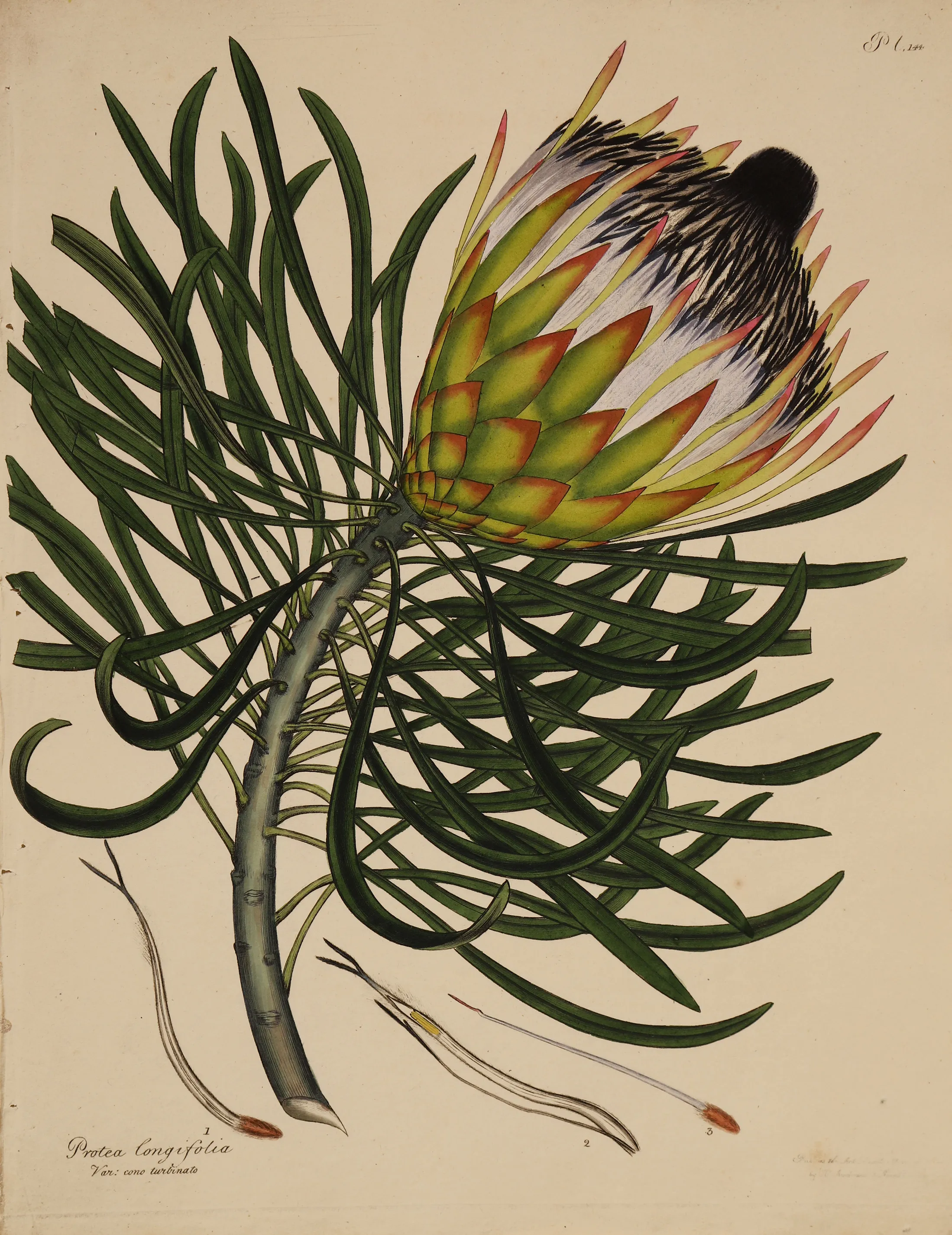
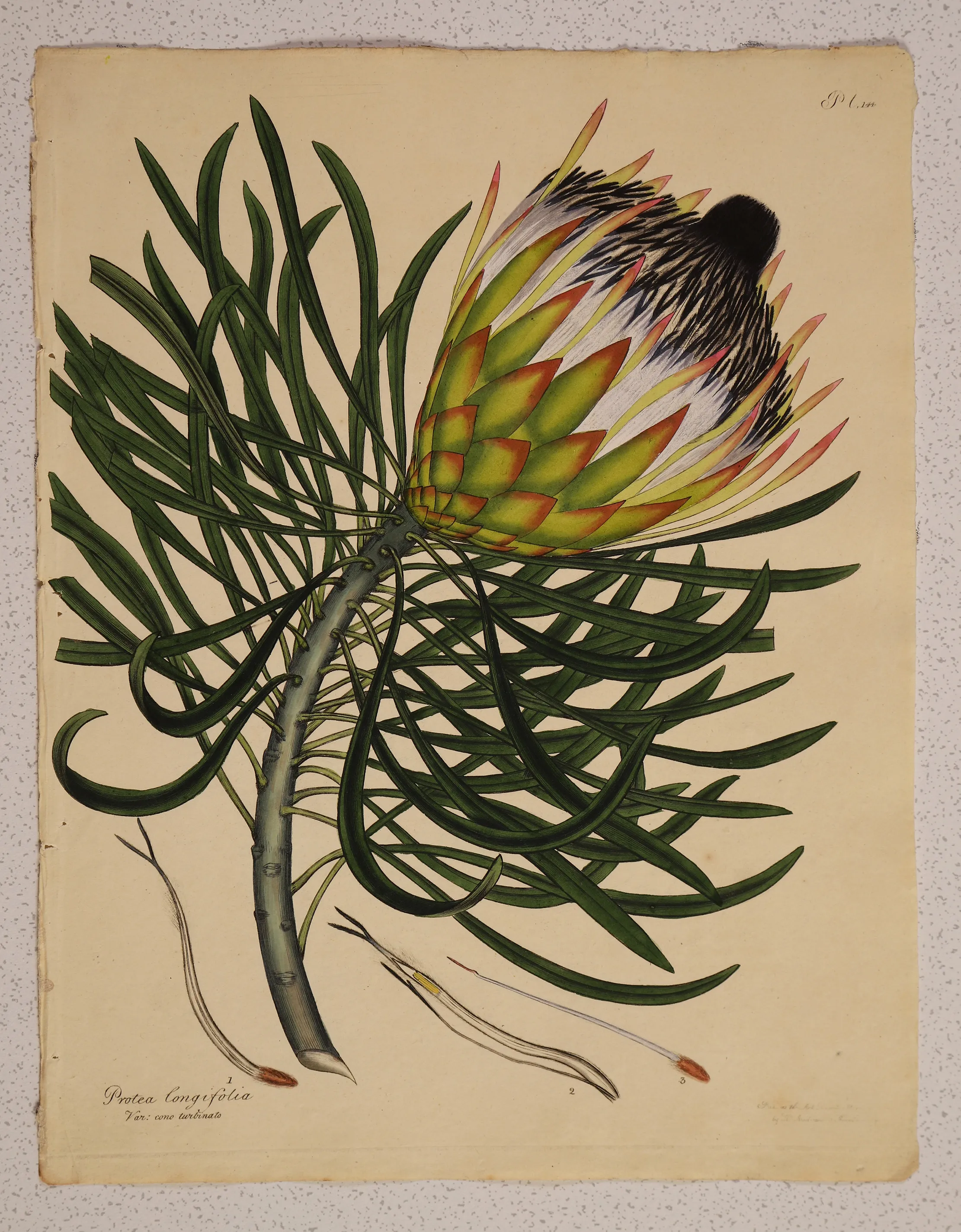
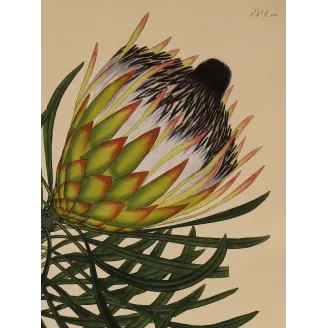
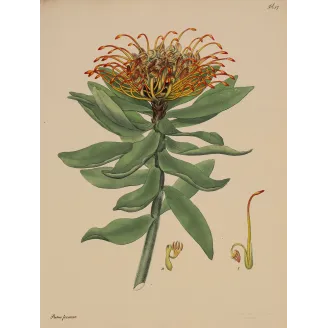
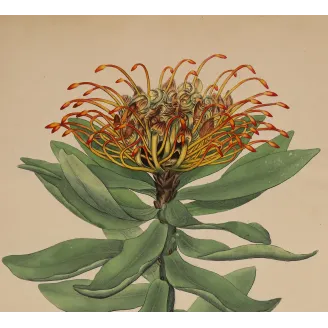
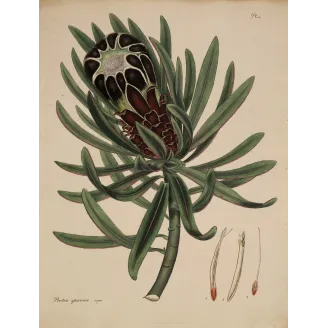
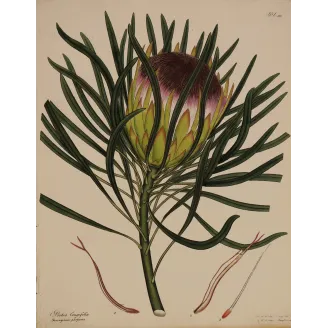
An original hand-coloured copper engraving depicting the Long-Leaved Protea (Protea longifolia), published by Henry Charles Andrews in The Botanist's Repository in 1801. Elegant linear foliage, a dramatic emerging flower head and exceptionally refined hand colouring distinguish one of the most dynamic Protea compositions of the series.
 Delivery policy
Your print will be carefully prepared and shipped worldwide via trusted couriers (UPS or similar).
 Authentic antique prints
Original engravings from the 17th–19th century.
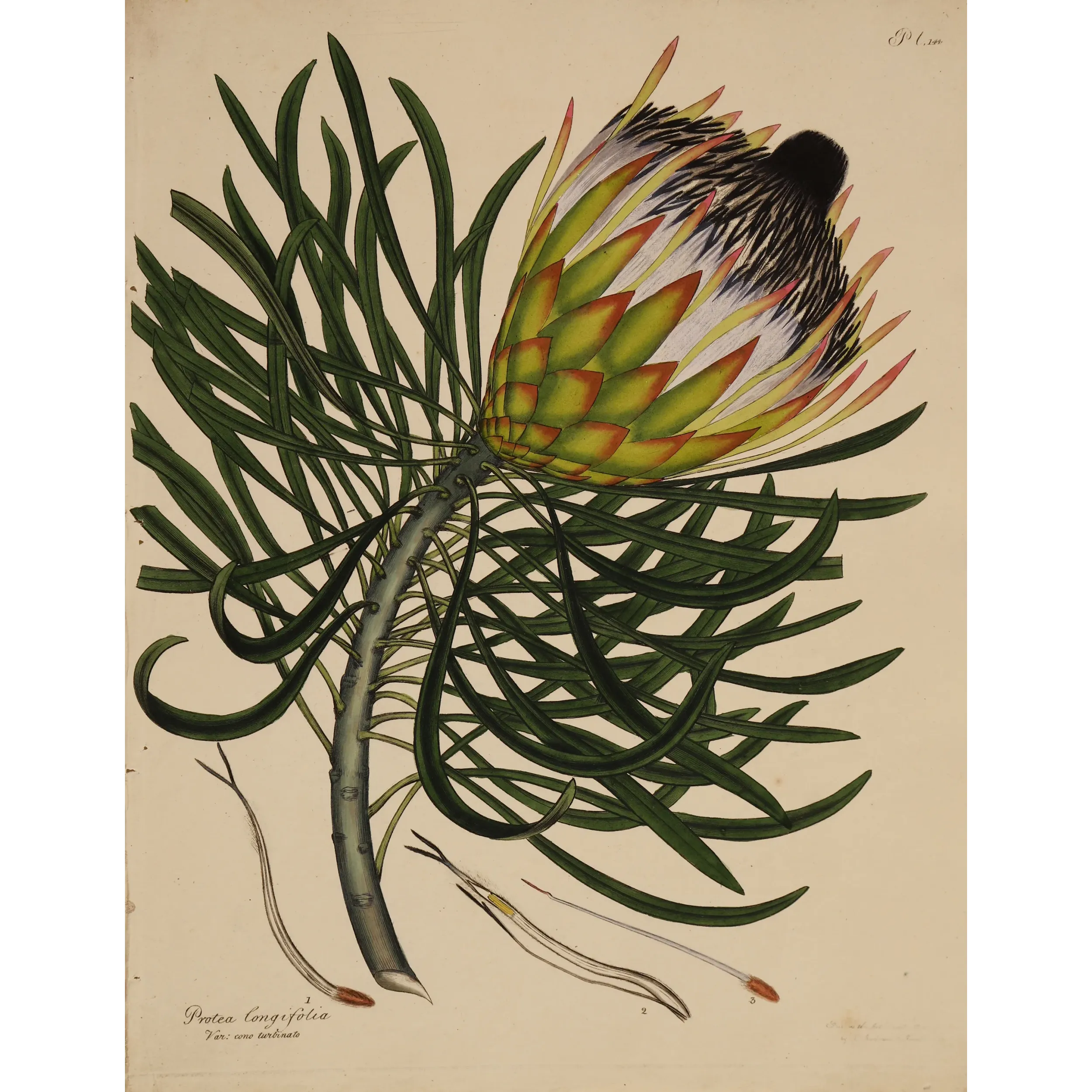
This exceptional original hand-coloured engraving from Henry Charles Andrews’ The Botanist’s Repository depicts the Long-Leaved Protea, historically identified as Protea longifolia, var. cono turbinato. Published in 1801, the plate combines an intricate network of elongated foliage with a magnificent flower head that emerges decisively towards the upper right of the composition.
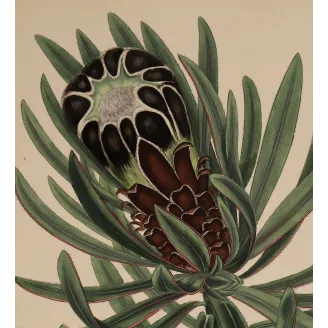
The flower appears to rise from a dense weave of dark green leaves in search of open space and light. Its pale inner structures, vivid green and red bracts and almost black flowering crown form a powerful architectural volume, while the flowing foliage beneath creates a contrasting language of movement, rhythm and line.
Unlike the predominantly vertical structures of several other Protea plates, this composition develops dynamically from left to right. The curving stem enters from below before bending towards the upper right, directing the viewer’s gaze towards the monumental flower head.
The foliage forms an exceptionally intricate network of elongated linear rhythms. Narrow leaves cross, overlap and turn through space, creating a dense botanical weave without losing their individual clarity. Their repeated curves generate movement throughout the lower and central parts of the image.
Some leaves project sharply outward, while others bend into broad loops or disappear behind neighbouring forms. Andrews uses these changes in direction to suggest both the natural flexibility of the foliage and the three-dimensional structure of the plant.
The composition is built upon a dialogue between two contrasting visual languages. The leaves form an animated network of dark linear forms, while the flower head emerges as a compact architectural volume. Andrews balances these opposing structures with remarkable clarity, allowing the eye to move naturally from the dense foliage towards the luminous inflorescence.
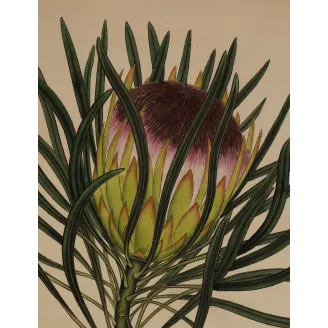
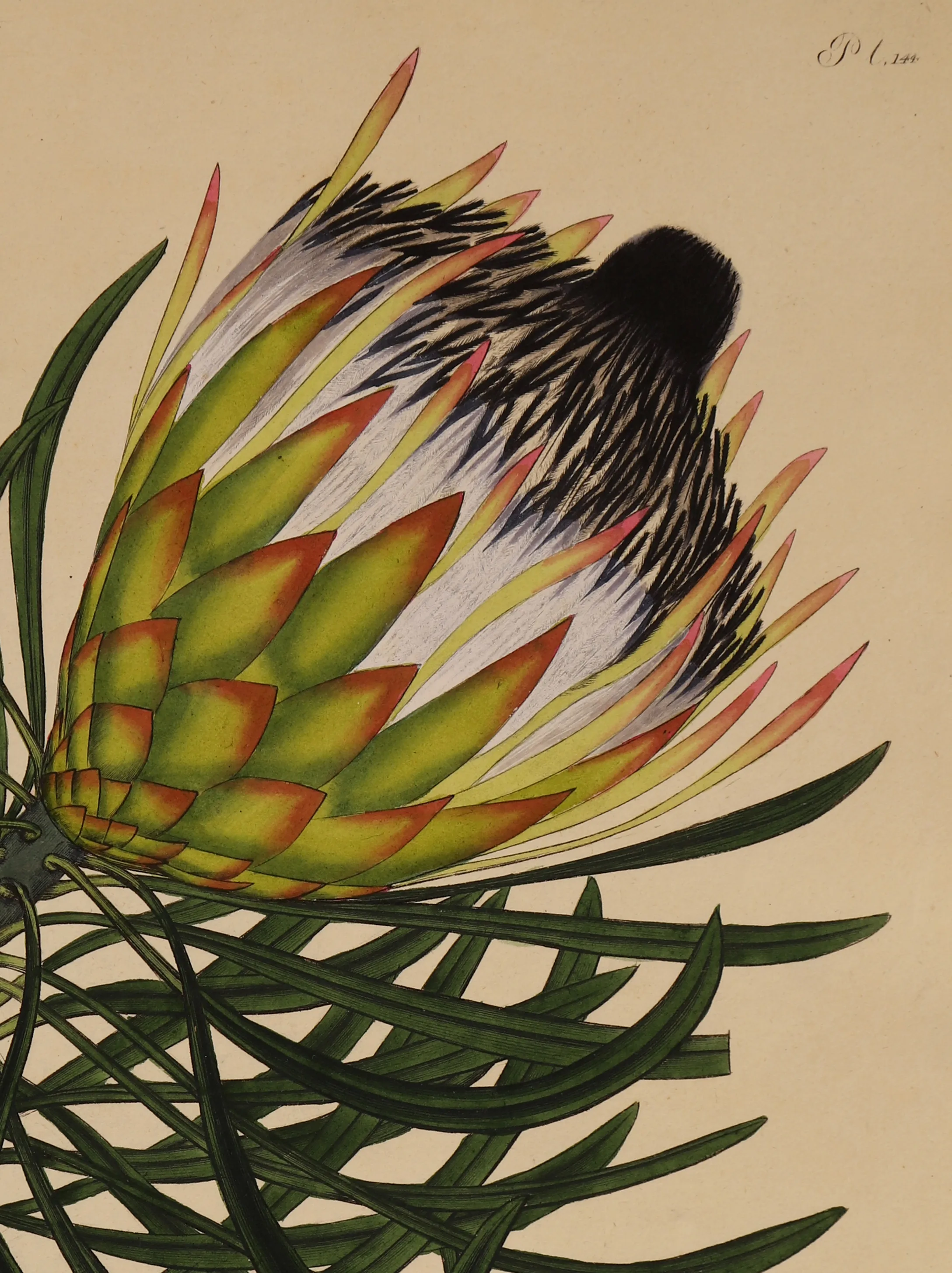
The flower head opens towards the right, as though extending beyond the surrounding foliage in search of light. Its overlapping green bracts are warmed by red and russet margins, creating a gradual transition towards the pale inner structures and the dark terminal crown.
The near-black flowering structures provide the strongest visual accent in the plate. Their dense, finely articulated mass contrasts with the pale areas immediately beneath them, intensifying the depth and sculptural presence of the flower.
The isolated botanical details arranged along the lower edge reveal the reproductive structures represented within the flower head. Their quiet linear precision provides a scientific counterpoint to the powerful decorative impact of the complete plant.
Protea longifolia belongs to the Proteaceae, a remarkable family of flowering plants strongly associated with the Cape region of South Africa. The species is distinguished by its exceptionally long, narrow foliage and by the dramatic architectural form of its inflorescence.
Andrews described this plate as the third variety of the Long-Leaved Protea represented in The Botanist’s Repository. He characterised its leaves as nearly linear, narrow, oblique, rigid and very long, and noted the dark purple colouring of the inner floral structures and flowering plume.
The historical varietal designation cono turbinato refers to the distinctive top-shaped or turbinate form of the flower cone. Although such historical varieties are not necessarily maintained within modern botanical classification, the original name remains fundamental to the identity and publication history of this engraving.
The accompanying text records that the plant was considered as rare as the other Long-Leaved Protea varieties already published by Andrews. It had been raised from seed by the celebrated Lee and Kennedy nursery in Hammersmith, one of the most important centres for the cultivation of exotic plants in Georgian Britain.
According to Andrews, the seeds had been received from the superintendent of the Imperial Gardens at Schönbrunn in Vienna. This provenance reflects the international exchange of seeds, living plants and botanical knowledge that connected European gardens, nurseries and private collections during the great age of plant exploration.
Andrews made his drawing in January 1801 from a plant cultivated in the renowned collection of George Hibbert. Although the species was reputed to be difficult to propagate, Andrews observed that it flourished when planted in light, loamy soil, revealing his practical engagement with living plants as well as their artistic representation.
Close examination reveals an exceptionally restrained engraved framework beneath the hand colouring. The copperplate provides the essential botanical structure, but it remains deliberately subordinate to the finely layered watercolour that creates most of the visual modelling.
Rather than constructing volume through dense engraved shading, Andrews uses the burin selectively to define contours, narrow internal divisions and minute botanical details. The engraved marks are so light across certain areas that the finished plate approaches the appearance of an original botanical watercolour.
This instrumental use of engraving is especially visible along the curving stem. Fine marks describe its surface texture, scars, nodes and small emerging buds with remarkable precision. These details strengthen the botanical credibility of the image without interrupting the fluidity of the painted surface.
The foliage is modelled predominantly through transparent green watercolour. Successive tonal layers establish curvature, depth and overlap, while deeper passages along selected edges distinguish individual leaves within the dense composition.
Selective gum arabic is preserved across the foliage. Its gentle reflections evoke the smooth, living surface of the narrow evergreen leaves and allow individual forms to catch the light as they turn through the complex arrangement.
The gum arabic does not flatten the foliage into a uniform glossy mass. Instead, its selective application works together with the transparent colour and delicate engraved contours, reinforcing the distinction between overlapping leaves and increasing the spatial depth of the composition.
The flower head is treated through a more concentrated chromatic structure. Green bracts progress towards red and russet tips, pale inner forms create passages of reflected light, and the dark flowering crown establishes the visual culmination of the image.
The plate therefore depends upon a carefully calibrated relationship between line, colour and surface. The engraved framework defines botanical information, watercolour constructs volume and atmosphere, and gum arabic activates the foliage through subtle variations of reflected light.
At the lower right, the sheet preserves Andrews’ characteristic handwritten publication inscription. The notation remains legible and forms an original component of the plate’s publication history rather than a later annotation.
The inscription commonly includes the wording “Published as the Act directs”, together with the date, Andrews’ name and his address at 5 Knightsbridge, London. Its presence records both the legal publication and the commercial circulation of the engraving.
The wording referred to the British Engravers’ Copyright Act of 1735, widely known as Hogarth’s Act. Created to protect engravers and graphic artists against unauthorised copying, the legislation required publication information that helped establish ownership of the design.
The vertical plate mark is not visible on this individual impression. Its absence should not be understood as evidence of severe trimming, since the sheet preserves substantial surrounding paper and the visibility of a plate mark can vary according to printing pressure, binding and the subsequent material history of the impression.
No watermark has been observed on this individual sheet. Examination of another original impression belonging to this Prantique group of Andrews engravings, however, revealed a clearly legible J. Whatman 1794 watermark, documenting the use of fine English Whatman paper within the publication.
Although the watermark is a collection-level observation rather than a feature recorded on this sheet, it provides valuable material context. Together with the restrained engraving, original hand colouring, selective gum arabic and handwritten publication inscription, it helps reconstruct the sophisticated artisanal production of The Botanist’s Repository.
Henry Charles Andrews was unusual among botanical artists because he maintained close control over almost every stage of production. He drew from living specimens, engraved the copperplates, supervised or executed the colouring and published the work himself. This integration of observation, engraving, painting and publishing enabled him to adapt the visual language of each plate to the distinctive character of the plant represented.
This engraving belongs to Henry Charles Andrews’ extraordinary world of new and rare plants, created during Britain’s great age of botanical exploration. Discover Andrews’ unusual working method and the material evidence preserved within original impressions, including hand colouring, engraved structure, handwritten publication inscriptions, selective applications of gum arabic and historical Whatman paper.
Henry Charles Andrews and Britain’s Passion for Exotic Plants →
Excellent condition. Exceptionally clean original early nineteenth-century paper with remarkably fresh and finely preserved hand colouring. No visible stains, foxing or signs of use are present. The delicate engraved details remain clearly defined, while the selective gum arabic across the foliage retains its subtle reflective quality. The original handwritten publication inscription remains legible. Please examine the professional high-resolution photographs for a complete visual assessment.
Historical botanical name: Protea longifolia
Historical variety: Var. cono turbinato — top-shaped cone
Accepted botanical name: Protea longifolia Andrews
Common name: Long-Leaved Protea
Work: The Botanist’s Repository, for New, and Rare Plants
Author, artist and engraver: Henry Charles Andrews
Publisher: Henry Charles Andrews, 5 Knightsbridge, London
Date: 1801
Technique: Original copper engraving with hand-applied watercolour and selective gum arabic finishing
Surface finishing: Selective gum arabic applied across the elongated foliage
Publication inscription: Original handwritten publication inscription present and legible at the lower right
Plate mark: Vertical plate mark not visible on this impression
Watermark: Not observed on this individual impression
Plate: CXLIV (144)
Plant family: Proteaceae
Historical provenance of the plant: Raised from seed by Lee and Kennedy, Hammersmith; seeds supplied through the Imperial Gardens at Schönbrunn, Vienna
Drawing recorded: January 1801, from a plant in the collection of George Hibbert
Native region: South Africa, Cape region
Sheet size: approx. 28 × 22 cm
Specific References
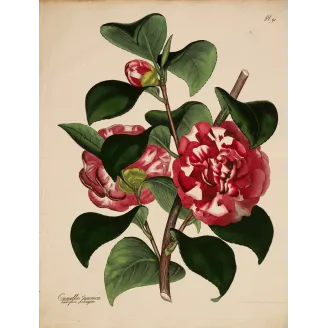
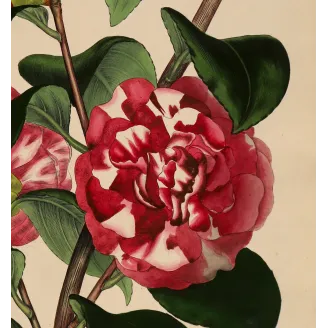
An original hand-coloured engraving of Camellia japonica from Henry Charles Andrews' celebrated The Botanist's Repository. Published around 1799, this elegant botanical print combines exceptionally refined hand colouring, selective gum arabic finishing on the foliage and Andrews' characteristic handwritten publication inscription.
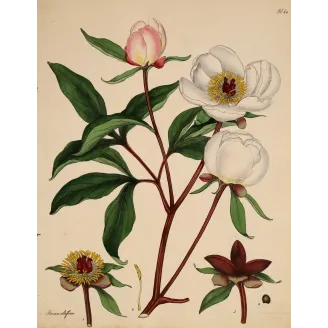
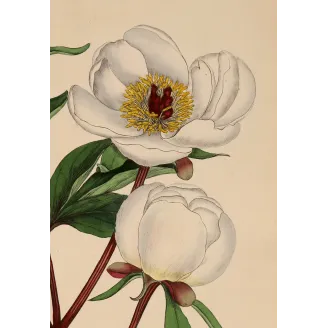
An exceptionally refined original hand-coloured engraving depicting the White Peony, published by Henry Charles Andrews in The Botanist's Repository in 1799. Delicate grey modelling, luminous white petals and beautifully preserved gum arabic finishing make this one of the finest botanical plates of the series.
An original hand-coloured copper engraving of Protea formosa, published by Henry Charles Andrews in The Botanist's Repository (1799). Distinguished by its spectacular upward flowering styles, exceptionally delicate watercolour and refined botanical execution, this plate represents one of the most elegant Protea engravings of the series.
A striking original hand-coloured engraving depicting the Black-Flowered Showy Protea, published by Henry Charles Andrews in The Botanist's Repository in 1799. Monumental foliage, sculptural flower structure and beautifully preserved hand colouring make this one of the most architecturally impressive plates of the series.
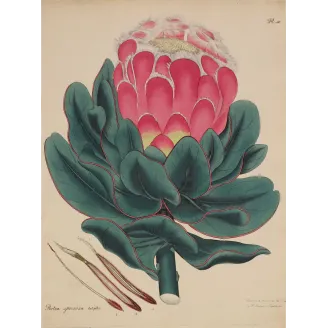
Monumental original hand-coloured engraving of the Broad-Leaved Showy Protea, published as Plate 110 in Henry Charles Andrews’ The Botanist’s Repository. Its sculptural blue-green foliage and extraordinary rose-pink flower make this one of the most iconic botanical images in the collection.
An original hand-coloured copper engraving depicting Protea longifolia (Rusty-purple Flower), published by Henry Charles Andrews in The Botanist's Repository in 1801. Distinguished by its protective arrangement of evergreen foliage, subtle engraved structure and exceptionally refined transparent watercolour.
An original hand-coloured copper engraving depicting the Long-Leaved Protea (Protea longifolia), published by Henry Charles Andrews in The Botanist's Repository in 1801. Elegant linear foliage, a dramatic emerging flower head and exceptionally refined hand colouring distinguish one of the most dynamic Protea compositions of the series.