
Histoire Naturelle des Oiseaux Exotiques: Art, Observation and the Living Bird
Histoire Naturelle des Oiseaux Exotiques: Art, Observation and the Living Bird
Published in Paris in 1836, Histoire Naturelle des Oiseaux Exotiques belongs to a period when European natural history was encountering an extraordinary expansion of the known natural world. Birds from distant regions fascinated naturalists and artists through an unfamiliar richness of colour, form and behaviour.
The work was conceived by C. L. Lemaire, a doctor of medicine and man of science, as part of the wider culture of nineteenth-century natural history. Its illustrations were entrusted to Pauquet, whose name appears prominently in the original edition as the artist responsible for figures peintes d’après nature and engraved on steel.
From the outset, the project joined two ambitions that might appear separate but are repeatedly brought together within its pages: to communicate knowledge of remarkable birds and to preserve something of the visual fascination of the living animal.
That ambition is immediately visible in the plates. The birds are carefully identifiable, yet they are rarely reduced to static specimens. They turn, climb, lean, reach towards flowers and engage with the branches and other birds around them. They appear alive.
Lemaire’s 1836 Ornithological Project
Histoire Naturelle des Oiseaux Exotiques was published in Paris in 1836 under the authorship of C. L. Lemaire. The original edition identifies Pauquet both with the production of its natural-history images and as one of the publishers of the work.
Lemaire approached ornithology within a culture of knowledge assembled from many interconnected sources. Established naturalists provided a foundation of published observation, while more recent accounts brought information from travellers and naturalists who had encountered unfamiliar species across distant regions of the world.
Among the authorities invoked by the work were Buffon, Levaillant, Vieillot, Temminck and Desmarest. Their accumulated knowledge could be considered alongside newer observations, allowing the illustrated book to become a meeting place between earlier scholarship and an expanding natural world.
The resulting publication was therefore more than an album of beautiful birds. Text and image participated in the same intellectual project: to make distant species visible, intelligible and memorable.
Why Exotic Birds?
For Lemaire, birds occupied an exceptional place within the animal kingdom. Their appearance could inspire both interest and admiration, while nature seemed to display through them an extraordinary abundance of colour, form and variety.
This fascination became particularly intense when attention turned towards tropical and equatorial regions. More constant warmth, vivid light and luxuriant vegetation appeared to find their counterpart in birds of remarkable chromatic brilliance. Cotingas, tanagers, hummingbirds, bee-eaters, parrots and birds of paradise offered some of the most spectacular examples.
The colours of certain species could seem comparable in brilliance to precious metals and sparkling stones. Yet visual splendour alone did not determine the structure of the project.
Lemaire deliberately concentrated upon species considered especially remarkable. Selection was therefore built into the conception of Oiseaux Exotiques: the work sought examples capable of revealing the extraordinary variety of birds rather than reducing that variety to an indiscriminate inventory.
Scientific interest and visual distinction were not competing criteria. In the most compelling subjects, they reinforced one another.
Beyond the Beauty of Plumage
The beauty of plumage was only one part of Lemaire’s conception of the bird.
Its mœurs et habitudes — behaviour and ways of life — deserved equal attention. Migration, the search for food, changes of season, nest construction and social organisation all contributed to an understanding of the animal.
Some birds gathered into groups; others lived in pairs or followed predominantly solitary lives. Each species possessed particular habits through which its natural history extended beyond anatomy and plumage.
This distinction is fundamental to understanding the images that follow. The subject to be represented was not simply the identifiable specimen, but the living bird.
Peintes d’Après Nature: The Gesture of the Living Bird
The original title page describes Pauquet’s figures with a concise but revealing expression: peintes d’après nature.
Across the plates, this relationship with nature is expressed not only through accurate plumage, proportion and identifying features, but through gesture. Pauquet repeatedly gives the birds a convincing sense of physical action.
Bodies turn and incline. Heads depart from the axis of the torso. Claws grip branches at angles that imply weight and balance. Wings open, tails establish direction, and bills reach towards flowers or vegetation.
The bird is not merely shown. It appears to be doing something.
When several birds occupy the same plate, their individual attitudes create relationships across the composition. One may lean while another turns; an extended tail may counter the direction of another body; a branch may become the structural axis around which the entire group is organised.
The vegetation participates without becoming a picturesque landscape. Branches provide resistance and support. Flowers create destinations. Leaves establish rhythm and direction. Nature gives the bird something to inhabit.
This is one of the most distinctive achievements of Histoire Naturelle des Oiseaux Exotiques. Pauquet preserves ornithological clarity while allowing the individual bird to appear momentarily caught within the continuity of life.
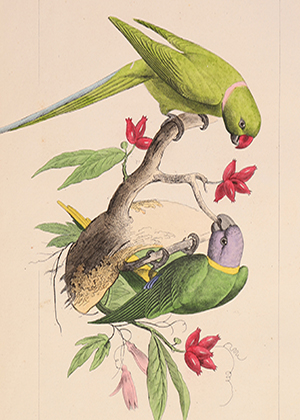
Two opposing gestures organised around the same branch reveal how Pauquet transforms anatomical precision into the suggestion of living movement.
A single plate allows Pauquet’s visual strategy to be read in detail. Two parrots share the same branching structure, yet nothing in their arrangement suggests static symmetry.
The upper bird shifts its weight forward and downward towards a flower. Its head and bill continue the direction established by the inclined body, while the feet gripping the branch make that forward movement physically convincing.
Below, the second bird introduces a counter-movement. Its body follows another direction while the head turns upward. The two subjects therefore become visually connected without requiring an artificial narrative between them.
Tails extend the opposing vectors, branches connect them and flowers become points of attraction within the composition.
Nothing actually moves on the sheet, yet almost every structural element suggests movement.
The effect depends upon a controlled sequence: branch → balance → body → head → gaze. The viewer follows the gesture before consciously analysing its construction.
Here Pauquet’s image becomes more than a vehicle for anatomical description. Line establishes weight, direction and tension. The scientific subject remains perfectly readable, but the specimen has become a bird.
Pauquet: Drawing and Engraving Nature
Pauquet occupied an unusually important position within the visual identity of the 1836 publication. The title page assigns the figures directly to him and specifies that they were engraved on steel.
Steel engraving offered the precision necessary to articulate fine plumage, anatomical structures and botanical details. Dense networks of line could establish texture and shadow, while lighter passages preserved luminosity and prevented the image from becoming visually heavy.
Yet technical precision alone does not explain the character of these plates. Pauquet uses line to organise posture as carefully as surface. Contours establish the inclination of bodies; feet communicate pressure upon branches; changes of direction create tension between neighbouring forms.
The result depends upon restraint. Too much animation would have transformed natural-history illustration into theatrical scene-making. Too little would have returned the subjects to the condition of inert specimens.
Pauquet preserves the space between the two. His achievement lies in making scientific legibility and visual life coexist upon the same sheet.
Colour, Light and Visual Presence
Colour gives immediate force to this visual language.
Brilliant reds, greens, blues, yellows and violets distinguish neighbouring birds and establish the principal chromatic masses of their plumage. More restrained botanical tones allow foliage and branches to remain present without competing with the subjects.
The engraved structure remains visible beneath these areas of colour. Fine lines continue to describe feathers, contours and overlapping forms, allowing chromatic intensity to reinforce rather than obscure anatomical construction.
Against generous areas of unprinted paper, the effect can be remarkably luminous. A vivid breast, wing or head attracts attention first; subtler passages then reveal secondary birds, vegetation and the engraved detail beneath the colour.
The plates therefore operate at two distances. Their colour can be immediately seductive across a room, while close observation reveals the precision and craftsmanship upon which that visual presence depends.
Natural History for the Observer and the Artist
Histoire Naturelle des Oiseaux Exotiques was conceived for an audience extending beyond specialist ornithologists.
Its descriptions could provide useful knowledge to amateurs of natural history, while its figures were also intended to offer guidance to artists. The same image could therefore participate in scientific understanding and visual education.
This dual purpose reveals something important about nineteenth-century natural-history illustration. Observation and artistic practice were not necessarily opposing activities. To understand plumage, anatomy, posture and proportion was simultaneously to learn how a living creature could be represented convincingly.
Natural history educated both knowledge and vision.
Within Oiseaux Exotiques, beauty therefore does not need to be added from outside the scientific project. Clarity of form, characteristic posture, differentiated plumage and compositional intelligence make the birds simultaneously intelligible and compelling.
From Distant Nature to the Printed Page
Behind the finished plate lay a network extending far beyond the printing workshop.
Knowledge of birds from distant regions circulated through naturalists, travellers, collections, published authorities and new observations. The illustrated book gathered elements of that dispersed knowledge and transformed them into something capable of travelling again.
Drawing translated natural form into visual interpretation. Engraving made the image reproducible. Colour restored distinctions that line alone could not communicate with equal immediacy. Text extended the image into behaviour, geography and natural history.
For a nineteenth-century reader, such a plate could make an unfamiliar species visually present with a specificity otherwise difficult to encounter.
Today that process has reversed. The image that once carried knowledge of a distant animal has itself become the historical object.
Why These Plates Still Matter
Ornithological knowledge has continued to develop, classifications have changed and many of the scientific frameworks surrounding these birds belong firmly to the nineteenth century.
The original plates nevertheless preserve something that later scientific knowledge cannot replace.
They preserve a way of seeing nature.
Observation, scientific curiosity, craftsmanship and artistic judgement remain materially joined upon the sheet. Engraved line records structure; colour restores visual intensity; composition preserves the attempt to represent not merely what a bird looks like, but something of how a living bird occupies the world.
Their decorative appeal is immediate, particularly in the most accomplished compositions. But that beauty is not independent of their historical purpose. It grew from it.
This is why these works can inhabit contemporary interiors without becoming merely historical decoration. Their beauty still carries the intelligence of observation from which it was created.
Prantique’s Curatorial Perspective
The first-edition plates selected by Prantique are approached individually as original works on paper, with particular attention to the visual decisions that distinguish one composition from another.
At first encounter, colour often dominates. Brilliant plumage against generous areas of unprinted paper gives many of the plates extraordinary visual immediacy.
Closer observation changes the experience.
The eye begins to recognise the decisions hidden inside the image: the inclination of a branch, the distribution of weight, the relationship between two bodies, the turn of a head or the direction established by a tail.
What initially appeared to be simply a beautiful nineteenth-century bird print reveals itself as a carefully constructed work of natural-history art.
This is perhaps the most compelling quality of Histoire Naturelle des Oiseaux Exotiques. Scientific observation establishes the subject. Artistic intelligence gives it presence.
Beauty draws us towards the bird. Understanding reveals the artwork.
It preserves centuries of wonder for the natural world,
careful observation and patient craftsmanship,
thanks to the care of those who chose
to preserve the values it embodies.
Editorial Note. This Historical Perspective refers specifically to the first edition of Histoire Naturelle des Oiseaux Exotiques, published in Paris in 1836 under the authorship of C. L. Lemaire, with figures by Pauquet described in the original publication as peintes d’après nature and engraved on steel. Later editions and reissues of the work present different editorial and bibliographical characteristics and should therefore be considered separately.
Continue Exploring the Original Works
Histoire Naturelle des Oiseaux Exotiques belongs to a moment when distant species were becoming visible through the combined work of naturalists, travellers, artists, engravers and publishers. The surviving first-edition impressions preserve that encounter in its material form.
Their colour attracts the eye. Their precision invites observation. And within the stillness of the printed sheet, Pauquet allows something much more difficult to survive: the gesture of the living bird.
Related posts
-
 Émile-Allain Séguy and Prismes: Art Deco Geometry in Full Color
At the intersection of biology, modernism, and decorative arts, Émile-Allain Séguy occupies a singular place. Best...Read more
-
 La Plante et ses Applications Ornementales: Eugène Grasset and the Birth of Modern Botanical Design
In the golden age of Art Nouveau, few works embody the marriage between art and nature as perfectly as La Plante et...Read more
-
 Gregory M. Mathews and The Birds of Australia: A Monument of Ornithological Ambition
Gregory M. Mathews’ The Birds of Australia is a monumental blend of taxonomy and art. This article explores the...Read more
-
 Jacob L'Admiral and the Metamorphosis of Insects – A Dutch Enlightenment Marvel (1774)
In the vibrant scientific atmosphere of the 18th century, Jacob L’Admiral (1700–1775), a Dutch naturalist and...Read more
-
 Pierre-Joseph Redouté: Botanical Illustration Beyond Roses
Pierre-Joseph Redouté (1759–1840) is universally regarded as the most influential botanical illustrator of the late...Read more
Leave a comment