
Basilius Besler – Original Hortus Eystettensis Botanical Engravings
First published in 1613, Basilius Besler's Hortus Eystettensis transformed the celebrated garden at Eichstätt into one of the great monuments of early botanical illustration. Its large-format engravings give individual plants an extraordinary visual presence: roots and bulbs emerge openly from the paper, stems rise through generous areas of untouched space, and flowers are arranged with a balance that often gives each specimen the character of a botanical portrait.
The original hand-coloured impressions presented in this collection unite botanical observation, monumental composition and the individuality of early colour applied by hand. More than four centuries after their creation, they remain compelling not only as images of plants, but as historical objects whose paper, versos, watermarks and surviving physical characteristics can still reveal something of the world in which the Hortus Eystettensis was made.
Original Impressions, Individually Examined
An original Hortus Eystettensis engraving is more than its botanical image. The sheet itself can preserve evidence of its history: the structure of the laid paper, surviving watermarks, printed material on the verso, the character of the impression, historical trimming and other physical traces accumulated through centuries of preservation.
Each work in the Prantique collection is therefore considered individually. Its catalogue entry distinguishes between bibliographic evidence, direct examination of the surviving impression and curatorial interpretation of its composition and visual character.
Professional photography of both recto and verso allows the object to be examined beyond the botanical subject alone, bringing the physical history of each surviving sheet into the experience of the work.
From Botanical Image to Historical Object
The monumental scale of Besler's plates allows the plants to occupy the page with unusual authority. Against largely unprinted backgrounds, foliage, flowers, bulbs and roots become the architecture of the composition itself.
In hand-coloured impressions, the engraved structure is transformed again through individually applied colour. Subtle variations of green, carefully modelled flowers and tonal changes across roots and bulbs return something of the living plant to the printed image while ensuring that no two coloured impressions are completely identical.
For the collector, this combination of image and material evidence is fundamental. Every surviving sheet belongs to the history of the Hortus Eystettensis, yet every individual impression has also acquired a physical biography of its own.
A Garden Against Time
The Hortus Eystettensis was conceived within a world in which flowers, gardens and human lives were understood to be transient. In his prefatory writing, Besler himself reflects upon permanence, memory and the desire to carry human achievement beyond an individual lifetime.
Our Historical Perspective follows this idea through Besler's own words, the seasonal architecture of the book, Georg Remus's contemporary description of an “immortal work”, and the privileges intended to protect the publication as its images began to circulate beyond Eichstätt.
Read: Basilius Besler and the Hortus Eystettensis – A Garden Against Time →
Explore the Collection
Explore the individual works below to discover what each original impression can reveal — from botanical identity and composition to the evidence preserved within the paper itself.
Front and verso photography, detailed material observations and individual curatorial analysis allow each sheet to be approached not simply as a decorative botanical image, but as an original historical object that has travelled from the early seventeenth century into the present.
It preserves centuries of wonder for the natural world,
careful observation and patient craftsmanship,
thanks to the care of those who chose
to preserve the values it embodies.
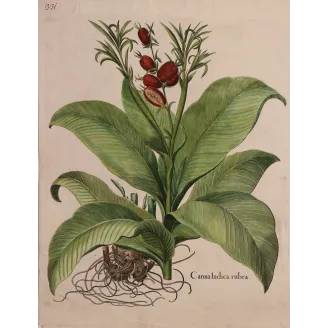
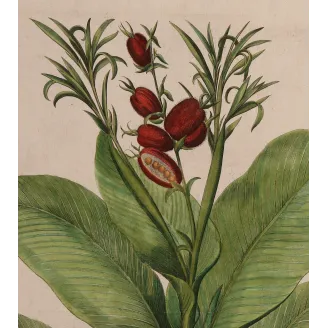
Canna Indica Rubra –...
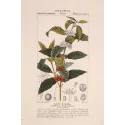
Original seventeenth-century hand-colored botanical engraving of Canna Indica rubra from Basilius Besler's monumental Hortus Eystettensis, first published in 1613. The imposing composition combines sweeping green foliage, exposed roots and vivid red botanical forms, while the laid-paper sheet preserves a watermark and the remarkable printed autumnal heading “SECVNDVS ORDO COLLECTARVM PLANTARVM AVTVMNALIVM” on its verso.
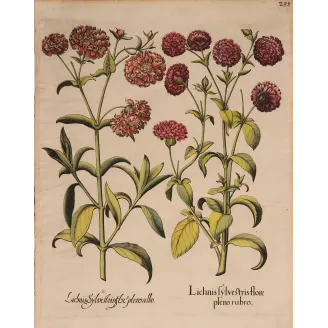
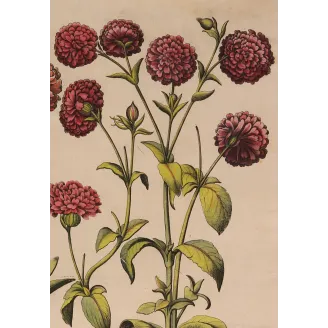
Lychnis Sylvestris –...
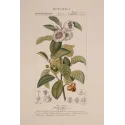
Original seventeenth-century hand-coloured botanical engraving depicting two forms historically inscribed <em>Lychnis Sylvestris</em>, from Basilius Besler’s monumental <em>Hortus Eystettensis</em>, published in 1613. The two flowering specimens create an exceptional comparative composition, with richly articulated red and crimson blossoms set against restrained green foliage. Printed on substantial laid paper with an approximately 30 mm chain-line spacing and a visible <em>pomme de pin</em> (pine-cone) watermark.
Martagon Imperiale –...
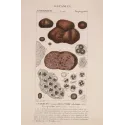
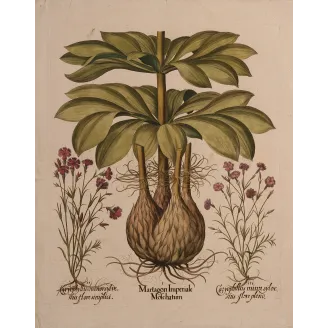
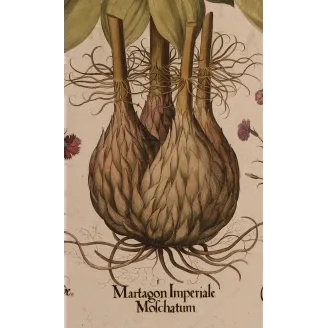
Original seventeenth-century hand-coloured botanical engraving from Basilius Besler’s monumental <em>Hortus Eystettensis</em>, published in 1613. This exceptionally large sheet preserves the lower part of an originally two-sheet composition, centred upon the imposing <em>Martagon Imperiale Molchatum</em> and accompanied by two flowering <em>Caryophyllus</em> forms. The verso retains the remarkable original typographical heading <em>Tertius Ordo Collectarum Plantarum Æstivalium</em>, material evidence of the seasonal organisation of Besler’s great botanical work.

Molucca Levis &...
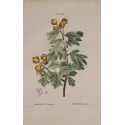
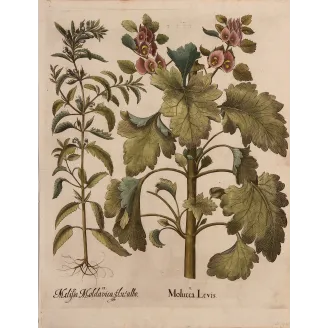
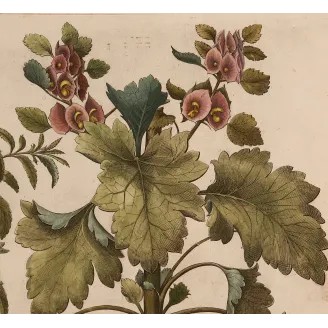
Original seventeenth-century hand-coloured botanical engraving depicting <em>Molucca Levis</em> and <em>Melissa Moldavica flor. albo</em>, from Basilius Besler’s monumental <em>Hortus Eystettensis</em>, published in 1613. The composition contrasts the slender architecture of the Melissa with the broad, sculptural foliage and distinctive pink-mauve flowers of the Molucca. Printed on substantial early laid paper with approximately 32 mm chain-line spacing and a visible, presently