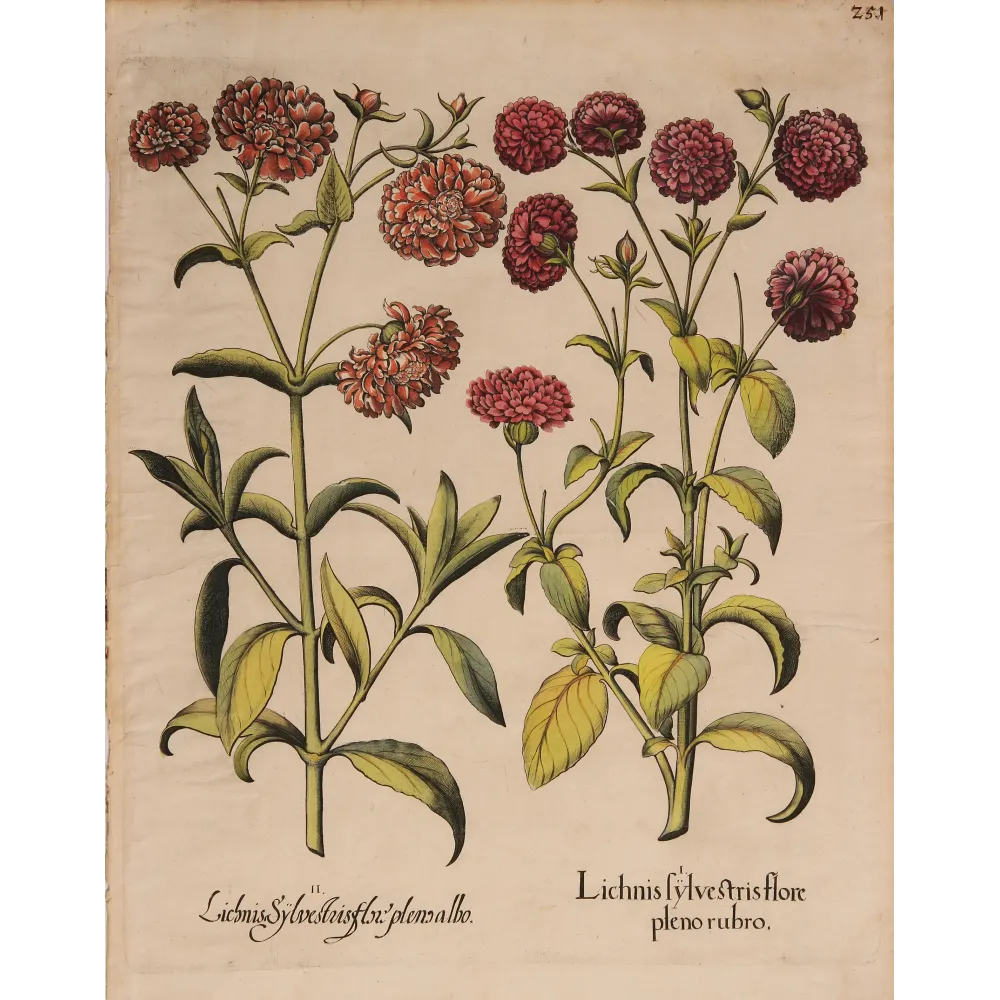
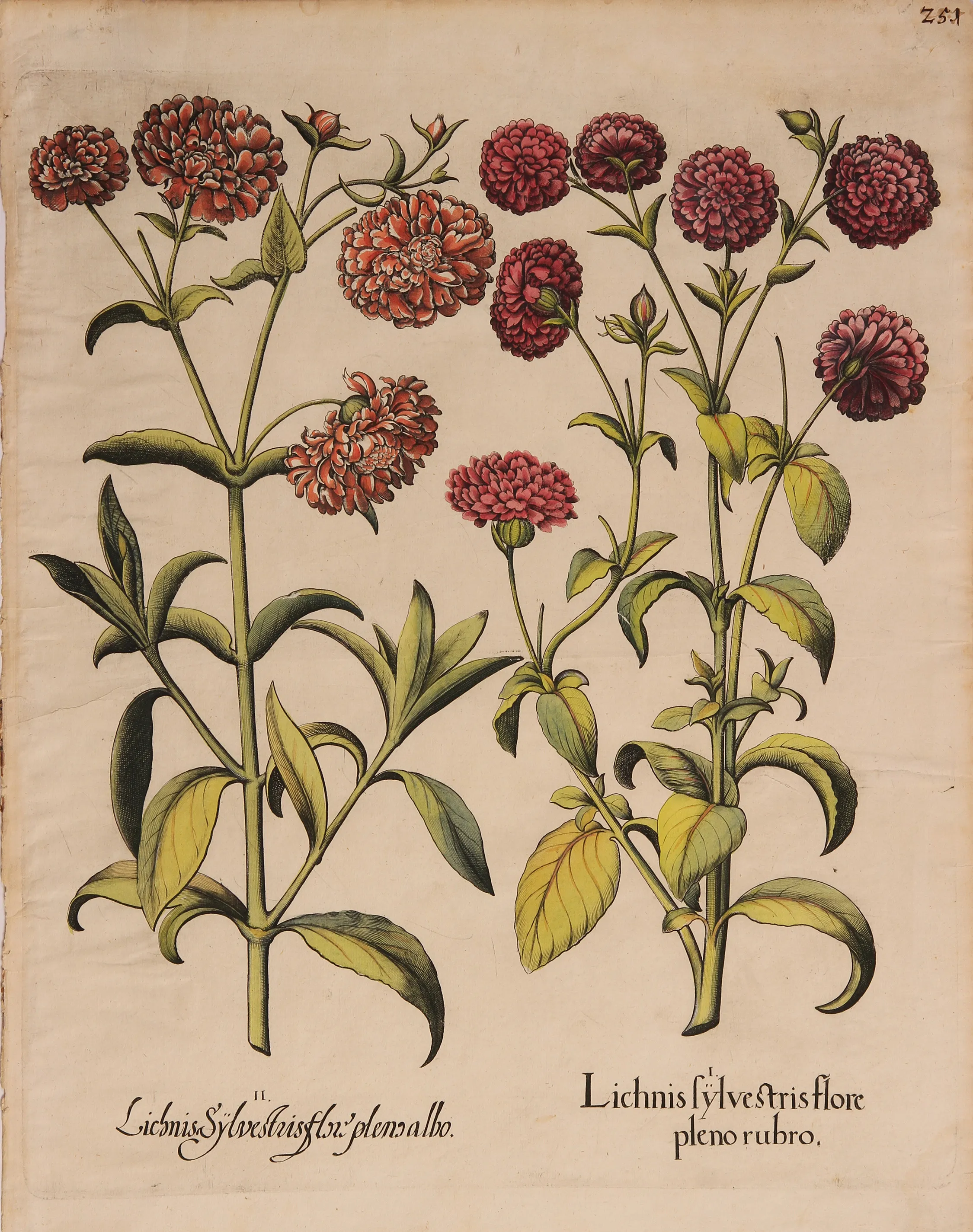
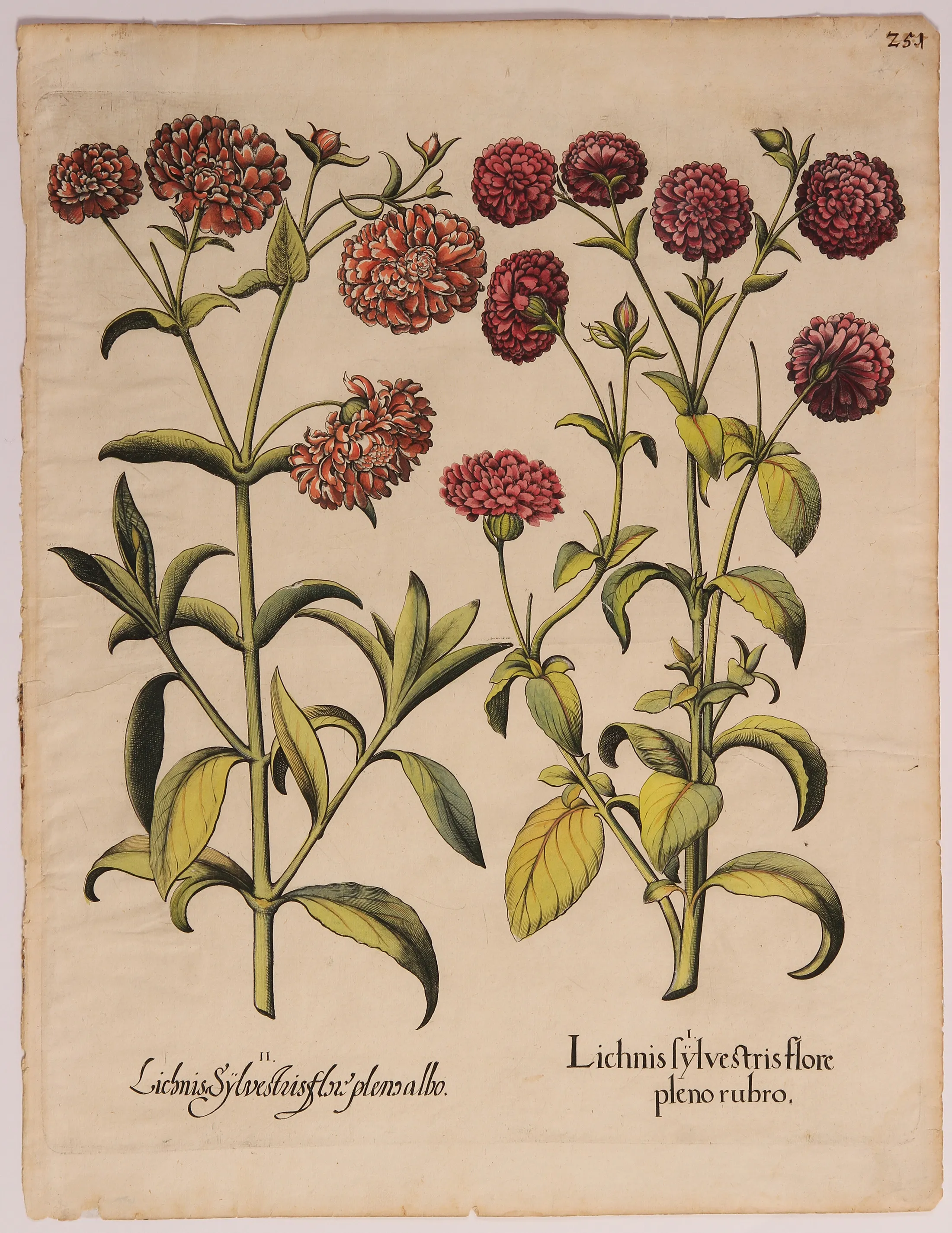
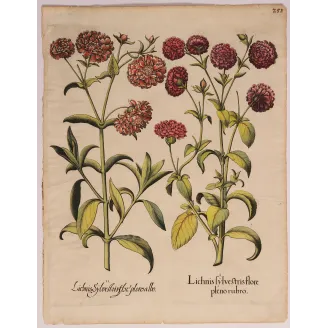
Original seventeenth-century hand-coloured botanical engraving depicting two forms historically inscribed <em>Lychnis Sylvestris</em>, from Basilius Besler’s monumental <em>Hortus Eystettensis</em>, published in 1613. The two flowering specimens create an exceptional comparative composition, with richly articulated red and crimson blossoms set against restrained green foliage. Printed on substantial laid paper with an approximately 30 mm chain-line spacing and a visible <em>pomme de pin</em> (pine-cone) watermark.
 Delivery policy
Your print will be carefully prepared and shipped worldwide via trusted couriers (UPS or similar).
 Authentic antique prints
Original engravings from the 17th–19th century.
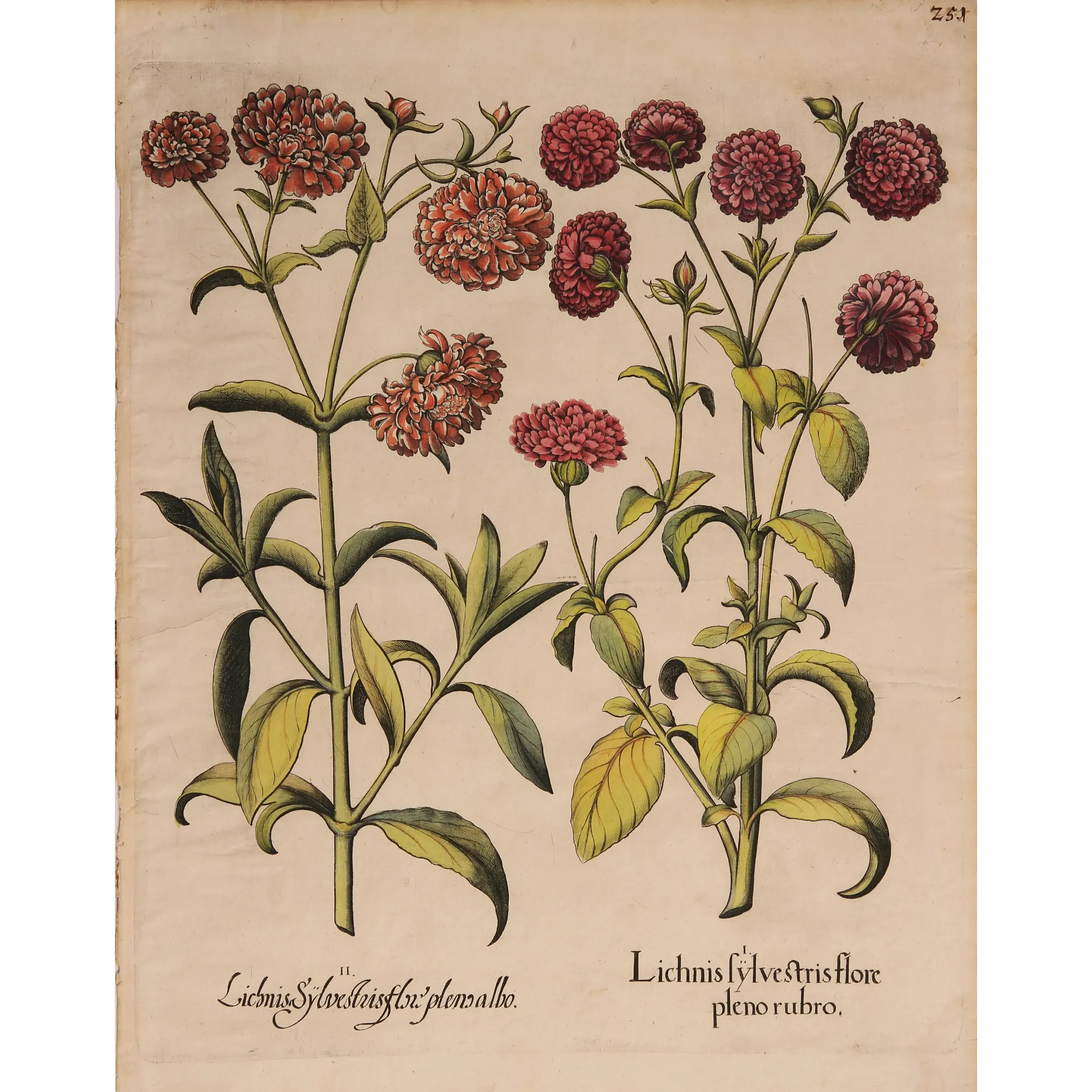
This original hand-coloured botanical engraving from Basilius Besler’s Hortus Eystettensis, first published in 1613, presents two forms historically inscribed Lychnis Sylvestris flor. pleno albo and Lychnis sylvestris flor pleno rubro. Placed together on the same large sheet, the two flowering plants create a composition built upon comparison: related botanical forms are allowed to reveal their differences through growth, foliage, flower structure and colour.
The left-hand specimen rises with a more open and expansive structure, its branching stems carrying large warm red-orange flowers. The right-hand plant is more compact and rhythmic, crowned by multiple rounded crimson flower heads arranged across a narrower vertical framework.
The power of the plate lies in this comparison: two closely related botanical forms share the same sheet, allowing differences of growth, foliage, flower and colour to become part of the composition itself.
The composition is divided into two principal vertical structures, each occupying approximately half of the engraved field while remaining visually independent. The left plant develops through long branching stems and large leaves, creating an open framework that spreads gradually across the sheet.
Its flowers are comparatively large and irregularly distributed. Warm red-orange petals are articulated with pale highlights and darker internal modelling, producing a dense layered appearance that contrasts strongly with the more restrained green foliage below.
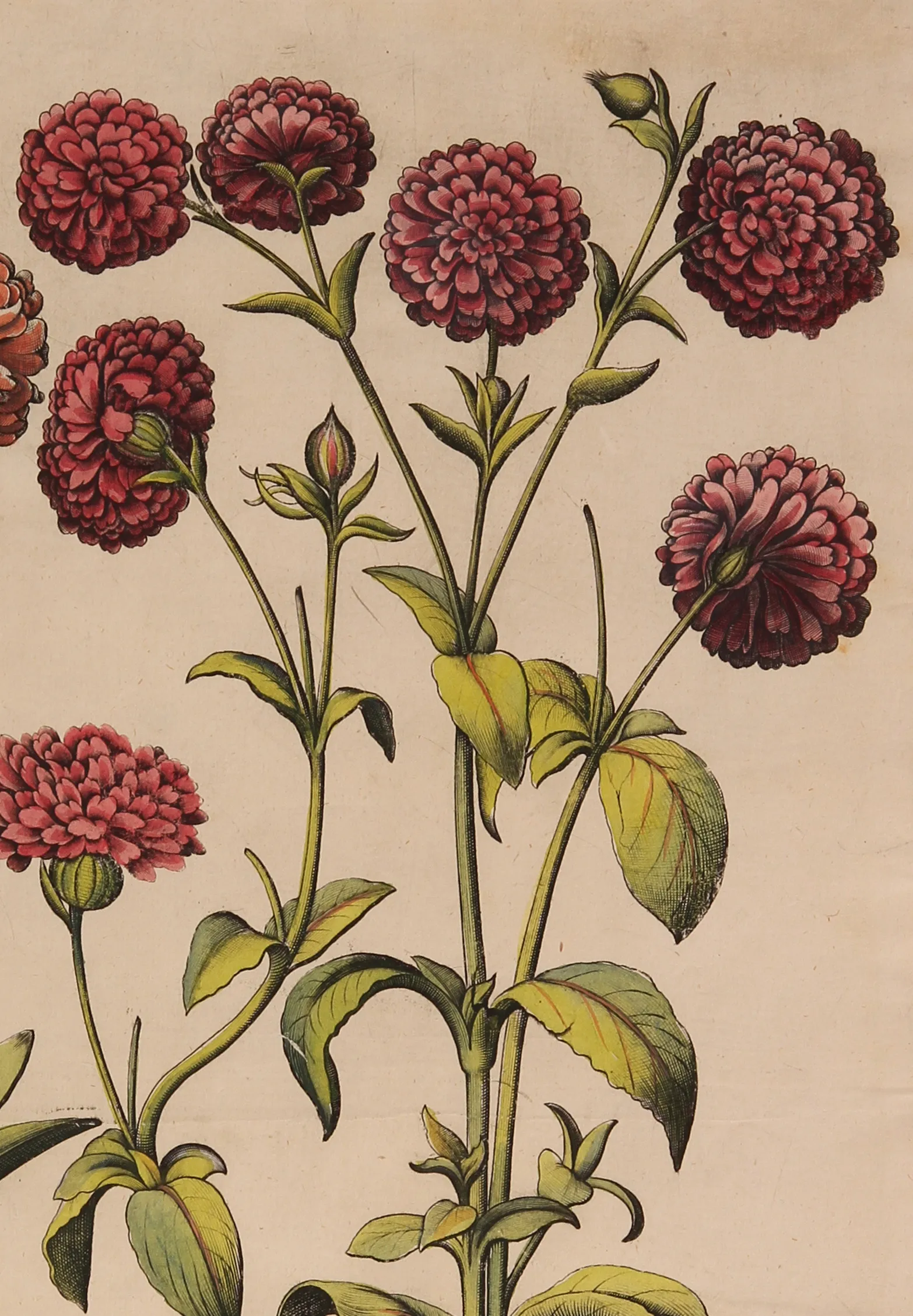
The right-hand specimen follows a different rhythm. Its stems are narrower and more upright, supporting multiple rounded crimson flower heads that repeat across the upper half of the composition. Their regular recurrence establishes a more compact and ordered visual structure.
The contrast between the two plants is therefore both botanical and compositional. The left side feels expansive, irregular and almost architectural, while the right side is more concentrated and repetitive. The eye moves naturally between these two systems, comparing not only individual flowers but the entire behaviour of each plant.
Colour reinforces this distinction. The flowers on the left move through warmer coral and orange-red passages, while those on the right deepen towards crimson and burgundy. Against the olive and yellow-green foliage, these differences create a strong chromatic dialogue across the sheet.
The open paper between and around the specimens is essential to the effect. It prevents the two plants from merging into a single mass and allows the viewer to compare their structures clearly. The generous scale of the Hortus Eystettensis transforms the sheet into a visual field in which botanical difference can be observed directly.
The historical inscriptions identify two cultivated forms of Lychnis Sylvestris, distinguished in the engraved text by the terms albo and rubro. These names belong to the botanical language of the early seventeenth century and should not be understood automatically as equivalent to a single modern taxonomic designation.
Plants historically grouped under Lychnis are characterised by upright herbaceous growth, opposite leaves and conspicuous flowering heads. Double-flowered garden forms were particularly valued for the density and ornamental richness of their blossoms.
Besler’s engraving is especially useful because the two forms are not represented separately. By placing them together, the plate allows the viewer to compare differences in branching, leaf proportion, flower density and colour within a single visual field.
The identification presented here therefore preserves the historical nomenclature engraved on the sheet rather than imposing a modern botanical name where the seventeenth-century source itself reflects an earlier system of classification.
The Hortus Eystettensis is often celebrated for the monumentality of its individual plant portraits, but this plate demonstrates another strength of the work: its ability to use the large folio sheet as a space for comparison.
The two specimens are not compressed into one arrangement. Each retains sufficient space to develop independently, allowing the viewer to read their structures from stem to flower while moving repeatedly between the left and right sides of the composition.
This arrangement creates an almost conversational relationship between the plants. The more open branching of the left-hand specimen is answered by the concentrated vertical rhythm of the right. Large irregular flowers are set against repeated rounded heads; warm coral tones against deeper crimson; broader structural movement against tighter repetition.
The result is not simply decorative symmetry. The sheet encourages the eye to recognise botanical variation through visual difference. Comparison itself becomes one of the organising principles of the image.
The engraved line plays an important role in maintaining clarity within this abundant floral composition. Stems remain sharply defined, individual petals are separated through controlled hatching, and leaf surfaces are modelled with directional lines that give volume without overwhelming the hand-applied colour.
Colour is concentrated where it has the greatest effect. The foliage remains relatively restrained, allowing the numerous flower heads to dominate the upper half of the sheet. Subtle variation within the reds prevents repetition from becoming monotonous and gives individual blossoms their own visual presence.
Seen as a whole, the plate demonstrates how the Hortus Eystettensis could transform botanical comparison into visual experience. Two related plants become more intelligible precisely because they are allowed to share the same page.
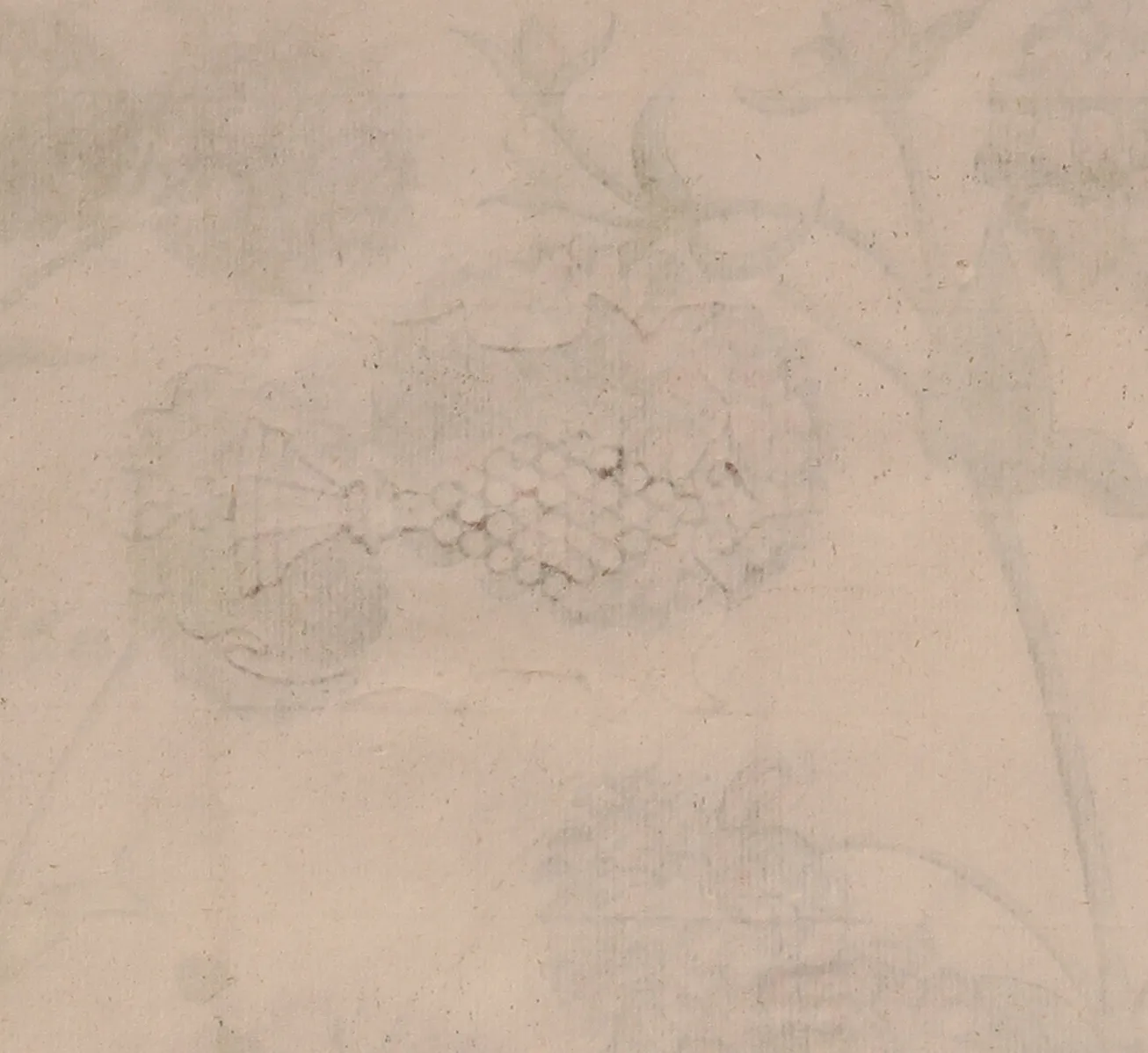
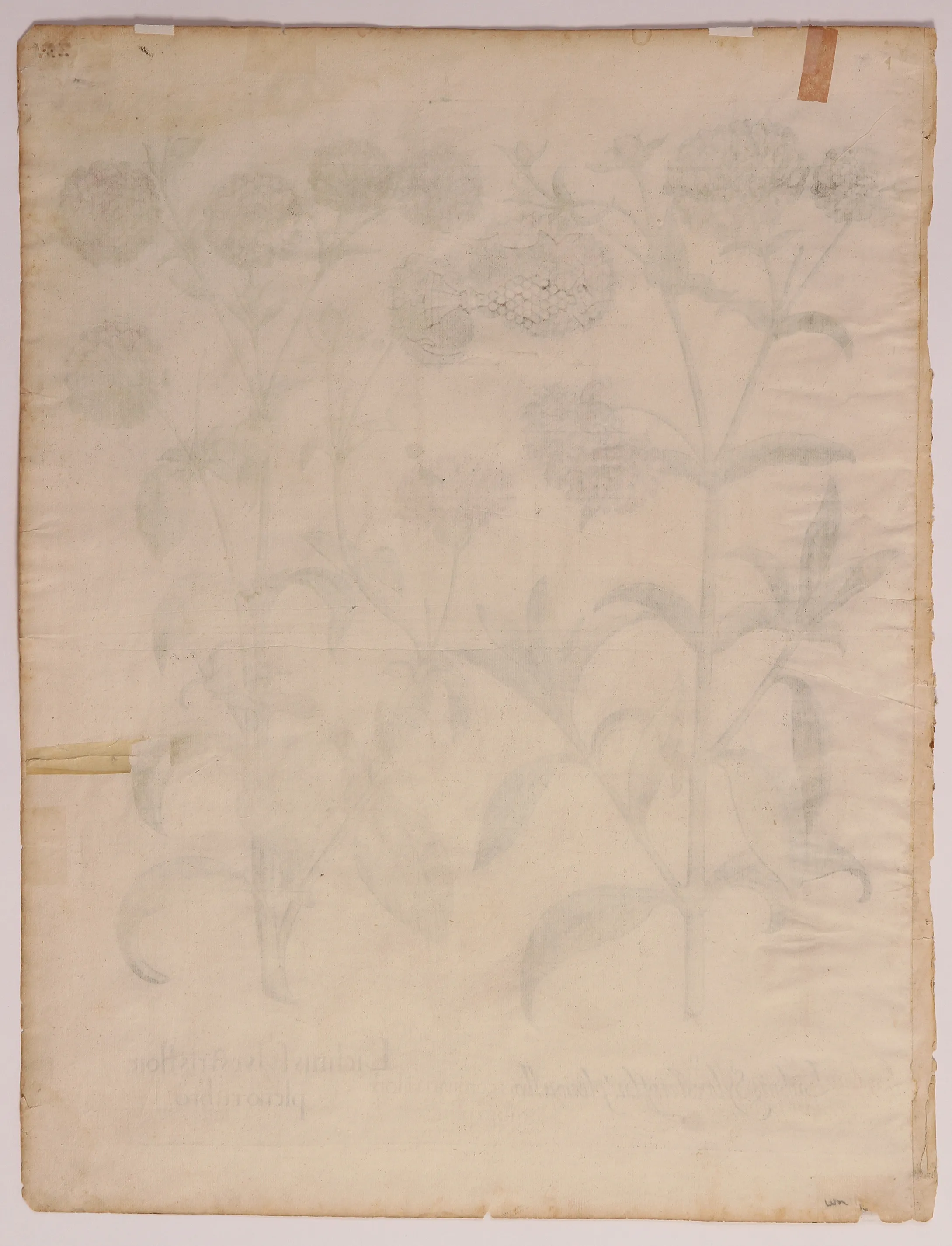
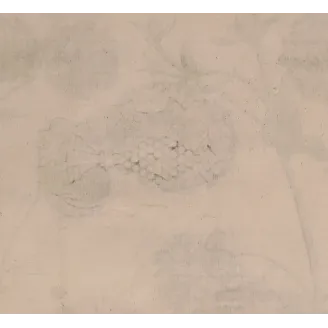
Direct examination of this impression reveals a substantial early laid sheet measuring approximately 54.0 × 41.3 cm. The handmade paper shows an approximate chain-line spacing of 30 mm, preserving the regular structural pattern created by the papermaking mould.
A watermark is visible within the sheet. Its surviving form corresponds to a pomme de pin, or pine-cone device, within a shield-like outline. This watermark type is associated with paper used for the Hortus Eystettensis.
The watermark is recorded here as direct material evidence observed on this individual impression. It is not used in isolation to assign a specific issue or edition.
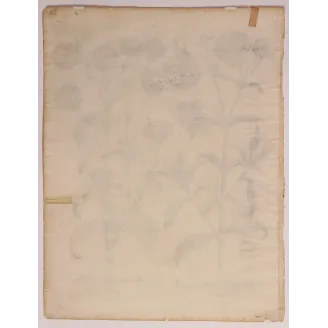
Unlike the Canna impression within the same Prantique collection, the verso of this sheet does not preserve a large seasonal typographical heading. Its relatively open surface instead allows the physical structure of the paper, the watermark and traces of the sheet’s historical handling to remain especially legible.
The image records botanical variation; the paper records the physical history of the object that carried it forward.
Light creasing, historical handling traces and small localised reinforcements visible from the verso belong to that material biography. They document the survival of an early seventeenth-century sheet through binding, collection, use and preservation without compromising the central botanical image.
Published in 1613, Basilius Besler’s Hortus Eystettensis transformed the celebrated garden at Eichstätt into one of the most ambitious botanical monuments of early modern Europe. Its monumental engravings recorded plants through an exceptional combination of botanical observation, large-scale composition and elaborate printmaking.
The work organised the garden into a permanent visual archive. Plants that could appear only at particular moments in the living garden could be examined again within the pages of the book, while individual sheets preserved both the botanical image and the material evidence of their own production.
This impression demonstrates another dimension of Besler’s project: the possibility of comparison. Two related forms occupy the same large sheet, allowing differences of growth, flower structure and colour to become visible through direct observation.
Our Historical Perspective explores the broader relationship between the living garden, the printed image and the passage of time through Besler’s own prefatory words, contemporary testimony and surviving pages of the work.
Basilius Besler and the Hortus Eystettensis: A Garden Against Time →
Explore the Basilius Besler – Hortus Eystettensis Collection →
Good to very good overall condition for an original early seventeenth-century botanical engraving. The substantial laid paper remains structurally sound and the botanical composition retains excellent visual presence and clarity.
The hand colouring remains strong and highly legible. The numerous flower heads retain rich variations of coral, red and crimson, while the foliage preserves a broad range of olive, yellow-green and deeper shadowed tones. The engraved modelling remains clearly visible beneath the colour throughout the composition.
Natural age-related toning, light creasing and historical handling traces are visible across the sheet, together with minor irregularities and wear along the outer margins. These characteristics are consistent with the age and physical history of the impression.
Several small historical paper reinforcements or repairs are visible principally from the verso, including localised interventions near the upper and left margins. They remain outside the principal botanical imagery and do not materially compromise the presentation of the engraving.
The central engraved field remains substantially intact, and the surviving pine-cone watermark and laid-paper structure can be observed under appropriate transmitted light.
Please examine the professional high-resolution photographs of both recto and verso for a complete visual assessment. Additional photographs are available upon request.
Historical botanical inscriptions: Lychnis Sylvestris flor. pleno albo; Lychnis sylvestris flor pleno rubro
Work: Hortus Eystettensis
Author / project director: Basilius Besler (1561–1629)
Place of publication: Nuremberg
Date: 1613
Technique: Original copper engraving with hand colouring
Artistic tradition: Early seventeenth-century botanical illustration
Paper: Early laid paper
Chain-line spacing: approx. 30 mm
Watermark: Present — pomme de pin / pine-cone device within a shield-like outline
Verso: Unprinted, with watermark and historical paper traces visible
Manuscript notation: Present, upper right recto
Sheet size: approx. 54.0 × 41.3 cm
Condition: Good to very good overall condition, with age-related toning, light creasing, marginal wear and small historical paper reinforcements visible principally from the verso
Photography: Professional high-resolution photography of recto and verso
Additional photographs: Available upon request
Authenticity: Original seventeenth-century print — never a modern reproduction

Specific References
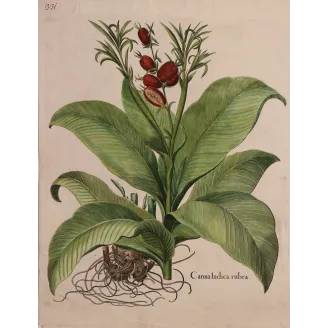
Original seventeenth-century hand-colored botanical engraving of Canna Indica rubra from Basilius Besler's monumental Hortus Eystettensis, first published in 1613. The imposing composition combines sweeping green foliage, exposed roots and vivid red botanical forms, while the laid-paper sheet preserves a watermark and the remarkable printed autumnal heading “SECVNDVS ORDO COLLECTARVM PLANTARVM AVTVMNALIVM” on its verso.
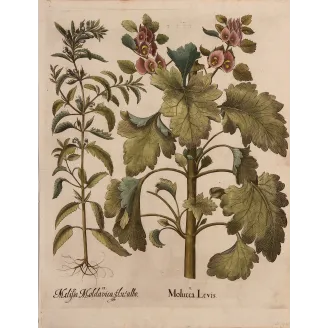
Original seventeenth-century hand-coloured botanical engraving depicting <em>Molucca Levis</em> and <em>Melissa Moldavica flor. albo</em>, from Basilius Besler’s monumental <em>Hortus Eystettensis</em>, published in 1613. The composition contrasts the slender architecture of the Melissa with the broad, sculptural foliage and distinctive pink-mauve flowers of the Molucca. Printed on substantial early laid paper with approximately 32 mm chain-line spacing and a visible, presently
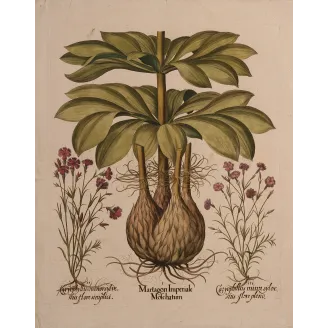
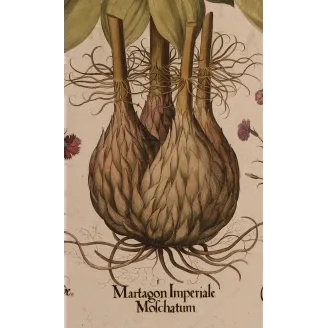
Original seventeenth-century hand-coloured botanical engraving from Basilius Besler’s monumental <em>Hortus Eystettensis</em>, published in 1613. This exceptionally large sheet preserves the lower part of an originally two-sheet composition, centred upon the imposing <em>Martagon Imperiale Molchatum</em> and accompanied by two flowering <em>Caryophyllus</em> forms. The verso retains the remarkable original typographical heading <em>Tertius Ordo Collectarum Plantarum Æstivalium</em>, material evidence of the seasonal organisation of Besler’s great botanical work.
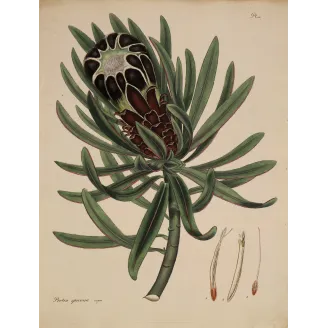
A striking original hand-coloured engraving depicting the Black-Flowered Showy Protea, published by Henry Charles Andrews in The Botanist's Repository in 1799. Monumental foliage, sculptural flower structure and beautifully preserved hand colouring make this one of the most architecturally impressive plates of the series.
Original 18th-century engraving of the Wild Cucumber by Elisabeth Blackwell, with spined fruit and yellow flowers.
Antique lithograph of the Sulphur-crested Cockatoo by Roland Green, hand-colored.
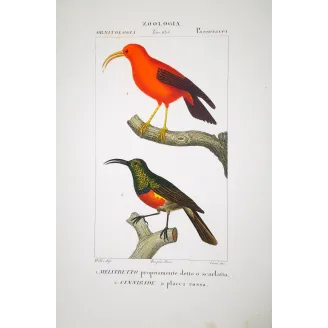
Brilliantly colored honeycreeper and sunbird illustration with tropical vibrancy, captured by Prêtre.
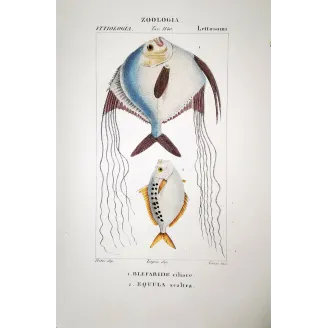
Delicate 19th-century hand-colored engraving of a ponyfish with companion species, ideal for marine-themed interiors and collectors.
Original 1835 hand-colored engraving of Nymphalis orion, drawn and engraved by Pauquet under the scientific direction of Hippolyte Lucas for Exotic Butterflies.
Original 1774 engraving by Jacob L'Admiral: Large Tortoiseshell on Sweet Cherry.
Original seventeenth-century hand-coloured botanical engraving depicting two forms historically inscribed <em>Lychnis Sylvestris</em>, from Basilius Besler’s monumental <em>Hortus Eystettensis</em>, published in 1613. The two flowering specimens create an exceptional comparative composition, with richly articulated red and crimson blossoms set against restrained green foliage. Printed on substantial laid paper with an approximately 30 mm chain-line spacing and a visible <em>pomme de pin</em> (pine-cone) watermark.