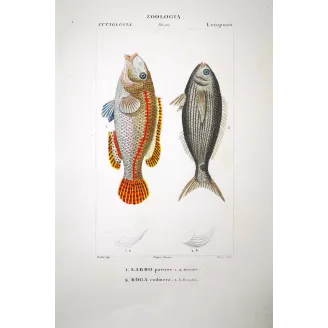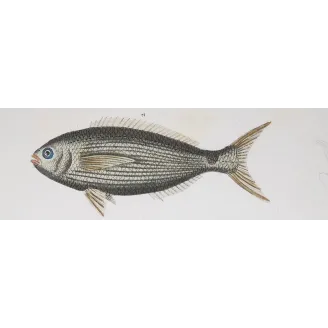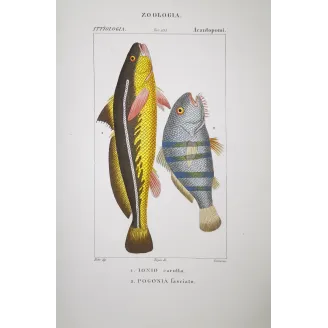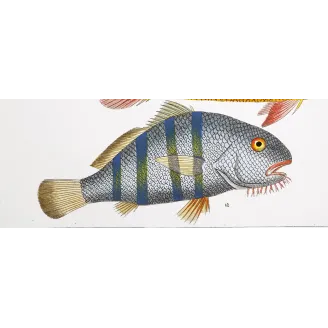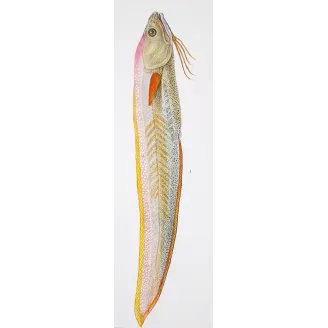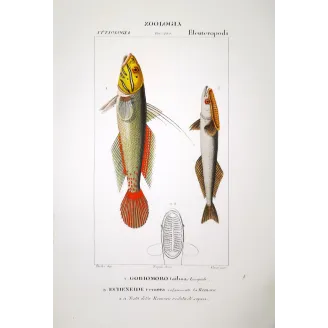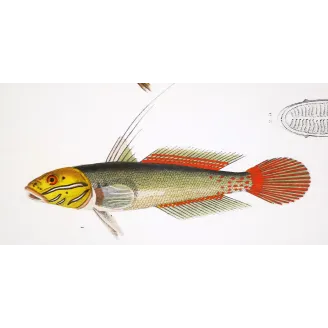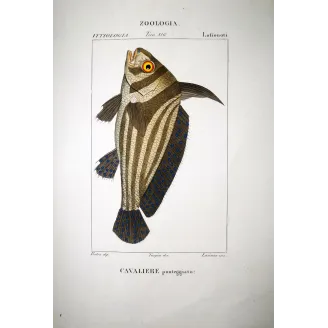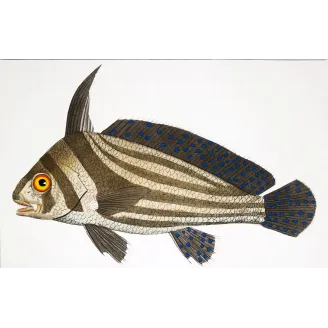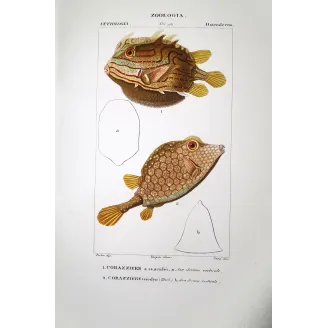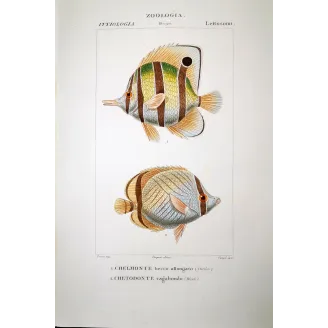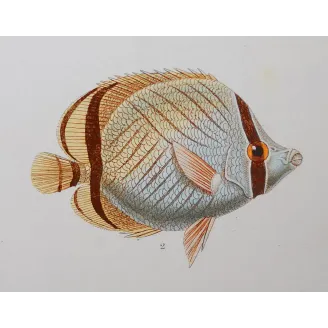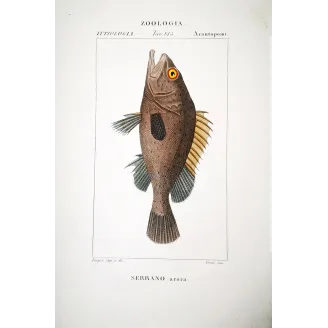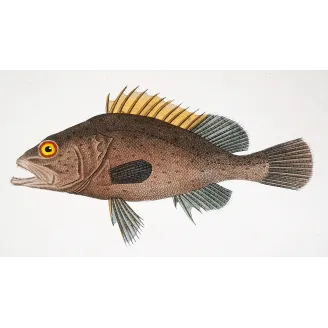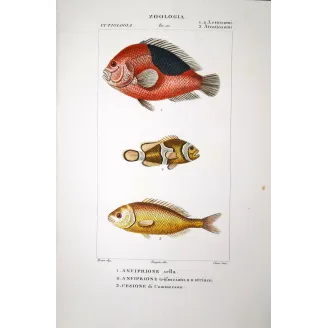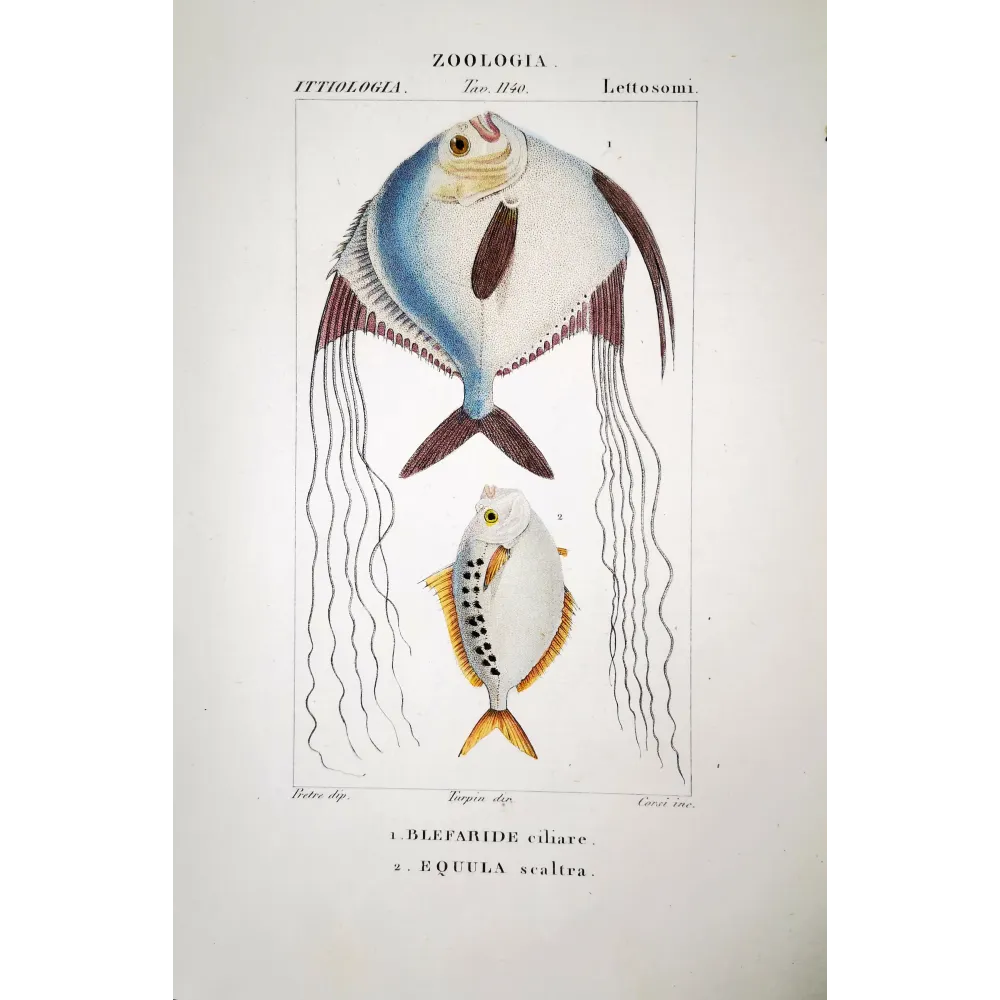
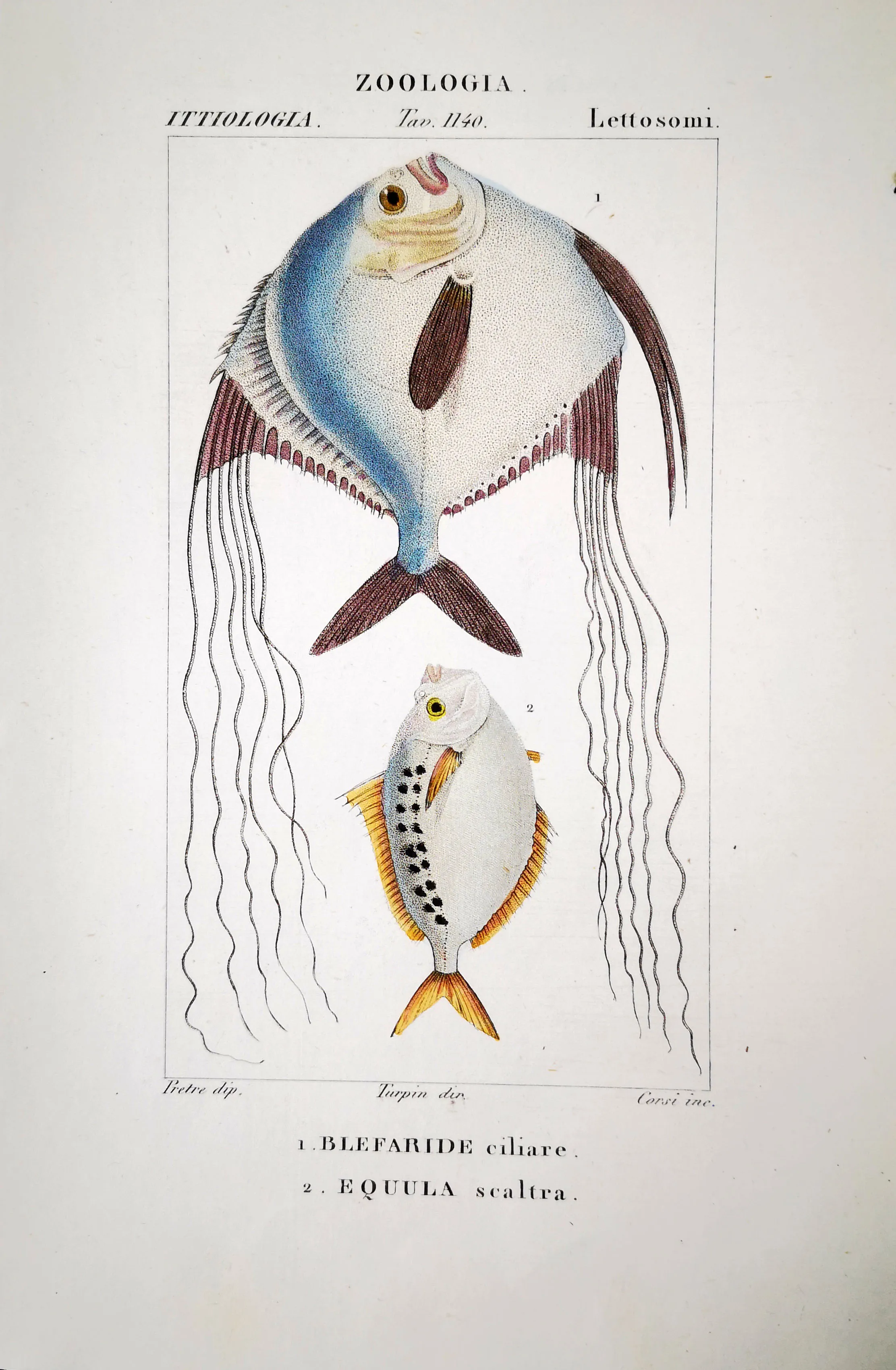
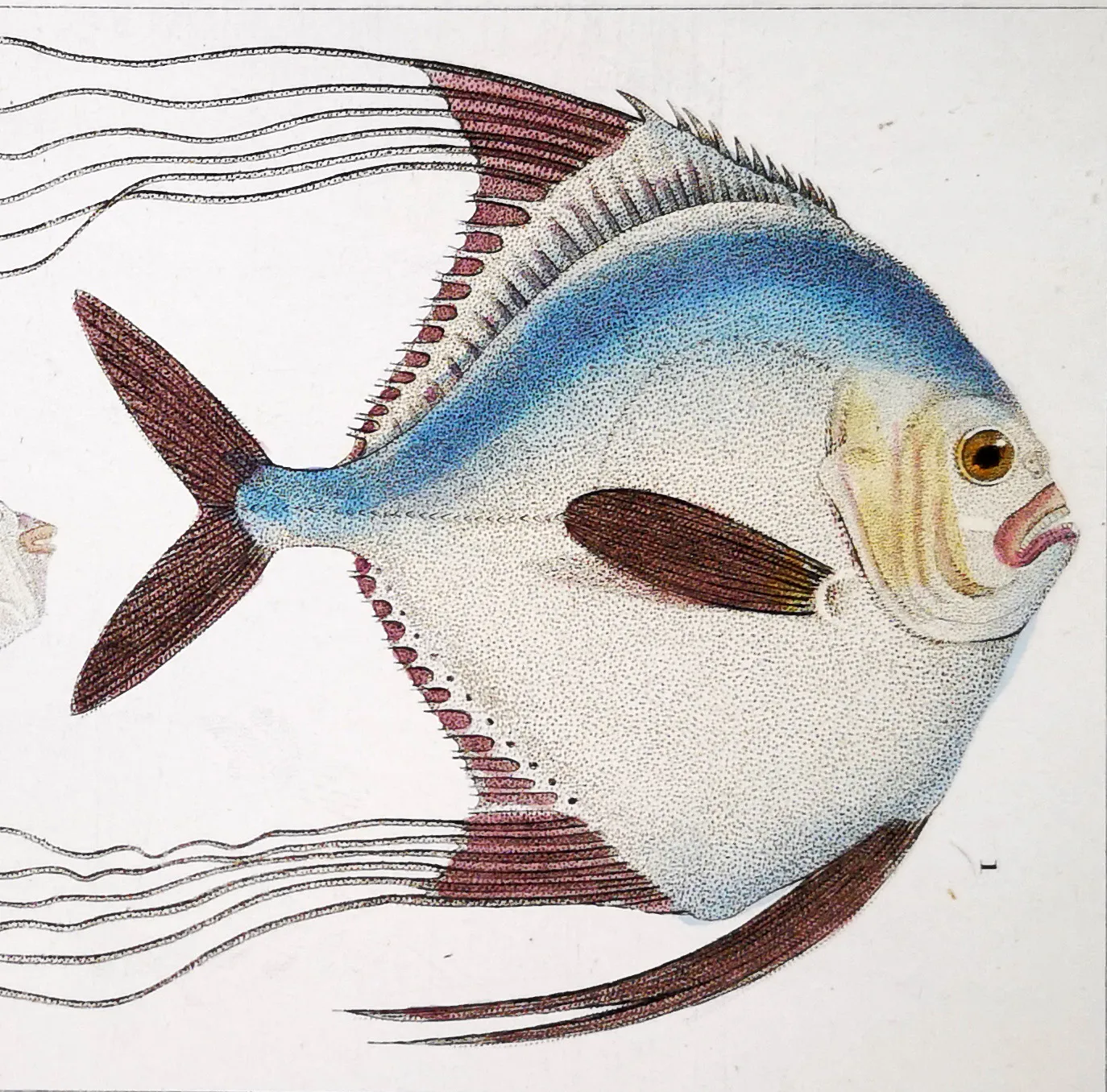
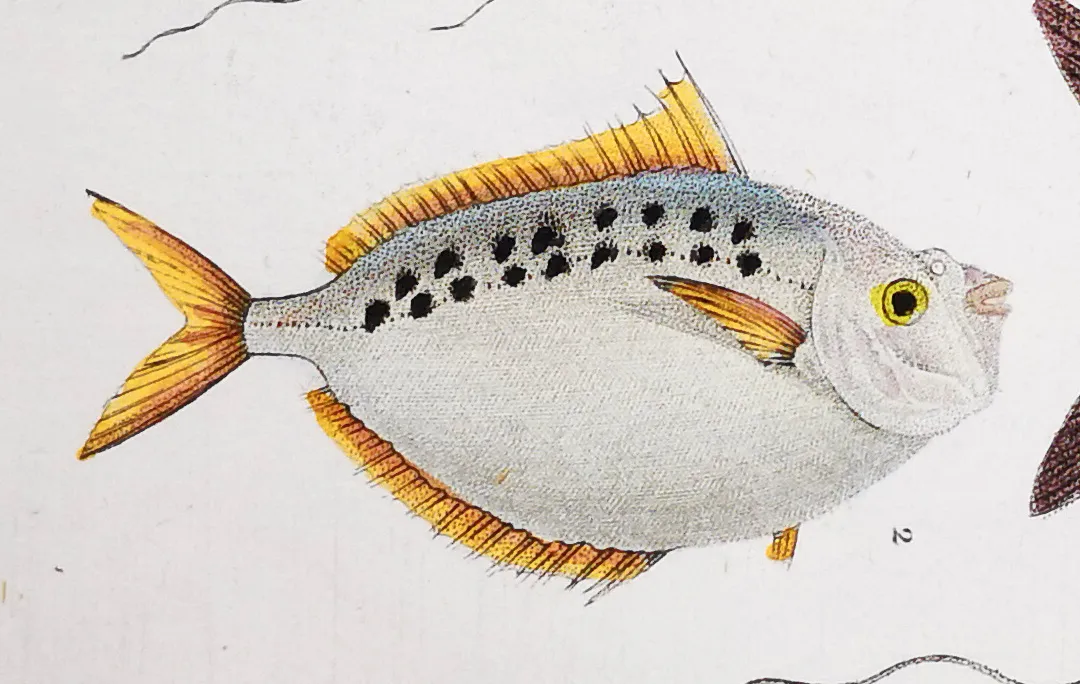
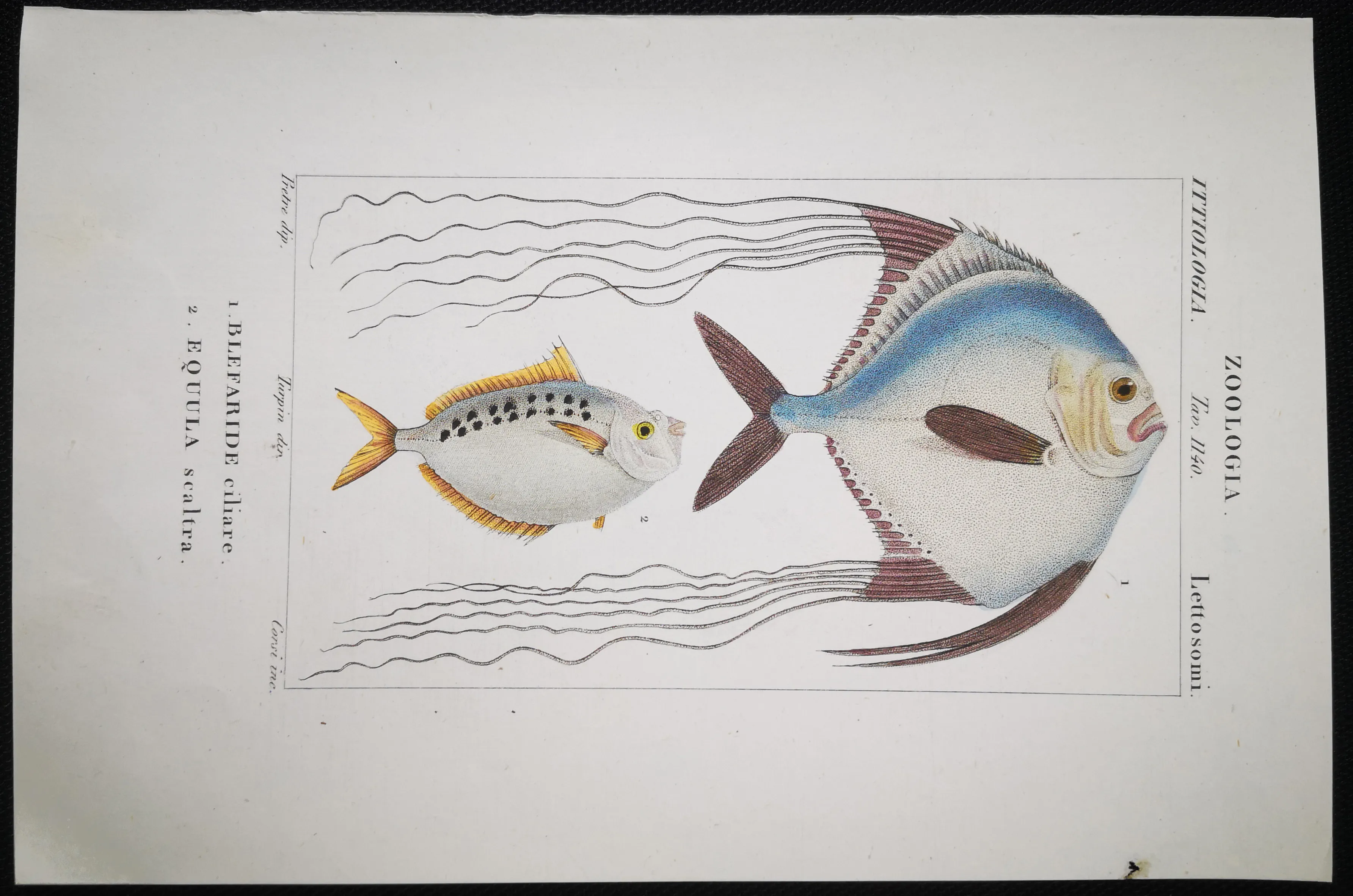

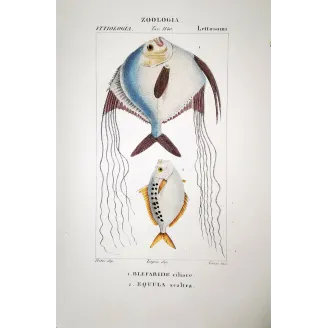
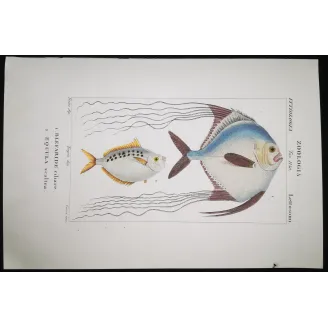
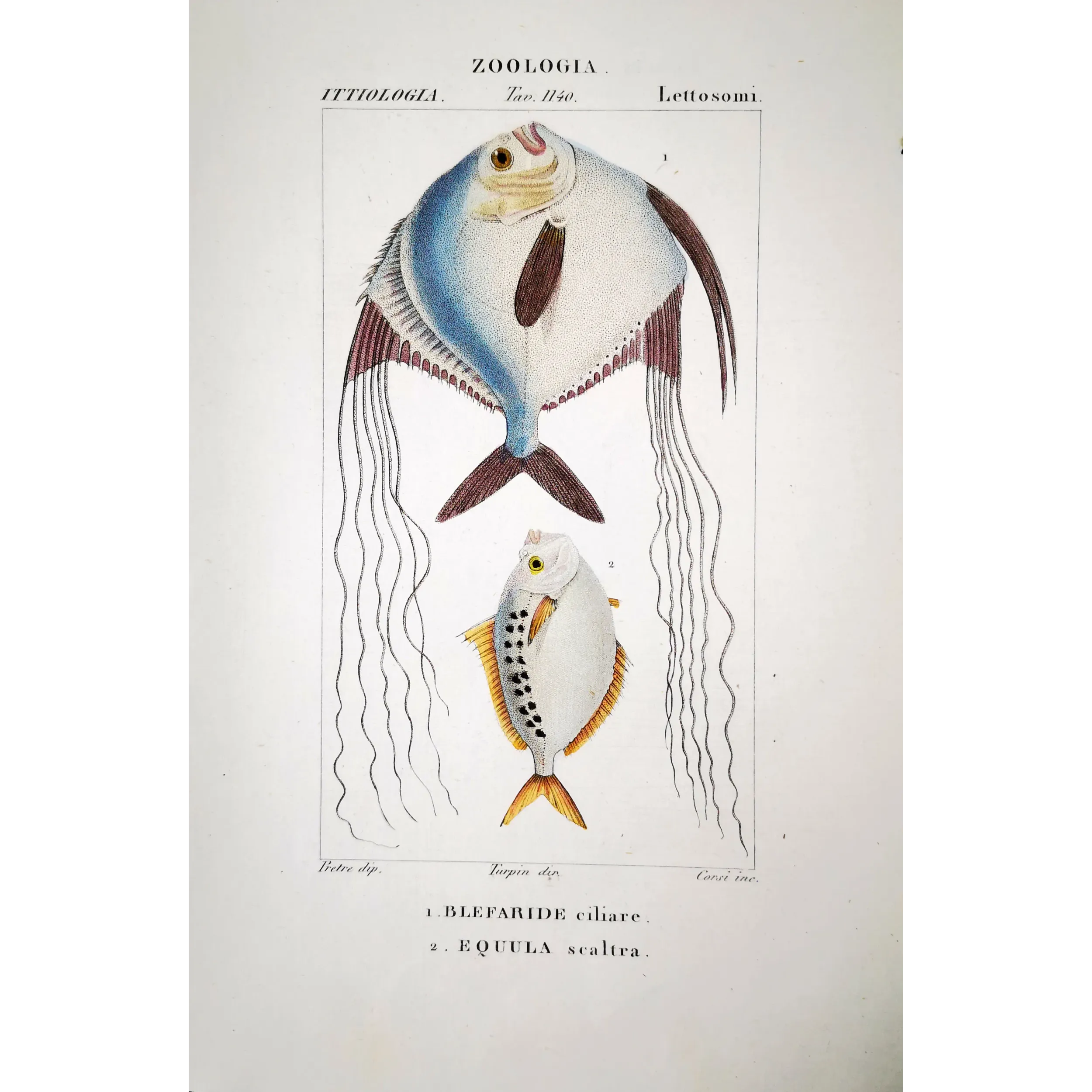
Delicate 19th-century hand-colored engraving of a ponyfish with companion species, ideal for marine-themed interiors and collectors.
 Delivery policy
Your print will be carefully prepared and shipped worldwide via trusted couriers (UPS or similar).
 Authentic antique prints
Original engravings from the 17th–19th century.
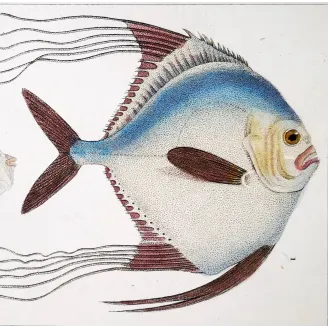
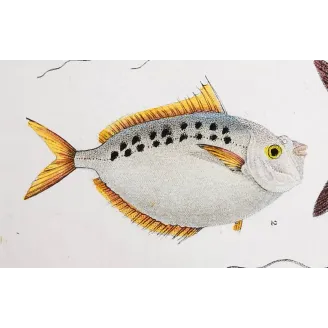
This original hand-colored engraving presents two marine fishes arranged for comparative study: a Ponyfish, Equula scalara, and the Blefaride, Blefaride ciliata. The plate is especially notable for the long filament-like appendages rendered as flowing lines, giving the composition an almost calligraphic grace while remaining grounded in scientific intent.
The engraving balances decorative refinement with morphological clarity. The larger fish is modelled through soft tonal gradation, while the smaller specimen introduces a secondary rhythm of pattern and proportion. Hand-colouring is controlled — cool silvery blues are contrasted with warm accents at fins and margins, preserving both legibility and elegance.
The plate belongs to the Italian edition of the Dizionario di Scienze Naturali (Florence, Battelli press), one of the most ambitious encyclopedic scientific enterprises of its time, for which Pierre Antoine Prêtre produced a remarkable series of marine life engravings.
— • —
The composition is unusually dynamic for a scientific plate. The long filament lines extend beyond the fish bodies like drawn currents, creating vertical movement and a sense of suspended motion. This “line as water” effect is both visually theatrical and structurally disciplined.
The tonal palette remains refined and light, allowing the filaments to read with clarity against the empty field. The result is a plate that feels at once zoological and intensely decorative — a natural fit for curated interiors.
The Ponyfish, Equula scalara, and the Blefaride, Blefaride ciliata, represent the nineteenth-century fascination with marine species whose anatomy appears almost ornamental — creatures where fins and appendages take on the quality of design. In cultural terms, such plates helped shape the European imagination of tropical seas as both scientific frontier and aesthetic theatre. As an antique fish engraving, this work is particularly strong: the filaments create immediate visual identity, while the paired specimens reinforce the encyclopedic method of comparison. For modern collectors, it functions as a distinctive 19th-century marine life print — elegant, rare in composition, and highly sought after within the tradition of antique scientific illustration.
This plate forms part of the historic Dizionario di Scienze Naturali, a monumental early nineteenth-century encyclopedic enterprise once preserved within a noble library and today housed in the Sacchetti Collection. Each engraving reflects a period in which scientific ambition was matched by exceptional artisanal execution — from the disciplined copperplate line to the luminous hand-colouring applied individually to every impression.
To discover the full story behind these rare prints and their noble provenance, we invite you to read our editorial feature “Not Just Another Print”.
The engraving is in excellent antique condition. The sheet presents clean margins and a well-preserved impression. The paper is smooth early nineteenth-century wove paper (non-laid), consistent with Italian scientific editions of the period. No watermark has been observed. The original hand-colouring remains fresh and well preserved, with no visible losses.
For further context on Pierre Antoine Prêtre and his contribution to nineteenth-century zoological illustration, see our editorial feature:
Pierre Antoine Prêtre – Illustrator of Natural Science and Marine Life
Specific References
Brilliant peacock wrasse with patterned fins and a silver boga; lively palette and refined stippling for elegant interiors.
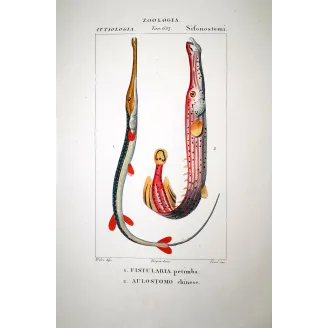
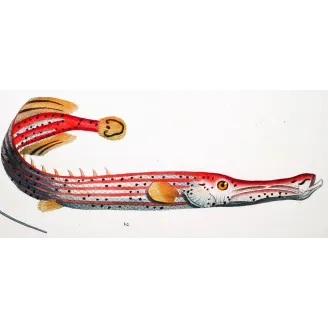
Striking plate with long, elegant cornetfish and trumpetfish, hand-colored with vivid reds and tealsbold marine decor statement.
Graphic pairing with bold yellow stripe and banded companion; vibrant hand-coloring and clear natural history styling.
Vivid 19th-century engraving of Mediterranean Rainbow Wrasse and Lesser Sandeel by Pierre Antoine Prêtre, bright palette and crisp lines.
Distinctive composition with streamlined forms and the famous remora disktechnical curiosity with refined aesthetics.
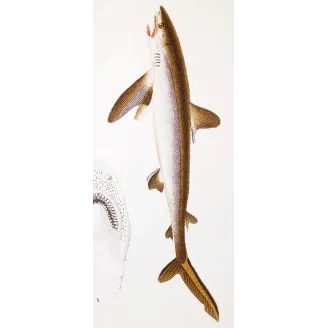
Spectacular 19th-century antique print of the Basking Shark by Pierre Antoine Prêtre, capturing monumental scale and serene presence.
Striking depiction of the Antennata Lionfish with vivid red and orange fins, full of exotic elegance.
Detailed 19th-century engraving of the Small-Spotted Catshark by Pierre Antoine Prêtre, combining elegance and scientific accuracy.
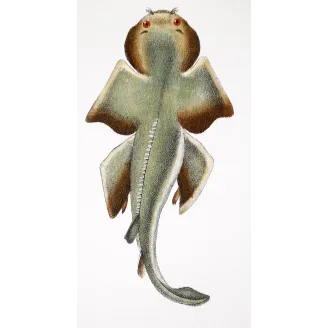
Graceful 19th-century engraving of the Angelshark by Pierre Antoine Prêtre, rich in soft tones and fine anatomical accuracy.
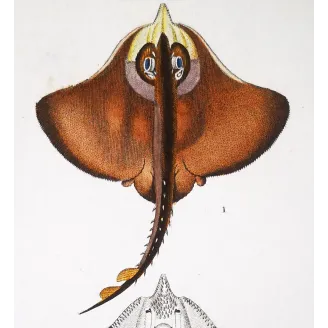
Elegant 19th-century hand-colored engraving of the Brown Ray by Pierre Antoine Prêtre, featuring graceful symmetry and refined marine tones.
Striped body with blue-spotted fins; a refined 19th-century marine engraving ideal for study walls and coastal interiors.
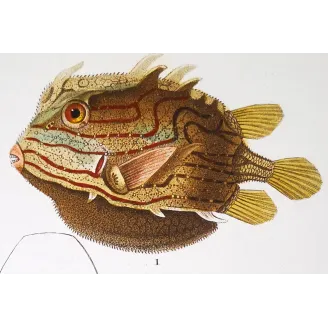
Remarkable plate with armored cowfish and boxfishhexagonal patterning and sculptural spines, superb for marine-themed decor.
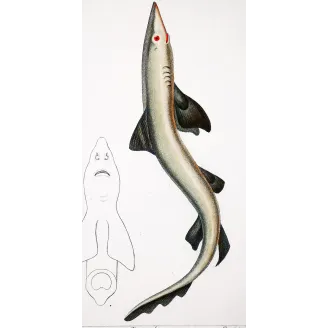
Refined 19th-century hand-colored engraving of the Tope Shark by Pierre Antoine Prêtre, notable for its elegant form and tonal realism.
Iconic Antique Print with two vivid butterflyfishes, finely hand-coloredstriking geometry and coral-reef charm for collectors.
Robust Brown Grouper illustrated with fine detail and earthy, natural tones.
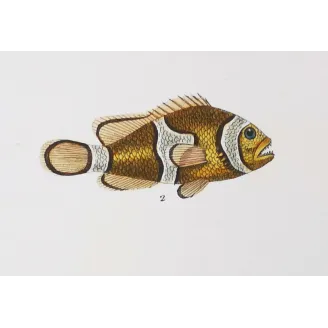
Charming clownfish with companion reef species, crisp colors and coral-reef appeal in a classic 19th-century plate.
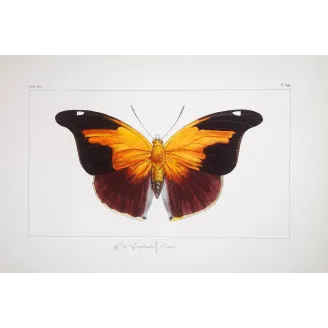
Original 1835 hand-colored engraving of Nymphalis orion, drawn and engraved by Pauquet under the scientific direction of Hippolyte Lucas for Exotic Butterflies.
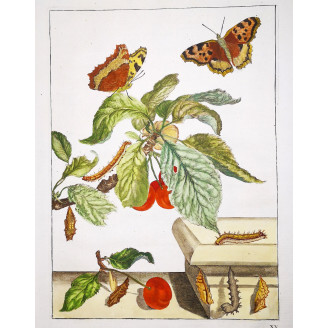
Original 1774 engraving by Jacob L'Admiral: Large Tortoiseshell on Sweet Cherry.
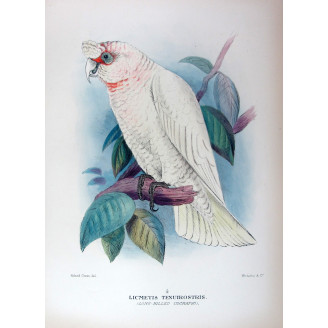
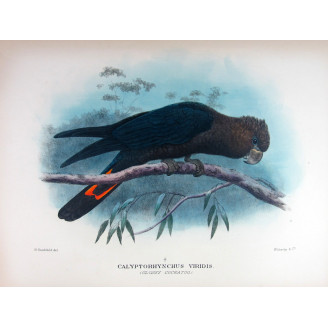
Glossy Cockatoo print by H. Goodchild, dark tones and rare presence on the plate
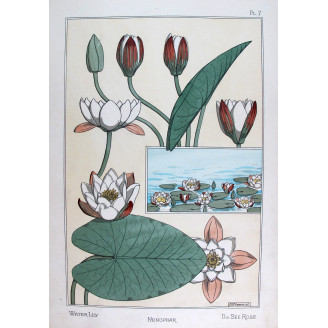
This second edition of the Water-Lily plate (No. 7) captures all the refined serenity of Plate 9, with slight variations in layout and ornamental balance.
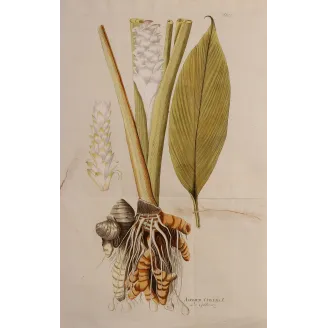
Exceptional large-format eighteenth-century botanical engraving depicting <em>Amomum Curcuma</em> L., published as Plate IV of Joseph Jacob von Plenck’s <em>Icones Plantarum Medicinalium</em>. Printed on a large folded sheet of Honig laid paper with complete watermark and contemporary hand colouring, the composition combines a remarkably refined pale inflorescence, monumental foliage and an exceptionally detailed rhizomatous structure. A powerful Plenck Statement Piece preserving both extraordinary botanical clarity and the visible material history of an eighteenth-century folded plate.
In this vibrant composition, Grasset elevates the humble gourd (courge) to an elegant decorative form.
Delicate 19th-century hand-colored engraving of a ponyfish with companion species, ideal for marine-themed interiors and collectors.