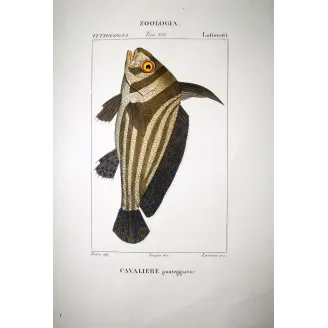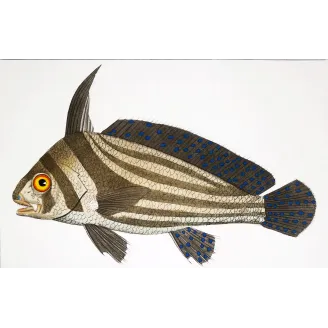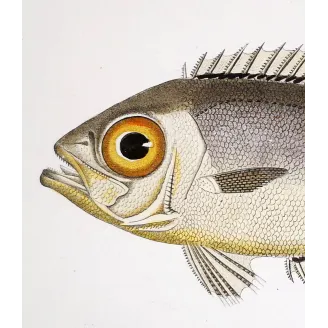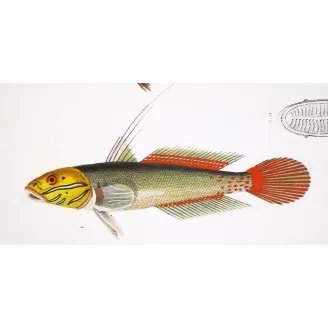
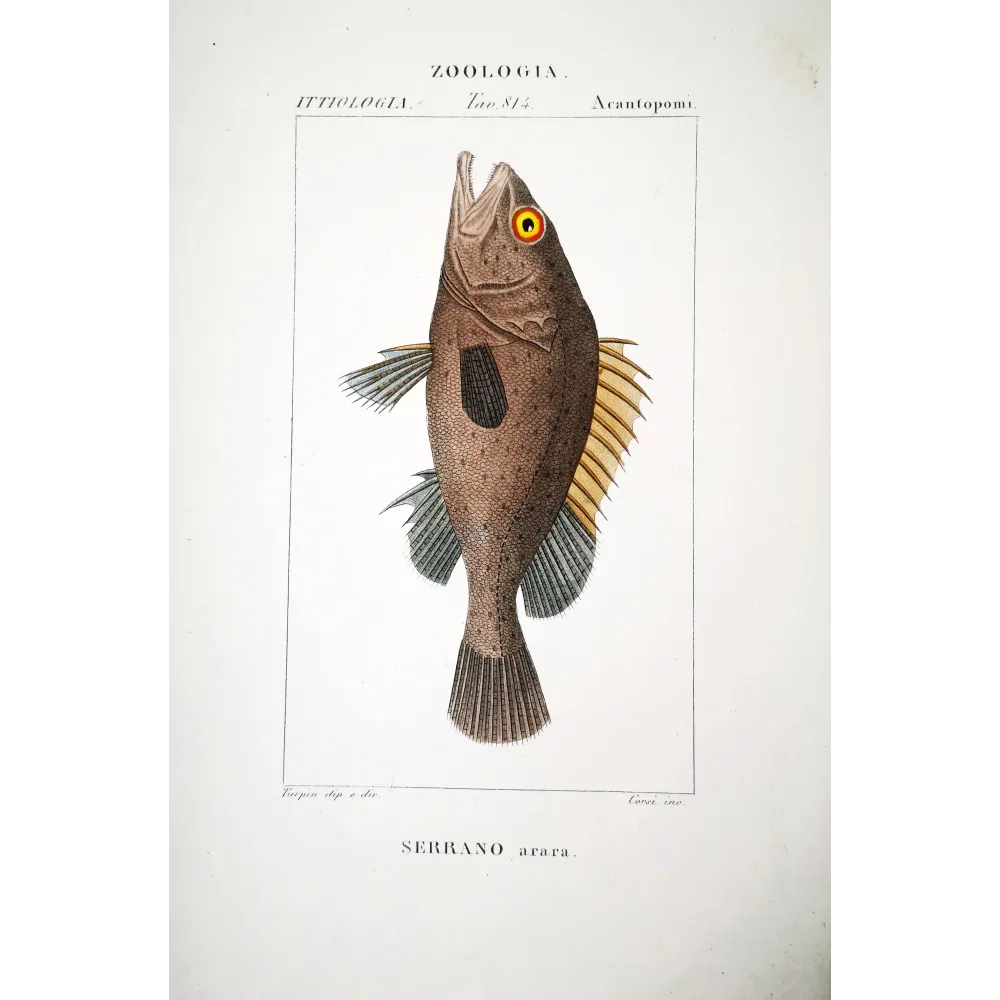
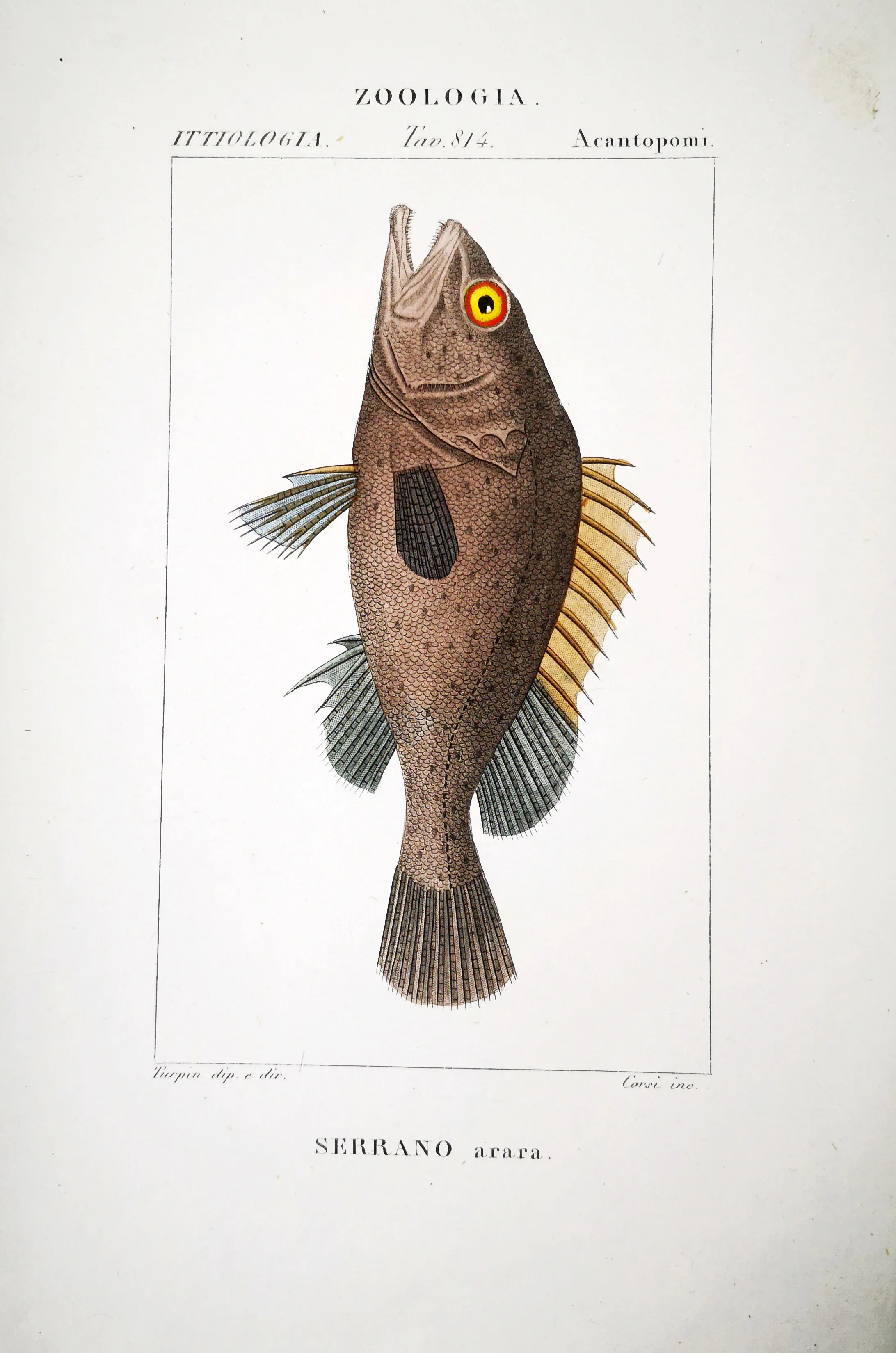
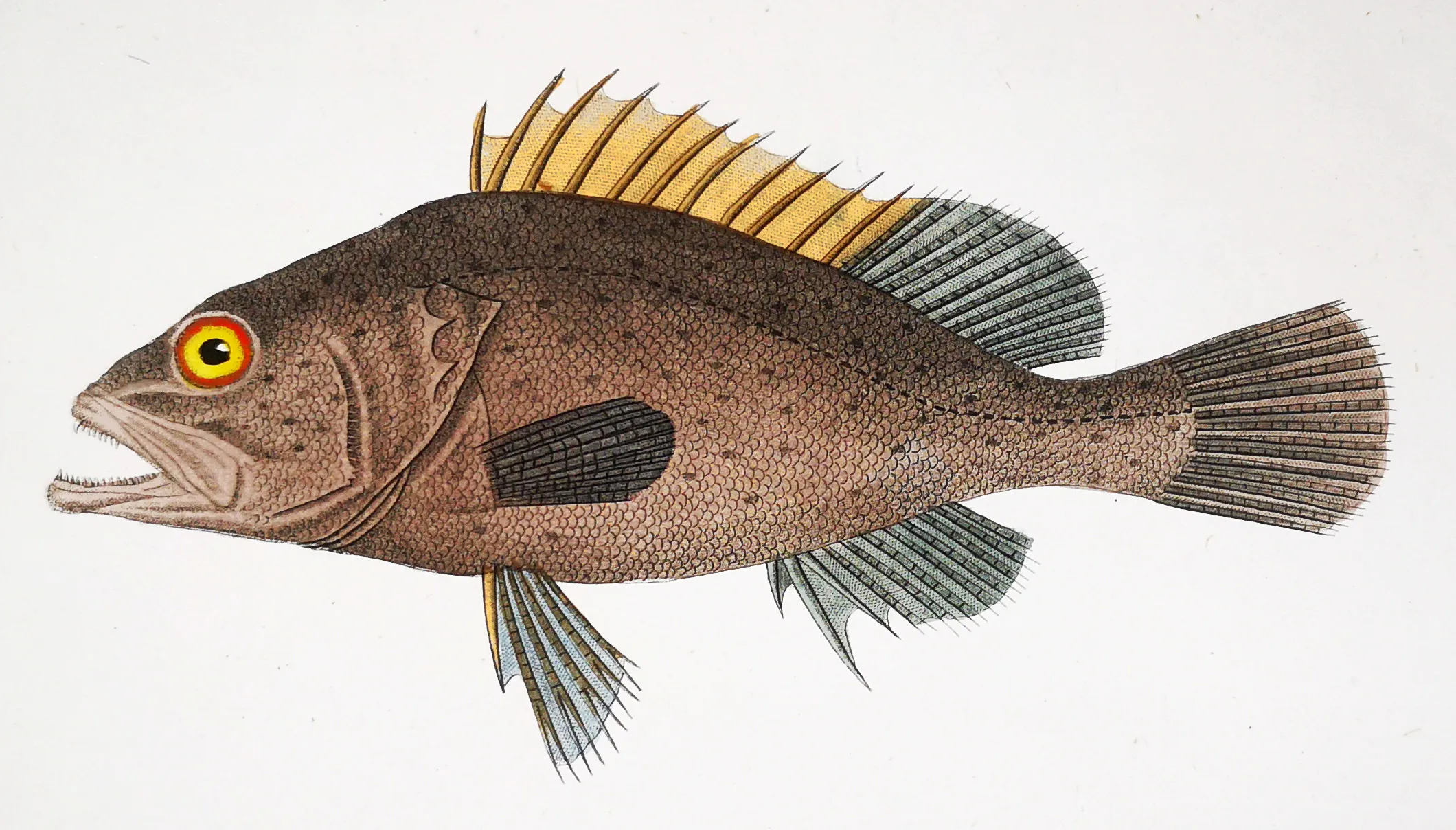
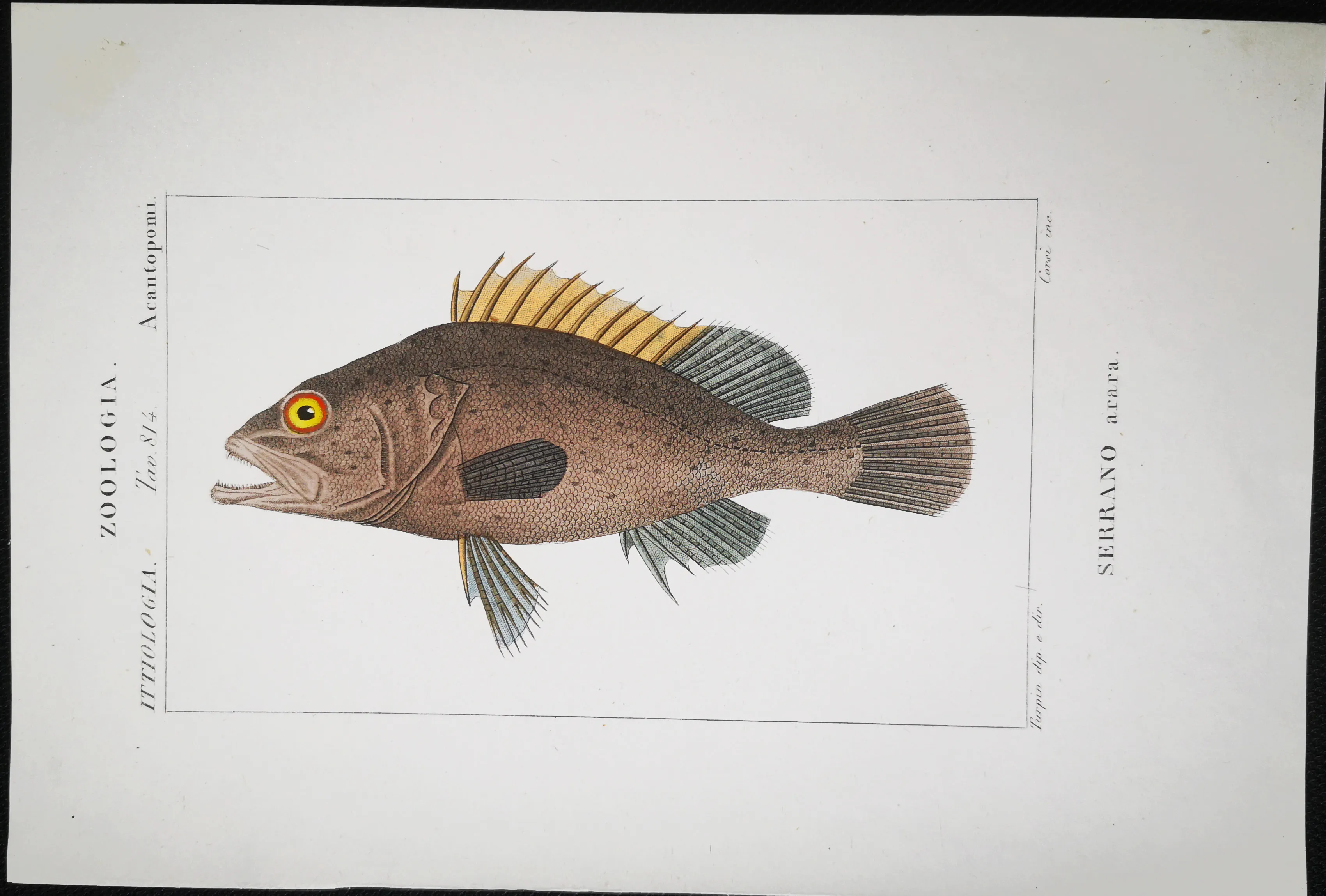

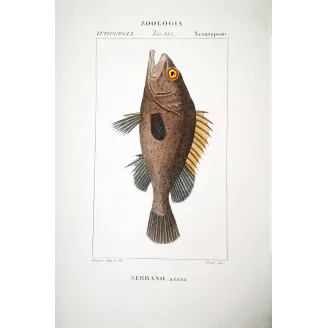
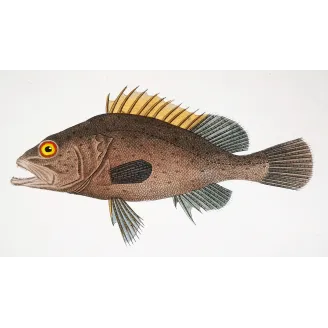
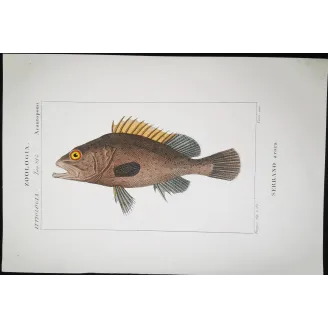
Robust Brown Grouper illustrated with fine detail and earthy, natural tones.
 Delivery policy
Your print will be carefully prepared and shipped worldwide via trusted couriers (UPS or similar).
 Authentic antique prints
Original engravings from the 17th–19th century.
This original hand-colored engraving depicts the Brown Grouper, Serranus accra, presented in a direct profile that emphasizes mass, proportion, and diagnostic structure. The robust head and open mouth suggest predatory character, yet the plate remains measured and precise, privileging clarity over dramatization.
Rather than relying on ornament, the engraving prioritizes morphological intelligibility. Scale texture is built through fine tonal modulation, fin rays are engraved with disciplined regularity, and the palette is controlled: earthy browns and muted greys are punctuated by the vivid eye and warm dorsal accents, producing both legibility and presence.
The engraving belongs to the Italian edition of the Dizionario di Scienze Naturali (Florence, Battelli press), one of the most ambitious encyclopedic scientific enterprises of its time, for which Pierre Antoine Prêtre produced some of the most compelling zoological illustrations devoted to marine life.
— • —
The composition is minimal and focused: a single specimen occupies the central field, isolated against the white sheet to concentrate attention on silhouette and texture. The granular body modelling is achieved through delicate transitions, while the darker fins and dorsal ridge stabilize the form.
The subdued palette gives the plate a sober, cultivated presence. It reads less as coastal decoration and more as cabinet-level natural history — an image intended for study, yet refined enough to function as a quiet statement piece in modern interiors.
The Brown Grouper, Serranus accra, belongs to a family of fishes historically associated with rocky coasts and ambush predation — species valued by early zoologists because form suggested behaviour. In nineteenth-century natural history, such single-profile plates served as scientific standards: jaw structure, fin placement, and body mass could be compared across engravings to support classification. For contemporary collectors, antique fish engravings of groupers carry a particular symbolic charge: they evoke the sea as a domain of strength and survival, rendered here with scholarly restraint. As a 19th-century marine life print, it offers a darker, more architectural aesthetic within the broader tradition of antique scientific illustration.
This plate forms part of the historic Dizionario di Scienze Naturali, a monumental early nineteenth-century encyclopedic enterprise once preserved within a noble library and today housed in the Sacchetti Collection. Each engraving reflects a period in which scientific ambition was matched by exceptional artisanal execution — from the disciplined copperplate line to the luminous hand-colouring applied individually to every impression.
The result is not merely zoological documentation, but a refined synthesis of scholarship and craftsmanship, where artistic discipline elevates marine observation into a form of quiet visual authority. To discover the full story behind these rare prints and their noble provenance, we invite you to read our editorial feature “Not Just Another Print” — a tribute to the enduring harmony between knowledge, art and prestige embodied in the Dizionario di Scienze Naturali.
The engraving is in excellent antique condition. The sheet presents clean margins and a well-preserved impression. The paper is smooth early nineteenth-century wove paper (non-laid), consistent with Italian scientific editions of the period. No watermark has been observed. The original hand-colouring remains fresh and well preserved, with no visible losses.
For further context on Pierre Antoine Prêtre and his contribution to nineteenth-century zoological illustration, see our editorial feature:
Pierre Antoine Prêtre – Illustrator of Natural Science and Marine Life
Specific References
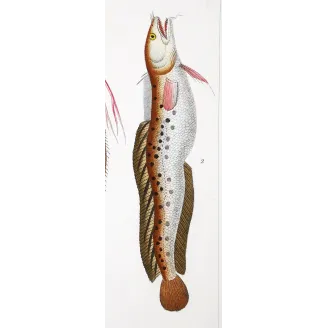
Classic 19th-century engraving of Greater Forkbeard and Rockling by Pierre Antoine Prêtre, subtle tones and elegant balance.
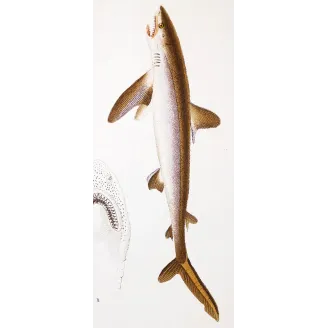
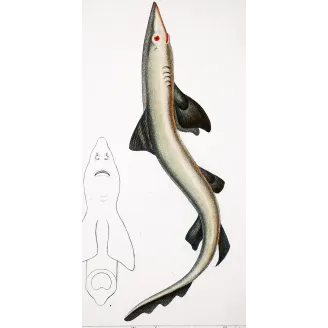
Detailed 19th-century engraving of the Small-Spotted Catshark by Pierre Antoine Prêtre, combining elegance and scientific accuracy.
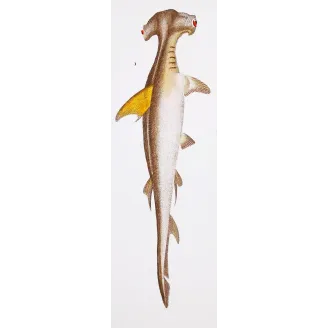
Vibrant 19th-century antique print by Pierre Antoine Prêtre depicting a Hammerhead Shark and Smoothhound, remarkable for color contrast and composition.
Striped body with blue-spotted fins; a refined 19th-century marine engraving ideal for study walls and coastal interiors.
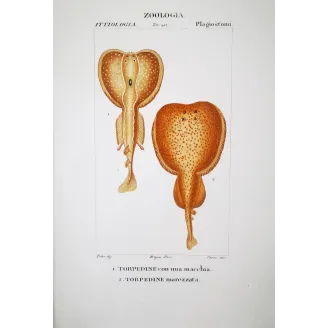
Spectacular electric rays with mottled patterns and sculptural forms; a rare and dramatic Antique Print for collectors.
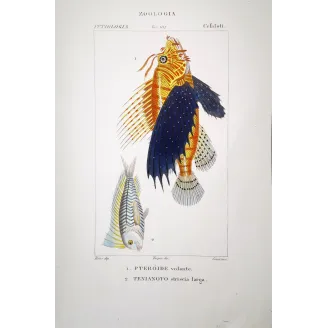
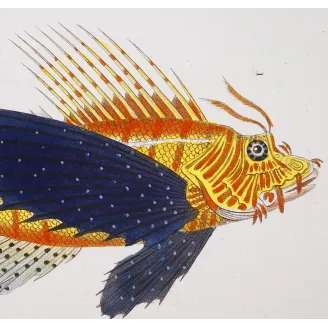
Vivid dual composition featuring the Flying Gurnard and Striped Wrasse, blending blue and golden hues.
Rare 19th-century engraving of the Angular Roughshark by Pierre Antoine Prêtre, remarkable for its unique texture and marine atmosphere.
Vivid 19th-century engraving of Mediterranean Rainbow Wrasse and Lesser Sandeel by Pierre Antoine Prêtre, bright palette and crisp lines.
Ocean Sunfish illustrated with refined color balance and elegant detail.
Distinctive composition with streamlined forms and the famous remora disktechnical curiosity with refined aesthetics.
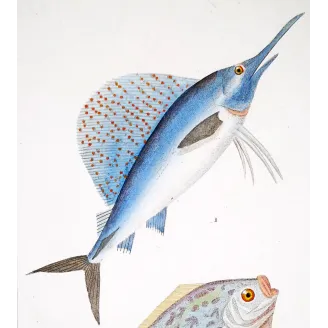
Elegant 19th-century antique print by Pierre Antoine Prêtre with Sailfish and Moonfish, luminous blues and refined detailing.
Refined 19th-century hand-colored engraving of the Tope Shark by Pierre Antoine Prêtre, notable for its elegant form and tonal realism.
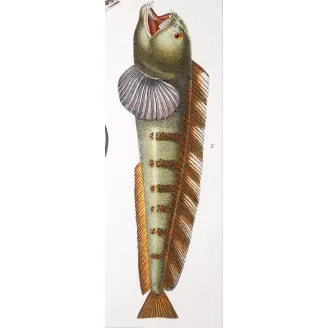
Expressive 19th-century engraving of the European Eel and Wolffish by Pierre Antoine Prêtre, contrasting silhouettes and textures.
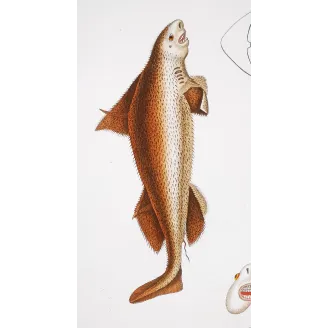
Dynamic 19th-century antique print with Spiny Dogfish and Tiger Catshark by Pierre Antoine Prêtre, contrasting forms and rich marine tones.
Classic natural history pairingsilver argentine and spotted troutclean composition and fine stippling for timeless appeal.
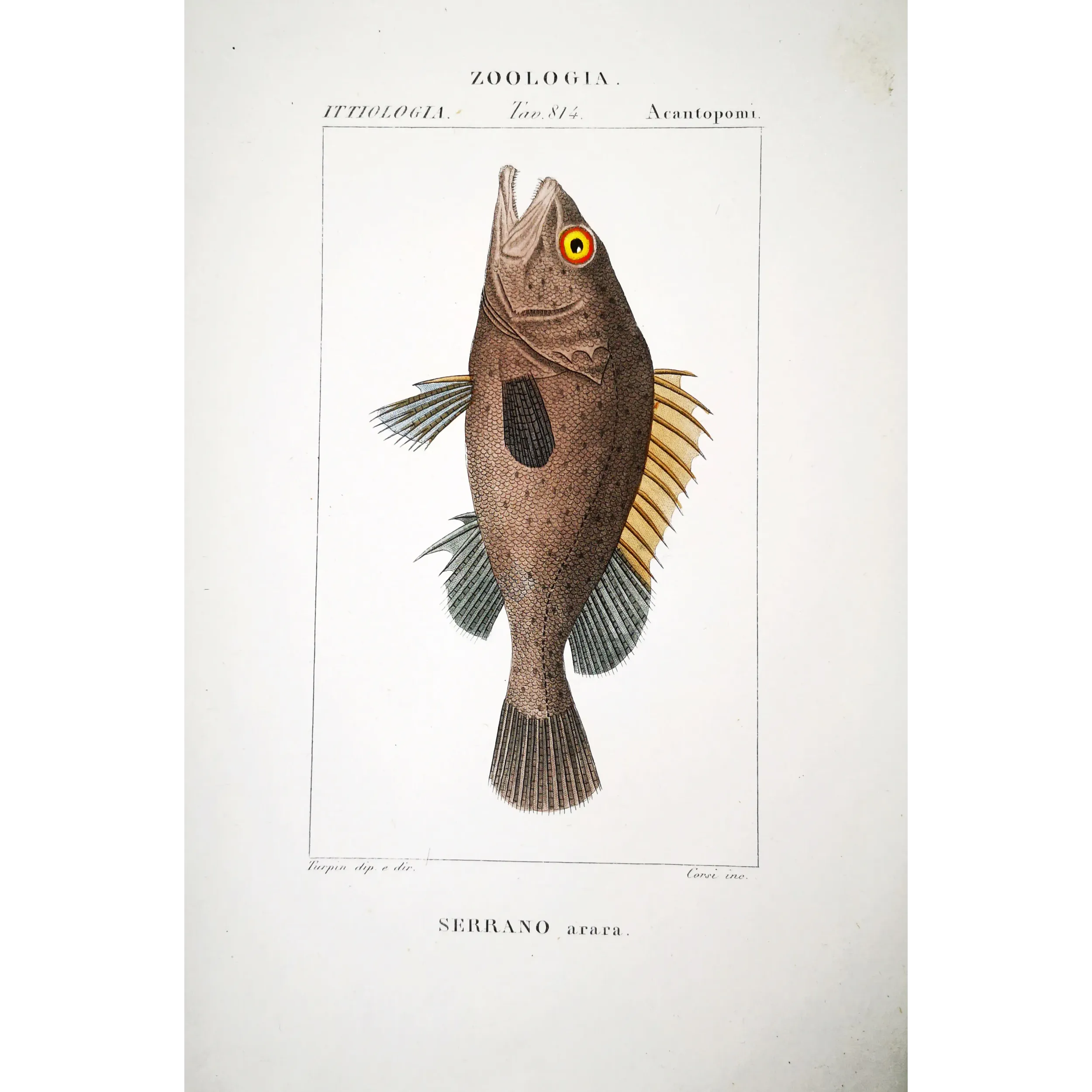
Robust Brown Grouper illustrated with fine detail and earthy, natural tones.