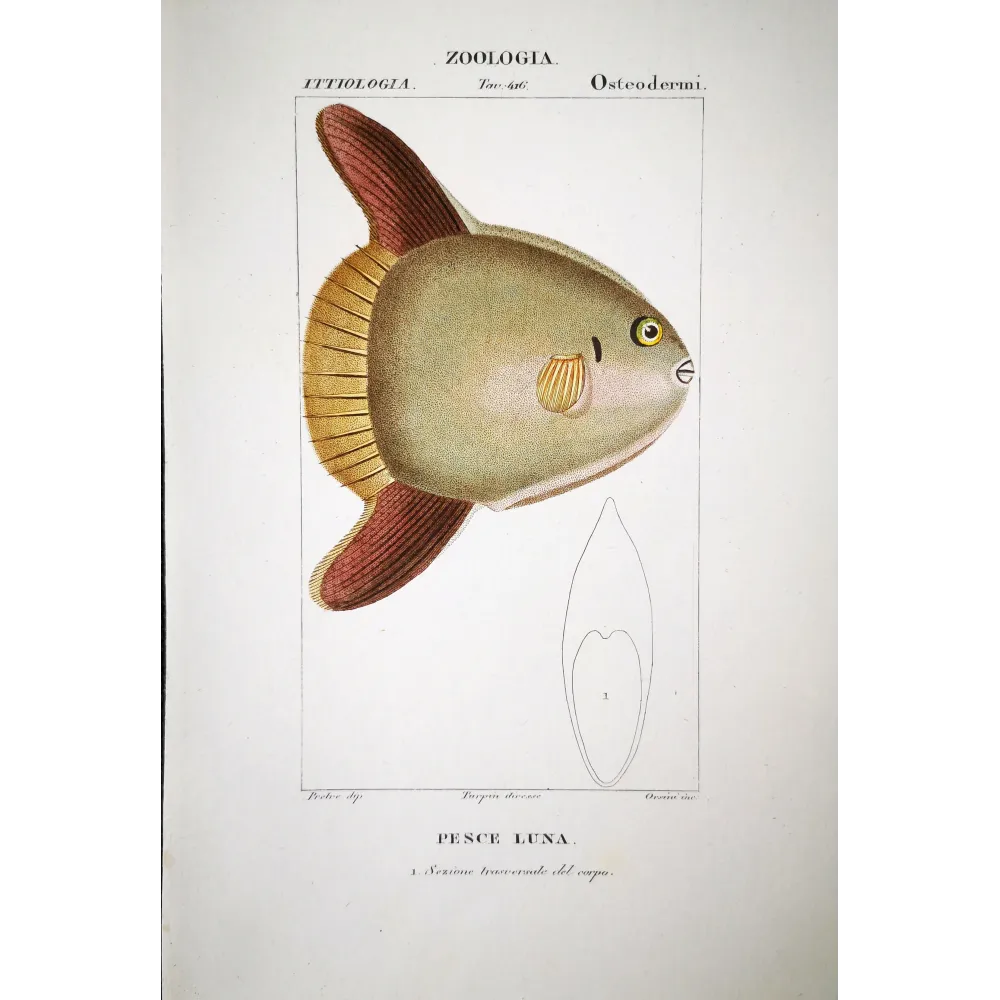
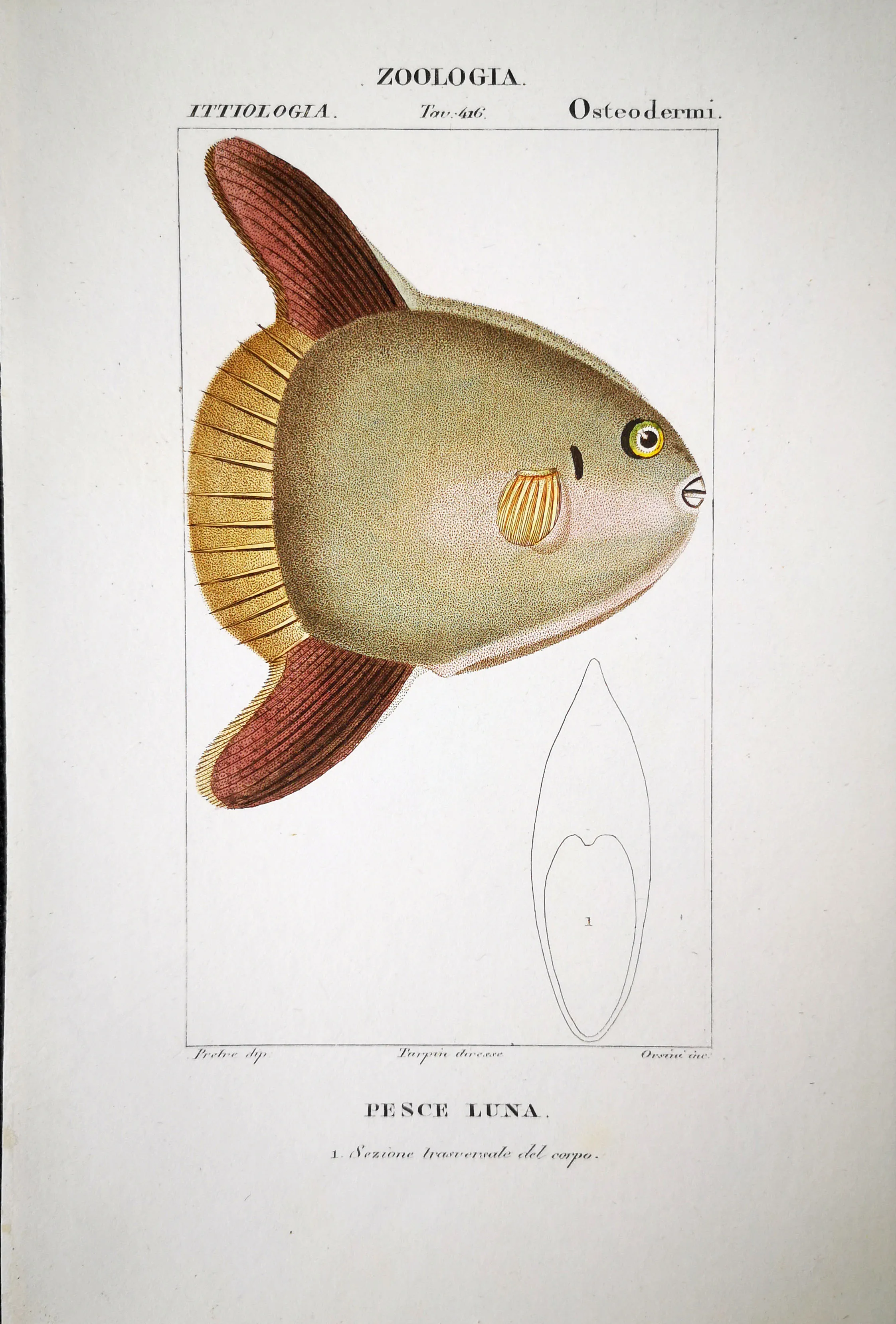
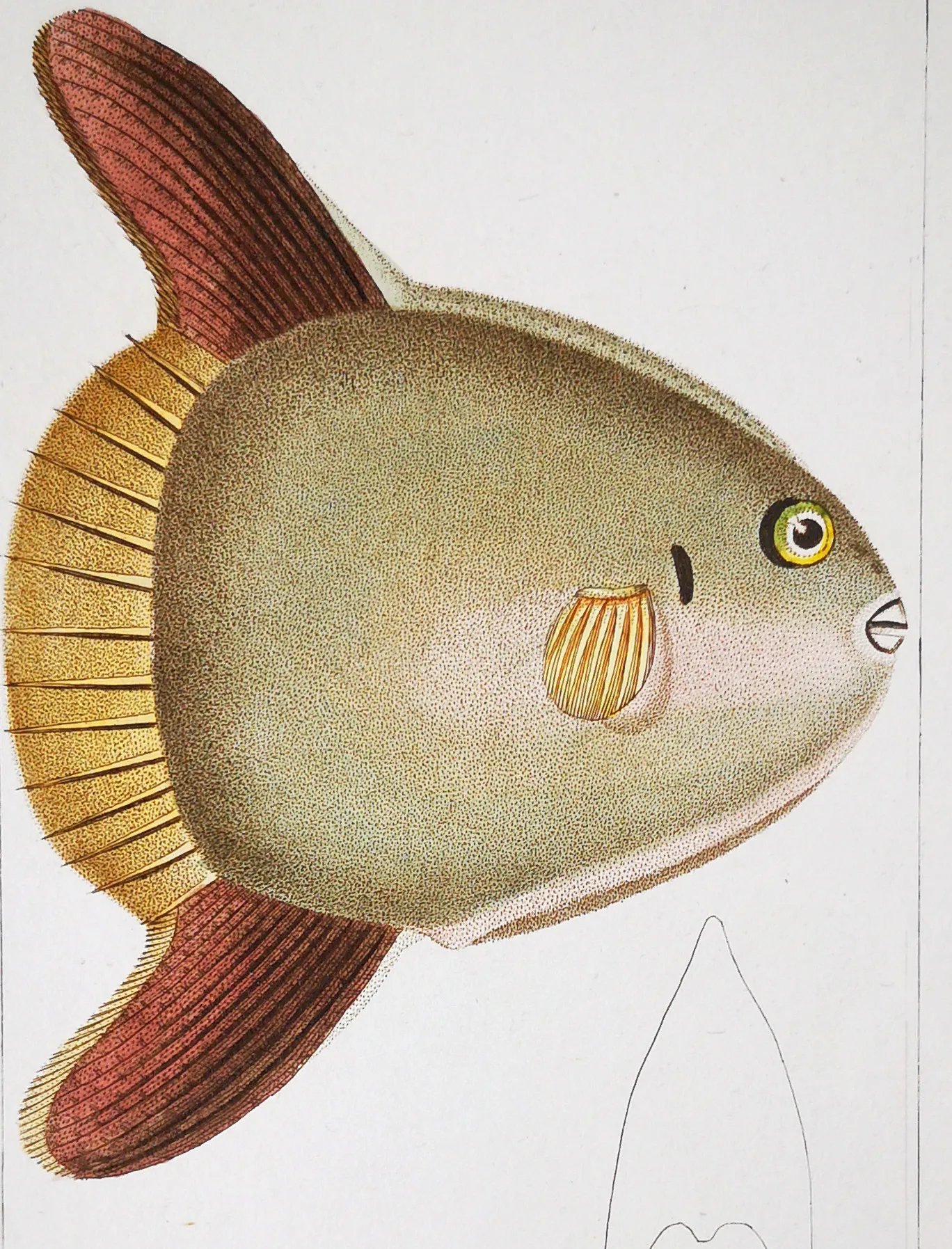
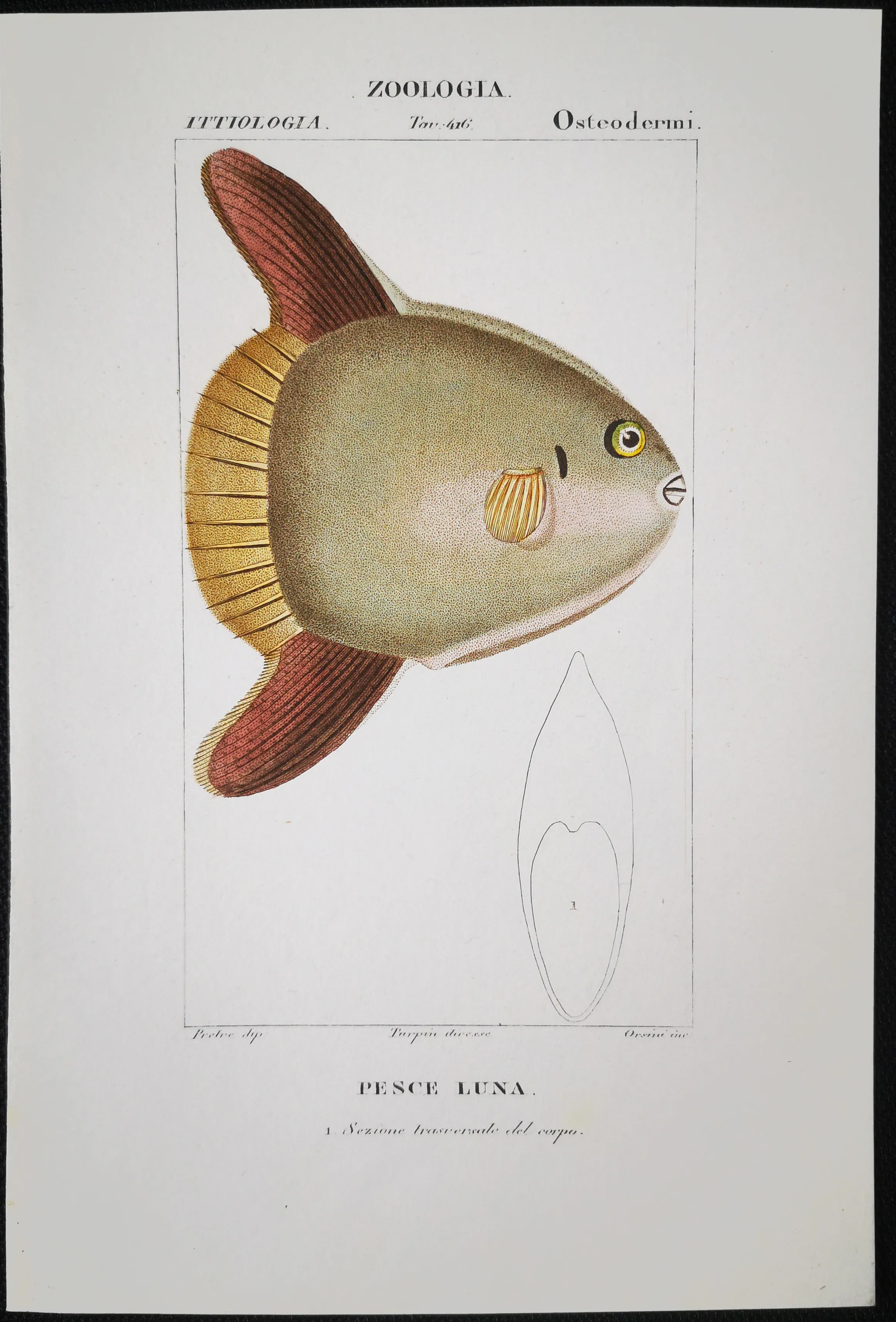
Ocean Sunfish illustrated with refined color balance and elegant detail.
 Delivery policy
Your print will be carefully prepared and shipped worldwide via trusted couriers (UPS or similar).
 Authentic antique prints
Original engravings from the 17th–19th century.
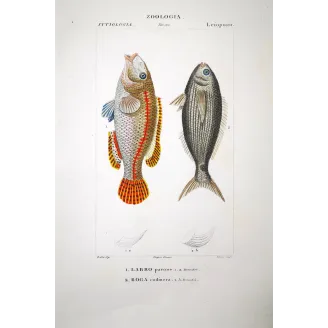
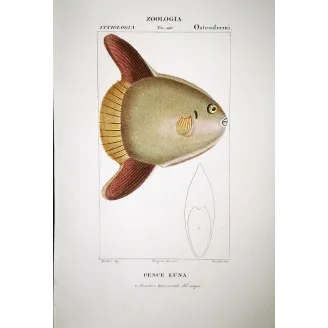
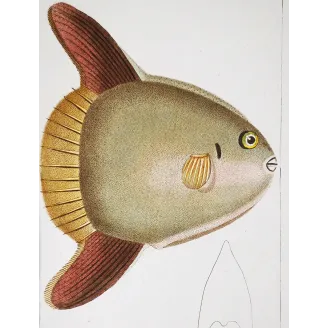
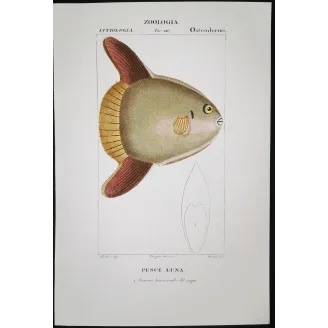
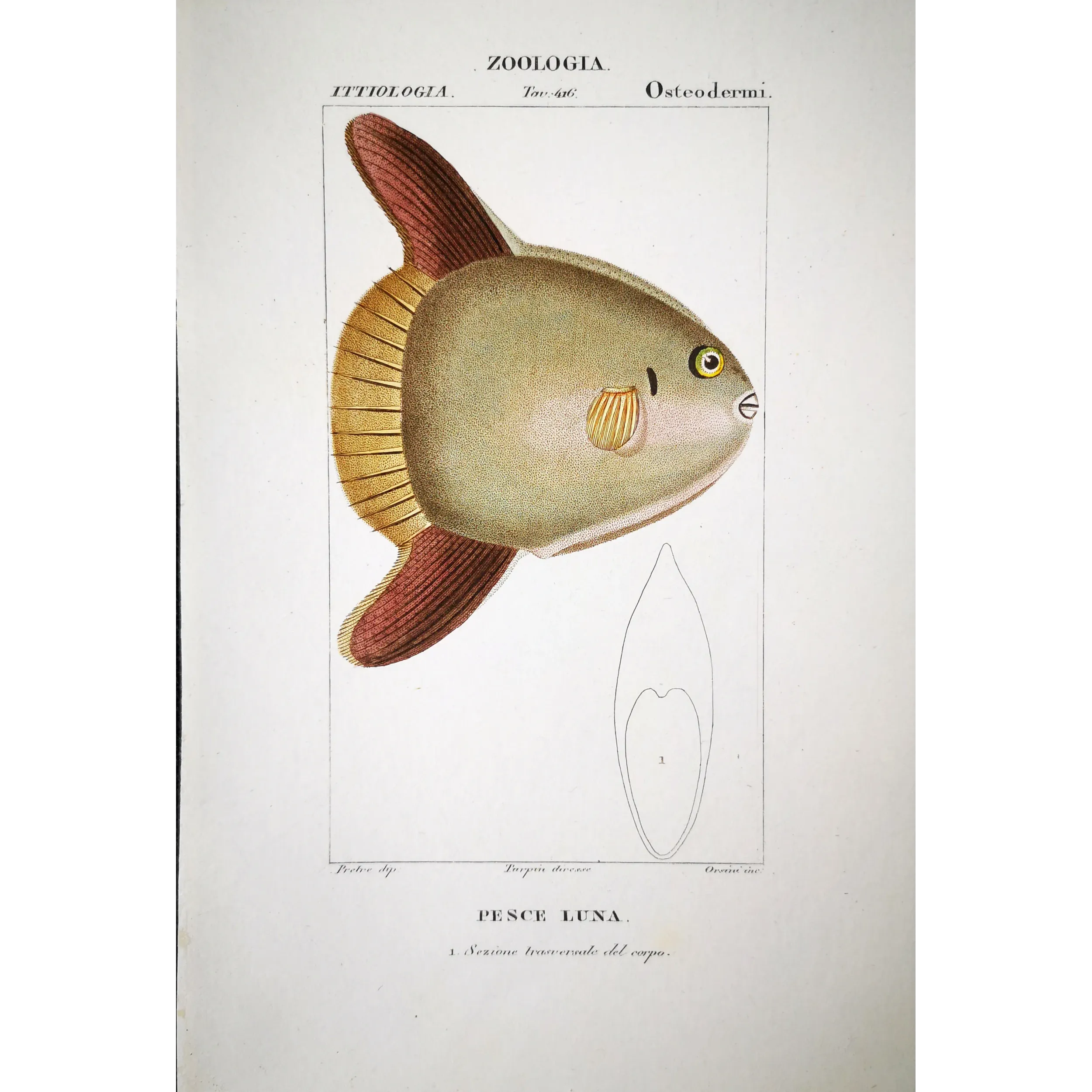
This original hand-colored engraving depicts the Ocean Sunfish, Mola mola, one of the most singular silhouettes in marine zoology. The specimen is presented with striking restraint, its rounded body modelled through controlled tonal transitions that prioritize volume and structural clarity over theatrical effect.
Unlike decorative marine imagery intended for ornament alone, this plate emphasizes analytical intelligibility. The fin planes are treated as measured fields of colour, the surface is softly graded rather than heavily outlined, and an accompanying diagram isolates a transversal section — a clear signal of the plate’s scientific purpose.
The engraving belongs to the Italian edition of the Dizionario di Scienze Naturali (Florence, Battelli press), one of the most important encyclopedic scientific enterprises of its time, for which Pierre Antoine Prêtre produced some of the most refined zoological illustrations dedicated to marine life.
— • —
The composition is vertically structured and remarkably modern in its quiet authority. The body occupies the central field like a sculptural object, with warm ochres and soft greenish-grey tones producing a luminous, almost porcelain-like surface. Muted reds and golds in the fins frame the form with controlled contrast.
The analytical outline placed beside the specimen reinforces the engraving’s scholarly character, creating an elegant balance between full depiction and scientific reduction. The overall impression is serene, precise, and unusually sophisticated for an early nineteenth-century marine plate.
The Ocean Sunfish, Mola mola, has long occupied a special place in the cultural imagination of the sea: an animal so anatomically unconventional that early naturalists treated it as evidence of nature’s boundless inventiveness. In the nineteenth century, before underwater photography, engravings like this were the authoritative visual language through which such “anomalous” species were studied and communicated. The inclusion of a transversal section is especially significant: it marks the plate as a true scientific document rather than a decorative marine scene. For modern collectors, an antique fish engraving of Mola mola offers both intellectual prestige and a rare, minimalistic aesthetic — a distinctive 19th-century marine life print that reads as calm, sculptural, and highly contemporary.
This plate forms part of the historic Dizionario di Scienze Naturali, a monumental early nineteenth-century encyclopedic enterprise once preserved within a noble library and today housed in the Sacchetti Collection. Each engraving reflects a period in which scientific ambition was matched by exceptional artisanal execution — from the disciplined copperplate line to the luminous hand-colouring applied individually to every impression.
The result is not merely zoological documentation, but a refined synthesis of scholarship and craftsmanship, where artistic discipline elevates marine observation into a form of quiet visual authority. To discover the full story behind these rare prints and their noble provenance, we invite you to read our editorial feature “Not Just Another Print” — a tribute to the enduring harmony between knowledge, art and prestige embodied in the Dizionario di Scienze Naturali.
The engraving is in excellent antique condition. The sheet presents clean margins and a well-preserved impression. The paper is smooth early nineteenth-century wove paper (non-laid), consistent with Italian scientific editions of the period. No watermark has been observed. The original hand-colouring remains fresh and well preserved, with no visible losses. The accompanying analytical figure is clearly legible.
For further context on Pierre Antoine Prêtre and his contribution to nineteenth-century zoological illustration, see our editorial feature:
Pierre Antoine Prêtre – Illustrator of Natural Science and Marine Life
Specific References
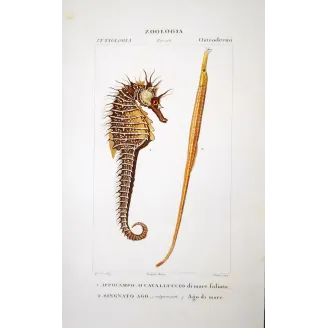
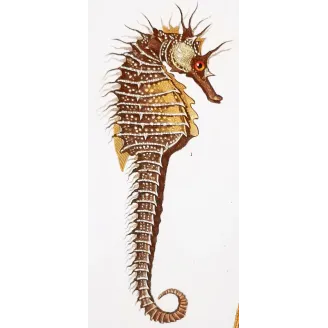
Vivid hand-colored Antique Print of a leafy seahorse with a slender pipefishan iconic duo for marine art lovers and collectors.
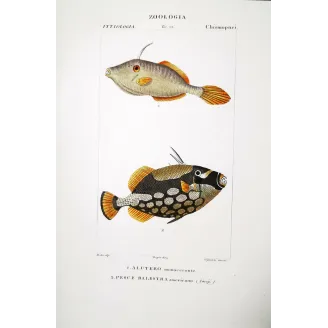
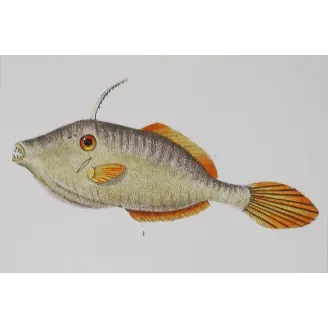
Geometric patterns and bold contrasts; elegant plate featuring a refined filefish with a dramatic American triggerfish.
Grenadier and Ribbonfish illustrated with refined color balance and elegant detail.
Dramatic eel composition with sinuous forms and precise stippling; a rare and architectural marine subject for refined interiors.
Vibrant 19th-century antique print by Pierre Antoine Prêtre depicting a Hammerhead Shark and Smoothhound, remarkable for color contrast and composition.
Silver and golden marine pair with crisp scales; a balanced 19th-century composition for refined coastal interiors.
Vivid 19th-century engraving of Mediterranean Rainbow Wrasse and Lesser Sandeel by Pierre Antoine Prêtre, bright palette and crisp lines.
Classic 19th-century engraving of Greater Forkbeard and Rockling by Pierre Antoine Prêtre, subtle tones and elegant balance.
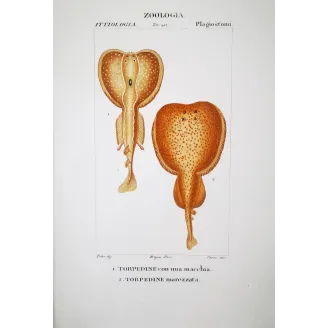
Spectacular electric rays with mottled patterns and sculptural forms; a rare and dramatic Antique Print for collectors.
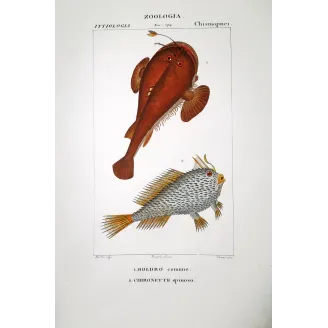
Iconic plate: dramatic anglerfish with lure and a spiny companionbold textures and collector appeal, a standout Antique Print.
Elegant coastal plate with shimmering scales and yellow-olive fins; a balanced, classic choice for study or living spaces.
Elegant 19th-century antique print by Pierre Antoine Prêtre with Sailfish and Moonfish, luminous blues and refined detailing.
Striped body with blue-spotted fins; a refined 19th-century marine engraving ideal for study walls and coastal interiors.
Brilliant peacock wrasse with patterned fins and a silver boga; lively palette and refined stippling for elegant interiors.
Striking plate with long, elegant cornetfish and trumpetfish, hand-colored with vivid reds and tealsbold marine decor statement.
Ocean Sunfish illustrated with refined color balance and elegant detail.