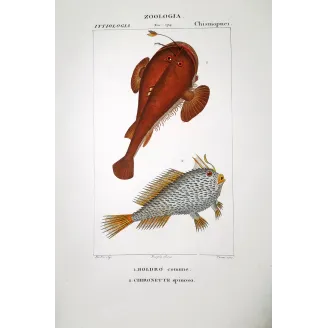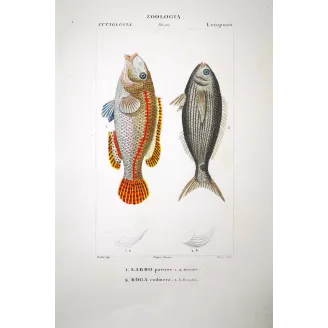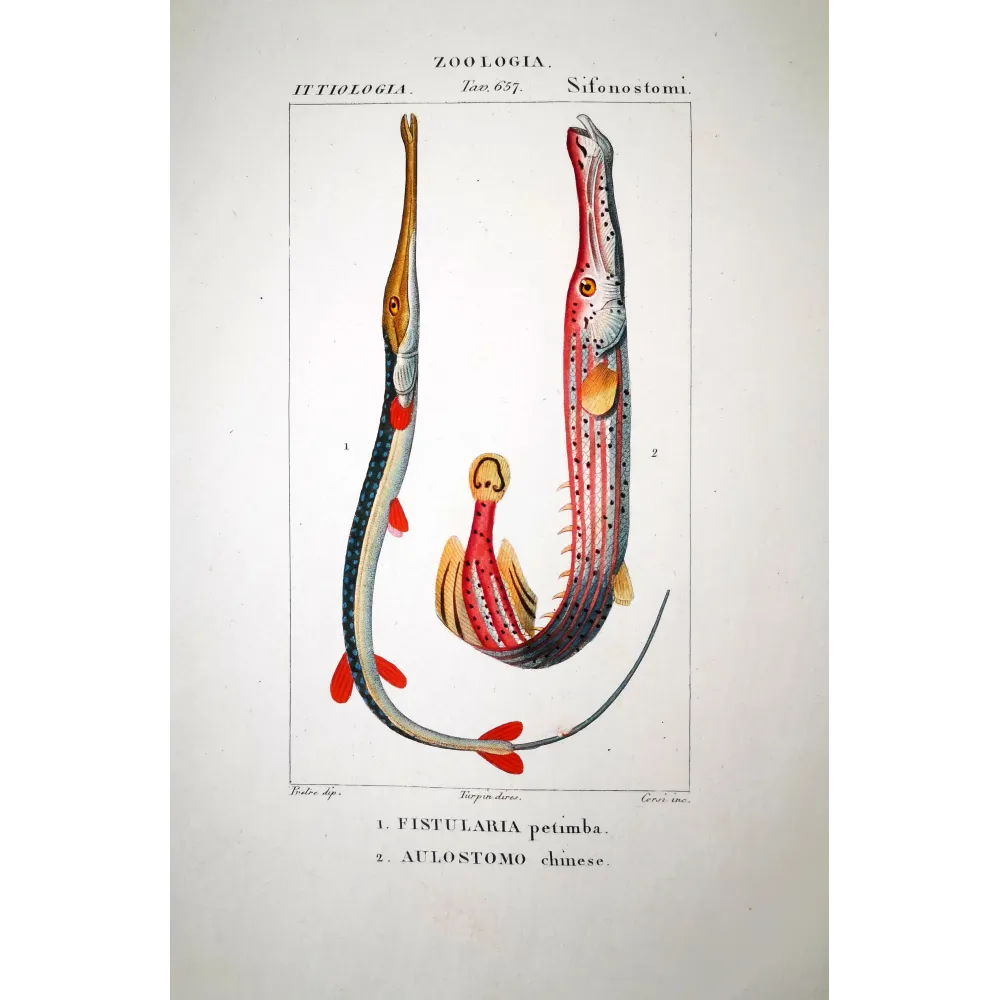
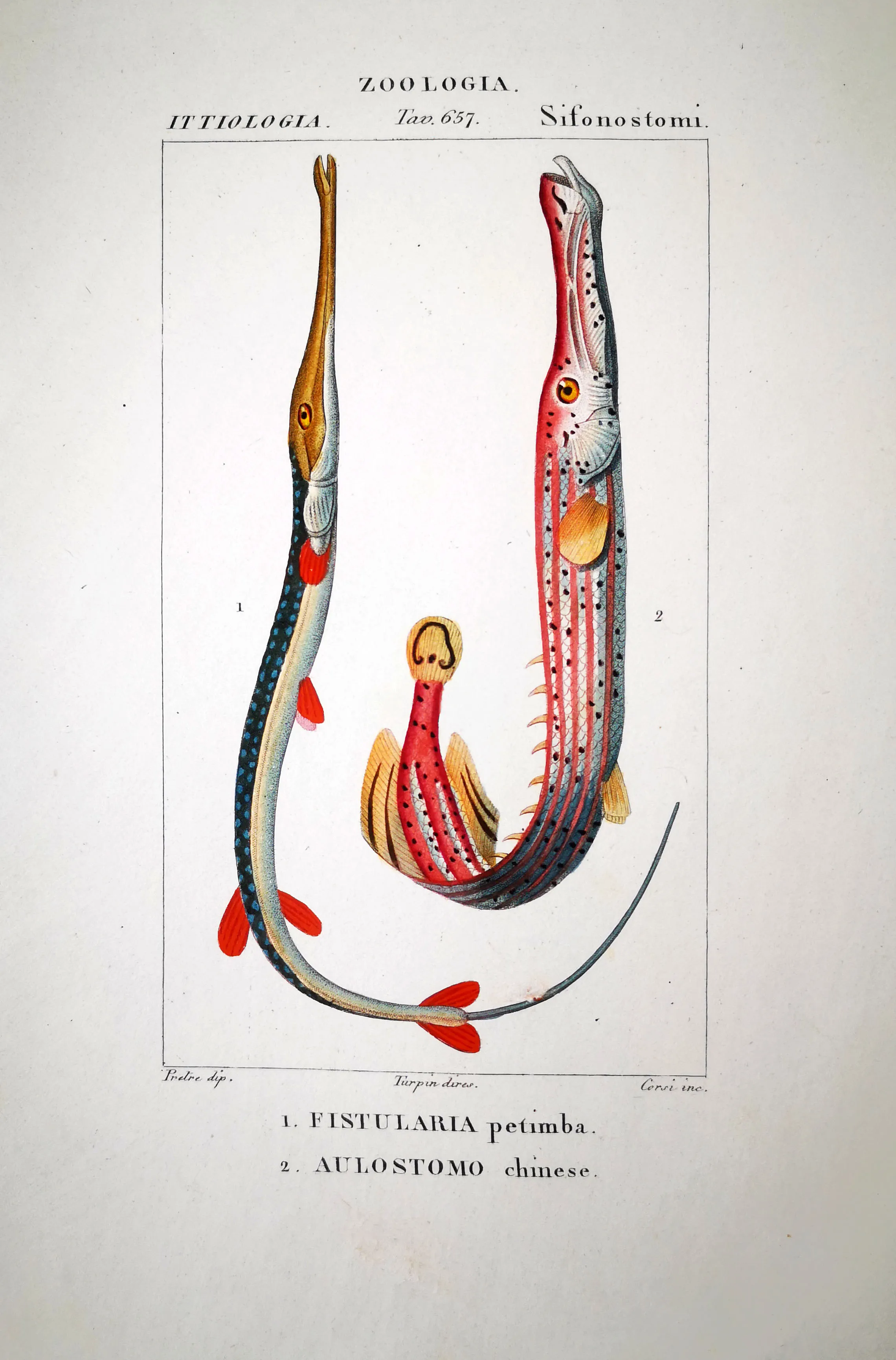
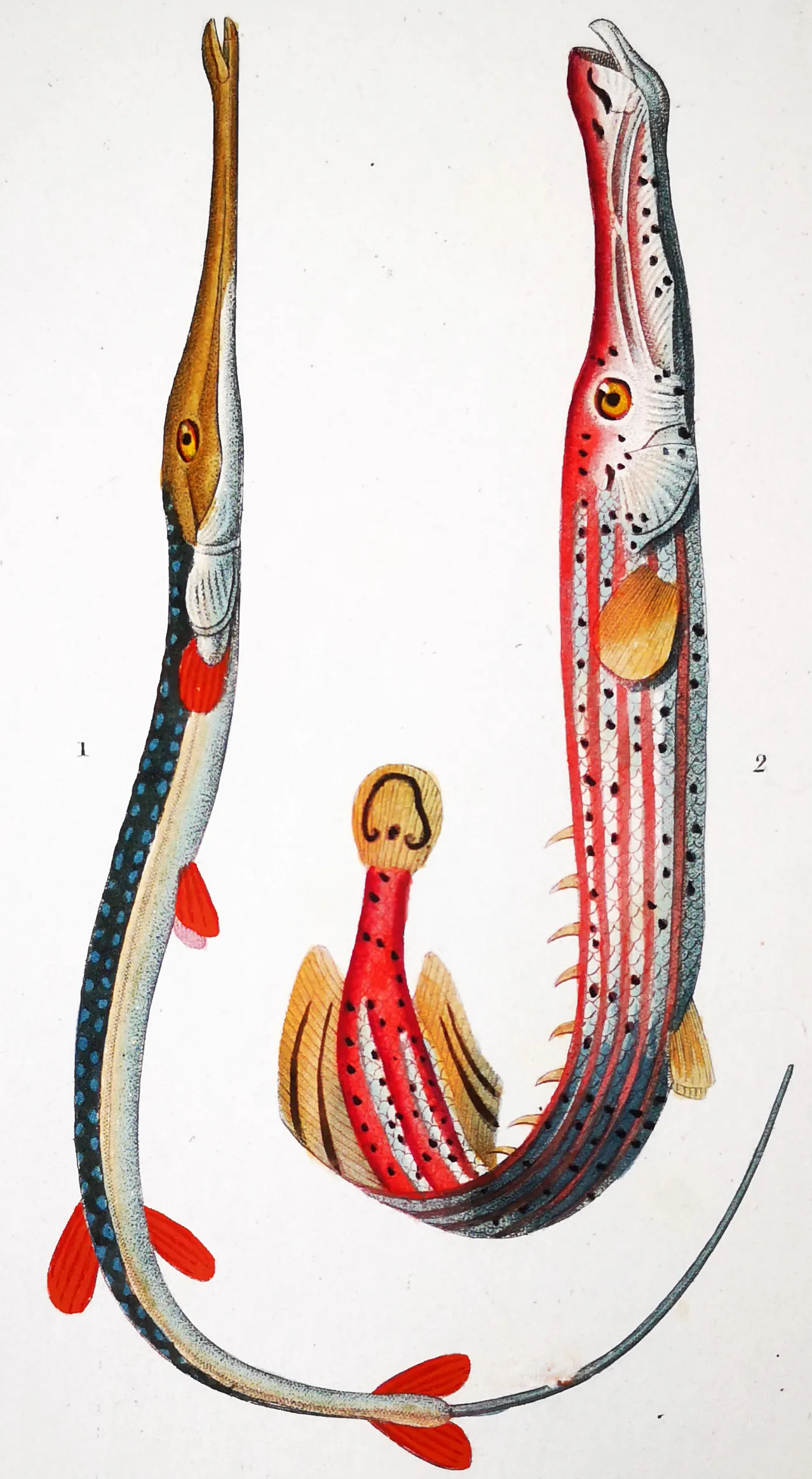
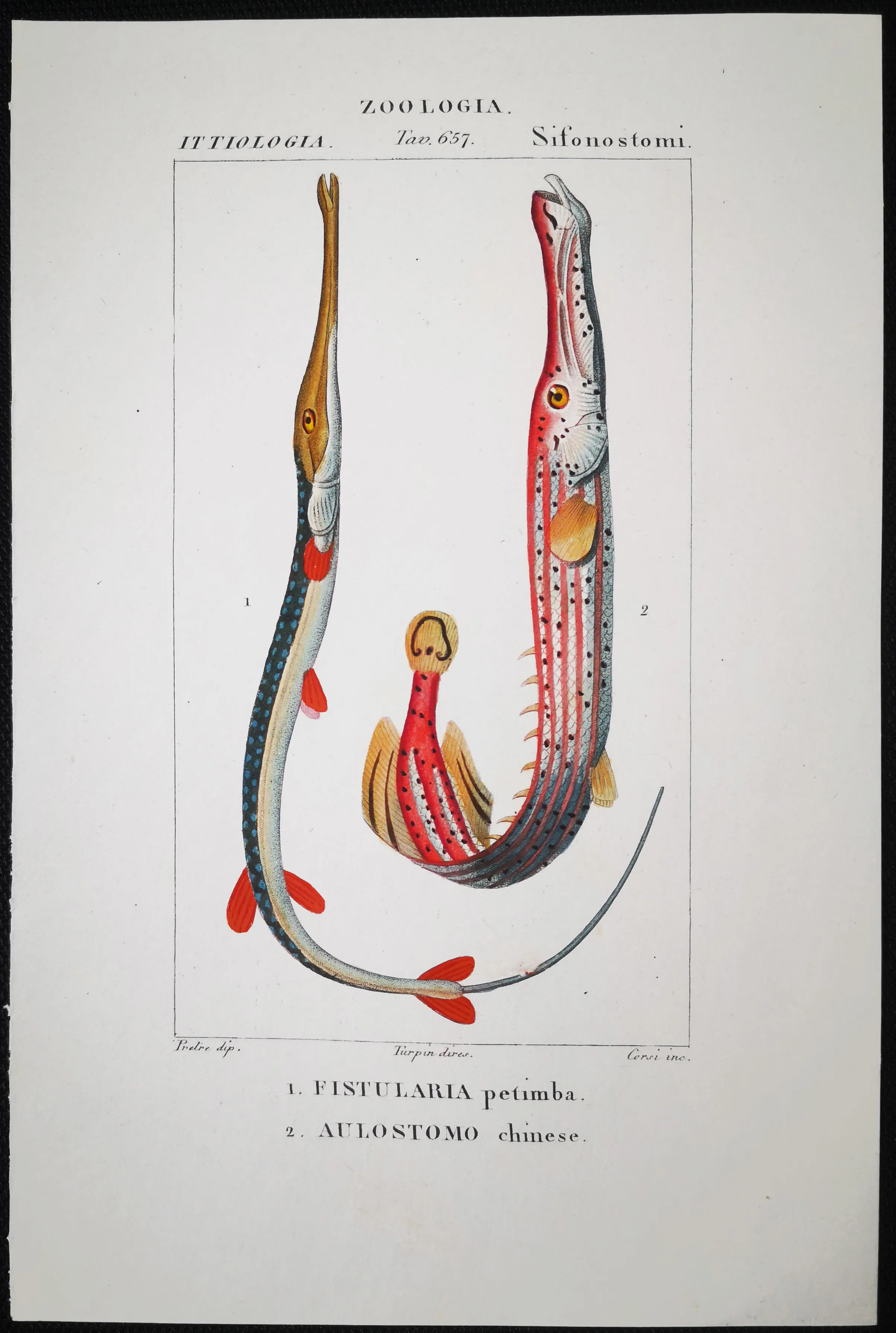

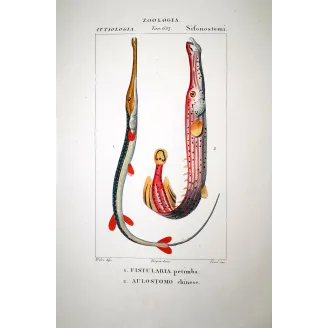
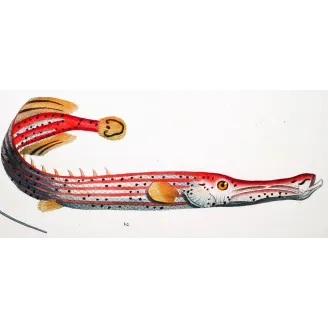
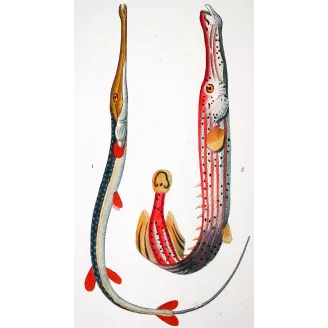
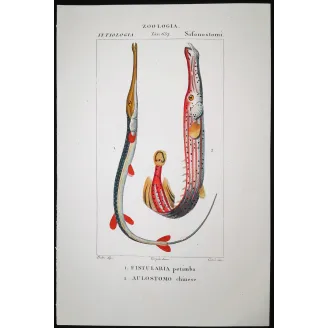
Striking plate with long, elegant cornetfish and trumpetfish, hand-colored with vivid reds and tealsbold marine decor statement.
 Delivery policy
Your print will be carefully prepared and shipped worldwide via trusted couriers (UPS or similar).
 Authentic antique prints
Original engravings from the 17th–19th century.
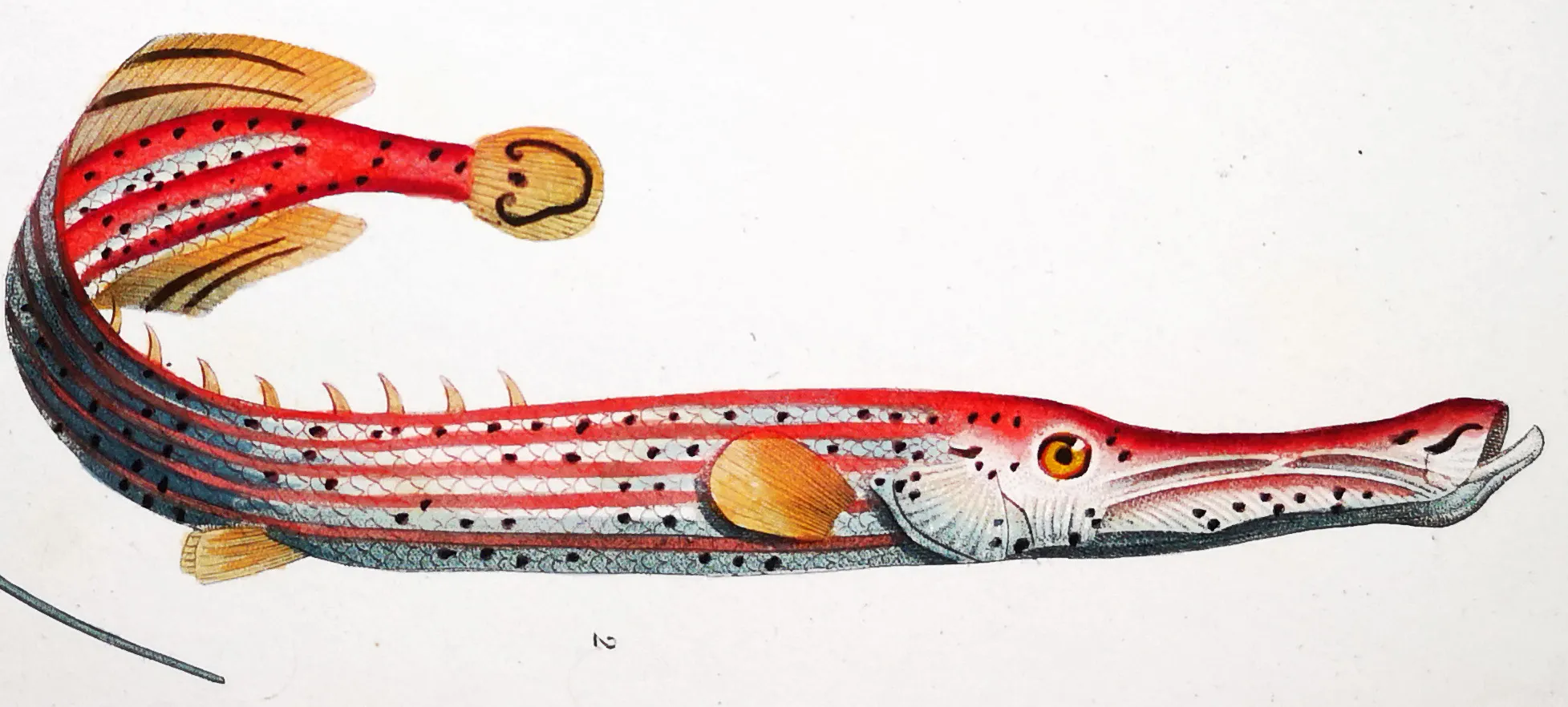
This original hand-colored engraving presents two elongated marine fishes with striking “beak-like” profiles: the Red Cornetfish, Fistularia petimba, and the Chinese Trumpetfish, Aulostomus chinensis. The plate is conceived as a comparative study of extreme form — bodies stretched into near-calligraphic lines, defined by precision and restraint.
Prêtre renders both specimens with disciplined clarity: the head and snout are described with careful contour, while the long bodies are articulated through segmented patterning and finely controlled colour. Reds and cool blues create immediate visual identity, yet remain balanced by the clean, encyclopedic margins.
The engraving belongs to the Italian edition of the Dizionario di Scienze Naturali (Florence, Battelli press), one of the most ambitious encyclopedic scientific enterprises of its time, for which Pierre Antoine Prêtre produced a refined series of marine life plates.
— • —
The composition is highly graphic: two vertical figures, each treated as an independent column of colour and structure. The Red Cornetfish reads as a long, cool-toned ribbon punctuated by red fin accents, while the Chinese Trumpetfish introduces a warmer, more saturated spectrum and a more intricate internal rhythm.
The interplay between the two creates a curated, almost gallery-like balance — minimal, modern, and exceptionally strong for display in contemporary interiors.
The Red Cornetfish, Fistularia petimba, and the Chinese Trumpetfish, Aulostomus chinensis, are culturally resonant subjects because their anatomy appears deliberately engineered: long tubular snouts and extended bodies evoke the sea as a place of extraordinary design. In the nineteenth century, such “extreme” forms were prized in antique fish engravings because they communicated difference instantly — making them ideal for encyclopedic plates in the pre-photographic era. As a 19th-century marine life print: two unusual species, strong colour contrast, and the intellectual prestige of antique scientific illustration.
This plate forms part of the historic Dizionario di Scienze Naturali, a monumental early nineteenth-century encyclopedic enterprise once preserved within a noble library and today housed in the Sacchetti Collection. Each engraving reflects a period in which scientific ambition was matched by exceptional artisanal execution — from the disciplined copperplate line to the luminous hand-colouring applied individually to every impression.
To discover the full story behind these rare prints and their noble provenance, we invite you to read our editorial feature “Not Just Another Print”.
The engraving is in excellent antique condition. The sheet presents clean margins and a well-preserved impression. The paper is smooth early nineteenth-century wove paper (non-laid), consistent with Italian scientific editions of the period. No watermark has been observed. The original hand-colouring remains fresh and well preserved, with no visible losses.
For further context on Pierre Antoine Prêtre and his contribution to nineteenth-century zoological illustration, see our editorial feature:
Pierre Antoine Prêtre – Illustrator of Natural Science and Marine Life
Specific References
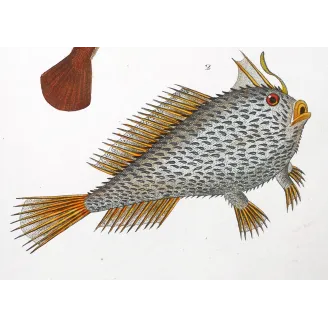
Iconic plate: dramatic anglerfish with lure and a spiny companionbold textures and collector appeal, a standout Antique Print.
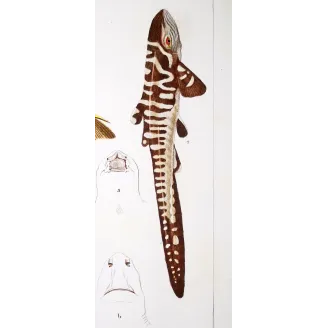
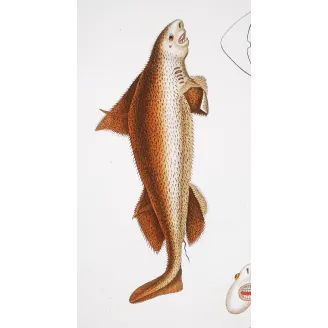
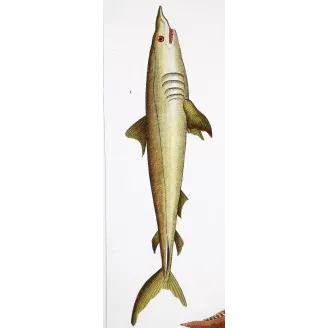
Dynamic 19th-century antique print with Spiny Dogfish and Tiger Catshark by Pierre Antoine Prêtre, contrasting forms and rich marine tones.
Vivid 19th-century engraving of Mediterranean Rainbow Wrasse and Lesser Sandeel by Pierre Antoine Prêtre, bright palette and crisp lines.
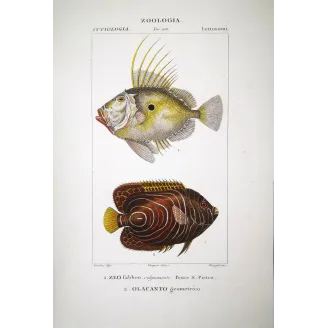
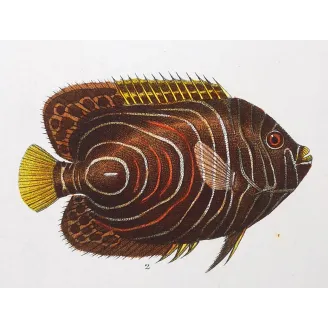
Iconic plate with the celebrated John Dory and a striking angelfishsuperb color contrasts and collector appeal.
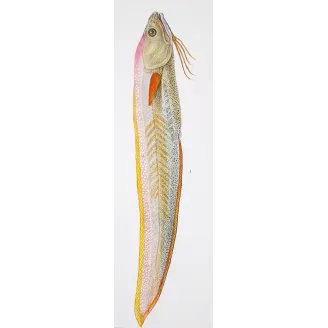
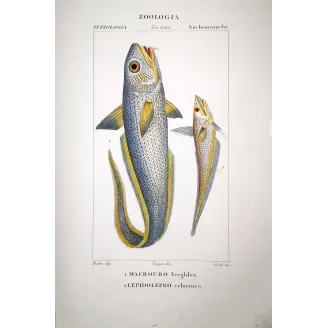
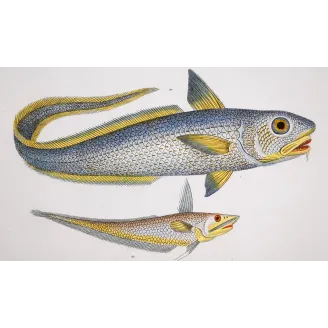
Grenadier and Ribbonfish illustrated with refined color balance and elegant detail.
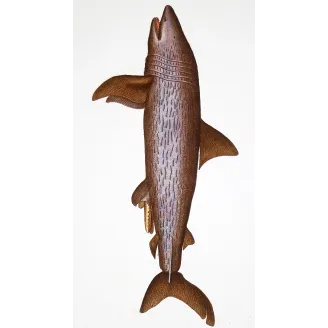
Spectacular 19th-century antique print of the Basking Shark by Pierre Antoine Prêtre, capturing monumental scale and serene presence.
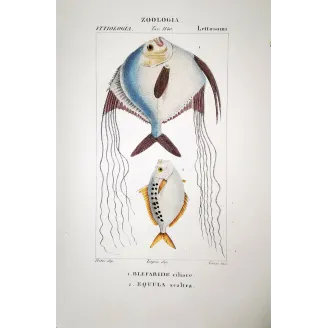
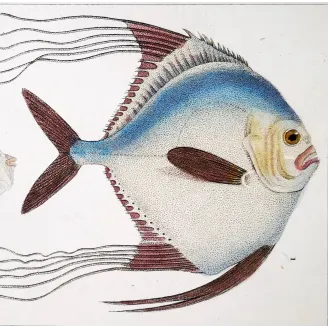
Delicate 19th-century hand-colored engraving of a ponyfish with companion species, ideal for marine-themed interiors and collectors.
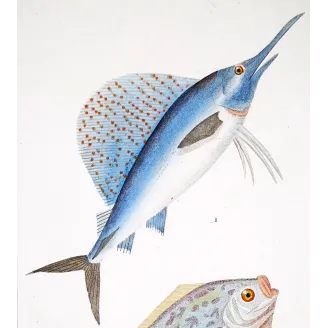
Elegant 19th-century antique print by Pierre Antoine Prêtre with Sailfish and Moonfish, luminous blues and refined detailing.
Rare 19th-century engraving of the Angular Roughshark by Pierre Antoine Prêtre, remarkable for its unique texture and marine atmosphere.
Fine 19th-century antique print depicting Porbeagle and Spiny Dogfish by Pierre Antoine Prêtre, detailed and vibrant marine pair.
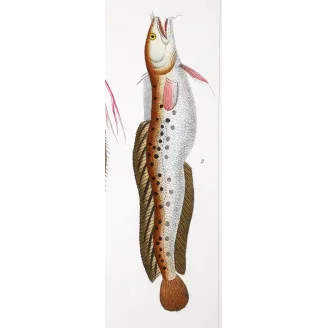
Classic 19th-century engraving of Greater Forkbeard and Rockling by Pierre Antoine Prêtre, subtle tones and elegant balance.
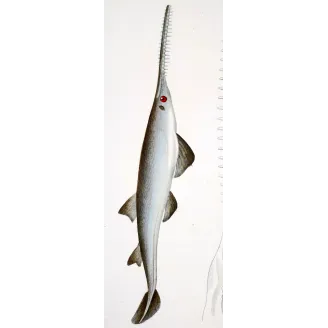
Exceptional 19th-century antique print by Pierre Antoine Prêtre depicting the majestic Sawfish with anatomical accuracy and rare charm.
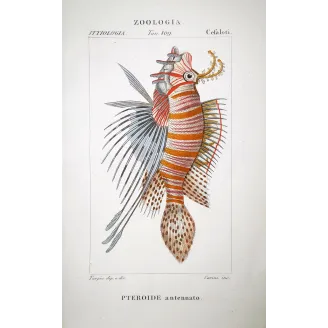
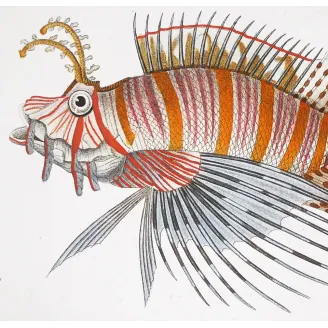
Striking depiction of the Antennata Lionfish with vivid red and orange fins, full of exotic elegance.
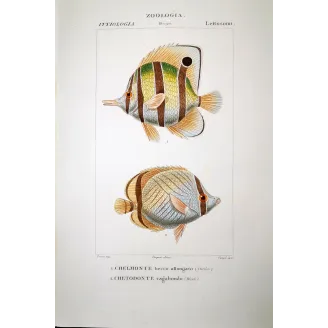
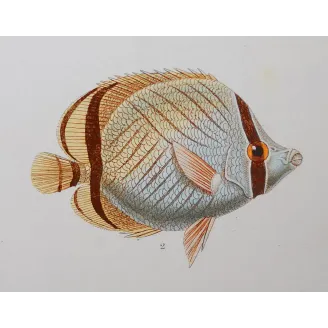
Iconic Antique Print with two vivid butterflyfishes, finely hand-coloredstriking geometry and coral-reef charm for collectors.
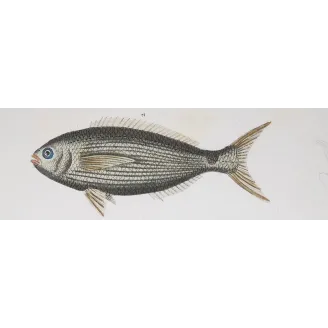
Brilliant peacock wrasse with patterned fins and a silver boga; lively palette and refined stippling for elegant interiors.
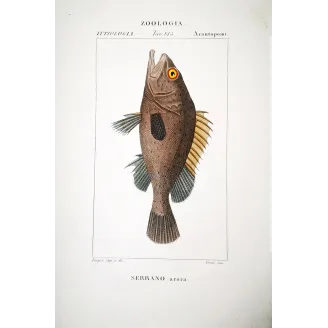
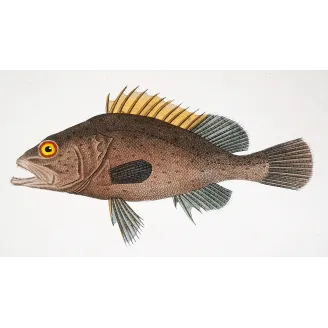
Robust Brown Grouper illustrated with fine detail and earthy, natural tones.
Original 1774 engraving by Jacob LâAdmiral: Swallowtail Butterfly on Thistle.
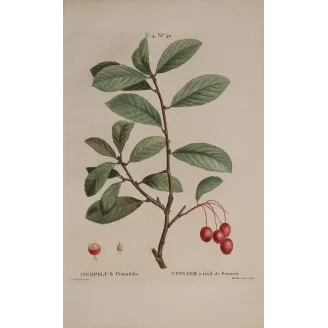
Original botanical engraving of Mespilus prunifolia by Redouté. Elegant branch and fruit, perfect for refined interiors.
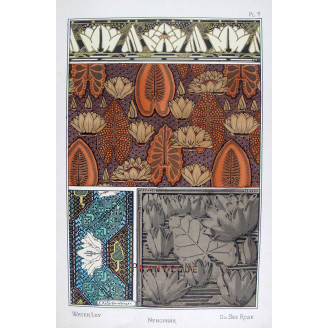
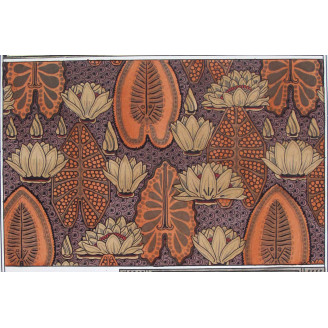
his extraordinary plate by Eugène Grasset features the water-lily (Nénuphar), rendered with both botanical accuracy and ornamental imagination.
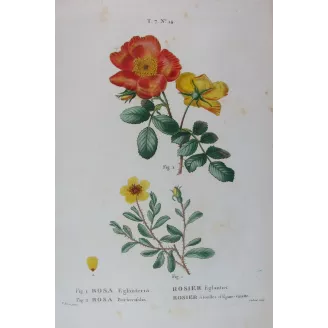
Eglantine & Berberis-leaved Rose Rosier à feuilles d'Épine-vinette Original hand-colored botanical engraving by Pancrace Bessa.
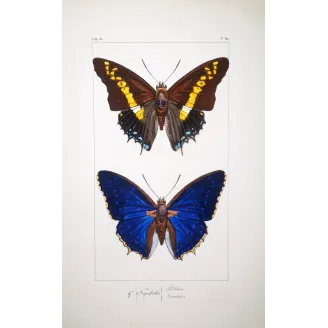
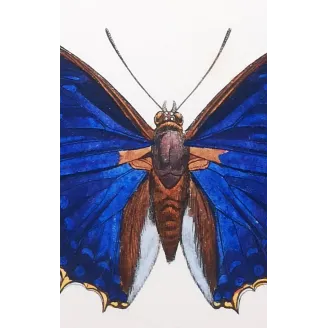
Original 1835 hand-colored copper engraving depicting the butterflies Pollux and Eurilochus. A visually striking double-specimen plate from Hippolyte Lucas’ celebrated Exotic Butterflies, engraved by Pauquet, with strong appeal as natural history art and antique butterfly wall art.
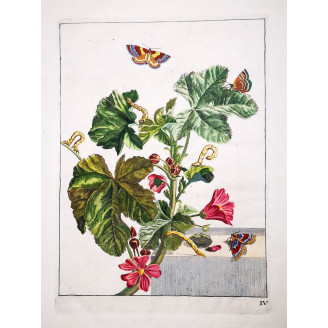
Original 1774 engraving by Jacob L'Admiral: Red Twin-spot Carpet on Mallow.
18th-century hand-colored engraving of the Wilding or Crab Tree by Elisabeth Blackwell, with blossom and fruit details.
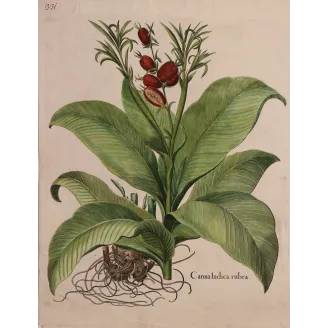
Original seventeenth-century hand-colored botanical engraving of Canna Indica rubra from Basilius Besler's monumental Hortus Eystettensis, first published in 1613. The imposing composition combines sweeping green foliage, exposed roots and vivid red botanical forms, while the laid-paper sheet preserves a watermark and the remarkable printed autumnal heading “SECVNDVS ORDO COLLECTARVM PLANTARVM AVTVMNALIVM” on its verso.
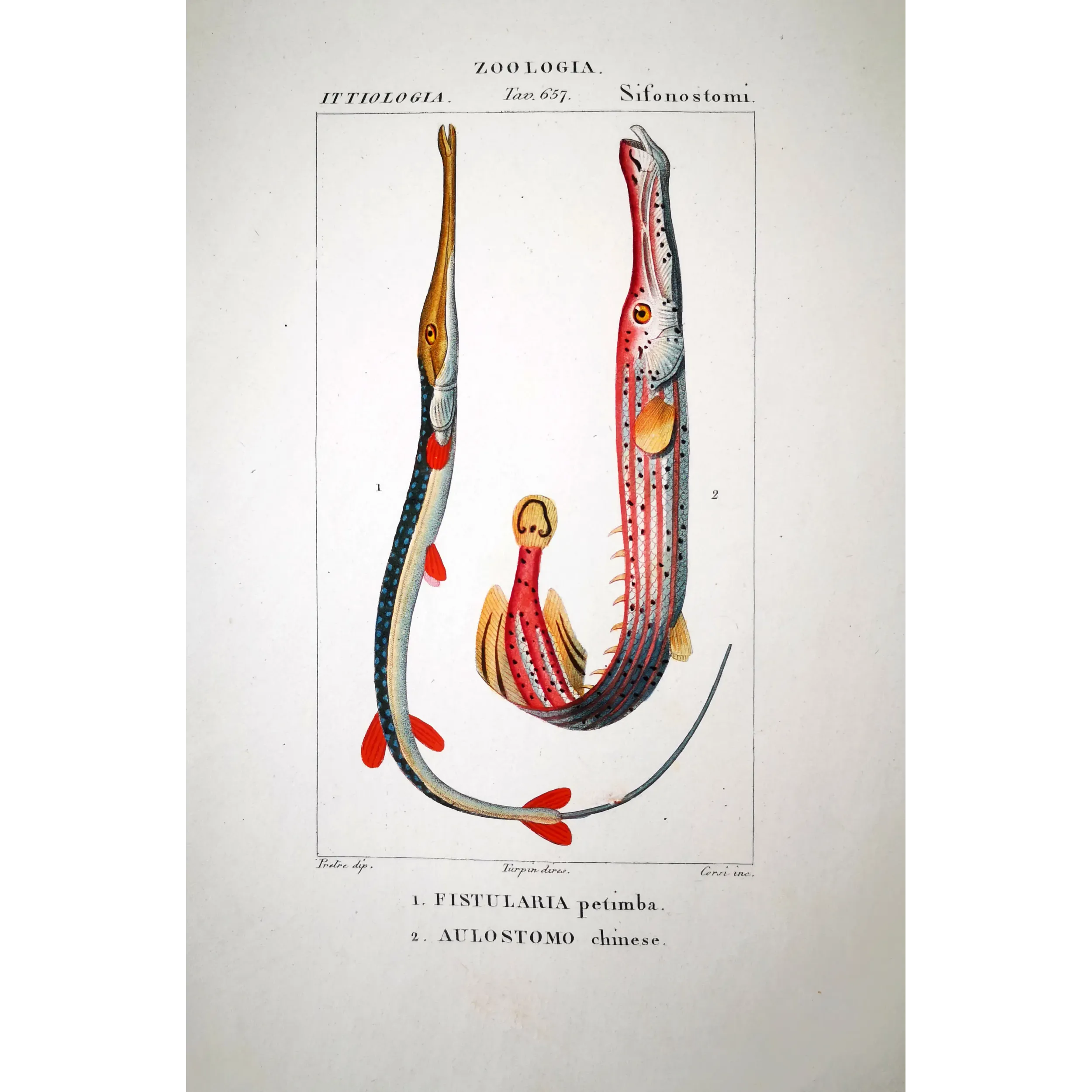
Striking plate with long, elegant cornetfish and trumpetfish, hand-colored with vivid reds and tealsbold marine decor statement.