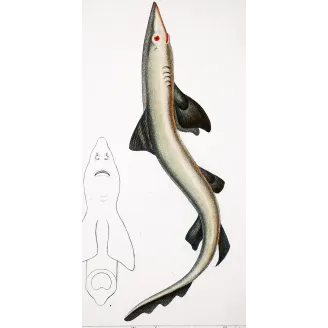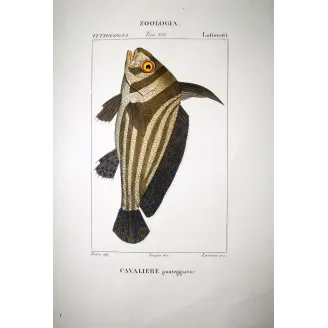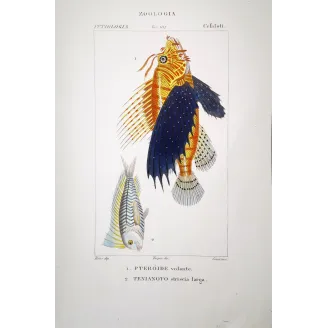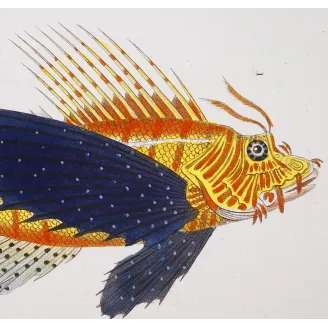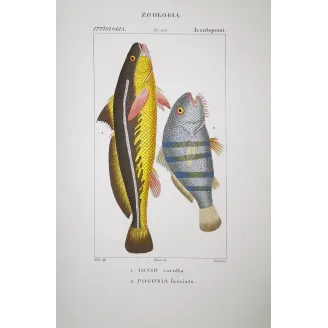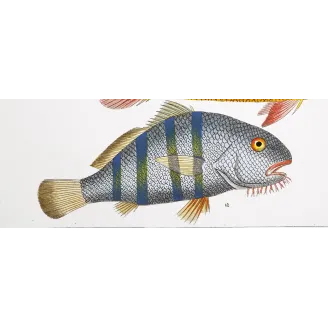

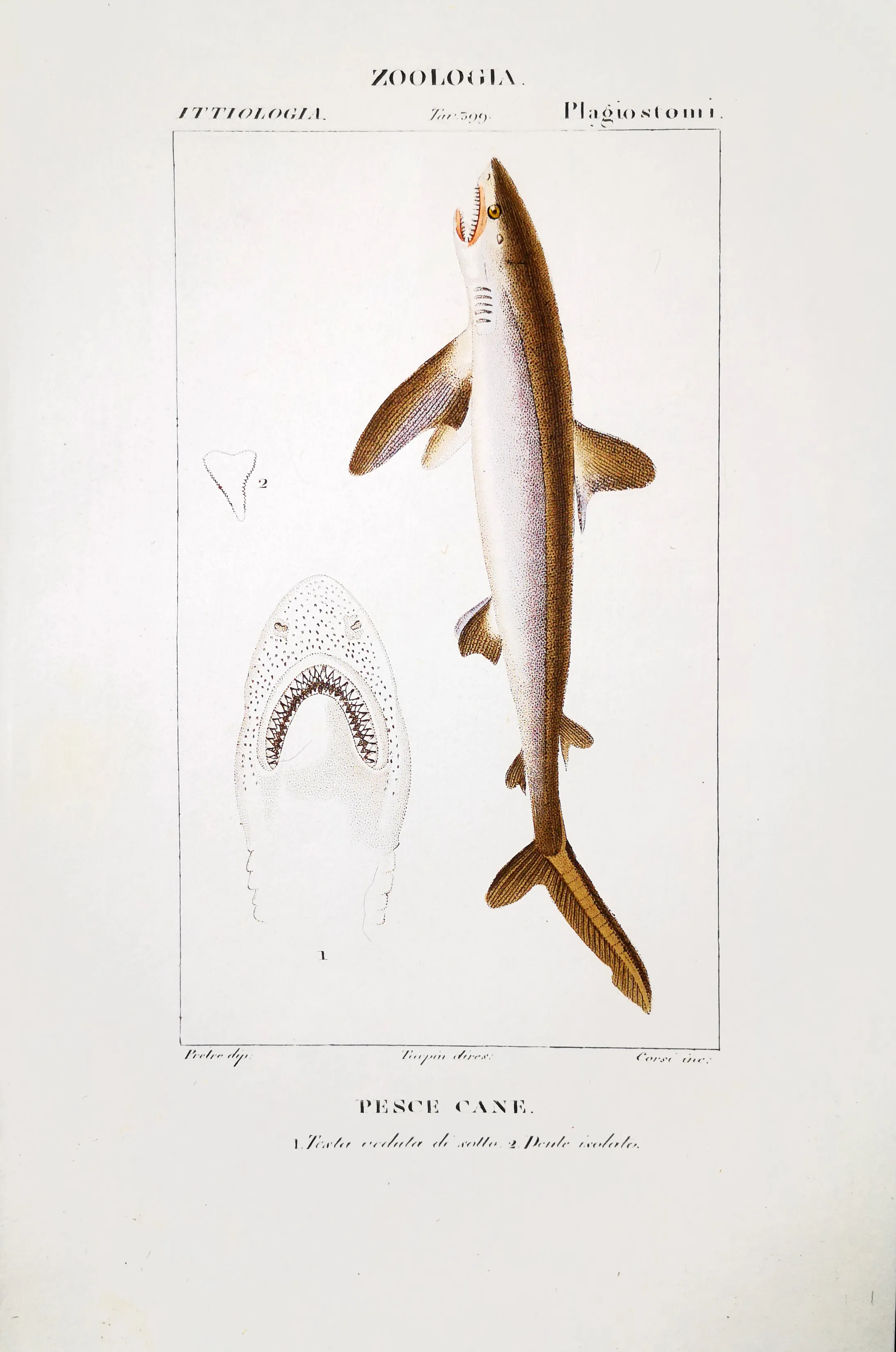
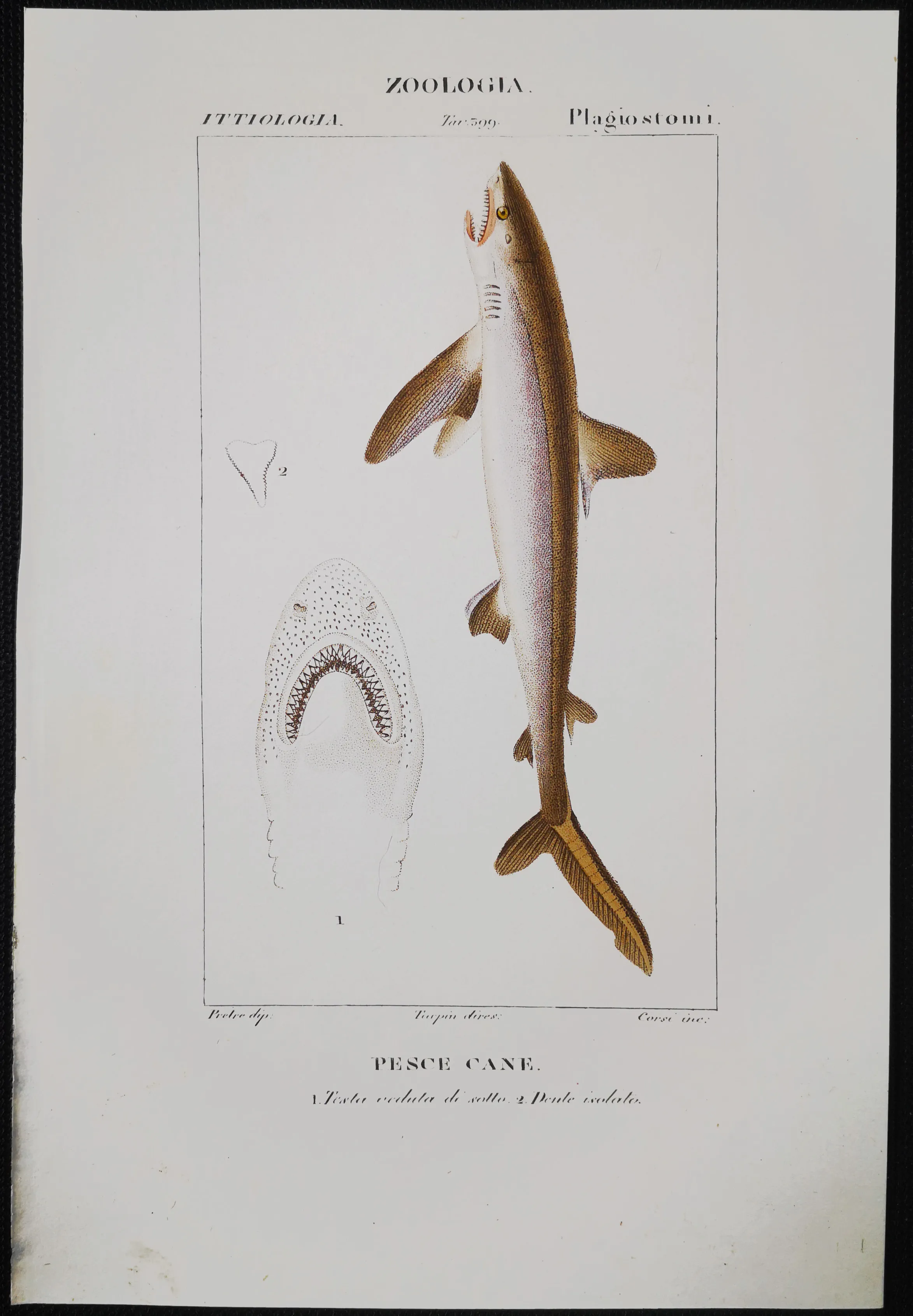




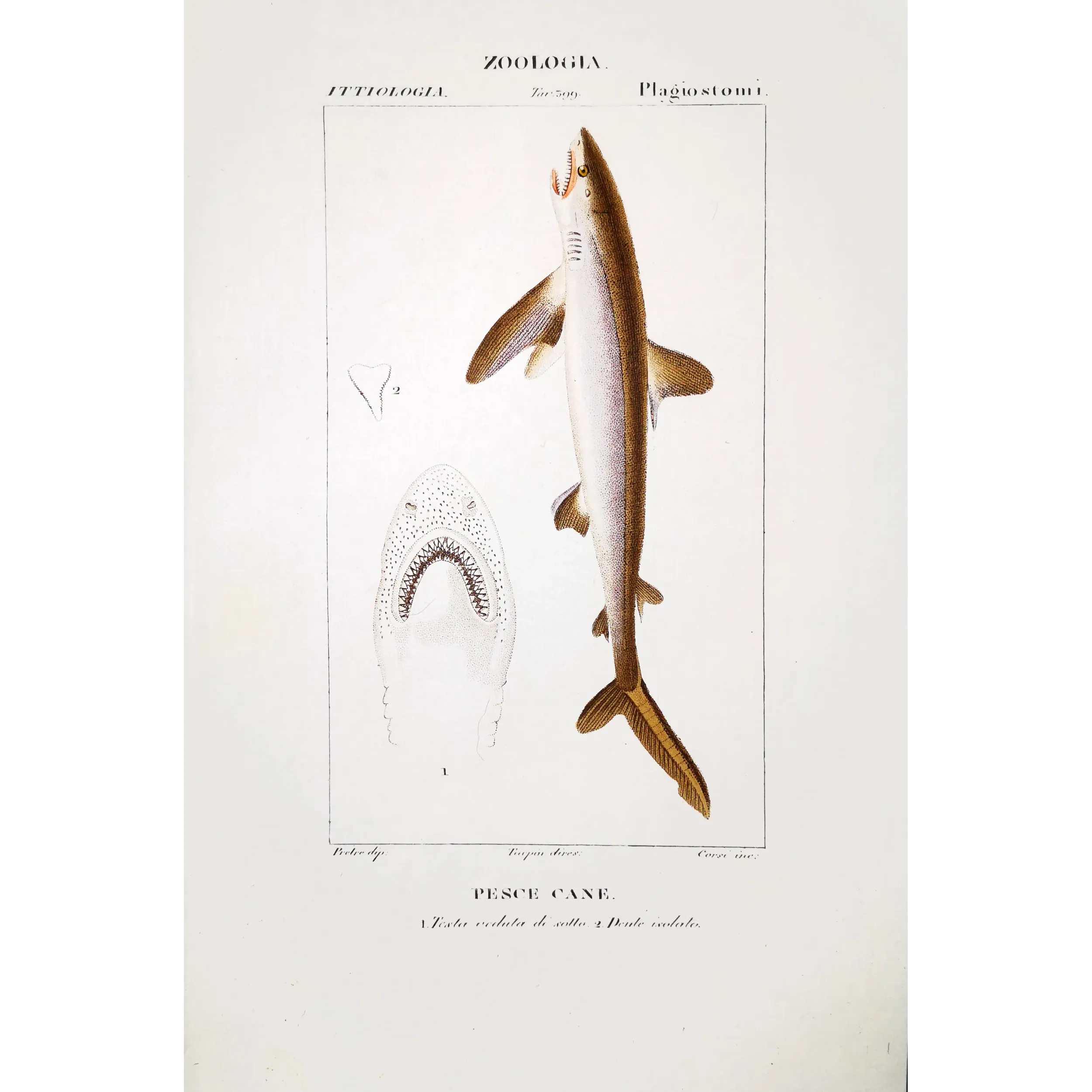
Detailed 19th-century engraving of the Small-Spotted Catshark by Pierre Antoine Prêtre, combining elegance and scientific accuracy.
 Delivery policy
Your print will be carefully prepared and shipped worldwide via trusted couriers (UPS or similar).
 Authentic antique prints
Original engravings from the 17th–19th century.
This original hand-colored engraving depicts the Small-Spotted Catshark (Galeus melastomus), presented here under the traditional Italian naming of “Pesce Cane.” Prêtre offers an image of lean, purposeful anatomy, and enriches it with a secondary figure devoted to the mouth — a detail that shifts the plate from portrait to scientific demonstration.
The result is strikingly modern in its clarity: a single body rendered with calm precision, accompanied by an isolated study of the teeth. It is the language of encyclopedic publishing at its best — the visual equivalent of a well-composed definition.
The engraving belongs to the Italian edition of the Dizionario di Scienze Naturali (Florence, Battelli press), a monumental publication in which Pierre Antoine Prêtre’s zoological subjects stand out for their refinement and display quality.
— • —
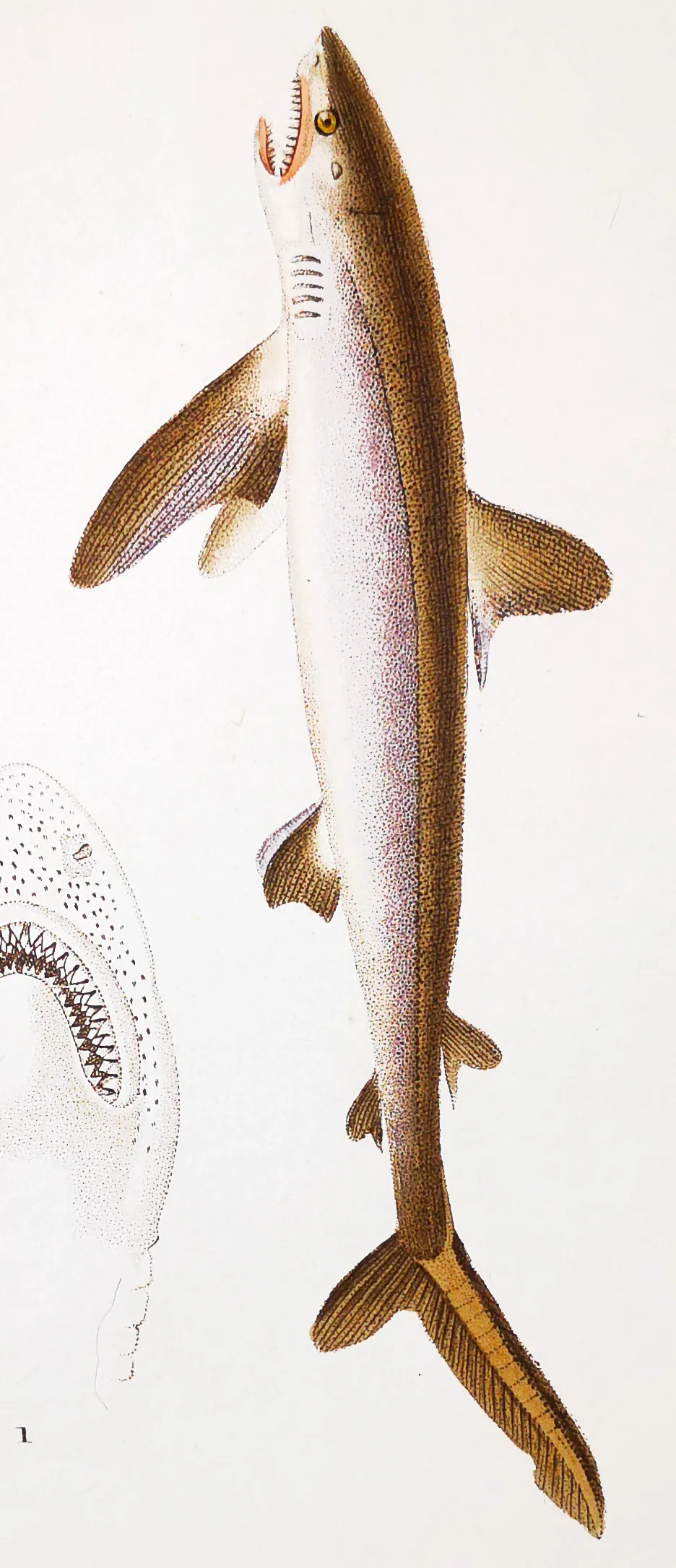
The shark is painted in subdued bronze and pale grey, with a gentle deepening along the dorsal ridge that gives the body volume without drama. The fins, slightly darker at the edges, articulate the creature’s direction and balance, while the tail narrows into a clean, tapering finish.
To the left, the open mouth is rendered in delicate stippling — rows of fine, repeating teeth that read almost as pattern. This pairing of whole form and extracted detail creates a quiet tension: elegance on the right, latent power on the left, both held within the same disciplined page.
In nineteenth-century natural history, sharks were not illustrated merely for spectacle, but for what they represented: a distinct order of life defined by cartilage, sensory adaptation, and ancient lineage. The “dogfish” name carries a cultural history of familiarity — a creature known to sailors and coastal communities — yet the plate insists on dignity rather than folklore. By including the mouth study, the encyclopedic impulse becomes explicit: classification depended not only on silhouette, but on structures that could be compared, measured, and remembered. The subject thus becomes a bridge between lived maritime knowledge and the formal language of scientific publishing.
This engraving forms part of the historic Dizionario di Scienze Naturali, preserved today in the Sacchetti Collection. These works are nearly two centuries old, created in an era when nature was celebrated through monumental publishing projects — ambitious enterprises that are now practically unachievable.
For the wider context of this noble provenance and its cultural value, we invite you to read “Not Just Another Print”.
The engraving is in excellent antique condition, with clean margins and a fresh, well-preserved hand-coloured surface. Printed on original smooth wove paper (non-laid), consistent with Italian scientific editions of the period. No watermark has been observed. The impression is clear and the colour remains vibrant, with no visible losses.
For further context on Pierre Antoine Prêtre and his contribution to nineteenth-century zoological illustration, see our editorial feature:
Pierre Antoine Prêtre – Illustrator of Natural Science and Marine Life
Looking for: small-spotted catshark engraving, dogfish antique print, Prêtre shark mouth study, 19th-century cartilaginous fish illustration.
Specific References
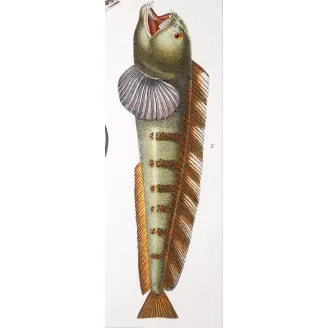
Expressive 19th-century engraving of the European Eel and Wolffish by Pierre Antoine Prêtre, contrasting silhouettes and textures.
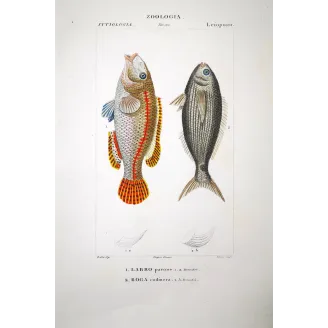
Brilliant peacock wrasse with patterned fins and a silver boga; lively palette and refined stippling for elegant interiors.
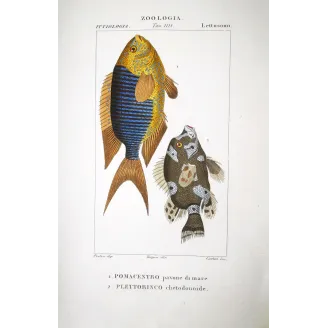
Two contrasting species in one plate: a delicate Damselfish and a robust Triggerfish, rich in color and texture.
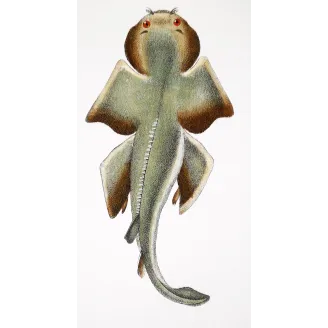
Graceful 19th-century engraving of the Angelshark by Pierre Antoine Prêtre, rich in soft tones and fine anatomical accuracy.
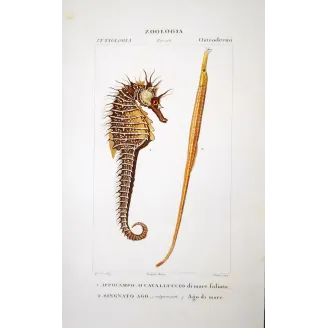
Vivid hand-colored Antique Print of a leafy seahorse with a slender pipefishan iconic duo for marine art lovers and collectors.
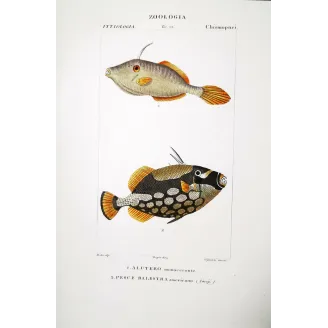
Geometric patterns and bold contrasts; elegant plate featuring a refined filefish with a dramatic American triggerfish.
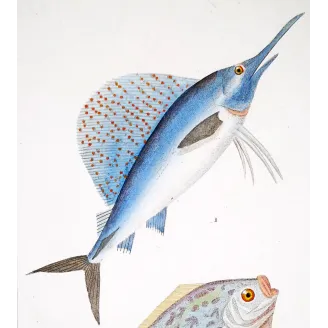
Elegant 19th-century antique print by Pierre Antoine Prêtre with Sailfish and Moonfish, luminous blues and refined detailing.
Refined 19th-century hand-colored engraving of the Tope Shark by Pierre Antoine Prêtre, notable for its elegant form and tonal realism.
Charming clownfish with companion reef species, crisp colors and coral-reef appeal in a classic 19th-century plate.
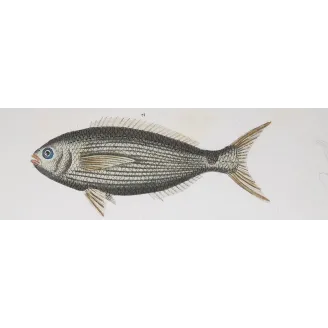
Elegant coastal plate with shimmering scales and yellow-olive fins; a balanced, classic choice for study or living spaces.
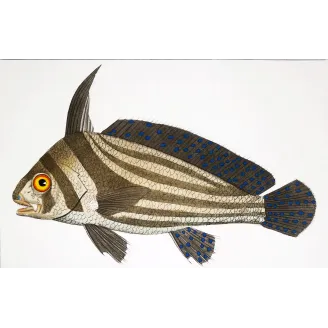
Striped body with blue-spotted fins; a refined 19th-century marine engraving ideal for study walls and coastal interiors.
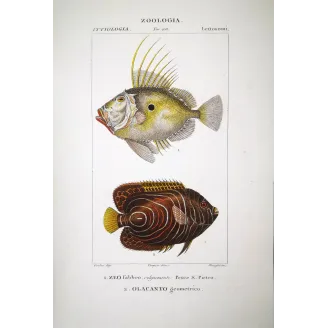
Iconic plate with the celebrated John Dory and a striking angelfishsuperb color contrasts and collector appeal.
Vivid dual composition featuring the Flying Gurnard and Striped Wrasse, blending blue and golden hues.
Graphic pairing with bold yellow stripe and banded companion; vibrant hand-coloring and clear natural history styling.
Classic 19th-century engraving of Greater Forkbeard and Rockling by Pierre Antoine Prêtre, subtle tones and elegant balance.
Vibrant 19th-century antique print by Pierre Antoine Prêtre depicting a Hammerhead Shark and Smoothhound, remarkable for color contrast and composition.
Elegant 19th-century antique print by Pierre Antoine Prêtre with Sailfish and Moonfish, luminous blues and refined detailing.
Brilliant peacock wrasse with patterned fins and a silver boga; lively palette and refined stippling for elegant interiors.
Detailed 19th-century engraving of the Small-Spotted Catshark by Pierre Antoine Prêtre, combining elegance and scientific accuracy.