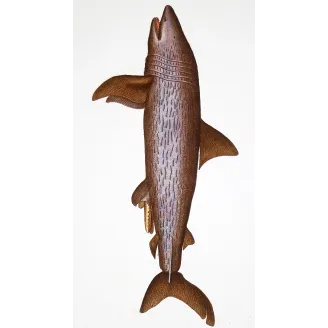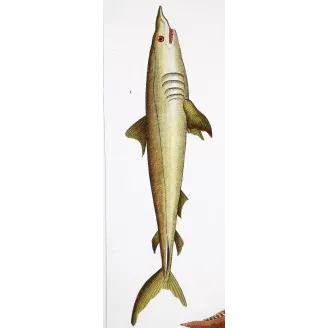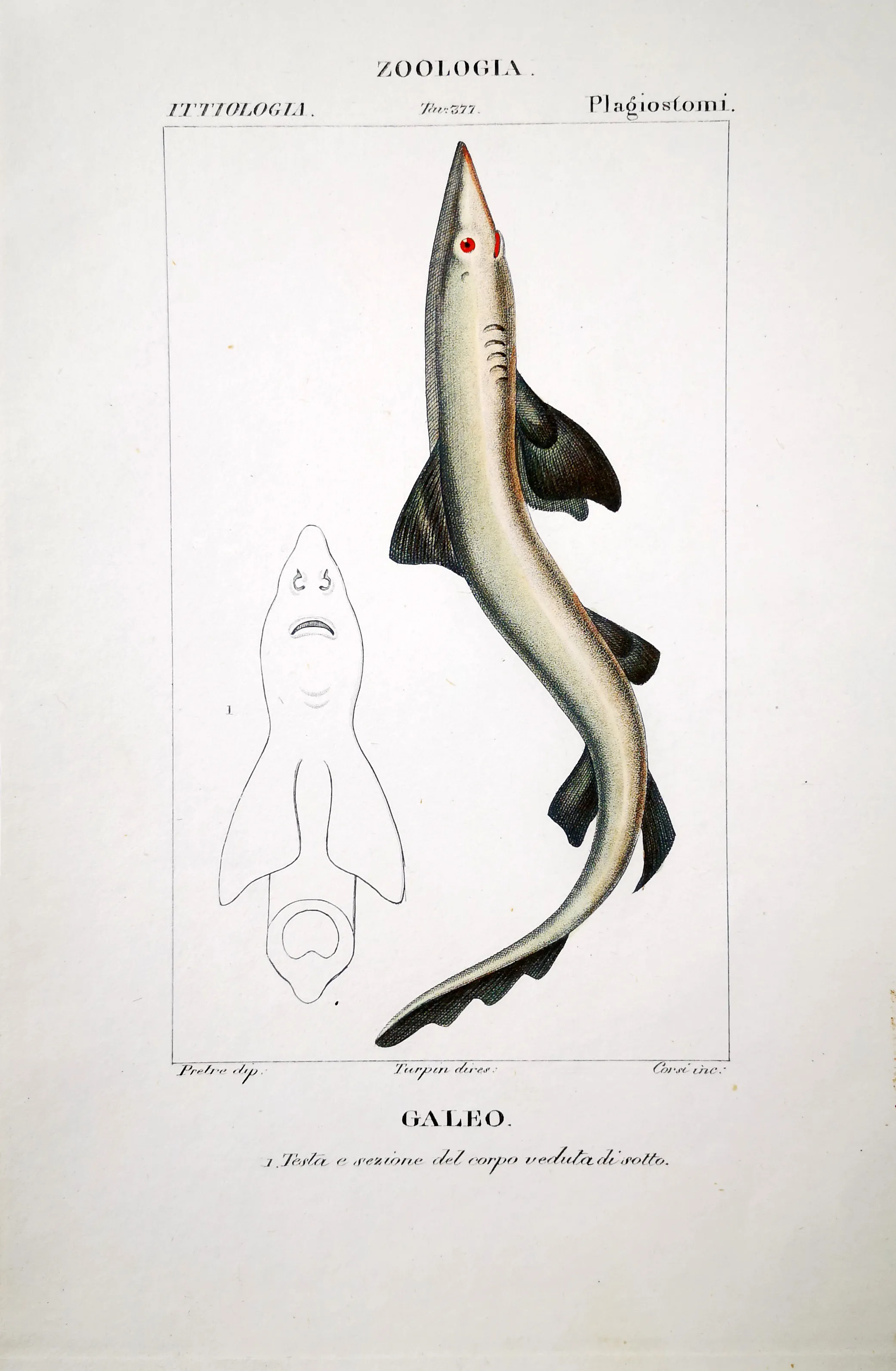
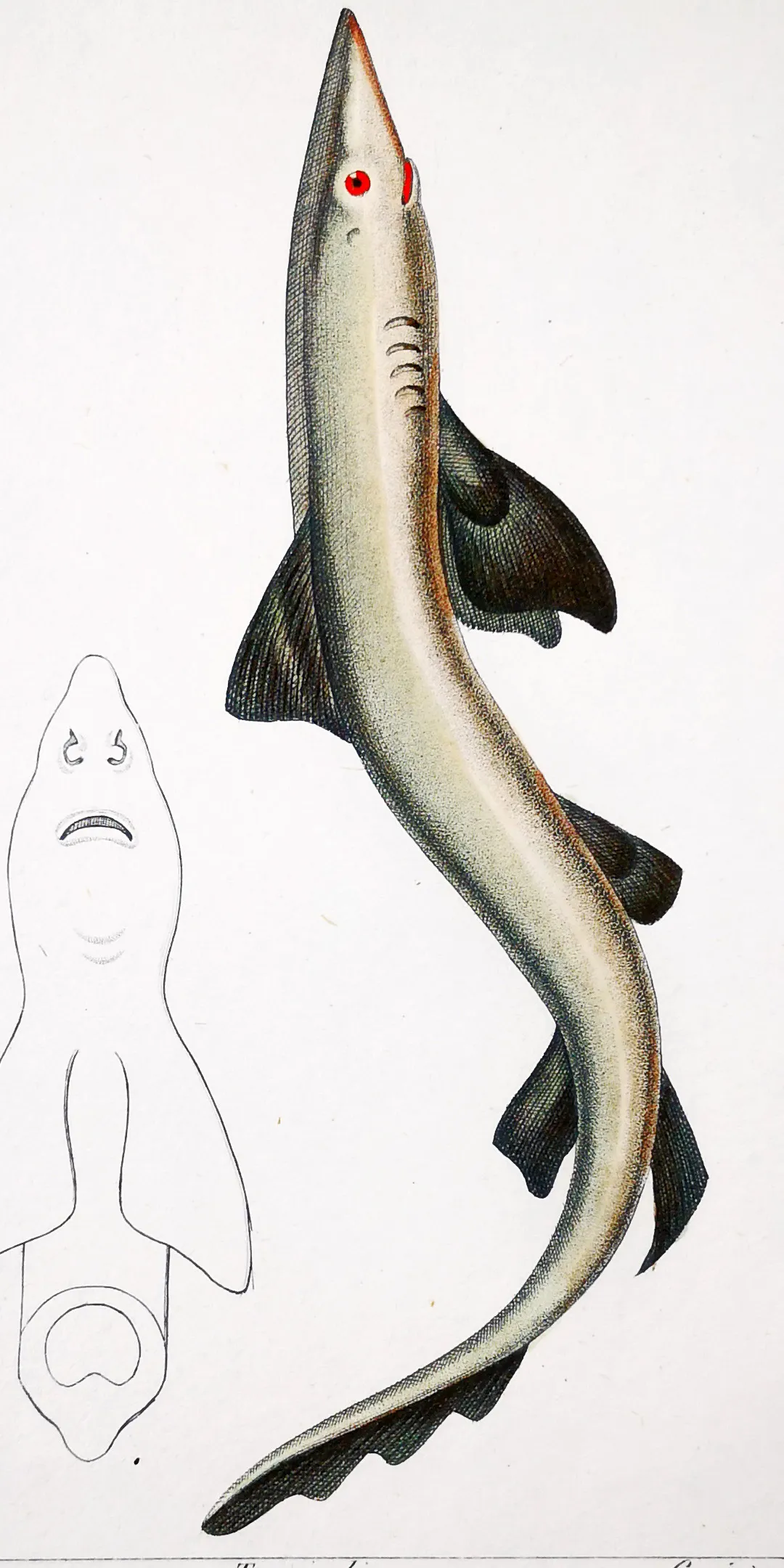
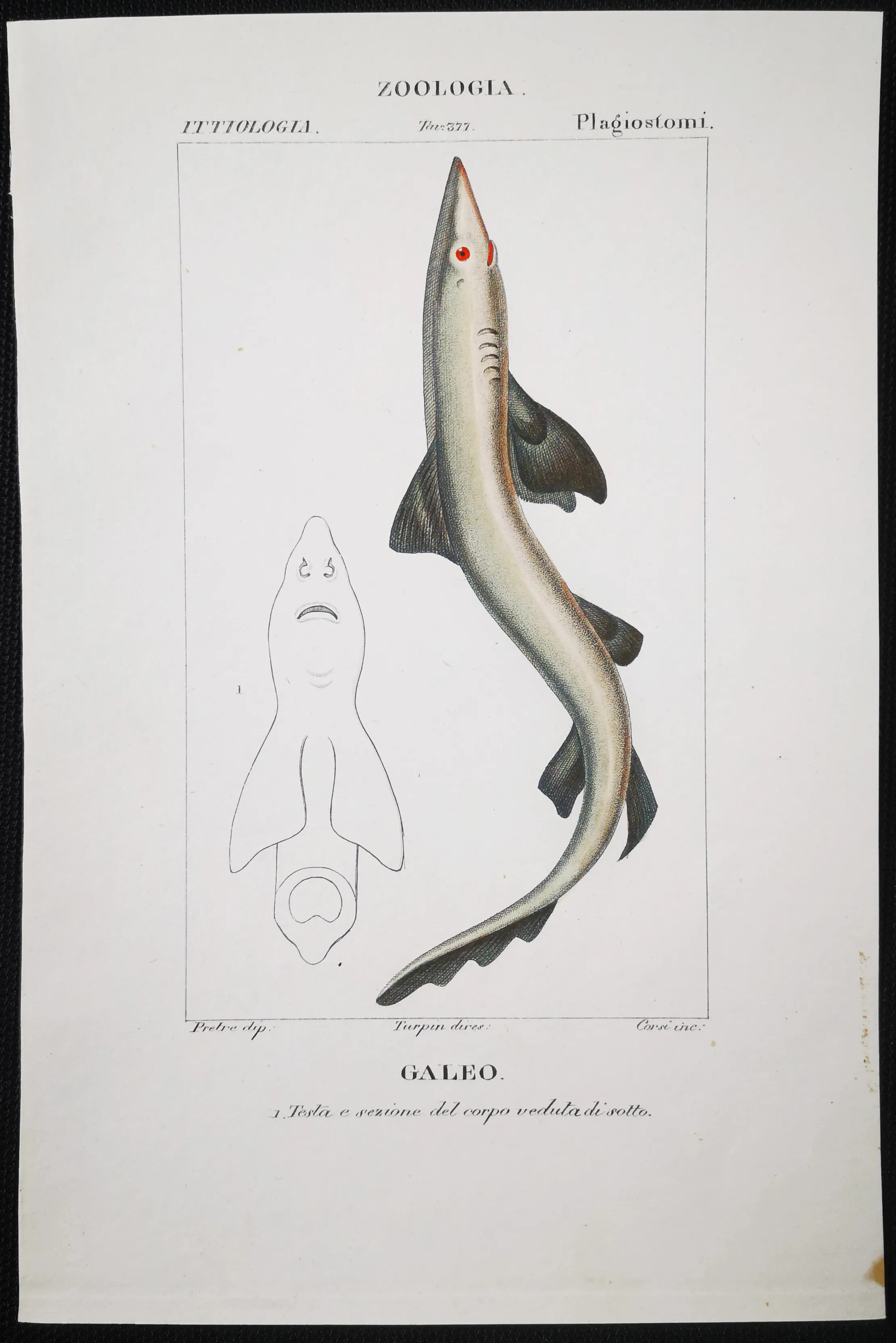



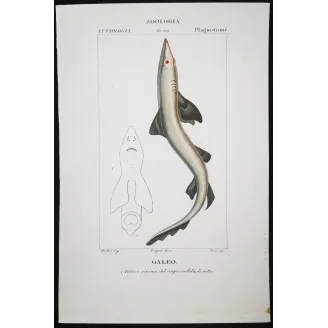
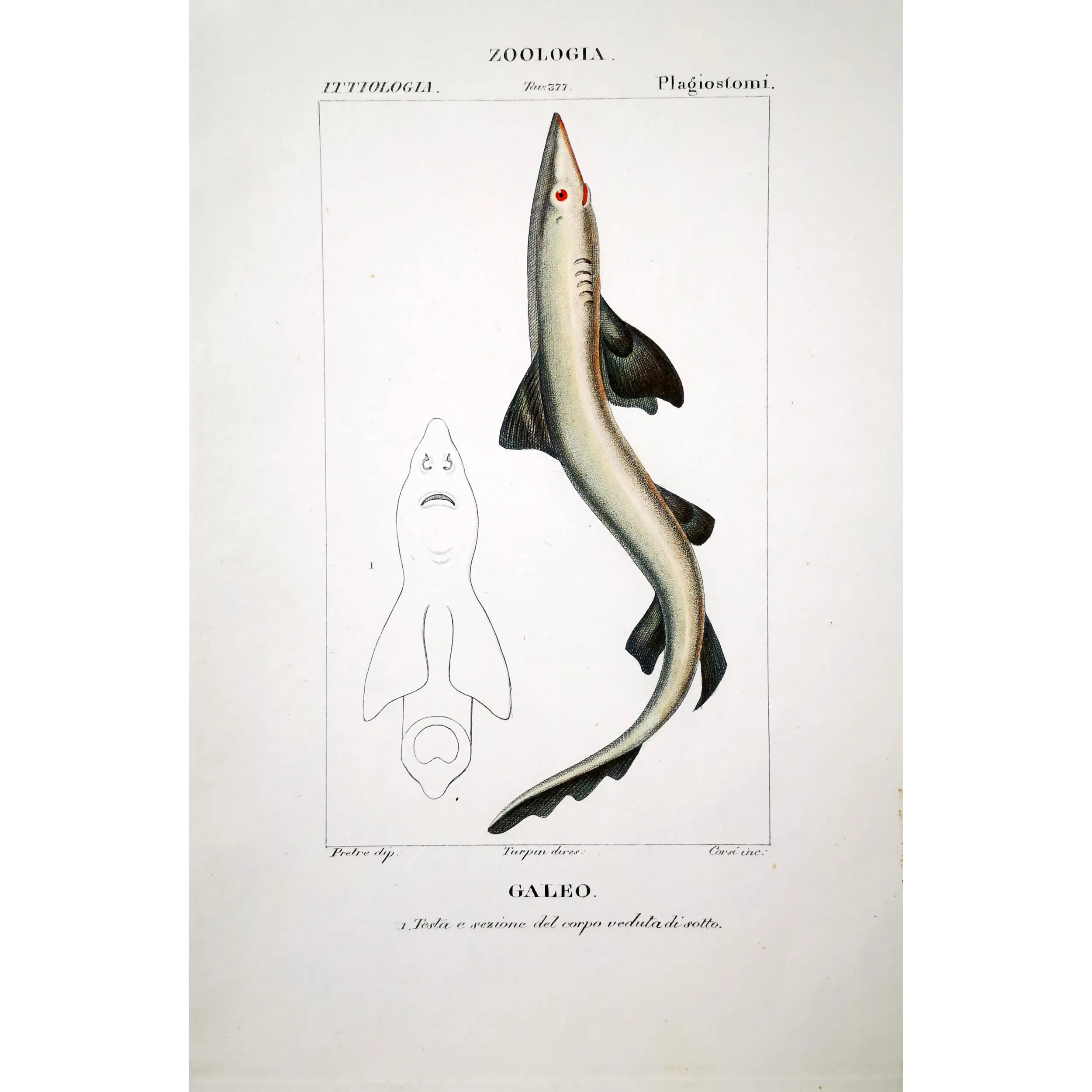
Refined 19th-century hand-colored engraving of the Tope Shark by Pierre Antoine Prêtre, notable for its elegant form and tonal realism.
 Delivery policy
Your print will be carefully prepared and shipped worldwide via trusted couriers (UPS or similar).
 Authentic antique prints
Original engravings from the 17th–19th century.
This original hand-colored engraving depicts the Tope Shark (Galeus galeus), identified on the plate simply as “Galeo.” The image is a model of encyclopedic economy: one sinuous figure, carefully shaded, paired with an outline diagram that presents the body as a readable plan.
The effect is quietly compelling. The shark appears not as a dramatic predator, but as an elegant system of curves and fin planes — a marine form designed for endurance, migration, and steady motion through open water.
The engraving belongs to the Italian edition of the Dizionario di Scienze Naturali (Florence, Battelli press), a monumental publication in which Pierre Antoine Prêtre’s zoological subjects stand out for their refinement and display quality.
— • —
The shark is painted in cool grey-green tones with a soft transition toward the pale underside, giving the body a polished, almost satin presence. The dorsal fin and tail are darkened at the edges, sharpening the silhouette and reinforcing the sense of forward drive.
To the left, the simplified outline acts like a shadow blueprint — a spare, instructive counterpoint to the fully coloured figure. Together, the two images create a refined balance between aesthetics and pedagogy: the eye is first drawn to the graceful curve of the main specimen, then guided toward structure and comparison.
The tope shark occupied an important place in nineteenth-century natural history because it was both familiar and elusive: known to coastal experience, yet belonging to the wider, moving world of pelagic life. Its streamlined body spoke to function — speed, efficiency, and distance — making it an ideal subject for encyclopedias intent on describing the sea as a coherent order. The name “Galeo,” inherited from older vernacular traditions, carries a subtle cultural echo: a reminder that these plates sit at the intersection of seafaring knowledge and scholarly taxonomy. In the Dizionario di Scienze Naturali, the tope becomes not a spectacle, but a disciplined emblem of marine design.
This engraving forms part of the historic Dizionario di Scienze Naturali, preserved today in the Sacchetti Collection. These works are nearly two centuries old, created in an era when nature was celebrated through monumental publishing projects — ambitious enterprises that are now practically unachievable.
For the wider context of this noble provenance and its cultural value, we invite you to read “Not Just Another Print”.
The engraving is in excellent antique condition, with clean margins and a fresh, well-preserved hand-coloured surface. Printed on original smooth wove paper (non-laid), consistent with Italian scientific editions of the period. No watermark has been observed. The impression is clear and the colour remains vibrant, with no visible losses.
For further context on Pierre Antoine Prêtre and his contribution to nineteenth-century zoological illustration, see our editorial feature:
Pierre Antoine Prêtre – Illustrator of Natural Science and Marine Life
Looking for: tope shark engraving, Galeus galeus antique print, Galeo Prêtre plate, 19th-century shark illustration, Italian natural history engraving.
Specific References
Dramatic eel composition with sinuous forms and precise stippling; a rare and architectural marine subject for refined interiors.
Expressive 19th-century engraving of the European Eel and Wolffish by Pierre Antoine Prêtre, contrasting silhouettes and textures.
Classic natural history pairingsilver argentine and spotted troutclean composition and fine stippling for timeless appeal.
Spectacular 19th-century antique print of the Basking Shark by Pierre Antoine Prêtre, capturing monumental scale and serene presence.
Vivid dual composition featuring the Flying Gurnard and Striped Wrasse, blending blue and golden hues.
Striking plate with long, elegant cornetfish and trumpetfish, hand-colored with vivid reds and tealsbold marine decor statement.
Iconic Antique Print with two vivid butterflyfishes, finely hand-coloredstriking geometry and coral-reef charm for collectors.
Iconic plate: dramatic anglerfish with lure and a spiny companionbold textures and collector appeal, a standout Antique Print.
Vivid hand-colored Antique Print of a leafy seahorse with a slender pipefishan iconic duo for marine art lovers and collectors.
Graphic pairing with bold yellow stripe and banded companion; vibrant hand-coloring and clear natural history styling.
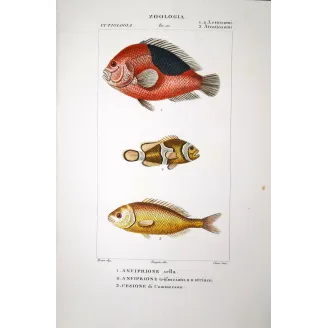
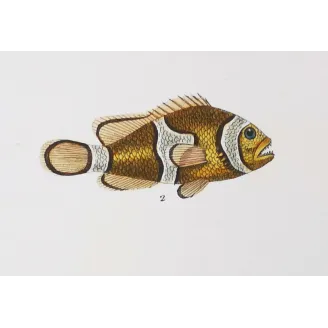
Charming clownfish with companion reef species, crisp colors and coral-reef appeal in a classic 19th-century plate.
Fine 19th-century antique print depicting Porbeagle and Spiny Dogfish by Pierre Antoine Prêtre, detailed and vibrant marine pair.
Detailed 19th-century engraving of the Small-Spotted Catshark by Pierre Antoine Prêtre, combining elegance and scientific accuracy.
Vibrant 19th-century antique print by Pierre Antoine Prêtre depicting a Hammerhead Shark and Smoothhound, remarkable for color contrast and composition.
18th-century hand-colored engraving of Rhapontic with broad leaves and sculptural root, ideal for botanical décor.
Original lithograph of the Sacred Kingfisher (Sauropatis sancta) by Roland Green
Fan-tailed Cuckoo (Cacomantis rubricatus) – Original lithograph by Henrik Grønvold.
Original lithograph of the Red-backed Kingfisher (Cyanalcyon pyrrhopygus) by Roland Green
An original nineteenth-century hand-colored engraving from Ludwig Reichenbach's Trochilinarum Enumeratio, depicting hummingbirds surrounding their nest among brilliant tubular blossoms. This elegant composition celebrates the harmony between tropical birds, flowers and the delicate cycle of new life.
Delicate engraving of Madder with berries and exposed roots, ideal for refined botanical décor.
Refined 19th-century hand-colored engraving of the Tope Shark by Pierre Antoine Prêtre, notable for its elegant form and tonal realism.