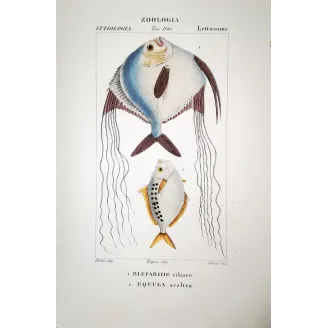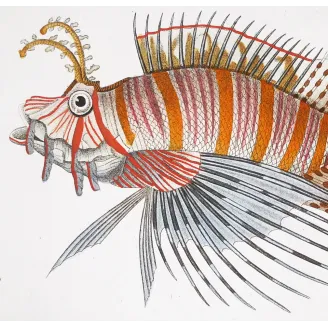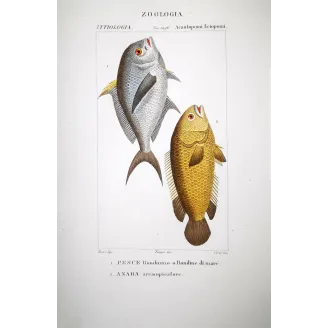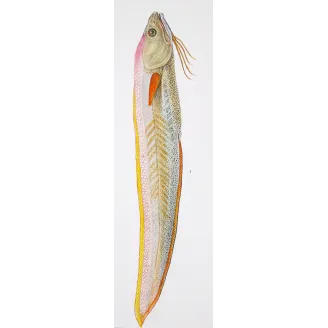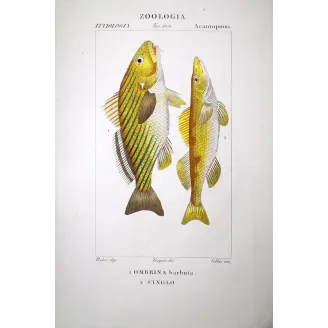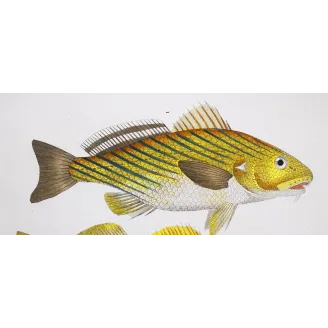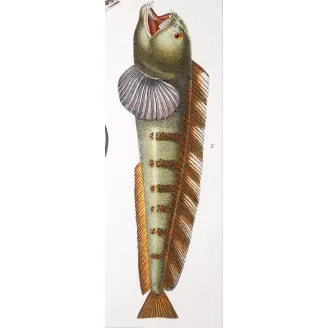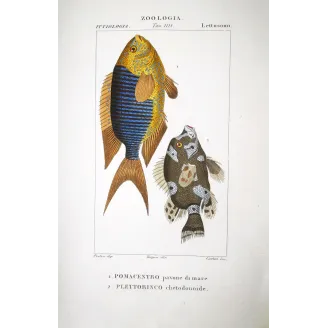
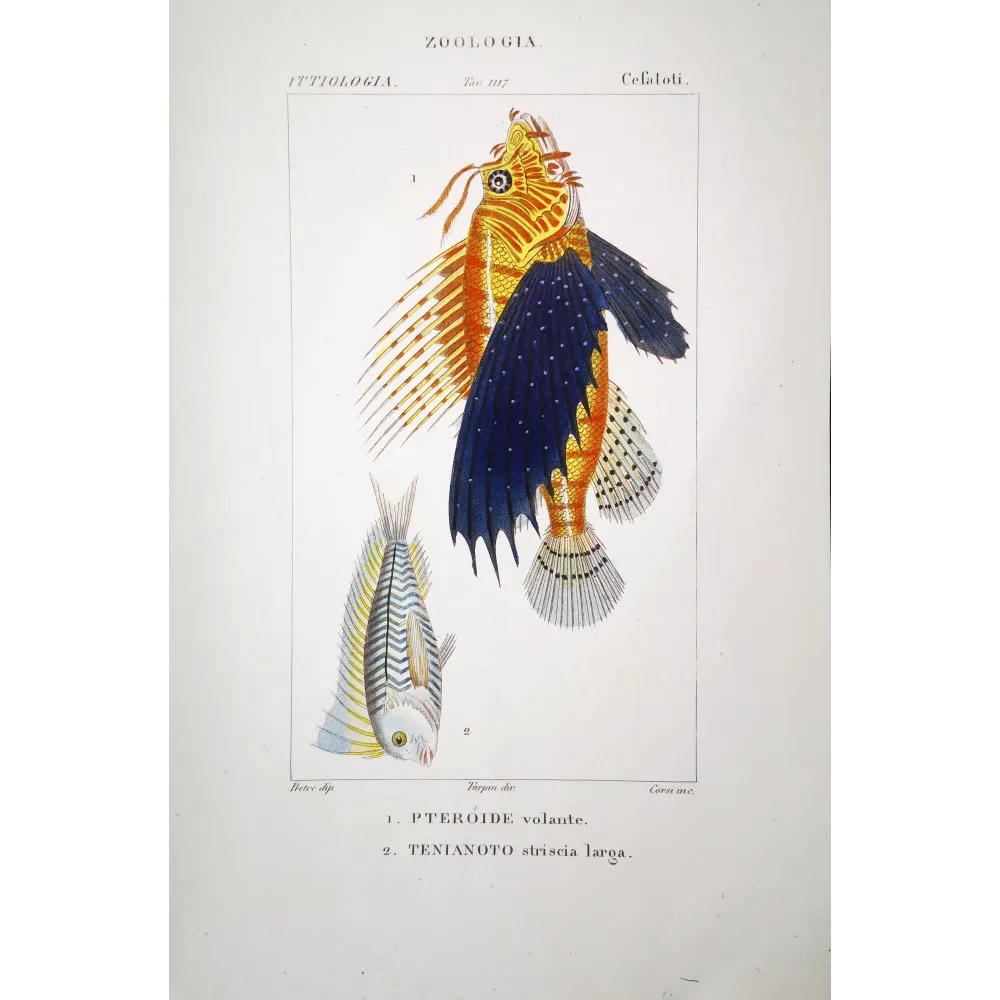
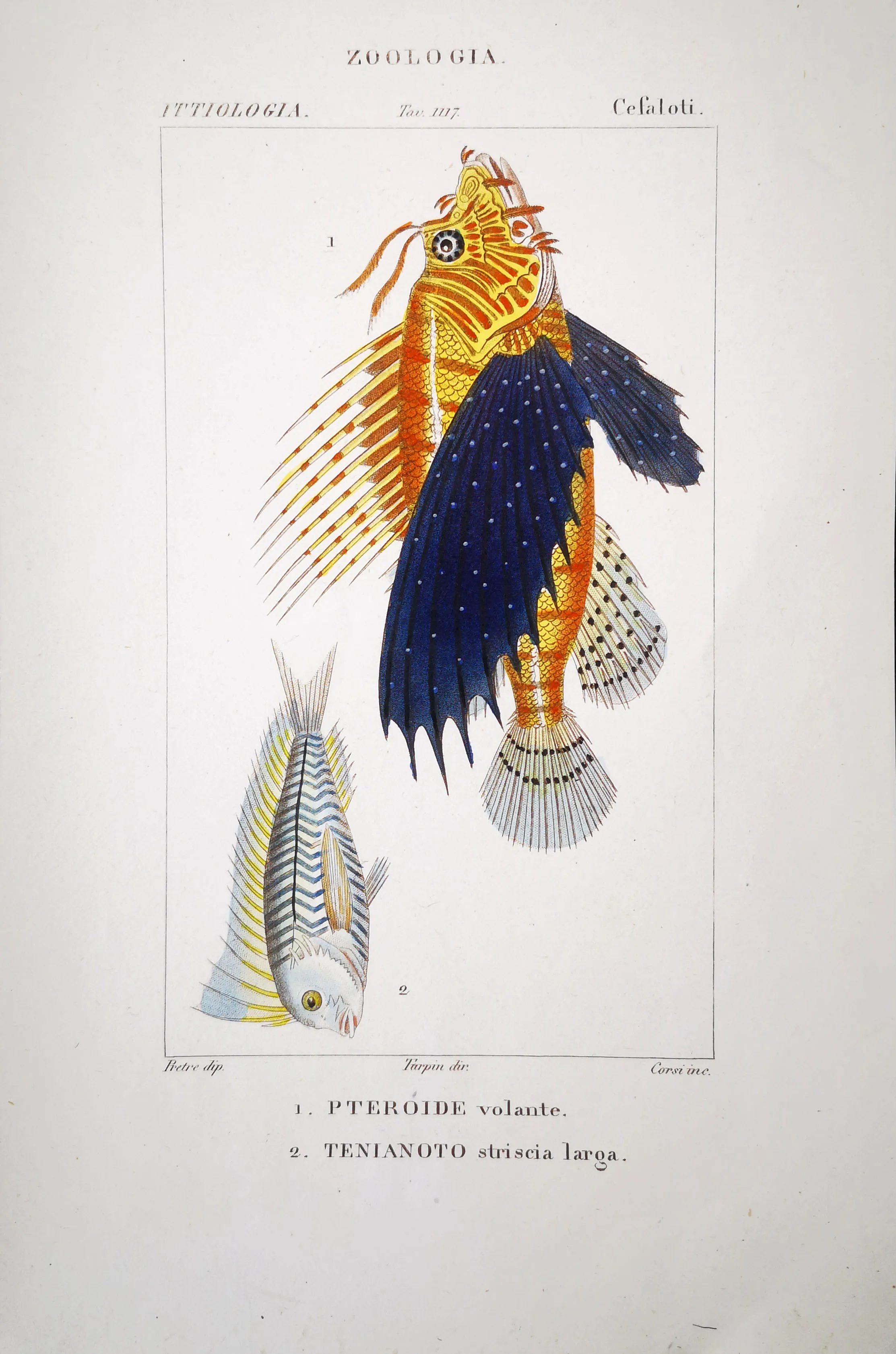
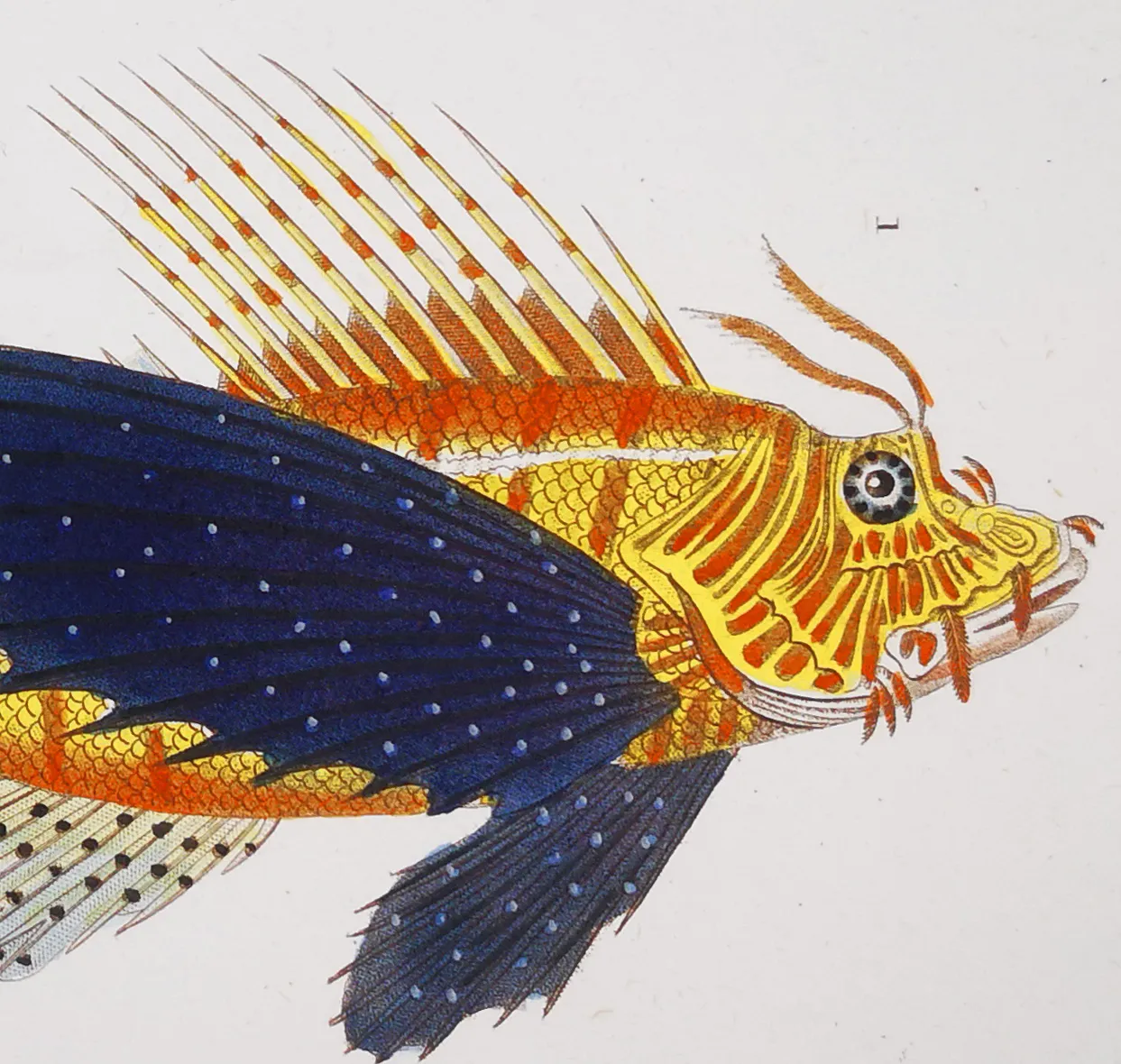
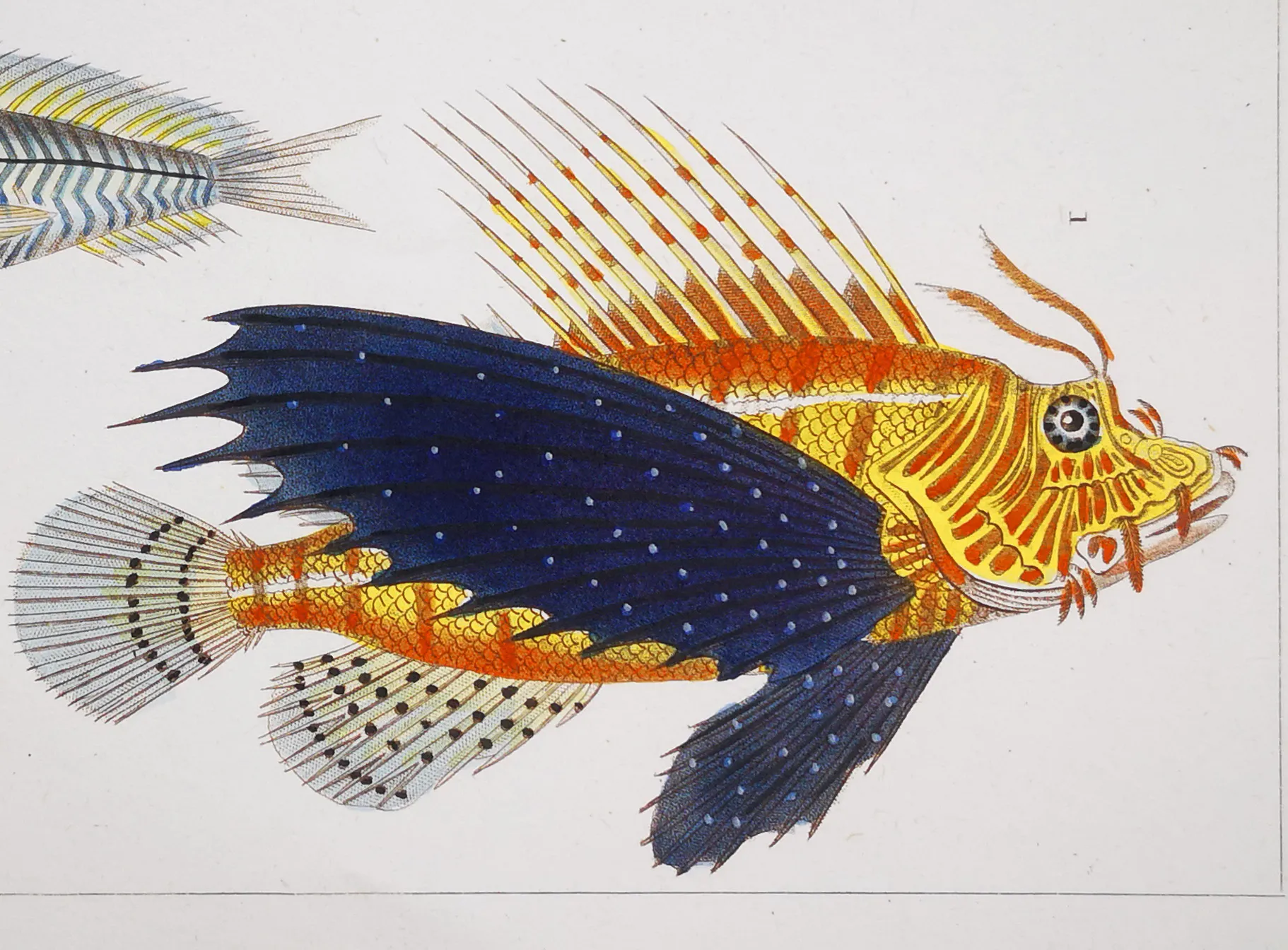
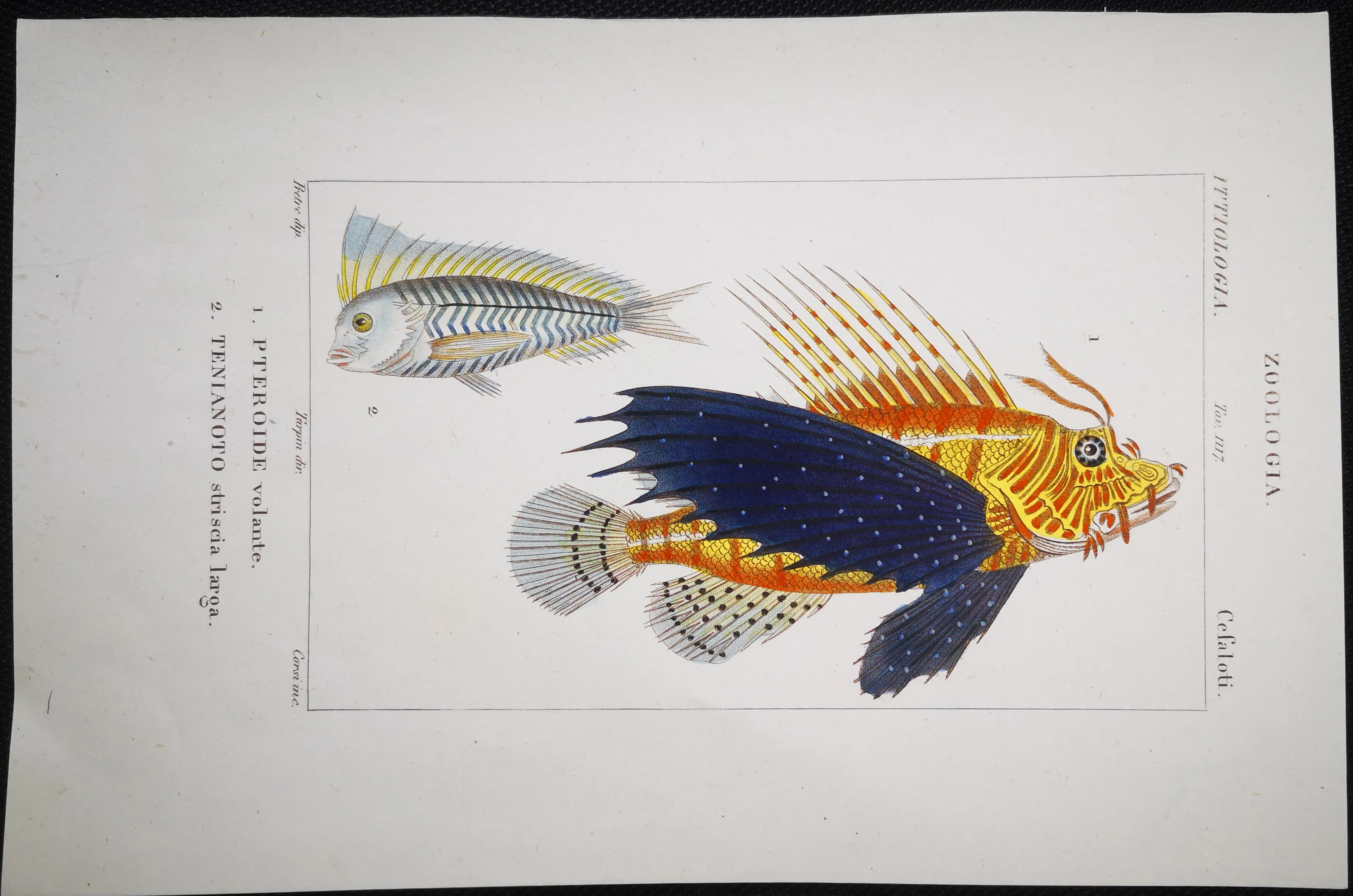


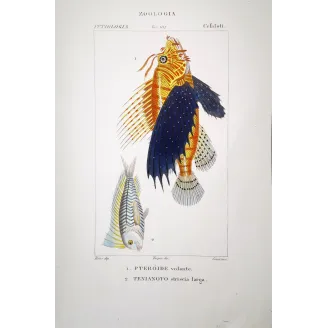
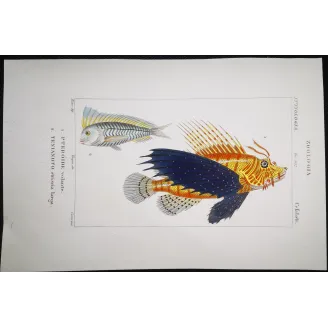
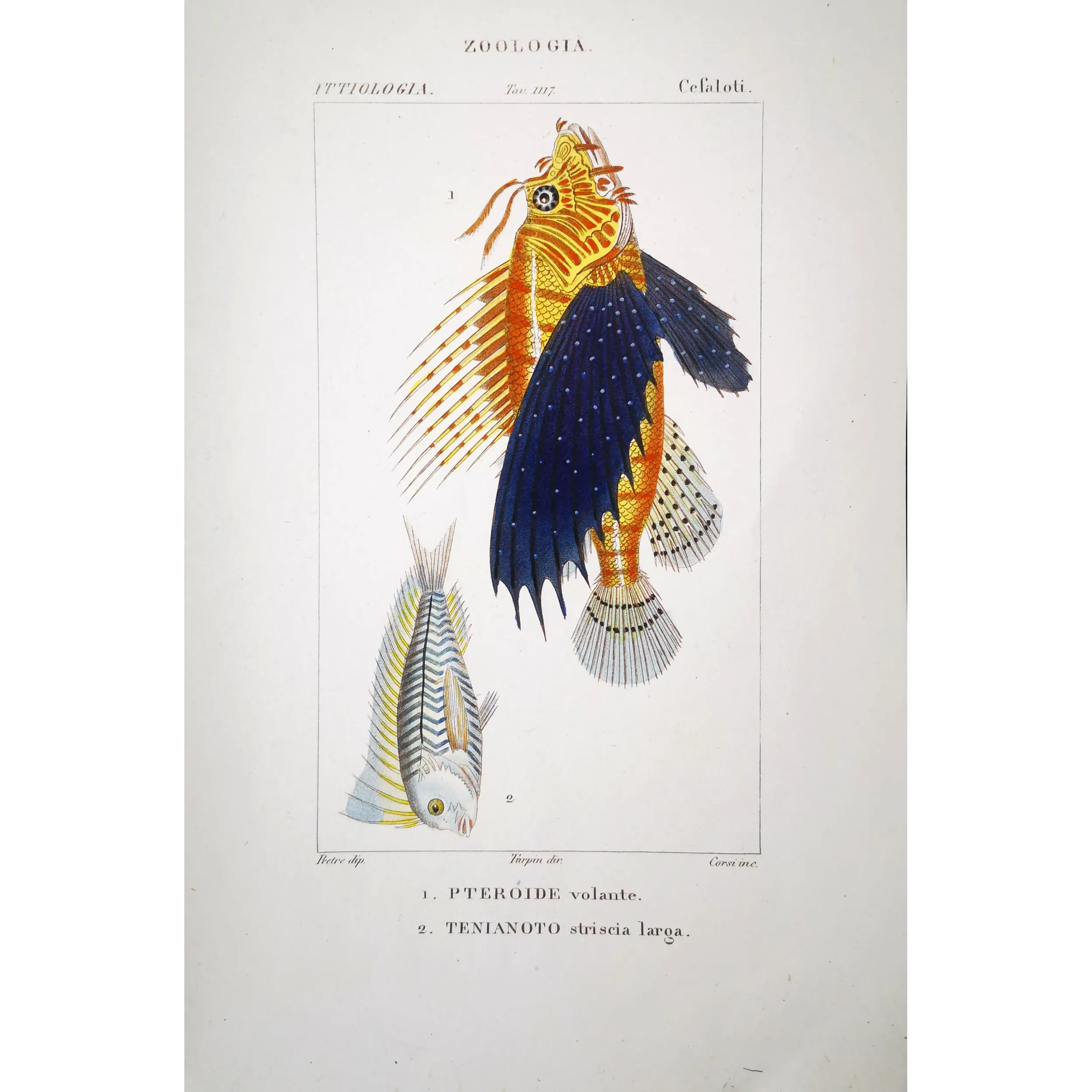
Vivid dual composition featuring the Flying Gurnard and Striped Wrasse, blending blue and golden hues.
 Delivery policy
Your print will be carefully prepared and shipped worldwide via trusted couriers (UPS or similar).
 Authentic antique prints
Original engravings from the 17th–19th century.
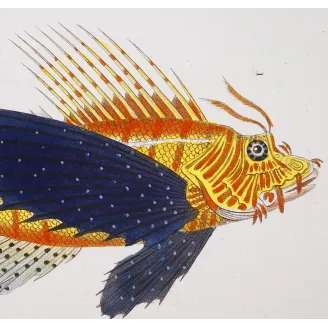
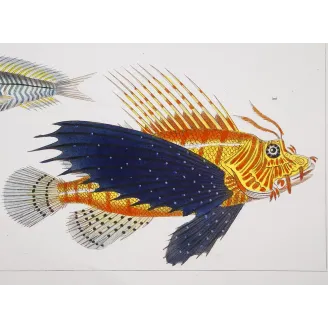
This refined zoological engraving presents two marine fishes arranged for comparison: the Flying Gurnard, Pterois volitans, and the Striped Wrasse, Tenianotus striatus. The plate foregrounds fin architecture and pattern as scientific information, demonstrating how early nineteenth-century natural history relied on comparison to articulate diversity.
Rather than offering ornament alone, the engraving emphasizes morphological intelligibility. Each fin ray is individually engraved, body markings are structured with disciplined repetition, and the hand-colouring reinforces form — from warm golds and oranges to the deep, saturated blues that define the dominant figure’s expanded fins.
The plate belongs to the Italian edition of the Dizionario di Scienze Naturali (Florence, Battelli press), one of the most ambitious encyclopedic scientific enterprises of its time, for which Pierre Antoine Prêtre produced some of the most accomplished zoological illustrations of marine life.
— • —
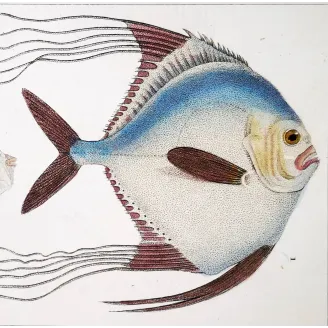
The composition is structured around a dominant central figure whose expanded fins create a bold triangular geometry across the sheet. The interplay between warm pigments and deep blue fields generates a striking tonal contrast, while fine stippling preserves transparency and lightness within the fin membranes.
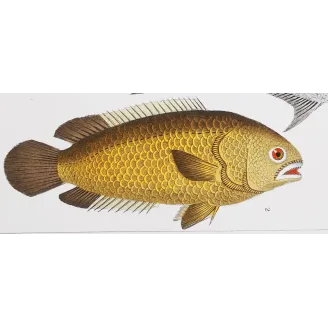
The secondary specimen, smaller and cooler in palette, introduces a counter-rhythm of line and banding that stabilizes the composition. Together, the two figures produce equilibrium between spectacle and discipline, transforming zoological documentation into a plate of quiet decorative authority.
The Flying Gurnard, Pterois volitans, is celebrated for its dramatic fin expansion — a “winged” anatomy that made such species culturally emblematic of the nineteenth-century imagination of tropical seas. For European audiences, these forms signified the marvels of distant waters encountered through exploration and global trade, and they became some of the most iconic subjects in antique fish engravings. The Striped Wrasse, Tenianotus striatus, provides a contrasting taxonomy and a second visual logic, reinforcing the encyclopedic method of comparison. As a 19th-century marine life print, this plate is especially sought after: it combines scientific clarity with maximal decorative impact, making it one of the strongest formats for collectors of antique scientific illustration and refined coastal interiors.
This plate forms part of the historic Dizionario di Scienze Naturali, a monumental early nineteenth-century encyclopedic enterprise once preserved within a noble library and today housed in the Sacchetti Collection. Each engraving reflects a period in which scientific ambition was matched by exceptional artisanal execution — from the disciplined copperplate line to the luminous hand-colouring applied individually to every impression.
The result is not merely zoological documentation, but a refined synthesis of scholarship and craftsmanship, where artistic discipline elevates marine observation into a form of quiet visual authority. To discover the full story behind these rare prints and their noble provenance, we invite you to read our editorial feature “Not Just Another Print” — a tribute to the enduring harmony between knowledge, art and prestige embodied in the Dizionario di Scienze Naturali.
The engraving is in excellent antique condition. The sheet presents clean margins and a well-preserved impression. The paper is smooth early nineteenth-century wove paper (non-laid), consistent with Italian scientific editions of the period. No watermark has been observed. The original hand-colouring remains vivid and balanced, with no visible losses.
For further context on Pierre Antoine Prêtre and his contribution to nineteenth-century zoological illustration, see our editorial feature:
Pierre Antoine Prêtre – Illustrator of Natural Science and Marine Life
Specific References
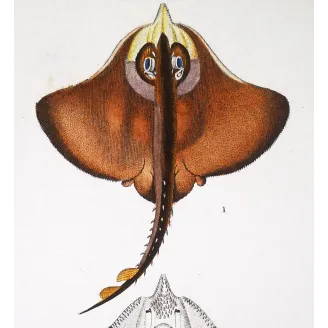
Elegant 19th-century hand-colored engraving of the Brown Ray by Pierre Antoine Prêtre, featuring graceful symmetry and refined marine tones.
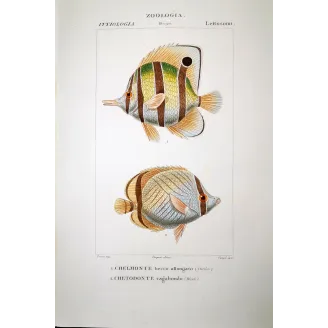
Iconic Antique Print with two vivid butterflyfishes, finely hand-coloredstriking geometry and coral-reef charm for collectors.
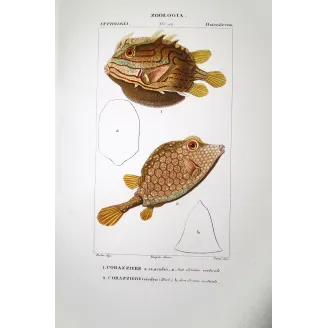
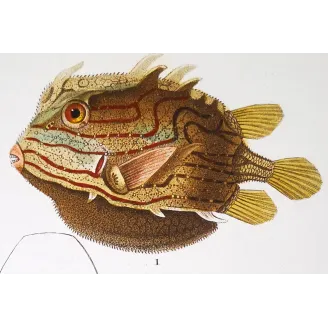
Remarkable plate with armored cowfish and boxfishhexagonal patterning and sculptural spines, superb for marine-themed decor.
Delicate 19th-century hand-colored engraving of a ponyfish with companion species, ideal for marine-themed interiors and collectors.
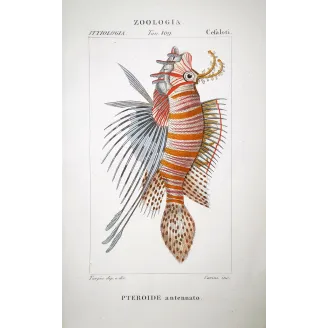
Striking depiction of the Antennata Lionfish with vivid red and orange fins, full of exotic elegance.
Silver and golden marine pair with crisp scales; a balanced 19th-century composition for refined coastal interiors.
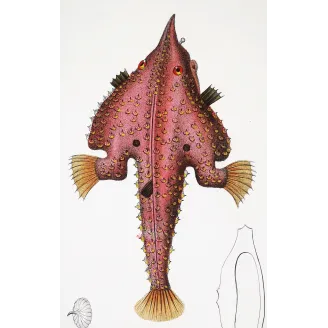
Exceptional 19th-century engraving of the Batfish by Pierre Antoine Prêtre, with rare pink tones and textured surface detail.
Vivid 19th-century engraving of Mediterranean Rainbow Wrasse and Lesser Sandeel by Pierre Antoine Prêtre, bright palette and crisp lines.
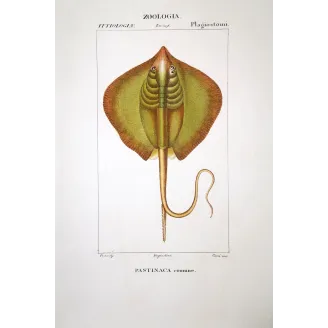
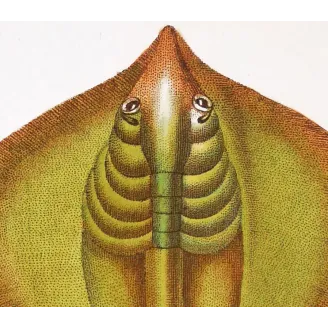
Graceful stingray with warm olive-brown tones and a long tail; tranquil marine subject with elegant presence.
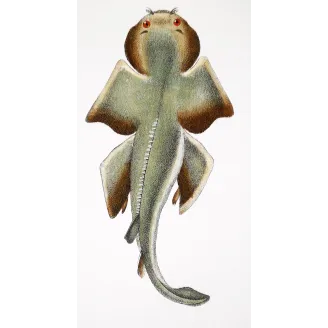
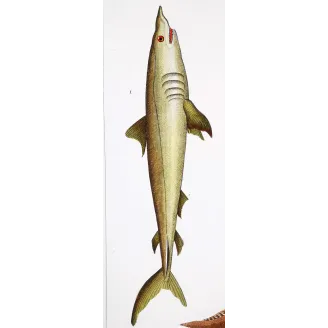
Graceful 19th-century engraving of the Angelshark by Pierre Antoine Prêtre, rich in soft tones and fine anatomical accuracy.
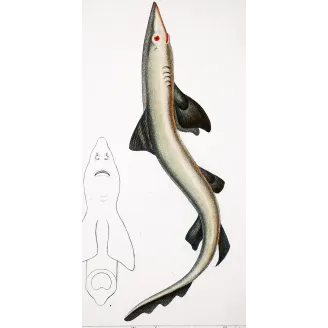
Refined 19th-century hand-colored engraving of the Tope Shark by Pierre Antoine Prêtre, notable for its elegant form and tonal realism.
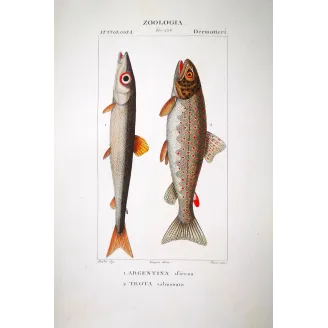
Classic natural history pairingsilver argentine and spotted troutclean composition and fine stippling for timeless appeal.
Fine 19th-century antique print depicting Porbeagle and Spiny Dogfish by Pierre Antoine Prêtre, detailed and vibrant marine pair.
Elegant coastal plate with shimmering scales and yellow-olive fins; a balanced, classic choice for study or living spaces.
Expressive 19th-century engraving of the European Eel and Wolffish by Pierre Antoine Prêtre, contrasting silhouettes and textures.
Two contrasting species in one plate: a delicate Damselfish and a robust Triggerfish, rich in color and texture.
Ocean Sunfish illustrated with refined color balance and elegant detail.
Vivid dual composition featuring the Flying Gurnard and Striped Wrasse, blending blue and golden hues.