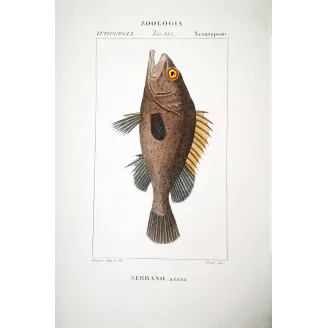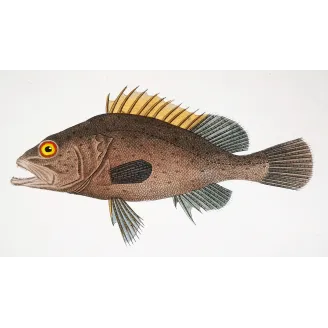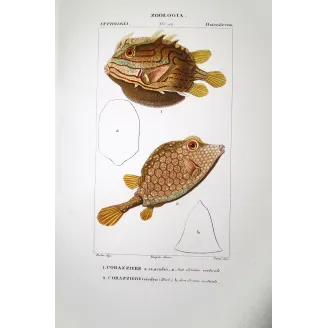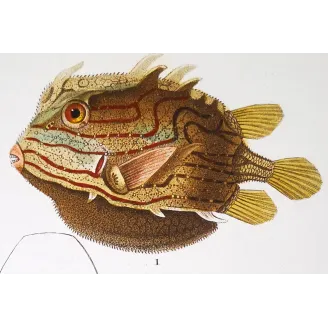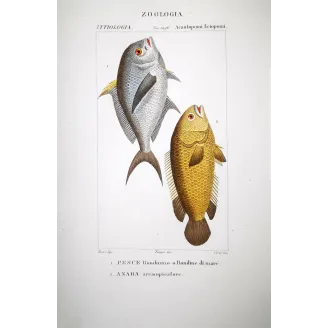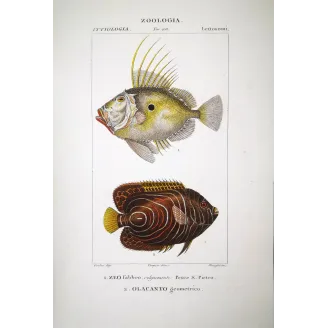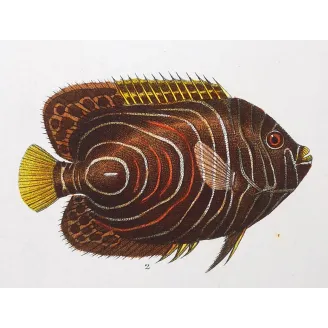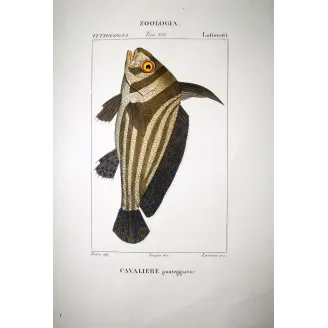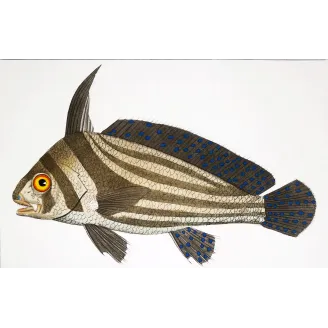
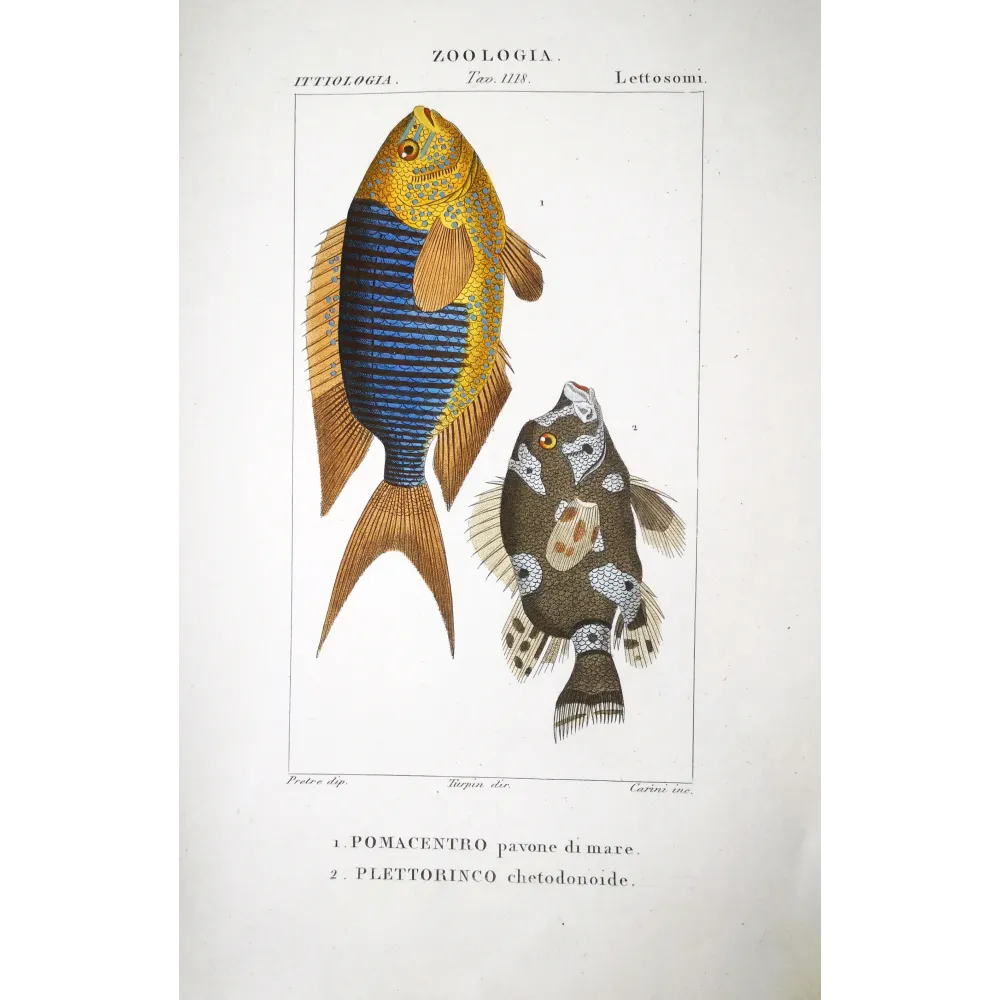
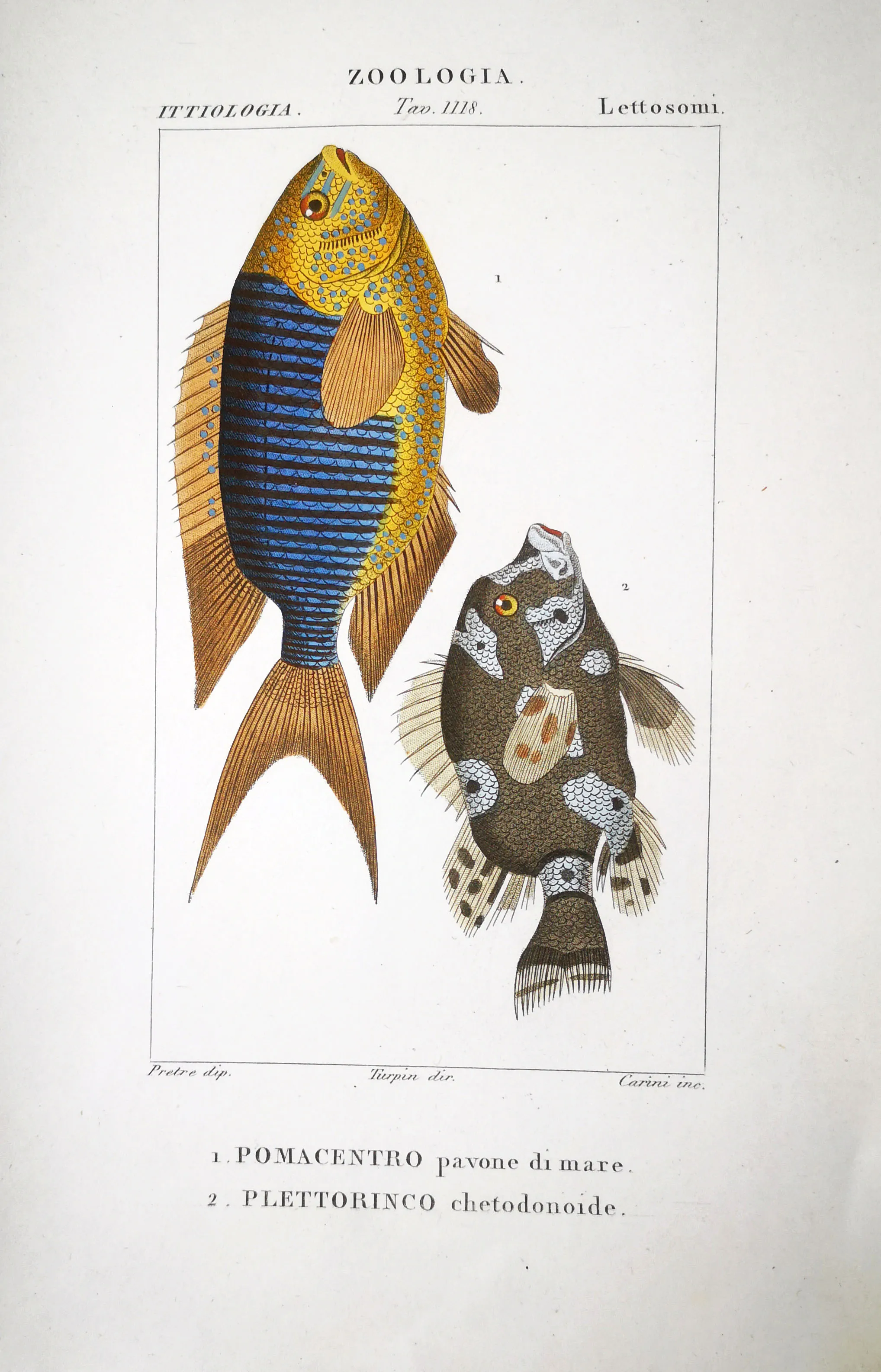
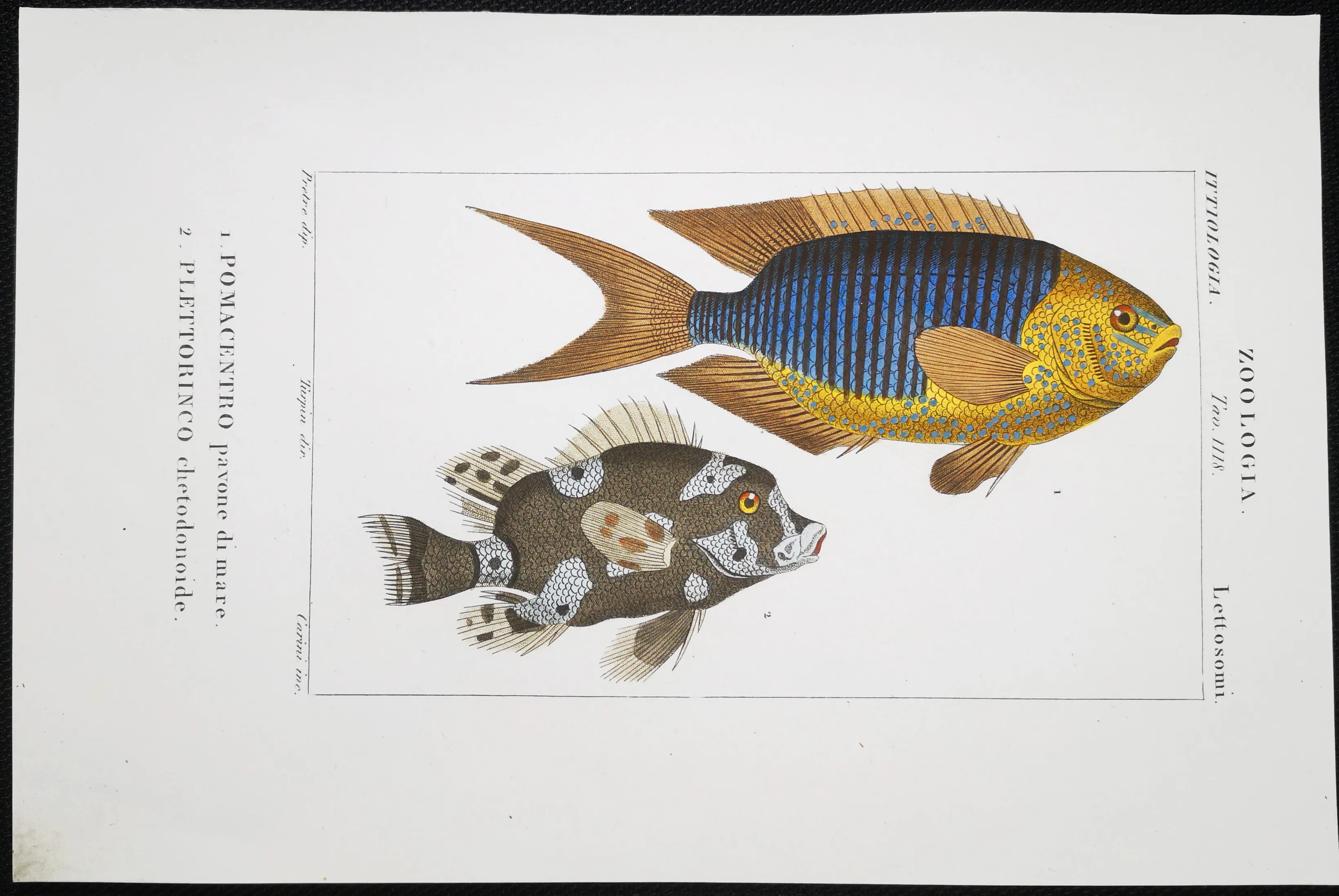



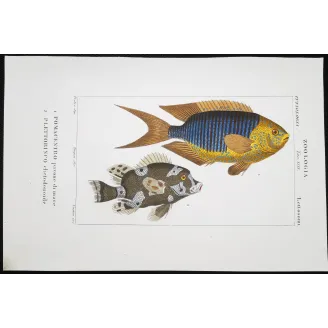

Two contrasting species in one plate: a delicate Damselfish and a robust Triggerfish, rich in color and texture.
 Delivery policy
Your print will be carefully prepared and shipped worldwide via trusted couriers (UPS or similar).
 Authentic antique prints
Original engravings from the 17th–19th century.
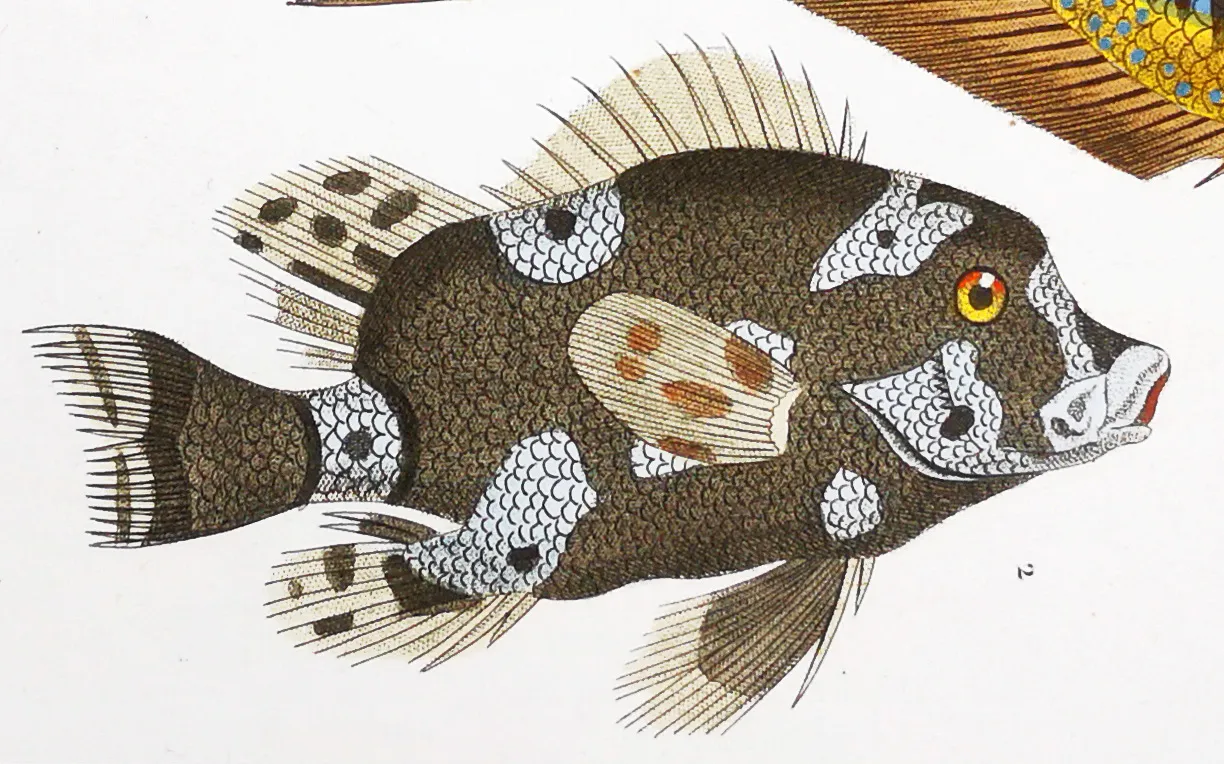
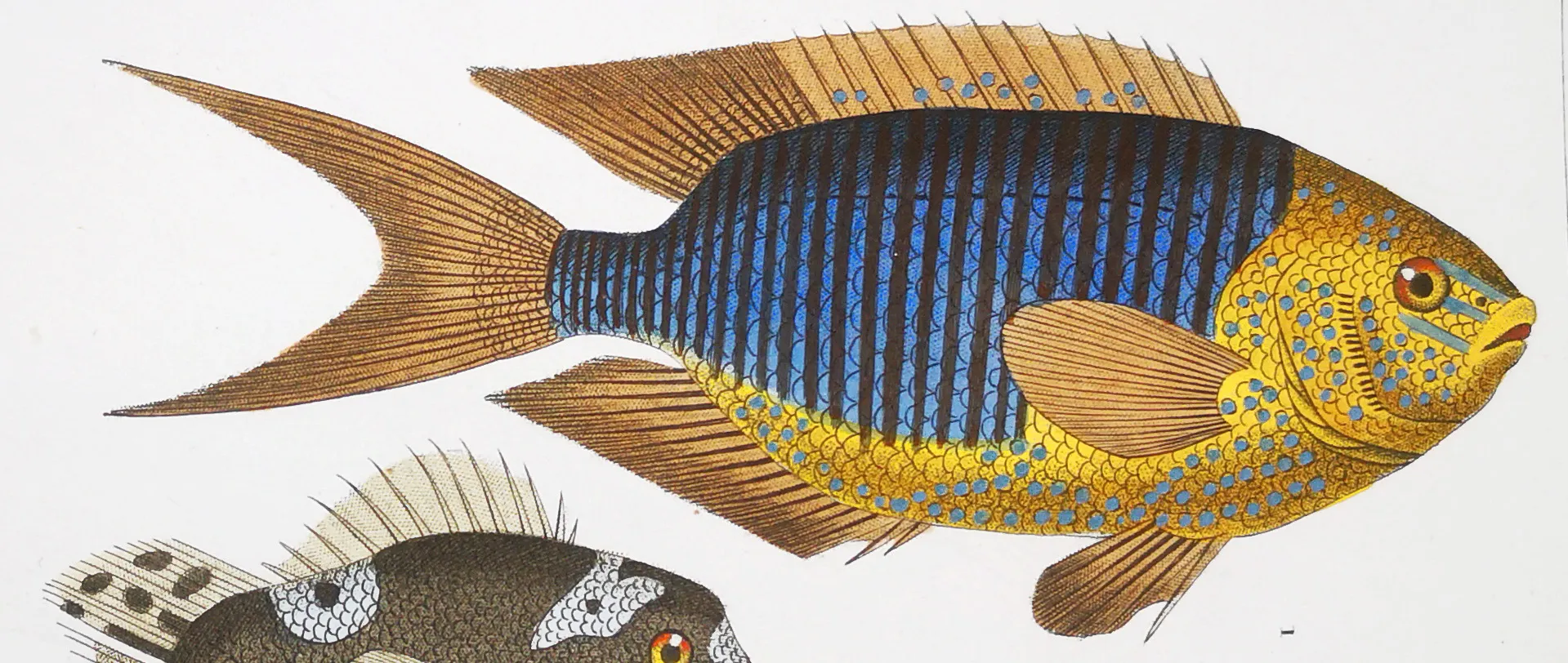
This original hand-colored engraving presents two tropical marine fishes arranged for comparative study: the Marine Damselfish, Pomacentrus marinus, and a Triggerfish, Plethodonodon cirrhigonoides. The pairing reflects the encyclopedic logic of early nineteenth-century zoology, where contrast in colour, surface pattern, and body architecture served as a tool for classification.
Rather than relying on ornament, the engraving emphasizes morphological intelligibility. Scale fields are rendered with controlled repetition, fin edges are precisely articulated, and the hand-colouring is disciplined: saturated blues and warm golds clarify the damselfish’s patterning, while denser markings and muted tones define the triggerfish’s protective visual grammar.
The plate belongs to the Italian edition of the Dizionario di Scienze Naturali (Florence, Battelli press), one of the most ambitious encyclopedic scientific enterprises of its time, for which Pierre Antoine Prêtre produced a remarkable body of zoological plates devoted to marine life.
— • —
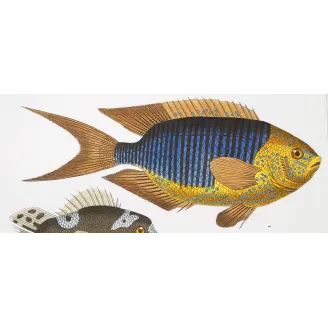
The composition is spacious, allowing each specimen to read as an isolated study against the blank field. The damselfish dominates through chromatic authority: rhythmic blue banding creates a measured cadence, while golden detailing around the head and flank introduces brilliance and immediacy.
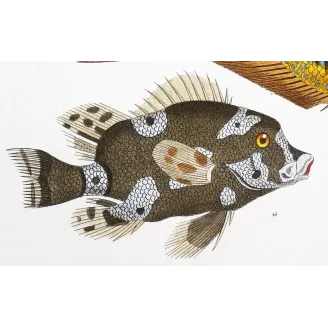
The triggerfish provides tonal counterweight through darker pigments and more complex patterning, producing a visual dialogue between radiance and armour. The plate achieves equilibrium between scientific purpose and decorative refinement — a quality that makes it particularly compelling for display.
The Marine Damselfish, Pomacentrus marinus, belongs to a group celebrated for vivid patterning and reef-associated life, forms that became emblematic of the nineteenth-century fascination with tropical seas. The Triggerfish, Plethodonodon cirrhigonoides, introduces a contrasting visual logic: a sturdier body and markings suggestive of defence and adaptation. In the pre-photographic era, antique fish engravings like this were essential scientific tools, conveying reef biodiversity through engraved line and controlled hand colour. Today, the plate functions equally as a 19th-century marine life print and as a culturally charged document of exploration — a refined antique scientific illustration whose colour and contrast remain highly sought after for coastal interiors and cabinet-of-curiosity display.
This plate forms part of the historic Dizionario di Scienze Naturali, a monumental early nineteenth-century encyclopedic enterprise once preserved within a noble library and today housed in the Sacchetti Collection. Each engraving reflects a period in which scientific ambition was matched by exceptional artisanal execution — from the disciplined copperplate line to the luminous hand-colouring applied individually to every impression.
The result is not merely zoological documentation, but a refined synthesis of scholarship and craftsmanship, where artistic discipline elevates marine observation into a form of quiet visual authority. To discover the full story behind these rare prints and their noble provenance, we invite you to read our editorial feature “Not Just Another Print” — a tribute to the enduring harmony between knowledge, art and prestige embodied in the Dizionario di Scienze Naturali.
The engraving is in excellent antique condition. The sheet presents clean margins and a well-preserved impression. The paper is smooth early nineteenth-century wove paper (non-laid), consistent with Italian scientific editions of the period. No watermark has been observed. The original hand-colouring remains fresh and well balanced, with no visible losses.
For further context on Pierre Antoine Prêtre and his contribution to nineteenth-century zoological illustration, see our editorial feature:
Pierre Antoine Prêtre – Illustrator of Natural Science and Marine Life
Specific References
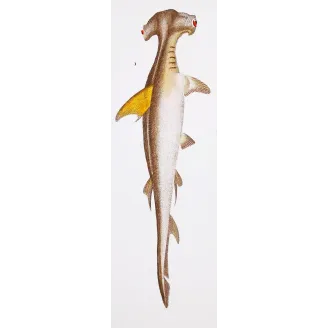
Vibrant 19th-century antique print by Pierre Antoine Prêtre depicting a Hammerhead Shark and Smoothhound, remarkable for color contrast and composition.
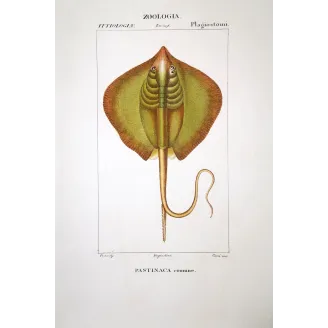
Graceful stingray with warm olive-brown tones and a long tail; tranquil marine subject with elegant presence.
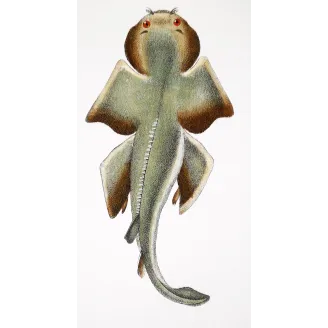
Graceful 19th-century engraving of the Angelshark by Pierre Antoine Prêtre, rich in soft tones and fine anatomical accuracy.
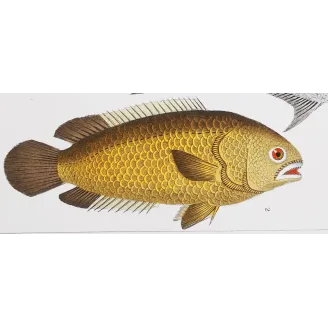
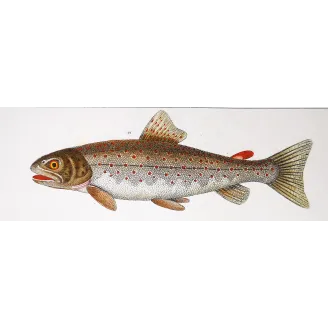
Robust Brown Grouper illustrated with fine detail and earthy, natural tones.
Remarkable plate with armored cowfish and boxfishhexagonal patterning and sculptural spines, superb for marine-themed decor.
Vivid 19th-century engraving of Mediterranean Rainbow Wrasse and Lesser Sandeel by Pierre Antoine Prêtre, bright palette and crisp lines.
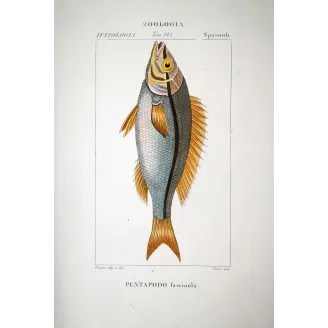
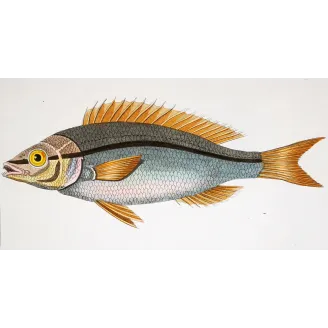
Elegant Pentapodus fish with shimmering orange-silver tones and refined aquatic poise.
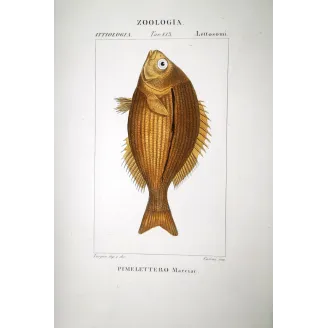
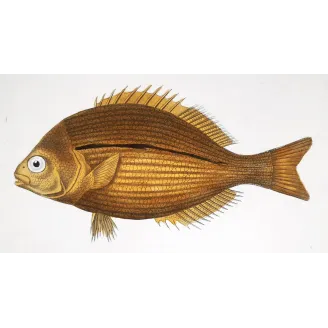
Silver and golden marine pair with crisp scales; a balanced 19th-century composition for refined coastal interiors.
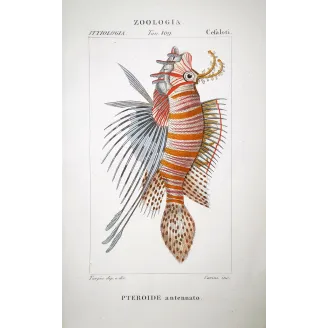
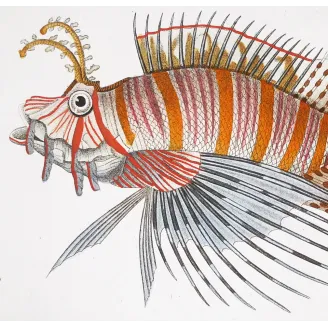
Striking depiction of the Antennata Lionfish with vivid red and orange fins, full of exotic elegance.
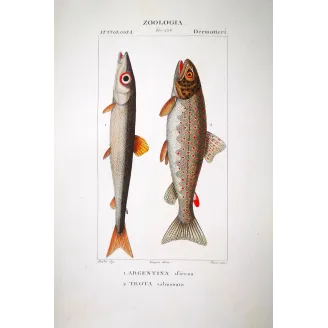
Classic natural history pairingsilver argentine and spotted troutclean composition and fine stippling for timeless appeal.
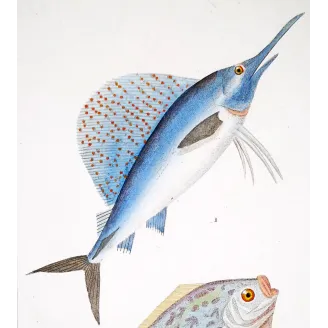
Elegant 19th-century antique print by Pierre Antoine Prêtre with Sailfish and Moonfish, luminous blues and refined detailing.
Iconic plate with the celebrated John Dory and a striking angelfishsuperb color contrasts and collector appeal.
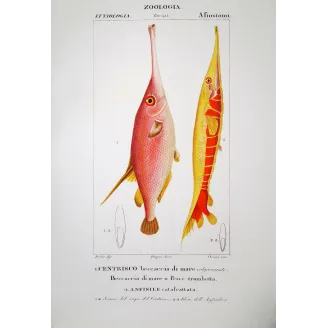
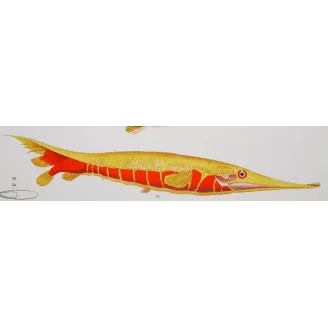
Vivid coral-pink snipefish with golden pipefish; long elegant silhouettes, striking color contrast for refined marine decor.
Striped body with blue-spotted fins; a refined 19th-century marine engraving ideal for study walls and coastal interiors.
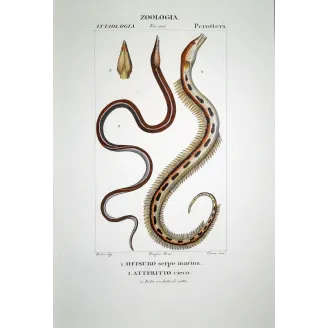
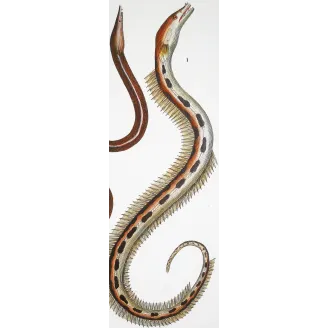
Dramatic eel composition with sinuous forms and precise stippling; a rare and architectural marine subject for refined interiors.
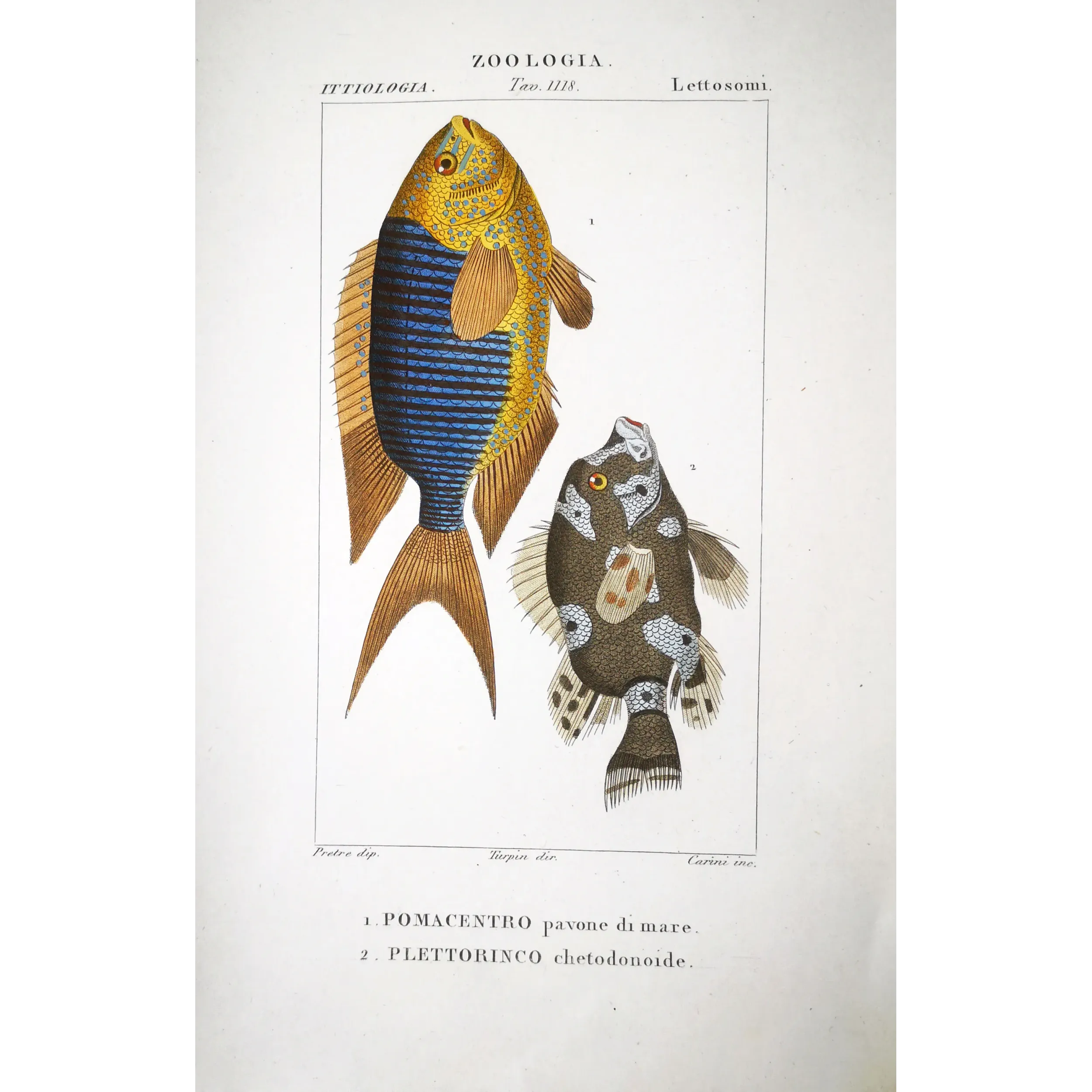
Two contrasting species in one plate: a delicate Damselfish and a robust Triggerfish, rich in color and texture.