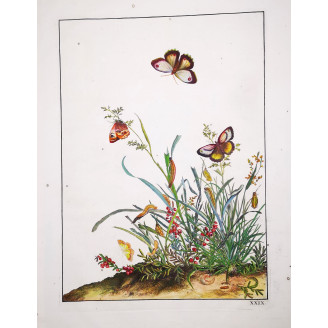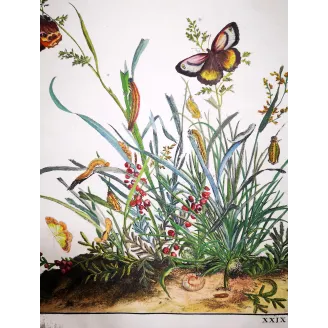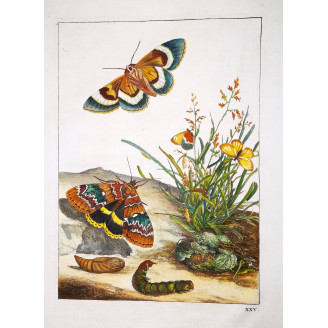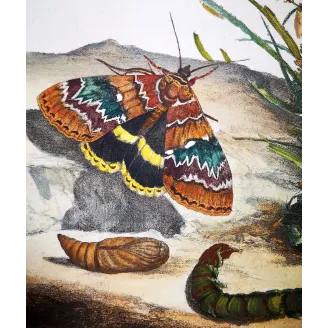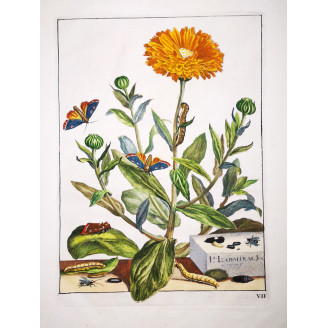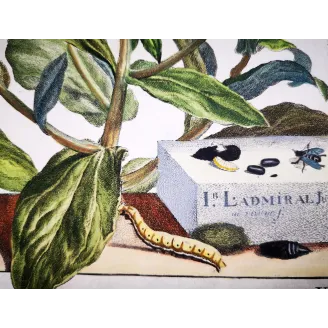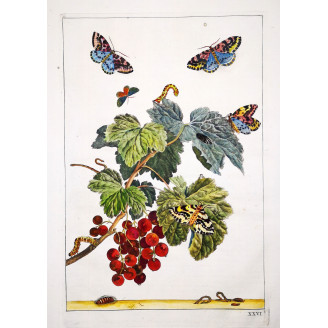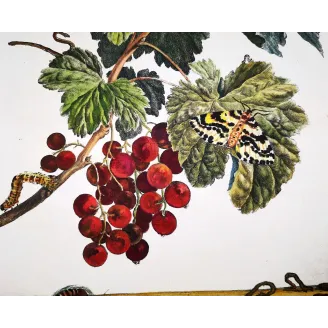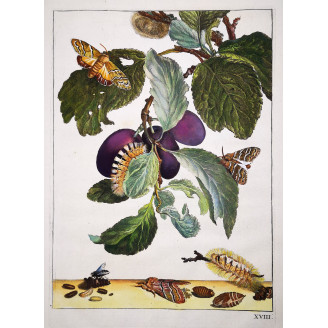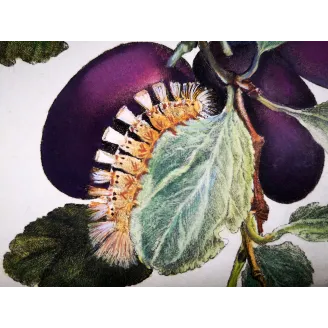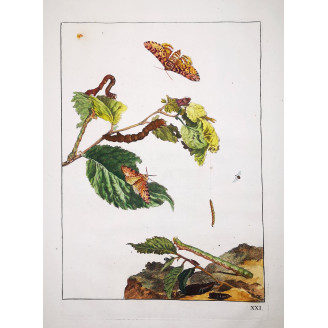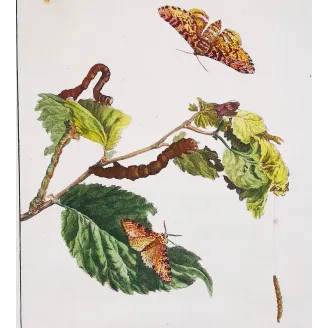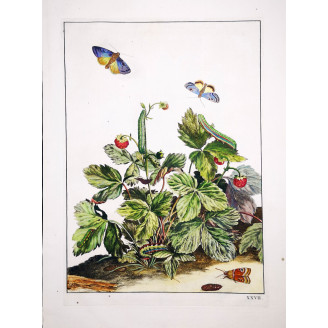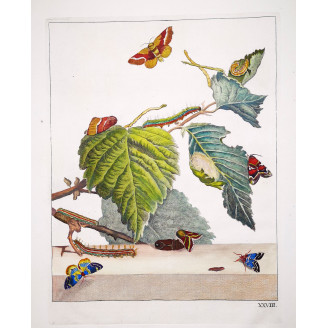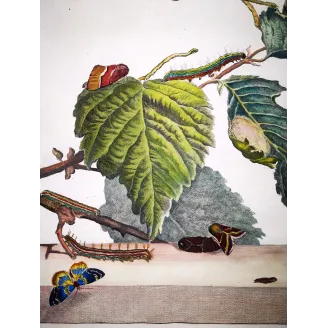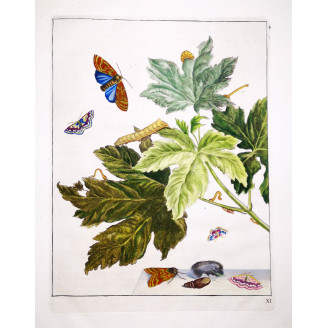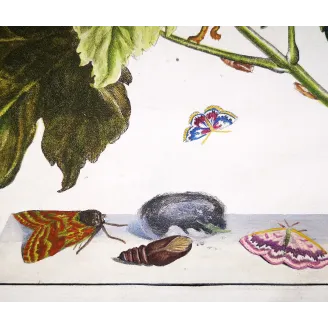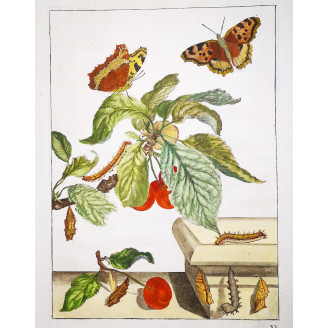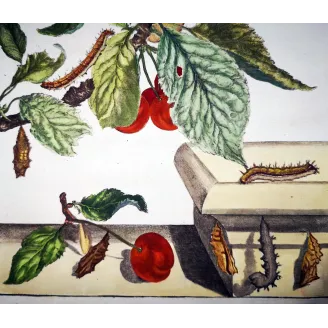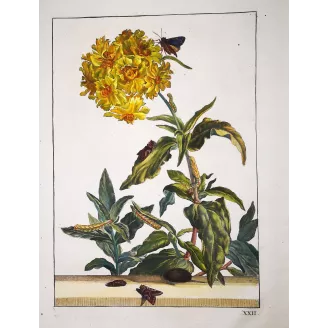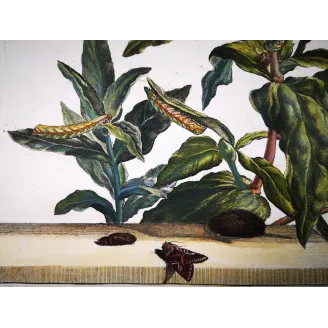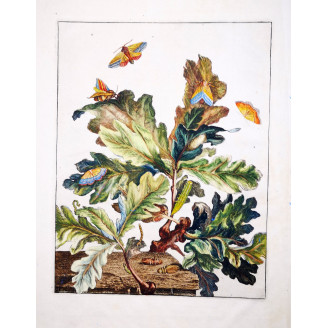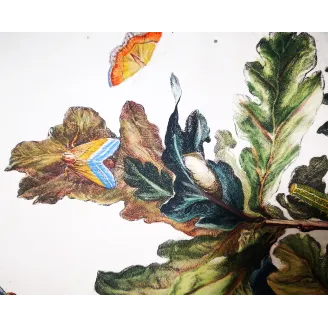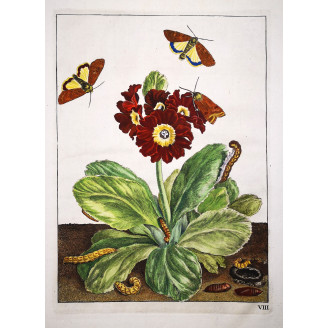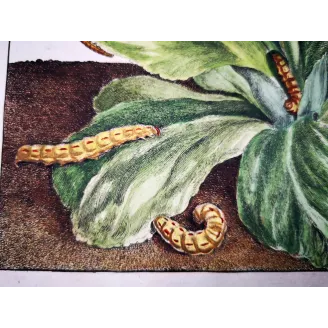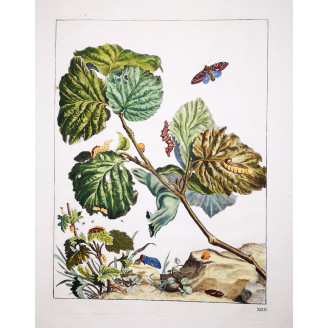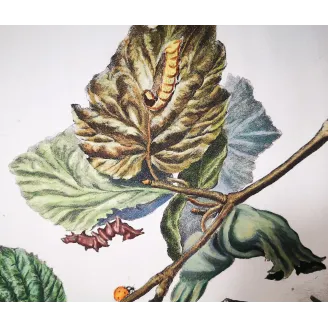
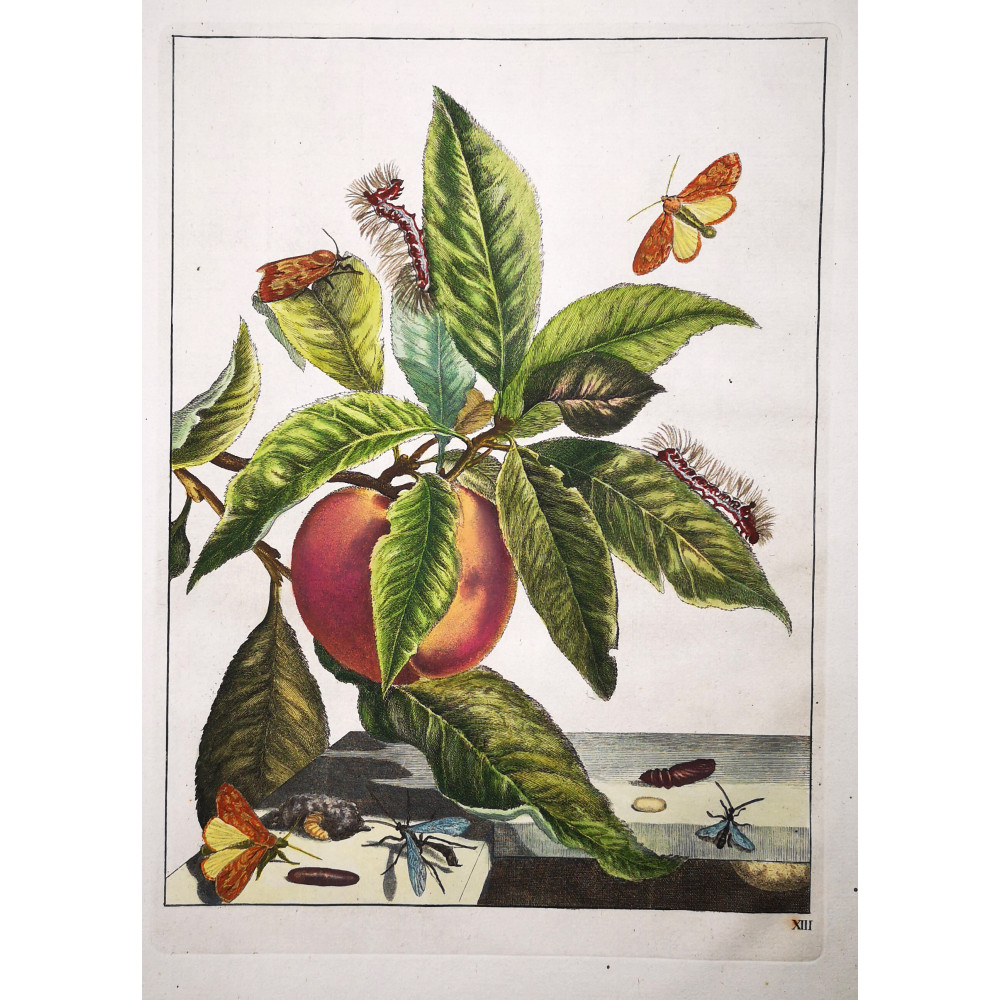
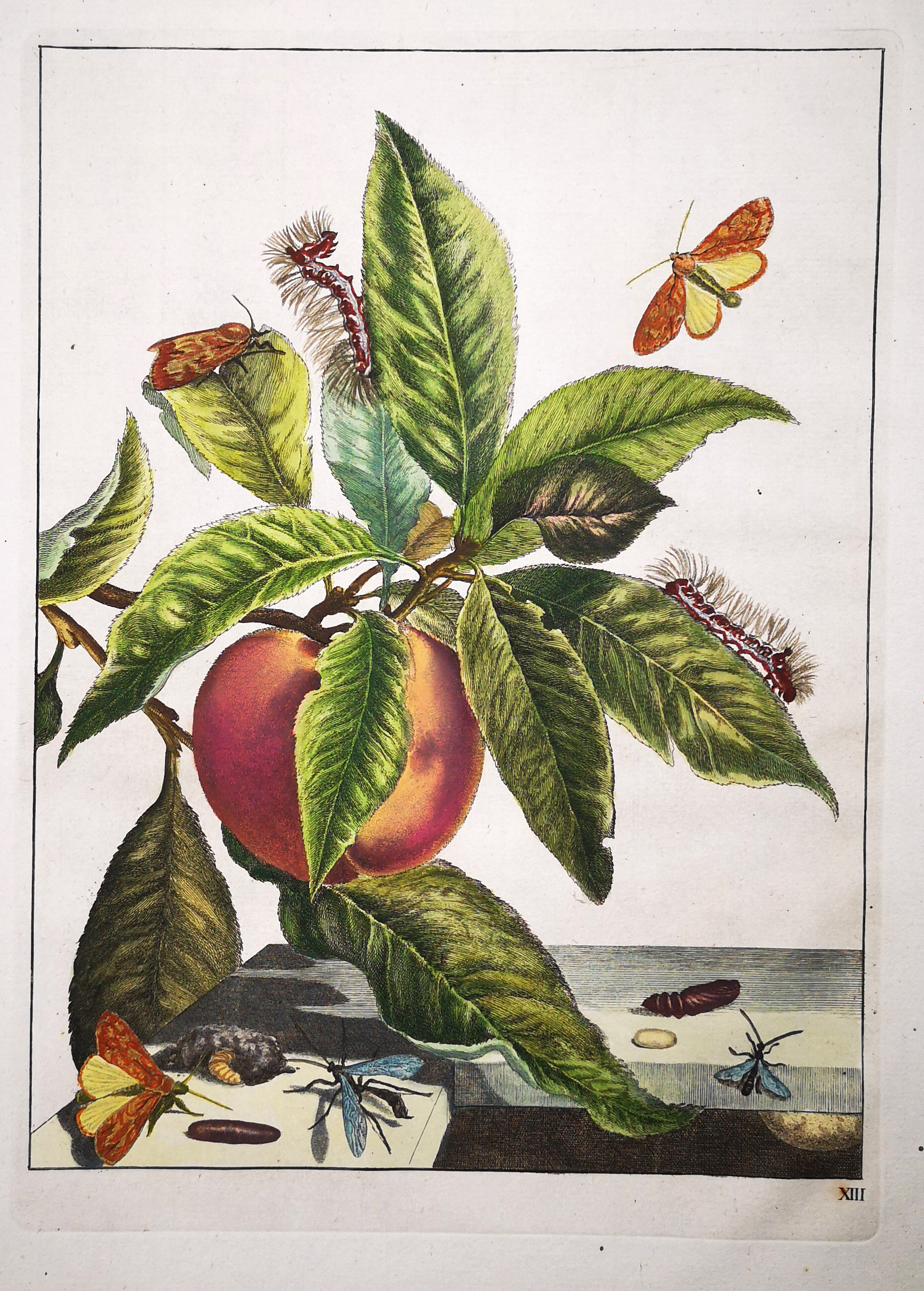
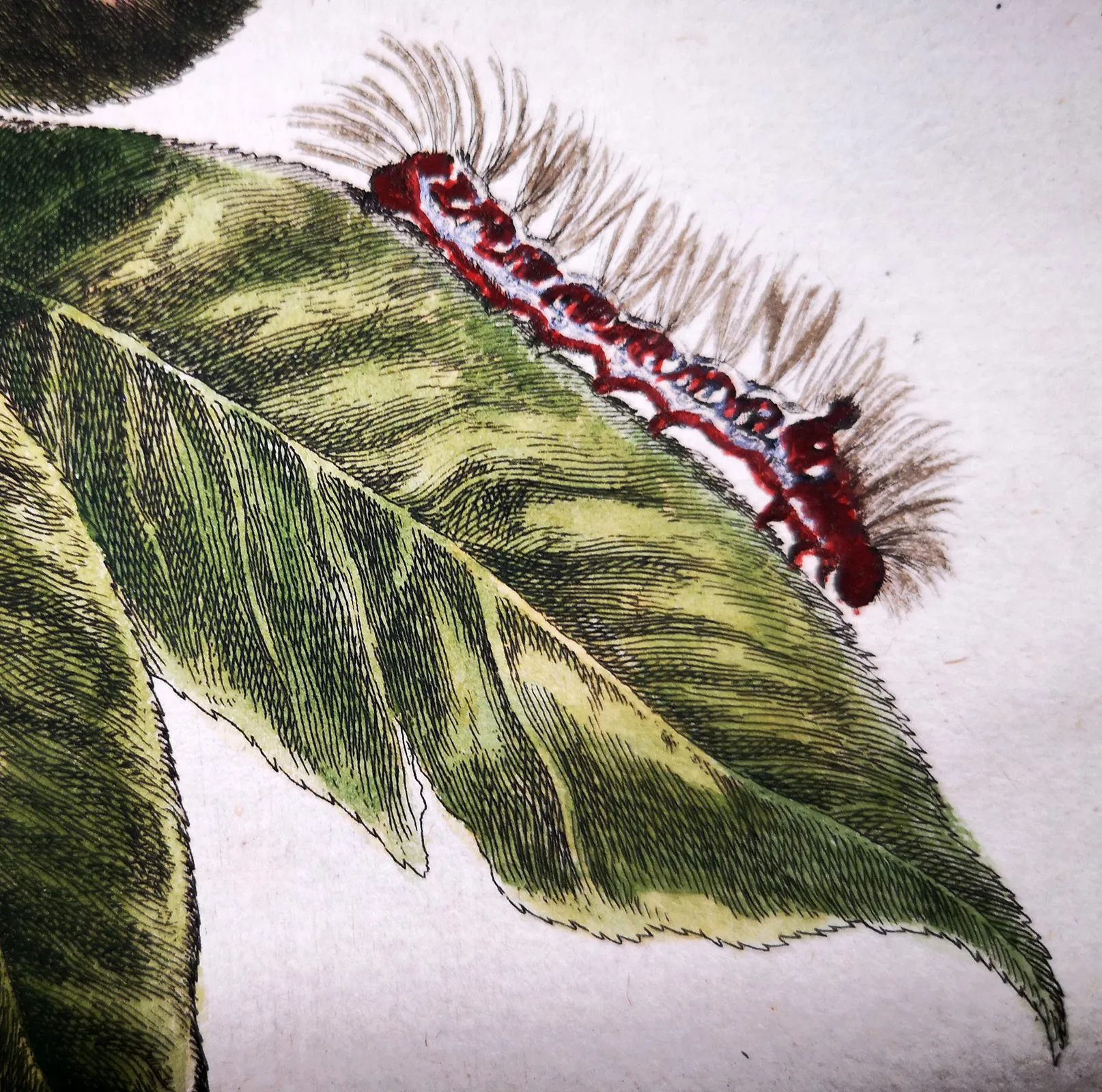
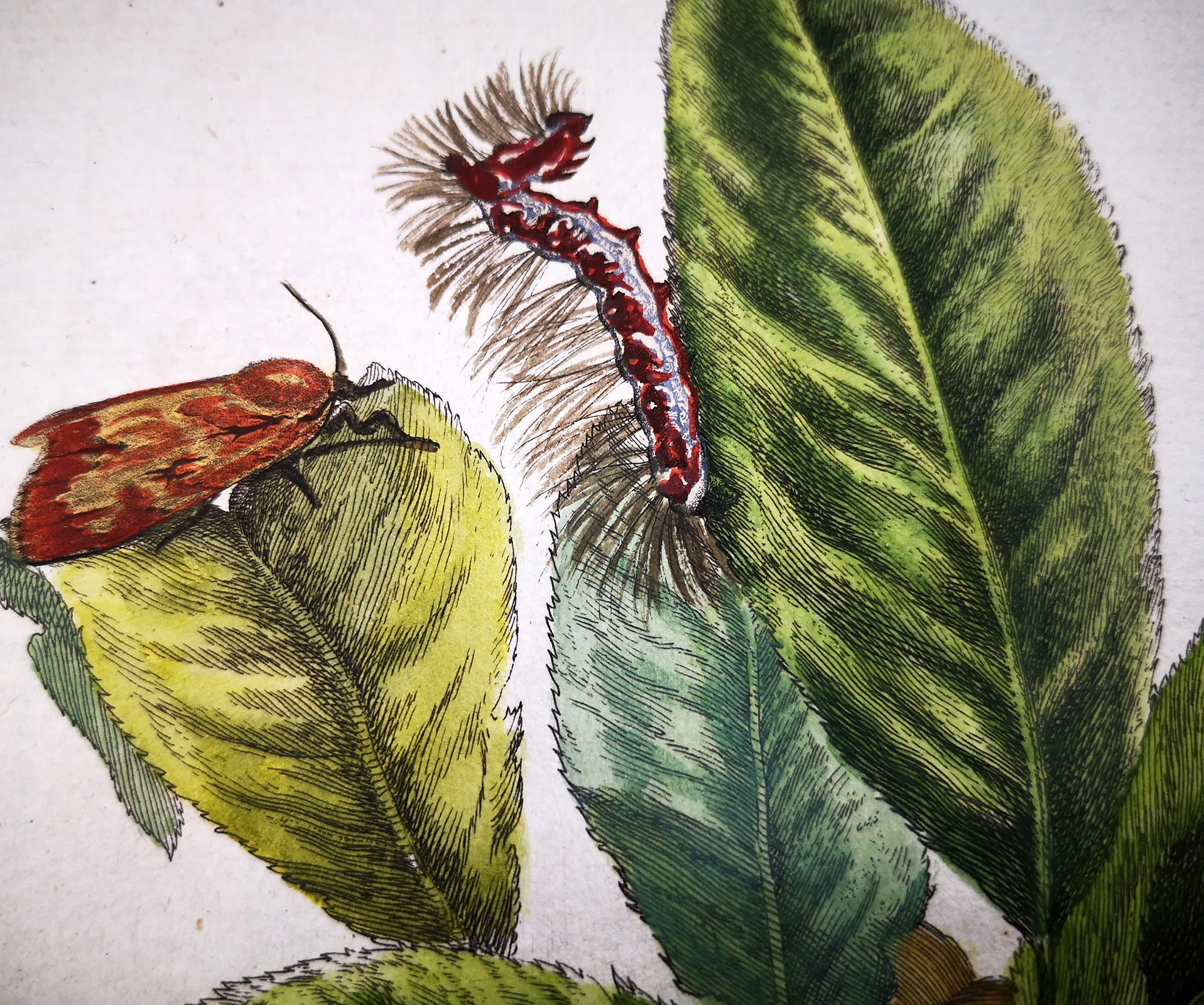
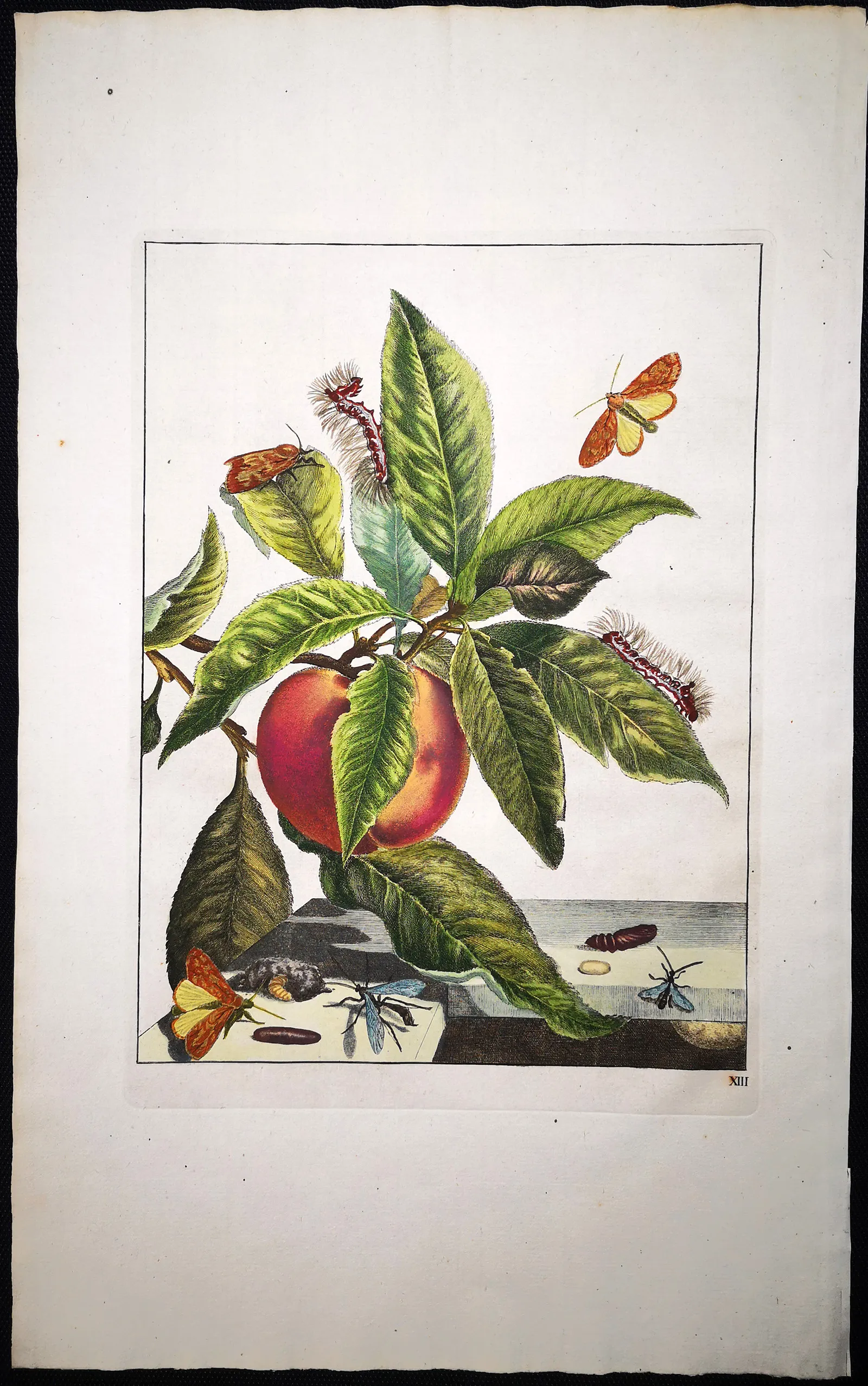
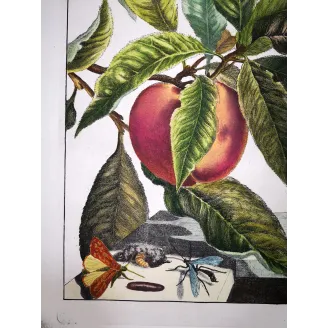
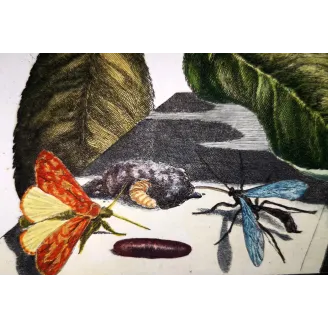
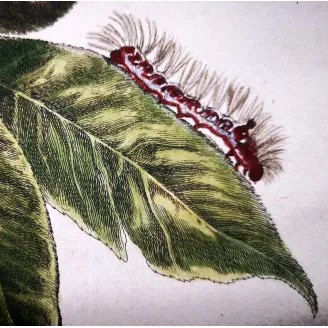
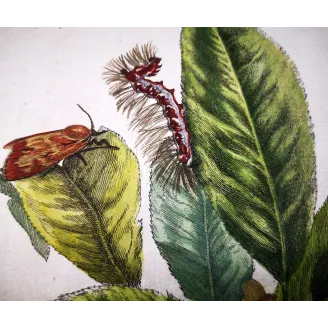
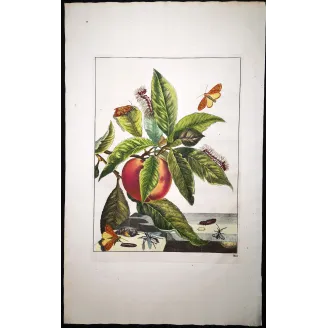
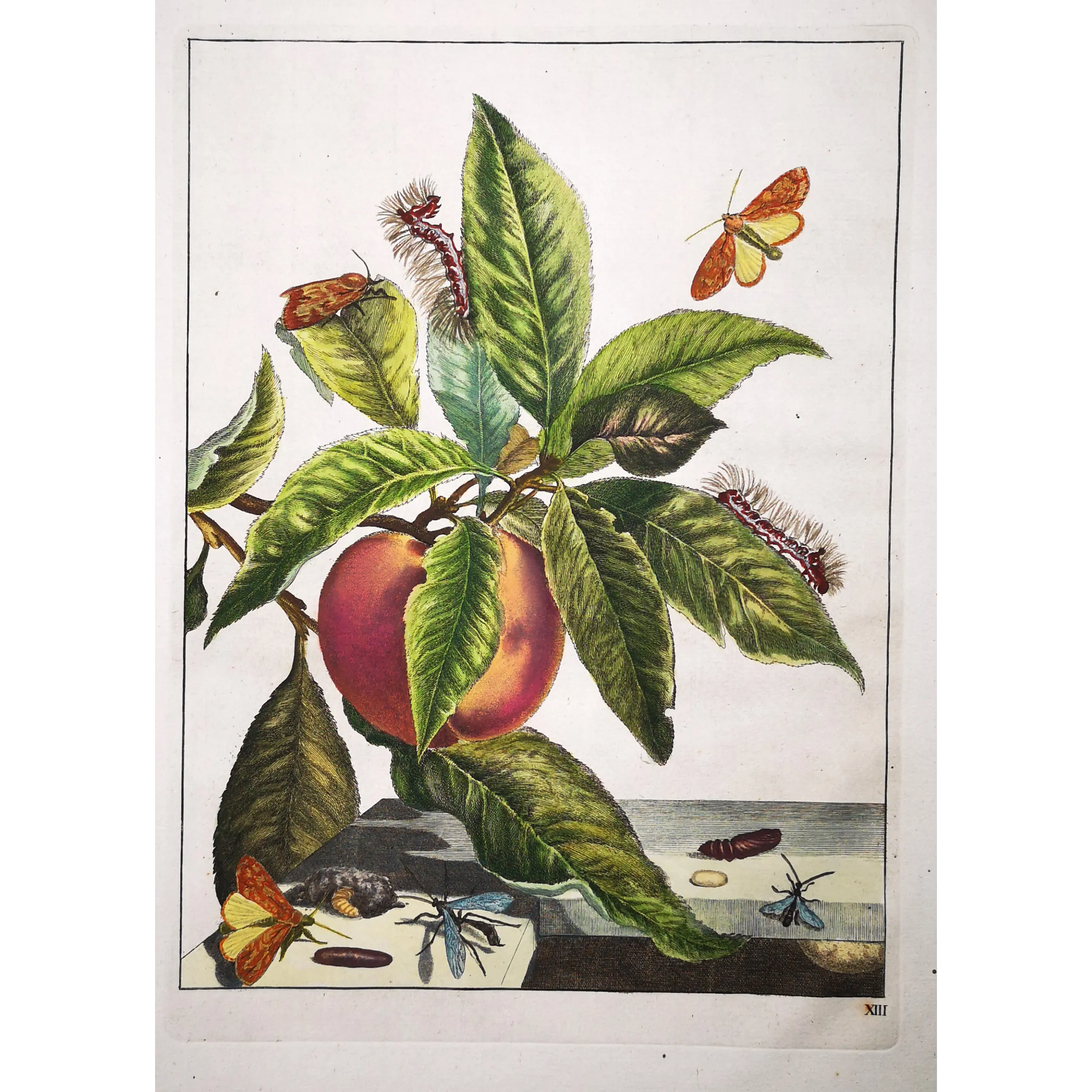
Original 1774 engraving by Jacob L'Admiral: Moths and Larvae on Fruit Tree Branch.
 Delivery policy
Your print will be carefully prepared and shipped worldwide via trusted couriers (UPS or similar).
 Authentic antique prints
Original engravings from the 17th–19th century.
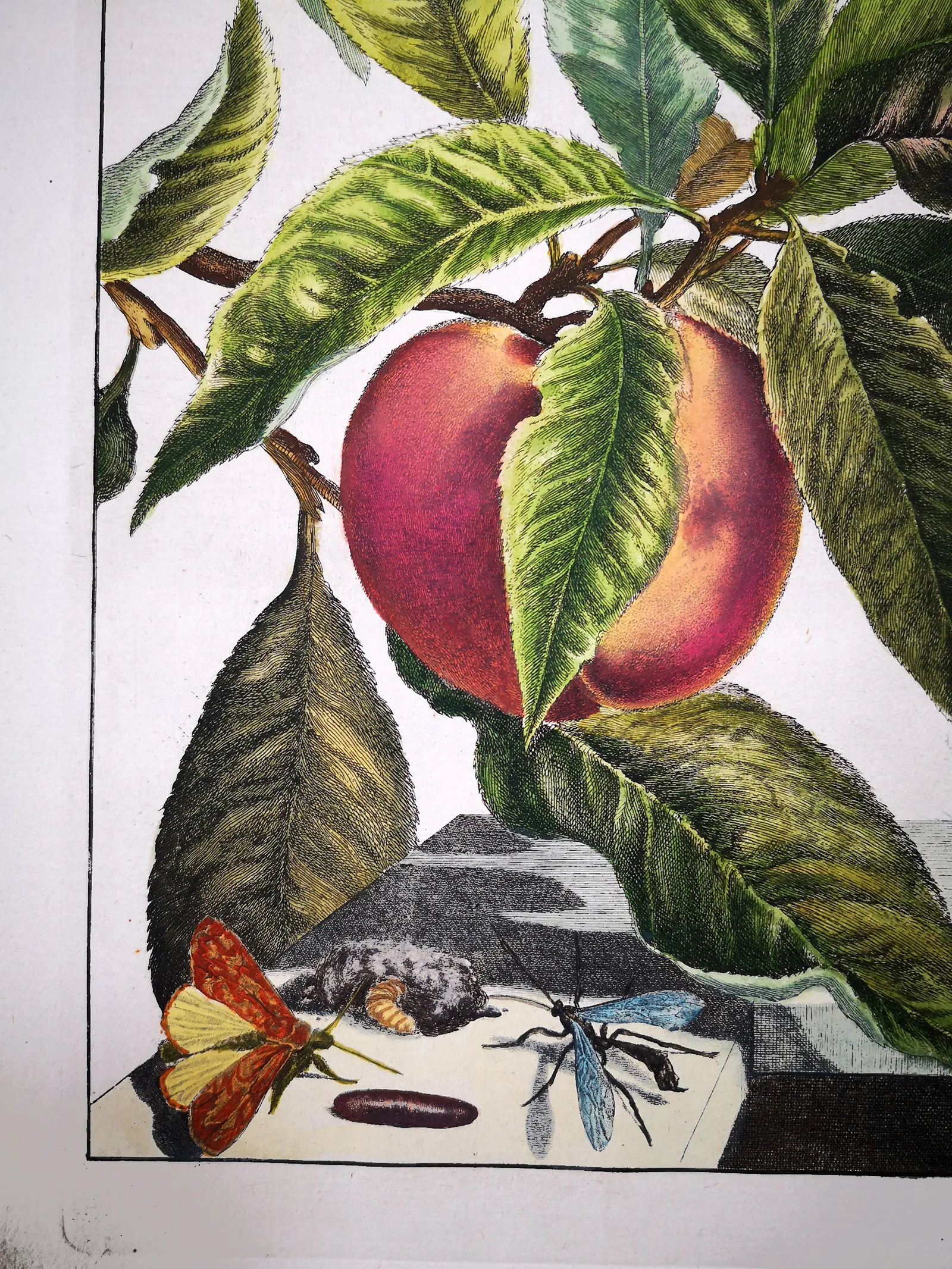
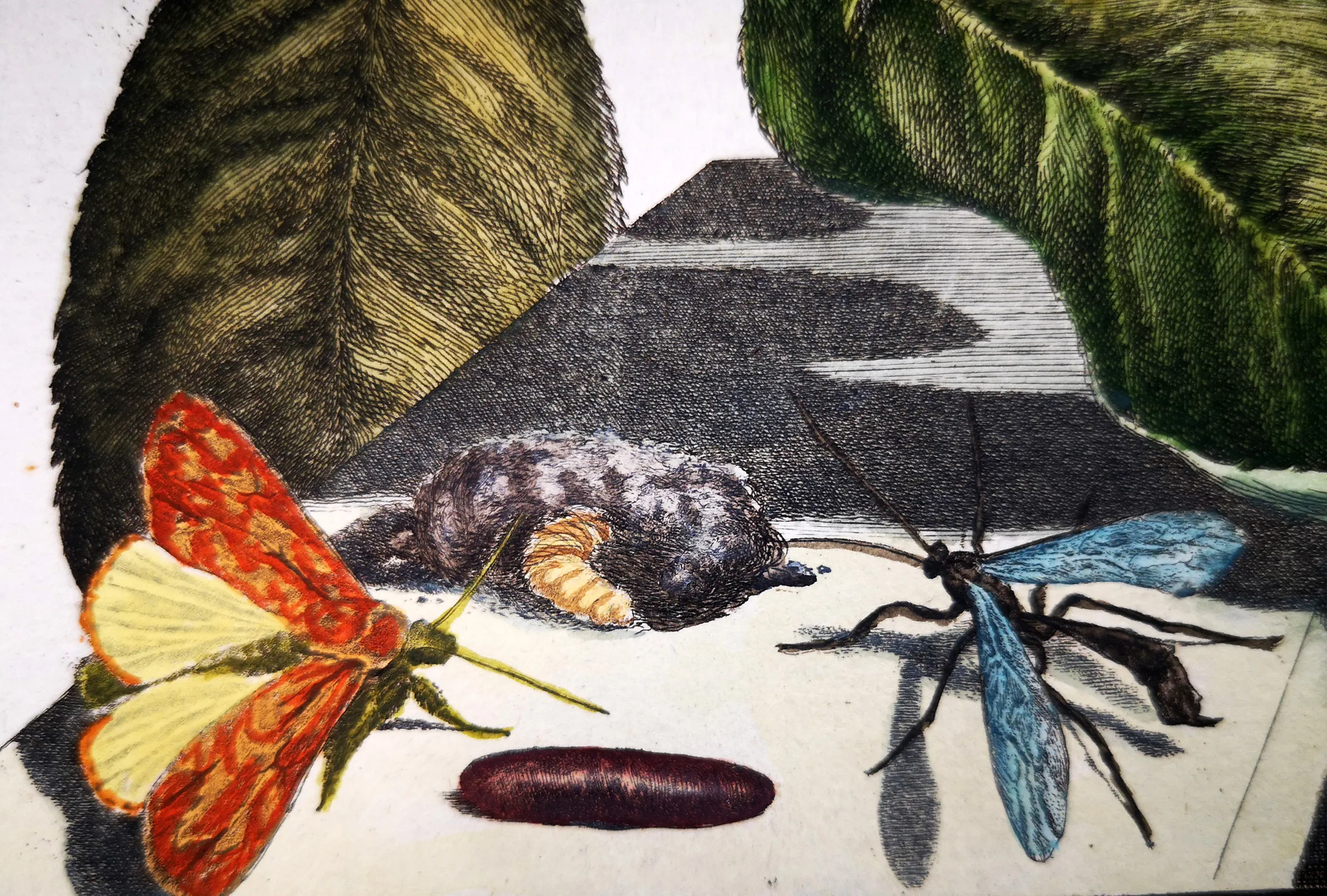
This original 1774 hand-colored engraving by Jacob L’Admiral depicts the Grey Dagger Moth (Polia nebulosa) in its various stages of transformation upon the peach tree (Prunus persica). The composition integrates fruit, foliage, larva, pupa, and winged adults into a single observational field — a hallmark of Enlightenment natural history.
The peach, rendered in warm gradations of rose and amber, anchors the plate visually, while the surrounding leaves create a structured yet organic rhythm. Caterpillars advance across the foliage, and adult moths hover in poised suspension, each element positioned with studied balance rather than decorative excess.
Unlike purely ornamental botanical engravings of the period, L’Admiral’s work reflects empirical observation. The insects are not symbolic embellishments but biological subjects presented within their ecological context.
— • —
The plate is structured around a quiet triangular balance: fruit at the center, branching foliage extending laterally, and insect life distributed with deliberate asymmetry. The peach’s rounded volume contrasts with the angular articulation of the leaves, while the moths introduce motion into an otherwise still composition.
The restrained yet luminous palette — deep greens, muted ochres, and soft crimson — enhances the naturalistic tone. The engraved line remains crisp and controlled, allowing the hand-coloring to define texture without overpowering the structural clarity of the plate.
Polia nebulosa, commonly known as the Grey Dagger Moth, is a widespread European noctuid species whose larvae feed on various deciduous trees and cultivated plants, including fruit-bearing species such as Prunus persica. In eighteenth-century horticultural environments, such caterpillars were closely observed for their relationship to orchard cultivation.
L’Admiral records the insect’s metamorphosis with methodological precision: larval forms, pupal stage, and winged adults appear alongside the host plant. This integration reflects the empirical spirit of Dutch Enlightenment science, in which insects were studied as active participants within ecological and agricultural systems rather than as isolated curiosities.
This engraving forms part of Jacob L’Admiral’s celebrated 1774 work dedicated to the metamorphosis of insects — a publication emblematic of Dutch Enlightenment natural history. Produced on laid paper and carefully hand-colored, each sheet embodies the intersection of scientific inquiry and artisanal printmaking.
To explore the historical and intellectual context of L’Admiral’s work, see our editorial feature Jacob L’Admiral and the Metamorphosis of Insects.
Printed on original eighteenth-century laid paper with visible chain lines. The sheet retains fresh and clean margins, and the impression remains crisp and well-defined. The hand-coloring is vivid and stable. No watermark is present. Exceptionally well preserved for a publication dated 1774.
Specific References
Original 1774 engraving by Jacob L'Admiral: Colorful Insects on Flowering Stalk.
Original 1774 engraving by Jacob LâAdmiral: Swallowtail Butterfly on Thistle.
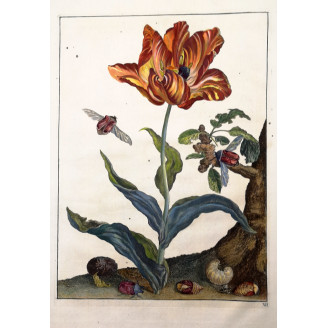
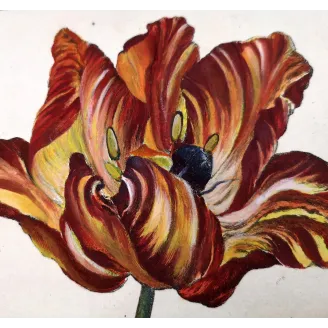
Original 1774 engraving by Jacob L'Admiral: Rose Chafer beetle with Pupae Stages and Tulip.
Original 1774 engraving by Jacob LâAdmiral: Pepperes Moth on Birch.
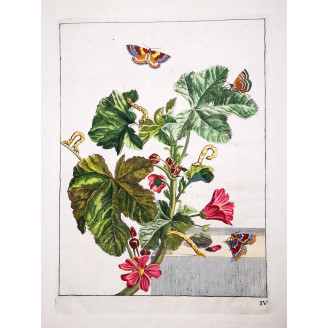
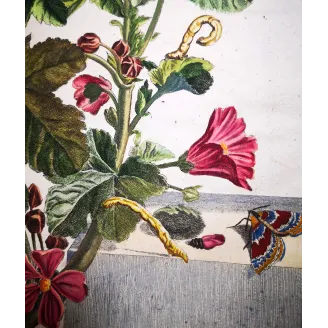
Original 1774 engraving by Jacob L'Admiral: Red Twin-spot Carpet on Mallow.
Original 1774 engraving by Jacob L'Admiral: Large Tortoiseshell on Sweet Cherry.
Original 1774 engraving by Jacob L'Admiral: Red Butterflies on Flowering Stem.
Original 1774 engraving by Jacob L'Admiral: Early Moth Stage among Willow Leaves.
Original 1774 engraving by Jacob L'Admiral: Moths and Larvae on Fruit Tree Branch.