
Statement Pieces – Large Antique Prints for Contemporary Interiors
A Prantique Statement Piece is an original antique print selected for its exceptional scale, visual presence and ability to command a substantial wall. Drawn from botanical and natural-history works of the seventeenth to nineteenth centuries, these individual works combine historical authenticity with dimensions capable of creating a strong architectural presence within contemporary interiors.
Their size is not the result of modern enlargement. It belongs to the historical object itself: generous folio sheets, large botanical plates and exceptional folded engravings conceived centuries ago for scientific observation, publishing or visual study.
Large by origin, not by reproduction.
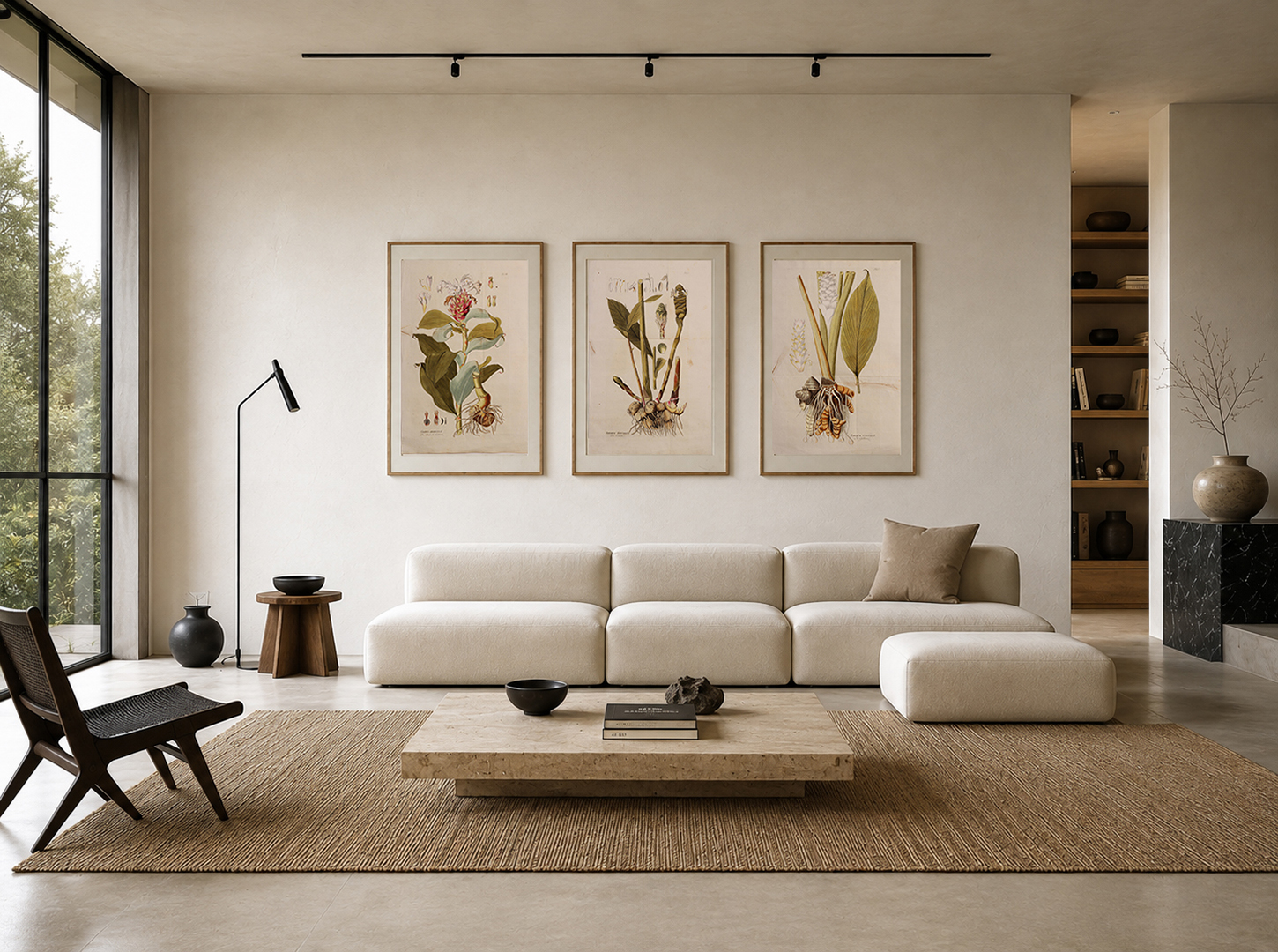
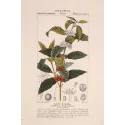
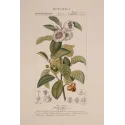
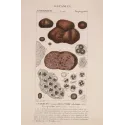
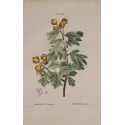
Original Joseph Jacob von Plenck botanical engravings from the Prantique collection presented in a contemporary interior. Interior visualization featuring photographs of the original works.
Original Antique Prints for Contemporary Interiors
If you are choosing an important work for your home, a Statement Piece offers an original historical focal point for a contemporary space. Its scale, composition and material character can establish a distinct relationship with the surrounding architecture and furnishings.
Considered framing gives a substantial historical sheet room to be seen. Simple profiles, suitable conservation materials and glazing can create a clear presentation that respects the paper, margins and plate impression while complementing the character of your home.
This makes large antique prints particularly effective in living rooms, libraries, entrance halls, dining spaces and other interiors where the architecture calls for one or two significant works rather than a collection of smaller decorative elements.
Their presence comes not only from physical dimensions but from the tension between historical craftsmanship and contemporary space. Handmade paper, engraved lines and original hand-colouring can acquire remarkable visual intensity when surrounded by clean architecture and sufficient negative space.
An original historical work. A focal point of its own.
Explore how historical works relate to modern spaces in Antique Prints in Contemporary Interiors.
The Prantique Network — Bringing Your Prints into Your Home
Choosing original antique prints for your home involves both the works themselves and the space in which they will live. Through the Prantique Network, we maintain contacts with conservation framers and interior design studios in different parts of the world, selected for the suitability of their work to these needs.
Whether you are considering a Statement Piece or have already chosen your work, tell us about your plans and your location. We can recommend a relevant professional from our network where a suitable contact is available in your area.
Conservation framing
Original works on paper benefit from framing that considers both conservation and presentation. We can introduce you to a specialist experienced in historical works on paper, with whom you can discuss appropriate materials and a finish suited to your home.
Interior design
If you would like to furnish your space with original antique prints and would welcome professional support, we can introduce you to an interior design studio we know and whose work we consider well suited to incorporating historical prints into residential interiors. Where a suitable studio from our network is available in your area, we can recommend a contact with your home and the works you have in mind in view.
You would contact the recommended professional directly to discuss your requirements and their services.
The Challenge of Art for a Large Wall
Choosing art for a substantial wall involves more than dimensions. The work needs a composition, visual presence and character that remain convincing within the architecture and reward closer examination.
The usual response is often to increase quantity: multiple smaller images, decorative groupings or a dense gallery wall. Yet some interiors benefit from the opposite approach — fewer works, each with sufficient scale and character to establish its own relationship with the surrounding space.
Statement Pieces bring together antique originals capable of fulfilling that role. A single large botanical or natural-history print can act as a focal point; two related works can create a measured pairing; several substantial sheets can establish rhythm across a broader wall without sacrificing the individuality of each object.
The aim is not to fill the wall. It is to give an important original enough space to be seen.
Scale with Historical Meaning
The dimensions of these works were determined long before the idea of modern wall art existed. Botanical illustrators required sufficient space to describe plants clearly. Natural-history publishers used generous sheets to accommodate complex specimens. In exceptional cases, an image could exceed the normal dimensions of the bound volume and be printed on a larger sheet designed to fold into the book.
Joseph Jacob von Plenck’s large folded botanical plates provide a particularly revealing example. Their expansive eighteenth-century sheets allow substantial plants to extend across the paper from underground structures to flowering stems, preserving botanical information together with an unusually powerful sense of physical scale.
The monumental botanical plates associated with works such as Basilius Besler’s Hortus Eystettensis achieve a different but equally compelling effect. Broad sheets, isolated specimens and extraordinary botanical detail give these seventeenth-century images a visual authority capable of holding its own within restrained contemporary architecture.
Their contemporary relevance therefore comes from a historical fact rather than a decorative intervention. The work has not been enlarged to suit the room. The room is responding to the original scale of the work.
Paper, plate mark, watermark, historical folds, engraved line and period colouring remain part of the same surviving object. Scale is inseparable from that material history.
A Specialist Collection, Wherever You Live
Detailed professional photography allows each Statement Piece to be examined closely before acquisition, from the complete composition and colouring to paper, margins, plate mark, watermark, folds, condition and other material characteristics relevant to the individual work.
Where appropriate, both recto and verso are documented. This allows the scale and visual effect of the work to be considered alongside the physical evidence that establishes its character as a historical object.
A broad specialist collection also makes it possible to compare different possibilities for a design project — considering format, scale, period, subject, colour, visual character and historical context — rather than choosing from works selected primarily for decorative size.
Each Statement Piece remains individually catalogued and available as a distinct historical work. The category simply provides another way of discovering originals whose physical presence makes them especially relevant to substantial walls and larger interior spaces.
With detailed documentation, clearly presented works and worldwide delivery, the same specialist collection can be explored and evaluated wherever the project is located.
How We Select a Statement Piece
Statement Pieces are not defined by a rigid minimum measurement. A sheet is considered in relation to its composition, proportions, visual weight and the presence it can achieve once appropriately mounted and framed.
An important work must remain convincing from across a room while continuing to reward close examination. Scale therefore operates together with rarity, historical significance, quality of execution, paper, colouring, condition and the particular character of the represented subject.
A large sheet alone is not sufficient. The work must possess the visual structure and material quality required to support that scale. Equally, a historically exceptional folio can achieve substantial presence even when its paper dimensions are more restrained than those of an oversized folded plate.
Scale matters. Presence decides.
Buy with Confidence
 Original antique prints — carefully selected and professionally preserved
- Individually curated — each Statement Piece is an original period work selected for scale, quality and visual presence
- Worldwide delivery via UPS / DHL Premium Express — free above €300
- No customs duties or taxes worldwide — no delays, no extra charges upon delivery
- Secure, professional packaging for safe international delivery
- Returns accepted — a smooth, worry-free experience
Looking for a Composition of Several Works?
If your wall calls for several related originals rather than a single substantial work, explore our Museum Quality Study Sets — coherent groups selected for their historical, scientific, material and visual relationships.
Each Study Set preserves works that genuinely belong together, allowing a larger composition to be created without relying on unrelated images assembled simply for decorative effect.
Explore Museum Quality Study Sets →
Explore the Wider Collection
Looking for a different scale, subject or historical period? Explore our Botanical and Natural History Collections, where original prints are organised by artist, publication and historical context.
The wider Prantique collection offers further possibilities for projects requiring different dimensions, visual directions or historical contexts, while every work remains individually selected and documented.
Looking for inspiration on how original antique prints can work in a contemporary interior?
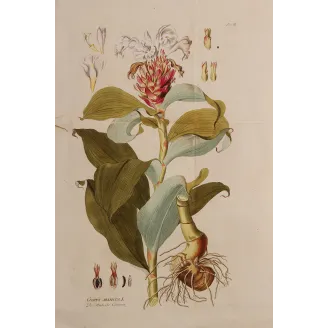
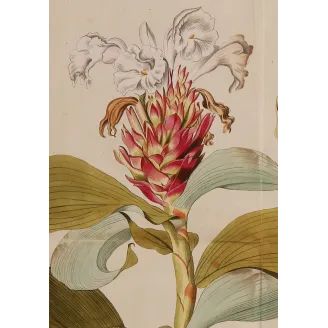
Arabian Costus (Costus...
Exceptional large-format eighteenth-century botanical engraving depicting <em>Costus arabicus</em> L., published as Plate VII of Joseph Jacob von Plenck’s <em>Icones Plantarum Medicinalium</em>. Printed on an unusually large folded sheet measuring 66.3 × 43.5 cm, the composition combines a monumental flowering specimen, extensive root and rhizome structures and finely observed botanical details with beautifully preserved contemporary hand colouring. Complete Honig watermark with logo.
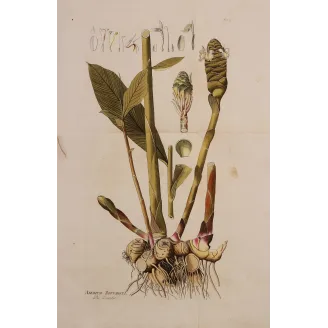
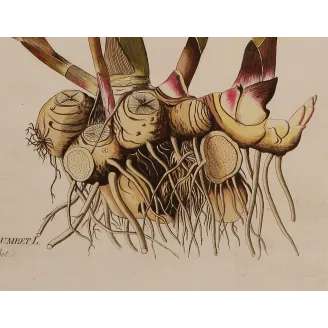
Amomum Zerumbet –...
Exceptional large-format eighteenth-century botanical engraving depicting <em>Amomum Zerumbet</em> L., published as Plate II of Joseph Jacob von Plenck’s <em>Icones Plantarum Medicinalium</em>. Printed on a large folded sheet of Honig laid paper with complete watermark and contemporary hand colouring, the composition combines monumental rhizomatous structures, tall architectural stems and precisely observed analytical details. A rare large-scale Plenck Statement Piece with remarkable historical and visual presence.
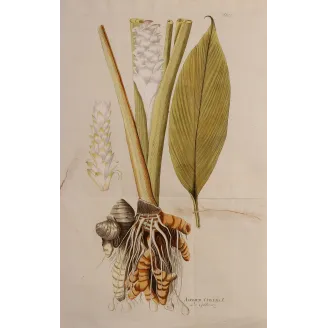
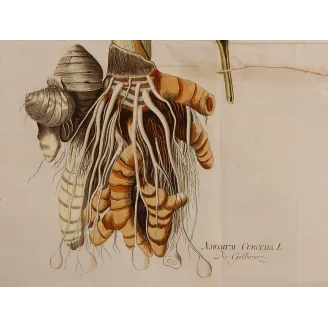
Amomum Curcuma – Large...
Exceptional large-format eighteenth-century botanical engraving depicting <em>Amomum Curcuma</em> L., published as Plate IV of Joseph Jacob von Plenck’s <em>Icones Plantarum Medicinalium</em>. Printed on a large folded sheet of Honig laid paper with complete watermark and contemporary hand colouring, the composition combines a remarkably refined pale inflorescence, monumental foliage and an exceptionally detailed rhizomatous structure. A powerful Plenck Statement Piece preserving both extraordinary botanical clarity and the visible material history of an eighteenth-century folded plate.
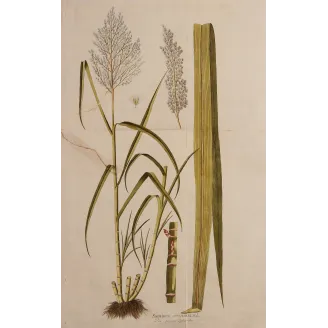
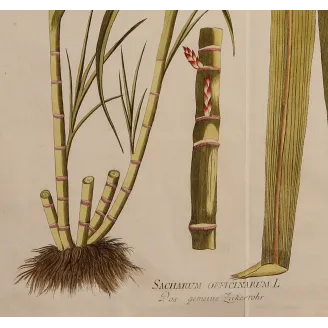
Sugar Cane (Saccharum...
Exceptional large-format eighteenth-century botanical engraving depicting <em>Saccharum officinarum</em> L. (sugar cane), published as Plate 40 of Joseph Jacob von Plenck’s <em>Icones Plantarum Medicinalium</em>. Printed on a large folded sheet of laid paper with “IV” watermark and contemporary hand colouring, the composition combines the elegant vertical architecture of the cane with exceptionally delicate flowering panicles and a monumental isolated leaf. A distinctive Plenck Statement Piece preserving remarkable botanical clarity together with the visible material history of an eighteenth-century folded plate.
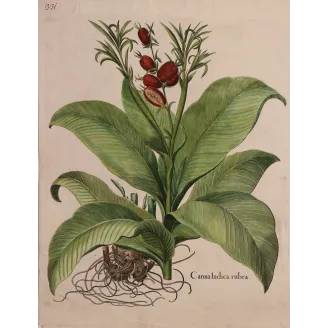
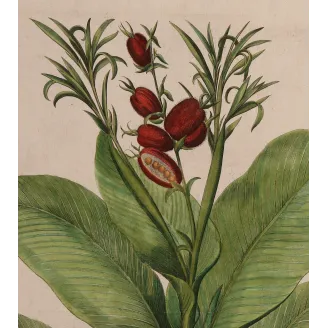
Canna Indica Rubra –...
Original seventeenth-century hand-colored botanical engraving of Canna Indica rubra from Basilius Besler's monumental Hortus Eystettensis, first published in 1613. The imposing composition combines sweeping green foliage, exposed roots and vivid red botanical forms, while the laid-paper sheet preserves a watermark and the remarkable printed autumnal heading “SECVNDVS ORDO COLLECTARVM PLANTARVM AVTVMNALIVM” on its verso.
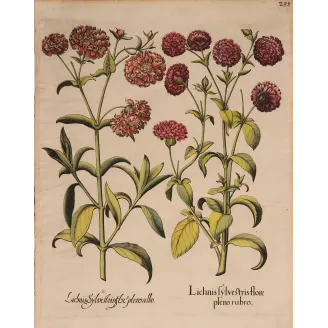
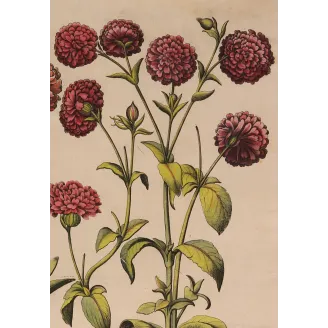
Lychnis Sylvestris –...
Original seventeenth-century hand-coloured botanical engraving depicting two forms historically inscribed <em>Lychnis Sylvestris</em>, from Basilius Besler’s monumental <em>Hortus Eystettensis</em>, published in 1613. The two flowering specimens create an exceptional comparative composition, with richly articulated red and crimson blossoms set against restrained green foliage. Printed on substantial laid paper with an approximately 30 mm chain-line spacing and a visible <em>pomme de pin</em> (pine-cone) watermark.
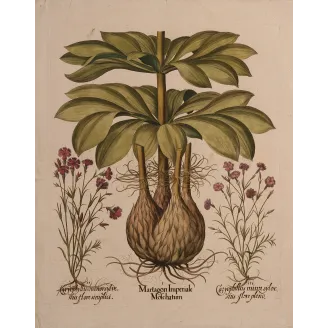
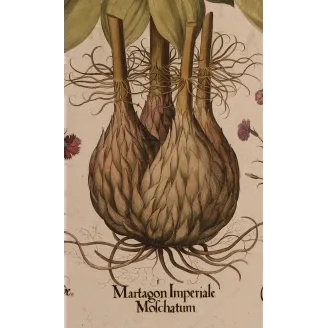
Martagon Imperiale –...
Original seventeenth-century hand-coloured botanical engraving from Basilius Besler’s monumental <em>Hortus Eystettensis</em>, published in 1613. This exceptionally large sheet preserves the lower part of an originally two-sheet composition, centred upon the imposing <em>Martagon Imperiale Molchatum</em> and accompanied by two flowering <em>Caryophyllus</em> forms. The verso retains the remarkable original typographical heading <em>Tertius Ordo Collectarum Plantarum Æstivalium</em>, material evidence of the seasonal organisation of Besler’s great botanical work.
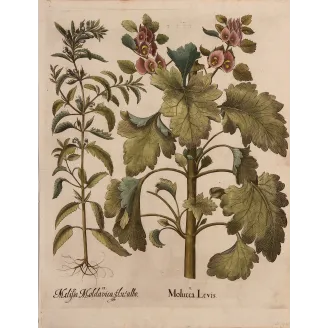
Molucca Levis &...
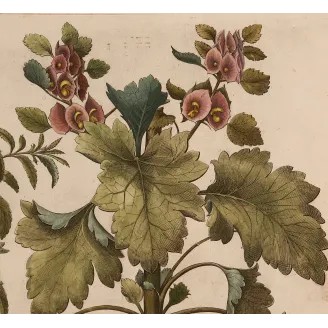
Original seventeenth-century hand-coloured botanical engraving depicting <em>Molucca Levis</em> and <em>Melissa Moldavica flor. albo</em>, from Basilius Besler’s monumental <em>Hortus Eystettensis</em>, published in 1613. The composition contrasts the slender architecture of the Melissa with the broad, sculptural foliage and distinctive pink-mauve flowers of the Molucca. Printed on substantial early laid paper with approximately 32 mm chain-line spacing and a visible, presently
Striped Orange Tree...
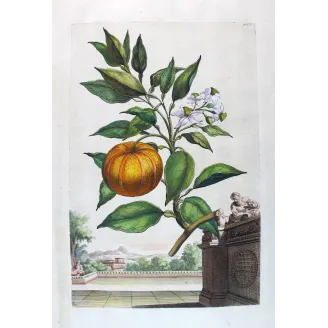
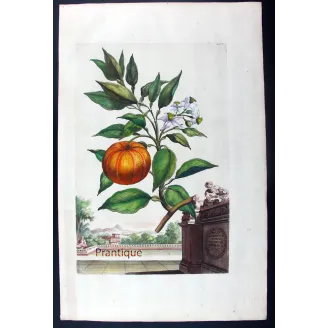
A rare 17th-century botanical engraving from Abraham Munting’s Nauwkeurige Beschryving der Aardgewassen - Phytographia Curiosa, featuring original contemporary hand-coloring and generous margins — a refined example of early botanical art where science, curiosity and decorative composition converge.
Purple Aloe (Aloe...
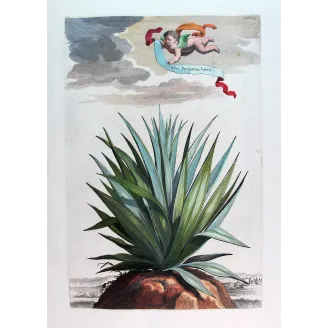
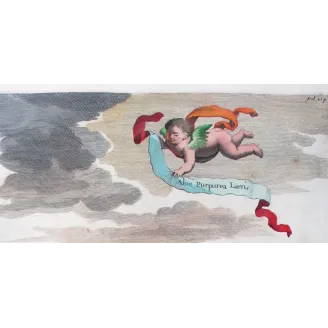
A striking 17th-century botanical engraving from Abraham Munting’s Nauwkeurige Beschryving der Aardgewassen - Phytographia Curiosa, depicting a monumental aloe with architectural structure and a decorative cartouche. A powerful example of early botanical art combining scientific observation with theatrical composition.
Spina Bifaria (Spina...
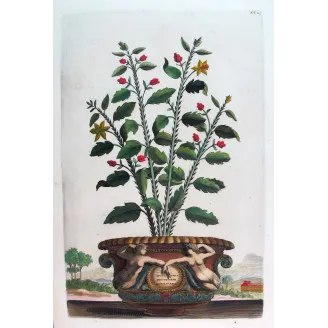
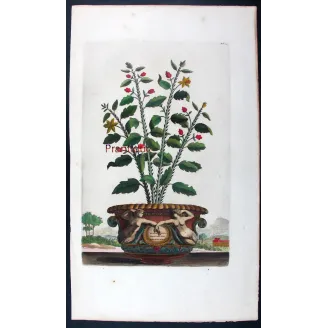
A refined 17th-century botanical engraving from Abraham Munting’s Nauwkeurige Beschryving der Aardgewassen - Phytographia Curiosa, depicting a flowering plant presented in an elaborate sculptural vessel with allegorical figures. A distinctive example of early botanical art where natural observation meets decorative imagination.
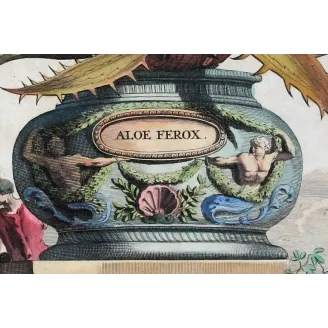

Aloe Ferox (Aloe...
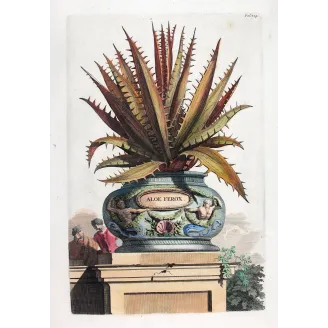
A striking 17th-century botanical engraving from Abraham Munting’s Nauwkeurige Beschryving der Aardgewassen, later known as Phytographia Curiosa, depicting Aloe ferox in an elaborate ornamental vase. A highly theatrical composition combining botanical rarity, sculptural form and strong decorative presence.