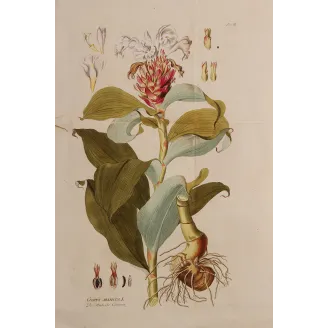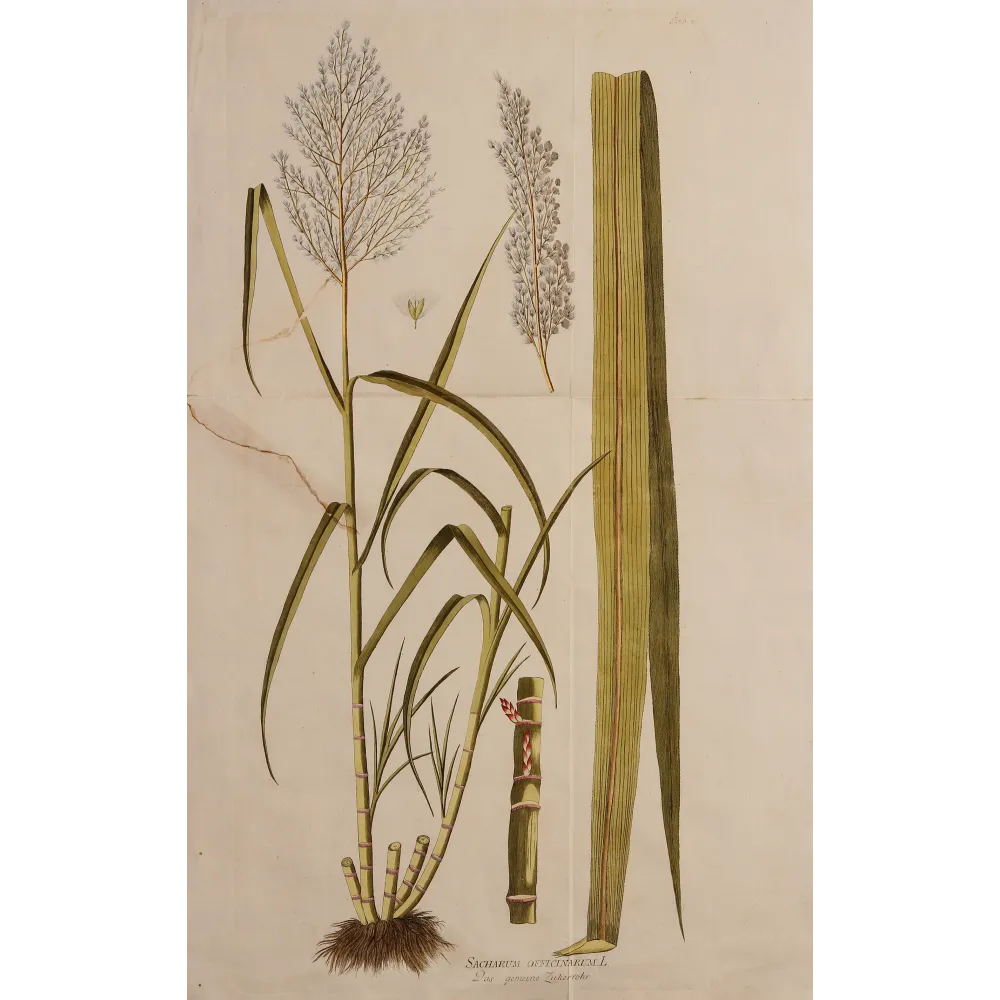
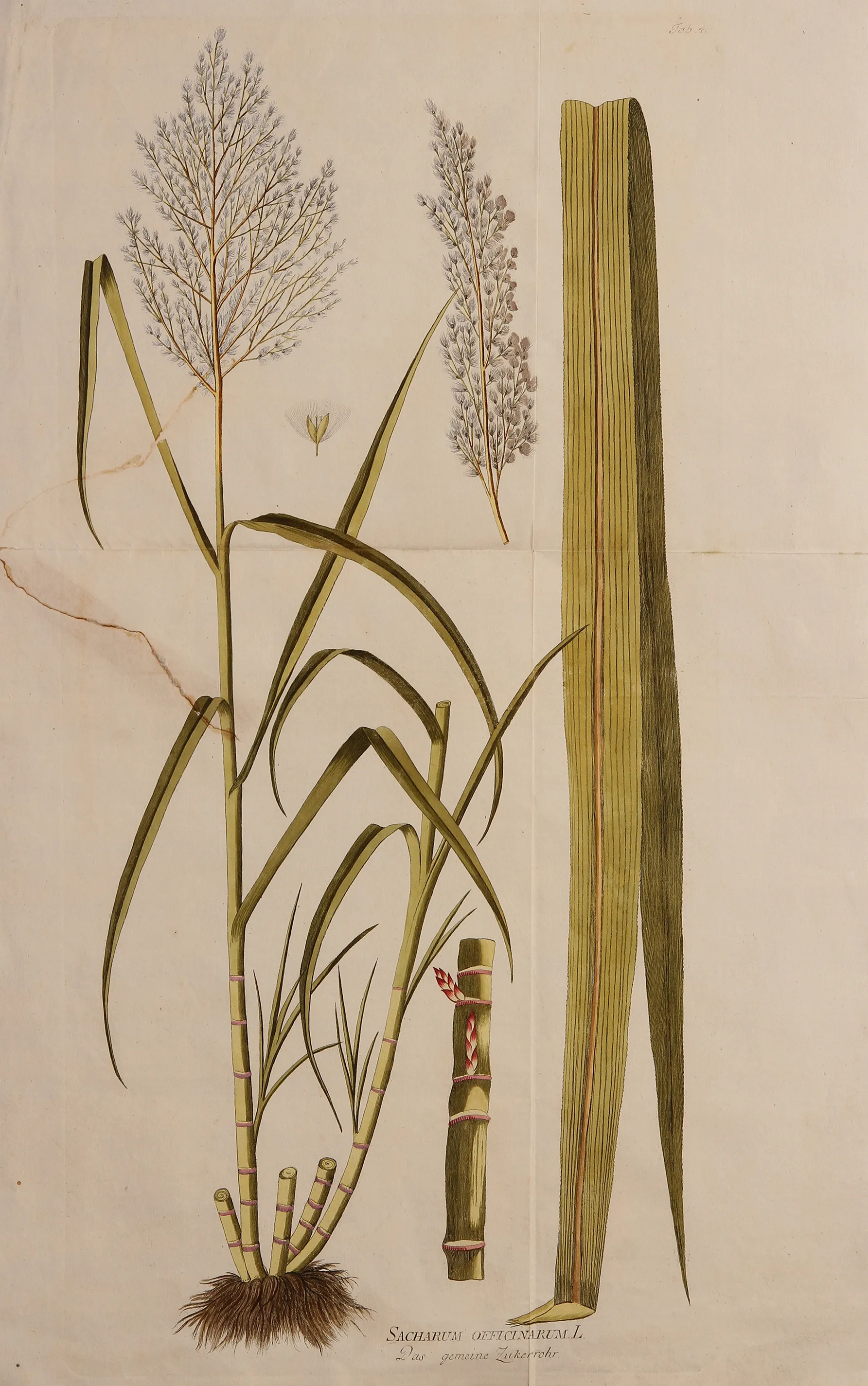
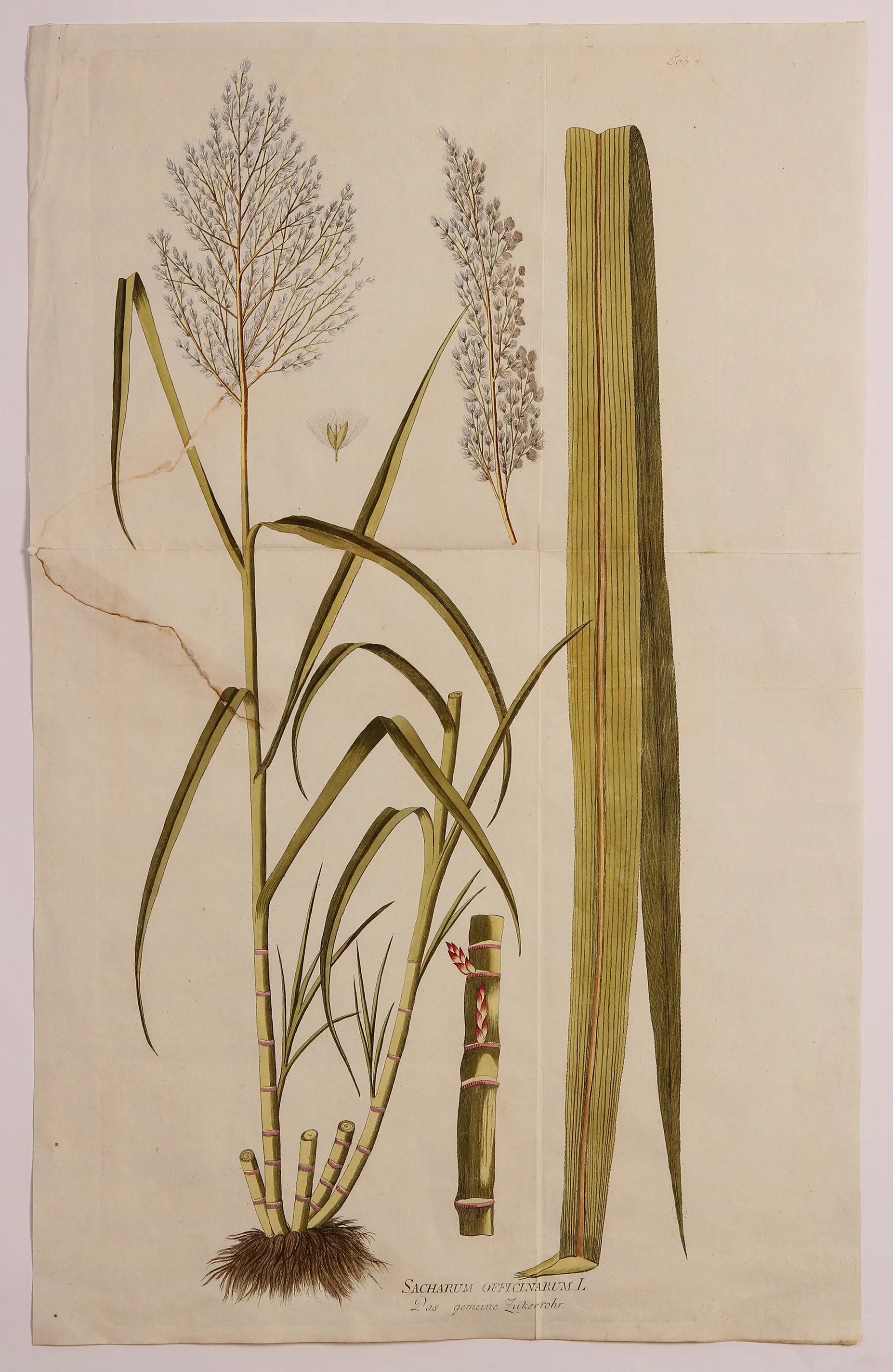
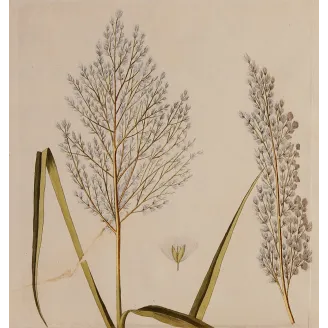
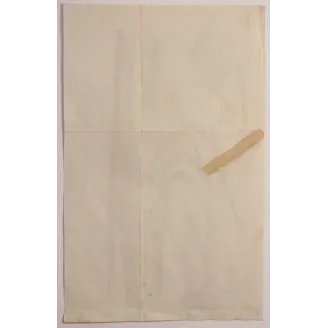
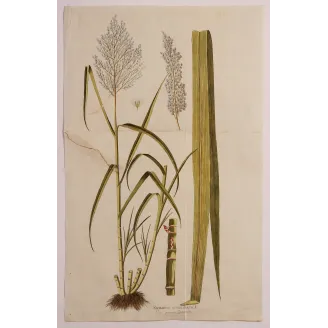
Exceptional large-format eighteenth-century botanical engraving depicting <em>Saccharum officinarum</em> L. (sugar cane), published as Plate 40 of Joseph Jacob von Plenck’s <em>Icones Plantarum Medicinalium</em>. Printed on a large folded sheet of laid paper with “IV” watermark and contemporary hand colouring, the composition combines the elegant vertical architecture of the cane with exceptionally delicate flowering panicles and a monumental isolated leaf. A distinctive Plenck Statement Piece preserving remarkable botanical clarity together with the visible material history of an eighteenth-century folded plate.
 Delivery policy
Your print will be carefully prepared and shipped worldwide via trusted couriers (UPS or similar).
 Authentic antique prints
Original engravings from the 17th–19th century.
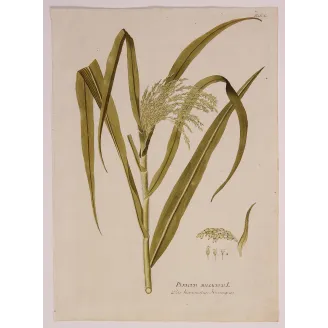
This exceptional large-format botanical engraving from Joseph Jacob von Plenck’s Icones Plantarum Medicinalium depicts Saccharum officinarum L., the sugar cane, published in Vienna during the late eighteenth century as Plate 40 of the first Centuria. Printed on an unusually large folded sheet measuring approximately 66.3 × 43.5 cm, the composition combines monumental vertical structure with remarkably delicate botanical detail.
Tall articulated canes rise from a compact root base and are accompanied by long curving leaves, two finely rendered flowering panicles and a monumental isolated leaf occupying the right side of the sheet. The result is unusually restrained for a plate of this scale: rather than filling the entire field, Plenck allows the plant to establish its presence through rhythm, proportion and open space.
The visual power of the engraving lies in this architectural economy: strong vertical stems, sweeping leaves and almost weightless flowering structures create a botanical image that is both scientifically precise and strikingly modern in its spatial organisation.
The composition develops primarily through vertical movement. Several segmented canes rise from the lower part of the sheet, their long stems interrupted by regularly spaced nodes and crossed by narrow leaves that curve outward in different directions.
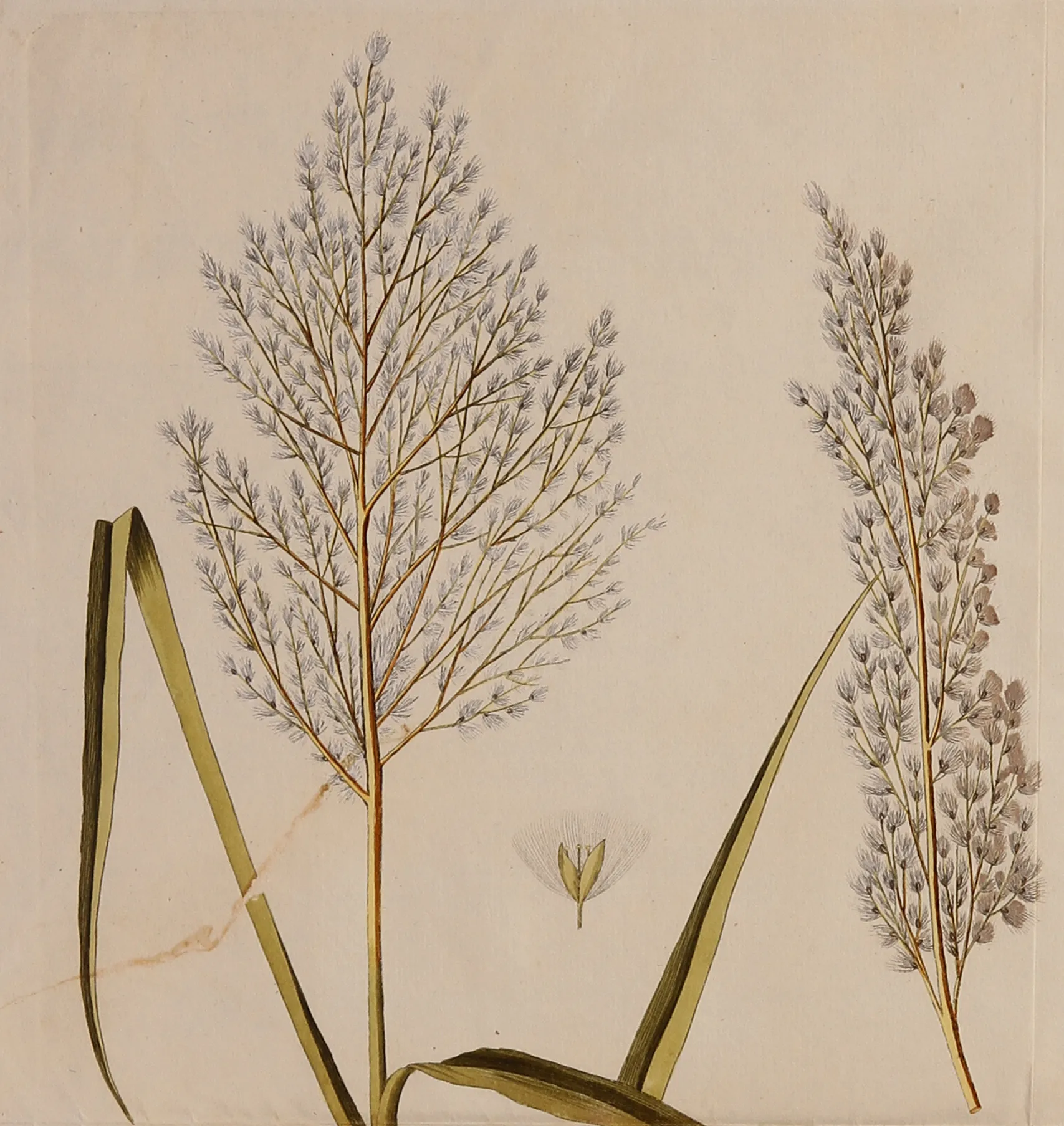
The principal flowering panicle on the left is extraordinarily delicate. Hundreds of fine branches spread outward from a slender central axis, producing a light, almost vaporous structure whose pale blue-grey and brown tones contrast with the denser greens of the stems and foliage below.
A second flowering structure, positioned slightly to the right, is shown in a more compact form. Its elongated profile creates a visual dialogue with the broader panicle beside it while extending the scientific description of the plant through comparison.
The isolated leaf on the right dominates the composition through scale and simplicity. Long, narrow and almost perfectly vertical, it is articulated by closely spaced engraved lines and a restrained olive-green wash. A warmer reddish central passage introduces a subtle chromatic accent without disturbing the disciplined linear structure.
Seen from across the room, this isolated leaf becomes almost abstract: a strong vertical form occupying a large expanse of open paper. At closer range, however, the engraved venation and carefully controlled contemporary colour reveal the botanical precision from which that apparent simplicity is constructed.
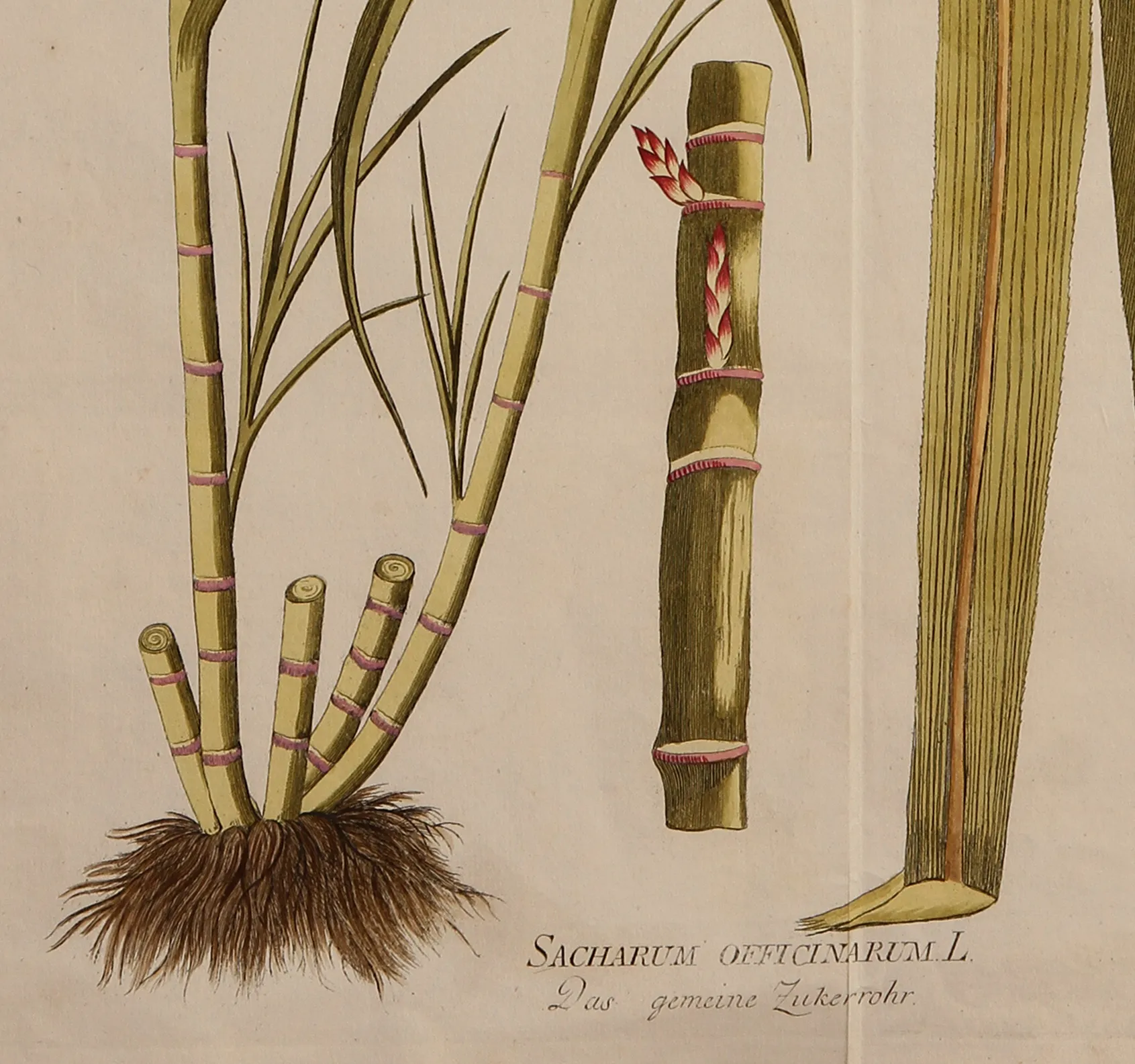
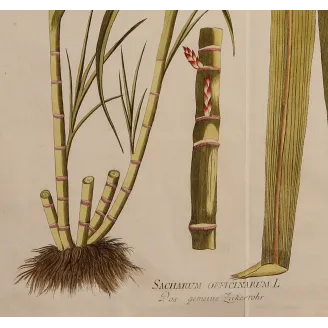
The lower portion of the composition is more compact. A small tuft of roots anchors the plant, while several segmented shoots rise upward in different stages of development. Pink and muted red accents mark the nodes and emerging structures, introducing controlled points of colour within the predominantly olive and brown palette.
The engraved line remains exceptionally disciplined throughout. It defines the longitudinal structure of the canes, the narrow foliage and the minute branching of the panicles without overwhelming the transparency of the hand-applied colour. The resulting image achieves scale without visual heaviness.
Saccharum officinarum L. is the cultivated sugar cane, a tall perennial grass belonging to the Poaceae. It develops robust jointed stems rich in sucrose, long narrow leaves and large terminal flowering panicles composed of numerous fine branches.
The species became one of the most economically important cultivated plants in global history. Its stems provided the raw material for sugar production, linking botanical cultivation with agriculture, commerce, colonial expansion, manufacturing and changing patterns of consumption.
For eighteenth-century botanical and medicinal study, the plant was significant not simply as an agricultural commodity but as a clearly defined botanical organism. Plenck therefore records its articulated stems, leaves, flowering structures and root base with the same systematic attention applied throughout Icones Plantarum Medicinalium.
The engraving should be understood within the scientific and pharmacological framework of the late eighteenth century. It documents the historical study of an economically and culturally important plant rather than providing modern medicinal guidance.
Joseph Jacob von Plenck conceived Icones Plantarum Medicinalium as a union of botanical instruction and refined artistic presentation. Plants were isolated against the open sheet and represented through the structures necessary for recognition, while fine copper engraving and contemporary hand colouring gave the images exceptional visual clarity.
Plate 40 demonstrates how effectively that programme could operate through restraint. Among Plenck’s large folded plates, the visual power of the Sugar Cane lies not in botanical abundance but in the controlled relationship between long articulated stems, narrow curving leaves and two extraordinarily delicate flowering panicles.
The substantial folded sheet gives these elements room to remain distinct. The flowering structures occupy the upper field without congestion, while the vertical canes rise through broad areas of open paper. Negative space becomes an active part of the composition, increasing both scientific legibility and visual impact.
The monumental isolated leaf on the right is especially striking. Its scale, simplicity and strongly linear surface give it an almost architectural character. Viewed from a distance it reads as a powerful vertical form; examined closely, it resolves into hundreds of controlled engraved lines beneath transparent contemporary colour.
The flowering panicles operate in the opposite manner. Their branching structures are among the lightest elements in the image, formed through extremely fine engraving and restrained washes. This contrast between the visual weight of the leaf and the near-weightlessness of the flowers gives the plate much of its distinctive rhythm.
The segmented stems provide the structural link between these extremes. Their repeated nodes introduce order and proportion, while small pink and reddish accents at selected points prevent the predominantly olive composition from becoming monochromatic.
At approximately 66.3 × 43.5 cm, the original eighteenth-century sheet possesses a scale rarely encountered in botanical engraving. Plenck does not use that surface simply to enlarge the plant; he uses it to preserve relationships between height, botanical structure and analytical clarity that would have been difficult to maintain within a conventional folio.
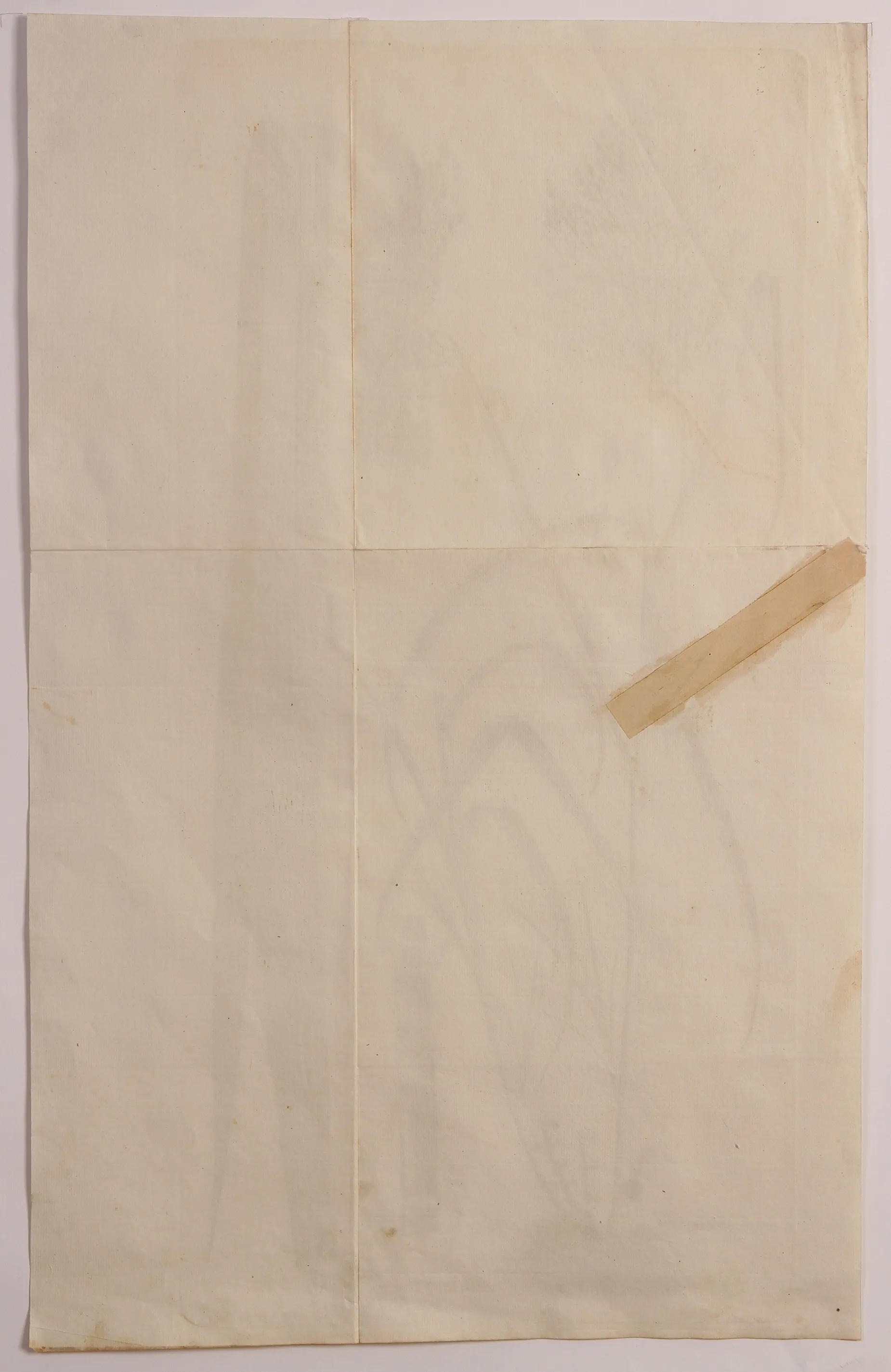
Original folds and historical repairs remain visible within the sheet. Rather than being concealed, these traces are documented as part of the physical history of a large-format work conceived to be folded, opened and consulted within an eighteenth-century botanical volume.
They coexist with an engraving whose botanical line and contemporary colour remain remarkably clear. The result is a surviving object in which scientific image, handmade paper and evidence of historical handling continue to be read together.
For the contemporary collector, the plate possesses an additional spatial quality. Its scale and unusually economical composition allow it to function convincingly as a major work within a substantial interior without altering or enlarging the original historical object.
For this reason, this work forms part of Prantique’s Statement Pieces — a curated selection of original antique prints distinguished by their exceptional scale and presence within contemporary interiors.
The engraving is printed on a large sheet of fine eighteenth-century laid paper. Closely spaced laid lines and broader chain lines belong to the physical structure of the handmade sheet and may become visible when examined in transmitted or raking light.
An “IV” watermark is preserved within this impression. Comparable lettered marks occur on other surviving plates from Plenck’s publication and provide useful material evidence for the paper used in the production of Icones Plantarum Medicinalium.
Unlike the standard-format plates within the work, this engraving was produced on an unusually large sheet designed to be folded for incorporation within the original volume. The historical vertical and horizontal folding structure remains clearly visible and forms an intrinsic part of the physical identity of the object.
When unfolded, the sheet measures approximately 66.3 × 43.5 cm. The expanded surface permits the long canes, extensive foliage and flowering structures to retain their natural visual proportions while remaining surrounded by generous areas of open paper.
The plate mark remains visible around the engraved field. Together with the “IV” watermark, laid structure, original folds and documented historical repair, it provides a detailed material record of the engraving’s eighteenth-century production, use and preservation.
Published in Vienna from 1788, Joseph Jacob von Plenck’s Icones Plantarum Medicinalium belongs to the great illustrated botanical projects of the European Enlightenment. It was intended to provide physicians, apothecaries and students with clear visual references for recognising plants associated with historical medicinal practice.
Each image was printed from a finely engraved copperplate and subsequently coloured by hand. Every surviving impression therefore combines the repeatable precision of printmaking with the individual judgement and craftsmanship of an eighteenth-century colourist.
Large folded plates such as this Saccharum officinarum reveal an especially ambitious aspect of Plenck’s publication. The expanded sheet allowed the height, foliage and flowering structures of a substantial plant to be represented without sacrificing clarity or proportion.
Sugar cane also connects this scientific image with a much broader history of cultivation, global commerce and material culture. A botanically restrained engraving therefore records a plant whose historical significance extended far beyond the boundaries of medicinal botany.
The “IV” watermark, original folding structure and documented historical repair further preserve the physical history of the object itself, linking the botanical image to eighteenth-century papermaking, printing, binding and subsequent preservation.
Discover how botanical observation, handmade paper, copper engraving and contemporary colour came together in Plenck’s remarkable visual encyclopaedia.
Excellent condition, with documented historical paper repair. The large eighteenth-century laid sheet remains visually strong and presents the botanical composition with exceptional clarity. The engraved impression retains excellent definition throughout the articulated canes, foliage, flowering panicles and root structures.
The contemporary hand colouring is beautifully preserved. Olive and green tones remain clear throughout the stems and leaves, while muted red and pink accents continue to articulate the nodes and developing shoots. The delicate blue-grey and brown passages of the flowering panicles retain their remarkable fineness.
The original vertical and horizontal folds associated with the large folded format remain clearly visible. These historical structural features result from the way the oversized plate was folded for incorporation within the original volume and form part of the material identity of the sheet.
Historical tears and an earlier paper repair are present, with the principal stabilising intervention clearly visible on the verso and locally perceptible on the recto. The repair does not materially compromise the botanical composition or its overall visual presentation.
Minor additional age-related traces are present and remain consistent with the history of an exceptionally large eighteenth-century folded plate. These material characteristics are documented rather than concealed and should be considered part of the physical history of the surviving sheet.
The “IV” watermark remains preserved, and the plate mark is visible around the engraved field. Overall, the impression combines excellent visual presentation, beautifully preserved contemporary colour and substantial evidence of its original paper structure and historical use. Please examine the professional high-resolution photographs of both recto and verso for a complete visual assessment.
Botanical name: Saccharum officinarum L.
Common name: Sugar Cane
German title: Das gemeine Zuckerrohr
Work: Icones Plantarum Medicinalium
Author: Joseph Jacob von Plenck (1735–1807)
Artistic tradition: Viennese botanical school
Place of publication: Vienna
Date: c. 1788
Technique: Original copper engraving with contemporary hand-applied watercolour
Paper: Fine eighteenth-century laid paper
Watermark: “IV” watermark
Plate mark: Visible around the engraved field
Plate: 40
Centuria: I
Historical classification: Classis III. Triandria — Ordo II. Digynia
Plant family: Poaceae
Sheet format: Large folded botanical plate
Sheet size: approx. 66.3 × 43.5 cm
Condition: Excellent condition, with original historical folds and documented historical paper repair visible principally on the verso and locally perceptible on the recto
Curatorial classification: Statement Piece
Collector positioning: Exceptional large-format Plenck engraving distinguished by its monumental vertical composition, delicately rendered flowering panicles, “IV” watermark and documented material history
Authenticity: Original eighteenth-century print — never a modern reproduction
```
Specific References
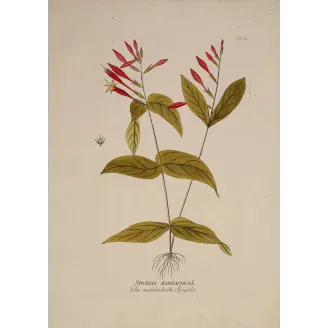
Original eighteenth-century botanical engraving depicting Spigelia marilandica L., published in Vienna as Plate 89 of Joseph Jacob von Plenck's Icones Plantarum Medicinalium. The elegant composition is distinguished by its graceful vertical rhythm, brilliant scarlet tubular flowers and refined contemporary hand colouring on fine laid paper.
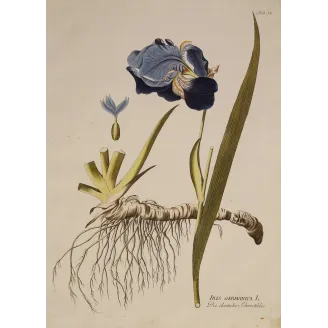
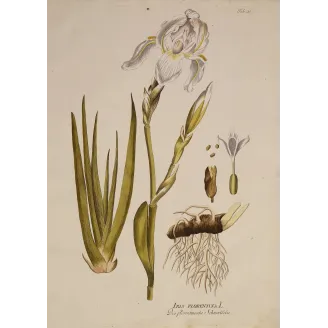
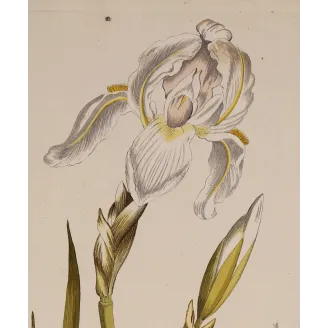
An original eighteenth-century botanical engraving depicting Iris germanica, published in Joseph Jacob von Plenck's celebrated Icones Plantarum Medicinalium. Printed on fine laid paper bearing the Honig watermark, the sheet combines scientific precision with the refined artistic craftsmanship of the Viennese botanical school.
A complete four-plate botanical study devoted to the genus <em>Salvia</em>, preserved exactly as originally published within Joseph Jacob von Plenck's <em>Icones Plantarum Medicinalium</em>. Combining remarkable scientific integrity with exceptional decorative harmony, this Museum Quality Study Set represents one of the most visually refined surviving botanical sequences of the late eighteenth century.
Seven-plate botanical corpus devoted to Europe's principal cereal crops, preserved exactly as originally published in Joseph Jacob von Plenck's Icones Plantarum Medicinalium. Combining scientific precision, historical significance and remarkable visual harmony, this Museum Quality Study Set documents the plants that shaped European agriculture and civilisation.
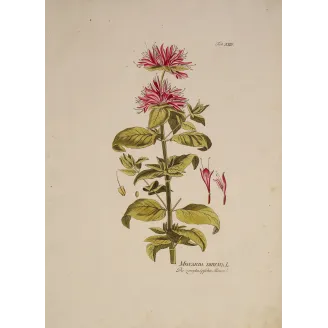
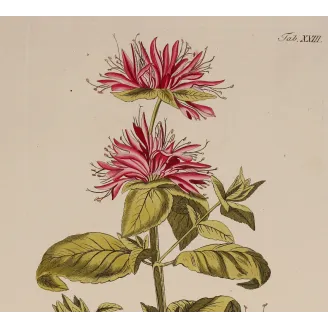
Original eighteenth-century botanical engraving depicting Monarda didyma L., published in Vienna as Plate XXIII of Joseph Jacob von Plenck's Icones Plantarum Medicinalium. This refined composition combines elegant vertical balance, delicate crimson flowers and beautifully preserved contemporary hand colouring on Honig laid paper with complete watermark.
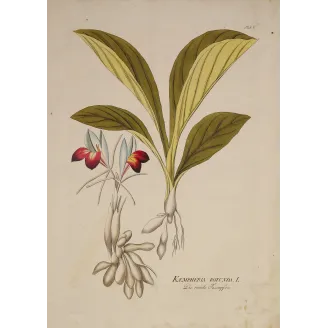
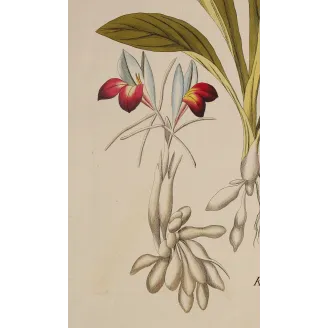
Original eighteenth-century botanical engraving depicting Kaempferia rotunda, published in Vienna by Joseph Jacob von Plenck for Icones Plantarum Medicinalium (Plate 5). The elegant composition combines broad architectural foliage, richly coloured crimson flowers and delicately modelled underground tubers, demonstrating the extraordinary refinement of Plenck's Viennese botanical school. Printed on fine Honig laid paper with visible "IV" watermark.
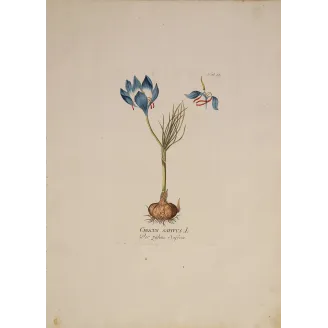
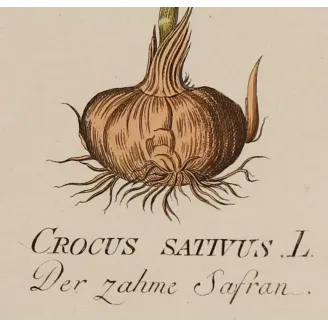
Original eighteenth-century botanical engraving depicting Crocus sativus L., the true saffron crocus, published in Vienna as Plate 32 of Joseph Jacob von Plenck's Icones Plantarum Medicinalium. This elegant composition celebrates one of history's most valuable medicinal and culinary plants through refined hand colouring, exceptional botanical clarity and beautifully preserved eighteenth-century laid paper.
An elegant original botanical engraving depicting Iris florentina, delicately hand-coloured and published by Joseph Jacob von Plenck around 1788. Printed on original laid paper with visible plate mark and exceptionally refined colouring.
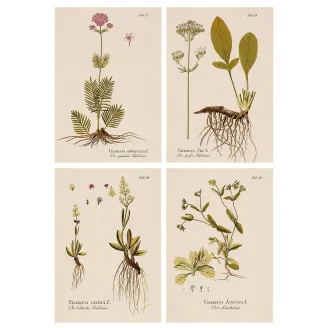
A complete four-plate botanical study devoted to the genus Valeriana, preserved exactly as originally published by Joseph Jacob von Plenck in Icones Plantarum Medicinalium. This Museum Quality Study Set combines scientific integrity, exceptional preservation and remarkable decorative harmony, offering collectors and interior designers an increasingly rare opportunity to acquire an intact eighteenth-century botanical sequence.
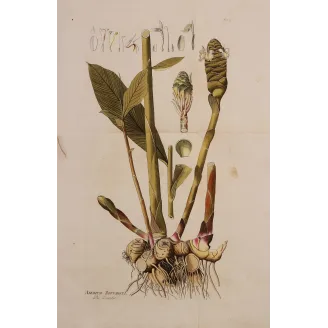
Exceptional large-format eighteenth-century botanical engraving depicting <em>Amomum Zerumbet</em> L., published as Plate II of Joseph Jacob von Plenck’s <em>Icones Plantarum Medicinalium</em>. Printed on a large folded sheet of Honig laid paper with complete watermark and contemporary hand colouring, the composition combines monumental rhizomatous structures, tall architectural stems and precisely observed analytical details. A rare large-scale Plenck Statement Piece with remarkable historical and visual presence.
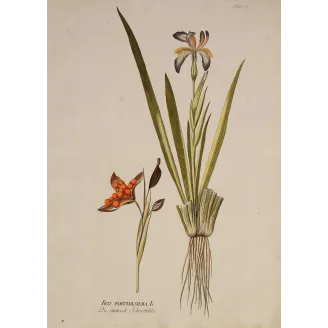
Original eighteenth-century botanical engraving depicting Iris foetidissima (Stinking Iris), published in Vienna by Joseph Jacob von Plenck for Icones Plantarum Medicinalium (Plate 37). Finely engraved and beautifully hand-coloured, the composition illustrates the flowering plant together with its open seed capsule and brilliant orange seeds, combining scientific precision with exceptional decorative elegance. Printed on fine laid Honig paper with visible "IV" watermark and excellent contemporary hand colouring.
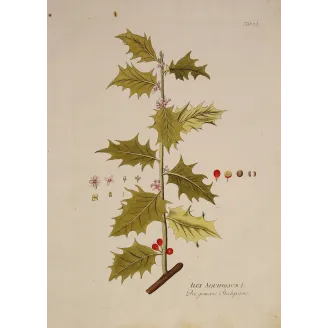
Original eighteenth-century botanical engraving depicting Ilex aquifolium L., the common holly, published in Vienna as Plate 72 of Joseph Jacob von Plenck’s Icones Plantarum Medicinalium. The composition combines sharply articulated evergreen foliage, delicate pink flowers, brilliant red fruits and separate botanical details, preserved on fine laid paper with a visible partial “IV” watermark.
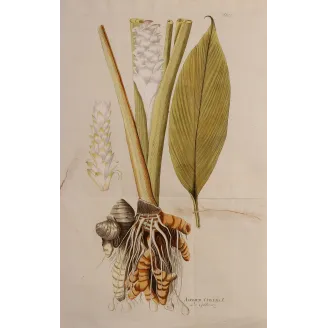
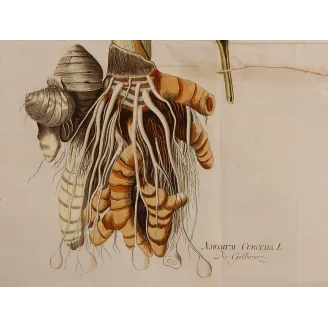
Exceptional large-format eighteenth-century botanical engraving depicting <em>Amomum Curcuma</em> L., published as Plate IV of Joseph Jacob von Plenck’s <em>Icones Plantarum Medicinalium</em>. Printed on a large folded sheet of Honig laid paper with complete watermark and contemporary hand colouring, the composition combines a remarkably refined pale inflorescence, monumental foliage and an exceptionally detailed rhizomatous structure. A powerful Plenck Statement Piece preserving both extraordinary botanical clarity and the visible material history of an eighteenth-century folded plate.
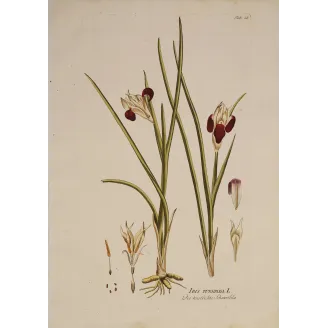
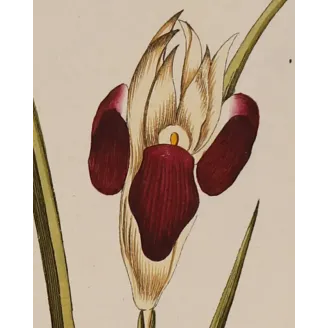
Original eighteenth-century botanical engraving depicting Iris tuberosa (Snake's Head Iris), published in Vienna by Joseph Jacob von Plenck for Icones Plantarum Medicinalium (Plate 38). This elegant composition combines two flowering specimens with finely engraved botanical details and a beautifully preserved complete Honig watermark. Contemporary hand colouring and selective gum arabic produce remarkable depth, while the velvety deep burgundy petals create one of the most refined colour harmonies within Plenck's celebrated Iris series.
Exceptional large-format eighteenth-century botanical engraving depicting <em>Costus arabicus</em> L., published as Plate VII of Joseph Jacob von Plenck’s <em>Icones Plantarum Medicinalium</em>. Printed on an unusually large folded sheet measuring 66.3 × 43.5 cm, the composition combines a monumental flowering specimen, extensive root and rhizome structures and finely observed botanical details with beautifully preserved contemporary hand colouring. Complete Honig watermark with logo.
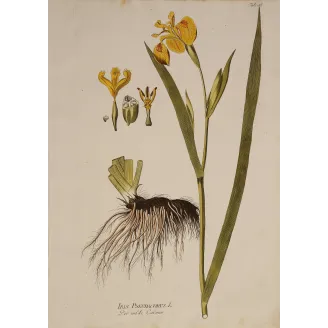
Original hand-coloured copper engraving depicting the Yellow Flag Iris (Iris pseudacorus), published by Joseph Jacob von Plenck in Vienna around 1788 for Icones Plantarum Medicinalium. A refined eighteenth-century botanical illustration distinguished by its elegant composition, beautifully engraved rhizome, luminous yellow flower, selective gum arabic highlights and excellent state of preservation.
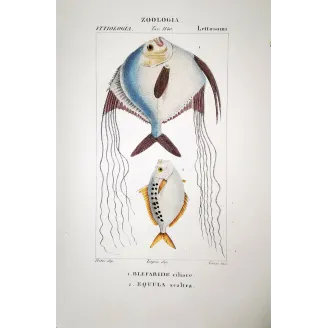
Delicate 19th-century hand-colored engraving of a ponyfish with companion species, ideal for marine-themed interiors and collectors.
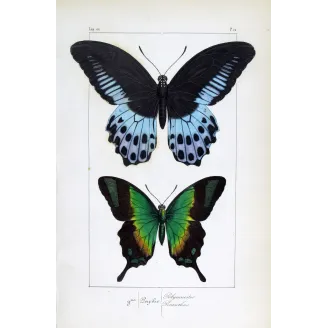
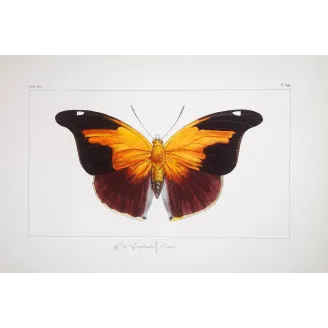
Original 1835 hand-colored engraving of Nymphalis orion, drawn and engraved by Pauquet under the scientific direction of Hippolyte Lucas for Exotic Butterflies.
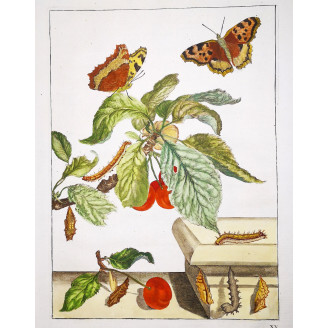
Original 1774 engraving by Jacob L'Admiral: Large Tortoiseshell on Sweet Cherry.
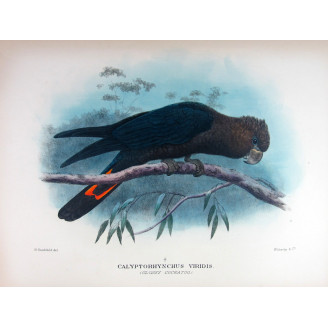
Glossy Cockatoo print by H. Goodchild, dark tones and rare presence on the plate
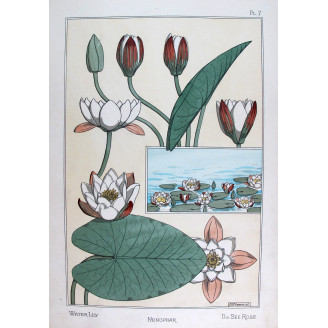
This second edition of the Water-Lily plate (No. 7) captures all the refined serenity of Plate 9, with slight variations in layout and ornamental balance.
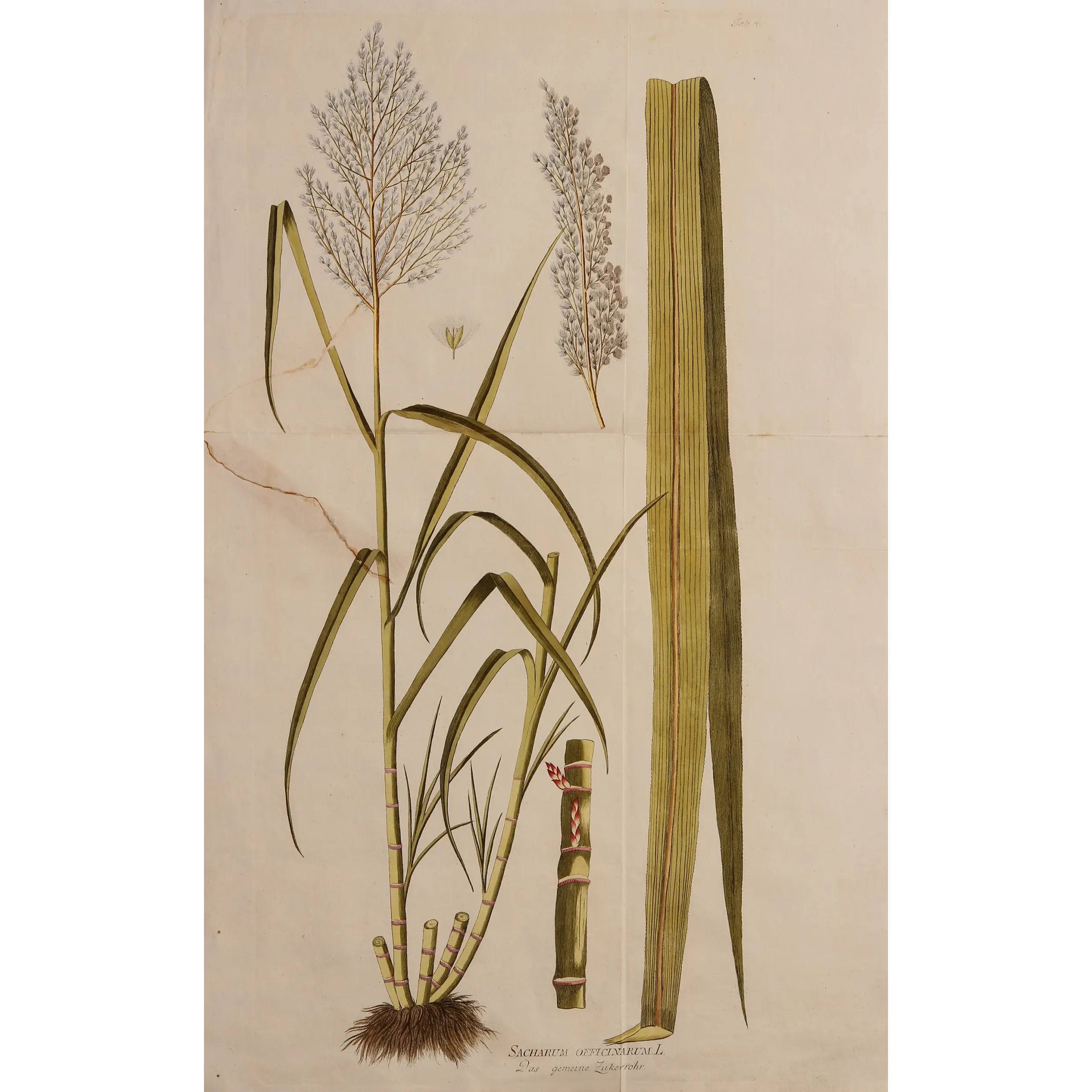
Exceptional large-format eighteenth-century botanical engraving depicting <em>Saccharum officinarum</em> L. (sugar cane), published as Plate 40 of Joseph Jacob von Plenck’s <em>Icones Plantarum Medicinalium</em>. Printed on a large folded sheet of laid paper with “IV” watermark and contemporary hand colouring, the composition combines the elegant vertical architecture of the cane with exceptionally delicate flowering panicles and a monumental isolated leaf. A distinctive Plenck Statement Piece preserving remarkable botanical clarity together with the visible material history of an eighteenth-century folded plate.