- New
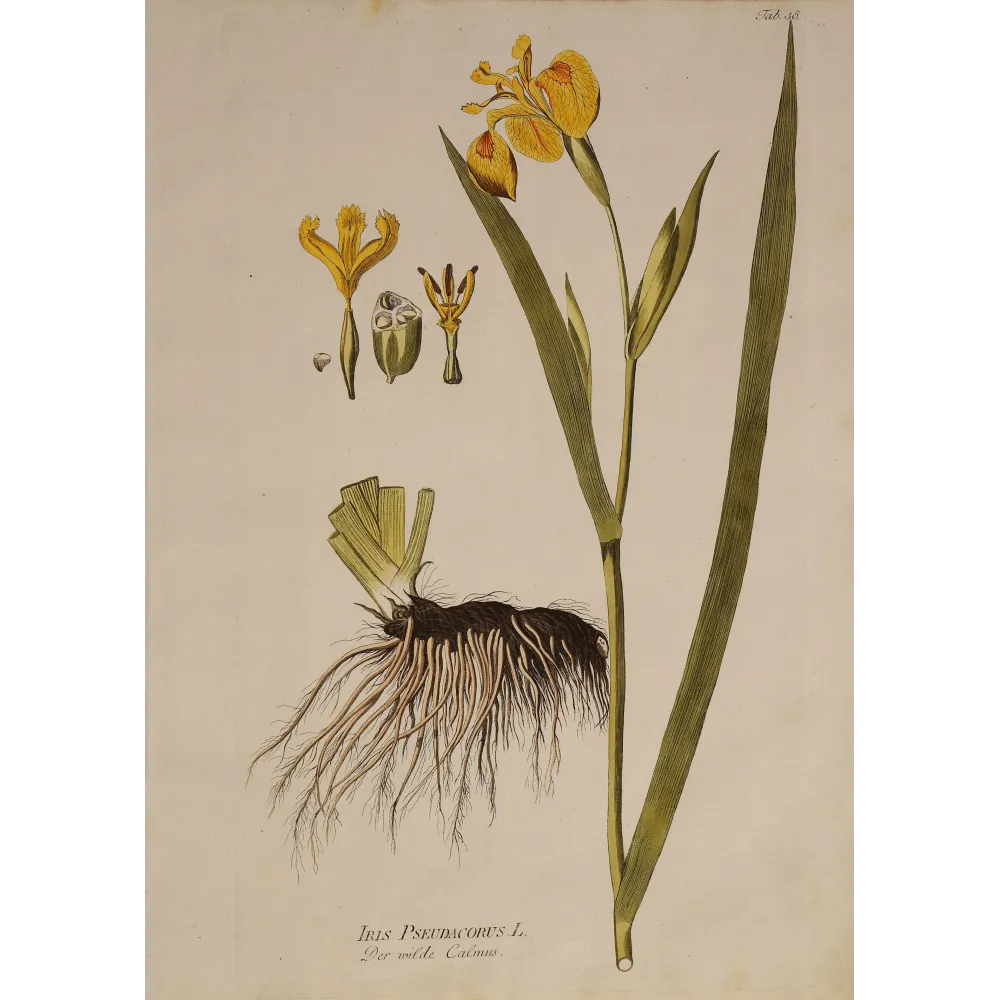
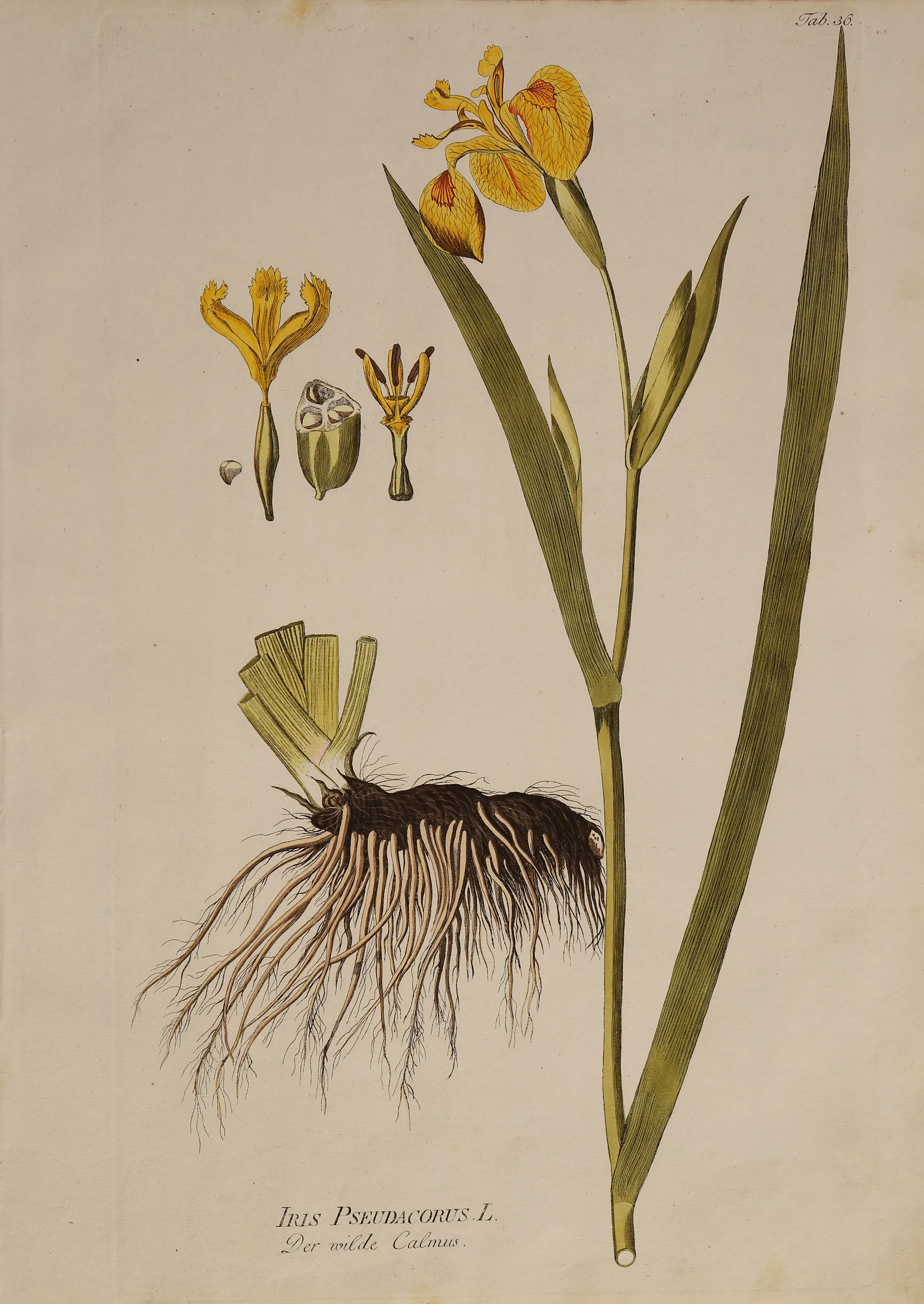
Original hand-coloured copper engraving depicting the Yellow Flag Iris (Iris pseudacorus), published by Joseph Jacob von Plenck in Vienna around 1788 for Icones Plantarum Medicinalium. A refined eighteenth-century botanical illustration distinguished by its elegant composition, beautifully engraved rhizome, luminous yellow flower, selective gum arabic highlights and excellent state of preservation.
 Delivery policy
Your print will be carefully prepared and shipped worldwide via trusted couriers (UPS or similar).
 Authentic antique prints
Original engravings from the 17th–19th century.
This exceptional original hand-coloured engraving from Joseph Jacob von Plenck’s Icones Plantarum Medicinalium depicts Iris pseudacorus L., commonly known as the Yellow Flag Iris. Published in Vienna during the late eighteenth century as Plate 36, the image presents the flowering plant together with its long sword-shaped leaves, branching stem, buds, rhizome, fibrous roots and separate botanical details.
Nothing has been included solely for decoration. Flower, foliage, underground structures and analytical elements are arranged as parts of a complete botanical description, allowing the species to be recognised through its natural form, colour and proportions. Yet scientific purpose never diminishes the beauty of the image. Through disciplined engraving and luminous hand colouring, the brilliant yellow iris becomes both an instrument of knowledge and an accomplished work of botanical art.
Icones Plantarum Medicinalium is one of the rare eighteenth-century botanical atlases in which scientific precision and decorative elegance exist in perfect balance.
The composition rises from the dense horizontal structure of the rhizome towards the open yellow flower at the summit of the sheet. The underground parts create a firm visual foundation, while the tall stems and blade-like leaves lead the eye upward through the generous white space surrounding the specimen.
The flower provides the principal focus. Transparent washes of lemon yellow, warm ochre and restrained orange describe the folded petals, with deeper tones concentrated in the descending falls and recessed areas. The colour remains luminous because it does not conceal the engraved framework beneath. Rather than appearing heavy or opaque, the blossom seems to gather and reflect light.
The long leaves and branching stems are rendered in carefully modulated greens. Their quieter tonal range balances the intensity of the flower and reinforces the vertical rhythm of the image. Closed and partially opened buds introduce different stages of development, allowing the plant to be read not as a static ornament but as a living botanical organism.
The engraved line is used with exceptional discipline. Fine marks establish the contours, veins and structural folds of the plant, becoming denser only where greater definition is scientifically necessary. Stronger hatching models the segmented rhizome and fibrous roots, while lighter lines preserve the delicacy of the petals and foliage.
Separate floral and reproductive details appear beside the principal specimen. These analytical elements permit closer examination of individual structures without interrupting the balance of the composition, revealing how naturally scientific explanation and artistic clarity coexist throughout the plate.
Iris pseudacorus is a vigorous rhizomatous perennial native to wetlands, riverbanks, marshes and the margins of ponds across Europe, western Asia and North Africa. It is readily recognised by its tall sword-shaped leaves and brilliant yellow flowers, whose upright standards and descending falls create the characteristic architecture of the iris family.
The species grows in close relationship with water. Its substantial creeping rhizome anchors the plant in saturated ground and allows it to spread through dense colonies. Plenck therefore gives the underground structure considerable prominence, recording its segmented form, emerging roots and direct relationship with the foliage and flowering stems above.
Within an eighteenth-century work devoted to medicinal plants, such completeness had practical importance. Physicians, apothecaries, botanists and students needed to recognise a species from more than the appearance of its flower. Leaves, roots, rhizomes, buds and reproductive structures all contributed to dependable identification.
Historically, the rhizome was included in medicinal and practical traditions, although the plant is now known to contain irritating compounds and should not be treated as a harmless domestic remedy. Its inclusion in Plenck’s atlas belongs to the history of botanical medicine rather than to modern therapeutic guidance.
In the preface to Icones Plantarum Medicinalium, Joseph Jacob von Plenck set out an ambitious objective: plants were to be represented accurately from life, preserving their natural size, colour and proportions so that the illustrations could support reliable scientific identification.
Plenck also made clear that accuracy alone was not sufficient. The elegance of the paper, the quality of the drawings and the refinement of the hand colouring were essential features of the publication. Knowledge and beauty were therefore conceived not as separate aims, but as complementary parts of the same botanical project.
This engraving of Iris pseudacorus fulfils that programme with exceptional clarity. The brilliant flower attracts immediate attention, yet the image steadily redirects the eye towards the complete structure of the plant: its leaves, branching stem, developing buds, articulated rhizome and fibrous roots.
The artists of the Viennese botanical school positioned the specimen with precision within the open sheet. Each structure remains legible, while the surrounding white space gives the composition an almost architectural clarity. The plant appears tall and vigorous without becoming crowded or theatrical.
The copper engraving acts as a delicate underlying framework. Across the petals and leaves, the line remains light and restrained, allowing transparent hand-applied watercolour to establish much of the volume and natural character. Denser hatching is reserved for the rhizome and roots, where texture and structural complexity require firmer definition.
The contemporary colouring is particularly effective in the yellow flower. Thin layers of pigment create gradual transitions from pale lemon to warm golden tones without masking the engraved detail. The restrained greens of the foliage and the earthier colours of the rhizome keep the blossom visually connected to the complete plant.
Viewed from a distance, the plate has immediate decorative strength; examined closely, it reveals a highly disciplined collaboration between engraver, printer and colourist. Its beauty is not added to the science afterwards. It emerges directly from the clarity with which the plant has been understood and represented.
The engraving is printed on fine eighteenth-century laid paper of the type associated with the Dutch Honig papermaking tradition. Closely spaced laid lines and broader chain lines remain part of the physical structure of the sheet and can be observed most clearly in transmitted light.
Honig papers were widely valued in European publishing for their strength, clean surface and ability to receive both a sharply impressed copperplate image and transparent hand-applied colour. Their presence within Plenck’s atlas reflects the exceptional material standards established for the publication.
A complete watermark or countermark is not always contained within an individual folio sheet, since the original papermaker’s mark could be divided when the larger mould-made sheet was cut or folded. The absence of a complete readable device therefore does not diminish the material relationship with the wider Honig paper group documented across surviving plates from the work.
The preserved plate mark records the pressure of the copperplate during printing and confirms the original intaglio process. Together with the laid paper, hand colouring and natural ageing of the sheet, it forms an essential part of the engraving’s authenticity and historical character.
Published in Vienna from 1788, Joseph Jacob von Plenck’s Icones Plantarum Medicinalium represents one of the Enlightenment’s most ambitious botanical publishing projects. Conceived for physicians, apothecaries and students, it joined Linnaean classification with the refined visual culture of the Viennese botanical school.
Each image was printed from a finely engraved copperplate and subsequently coloured by hand. Every surviving impression therefore combines mechanical precision with individual craftsmanship, making each sheet subtly unique through the decisions of its colourist.
Complete examples of the atlas are considerably less common than many nineteenth-century botanical works. Individual plates are now valued both as historical documents of medicinal botany and as visually accomplished works capable of standing independently within a refined interior.
Discover how scientific observation, natural scale, fine paper, copper engraving and hand colouring came together in Plenck’s botanical masterpiece.
Very good condition. The original late eighteenth-century laid paper remains structurally sound and presents with strong printing definition and fresh, luminous hand colouring. The yellow flower retains excellent transparency and tonal variation, while the engraved details remain clear throughout the plant.
The sheet shows only light historical traces consistent with its age and authentic handling. No significant damage affects the botanical image or its overall presentation. The plate mark and generous margins remain important evidence of the original copperplate printing process. Please examine the professional high-resolution photographs for a complete visual assessment.
Botanical name: Iris pseudacorus L.
Common name: Yellow Flag Iris
German title: Der wilde Calmus
Work: Icones Plantarum Medicinalium
Author: Joseph Jacob von Plenck (1735–1807)
Artistic tradition: Viennese botanical school
Place of publication: Vienna
Date: c. 1788
Technique: Original copper engraving with contemporary hand-applied watercolour
Paper: Fine eighteenth-century laid paper associated with the Honig papermaking tradition
Plate mark: Preserved
Plate: 36
Plant family: Iridaceae
Sheet size: approx. 44 × 33 cm
Condition: Very good condition
Authenticity: Original eighteenth-century print — never a modern reproduction
Specific References
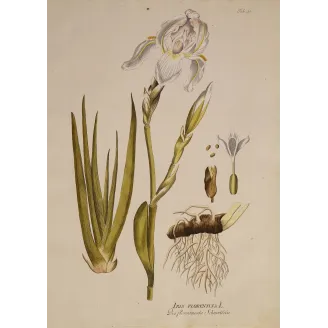
An elegant original botanical engraving depicting Iris florentina, delicately hand-coloured and published by Joseph Jacob von Plenck around 1788. Printed on original laid paper with visible plate mark and exceptionally refined colouring.
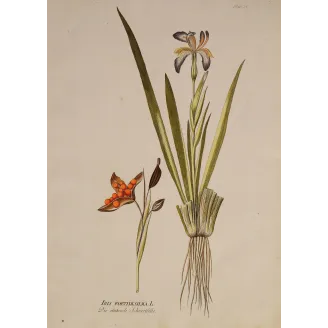
Original eighteenth-century botanical engraving depicting Iris foetidissima (Stinking Iris), published in Vienna by Joseph Jacob von Plenck for Icones Plantarum Medicinalium (Plate 37). Finely engraved and beautifully hand-coloured, the composition illustrates the flowering plant together with its open seed capsule and brilliant orange seeds, combining scientific precision with exceptional decorative elegance. Printed on fine laid Honig paper with visible "IV" watermark and excellent contemporary hand colouring.
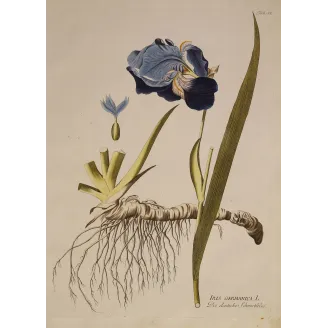
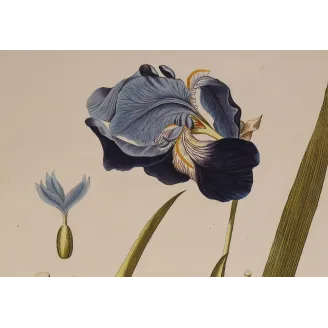
An original eighteenth-century botanical engraving depicting Iris germanica, published in Joseph Jacob von Plenck's celebrated Icones Plantarum Medicinalium. Printed on fine laid paper bearing the Honig watermark, the sheet combines scientific precision with the refined artistic craftsmanship of the Viennese botanical school.
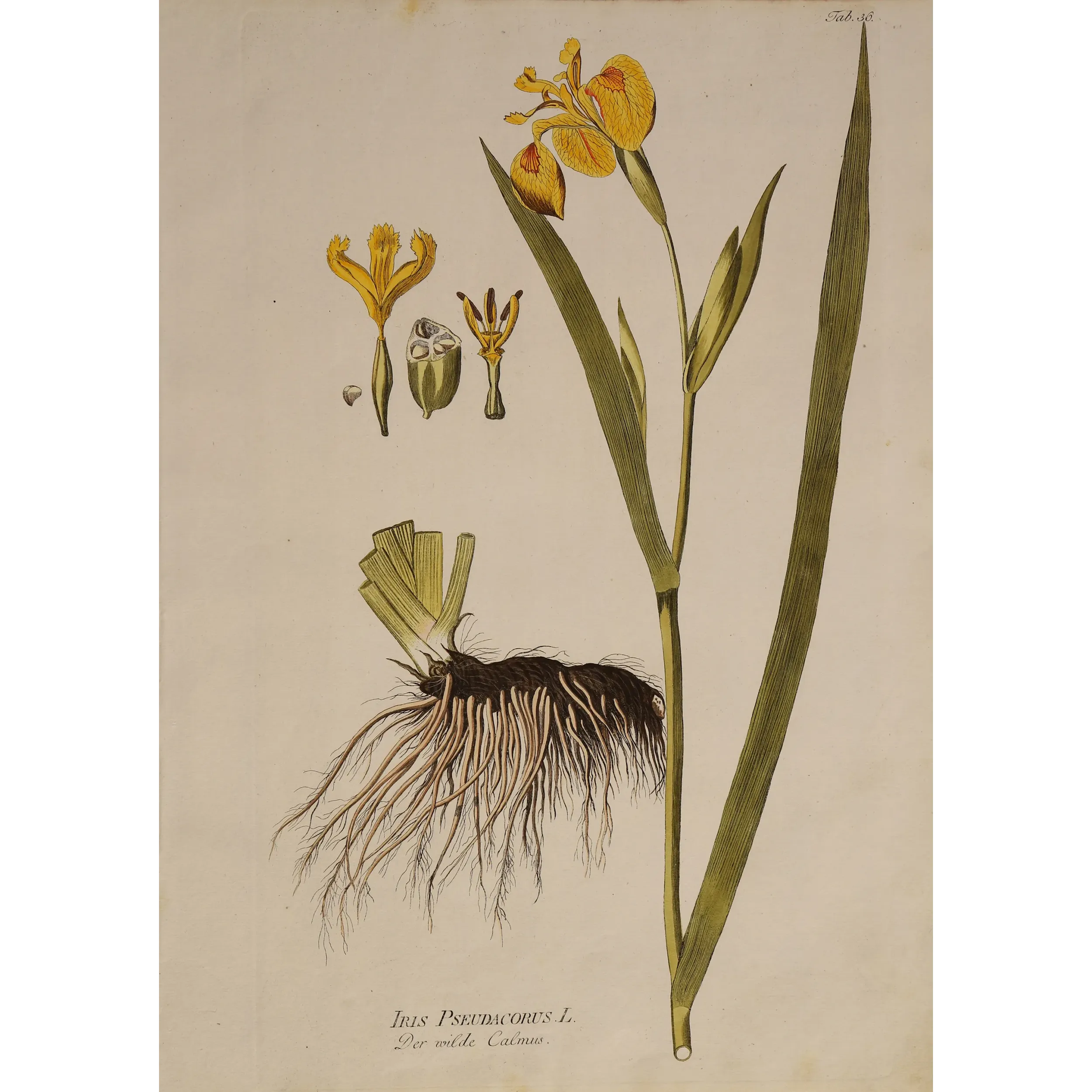
Original hand-coloured copper engraving depicting the Yellow Flag Iris (Iris pseudacorus), published by Joseph Jacob von Plenck in Vienna around 1788 for Icones Plantarum Medicinalium. A refined eighteenth-century botanical illustration distinguished by its elegant composition, beautifully engraved rhizome, luminous yellow flower, selective gum arabic highlights and excellent state of preservation.