- New
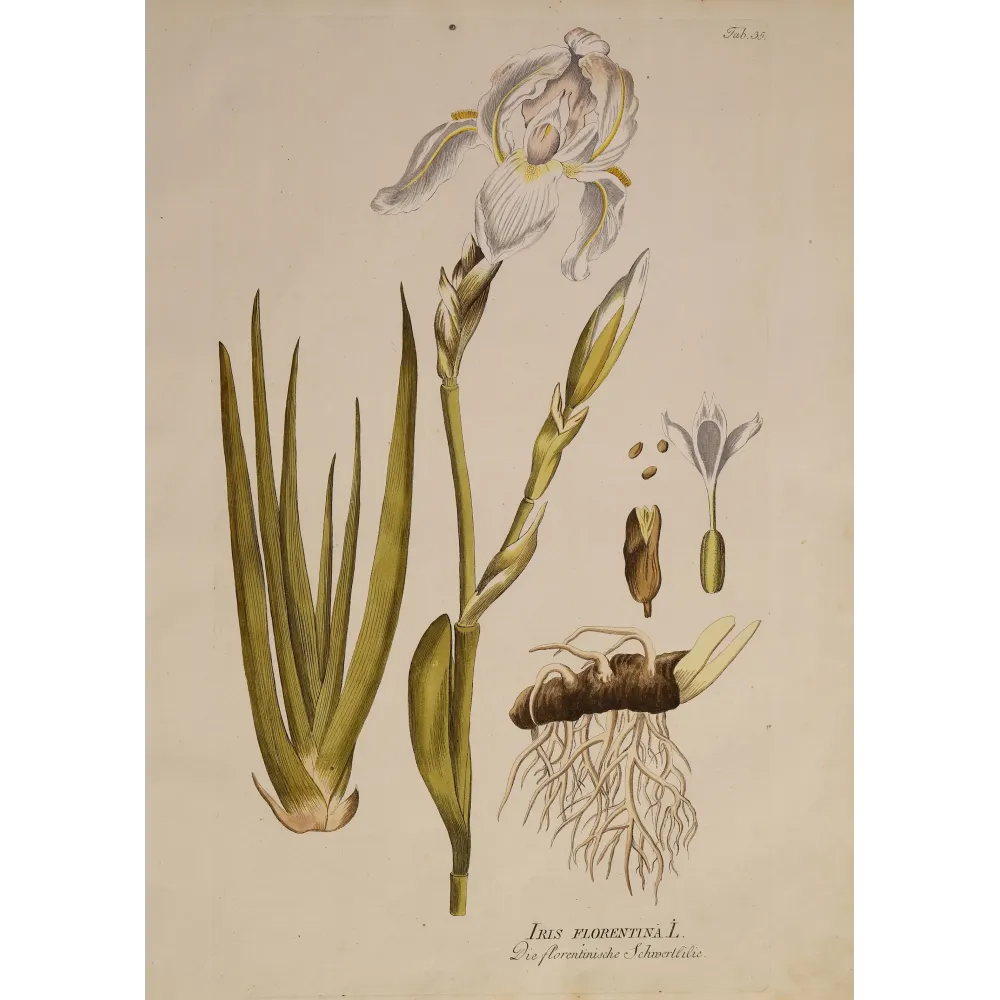
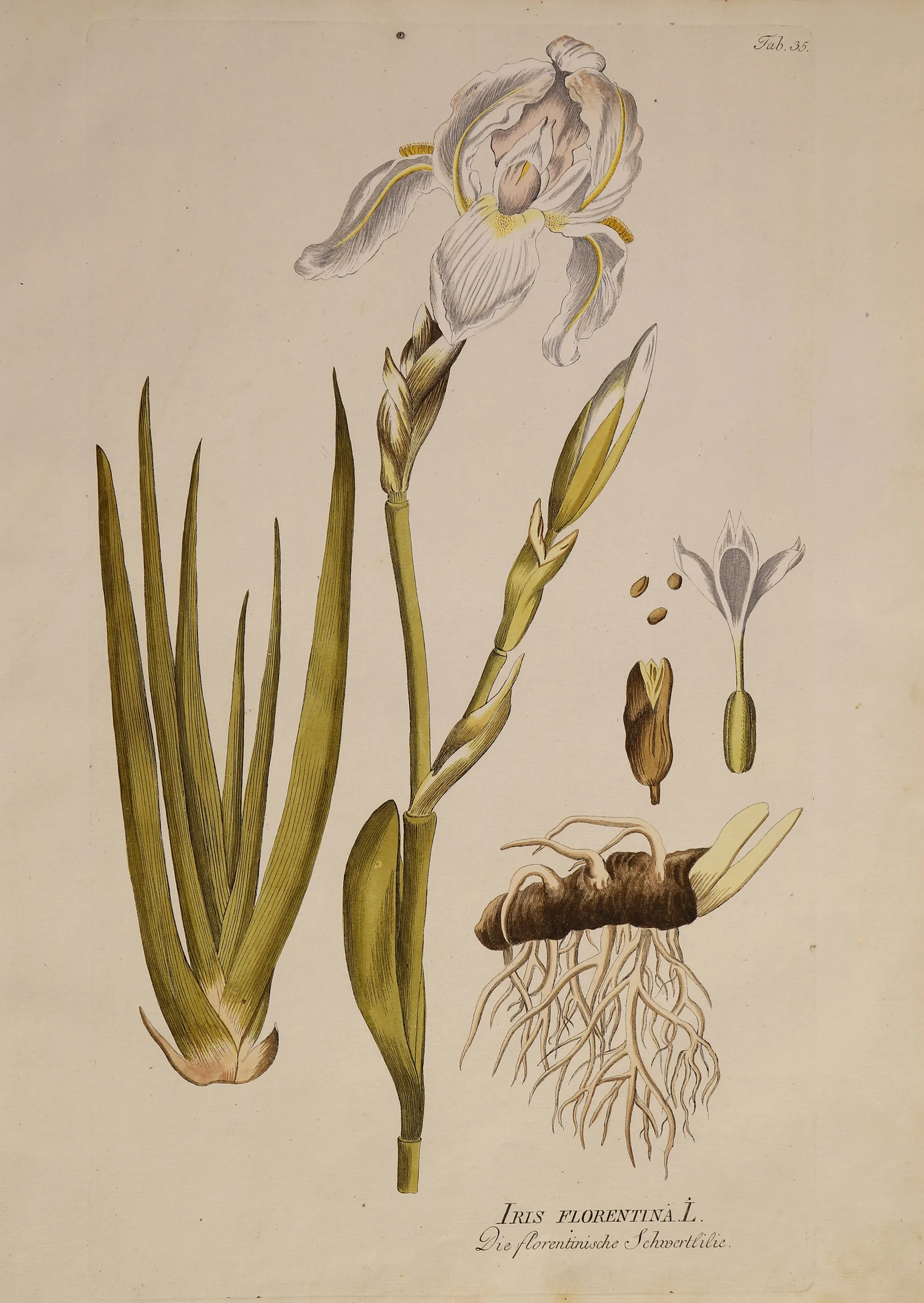
An elegant original botanical engraving depicting Iris florentina, delicately hand-coloured and published by Joseph Jacob von Plenck around 1788. Printed on original laid paper with visible plate mark and exceptionally refined colouring.
 Delivery policy
Your print will be carefully prepared and shipped worldwide via trusted couriers (UPS or similar).
 Authentic antique prints
Original engravings from the 17th–19th century.
This exceptional original hand-coloured engraving from Joseph Jacob von Plenck's Icones Plantarum Medicinalium depicts Iris florentina L., commonly known as the Florentine Iris. Published in Vienna during the late eighteenth century as Plate 35, the image presents the flowering plant together with its long sword-shaped leaves, developing bud, articulated rhizome, fibrous roots, seeds and separate floral details.
Nothing has been included solely for decoration. Flower, foliage, underground structures and reproductive details are arranged as parts of a complete botanical description, allowing the species to be recognised through its natural form, colour and proportions. Yet scientific purpose never diminishes the beauty of the image: through refined engraving, luminous hand colouring and an exceptionally restrained treatment of white, the Florentine Iris becomes both an instrument of knowledge and an accomplished work of botanical art.
The composition rises from the broad horizontal structure of the rhizome towards the pale flower at the top of the sheet. The underground parts give the image a strong visual foundation, while the long leaves, flowering stems and developing bud introduce an elegant upward movement through the generous white space surrounding the plant.
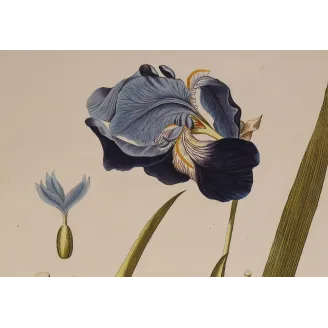
The fully opened flower provides the principal focus. Pale grey, warm ivory, restrained yellow and delicate violet accents define its folded petals, while darker tones are concentrated within recessed areas and along overlapping surfaces. The flower retains volume without losing its exceptional luminosity.
Much of this light comes from the paper itself. Across the broadest areas of the open flower, the natural brightness of the sheet remains visible and becomes an active component of the image. Fine engraved greys, transparent washes and only limited touches of opaque white work together without covering the paper beneath.
The engraved line is used with exceptional discipline. Fine marks establish the contours and essential internal structures of the plant, becoming denser only where greater definition is scientifically necessary. Parallel hatching models the segmented rhizome and tangled roots, while lighter lines describe the leaves, stems, bud and delicate folds of the flower.
Separate floral and reproductive details appear beside the principal specimen, together with individual seeds. These analytical elements support identification without interrupting the balance of the composition, revealing how naturally scientific explanation and artistic clarity coexist throughout the plate.
Iris florentina is a rhizomatous perennial recognised by its sword-shaped leaves, branching flowering stems and large pale flowers. Its upright standards, descending falls and subtle yellow accents distinguish it from the deeper violet-blue colouring associated with many cultivated irises.
The substantial underground rhizome is one of the plant's defining botanical structures. Plenck therefore gives it unusual visual prominence, showing its segmented form, emerging fibrous roots and direct relationship with the foliage and flowering stems above.
Once dried and matured, the aromatic rhizome was historically known as orris root and valued in European medicinal, perfumery and domestic traditions for its distinctive violet-like fragrance. Within an eighteenth-century work devoted to medicinal plants, such completeness had practical importance: reliable identification depended on the flower, leaves, rhizome, roots, seeds and reproductive structures being understood together.
In the preface to Icones Plantarum Medicinalium, Joseph Jacob von Plenck set out a remarkably ambitious objective. The plants were to be represented accurately from life, preserving their natural size, colour and proportion, so that the illustrations could support dependable scientific identification.
Plenck also made clear that scientific accuracy alone was not sufficient. He considered the elegance of the paper, the quality of the drawings and the refinement of the hand colouring essential features of the publication. Knowledge and beauty were therefore conceived not as separate aims, but as complementary parts of the same botanical project.
This engraving of Iris florentina fulfils that declared purpose with exceptional clarity. The architecture of the flower, the blade-like leaves, the developing bud, the articulated rhizome, the fibrous roots, the seeds and the separate floral structures are all presented as botanical evidence. The image does not simply depict an iris in bloom: it reveals how the complete living plant is constructed.
The copper engraving provides a delicate underlying framework rather than dominating the image. Across the petals, leaves and stems, the engraved line remains light and restrained, allowing transparent hand-applied watercolour to establish much of the volume, modelling and natural character. Stronger hatching is reserved for the rhizome and roots, where texture and structural complexity require more precise definition.
The contemporary hand colouring is particularly accomplished. Fine layers of transparent watercolour create gradual transitions across the pale flower without concealing the engraved detail beneath. The greens of the leaves, the warmer tones of the rhizome and the muted colours of the roots remain equally controlled, preserving the natural relationship between every part of the plant.
One of the most remarkable features is the selective use of opaque white pigment. White is clearly present on the developing bud and along passages of both flowering stems, where it contributes to rounded volume and the transition between light and shadow. Across the fully opened flower, however, its use is deliberately limited.
On the largest petals, the colourist relies instead on the natural brightness of the paper, supported by delicate engraved greys, transparent ivory washes and restrained accents. From a curatorial perspective, this appears to be more than an aesthetic choice. By avoiding extensive layers of opaque white across the most visually important surface, the artist reduced the area potentially vulnerable to future alteration.
More than two centuries later, the consequence of that restraint remains visible. The open flower retains remarkable freshness and luminosity, while any possible ageing of the white pigment is confined to limited passages. The technique suggests a practical awareness that beauty could be protected through moderation: the paper itself was allowed to preserve the strongest light.
Gum arabic has also been applied selectively across portions of the leaves, along the flowering stems and on the developing bud. These beautifully preserved glossy passages gently reflect the light and evoke the naturally fresh surface of living plant tissue. The open flower remains largely free from this finish, preserving the soft, almost velvety appearance of its petals.
A strong and clearly visible plate mark remains preserved around the engraved composition. Its relief records the pressure exerted when the dampened sheet was passed through the copperplate press and provides direct material evidence of the original eighteenth-century printing process.
The engraving is printed on fine eighteenth-century laid paper. When examined in transmitted light, the sheet reveals a partial Roman numeral IV countermark. Although the complete watermark is not preserved within this individual impression, the surviving fragment forms part of the original papermaker's identification system.
The wider Prantique group of original Plenck engravings provides important comparative evidence. Other sheets from the same publication preserve complete Honig watermarks, confirming the use of distinguished Dutch paper across the atlas and linking this partial countermark with the same high-quality eighteenth-century paper supply.
In this impression, restrained engraving, transparent hand colouring, selective white pigment, carefully placed gum arabic, strong copperplate relief and fine laid paper remain exceptionally well preserved. Each element contributes to the fulfilment of Plenck's original ambition: to create botanical images accurate enough to communicate knowledge and refined enough to endure as works of art.
This engraving belongs to Joseph Jacob von Plenck's ambitious project to transform medicinal botany into a precise visual language during the European Enlightenment. Discover how scientific observation, natural scale, botanical identification, fine paper, copper engraving, hand colouring and the refined craftsmanship of the Viennese botanical school came together in Icones Plantarum Medicinalium.
Very good condition. Original late eighteenth-century laid paper with exceptionally fresh and luminous hand colouring. The sheet is remarkably clean and structurally sound, with no tears or significant signs of use. The selective applications of white pigment and gum arabic remain beautifully preserved, while the strong plate mark is clearly visible. A partial Roman numeral IV countermark can be observed in transmitted light. Only a minute historical finger-contact mark is visible in the lower right margin, entirely consistent with the age and authentic handling of the work and without affecting the engraved image or its overall presentation. Please examine the professional high-resolution photographs for a complete visual assessment.
Botanical name: Iris florentina L.
Common name: Florentine Iris
Work: Icones Plantarum Medicinalium
Author: Joseph Jacob von Plenck
Artistic tradition: Viennese botanical school
Place of publication: Vienna
Date: c. 1788
Technique: Original copper engraving with contemporary hand-applied watercolour
Finishing: Selective opaque white pigment and gum arabic on the leaves, flowering stems and developing bud
Paper: Fine eighteenth-century laid paper
Watermark: Partial Roman numeral IV countermark, visible in transmitted light; complete Honig watermarks preserved on other sheets from the same collection
Plate mark: Strong and clearly preserved
Plate: 35
Plant family: Iridaceae
Sheet size: approx. 44 x 33 cm
Specific References
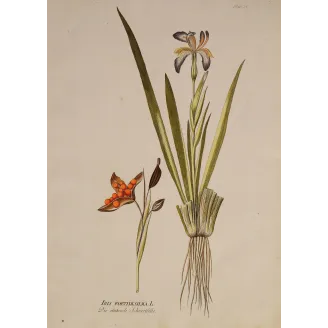
Original eighteenth-century botanical engraving depicting Iris foetidissima (Stinking Iris), published in Vienna by Joseph Jacob von Plenck for Icones Plantarum Medicinalium (Plate 37). Finely engraved and beautifully hand-coloured, the composition illustrates the flowering plant together with its open seed capsule and brilliant orange seeds, combining scientific precision with exceptional decorative elegance. Printed on fine laid Honig paper with visible "IV" watermark and excellent contemporary hand colouring.
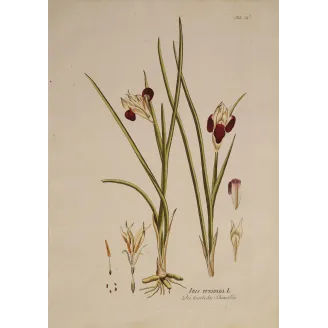
Original eighteenth-century botanical engraving depicting Iris tuberosa (Snake's Head Iris), published in Vienna by Joseph Jacob von Plenck for Icones Plantarum Medicinalium (Plate 38). This elegant composition combines two flowering specimens with finely engraved botanical details and a beautifully preserved complete Honig watermark. Contemporary hand colouring and selective gum arabic produce remarkable depth, while the velvety deep burgundy petals create one of the most refined colour harmonies within Plenck's celebrated Iris series.
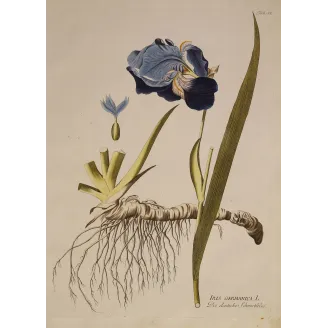
An original eighteenth-century botanical engraving depicting Iris germanica, published in Joseph Jacob von Plenck's celebrated Icones Plantarum Medicinalium. Printed on fine laid paper bearing the Honig watermark, the sheet combines scientific precision with the refined artistic craftsmanship of the Viennese botanical school.
Original hand-coloured copper engraving depicting the Yellow Flag Iris (Iris pseudacorus), published by Joseph Jacob von Plenck in Vienna around 1788 for Icones Plantarum Medicinalium. A refined eighteenth-century botanical illustration distinguished by its elegant composition, beautifully engraved rhizome, luminous yellow flower, selective gum arabic highlights and excellent state of preservation.
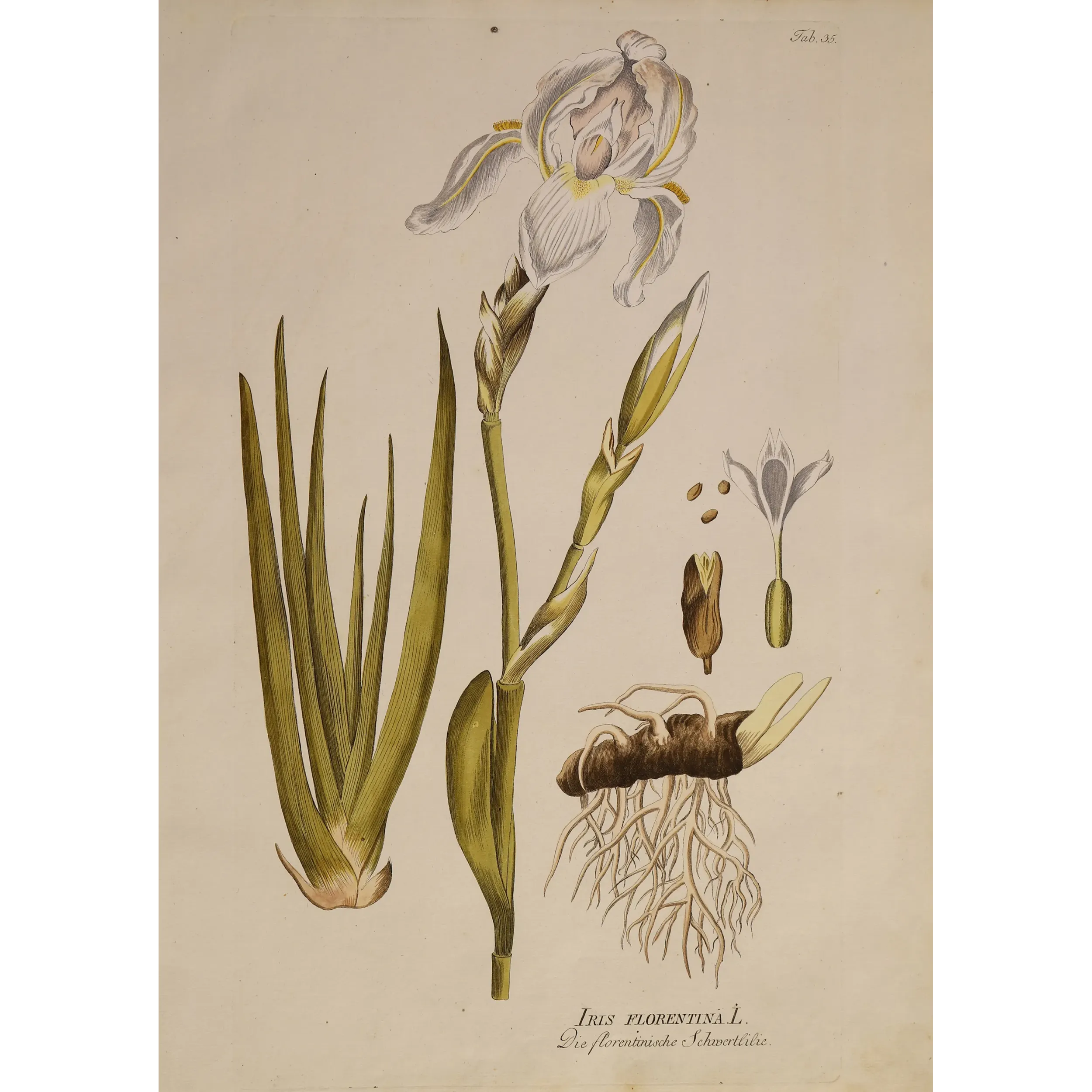
An elegant original botanical engraving depicting Iris florentina, delicately hand-coloured and published by Joseph Jacob von Plenck around 1788. Printed on original laid paper with visible plate mark and exceptionally refined colouring.