- New
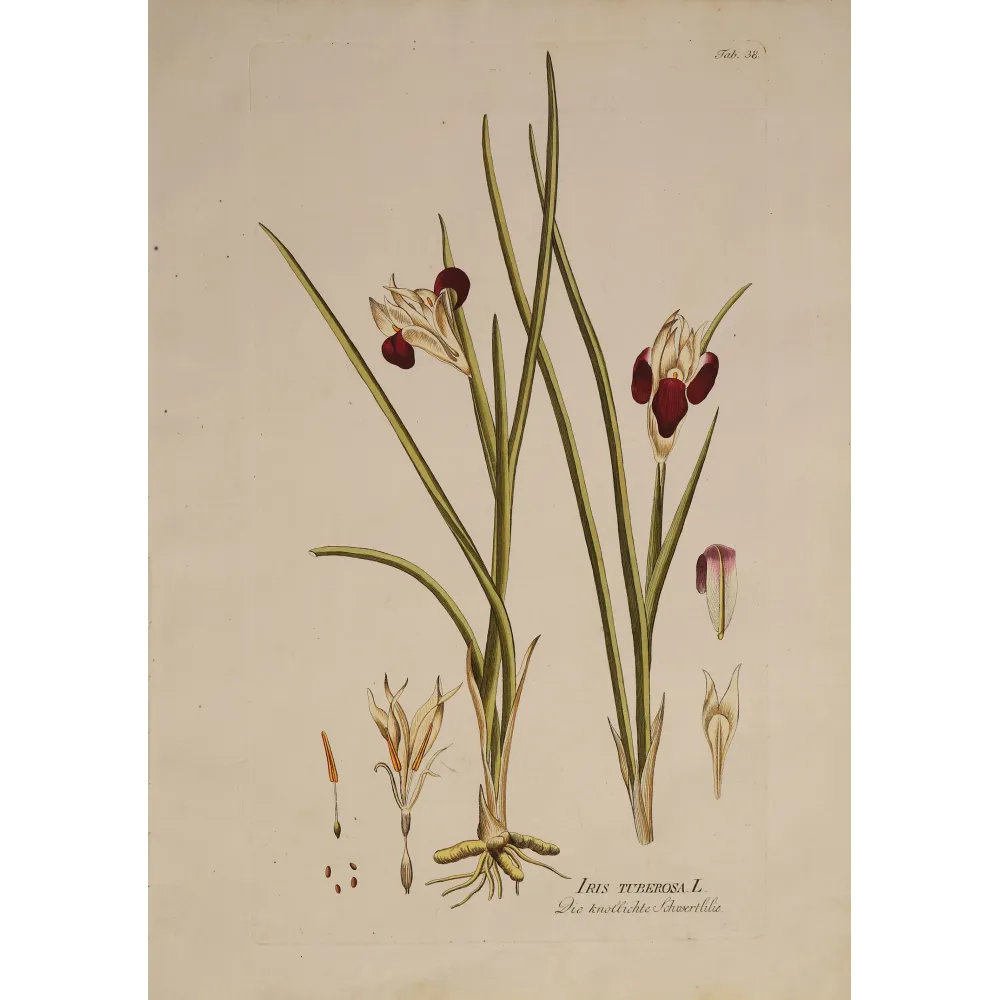
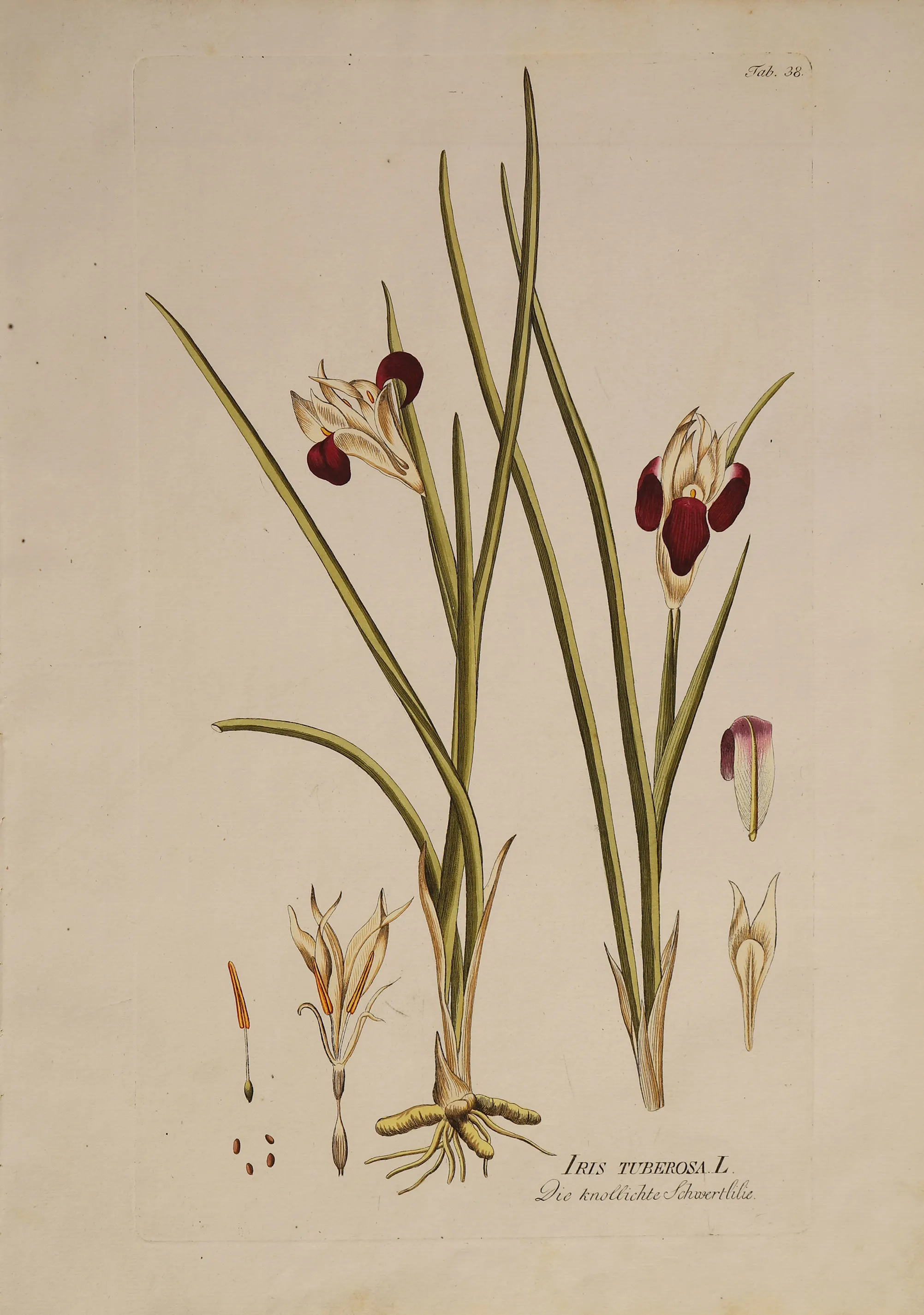
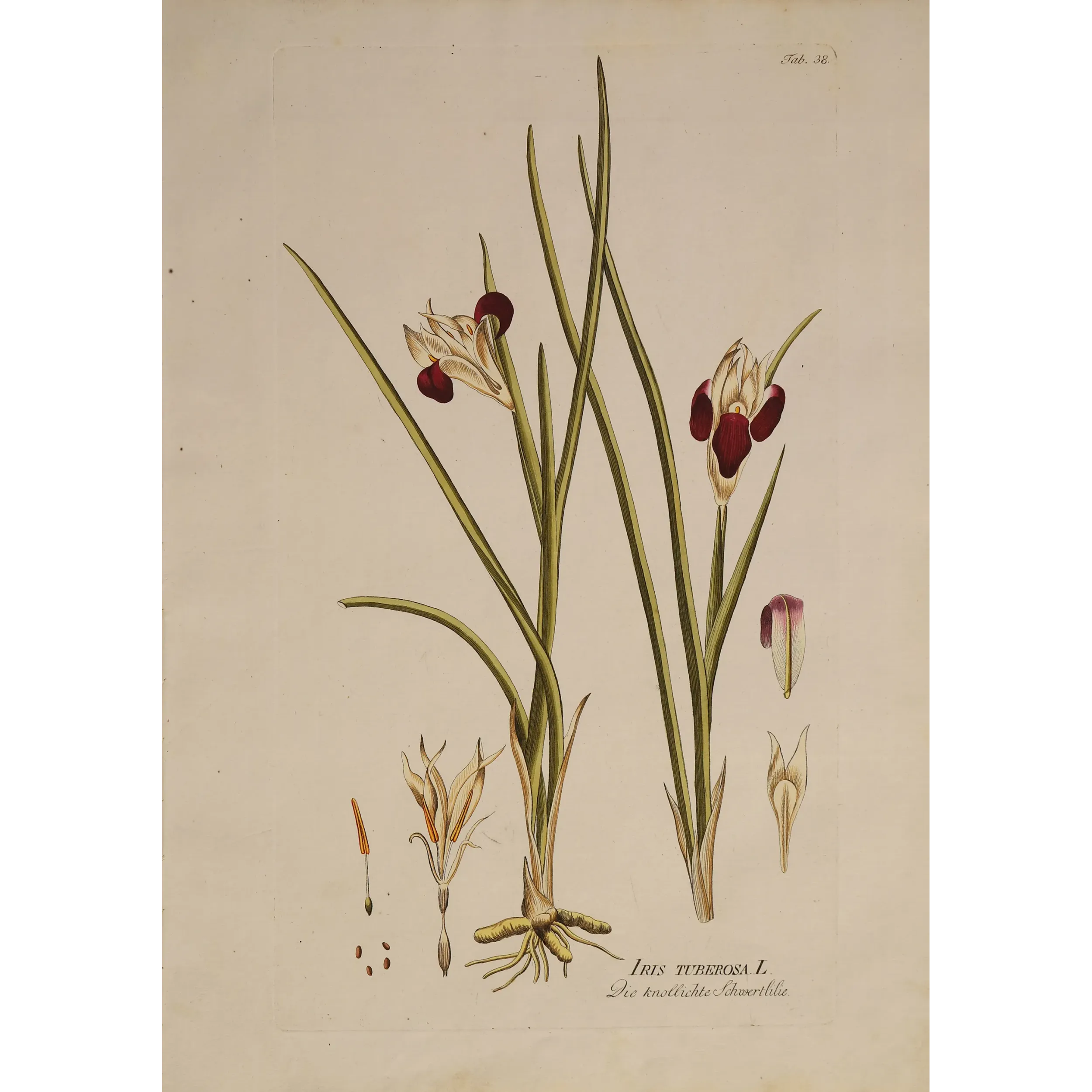
Original eighteenth-century botanical engraving depicting Iris tuberosa (Snake's Head Iris), published in Vienna by Joseph Jacob von Plenck for Icones Plantarum Medicinalium (Plate 38). This elegant composition combines two flowering specimens with finely engraved botanical details and a beautifully preserved complete Honig watermark. Contemporary hand colouring and selective gum arabic produce remarkable depth, while the velvety deep burgundy petals create one of the most refined colour harmonies within Plenck's celebrated Iris series.
 Delivery policy
Your print will be carefully prepared and shipped worldwide via trusted couriers (UPS or similar).
 Authentic antique prints
Original engravings from the 17th–19th century.
This exceptional original hand-coloured engraving from Joseph Jacob von Plenck’s Icones Plantarum Medicinalium depicts Iris tuberosa L., commonly known as the Snake’s Head Iris. Published in Vienna during the late eighteenth century as Plate 38, the image presents two flowering specimens together with their slender leaves, tuberous underground structure and a carefully arranged series of separate botanical details.
The composition is distinguished by movement. Long leaves rise, cross and diverge across the sheet, while the two flowers turn in different directions, allowing the species to be examined from complementary viewpoints. Smaller analytical elements occupy the lower and right-hand spaces, extending the botanical description without interrupting the elegant rhythm of the principal plants.
Among Plenck’s Iris plates, this engraving stands out for its dynamic composition, velvety burgundy flowers and exceptional material evidence, including a beautifully preserved complete Honig watermark.
The image is organised around two flowering specimens whose long, narrow leaves create a complex but perfectly controlled network of ascending lines. Some rise almost vertically, while others bend, cross or extend diagonally into the surrounding white space. This interplay gives the composition an unusually animated character, closer to a botanical choreography than to a rigid scientific diagram.
The two flowers provide the principal chromatic focus. Deep burgundy and purple-red washes cover the descending segments of the corollas, producing a rich, almost velvety appearance. These dark areas contrast with the pale cream interiors, fine golden-brown markings and restrained olive greens of the foliage.
The contemporary colourist worked with great refinement. Pigment has been applied in thin, carefully controlled layers, allowing subtle tonal transitions to establish volume without concealing the engraved framework beneath. Within the burgundy petals, darker passages define folds and recessed areas, while lighter edges preserve softness and suggest the natural texture of the flower.
The engraved line appears only where it contributes directly to botanical understanding. Across the leaves it defines longitudinal structure, overlapping forms and changes in direction. Within the flowers, short and delicate marks describe folds, veins and the relationship between pale and dark floral parts without making the image appear heavy.
The engraving becomes firmer around the tuberous base and roots. Here, denser hatching separates the rounded underground structures, clarifies their volume and establishes the direction of light across their surfaces. The increase in graphic definition is functional: it allows the more complex subterranean anatomy to remain fully legible.
Separate botanical details include floral structures, reproductive elements and seeds observed at different stages and from different viewpoints. Distributed around the lower portion and right side of the sheet, they create a second visual register: analytical and precise, yet still integrated within the overall balance of the plate.
Iris tuberosa is a distinctive Mediterranean perennial characterised by slender, often angular leaves and dark, unusually shaped flowers. The plant grows from an underground tuberous structure, clearly represented by Plenck at the base of the principal specimen.
Its flowers combine pale greenish or cream-coloured upper segments with deep brown, purple or burgundy falls. This striking contrast has inspired several common names, including Snake’s Head Iris and Widow Iris, reflecting the flower’s elongated form and sombre colour palette.
Modern botanical classification generally places the species in the genus Hermodactylus, under the name Hermodactylus tuberosus. The historical title Iris tuberosa L. is preserved here because it appears on the original engraving and records the Linnaean nomenclature used by Plenck in the late eighteenth century.
The complete representation of the plant was essential within an atlas devoted to medicinal botany. Flower colour alone could not provide dependable identification: foliage, tuberous structures, roots, reproductive organs and seeds all contributed to recognising and distinguishing the species.
Joseph Jacob von Plenck conceived Icones Plantarum Medicinalium as an ambitious union of scientific accuracy and refined botanical art. Plants were to be represented from life, preserving their characteristic proportions, natural colours and identifying structures, while fine paper and accomplished hand colouring would make the publication worthy of its subject.
Plate 38 demonstrates this programme with unusual visual energy. Rather than arranging the specimens along a single static axis, the artists allowed the leaves to intersect and the flowers to turn in different directions. The plant remains completely legible, but its living growth determines the movement of the composition.
The two principal specimens complement one another. The left flower opens laterally, exposing the layered relationship between its pale and burgundy segments. The more upright flower on the right offers a clearer frontal view. Together, they allow the viewer to understand the complex architecture of the corolla without reducing it to a schematic diagram.
The contemporary colouring is particularly accomplished. Transparent olive-green washes follow the changing direction of the narrow leaves, while warm cream and ochre define the lighter floral structures. The concentrated burgundy pigment of the falls creates the strongest visual accent, giving the petals their characteristic depth and velvety appearance.
A very light and selective application of gum arabic enhances the stems and foliage. Its purpose is not to create a conspicuous gloss, but to increase the legibility and natural surface sheen of the green structures. The petals remain untreated, preserving the soft, matte quality appropriate to their velvety visual character.
The copper engraving operates as a disciplined supporting framework. Fine lines establish botanical contours and surface details, becoming stronger only where increased definition is necessary. This is especially evident in the tuber and root system, where engraved hatching clarifies volume, overlapping forms and the formation of light and shadow.
Despite the quantity of scientific information it contains, the plate never appears crowded. The analytical details have been placed within the naturally available spaces around the specimens, while the generous margins preserve the visual independence of the composition. Scientific completeness and decorative elegance remain in perfect balance.
The exceptional preservation of the paper, colouring, plate mark and complete Honig watermark further distinguishes this impression. Its historical and material importance establishes a substantial foundation of value, while the sophisticated composition and extraordinary burgundy flowers place it among the hero plates of Plenck’s Iris group.
The engraving is printed on exceptionally fine eighteenth-century laid paper associated with the Dutch Honig papermaking tradition. Closely spaced laid lines and broader chain lines form part of the physical structure of the handmade sheet and become especially visible when examined in transmitted light.
This impression preserves a particularly beautiful and substantially complete watermark. The device includes a crowned heraldic shield, the initials “VR” beneath it and a visible Honig inscription in the lower portion of the sheet. Together, these elements provide unusually strong documentary evidence of the quality and origin of the paper selected for the publication.
The Honig family operated one of the most respected papermaking traditions in the Netherlands. Their papers circulated widely through European artistic, scientific and publishing networks, valued for their strength, clean surface and ability to receive both finely impressed copperplate lines and transparent hand-applied colour.
Watermarks were formed directly within the papermaking mould and therefore belong to the substance of the sheet rather than being printed upon it. Because large mould-made sheets were commonly divided or folded, individual plates often preserve only fragments of a papermaker’s device. The unusually complete evidence visible here gives this engraving particular interest for collectors concerned with paper history and the material culture of eighteenth-century botanical publishing.
The plate mark is also clearly and continuously visible. It records the pressure exerted by the copperplate during printing and surrounds the image with generous margins on all sides. These preserved features allow the original dimensions and production process of the folio to be appreciated with exceptional clarity.
Published in Vienna from 1788, Joseph Jacob von Plenck’s Icones Plantarum Medicinalium represents one of the Enlightenment’s most ambitious illustrated botanical projects. Created for physicians, apothecaries and students, it united Linnaean classification with the sophisticated visual culture of the Viennese botanical school.
Each image was printed from a finely engraved copperplate and then coloured individually by hand. Every surviving impression therefore combines the repeatable precision of printmaking with the unique decisions of an eighteenth-century colourist.
The material quality of the atlas was central to Plenck’s conception. Fine imported paper, sharp copperplate impressions and transparent watercolour were not merely luxurious additions: they allowed botanical structures, colours and proportions to be communicated with exceptional accuracy.
In this plate, the complete Honig watermark preserves the history of the paper alongside the botanical image. Plant, engraver, colourist, printer and papermaker all remain materially present within a single sheet, making the engraving both a botanical portrait and a document of eighteenth-century craftsmanship.
Discover how scientific observation, natural scale, fine Honig paper, copper engraving and contemporary hand colouring came together in Plenck’s botanical masterpiece.
Excellent condition. The fine eighteenth-century laid paper remains exceptionally clean, structurally sound and remarkably fresh. No significant stains, creases, abrasions or signs of use affect the botanical image or the overall presentation of the sheet.
The original copperplate impression remains sharp and clearly defined throughout. The contemporary hand colouring is beautifully preserved, retaining the restrained olive greens, warm cream tones and exceptionally deep burgundy of the flowers. The subtle tonal modelling responsible for their velvety appearance remains fully legible.
The selective gum arabic applied to the foliage and stems survives in excellent condition, producing only the intended gentle surface sheen. The petals remain naturally matte. The plate mark is perfectly visible, and generous original margins are preserved on all sides.
The crowned heraldic watermark, initials “VR” and visible Honig inscription are particularly well preserved within the laid paper. Please examine the professional high-resolution photographs for a complete visual assessment of the engraving, margins and paper evidence.
Historical botanical name: Iris tuberosa L.
Modern botanical name: Hermodactylus tuberosus
Common name: Snake’s Head Iris
German title: Die knollichte Schwertlilie
Work: Icones Plantarum Medicinalium
Author: Joseph Jacob von Plenck (1735–1807)
Artistic tradition: Viennese botanical school
Place of publication: Vienna
Date: c. 1788
Technique: Original copper engraving with contemporary hand-applied watercolour
Finishing: Selective soft gum arabic applied to foliage and stems; not applied to the petals
Paper: Fine eighteenth-century laid paper associated with the Honig papermaking tradition
Watermark: Crowned heraldic shield, initials “VR” and visible Honig inscription
Plate mark: Clearly and completely visible
Plate: 38
Plant family: Iridaceae
Sheet size: approx. 44 × 33 cm
Condition: Excellent condition
Curatorial classification: Hero plate of the Plenck Iris group
Authenticity: Original eighteenth-century print — never a modern reproduction
Specific References
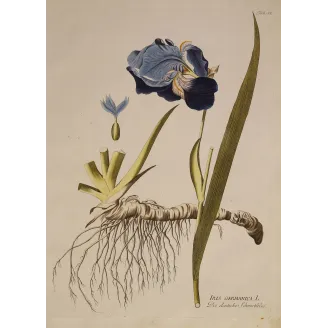
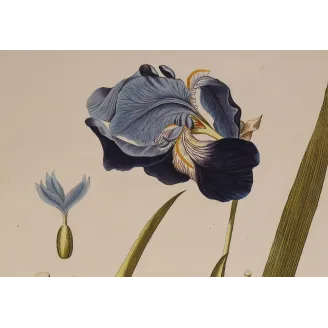
An original eighteenth-century botanical engraving depicting Iris germanica, published in Joseph Jacob von Plenck's celebrated Icones Plantarum Medicinalium. Printed on fine laid paper bearing the Honig watermark, the sheet combines scientific precision with the refined artistic craftsmanship of the Viennese botanical school.
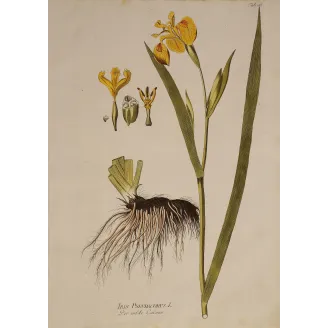
Original hand-coloured copper engraving depicting the Yellow Flag Iris (Iris pseudacorus), published by Joseph Jacob von Plenck in Vienna around 1788 for Icones Plantarum Medicinalium. A refined eighteenth-century botanical illustration distinguished by its elegant composition, beautifully engraved rhizome, luminous yellow flower, selective gum arabic highlights and excellent state of preservation.
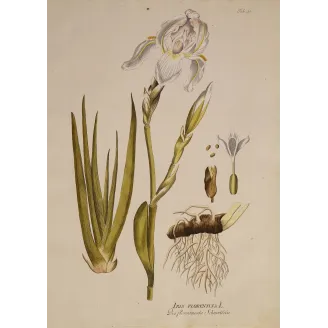
An elegant original botanical engraving depicting Iris florentina, delicately hand-coloured and published by Joseph Jacob von Plenck around 1788. Printed on original laid paper with visible plate mark and exceptionally refined colouring.
Original eighteenth-century botanical engraving depicting Iris foetidissima (Stinking Iris), published in Vienna by Joseph Jacob von Plenck for Icones Plantarum Medicinalium (Plate 37). Finely engraved and beautifully hand-coloured, the composition illustrates the flowering plant together with its open seed capsule and brilliant orange seeds, combining scientific precision with exceptional decorative elegance. Printed on fine laid Honig paper with visible "IV" watermark and excellent contemporary hand colouring.
Original eighteenth-century botanical engraving depicting Iris tuberosa (Snake's Head Iris), published in Vienna by Joseph Jacob von Plenck for Icones Plantarum Medicinalium (Plate 38). This elegant composition combines two flowering specimens with finely engraved botanical details and a beautifully preserved complete Honig watermark. Contemporary hand colouring and selective gum arabic produce remarkable depth, while the velvety deep burgundy petals create one of the most refined colour harmonies within Plenck's celebrated Iris series.