- New
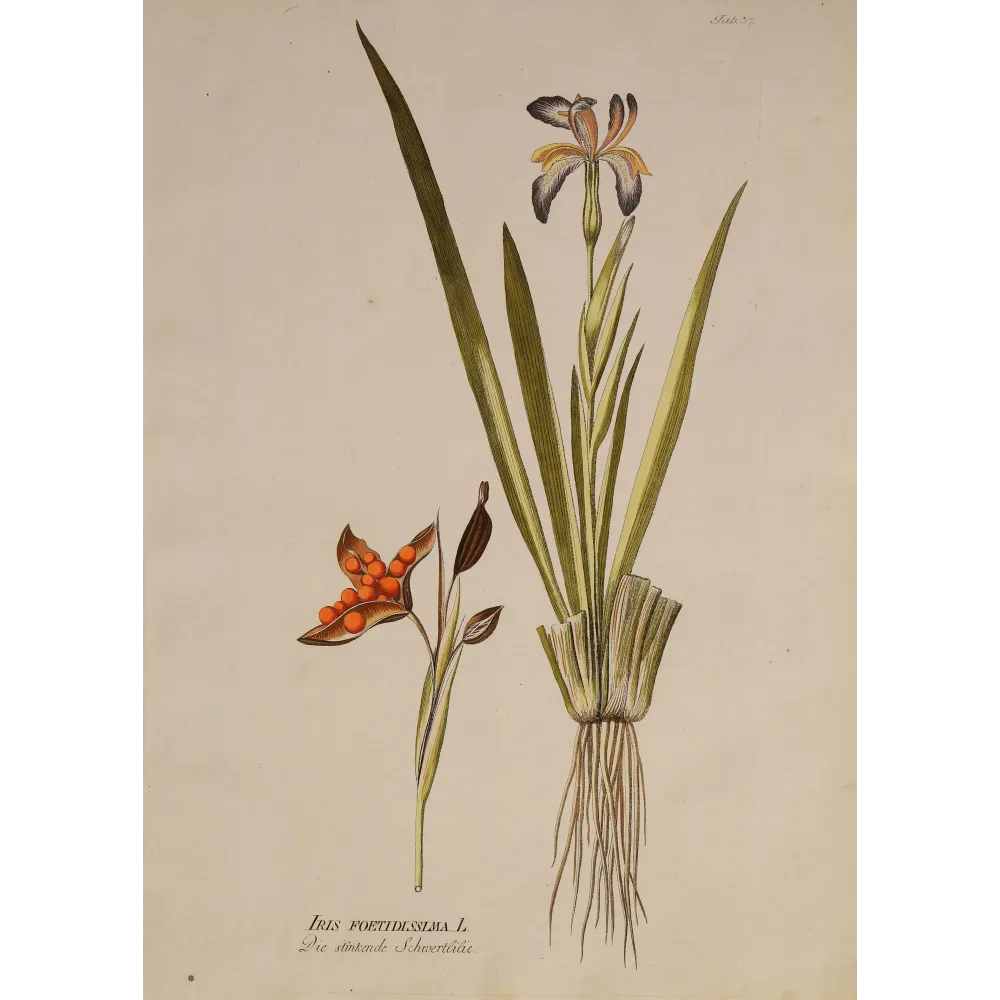
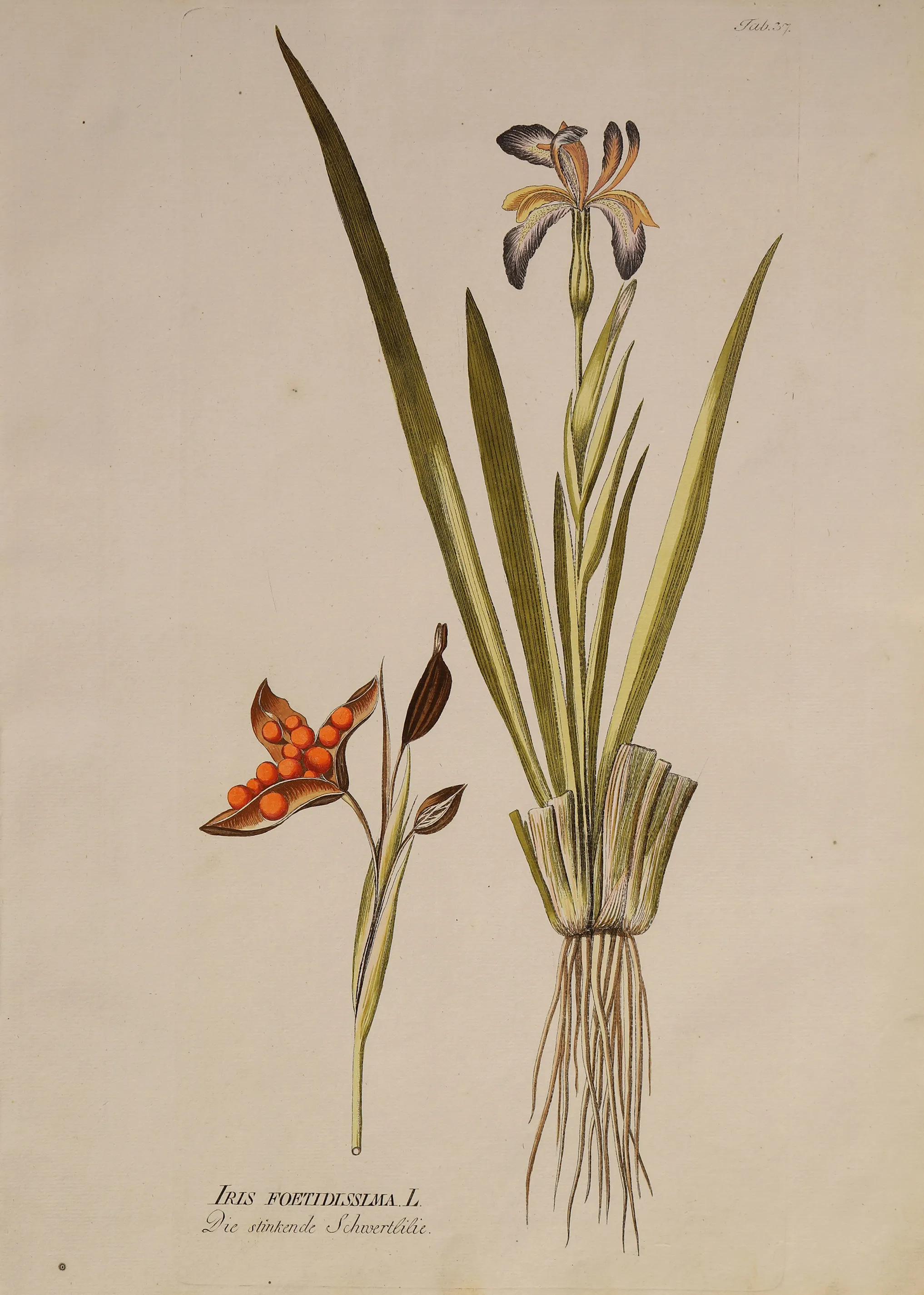
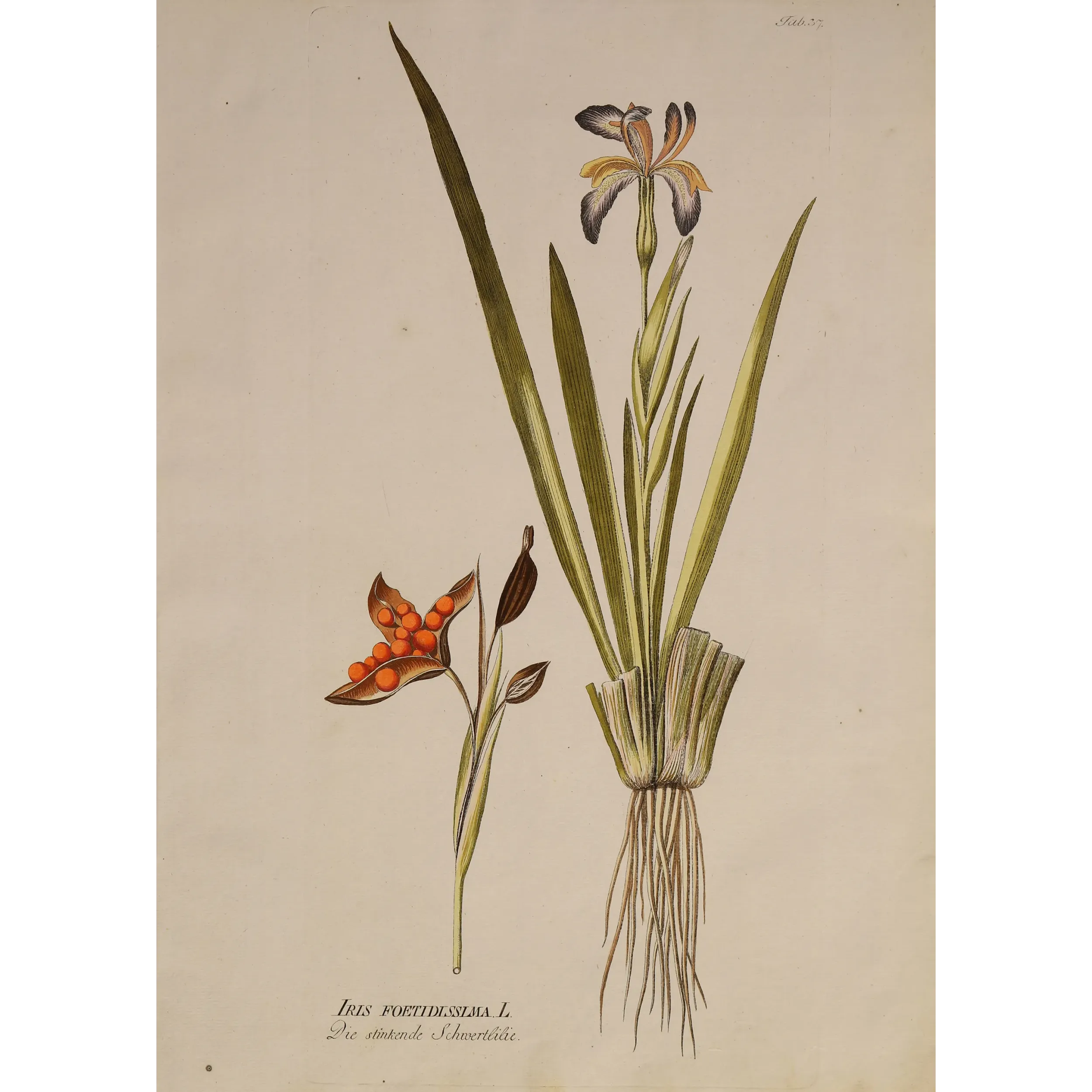
Original eighteenth-century botanical engraving depicting Iris foetidissima (Stinking Iris), published in Vienna by Joseph Jacob von Plenck for Icones Plantarum Medicinalium (Plate 37). Finely engraved and beautifully hand-coloured, the composition illustrates the flowering plant together with its open seed capsule and brilliant orange seeds, combining scientific precision with exceptional decorative elegance. Printed on fine laid Honig paper with visible "IV" watermark and excellent contemporary hand colouring.
 Delivery policy
Your print will be carefully prepared and shipped worldwide via trusted couriers (UPS or similar).
 Authentic antique prints
Original engravings from the 17th–19th century.
This exceptional original hand-coloured engraving from Joseph Jacob von Plenck’s Icones Plantarum Medicinalium depicts Iris foetidissima L., commonly known as the Stinking Iris. Published in Vienna during the late eighteenth century as Plate 37, the composition brings together the flowering plant, its long sword-shaped leaves and fibrous roots with a separate fruiting stem bearing an open capsule filled with brilliant orange seeds.
The image does more than identify a botanical species. By showing flower, foliage, roots, fruit and seed within a single plate, it presents the plant through successive stages of its natural cycle. Scientific description and visual narrative become inseparable: the tall flowering specimen establishes the structure of the species, while the smaller fruiting stem introduces an unexpected and highly decorative burst of colour.
Among Plenck’s representations of the genus Iris, this plate stands out for the refinement of its hand colouring, the elegance of its composition and the remarkable contrast between the delicately modelled flower and the vivid orange seeds.
The principal plant rises vertically from a compact cluster of fibrous roots. Long blade-like leaves open around the central flowering stem, creating a sequence of strong ascending lines that lead the eye towards the iris at the top of the composition. The generous unprinted space surrounding the specimen reinforces its height and gives every botanical structure exceptional clarity.
The open flower is rendered with extraordinary delicacy. Transparent washes of muted violet, smoky grey, pale yellow and warm ochre describe the folded petals without obscuring the engraved framework beneath. Fine tonal transitions establish depth within the corolla, producing a convincing three-dimensional effect and suggesting the flower at a mature, perhaps concluding stage of bloom.
The engraved line is applied only where it contributes directly to botanical definition. Across the petals and foliage it remains restrained, tracing contours, veins and folds with exceptional precision. Denser hatching appears in the shadowed parts of the flower and, above all, among the roots, where it clarifies texture, overlapping forms and the direction from which light falls across the plant.
To the left, a separate fruiting stem provides a dramatic counterpoint to the vertical flowering specimen. Its mature capsule has divided into three recurving sections, exposing a cluster of rounded orange-red seeds. These brilliant forms act almost like small jewels within the restrained palette of greens, browns and violets, becoming one of the most memorable decorative details in the entire Iris sequence.
The asymmetrical placement of the fruiting stem also transforms the rhythm of the composition. It balances the visual weight of the principal plant without competing with it, while connecting the flower to the later reproductive stage of the species. The result is both scientifically complete and aesthetically sophisticated.
Iris foetidissima is an evergreen or semi-evergreen perennial native to western and southern Europe and parts of North Africa. It grows in shaded woodland, hedgerows and other sheltered habitats, where its persistent sword-shaped leaves form dense architectural clumps.
Its common English name, Stinking Iris, refers to the distinctive odour released when the foliage is bruised. The flowers are generally more subdued than those of many cultivated irises, displaying combinations of violet, grey, yellow and brown that can vary between individual plants.
The species becomes especially conspicuous after flowering. Its mature capsules split open to reveal rows of vivid orange or scarlet seeds, which may remain attached for an extended period. Plenck records this important identifying feature with unusual prominence, presenting the fruiting stem as an integral part of the botanical portrait rather than as a minor analytical detail.
Within an eighteenth-century atlas of medicinal plants, the representation of roots, leaves, flowers and fruits had practical importance. Reliable identification depended upon observing the entire organism through different stages of growth, not merely upon recognising the flower in isolation.
Joseph Jacob von Plenck conceived Icones Plantarum Medicinalium as a work in which medicinal plants would be represented accurately from life, preserving their natural scale, proportions and colours. At the same time, he regarded fine paper, accomplished drawing and refined hand colouring as essential components of botanical instruction.
Plate 37 demonstrates that ambition with particular elegance. The plant is not reduced to a schematic diagram, nor transformed into a decorative fantasy. Every element remains botanically legible, yet the distribution of forms across the sheet reveals a carefully considered artistic intelligence.
The flowering specimen occupies the dominant right-hand side of the plate, while the fruiting stem appears lower and to the left. This arrangement allows two distinct moments in the life of the plant to coexist without visual confusion. The tall iris establishes growth and flowering; the open capsule introduces maturity, reproduction and the continuation of the species.
The contemporary colourist worked with remarkable restraint. Thin and transparent layers preserve the luminosity of the paper and permit the fine engraved marks to remain visible. Particularly accomplished is the modelling of the open flower, where subtle shifts between pale yellow, ochre, violet and grey create depth without any sense of heaviness or opacity.
The brilliant orange seeds required a very different treatment. Their saturated colour establishes the strongest chromatic accent on the sheet, yet each seed remains individually modelled through small tonal variations. This concentrated area of warmth gives the plate an immediate decorative identity while retaining its scientific precision.
A light and selective application of gum arabic appears across the foliage and stem. Its effect is discreet rather than theatrical, increasing the natural sheen and legibility of the green surfaces without disturbing the transparency of the watercolour. No gum arabic has been applied to the petals, which preserve their soft, velvety and delicately shaded appearance.
The engraver likewise uses line as a supporting structure rather than as an independent display of virtuosity. The marks become stronger only where required to explain volume, texture or shadow, especially in the fibrous root system. The resulting image approaches the freshness of an original botanical watercolour while retaining all the precision of copperplate engraving.
For its exceptional condition, refined colouring and complete botanical narrative, this engraving belongs among the hero plates of the Plenck Iris group. Its historical significance establishes its value; its unusual visual balance and the striking beauty of the open seed capsule elevate it further.
The engraving is printed on fine eighteenth-century laid paper associated with the Dutch Honig papermaking tradition. The closely spaced laid lines and broader chain lines form part of the physical structure of the sheet and become most readily visible when the paper is examined in transmitted light.
A visible “IV” mark survives within the paper. This represents a partial watermark or countermark from the original mould-made sheet and constitutes important material evidence of the paper used for the publication. Because large handmade sheets were divided or folded before printing and binding, an individual botanical plate may preserve only one section of a larger papermaker’s device.
Honig papers were prized throughout eighteenth-century Europe for their strength, clean surface and ability to receive both finely engraved copperplate impressions and transparent watercolour. The excellent preservation of this sheet demonstrates the durability and high quality of the material selected for Plenck’s ambitious botanical atlas.
The plate mark is clearly and continuously visible, recording the pressure exerted by the copperplate during printing. The lateral margins are generous, while the space above and below is more restrained. This appears consistent with the editorial priority given to representing the tall plant as closely as possible to its natural dimensions within the available folio format.
Published in Vienna from 1788, Joseph Jacob von Plenck’s Icones Plantarum Medicinalium represents one of the Enlightenment’s most ambitious botanical publishing projects. Conceived for physicians, apothecaries and students, it joined Linnaean classification with the refined visual language of the Viennese botanical school.
Each image was printed from a finely engraved copperplate and subsequently coloured by hand. Every surviving impression therefore combines the repeatable precision of printmaking with the individual decisions of an eighteenth-century colourist.
This plate is particularly revealing because it presents the same species through flowering and fruiting stages. The open capsule with its brilliant seeds transforms botanical chronology into visual storytelling, allowing the viewer to understand not only what the plant looks like, but how it develops through time.
Complete examples of Plenck’s atlas are considerably less common than many nineteenth-century botanical works. Individual plates are now valued both as historical documents of medicinal botany and as independent works of exceptional decorative refinement.
Discover how natural scale, fine Honig paper, copper engraving and contemporary hand colouring came together in Plenck’s botanical masterpiece.
Excellent condition. The fine eighteenth-century laid paper is exceptionally clean, structurally sound and remarkably fresh, with no significant stains, creases, abrasions or visible signs of use affecting the presentation of the sheet.
The copperplate impression remains sharp and clearly defined throughout. The contemporary hand colouring is beautifully preserved, retaining the delicate violet, yellow and green tonalities of the flowering plant together with the intense orange-red colour of the exposed seeds.
The plate mark is perfectly visible, and the margins remain well preserved, particularly along the longer sides. A partial “IV” watermark or countermark is visible within the laid paper. The subtle gum arabic applied to the foliage and stem also survives in excellent condition, preserving its intended gentle surface sheen. Please examine the professional high-resolution photographs for a complete visual assessment.
Botanical name: Iris foetidissima L.
Common name: Stinking Iris
German title: Die stinkende Schwertlilie
Work: Icones Plantarum Medicinalium
Author: Joseph Jacob von Plenck (1735–1807)
Artistic tradition: Viennese botanical school
Place of publication: Vienna
Date: c. 1788
Technique: Original copper engraving with contemporary hand-applied watercolour
Finishing: Selective soft gum arabic applied to foliage and stem; not applied to the petals
Paper: Fine eighteenth-century laid paper associated with the Honig papermaking tradition
Watermark or countermark: Visible partial “IV” mark
Plate mark: Clearly and completely visible
Plate: 37
Plant family: Iridaceae
Sheet size: approx. 44 × 33 cm
Condition: Excellent condition
Curatorial classification: Hero plate of the Plenck Iris group
Authenticity: Original eighteenth-century print — never a modern reproduction
Specific References
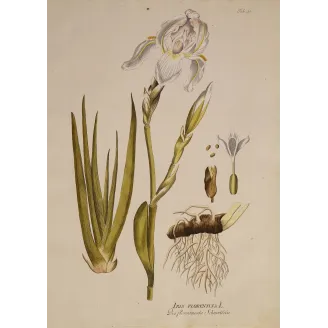
An elegant original botanical engraving depicting Iris florentina, delicately hand-coloured and published by Joseph Jacob von Plenck around 1788. Printed on original laid paper with visible plate mark and exceptionally refined colouring.
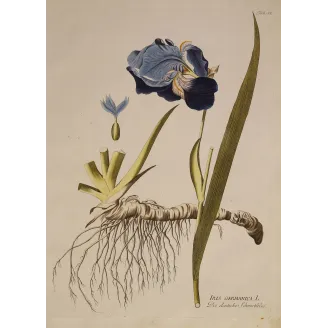
An original eighteenth-century botanical engraving depicting Iris germanica, published in Joseph Jacob von Plenck's celebrated Icones Plantarum Medicinalium. Printed on fine laid paper bearing the Honig watermark, the sheet combines scientific precision with the refined artistic craftsmanship of the Viennese botanical school.
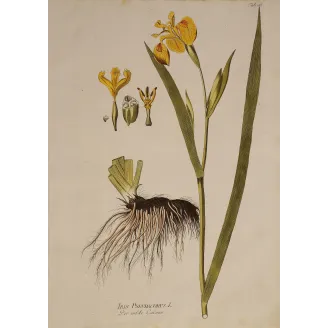
Original hand-coloured copper engraving depicting the Yellow Flag Iris (Iris pseudacorus), published by Joseph Jacob von Plenck in Vienna around 1788 for Icones Plantarum Medicinalium. A refined eighteenth-century botanical illustration distinguished by its elegant composition, beautifully engraved rhizome, luminous yellow flower, selective gum arabic highlights and excellent state of preservation.
Original eighteenth-century botanical engraving depicting Iris tuberosa (Snake's Head Iris), published in Vienna by Joseph Jacob von Plenck for Icones Plantarum Medicinalium (Plate 38). This elegant composition combines two flowering specimens with finely engraved botanical details and a beautifully preserved complete Honig watermark. Contemporary hand colouring and selective gum arabic produce remarkable depth, while the velvety deep burgundy petals create one of the most refined colour harmonies within Plenck's celebrated Iris series.
Original eighteenth-century botanical engraving depicting Iris foetidissima (Stinking Iris), published in Vienna by Joseph Jacob von Plenck for Icones Plantarum Medicinalium (Plate 37). Finely engraved and beautifully hand-coloured, the composition illustrates the flowering plant together with its open seed capsule and brilliant orange seeds, combining scientific precision with exceptional decorative elegance. Printed on fine laid Honig paper with visible "IV" watermark and excellent contemporary hand colouring.