- New
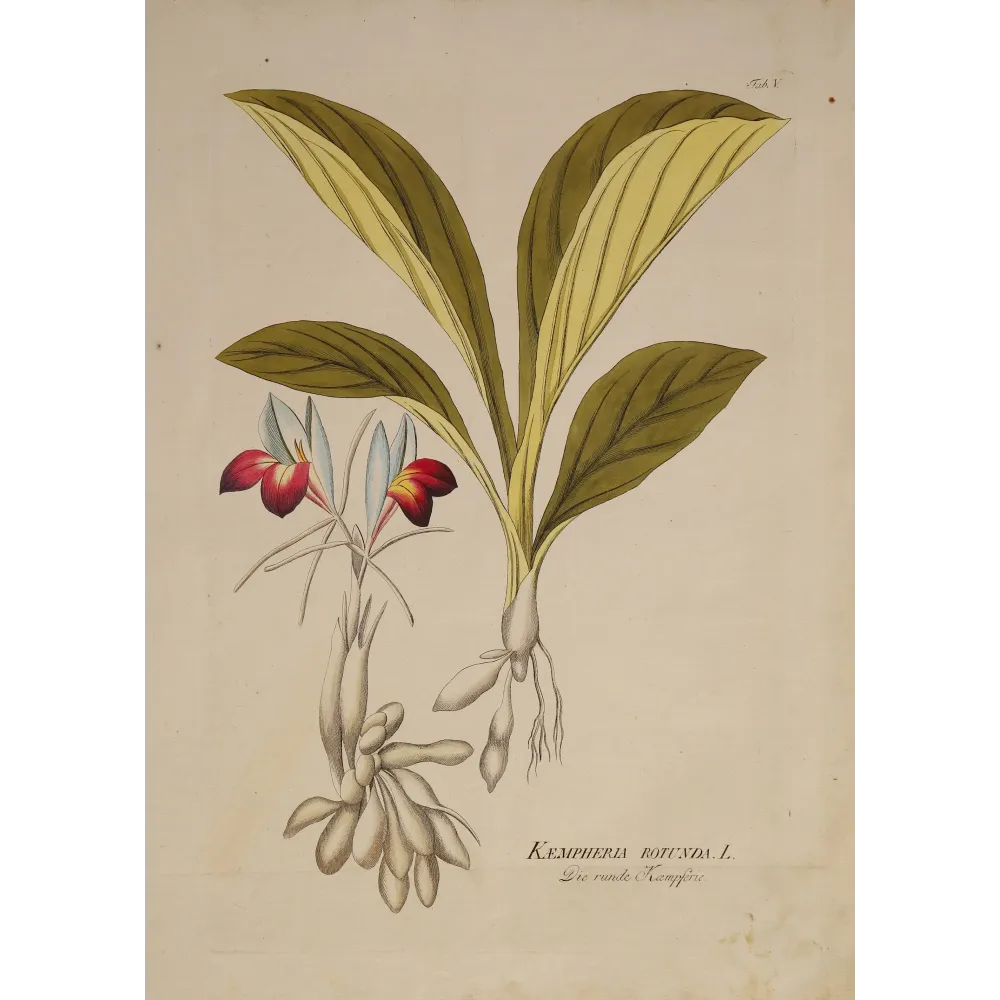
Original eighteenth-century botanical engraving depicting Kaempferia rotunda, published in Vienna by Joseph Jacob von Plenck for Icones Plantarum Medicinalium (Plate 5). The elegant composition combines broad architectural foliage, richly coloured crimson flowers and delicately modelled underground tubers, demonstrating the extraordinary refinement of Plenck's Viennese botanical school. Printed on fine Honig laid paper with visible "IV" watermark.
 Delivery policy
Your print will be carefully prepared and shipped worldwide via trusted couriers (UPS or similar).
 Authentic antique prints
Original engravings from the 17th–19th century.
This exceptional original hand-coloured engraving from Joseph Jacob von Plenck’s Icones Plantarum Medicinalium depicts Kaempferia rotunda L., a member of the ginger family distinguished by its broad foliage, delicately coloured flowers and fleshy underground structures. Published in Vienna during the late eighteenth century as Plate 5, the image presents the plant above and below ground, joining botanical completeness with remarkable visual refinement.
The composition is built upon a subtle contrast of scale and material. Four large leaves open across the upper half of the sheet, while two comparatively small crimson flowers concentrate the strongest colour near the centre. Below them, pale tubers and slender roots introduce an entirely different visual language: soft, sculptural and almost monochromatic.
Its beauty lies not in theatrical abundance, but in the quiet precision with which foliage, flower and underground structures are given distinct textures, weights and qualities of light.
The broad leaves dominate the upper portion of the engraving, opening from the centre in a balanced fan-like arrangement. The two largest leaves rise towards the upper corners, while the lateral pair extends outward at a lower level, stabilising the composition and giving the plant an architectural presence.
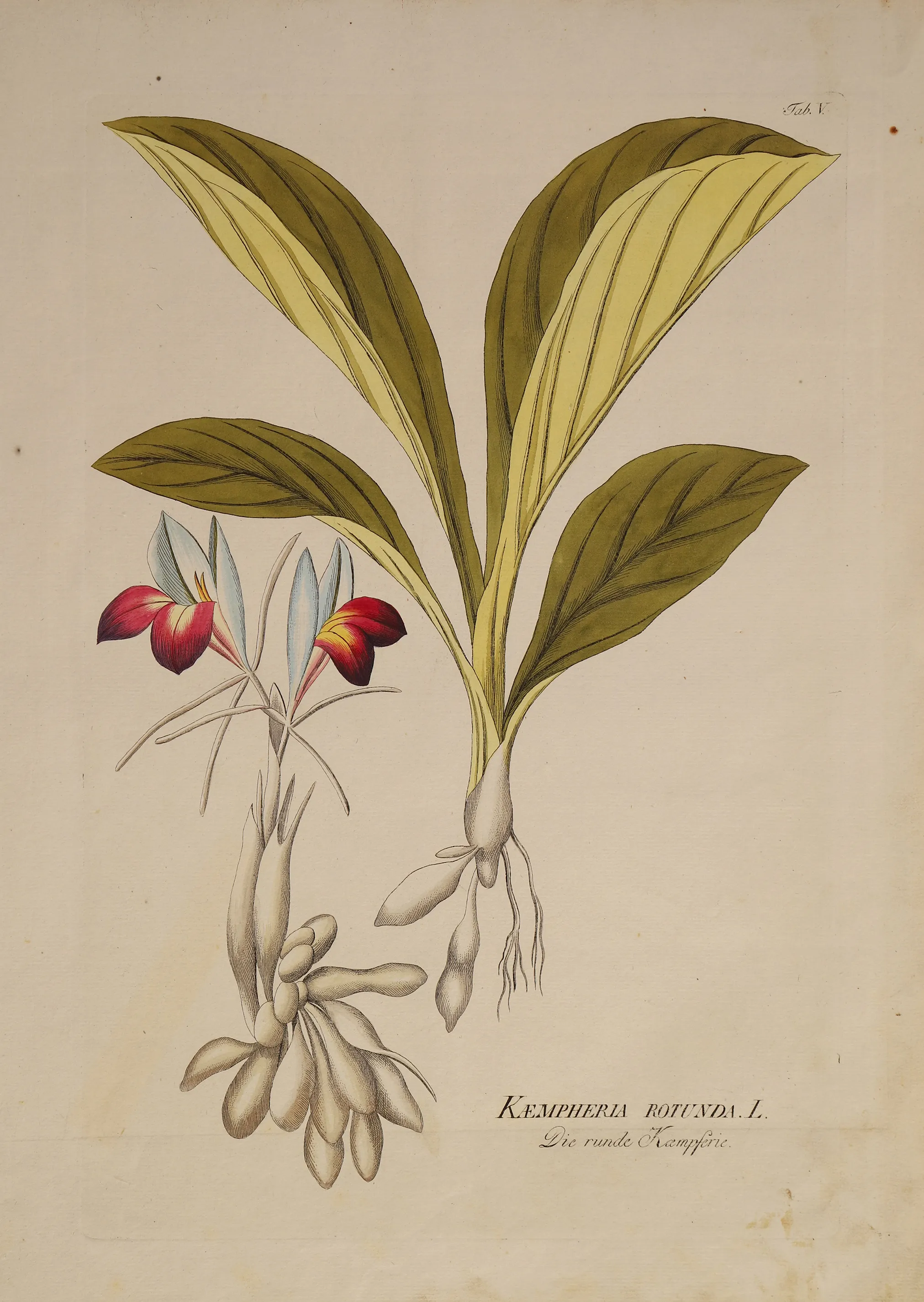
Their surfaces are modelled through restrained olive and yellow-green washes. Darker passages follow the folds and principal veins, while lighter areas suggest the portions turned towards the light. The engraved contours remain visible beneath the colour, establishing structure without making the foliage appear rigid or overly graphic.
The flowers are smaller in scale but immediately command attention. Their crimson-red petals are deepened towards the edges and shadowed folds, while warmer passages near the centre create a gradual transition towards the fine yellow reproductive structures. Pale blue-grey and nearly white floral segments provide a cool counterpoint to the concentrated red.
The lower part of the composition is particularly refined. Here the substantial mass of foliage gives way to delicate stems, roots and groups of fleshy underground tubers. Their pale surfaces create a calm visual interval between the vivid flower and the warm cream tone of the paper.
These tubers have not simply been left as uncoloured reserves. The natural white of the sheet is enriched with delicate applications of white and warm cream pigment, accompanied by subtle beige-grey shadows and finely engraved modelling. The result is soft and rounded, with an almost porcelain-like luminosity.
The engraved line is applied only where it contributes to botanical definition. It traces veins and changes of direction across the leaves, becomes lighter around the flowers and grows denser among the tubers and roots, where it establishes overlapping forms, volume and the direction from which the light falls.
Kaempferia rotunda is a perennial herb belonging to the Zingiberaceae, the botanical family that also includes ginger, turmeric and cardamom. It develops from fleshy underground structures that store nutrients and support the seasonal renewal of its foliage and flowers.
The species is recognised by its broad leaves and distinctive flowers, which emerge close to the base of the plant and combine pale floral segments with richer red or purple tones. Plenck records these contrasting structures with particular clarity, allowing the relationship between foliage, flower, roots and underground organs to be understood within a single image.
The underground structures were especially important in a botanical work concerned with medicinal plants. Accurate identification could not depend solely upon a flower that might appear only briefly. Leaves, roots, rhizomes and tubers provided additional evidence and could also represent the parts historically collected for practical or medicinal purposes.
This plate should therefore be understood as a historical document of eighteenth-century medicinal botany rather than as modern therapeutic guidance. Its value lies in recording how the species was classified, recognised and visually communicated within the scientific culture of Plenck’s time.
Joseph Jacob von Plenck conceived Icones Plantarum Medicinalium as an ambitious synthesis of scientific accuracy and artistic elegance. Plants were to be represented from life, preserving their characteristic forms, proportions and colours, while fine paper, accomplished engraving and refined hand colouring would ensure exceptional clarity.
Plate 5 demonstrates this programme through a composition of unusual restraint. The plant is botanically complete, yet no element appears crowded or diagrammatic. The broad leaves occupy the upper field with confidence, the flowers establish a concentrated chromatic centre and the pale underground structures are allowed sufficient space to remain fully legible.
The contemporary colourist differentiated the natural surfaces with notable sensitivity. Transparent green washes describe the living flexibility of the leaves, while the crimson petals receive deeper and more concentrated tones. The pale underground structures required a different approach, combining the luminosity of the paper with white, cream and lightly tinted pigments.
The handling of these tubers deserves particular attention. Their apparent simplicity conceals a sophisticated interaction between bodycolour, transparent shading and engraved line. White and warm cream pigment establish their fleshy substance, while restrained grey and beige tones create depth around folds, overlaps and recessed areas.
Rather than appearing flat, the tubers acquire a softly modelled and almost sculptural presence. Their quiet luminosity contrasts with both the strong olive foliage above and the concentrated crimson of the flowers, establishing three distinct material registers within the same botanical image.
A very light and selective application of gum arabic increases the natural sheen of the green upper surfaces and stem. Its effect remains discreet and appears designed to improve legibility rather than produce conspicuous brilliance. The flower petals remain untreated, preserving their softer and more delicate surface.
The copper engraving acts as a disciplined framework throughout. Across the leaves, the line defines veins, folds and changes in orientation. Around the flowers it remains fine and restrained, allowing the watercolour to establish much of the volume. Among the roots and tubers, denser hatching clarifies structure and creates the perception of light and shadow.
This collaboration between engraver and colourist gives the plate its distinctive refinement. Colour does not conceal the scientific structure, and the engraved line never overwhelms the natural appearance of the plant. Each technique performs only the task for which it is best suited.
The resulting engraving is less theatrical than Plenck’s most monumental flowering subjects, yet equally accomplished. Its decorative impact emerges gradually through balance, subtle contrasts and the convincing representation of different botanical surfaces. Historical value establishes its importance; technical sensitivity and quiet visual elegance elevate its place within the collection.
The engraving is printed on fine eighteenth-century laid paper associated with the Dutch Honig papermaking tradition. Closely spaced laid lines and broader chain lines form part of the physical structure of the handmade sheet and become especially apparent when examined in transmitted light.
A partial watermark or countermark is visible within the paper, including the initials “IV” and a surviving portion of the Honig papermaker’s inscription. These elements provide valuable material evidence connecting the sheet with the high-quality papers documented across Plenck’s botanical publication.
Large mould-made paper sheets were normally divided or folded before printing and binding. Consequently, an individual folio may preserve only one section of a larger watermark or countermark. The partial character of the device is therefore consistent with the original production process and forms part of the physical history of the engraving.
Honig papers were highly valued in eighteenth-century European publishing for their durability, clean surface and ability to receive both sharply impressed copperplate lines and delicate hand-applied colour. The excellent preservation and refined surface of this sheet demonstrate the exceptional material standards established for Icones Plantarum Medicinalium.
The plate mark is clearly and continuously visible, recording the pressure exerted by the copperplate during printing. Generous margins survive on all sides, preserving the original relationship between image, plate impression and folio sheet.
Published in Vienna from 1788, Joseph Jacob von Plenck’s Icones Plantarum Medicinalium represents one of the Enlightenment’s most ambitious illustrated botanical projects. Conceived for physicians, apothecaries and students, it united scientific classification with the refined visual culture of the Viennese botanical school.
Each image was printed from a finely engraved copperplate and subsequently coloured by hand. Every surviving impression therefore combines the repeatable precision of printmaking with the individual judgement and craftsmanship of an eighteenth-century colourist.
This plate reveals the technical range available to those colourists. Transparent watercolour describes foliage and petals, selective gum arabic evokes the gentle sheen of living green surfaces, and pale white and cream pigments give the underground tubers their fleshy, softly modelled appearance.
The image also reflects the scientific importance of representing medicinal plants in their entirety. Structures hidden beneath the soil were often as significant as the visible flower, and Plenck’s artists recorded them with the same precision and care.
Discover how scientific observation, fine Honig paper, copper engraving and contemporary hand colouring came together in Plenck’s botanical masterpiece.
Excellent condition. The fine eighteenth-century laid paper remains clean, structurally sound and remarkably fresh. The botanical image is free from significant stains, creases or abrasions, and the original copperplate impression retains excellent definition throughout.
The contemporary hand colouring is beautifully preserved. The olive and yellow-green foliage remains luminous, the crimson flowers retain their tonal depth and the delicate white, cream and grey modelling of the underground tubers is fully legible.
The subtle gum arabic applied to the upper green surfaces and stem survives in excellent condition, preserving its intended gentle sheen. The plate mark is perfectly visible, and generous original margins remain on all sides.
Minor historical handling traces and light surface marks are confined principally to the lower right corner, outside the central botanical composition. They are consistent with the age and authentic history of the sheet and do not compromise its overall presentation. Please examine the professional high-resolution photographs for a complete visual assessment.
Botanical name: Kaempferia rotunda L.
Common name: Round-Leaved Kaempferia
German title: Die runde Kaempferie
Work: Icones Plantarum Medicinalium
Author: Joseph Jacob von Plenck (1735–1807)
Artistic tradition: Viennese botanical school
Place of publication: Vienna
Date: c. 1788
Technique: Original copper engraving with contemporary hand-applied watercolour and delicate white and cream bodycolour
Finishing: Selective soft gum arabic applied to the upper green foliage and stem; not applied to the flower petals
Paper: Fine eighteenth-century laid paper associated with the Honig papermaking tradition
Watermark or countermark: Partial Honig mark with visible “IV” and surviving portion of the papermaker’s inscription
Plate mark: Clearly and completely visible
Plate: 5
Plant family: Zingiberaceae
Sheet size: approx. 44 × 33 cm
Condition: Excellent condition, with minor historical handling traces confined to the lower right corner
Curatorial classification: Major Premium plate
Authenticity: Original eighteenth-century print — never a modern reproduction
Specific References
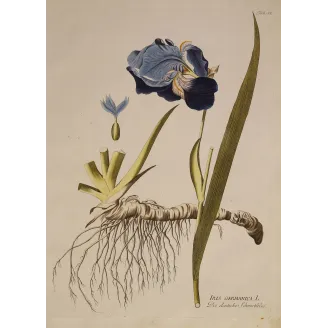
An original eighteenth-century botanical engraving depicting Iris germanica, published in Joseph Jacob von Plenck's celebrated Icones Plantarum Medicinalium. Printed on fine laid paper bearing the Honig watermark, the sheet combines scientific precision with the refined artistic craftsmanship of the Viennese botanical school.
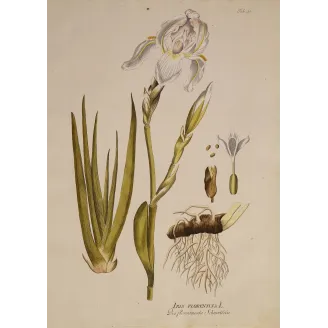
An elegant original botanical engraving depicting Iris florentina, delicately hand-coloured and published by Joseph Jacob von Plenck around 1788. Printed on original laid paper with visible plate mark and exceptionally refined colouring.
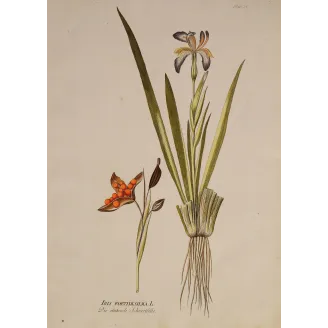
Original eighteenth-century botanical engraving depicting Iris foetidissima (Stinking Iris), published in Vienna by Joseph Jacob von Plenck for Icones Plantarum Medicinalium (Plate 37). Finely engraved and beautifully hand-coloured, the composition illustrates the flowering plant together with its open seed capsule and brilliant orange seeds, combining scientific precision with exceptional decorative elegance. Printed on fine laid Honig paper with visible "IV" watermark and excellent contemporary hand colouring.
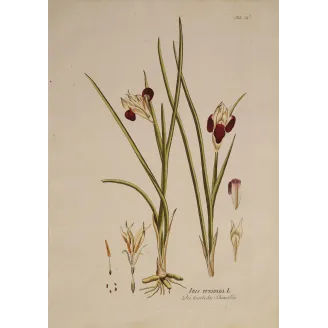
Original eighteenth-century botanical engraving depicting Iris tuberosa (Snake's Head Iris), published in Vienna by Joseph Jacob von Plenck for Icones Plantarum Medicinalium (Plate 38). This elegant composition combines two flowering specimens with finely engraved botanical details and a beautifully preserved complete Honig watermark. Contemporary hand colouring and selective gum arabic produce remarkable depth, while the velvety deep burgundy petals create one of the most refined colour harmonies within Plenck's celebrated Iris series.
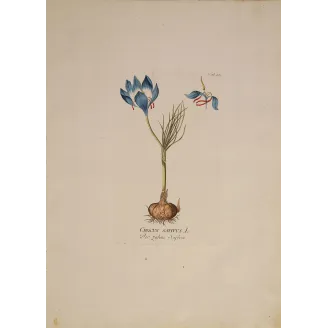
Original eighteenth-century botanical engraving depicting Crocus sativus L., the true saffron crocus, published in Vienna as Plate 32 of Joseph Jacob von Plenck's Icones Plantarum Medicinalium. This elegant composition celebrates one of history's most valuable medicinal and culinary plants through refined hand colouring, exceptional botanical clarity and beautifully preserved eighteenth-century laid paper.
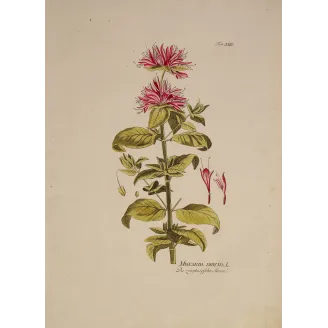
Original eighteenth-century botanical engraving depicting Monarda didyma L., published in Vienna as Plate XXIII of Joseph Jacob von Plenck's Icones Plantarum Medicinalium. This refined composition combines elegant vertical balance, delicate crimson flowers and beautifully preserved contemporary hand colouring on Honig laid paper with complete watermark.
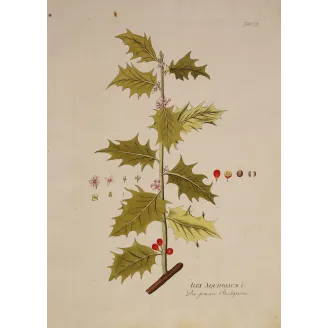
Original eighteenth-century botanical engraving depicting Ilex aquifolium L., the common holly, published in Vienna as Plate 72 of Joseph Jacob von Plenck’s Icones Plantarum Medicinalium. The composition combines sharply articulated evergreen foliage, delicate pink flowers, brilliant red fruits and separate botanical details, preserved on fine laid paper with a visible partial “IV” watermark.
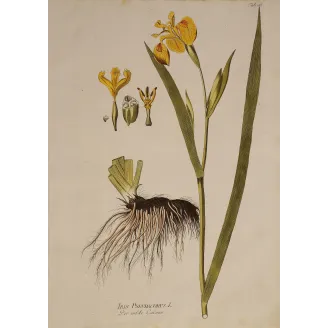
Original hand-coloured copper engraving depicting the Yellow Flag Iris (Iris pseudacorus), published by Joseph Jacob von Plenck in Vienna around 1788 for Icones Plantarum Medicinalium. A refined eighteenth-century botanical illustration distinguished by its elegant composition, beautifully engraved rhizome, luminous yellow flower, selective gum arabic highlights and excellent state of preservation.
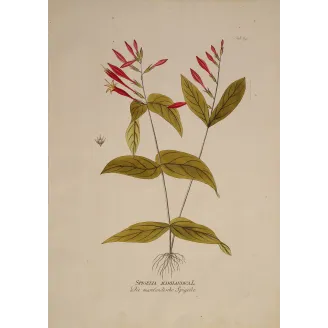
Original eighteenth-century botanical engraving depicting Spigelia marilandica L., published in Vienna as Plate 89 of Joseph Jacob von Plenck's Icones Plantarum Medicinalium. The elegant composition is distinguished by its graceful vertical rhythm, brilliant scarlet tubular flowers and refined contemporary hand colouring on fine laid paper.
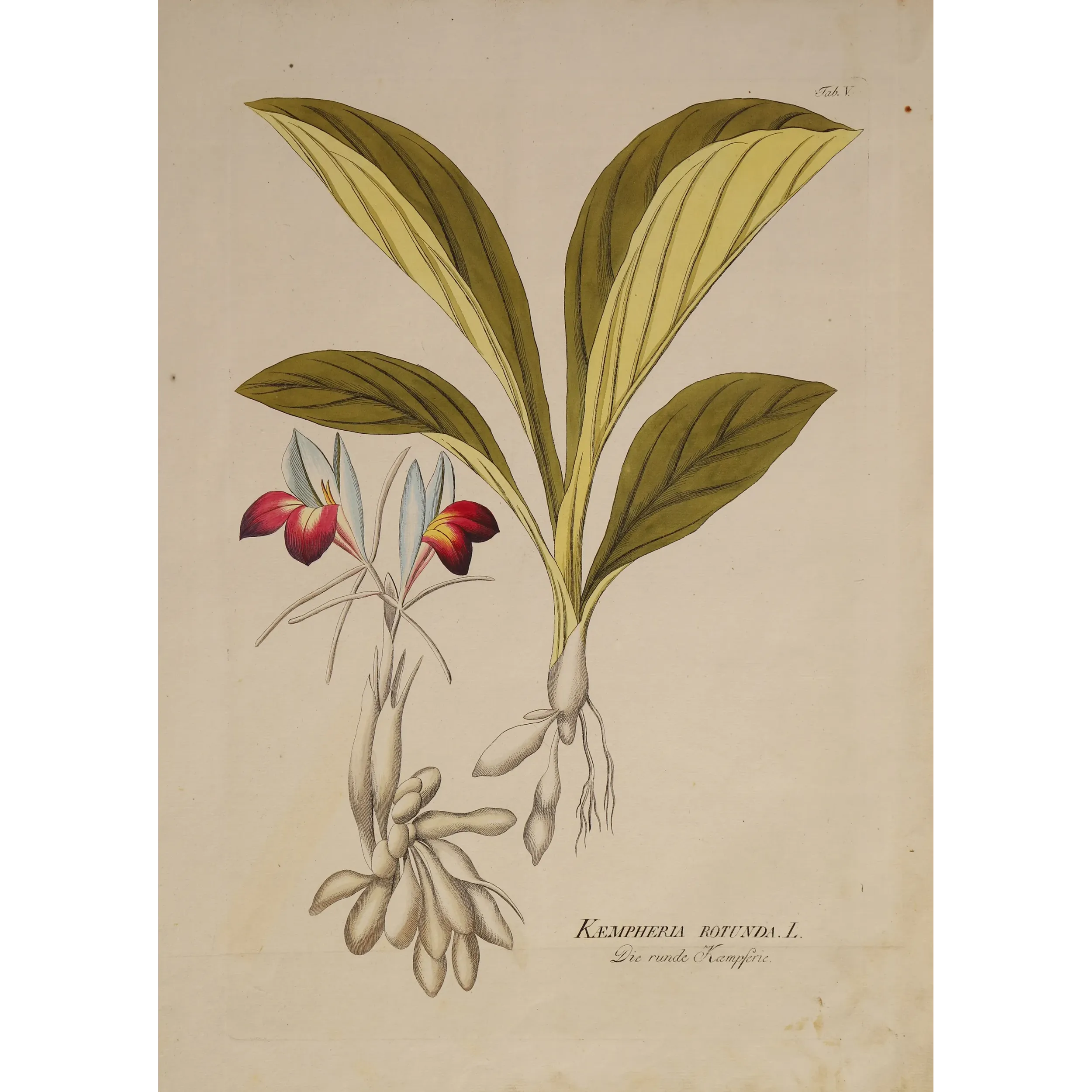
Original eighteenth-century botanical engraving depicting Kaempferia rotunda, published in Vienna by Joseph Jacob von Plenck for Icones Plantarum Medicinalium (Plate 5). The elegant composition combines broad architectural foliage, richly coloured crimson flowers and delicately modelled underground tubers, demonstrating the extraordinary refinement of Plenck's Viennese botanical school. Printed on fine Honig laid paper with visible "IV" watermark.