- New
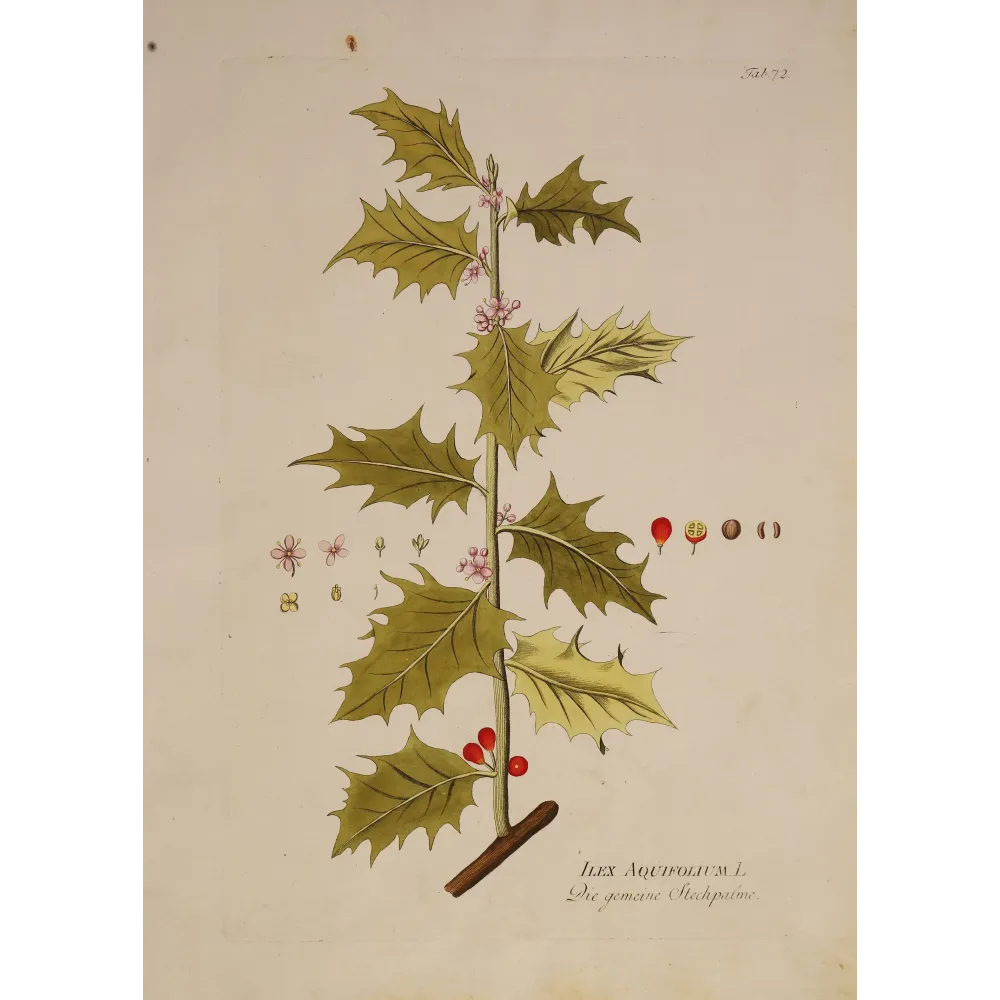
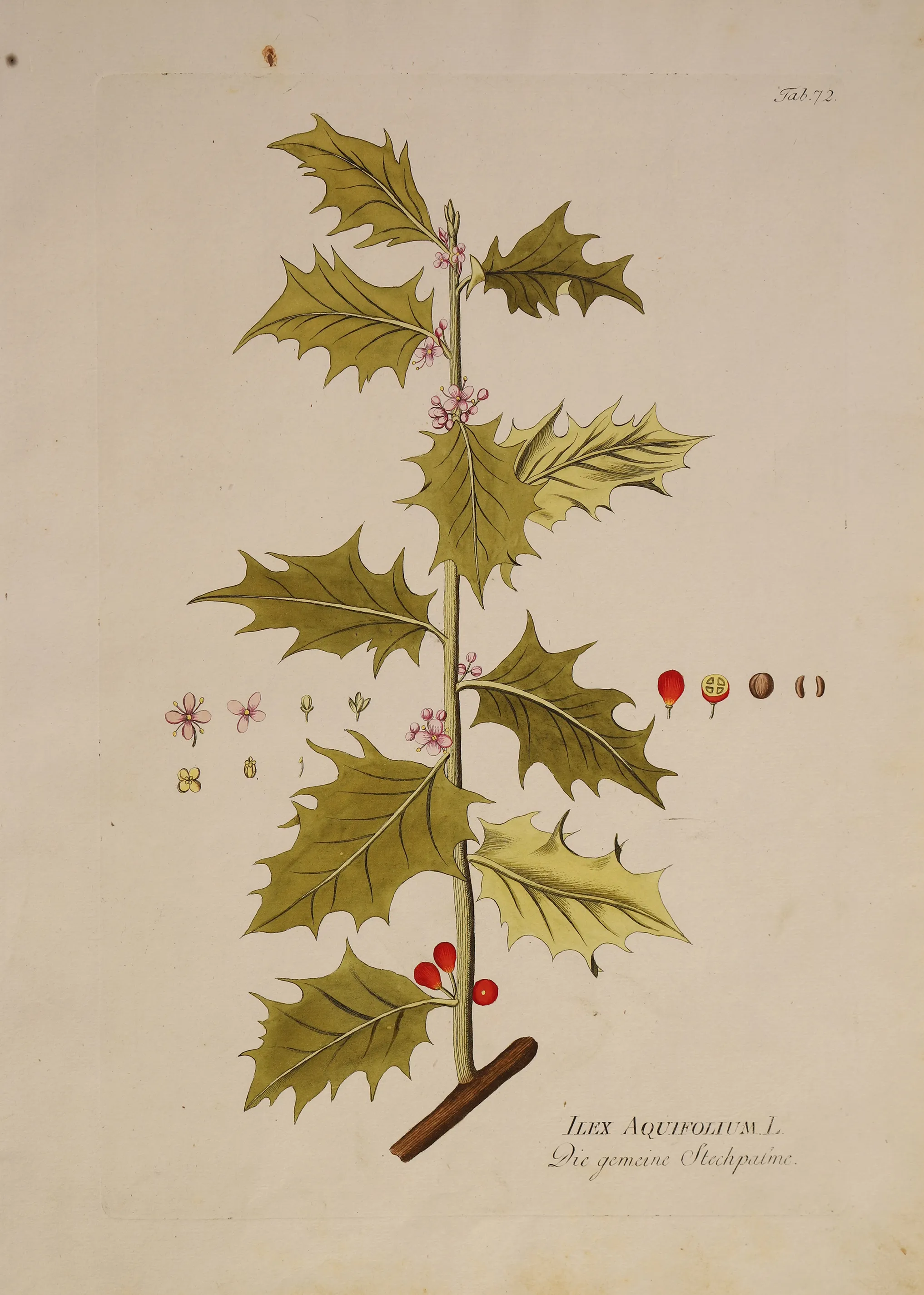
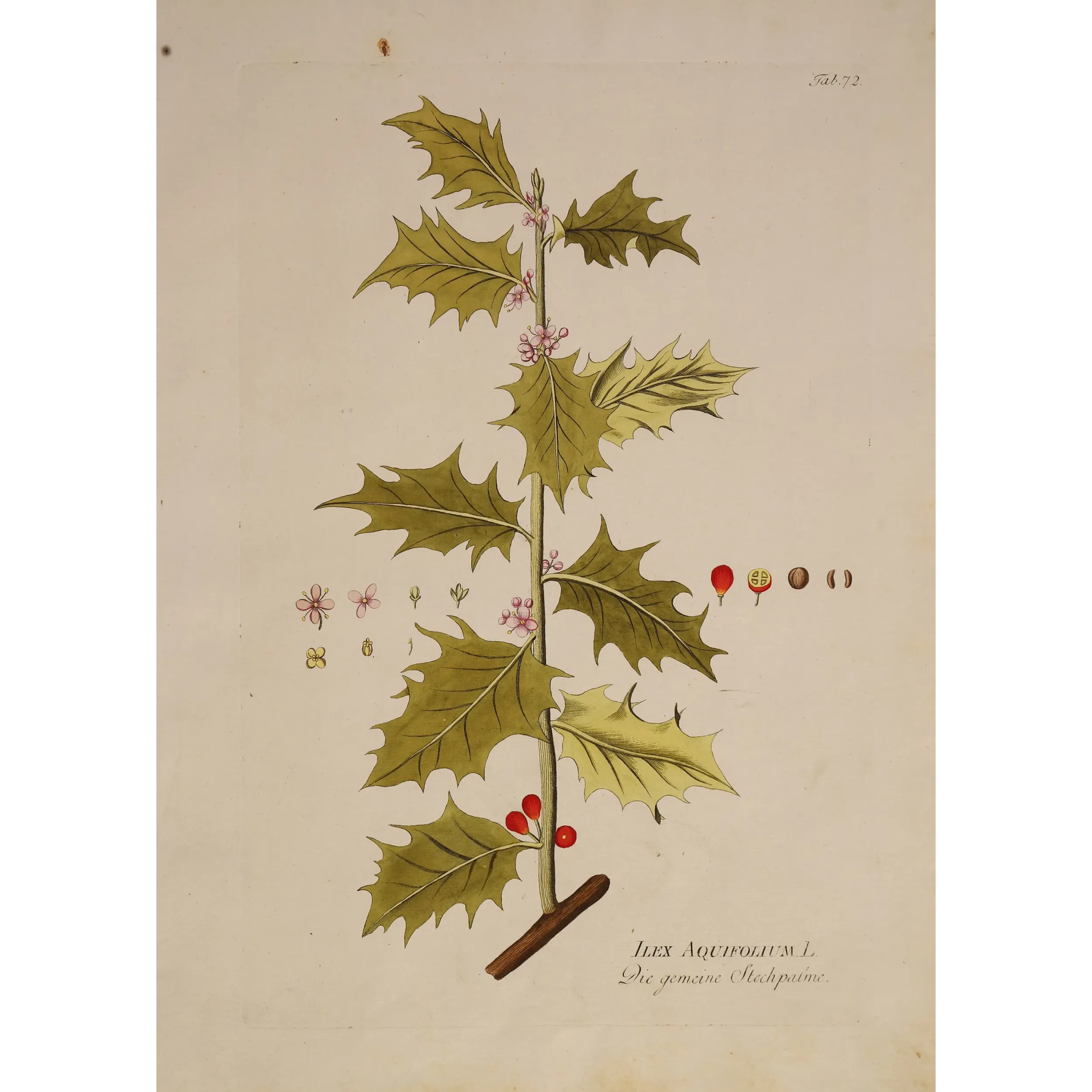
Original eighteenth-century botanical engraving depicting Ilex aquifolium L., the common holly, published in Vienna as Plate 72 of Joseph Jacob von Plenck’s Icones Plantarum Medicinalium. The composition combines sharply articulated evergreen foliage, delicate pink flowers, brilliant red fruits and separate botanical details, preserved on fine laid paper with a visible partial “IV” watermark.
 Delivery policy
Your print will be carefully prepared and shipped worldwide via trusted couriers (UPS or similar).
 Authentic antique prints
Original engravings from the 17th–19th century.
This original hand-coloured botanical engraving from Joseph Jacob von Plenck’s Icones Plantarum Medicinalium depicts Ilex aquifolium L., the common holly. Published in Vienna during the late eighteenth century as Plate 72, the image presents one of Europe’s most familiar evergreen plants through an unusually complete botanical narrative.
The upright branch is shown with mature spiny leaves, delicate pink flowers and brilliant red fruits, while separate studies arranged around the stem examine the flower, fruit and seed in greater detail. The result is both immediately recognisable and scientifically informative: a decorative portrait of the holly and, at the same time, a carefully organised record of its reproductive cycle.
The plate’s distinction lies in this union of botanical completeness and visual clarity. Every stage of the plant is represented, yet the image remains balanced, spacious and elegant.
The composition develops along a strong central stem rising from a short section of warm brown wood. Alternating leaves open to either side, creating a measured rhythm of pointed silhouettes that guides the eye upwards through the sheet. Their changing orientations prevent the vertical structure from becoming rigid: some leaves are presented almost frontally, while others turn, overlap or reveal their paler undersides.
The sharply serrated foliage gives the engraving its most distinctive graphic character. Each leaf is carefully articulated through the principal midrib, branching veins and pointed margins. The engraved line becomes denser where surfaces turn away from the light, clarifying folds, overlaps and areas of shadow without overwhelming the transparent hand colouring.
The contemporary colourist used a restrained range of olive, yellow-green and softly brown pigments across the foliage. Darker upper surfaces alternate with paler, more luminous leaves, allowing different orientations and qualities of light to be perceived throughout the composition. These tonal variations give the branch greater depth than a uniform application of green could have achieved.
Small pink flowers appear at several points along the stem. Their rounded petals and delicate colouring provide a gentle contrast to the defensive geometry of the leaves. Although modest in scale, they introduce softness and reveal the less familiar flowering phase of a plant more commonly recognised through its evergreen foliage and winter berries.
The vivid red fruits form the principal chromatic accent near the base of the branch. Their rounded shapes and concentrated colour stand apart from the angular foliage, while subtle tonal changes give them volume. Their surface remains free from gum arabic; the impression of brightness and ripeness is created by the inherent luminosity of the pigments themselves.
Separate botanical studies flank the main specimen. On the left, flowers and their reproductive structures are shown at different stages. On the right, the fruit is depicted whole, in section and through its enclosed seed structures. These elements extend the scientific content of the plate without interrupting the visual authority of the central branch.
Ilex aquifolium is an evergreen tree or shrub native to western, central and southern Europe, as well as parts of North Africa and western Asia. It belongs to the Aquifoliaceae and is immediately recognised by its glossy, leathery leaves, often armed with prominent marginal spines, and by its bright red fruits.
The flowers are much less conspicuous than the fruits. They are small and typically pale, appearing in clusters close to the leaf axils. Plenck’s engraving gives these delicate structures unusual prominence, recording their form and arrangement alongside the more familiar foliage.
The red fruits develop on female plants after pollination and persist into winter, when they provide food for birds. Their strong colour against evergreen leaves has made the holly one of the most recognisable plants in European visual and seasonal culture.
Within a work devoted to medicinal plants, however, the species was represented for purposes of identification and historical botanical study. This engraving should therefore be understood as a document of eighteenth-century medicinal botany rather than as modern therapeutic guidance.
Joseph Jacob von Plenck’s Icones Plantarum Medicinalium was conceived as a visual system in which scientific observation, fine copper engraving and contemporary hand colouring could work together with exceptional clarity. Plants were isolated against the open paper and represented through the structures necessary for reliable recognition.
Plate 72 is especially successful in showing how botanical completeness could be achieved without visual congestion. The main branch occupies the vertical centre of the image, while the separate analytical studies are distributed across the surrounding field in a balanced sequence. Each detail remains easy to examine, yet none competes with the primary specimen.
The engraving is instrumental rather than decorative in its use of line. The copperplate defines the pointed margins and internal structure of the leaves, clarifies the fine flowers and gives the woody stem its cylindrical volume. Changes in the density of hatching establish the direction of the light and produce convincing shadows across overlapping foliage.
The hand-applied watercolour is equally disciplined. Delicate olive and yellow-green washes allow the paper and engraved framework to remain active within the image. Darker pigments are concentrated on upper surfaces and recessed areas, while several turned leaves are rendered in lighter tones that suggest their paler undersides.
Soft gum arabic was selectively applied across the darker upper surfaces of the foliage. The finish increases their gentle reflectivity and evokes the naturally glossy character of living holly leaves. It remains subtle, reinforcing the existing tonal modelling rather than creating a conspicuous or uniform varnished effect.
The fruits were deliberately left untreated. Their luminosity derives from the richness of the red pigments and from the careful preservation of lighter passages within their rounded forms. This distinction between polished foliage and naturally brilliant fruit creates a refined contrast between botanical surfaces.
The small flowers introduce another material quality. Their pale pink colour has been applied lightly, maintaining a soft and delicate appearance that contrasts with both the firm evergreen leaves and the concentrated red berries. The colourist therefore differentiated foliage, flower and fruit through pigment, transparency and selective finishing.
The separate studies reveal Plenck’s educational purpose particularly clearly. Flowering structures, the developing fruit, its internal section and the enclosed seeds allow the viewer to move beyond the plant’s familiar appearance and understand the mechanisms of its reproduction.
Within the collection, this is not one of the most theatrical plates, but it is among the most complete. Its appeal rests on the immediate familiarity of the subject, the strong rhythm of its spiny leaves and the intellectual pleasure of seeing the holly represented from flower to mature fruit.
The engraving is printed on fine eighteenth-century laid paper associated with the Honig papermaking tradition. Its closely spaced laid lines and broader chain lines belong to the physical structure of the handmade sheet and can become visible when examined in transmitted or raking light.
A partial watermark or countermark containing the characters “IV” is visible within this impression. Comparable lettered fragments occur on other sheets from Plenck’s publication and form part of the material evidence connecting the plates with the high-quality papers selected for the work.
The incomplete character of the mark reflects the historical manufacture and use of handmade paper. Watermarks occupied only a particular area of the original mould-made sheet, which could subsequently be divided, folded or trimmed before printing and binding. An individual folio may therefore preserve only one section of the original device.
Honig papers were valued in eighteenth-century European publishing for their durability, clean surface and ability to receive sharply impressed copperplate lines alongside delicate hand-applied colour. The preserved surface of this sheet demonstrates how effectively those qualities supported Plenck’s demanding combination of engraving and watercolour.
The plate mark is clearly and continuously visible around the engraved field. Together with the generous margins surviving on every side, it preserves the original physical relationship between the copperplate impression and the larger folio sheet.
Published in Vienna from 1788, Joseph Jacob von Plenck’s Icones Plantarum Medicinalium belongs to the great illustrated botanical projects of the European Enlightenment. It was intended to provide physicians, apothecaries and students with clear visual references for the recognition of medicinal plants.
Each image was printed from a finely engraved copperplate and subsequently coloured by hand. Every surviving impression therefore combines the precision of printmaking with the individual decisions of an eighteenth-century colourist.
This plate demonstrates how several techniques could distinguish different natural surfaces. Transparent watercolour models the leaves and flowers, soft gum arabic evokes the gentle gloss of evergreen foliage, and luminous red pigment gives the fruits their brilliance without additional surface coating.
The inclusion of flowers, mature fruits, sectional studies and seeds reflects the scientific ambition of the publication. Plenck did not present only the plant’s most decorative appearance, but sought to record the structures necessary for a more complete understanding of the species.
Discover how scientific observation, handmade paper, copper engraving and contemporary colour came together in Plenck’s botanical masterpiece.
Excellent condition. The fine eighteenth-century laid paper remains structurally sound, clean and exceptionally fresh. The central botanical composition is free from significant creases, abrasions or disruptive stains, and the engraved impression retains excellent definition throughout.
The contemporary hand colouring is beautifully preserved. The olive and yellow-green foliage remains luminous, the delicate pink flowers retain their subtle tonal variation and the red fruits preserve their rich, concentrated colour.
The selective gum arabic applied to the darker upper leaf surfaces survives in excellent condition, maintaining its intended gentle sheen. The complete plate mark remains clearly visible, and generous original margins are preserved on all four sides.
Minor historical traces are visible principally in the margins, including light handling marks near the lower right corner and a small number of isolated age-related marks in the upper area. These remain outside the principal botanical image and are consistent with the authentic history of an eighteenth-century sheet.
Overall, the paper may be described as exceptionally well preserved and remarkably fresh for its age. Please examine the professional high-resolution photographs for a complete visual assessment.
Botanical name: Ilex aquifolium L.
Common name: Common Holly
German title: Die gemeine Stechpalme
Work: Icones Plantarum Medicinalium
Author: Joseph Jacob von Plenck (1735–1807)
Artistic tradition: Viennese botanical school
Place of publication: Vienna
Date: c. 1788
Technique: Original copper engraving with contemporary hand-applied watercolour
Finishing: Selective soft gum arabic applied to the darker upper surfaces of the foliage; not applied to the fruits
Paper: Fine eighteenth-century laid paper associated with the Honig papermaking tradition
Watermark or countermark: Partial mark with visible “IV”
Plate mark: Clearly and completely visible
Plate: 72
Plant family: Aquifoliaceae
Sheet size: approx. 44 × 33 cm
Condition: Excellent condition, with minor historical traces principally confined to the margins
Curatorial classification: Major Collection plate
Authenticity: Original eighteenth-century print — never a modern reproduction
Specific References
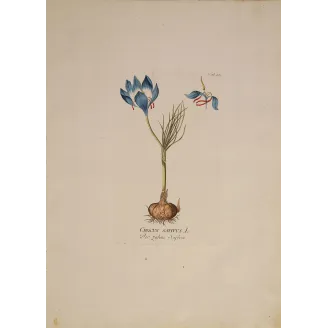
Original eighteenth-century botanical engraving depicting Crocus sativus L., the true saffron crocus, published in Vienna as Plate 32 of Joseph Jacob von Plenck's Icones Plantarum Medicinalium. This elegant composition celebrates one of history's most valuable medicinal and culinary plants through refined hand colouring, exceptional botanical clarity and beautifully preserved eighteenth-century laid paper.
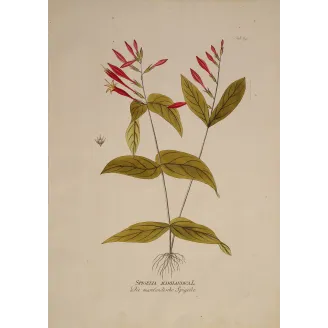
Original eighteenth-century botanical engraving depicting Spigelia marilandica L., published in Vienna as Plate 89 of Joseph Jacob von Plenck's Icones Plantarum Medicinalium. The elegant composition is distinguished by its graceful vertical rhythm, brilliant scarlet tubular flowers and refined contemporary hand colouring on fine laid paper.
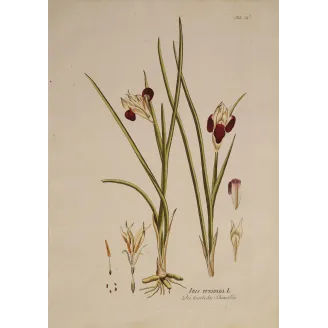
Original eighteenth-century botanical engraving depicting Iris tuberosa (Snake's Head Iris), published in Vienna by Joseph Jacob von Plenck for Icones Plantarum Medicinalium (Plate 38). This elegant composition combines two flowering specimens with finely engraved botanical details and a beautifully preserved complete Honig watermark. Contemporary hand colouring and selective gum arabic produce remarkable depth, while the velvety deep burgundy petals create one of the most refined colour harmonies within Plenck's celebrated Iris series.
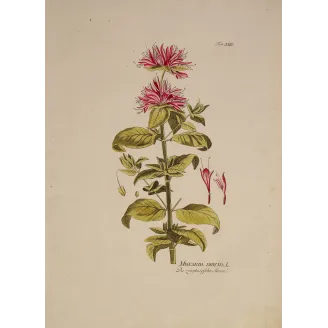
Original eighteenth-century botanical engraving depicting Monarda didyma L., published in Vienna as Plate XXIII of Joseph Jacob von Plenck's Icones Plantarum Medicinalium. This refined composition combines elegant vertical balance, delicate crimson flowers and beautifully preserved contemporary hand colouring on Honig laid paper with complete watermark.
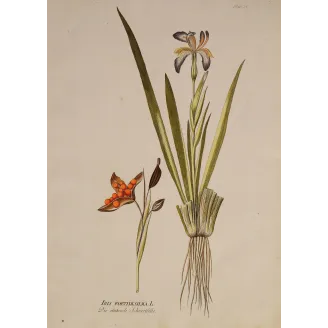
Original eighteenth-century botanical engraving depicting Iris foetidissima (Stinking Iris), published in Vienna by Joseph Jacob von Plenck for Icones Plantarum Medicinalium (Plate 37). Finely engraved and beautifully hand-coloured, the composition illustrates the flowering plant together with its open seed capsule and brilliant orange seeds, combining scientific precision with exceptional decorative elegance. Printed on fine laid Honig paper with visible "IV" watermark and excellent contemporary hand colouring.
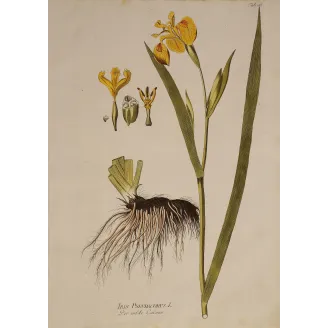
Original hand-coloured copper engraving depicting the Yellow Flag Iris (Iris pseudacorus), published by Joseph Jacob von Plenck in Vienna around 1788 for Icones Plantarum Medicinalium. A refined eighteenth-century botanical illustration distinguished by its elegant composition, beautifully engraved rhizome, luminous yellow flower, selective gum arabic highlights and excellent state of preservation.
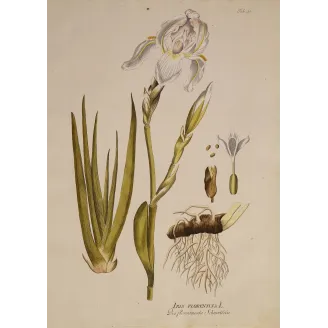
An elegant original botanical engraving depicting Iris florentina, delicately hand-coloured and published by Joseph Jacob von Plenck around 1788. Printed on original laid paper with visible plate mark and exceptionally refined colouring.
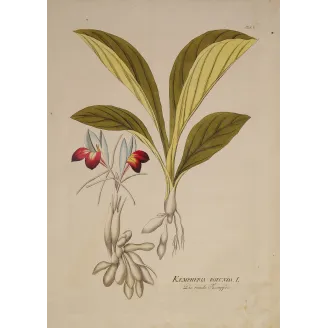
Original eighteenth-century botanical engraving depicting Kaempferia rotunda, published in Vienna by Joseph Jacob von Plenck for Icones Plantarum Medicinalium (Plate 5). The elegant composition combines broad architectural foliage, richly coloured crimson flowers and delicately modelled underground tubers, demonstrating the extraordinary refinement of Plenck's Viennese botanical school. Printed on fine Honig laid paper with visible "IV" watermark.
An original eighteenth-century botanical engraving depicting Iris germanica, published in Joseph Jacob von Plenck's celebrated Icones Plantarum Medicinalium. Printed on fine laid paper bearing the Honig watermark, the sheet combines scientific precision with the refined artistic craftsmanship of the Viennese botanical school.
Original eighteenth-century botanical engraving depicting Ilex aquifolium L., the common holly, published in Vienna as Plate 72 of Joseph Jacob von Plenck’s Icones Plantarum Medicinalium. The composition combines sharply articulated evergreen foliage, delicate pink flowers, brilliant red fruits and separate botanical details, preserved on fine laid paper with a visible partial “IV” watermark.