- New
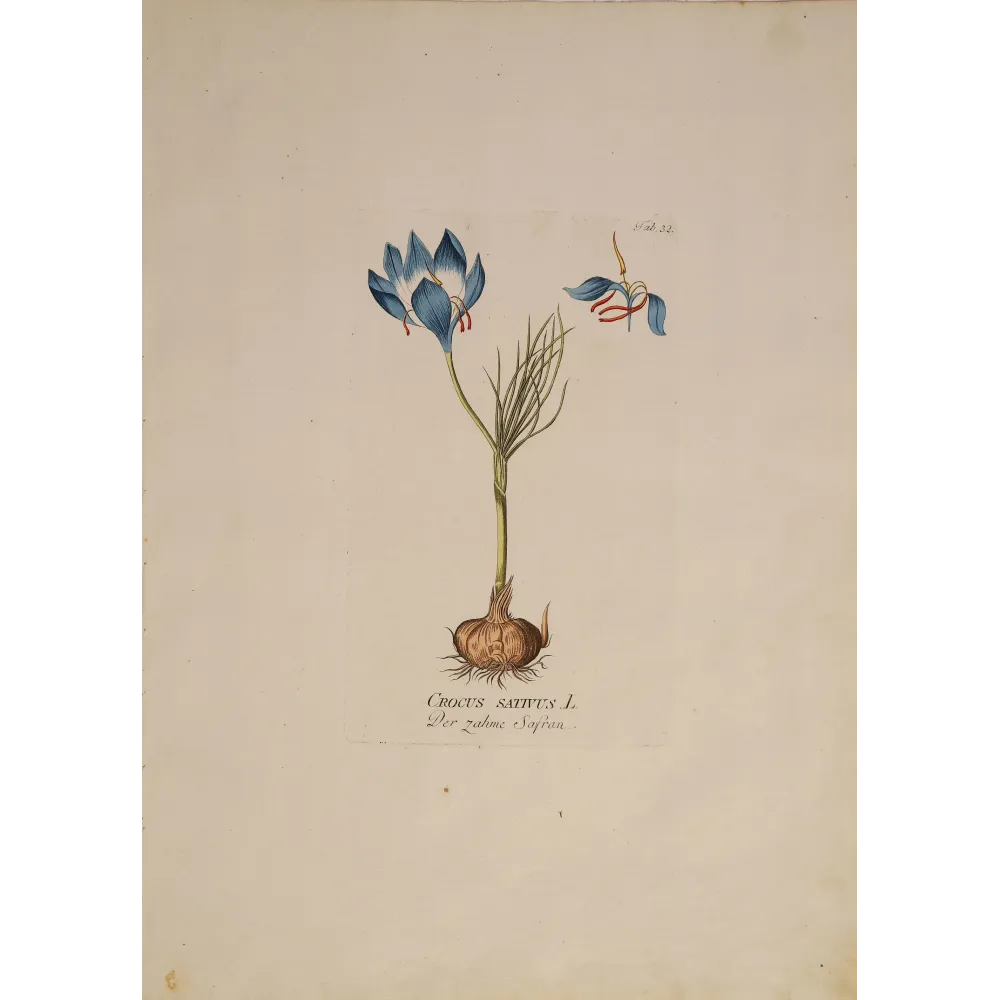
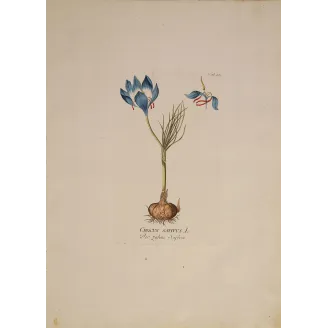
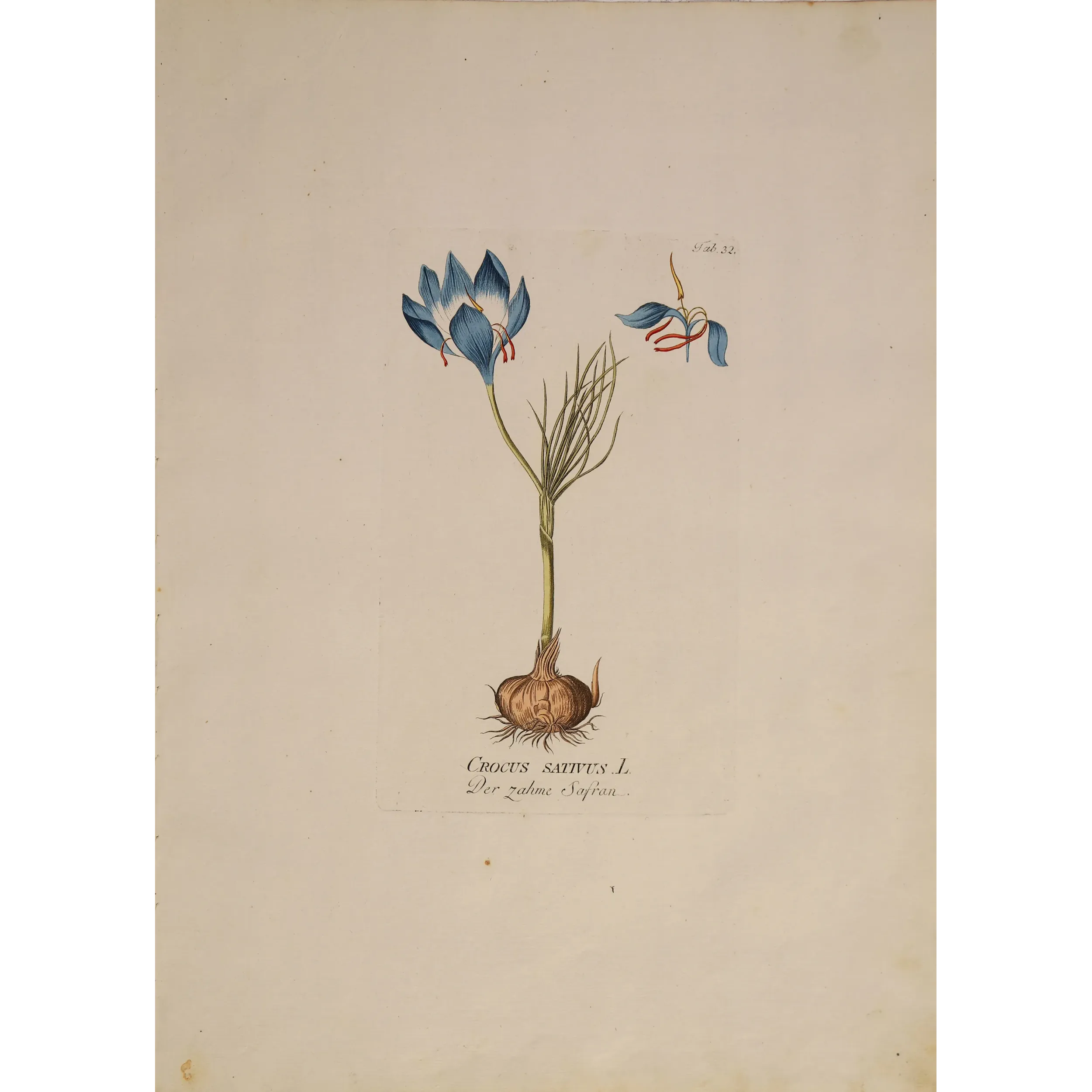
Original eighteenth-century botanical engraving depicting Crocus sativus L., the true saffron crocus, published in Vienna as Plate 32 of Joseph Jacob von Plenck's Icones Plantarum Medicinalium. This elegant composition celebrates one of history's most valuable medicinal and culinary plants through refined hand colouring, exceptional botanical clarity and beautifully preserved eighteenth-century laid paper.
 Delivery policy
Your print will be carefully prepared and shipped worldwide via trusted couriers (UPS or similar).
 Authentic antique prints
Original engravings from the 17th–19th century.
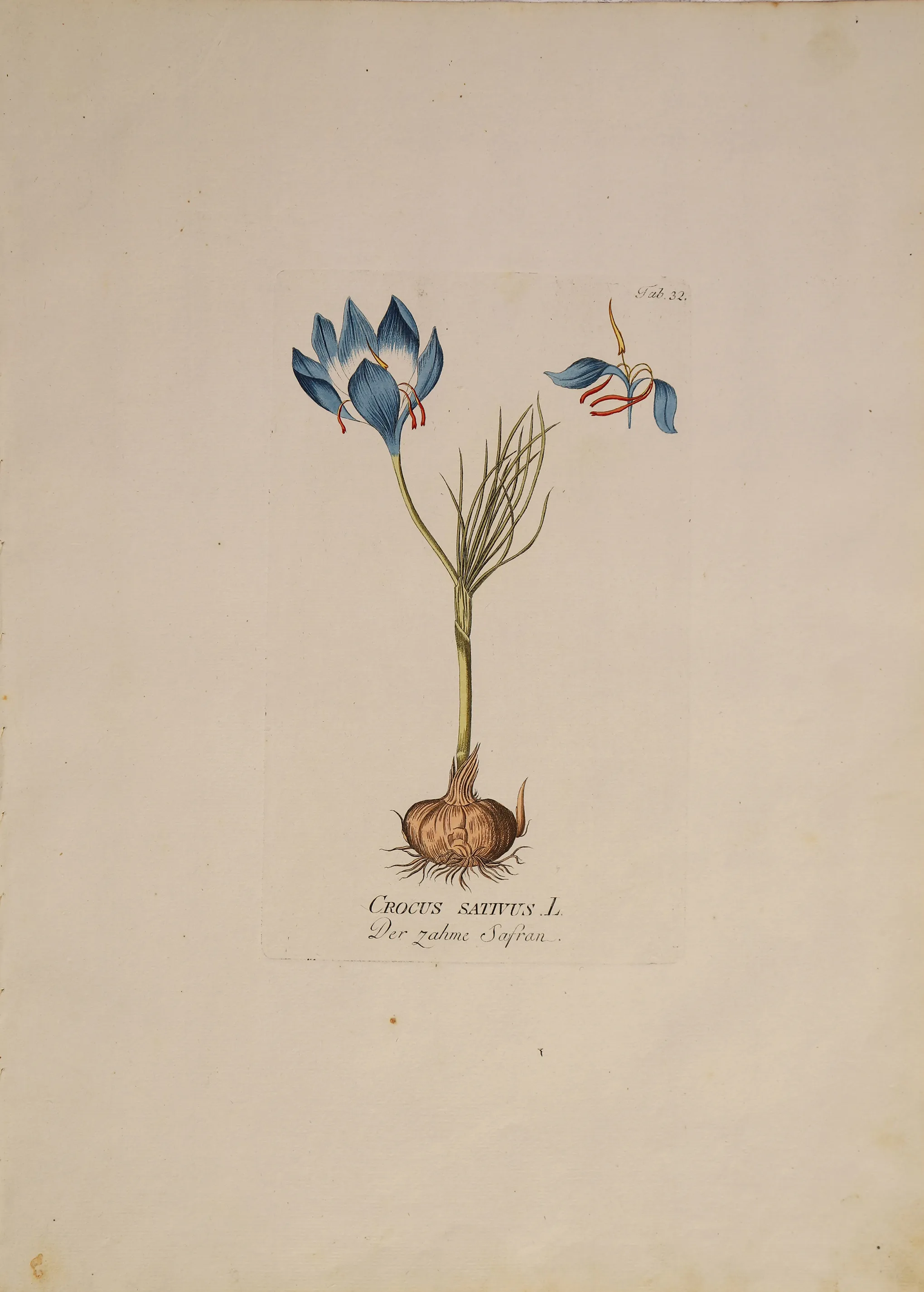
This original hand-coloured botanical engraving from Joseph Jacob von Plenck’s Icones Plantarum Medicinalium depicts Crocus sativus L., the true saffron crocus. Published in Vienna during the late eighteenth century as Plate 32, the image presents one of the most historically significant cultivated plants through a composition of exceptional clarity and restraint.
A single flowering specimen rises from its rounded underground corm, accompanied by slender leaves and a separate analytical study of the flower. Deep blue petals frame the vivid red stigmas from which saffron is obtained, concentrating the botanical and cultural identity of the species within a remarkably economical image.
The plate’s apparent simplicity is its greatest strength: nothing distracts from the flower, the crimson stigmas and the underground structure that together identify one of the most precious plants in the history of medicine, food and trade.
The composition is centred upon a single slender stem emerging from a carefully modelled corm. Narrow leaves rise beside it in a compact group, their fine linear forms creating a delicate transition between the substantial underground structure and the open flower above.
The flower bends slightly towards the left, preventing the image from becoming rigidly symmetrical. Its blue petals open in a restrained fan-like arrangement, while the enlarged floral study placed to the upper right balances the main specimen and clarifies the structure of the flower.
The contemporary hand colouring is exceptionally refined. The petals move from lighter blue-grey passages towards deeper indigo at their tips and shadowed folds. The transparent pigments allow the engraved modelling to remain visible beneath the colour, giving the flower volume without sacrificing its delicate character.
The crimson stigmas provide the strongest chromatic accent. Their warm red colour immediately distinguishes them from the cooler petals and draws attention to the part of the flower historically collected as saffron. Fine yellow and olive details complete the reproductive structures without competing with this central contrast.
The corm is represented with greater density and material weight. Brown, ochre and cream washes are supported by closely controlled engraved lines that describe its layered outer covering, rounded volume and fine roots. This concentrated modelling anchors the otherwise light and open composition.
The engraved line is applied only where structurally useful. It defines the slender leaves, clarifies the folds of the petals and becomes denser around the corm, where line and colour work together to establish the direction of the light and the formation of shadow.
No gum arabic has been detected. The luminosity of the blue petals and red stigmas therefore derives from the transparency, concentration and careful layering of the contemporary pigments themselves.
Crocus sativus is the cultivated saffron crocus, a perennial plant belonging to the Iridaceae. It develops from an underground corm and produces slender leaves together with violet or blue-violet flowers distinguished by three elongated red stigmas.
These stigmas are harvested and dried to produce saffron. Because each flower provides only a very small quantity and the collection must be undertaken with great care, saffron has long been regarded as an exceptionally precious botanical product.
Across different historical cultures it has been valued as a spice, colouring material, aromatic substance and ingredient within traditional medicinal practice. Its importance therefore extends beyond botanical classification into the histories of agriculture, commerce, cuisine and material culture.
Plenck’s engraving concentrates on the structures required for recognition: the flowering plant, the corm, the slender foliage and a separate floral detail exposing the distinctive stigmas. The image should be understood as a historical document of eighteenth-century medicinal botany rather than as modern therapeutic guidance.
Joseph Jacob von Plenck conceived Icones Plantarum Medicinalium as a union of botanical instruction and refined artistic presentation. Plants were isolated against the open sheet and represented through the structures necessary for identification, while fine copper engraving and contemporary hand colouring gave each plate exceptional visual clarity.
Plate 32 demonstrates how effectively this programme could operate through reduction. The specimen occupies only a relatively small area of the generous folio sheet, yet every important element is present. Flower, stigmas, foliage, corm and roots form a complete botanical statement without the need for an elaborate or abundant composition.
The expansive surrounding paper is therefore not empty in a negative sense. It isolates the plant, increases its legibility and gives the image an unexpectedly modern quality. The eye is directed immediately towards the contrast between the cool flower and the warm red stigmas, before descending through the fine leaves to the substantial corm below.
The engraved line provides the botanical framework with notable discipline. Around the petals it remains light, defining folds and changes of direction without diminishing the transparency of the blue colour. In the corm, denser and more closely spaced lines create a greater sense of weight, texture and three-dimensional form.
The watercolour is similarly economical. Variations of blue establish the structure of the flower, olive tones articulate the stem and foliage, and warm brown pigments model the corm. The brilliant red stigmas require little additional elaboration: their colour alone identifies the most culturally significant feature of the plant.
The absence of gum arabic is especially appropriate to this restrained image. No additional surface gloss was required. The flower achieves its luminosity through transparent washes, carefully preserved highlights and the natural brilliance of the pigments, maintaining a soft and convincingly organic appearance.
The separate floral study expands the scientific content without disturbing the composition. By isolating the petals, stamens and elongated red stigmas, it allows the viewer to understand precisely which structures distinguish the saffron crocus and which part of the flower is collected.
Artistically, this is one of the more minimal plates within the Plenck collection. Its importance, however, cannot be judged by visual complexity alone. Crocus sativus possesses exceptional historical and collector desirability as the source of saffron, giving the engraving a cultural resonance extending far beyond the field of botanical art.
The plate therefore illustrates an essential principle in the evaluation of antique botanical prints. Historical importance establishes the foundation of value, while artistic quality, technical execution, botanical narrative and the desirability of the represented species determine its final position within a collection.
Here, the modest scale of the image is balanced by the extraordinary significance of its subject. The result is a Hero Collection plate whose appeal lies not in spectacle, but in the rare union of visual purity, scientific clarity and exceptional cultural importance.
The engraving is printed on fine eighteenth-century laid paper associated with the Honig papermaking tradition. Closely spaced laid lines and broader chain lines belong to the physical structure of the handmade sheet and may become visible when examined in transmitted or raking light.
A partial watermark or countermark containing the characters “IV” is visible within this impression. Comparable lettered fragments appear across other plates from Plenck’s publication and provide valuable material evidence connecting the sheet with the high-quality papers selected for the work.
The partial nature of the mark is consistent with the historical production of handmade paper. A watermark occupied only a specific area of the original mould-made sheet, which could subsequently be divided or folded before printing and binding. Individual folios may therefore contain only one portion of the larger device.
Honig papers were valued in eighteenth-century European publishing for their durability, refined surface and ability to receive both sharply impressed copperplate lines and delicate hand-applied colour. The freshness and stability of this sheet demonstrate the high material standards associated with Icones Plantarum Medicinalium.
The plate mark is clearly and continuously visible around the engraved field. Its complete preservation, together with generous margins on every side, retains the original relationship between the copperplate impression and the larger folio sheet.
Published in Vienna from 1788, Joseph Jacob von Plenck’s Icones Plantarum Medicinalium belongs to the great illustrated botanical projects of the European Enlightenment. It was intended to provide physicians, apothecaries and students with clear visual references for recognising plants associated with historical medicinal practice.
Each image was printed from a finely engraved copperplate and subsequently coloured by hand. Every surviving impression therefore combines the repeatable precision of printmaking with the individual judgement and craftsmanship of an eighteenth-century colourist.
In this plate, the transparency of the watercolour is sufficient to create every visual effect. Blue pigments model the flower, warm browns give substance to the corm and vivid red identifies the precious saffron stigmas. No gum arabic was required to increase their brilliance.
The cultivation and exchange of saffron connect this botanical image with a much broader history of agriculture, luxury consumption and international commerce. A scientifically concise engraving thus becomes a document of one of humanity’s longest and most significant relationships with a cultivated plant.
Discover how scientific observation, handmade paper, copper engraving and contemporary colour came together in Plenck’s botanical masterpiece.
Excellent condition. The fine eighteenth-century laid paper remains structurally sound, remarkably clean and exceptionally fresh. The botanical image is free from significant creases, abrasions or disruptive stains, and the engraved impression retains excellent definition throughout.
The contemporary hand colouring is beautifully preserved. The blue flower retains its delicate tonal transitions, the crimson stigmas remain vivid and the warm brown modelling of the corm is fully legible. The absence of gum arabic allows the original transparency and natural luminosity of the pigments to be appreciated clearly.
The plate mark is perfectly visible, and generous original margins survive on all four sides. The broad unprinted areas remain clean and provide an elegant presentation appropriate to the restrained scale of the botanical composition.
Only extremely light historical handling and age-related traces are visible, principally near the lower right corner and in the outer margins. These remain outside the central engraved field and do not compromise the presentation of the plate.
Overall, the paper may be described as exceptionally well preserved and virtually perfect for an eighteenth-century botanical engraving. Please examine the professional high-resolution photographs for a complete visual assessment.
Botanical name: Crocus sativus L.
Common name: Saffron Crocus
German title: Der zahme Safran
Work: Icones Plantarum Medicinalium
Author: Joseph Jacob von Plenck (1735–1807)
Artistic tradition: Viennese botanical school
Place of publication: Vienna
Date: c. 1788
Technique: Original copper engraving with contemporary hand-applied watercolour
Finishing: No gum arabic detected
Paper: Fine eighteenth-century laid paper associated with the Honig papermaking tradition
Watermark or countermark: Partial mark with visible “IV”
Plate mark: Clearly and completely visible
Plate: 32
Plant family: Iridaceae
Sheet size: approx. 44 × 33 cm
Condition: Excellent condition, with only extremely light historical traces principally confined to the margins
Curatorial classification: Hero Collection plate
Collector positioning: Highly desirable historical subject associated with saffron cultivation, medicine, cuisine and trade
Authenticity: Original eighteenth-century print — never a modern reproduction
Specific References
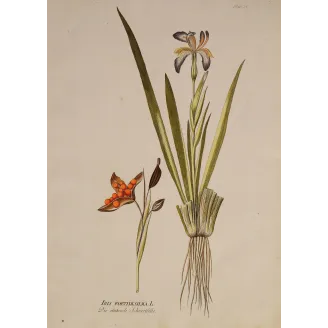
Original eighteenth-century botanical engraving depicting Iris foetidissima (Stinking Iris), published in Vienna by Joseph Jacob von Plenck for Icones Plantarum Medicinalium (Plate 37). Finely engraved and beautifully hand-coloured, the composition illustrates the flowering plant together with its open seed capsule and brilliant orange seeds, combining scientific precision with exceptional decorative elegance. Printed on fine laid Honig paper with visible "IV" watermark and excellent contemporary hand colouring.
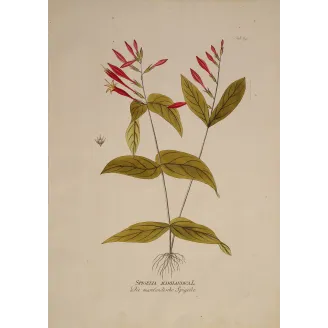
Original eighteenth-century botanical engraving depicting Spigelia marilandica L., published in Vienna as Plate 89 of Joseph Jacob von Plenck's Icones Plantarum Medicinalium. The elegant composition is distinguished by its graceful vertical rhythm, brilliant scarlet tubular flowers and refined contemporary hand colouring on fine laid paper.
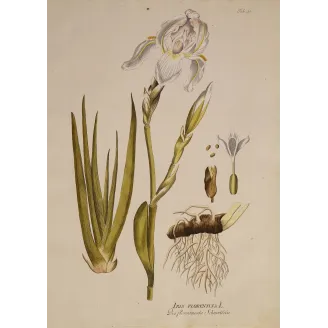
An elegant original botanical engraving depicting Iris florentina, delicately hand-coloured and published by Joseph Jacob von Plenck around 1788. Printed on original laid paper with visible plate mark and exceptionally refined colouring.
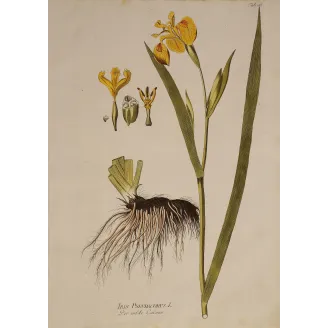
Original hand-coloured copper engraving depicting the Yellow Flag Iris (Iris pseudacorus), published by Joseph Jacob von Plenck in Vienna around 1788 for Icones Plantarum Medicinalium. A refined eighteenth-century botanical illustration distinguished by its elegant composition, beautifully engraved rhizome, luminous yellow flower, selective gum arabic highlights and excellent state of preservation.
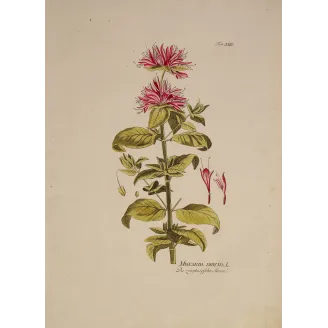
Original eighteenth-century botanical engraving depicting Monarda didyma L., published in Vienna as Plate XXIII of Joseph Jacob von Plenck's Icones Plantarum Medicinalium. This refined composition combines elegant vertical balance, delicate crimson flowers and beautifully preserved contemporary hand colouring on Honig laid paper with complete watermark.
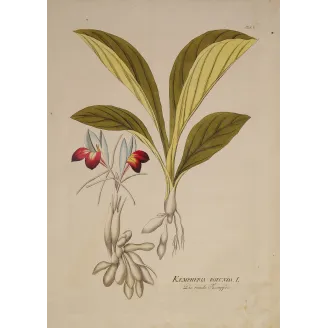
Original eighteenth-century botanical engraving depicting Kaempferia rotunda, published in Vienna by Joseph Jacob von Plenck for Icones Plantarum Medicinalium (Plate 5). The elegant composition combines broad architectural foliage, richly coloured crimson flowers and delicately modelled underground tubers, demonstrating the extraordinary refinement of Plenck's Viennese botanical school. Printed on fine Honig laid paper with visible "IV" watermark.
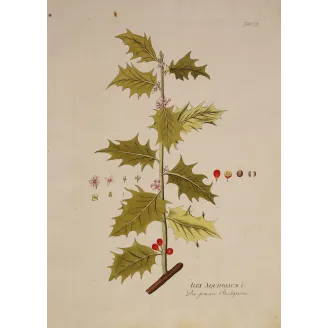
Original eighteenth-century botanical engraving depicting Ilex aquifolium L., the common holly, published in Vienna as Plate 72 of Joseph Jacob von Plenck’s Icones Plantarum Medicinalium. The composition combines sharply articulated evergreen foliage, delicate pink flowers, brilliant red fruits and separate botanical details, preserved on fine laid paper with a visible partial “IV” watermark.
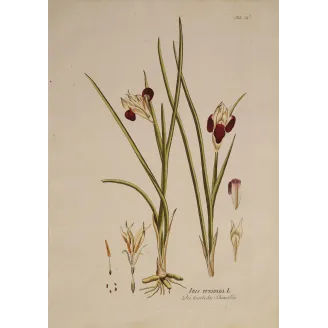
Original eighteenth-century botanical engraving depicting Iris tuberosa (Snake's Head Iris), published in Vienna by Joseph Jacob von Plenck for Icones Plantarum Medicinalium (Plate 38). This elegant composition combines two flowering specimens with finely engraved botanical details and a beautifully preserved complete Honig watermark. Contemporary hand colouring and selective gum arabic produce remarkable depth, while the velvety deep burgundy petals create one of the most refined colour harmonies within Plenck's celebrated Iris series.
An original eighteenth-century botanical engraving depicting Iris germanica, published in Joseph Jacob von Plenck's celebrated Icones Plantarum Medicinalium. Printed on fine laid paper bearing the Honig watermark, the sheet combines scientific precision with the refined artistic craftsmanship of the Viennese botanical school.
Original eighteenth-century botanical engraving depicting Crocus sativus L., the true saffron crocus, published in Vienna as Plate 32 of Joseph Jacob von Plenck's Icones Plantarum Medicinalium. This elegant composition celebrates one of history's most valuable medicinal and culinary plants through refined hand colouring, exceptional botanical clarity and beautifully preserved eighteenth-century laid paper.