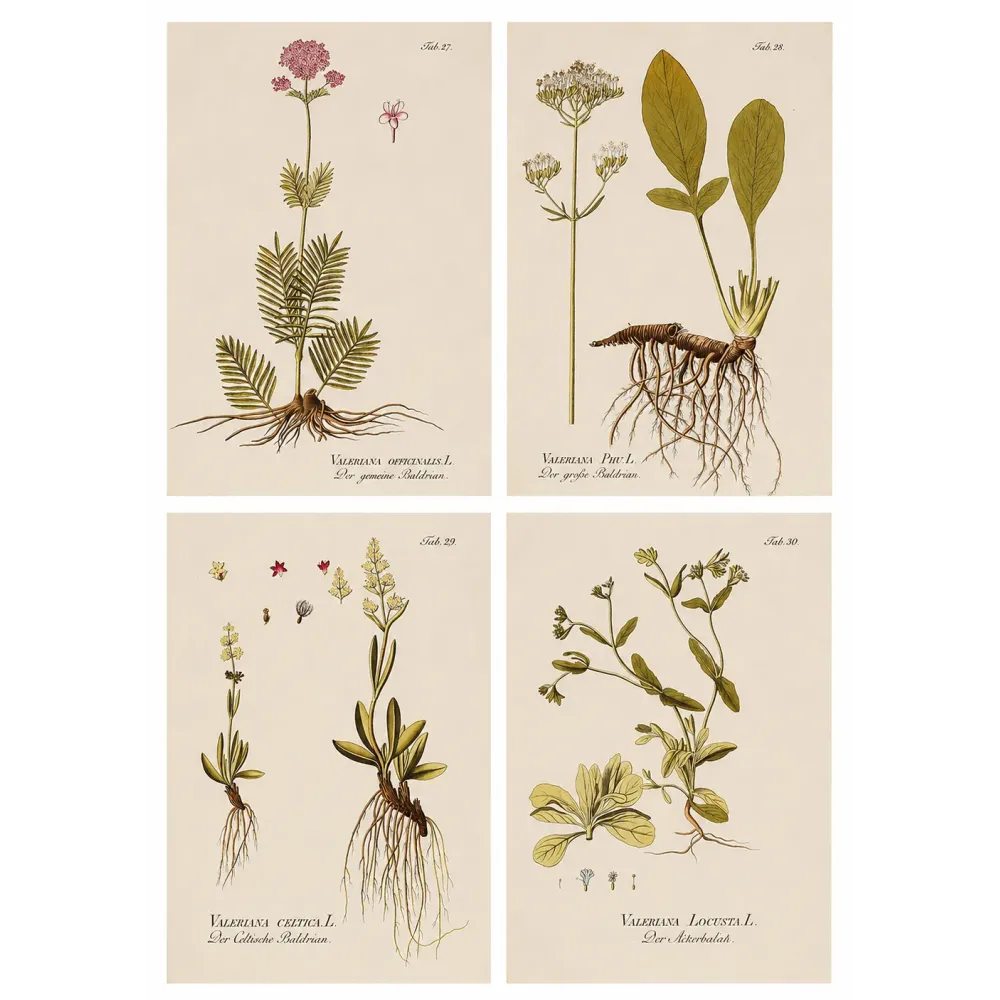
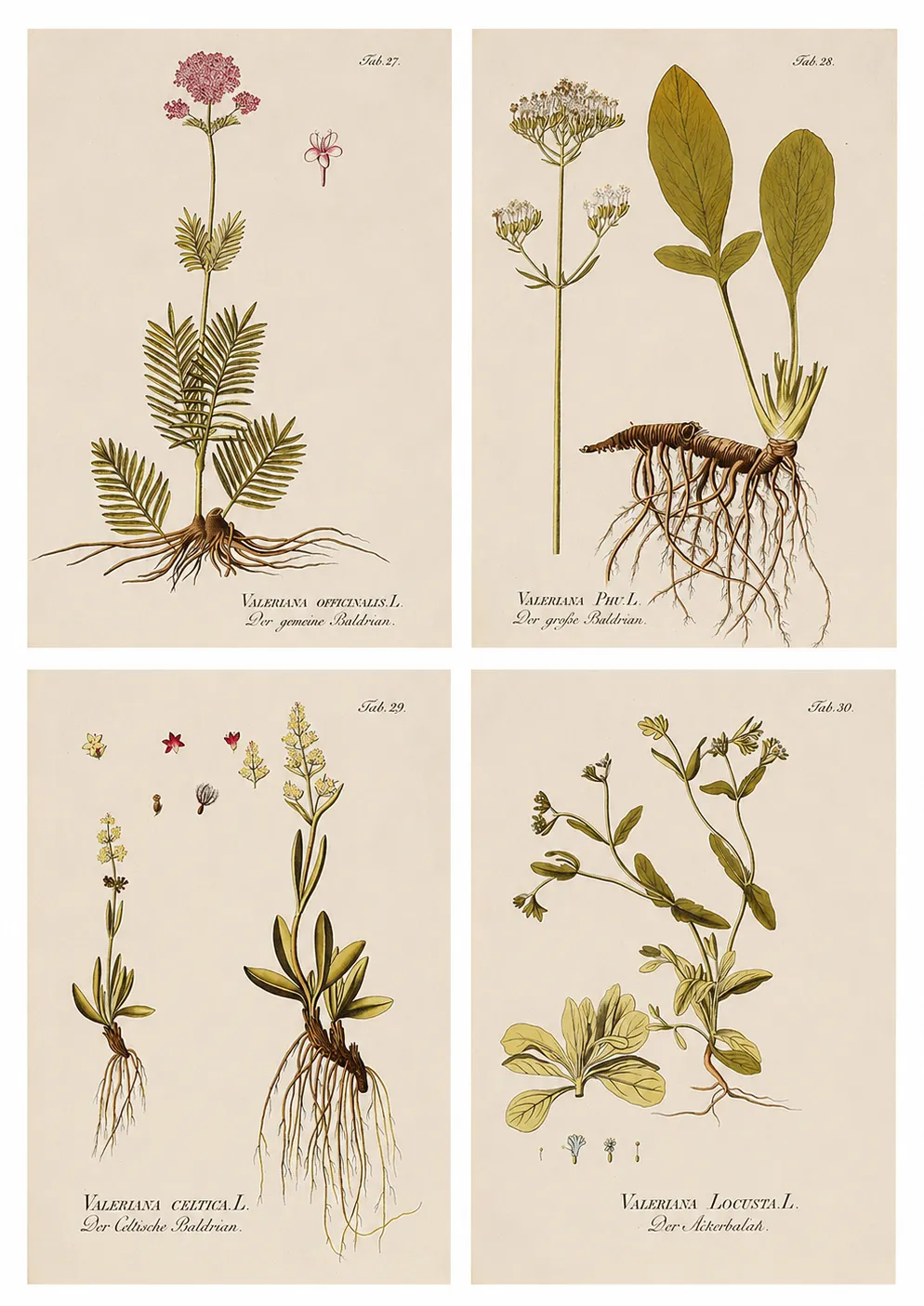
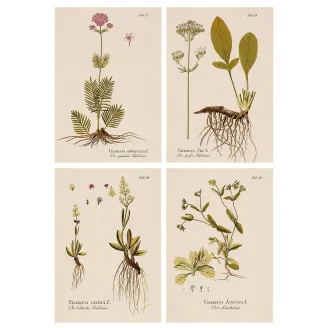
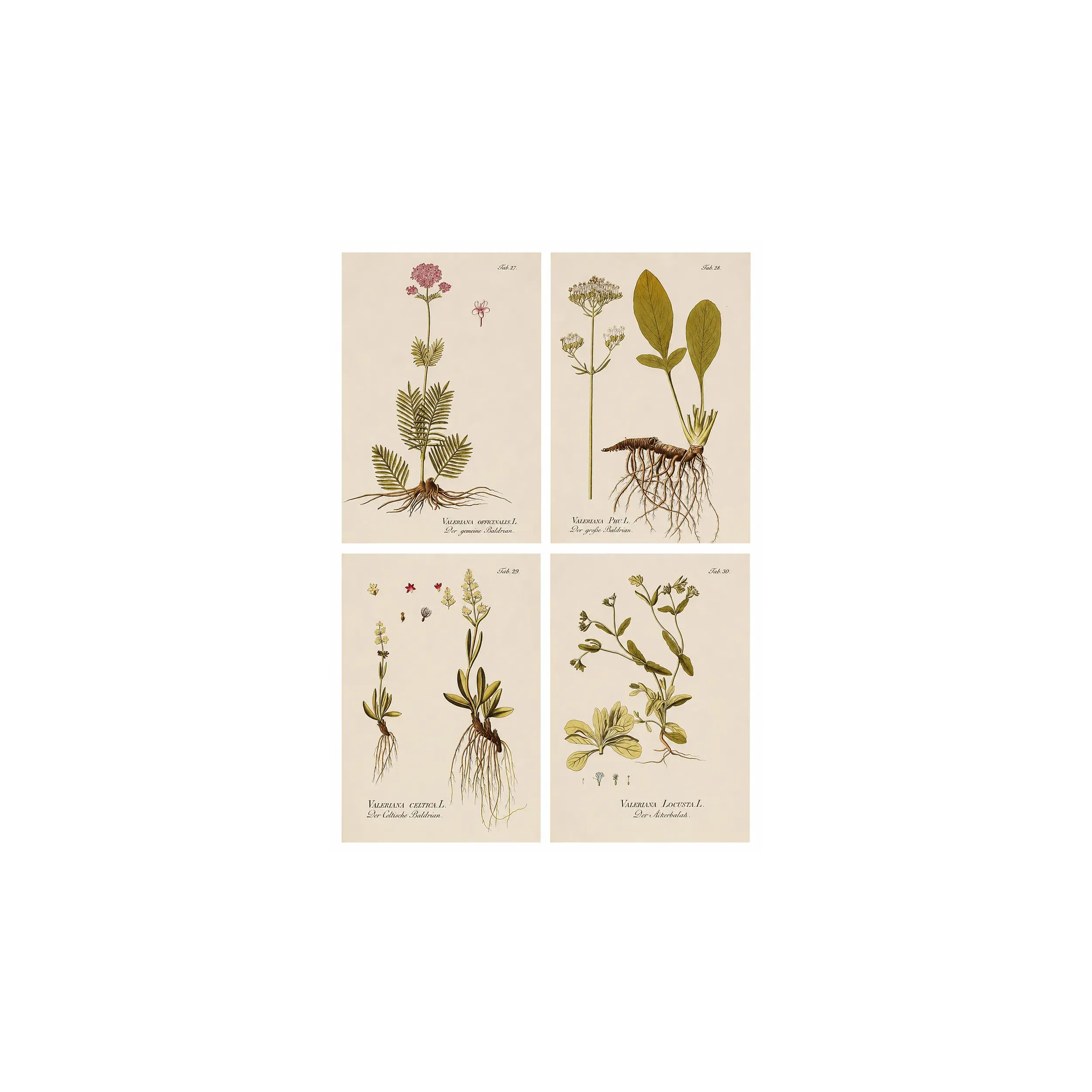
A complete four-plate botanical study devoted to the genus Valeriana, preserved exactly as originally published by Joseph Jacob von Plenck in Icones Plantarum Medicinalium. This Museum Quality Study Set combines scientific integrity, exceptional preservation and remarkable decorative harmony, offering collectors and interior designers an increasingly rare opportunity to acquire an intact eighteenth-century botanical sequence.
 Delivery policy
Your print will be carefully prepared and shipped worldwide via trusted couriers (UPS or similar).
 Authentic antique prints
Original engravings from the 17th–19th century.
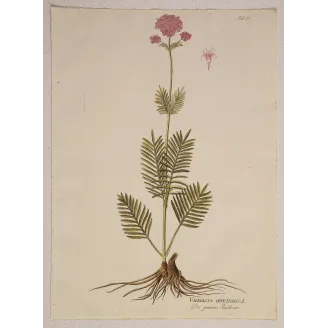
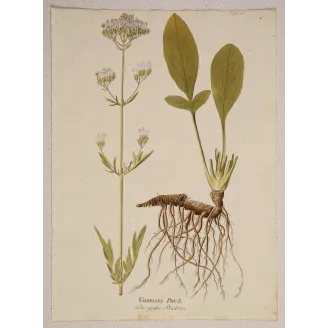
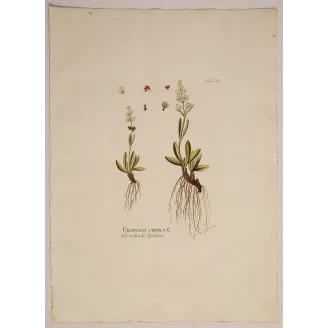
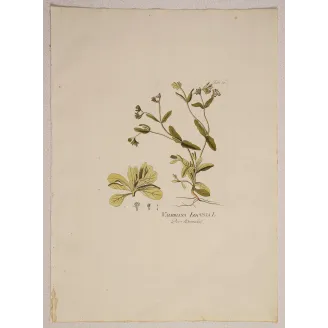
This Museum Quality Study Set preserves the complete consecutive sequence devoted by Joseph Jacob von Plenck to Valeriana within his monumental Icones Plantarum Medicinalium. Published in Vienna during the late eighteenth century, the four original hand-coloured copper engravings comprise Plates 27–30: Valeriana officinalis, Valeriana phu, Valeriana celtica and Valeriana locusta.
Presented together, the plates reveal the comparative method underlying Plenck’s botanical project. Flowering stems, foliage, roots, rhizomes, basal rosettes and enlarged analytical details are distributed across four distinct compositions, allowing related species to be examined as a coherent scientific group rather than as isolated decorative images.
The set combines exceptional scientific integrity with remarkable visual harmony. The sheets share the same generous folio format, eighteenth-century laid paper, warm paper tone, refined engraved language and luminous contemporary hand colouring.
Exceptionally fresh and retaining complete or significant Honig watermarks, this intact four-plate sequence may be confidently classified as a Museum Quality Study Set.
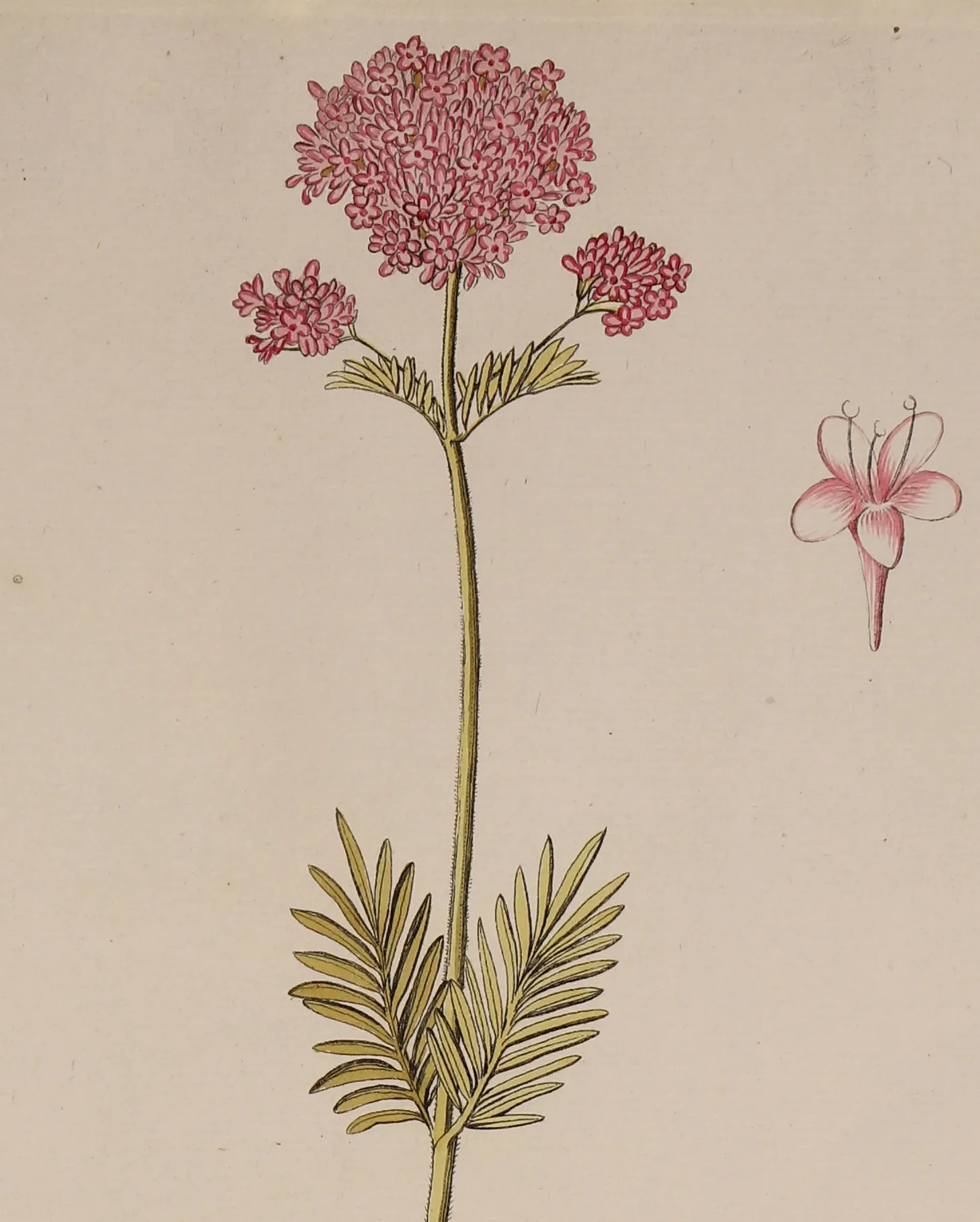
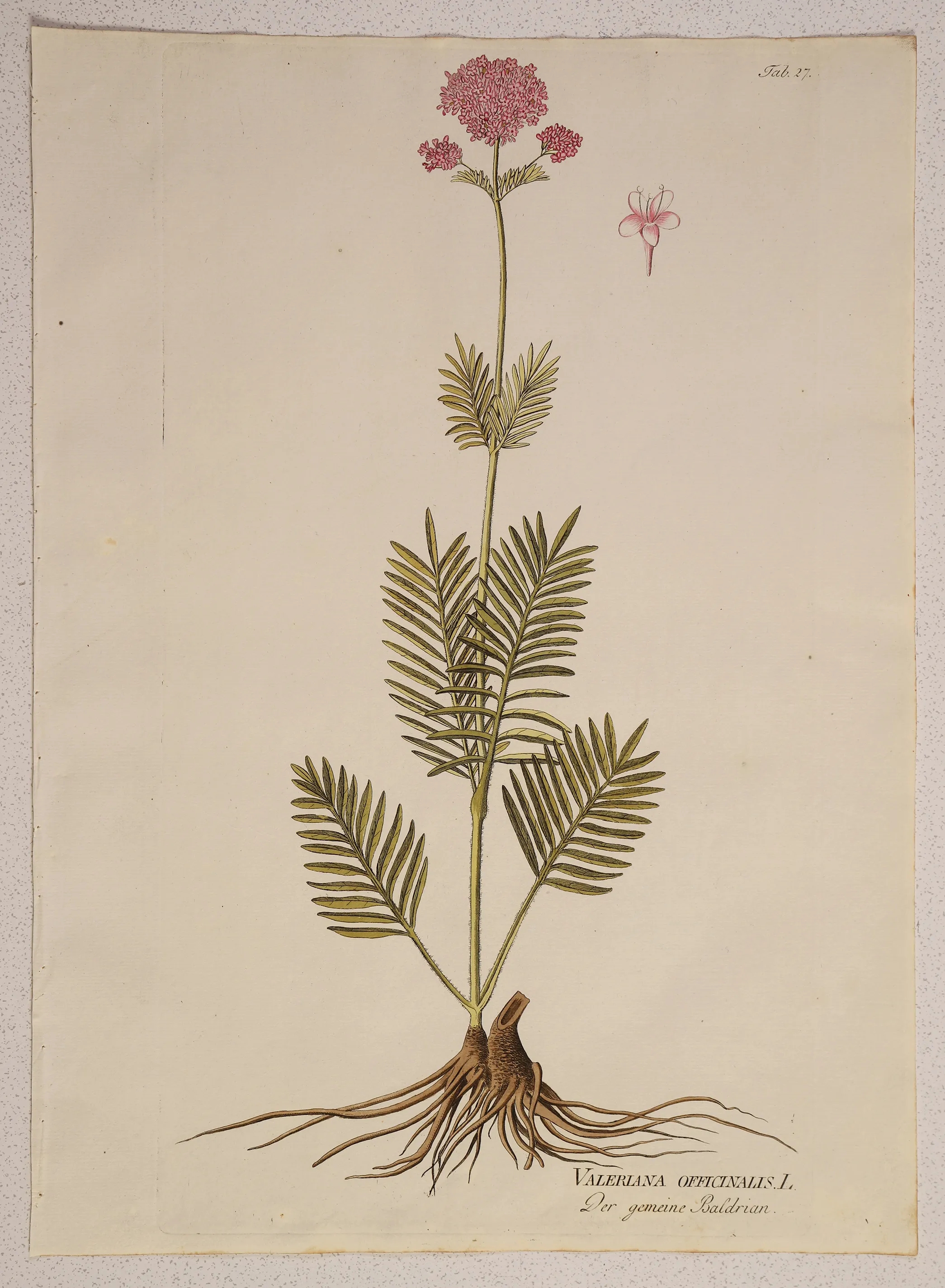
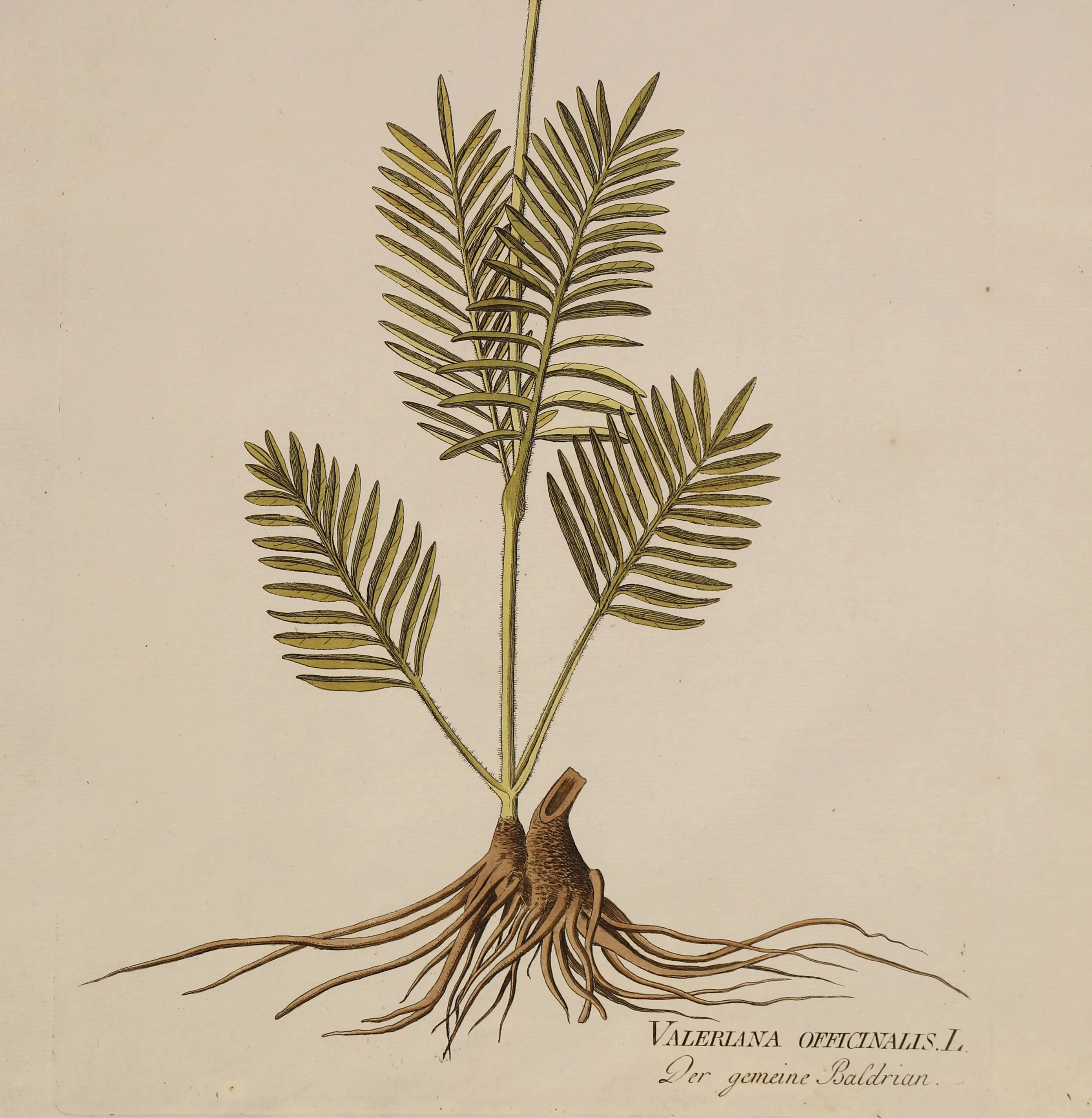
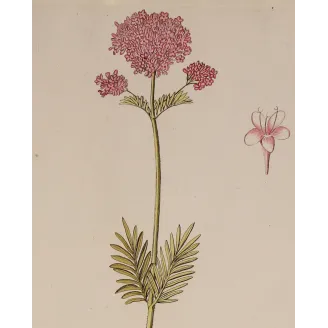
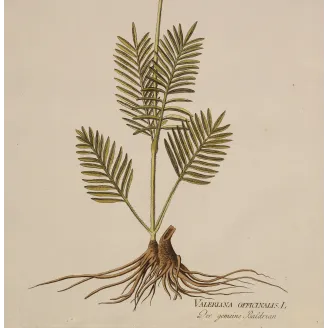
The sequence opens with Plate 27, Valeriana officinalis, the most visually commanding composition in the group. A tall flowering specimen rises vertically through the sheet, balancing finely divided leaves, pale rose inflorescences and a fully represented underground structure. A separate floral detail reinforces the analytical purpose of the image without disturbing its elegant upward movement.
Transparent green washes distinguish the successive forms of the foliage, while pale rose and violet touches articulate the clustered flowers. The warm brown roots anchor the plant and provide a material counterpoint to the luminous flowering crown.
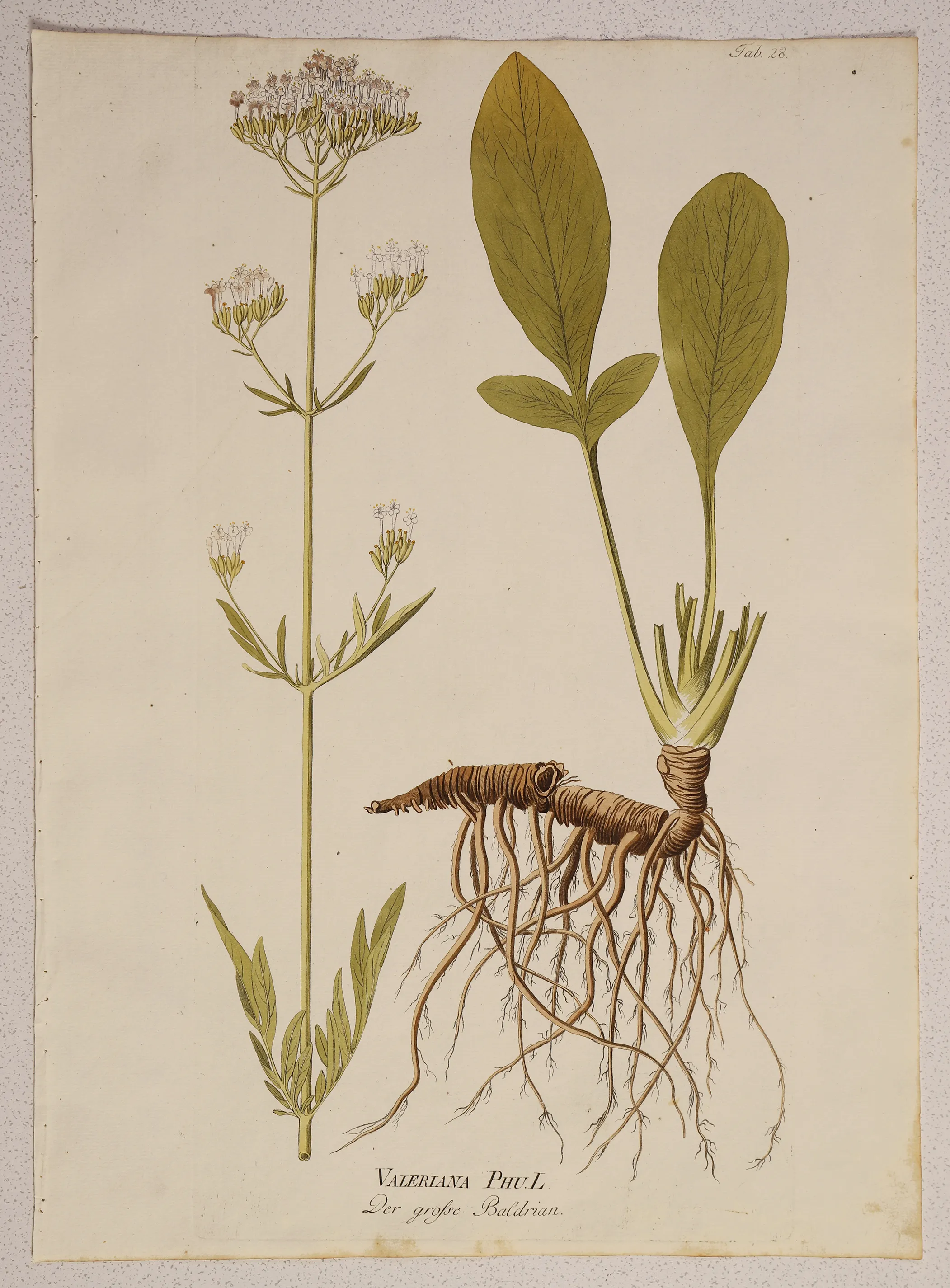
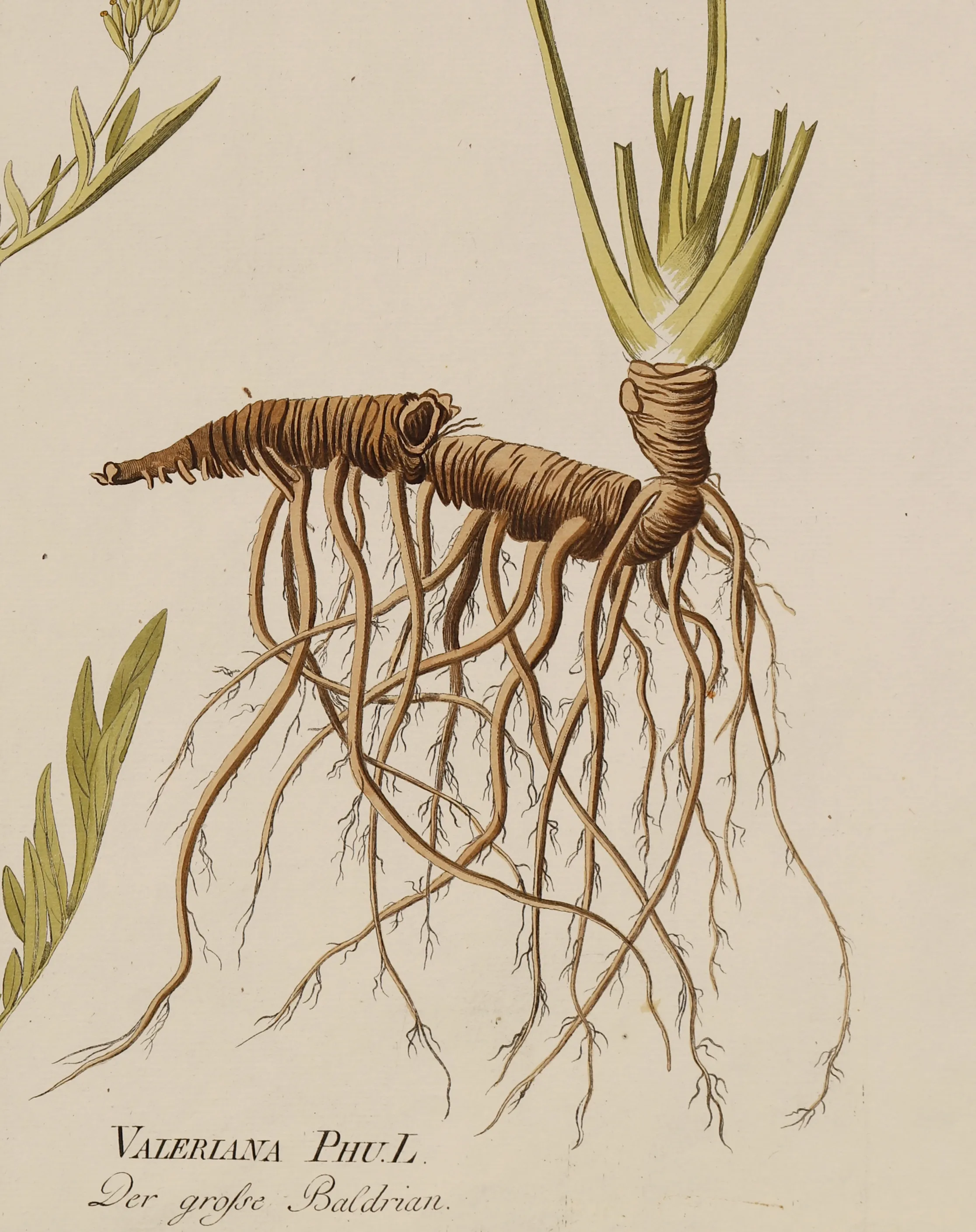
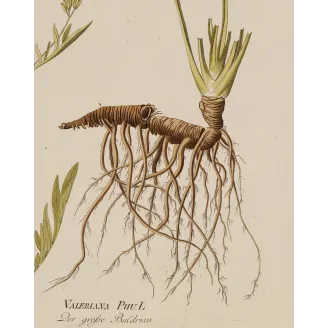
Plate 28, Valeriana phu, places greater emphasis on underground anatomy. The flowering stem is accompanied by broad basal leaves and a substantial rhizome surrounded by an extensive network of roots. The engraved line becomes denser in the lower structure and remains lighter across the foliage and flowers.
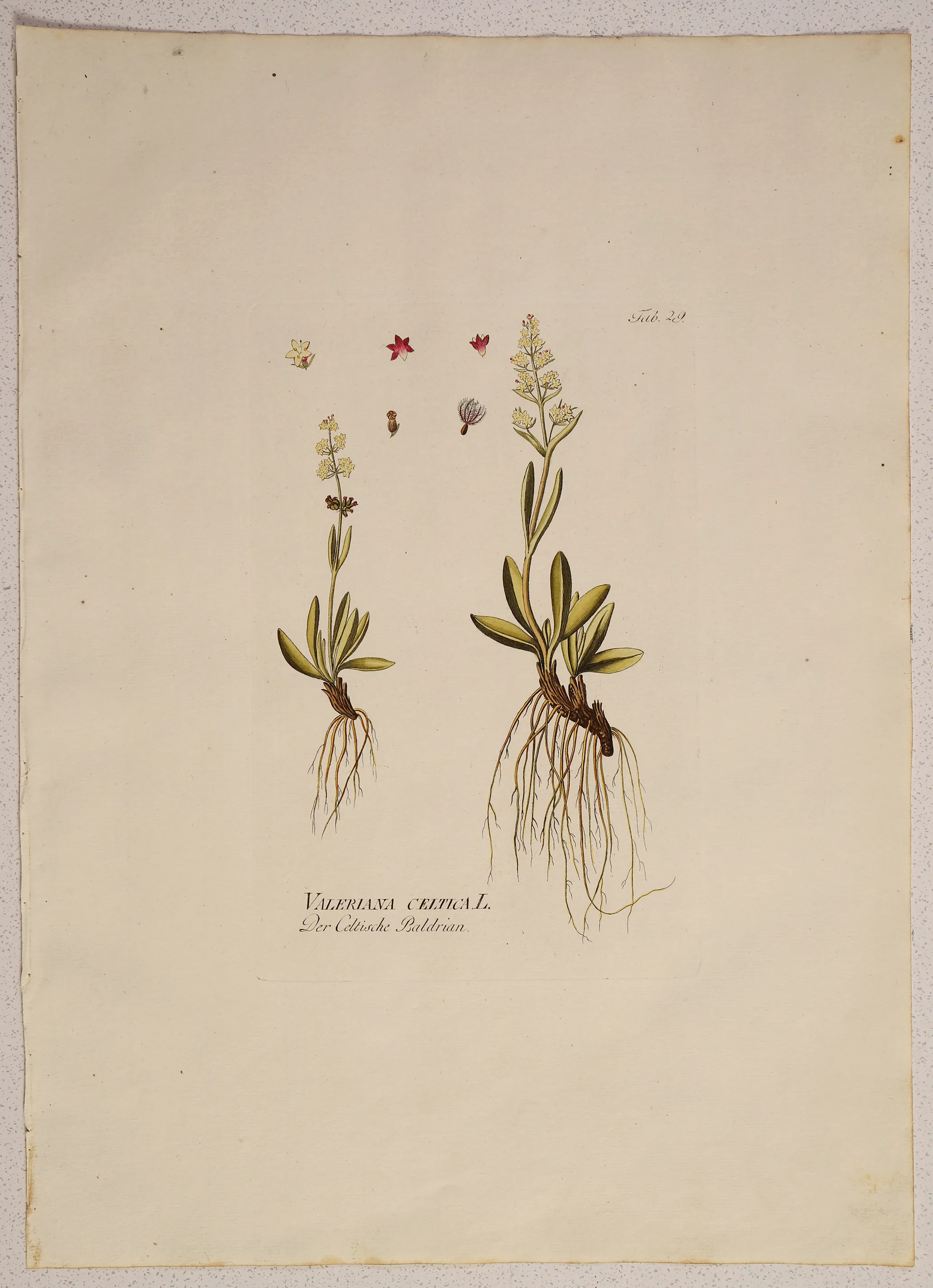
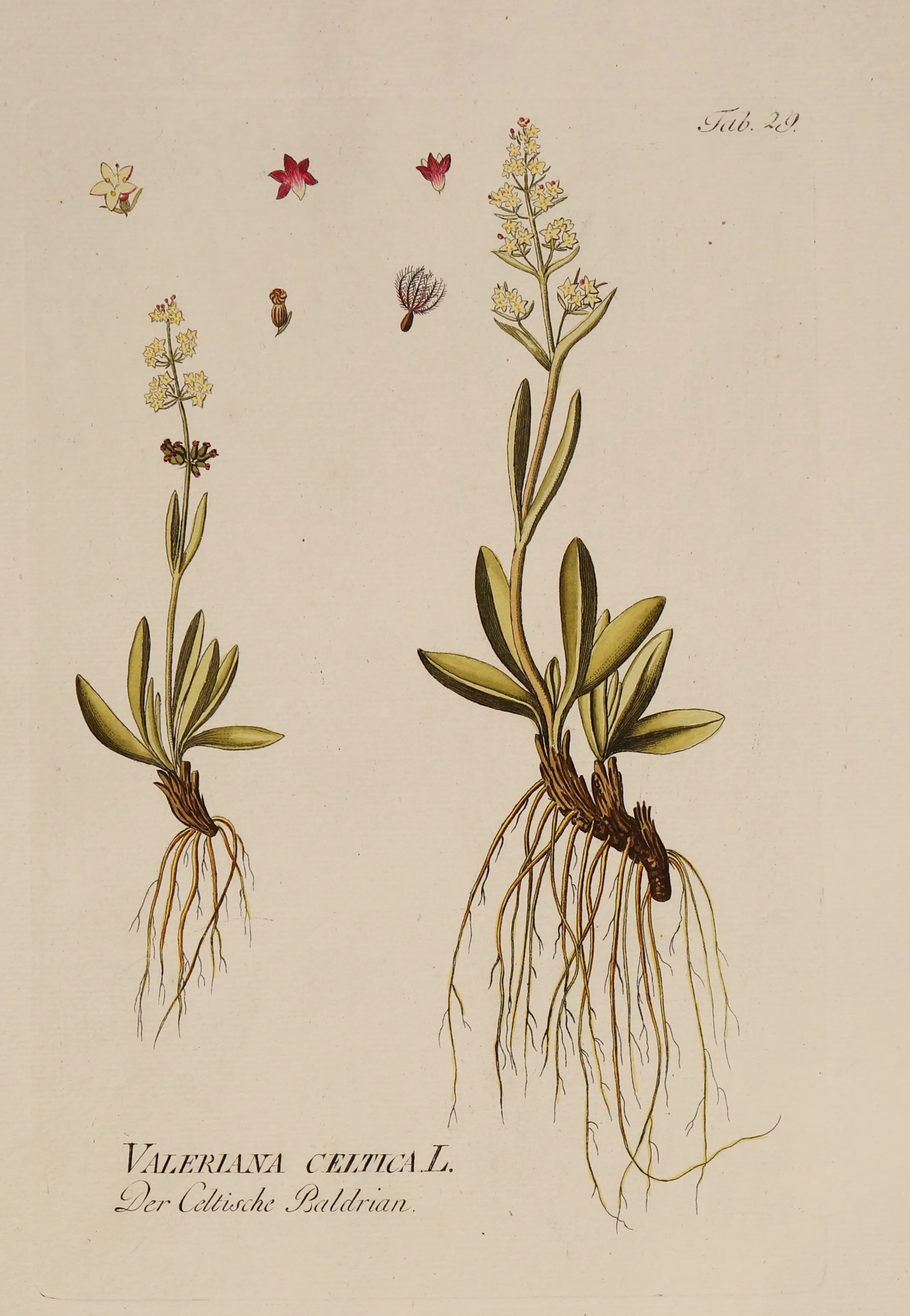
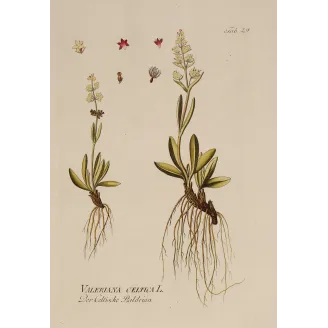
Plate 29, Valeriana celtica, introduces a quieter rhythm. Two slender specimens are presented independently against the broad unprinted sheet, accompanied by small floral details. Their reduced scale and open arrangement create a refined visual pause within the sequence.
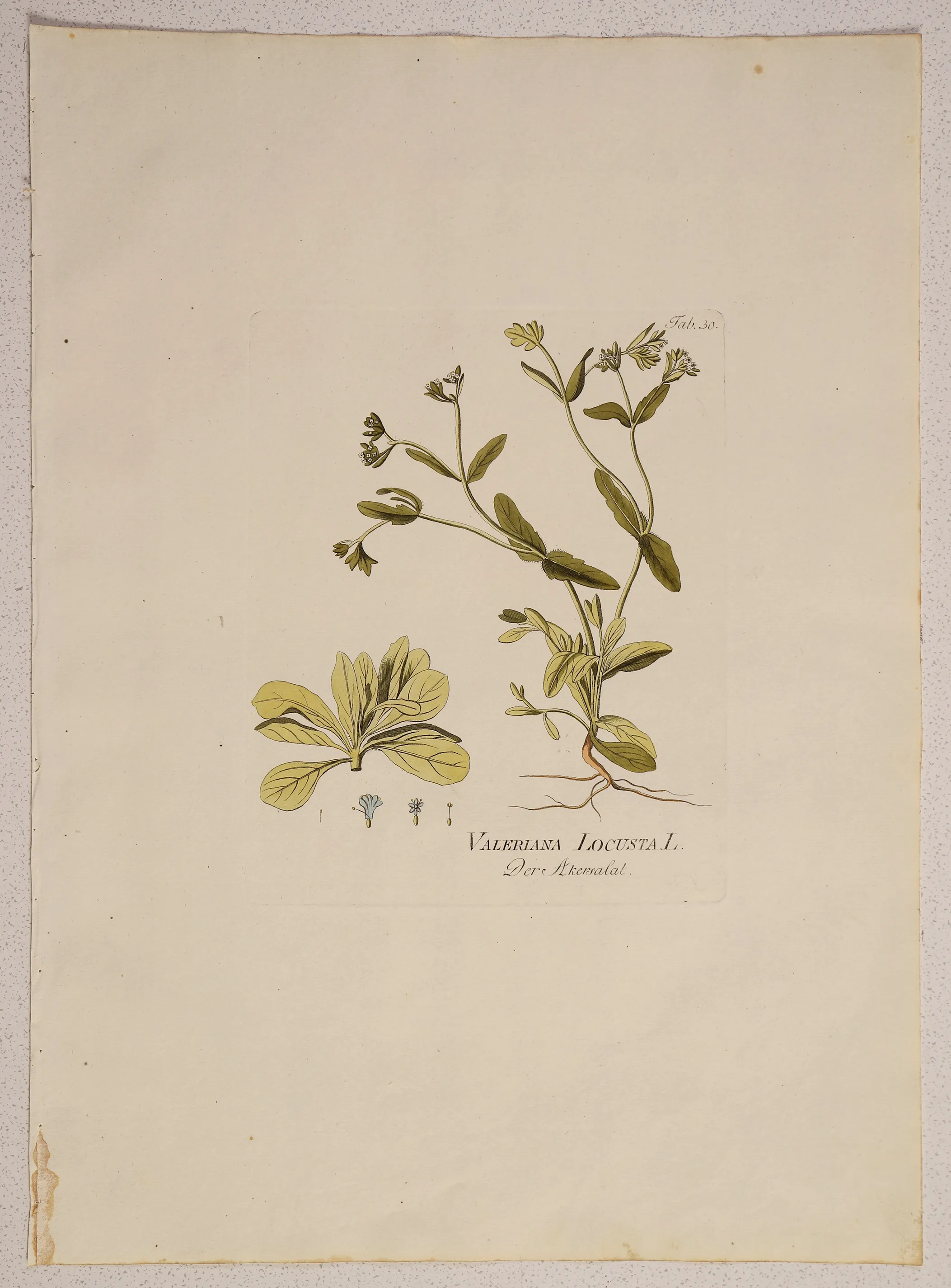
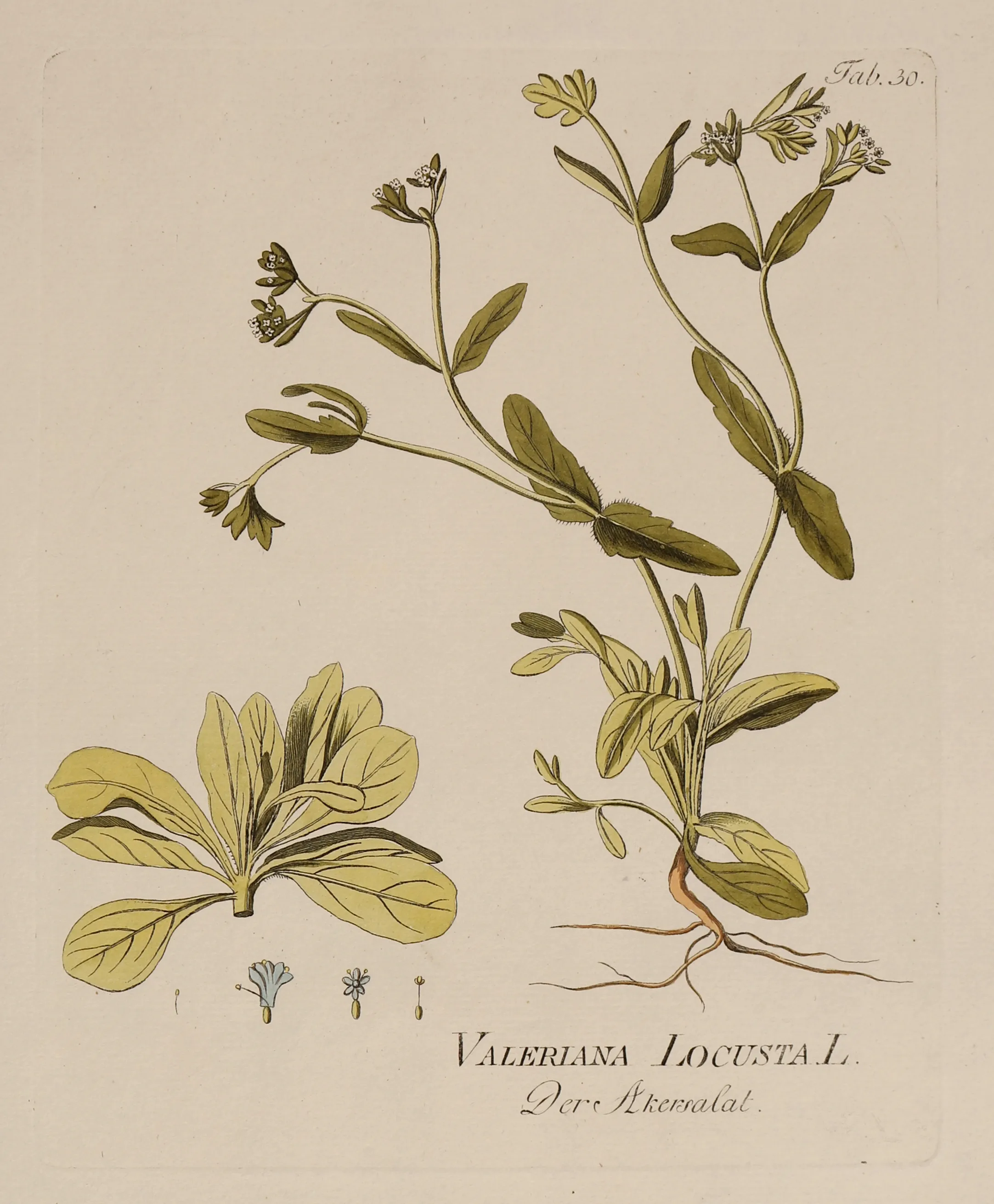
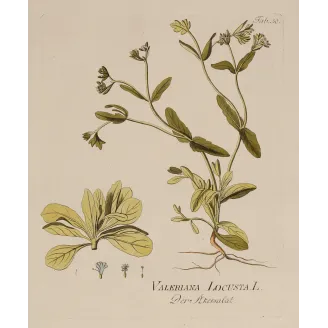
Plate 30, Valeriana locusta, concludes the group through an explicitly comparative arrangement. A mature flowering specimen is shown beside a separate basal rosette, while enlarged details clarify the reproductive structures.
Viewed together, the four sheets establish a measured alternation of density and openness. Monumental flowering stems are balanced by smaller plants, isolated leaves, exposed roots and analytical details. This rhythm gives the complete sequence a visual coherence that would be lost if the plates were dispersed.
The contemporary colouring remains exceptionally well preserved. Greens range from cool olive to warmer yellow-green passages; flowers are defined through restrained pink, violet and cream tones; roots and rhizomes retain subtle modulations of brown and ochre. The engraved line is applied only where structurally necessary, preserving the clarity and luminosity characteristic of the finest plates from the work.
The genus Valeriana belongs to the family Caprifoliaceae and includes herbaceous plants historically associated with European medicinal botany. The species represented by Plenck differ considerably in scale, foliage, root formation and flowering habit, making their consecutive presentation especially valuable as a comparative visual study.
Valeriana officinalis, commonly known as common valerian, is a perennial species characterised by divided leaves, branching flowering stems and clusters of small pale flowers. Its substantial root system was historically the part most closely associated with medicinal use.
Valeriana phu is represented with particular emphasis on its broad basal foliage and developed underground structure. Plenck’s decision to expose the rhizome and roots reflects the practical importance of recognising not only the aerial parts of medicinal plants but also the structures handled by physicians and apothecaries.
Valeriana celtica is a smaller alpine species whose slender habit contrasts markedly with the more expansive forms of V. officinalis and V. phu. Valeriana locusta, now more commonly associated with corn salad under later classifications, is shown through both a flowering plant and a separate leaf rosette.
Together, the engravings document how medicinal plants were observed, distinguished and taught during the European Enlightenment. They should be understood as historical records of botanical and pharmaceutical knowledge rather than as modern therapeutic guidance.
Joseph Jacob von Plenck conceived Icones Plantarum Medicinalium as a comparative visual instrument for the recognition and study of medicinal plants. Its plates were not designed as unrelated decorative illustrations. Species and botanical groups were arranged in ordered sequences so that shared characteristics and individual differences could be examined together.
The present group preserves the entire consecutive sequence numbered 27–30 and devoted to Valeriana. Retaining the sheets as a complete Study Set therefore protects the scientific and editorial structure of the original publication.
Each plate contributes different information. Valeriana officinalis provides the most complete flowering specimen; V. phu emphasises the root and rhizome; V. celtica demonstrates the reduced habit of a smaller species; and V. locusta combines mature growth, basal foliage and enlarged analytical details.
The sequence operates as a coherent chapter of illustrated botanical knowledge. Its importance lies not only in the beauty of the individual sheets but also in the relationships established between them. Scale, foliage, inflorescence, root structure and reproductive detail can be compared from one plate to the next.
The set also possesses exceptional decorative unity. All four engravings share the same folio dimensions, paper tone, inscriptions, numbering, technique and restrained palette. When displayed together, these repeated material and visual characteristics create rhythm without monotony.
This degree of consistency is almost impossible to reproduce by assembling unrelated antique prints. The sheets were created in the same place, during the same publishing period and for the same scientific work. Their harmony is therefore intrinsic rather than artificially constructed.
For an interior designer, architect or collector, the group offers an unusually resolved installation. The warm tone of the handmade paper, generous margins and alternation between dense and open compositions allow the plates to form a balanced horizontal or grid arrangement while retaining their individual identity.
The remarkable condition of the sheets further elevates the set. The paper remains exceptionally clean and fresh, the engraved lines are sharply preserved and the contemporary watercolour retains the luminosity and transparency intended by the eighteenth-century colourists.
Material evidence reinforces the integrity of the group. Two sheets preserve complete and clearly legible watermarks, while the other two retain visible “IV” watermark or countermark elements associated with the same high-quality papermaking tradition.
This Study Set is not offered as a commercial bundle. It is preserved as a complete botanical corpus whose value derives from the survival of Plenck’s original comparative programme, the exceptional condition of the impressions and the increasing rarity of intact sequences from eighteenth-century illustrated works.
Historical value establishes the plateau. Decorative harmony raises the price. Curatorial integrity creates the rarity.
The four engravings are printed on fine eighteenth-century laid paper associated with the Honig papermaking tradition. Closely spaced laid lines and broader chain lines belong to the structure of the handmade sheets and become visible in transmitted or raking light.
Valeriana officinalis preserves a complete and perfectly legible Honig watermark. Valeriana celtica likewise retains an integral watermark, further strengthening the material coherence of the sequence.
Valeriana phu and Valeriana locusta each preserve a visible “IV” watermark or countermark element. Comparable lettered fragments occur across other sheets from the publication and are consistent with the division and use of larger handmade paper sheets during printing and binding.
Honig papers were valued for their durability, refined surface and capacity to receive both sharply impressed copperplate lines and delicate hand-applied colour. The extraordinary freshness of the present sheets demonstrates the quality of these materials and their exceptional preservation over more than two centuries.
The plate marks remain visible around the engraved fields, with the exception of the upper edge of Plate 28, Valeriana phu, where the upper plate mark has been historically trimmed out. The botanical image, inscriptions and remaining margins are unaffected.
Published in Vienna from 1788, Joseph Jacob von Plenck’s Icones Plantarum Medicinalium belongs to the great illustrated botanical projects of the European Enlightenment. It provided physicians, apothecaries and students with clear visual references for recognising plants connected with historical medicinal practice.
Each image was printed from a finely engraved copperplate and subsequently coloured by hand. Every surviving impression therefore combines the precision of printmaking with the individual judgement and craftsmanship of an eighteenth-century colourist.
Plenck arranged related plants in consecutive sequences rather than treating them as isolated ornamental subjects. When such groups survive intact, they preserve the comparative structure through which the original publication communicated botanical knowledge.
Today, the same coherence gives the set a second life within carefully designed interiors. What was originally conceived as an organised body of scientific knowledge can now define an architectural space without losing its historical integrity.
Discover how scientific observation, handmade paper, copper engraving and contemporary colour came together in Plenck’s botanical masterpiece.
Museum-quality condition. The four eighteenth-century laid-paper sheets remain structurally sound, remarkably clean and exceptionally fresh. The engraved impressions retain excellent definition, and the contemporary hand colouring is preserved with unusual luminosity and transparency throughout the sequence.
Valeriana officinalis is in virtually perfect condition and appears exceptionally close to its original state at publication. The paper is extraordinarily fresh, the colour remains luminous and the complete watermark is perfectly legible.
Valeriana phu is likewise exceptionally well preserved. The upper plate mark has been historically trimmed out, while the botanical image, inscriptions, paper and remaining margins are clean and undisturbed. A visible “IV” mark is present.
Valeriana celtica is in virtually perfect condition. The broad unprinted areas remain remarkably clean, the engraved structures retain excellent clarity and the integral watermark is clearly preserved.
Valeriana locusta is in exceptional condition, with clean paper, beautifully preserved colouring and a visible “IV” watermark or countermark. Any extremely light historical traces are confined to the outer margins.
Across the complete group there are no significant stains, abrasions, disruptive creases or visually intrusive restorations. The consistent tone and preservation of the paper give the four sheets an unusually unified appearance when displayed together.
Overall, the set may be described as genuinely Museum Quality. The sheets retain a degree of freshness rarely encountered in eighteenth-century botanical engravings and appear remarkably close to the state in which they left the Viennese publisher more than two centuries ago. Please examine the professional high-resolution photographs for a complete visual assessment.
Study Set: Complete Valeriana sequence
Included plates: Four original botanical engravings
Botanical subjects: Valeriana officinalis L.; Valeriana phu L.; Valeriana celtica L.; Valeriana locusta L.
Work: Icones Plantarum Medicinalium
Author: Joseph Jacob von Plenck (1735–1807)
Artistic tradition: Viennese botanical school
Place of publication: Vienna
Date: c. 1788
Technique: Four original copper engravings with contemporary hand-applied watercolour
Paper: Fine eighteenth-century laid paper associated with the Honig papermaking tradition
Watermarks: Complete marks in V. officinalis and V. celtica; visible “IV” marks in V. phu and V. locusta
Plate marks: Preserved and visible; upper plate mark historically trimmed out in Plate 28
Plate numbers: 27, 28, 29 and 30
Plant family: Caprifoliaceae
Individual sheet size: approx. 44 × 33 cm
Number of sheets: 4
Condition: Museum-quality condition; exceptionally clean, fresh and remarkably close to the original state of publication
Curatorial classification: Museum Quality Study Set
Collector positioning: Complete consecutive eighteenth-century botanical sequence preserved as an intact scientific and editorial corpus
Interior design positioning: Four historically coordinated works sharing the same format, date, paper tone, technique and visual language
Authenticity: Four original eighteenth-century prints — never modern reproductions
Specific References
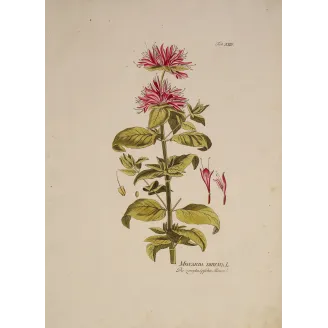
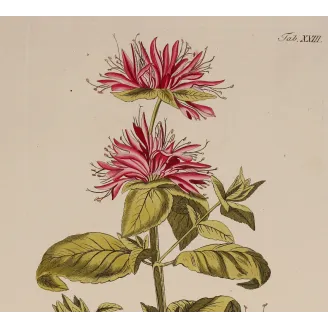
Original eighteenth-century botanical engraving depicting Monarda didyma L., published in Vienna as Plate XXIII of Joseph Jacob von Plenck's Icones Plantarum Medicinalium. This refined composition combines elegant vertical balance, delicate crimson flowers and beautifully preserved contemporary hand colouring on Honig laid paper with complete watermark.
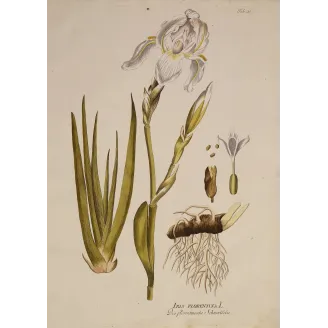
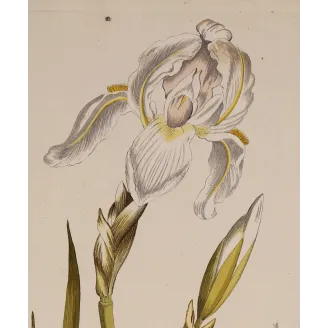
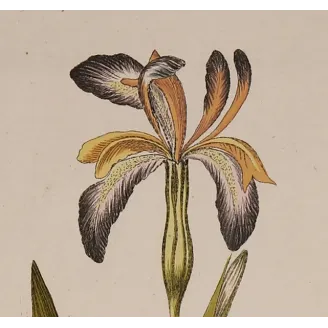
An elegant original botanical engraving depicting Iris florentina, delicately hand-coloured and published by Joseph Jacob von Plenck around 1788. Printed on original laid paper with visible plate mark and exceptionally refined colouring.
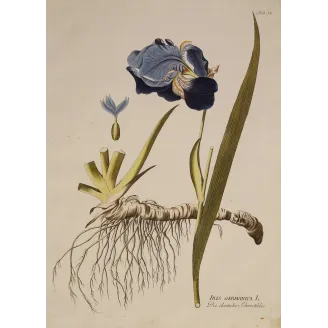
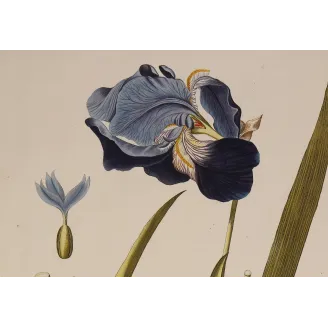
An original eighteenth-century botanical engraving depicting Iris germanica, published in Joseph Jacob von Plenck's celebrated Icones Plantarum Medicinalium. Printed on fine laid paper bearing the Honig watermark, the sheet combines scientific precision with the refined artistic craftsmanship of the Viennese botanical school.
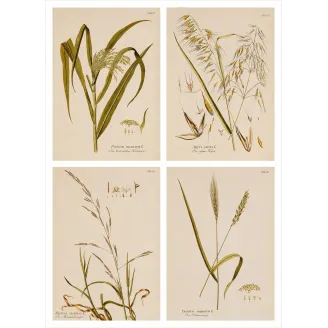
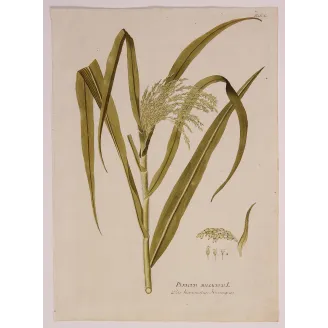
Seven-plate botanical corpus devoted to Europe's principal cereal crops, preserved exactly as originally published in Joseph Jacob von Plenck's Icones Plantarum Medicinalium. Combining scientific precision, historical significance and remarkable visual harmony, this Museum Quality Study Set documents the plants that shaped European agriculture and civilisation.
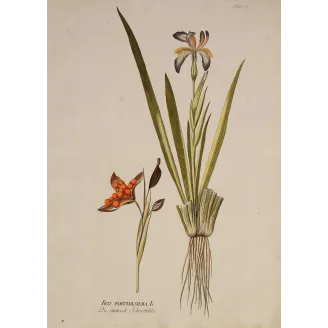
Original eighteenth-century botanical engraving depicting Iris foetidissima (Stinking Iris), published in Vienna by Joseph Jacob von Plenck for Icones Plantarum Medicinalium (Plate 37). Finely engraved and beautifully hand-coloured, the composition illustrates the flowering plant together with its open seed capsule and brilliant orange seeds, combining scientific precision with exceptional decorative elegance. Printed on fine laid Honig paper with visible "IV" watermark and excellent contemporary hand colouring.
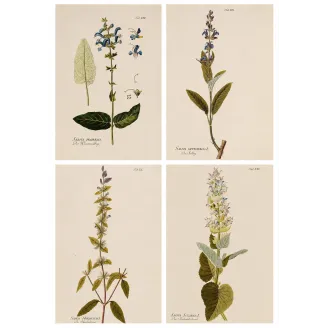
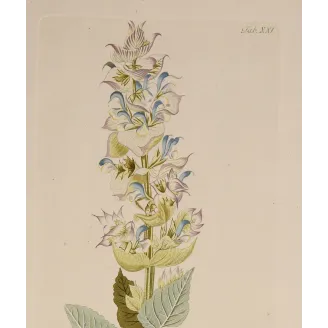
A complete four-plate botanical study devoted to the genus <em>Salvia</em>, preserved exactly as originally published within Joseph Jacob von Plenck's <em>Icones Plantarum Medicinalium</em>. Combining remarkable scientific integrity with exceptional decorative harmony, this Museum Quality Study Set represents one of the most visually refined surviving botanical sequences of the late eighteenth century.
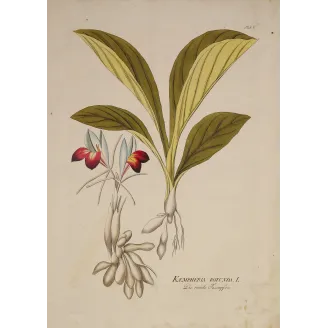
Original eighteenth-century botanical engraving depicting Kaempferia rotunda, published in Vienna by Joseph Jacob von Plenck for Icones Plantarum Medicinalium (Plate 5). The elegant composition combines broad architectural foliage, richly coloured crimson flowers and delicately modelled underground tubers, demonstrating the extraordinary refinement of Plenck's Viennese botanical school. Printed on fine Honig laid paper with visible "IV" watermark.
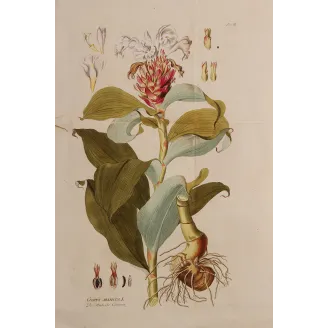
Exceptional large-format eighteenth-century botanical engraving depicting <em>Costus arabicus</em> L., published as Plate VII of Joseph Jacob von Plenck’s <em>Icones Plantarum Medicinalium</em>. Printed on an unusually large folded sheet measuring 66.3 × 43.5 cm, the composition combines a monumental flowering specimen, extensive root and rhizome structures and finely observed botanical details with beautifully preserved contemporary hand colouring. Complete Honig watermark with logo.
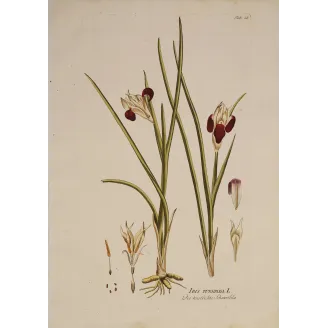
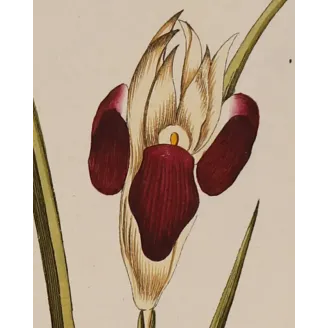
Original eighteenth-century botanical engraving depicting Iris tuberosa (Snake's Head Iris), published in Vienna by Joseph Jacob von Plenck for Icones Plantarum Medicinalium (Plate 38). This elegant composition combines two flowering specimens with finely engraved botanical details and a beautifully preserved complete Honig watermark. Contemporary hand colouring and selective gum arabic produce remarkable depth, while the velvety deep burgundy petals create one of the most refined colour harmonies within Plenck's celebrated Iris series.
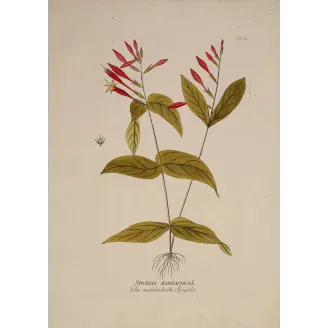
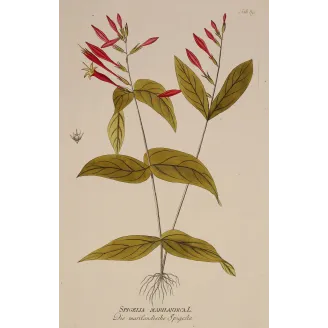
Original eighteenth-century botanical engraving depicting Spigelia marilandica L., published in Vienna as Plate 89 of Joseph Jacob von Plenck's Icones Plantarum Medicinalium. The elegant composition is distinguished by its graceful vertical rhythm, brilliant scarlet tubular flowers and refined contemporary hand colouring on fine laid paper.
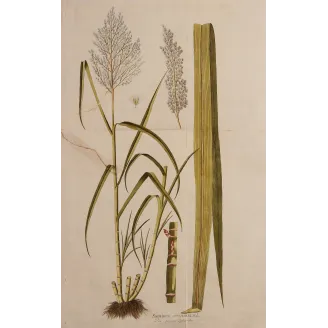
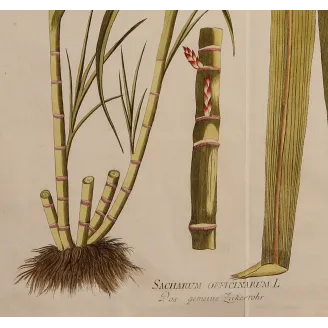
Exceptional large-format eighteenth-century botanical engraving depicting <em>Saccharum officinarum</em> L. (sugar cane), published as Plate 40 of Joseph Jacob von Plenck’s <em>Icones Plantarum Medicinalium</em>. Printed on a large folded sheet of laid paper with “IV” watermark and contemporary hand colouring, the composition combines the elegant vertical architecture of the cane with exceptionally delicate flowering panicles and a monumental isolated leaf. A distinctive Plenck Statement Piece preserving remarkable botanical clarity together with the visible material history of an eighteenth-century folded plate.
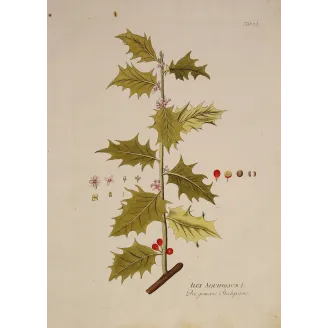
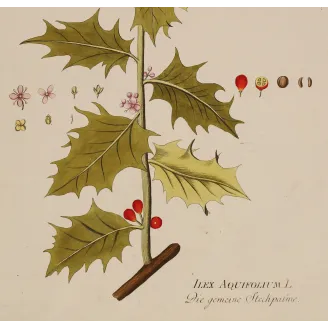
Original eighteenth-century botanical engraving depicting Ilex aquifolium L., the common holly, published in Vienna as Plate 72 of Joseph Jacob von Plenck’s Icones Plantarum Medicinalium. The composition combines sharply articulated evergreen foliage, delicate pink flowers, brilliant red fruits and separate botanical details, preserved on fine laid paper with a visible partial “IV” watermark.
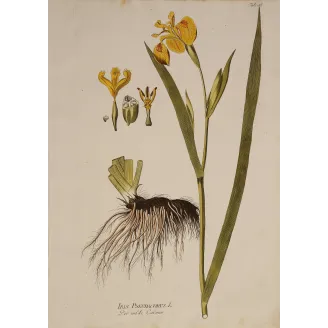
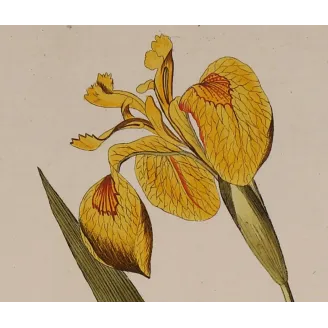
Original hand-coloured copper engraving depicting the Yellow Flag Iris (Iris pseudacorus), published by Joseph Jacob von Plenck in Vienna around 1788 for Icones Plantarum Medicinalium. A refined eighteenth-century botanical illustration distinguished by its elegant composition, beautifully engraved rhizome, luminous yellow flower, selective gum arabic highlights and excellent state of preservation.
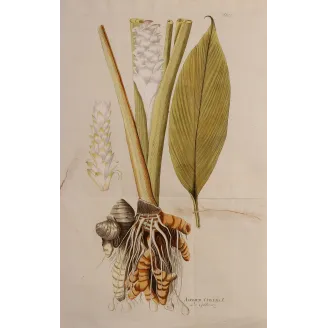
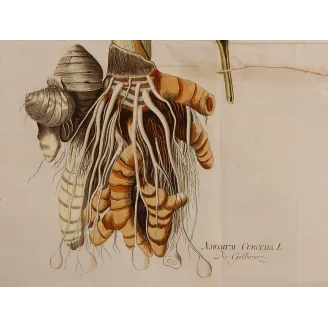
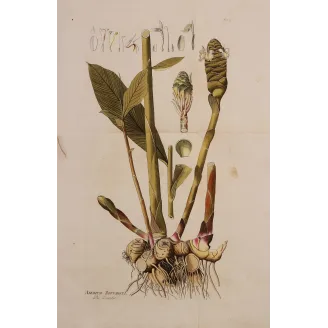
Exceptional large-format eighteenth-century botanical engraving depicting <em>Amomum Curcuma</em> L., published as Plate IV of Joseph Jacob von Plenck’s <em>Icones Plantarum Medicinalium</em>. Printed on a large folded sheet of Honig laid paper with complete watermark and contemporary hand colouring, the composition combines a remarkably refined pale inflorescence, monumental foliage and an exceptionally detailed rhizomatous structure. A powerful Plenck Statement Piece preserving both extraordinary botanical clarity and the visible material history of an eighteenth-century folded plate.
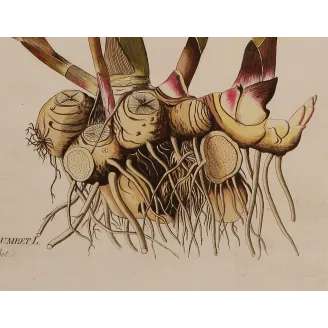
Exceptional large-format eighteenth-century botanical engraving depicting <em>Amomum Zerumbet</em> L., published as Plate II of Joseph Jacob von Plenck’s <em>Icones Plantarum Medicinalium</em>. Printed on a large folded sheet of Honig laid paper with complete watermark and contemporary hand colouring, the composition combines monumental rhizomatous structures, tall architectural stems and precisely observed analytical details. A rare large-scale Plenck Statement Piece with remarkable historical and visual presence.
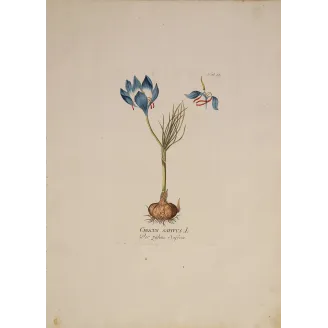
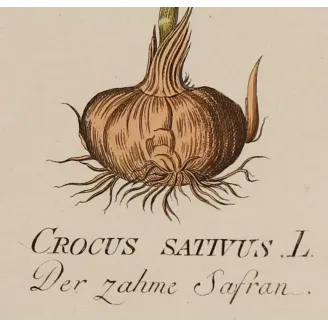
Original eighteenth-century botanical engraving depicting Crocus sativus L., the true saffron crocus, published in Vienna as Plate 32 of Joseph Jacob von Plenck's Icones Plantarum Medicinalium. This elegant composition celebrates one of history's most valuable medicinal and culinary plants through refined hand colouring, exceptional botanical clarity and beautifully preserved eighteenth-century laid paper.
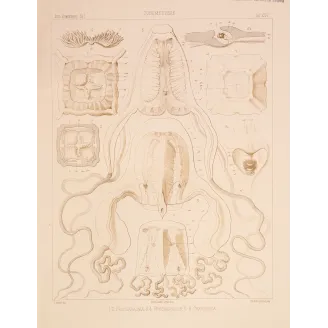
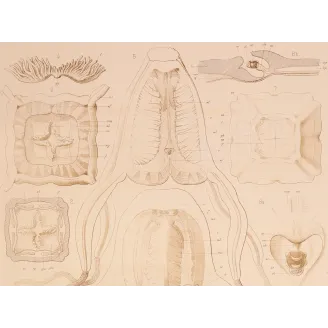
An original 1879 lithograph by Ernst Haeckel from Das System der Medusen, depicting the remarkable anatomy of Cubomedusae (box jellyfish). Combining scientific precision with striking architectural symmetry, this authentic nineteenth-century plate reveals the hidden biological structures behind one of the ocean’s most fascinating marine organisms.
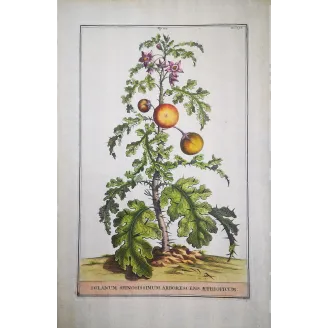
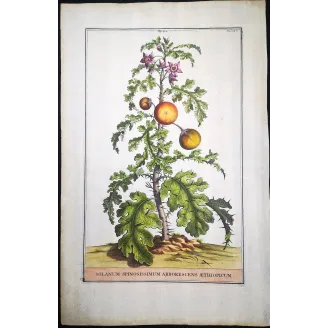
Original 17th-century hand-colored engraving of a spiny Solanum (Solanum aethiopicum) by Abraham Munting, featuring thorned stems, vivid fruit and striking botanical contrast.
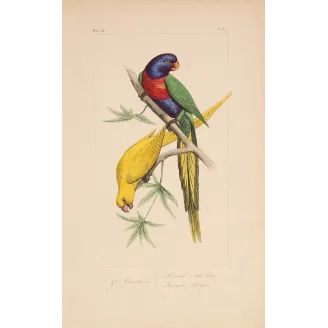
A striking 19th-century engraving depicting two vividly colored parakeets in a dynamic composition. The intense contrast of blue, red, green and yellow creates a highly decorative work, ideal as a focal piece in refined interiors.
A coherent ensemble of eight original orange and bigarade engravings by Pancrace Bessa, reflecting the cultivated discipline of French orangeries in the Napoleonic era. Botanical precision and architectural composure unite in a refined citrus portfolio preserved as a complete series.
Graceful composition of bay laurel with fruits, blossoms, and internal flower structure.
A complete four-plate botanical study devoted to the genus Valeriana, preserved exactly as originally published by Joseph Jacob von Plenck in Icones Plantarum Medicinalium. This Museum Quality Study Set combines scientific integrity, exceptional preservation and remarkable decorative harmony, offering collectors and interior designers an increasingly rare opportunity to acquire an intact eighteenth-century botanical sequence.