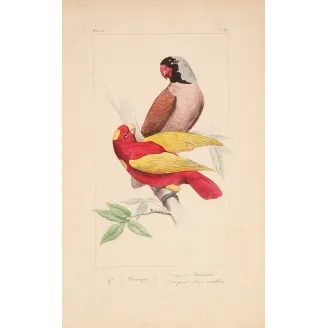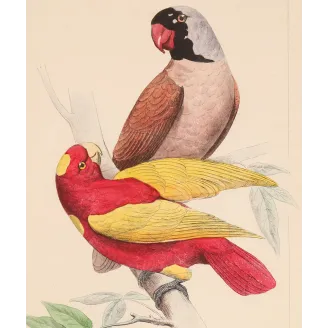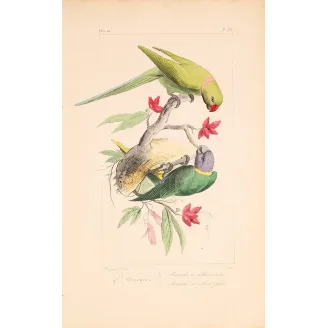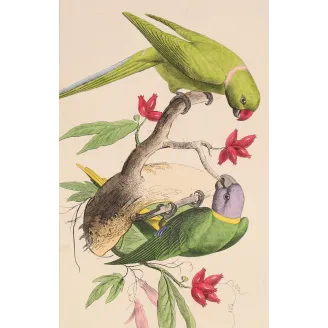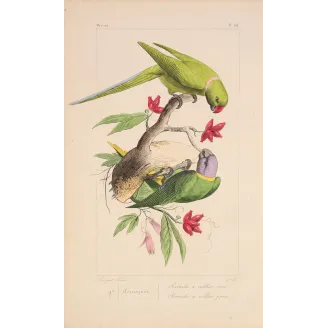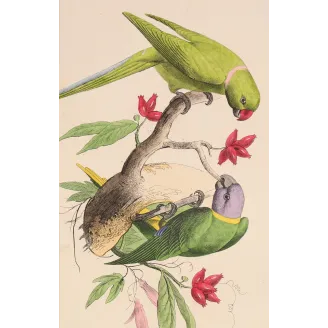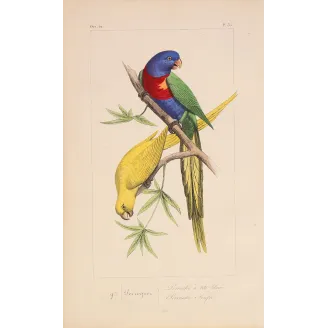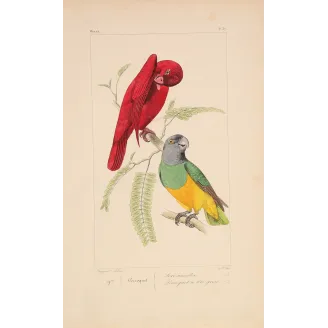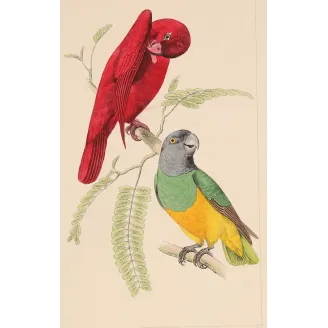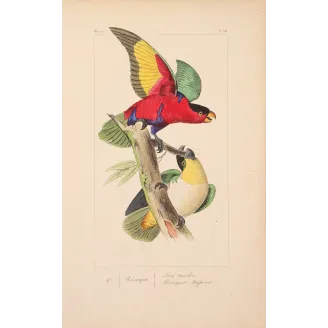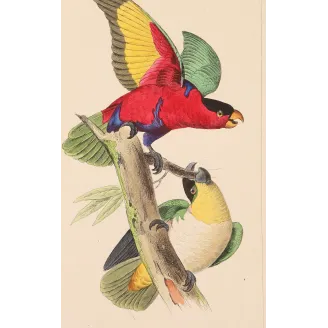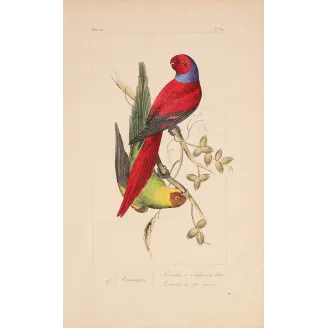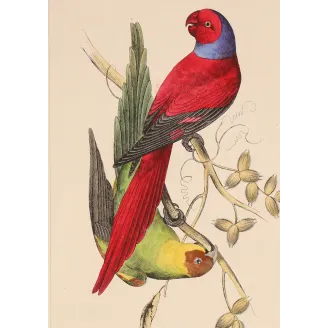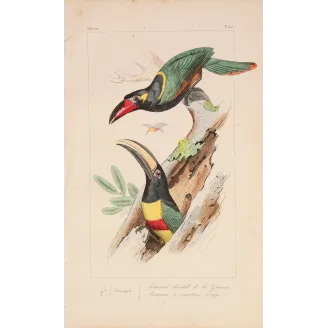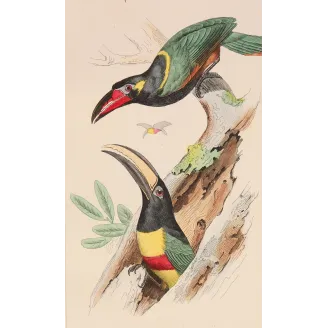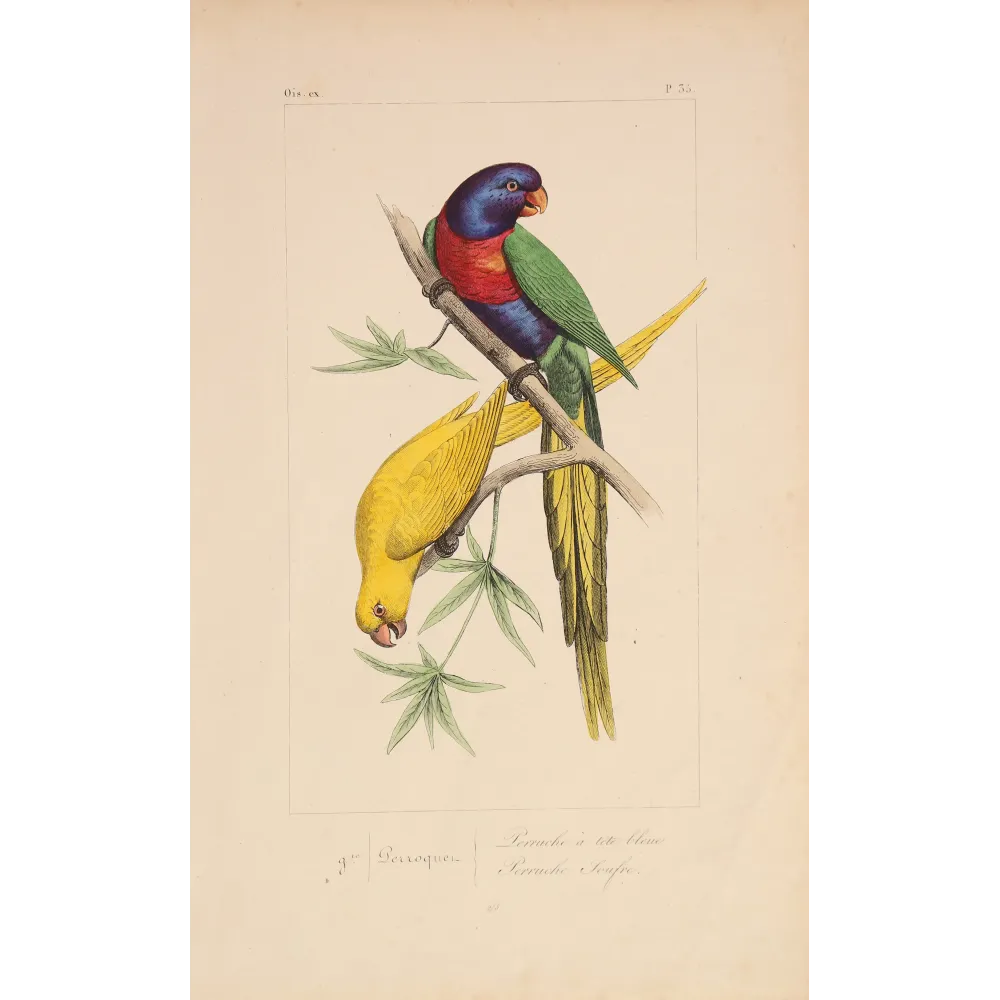
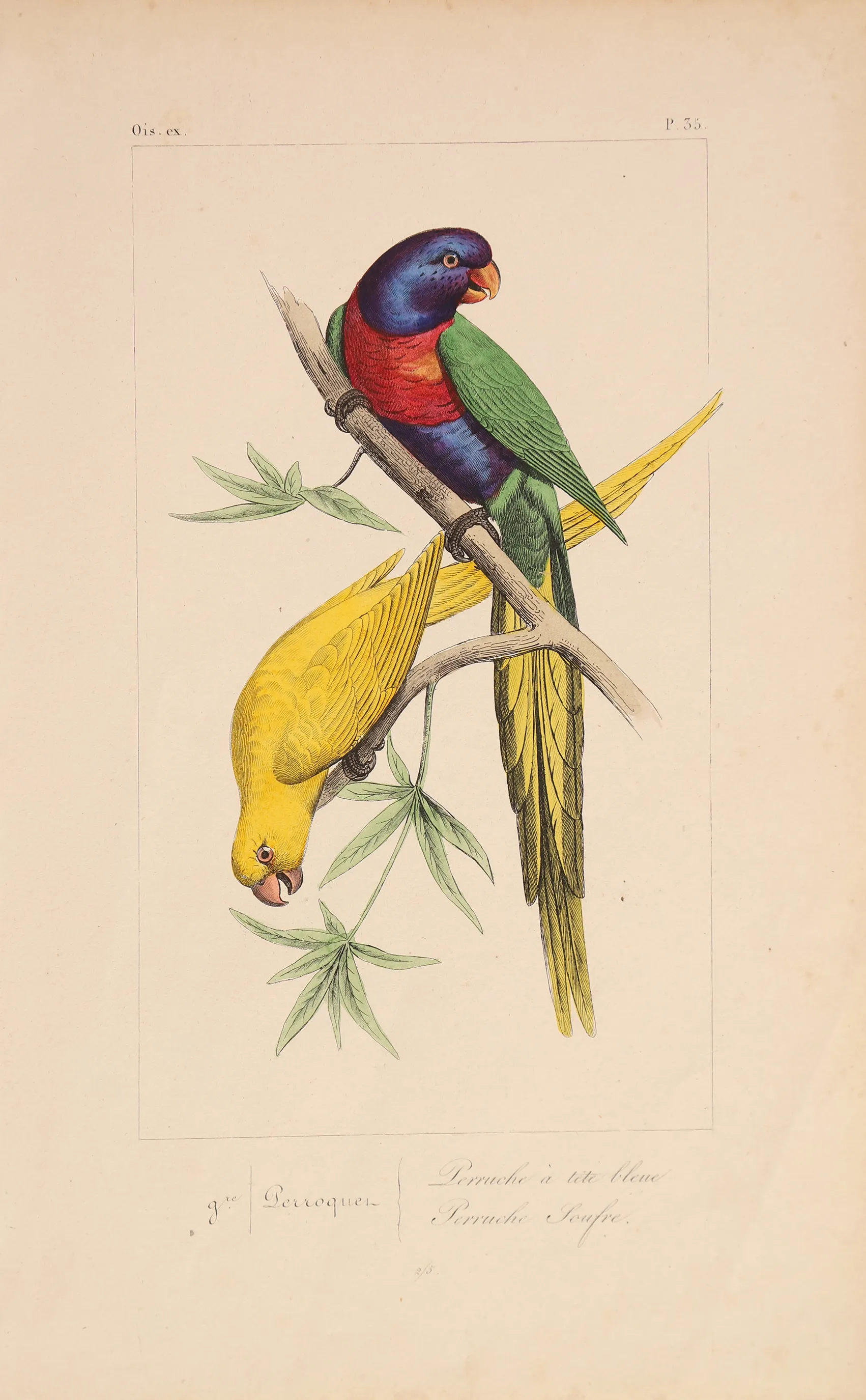
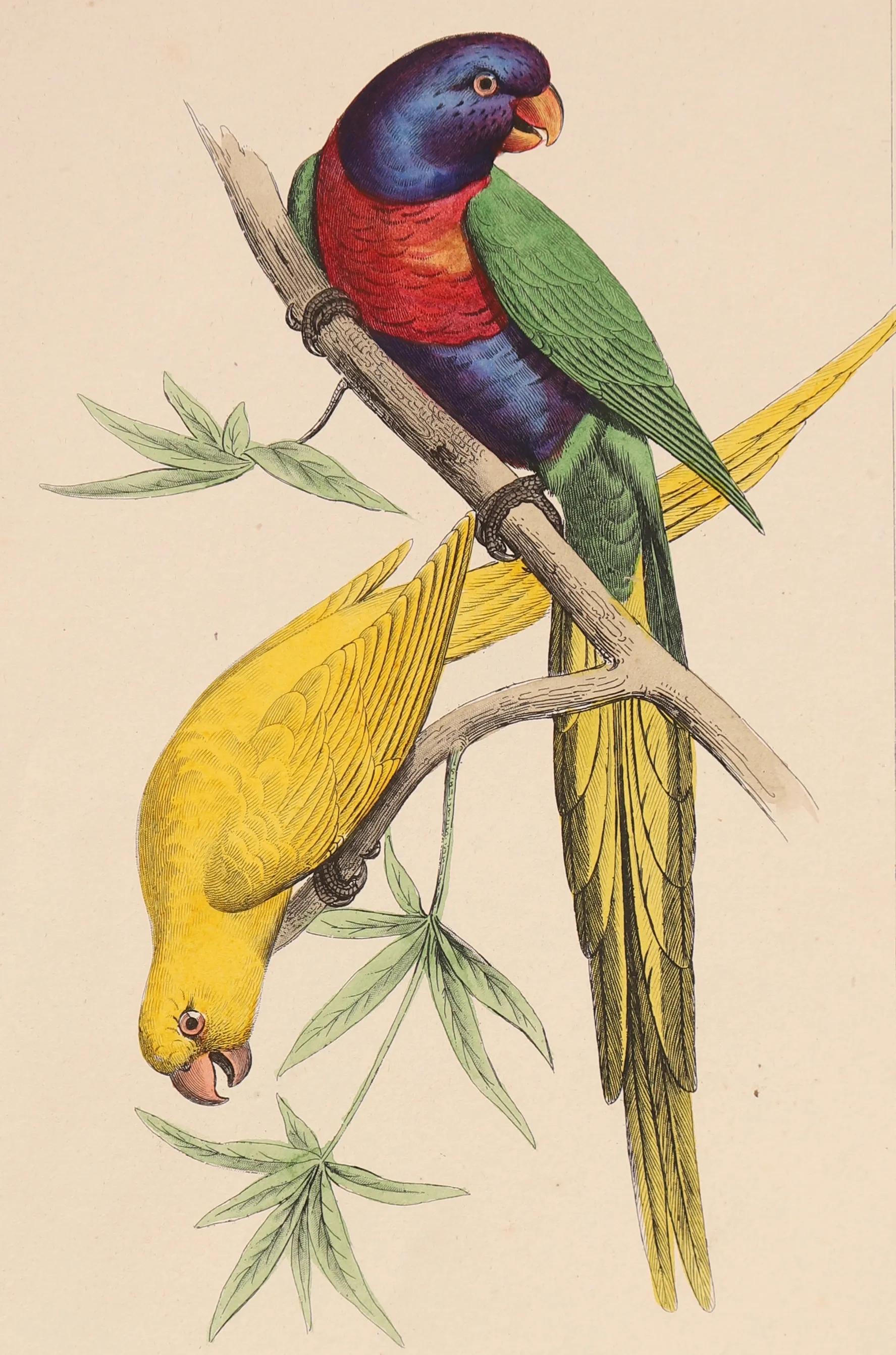
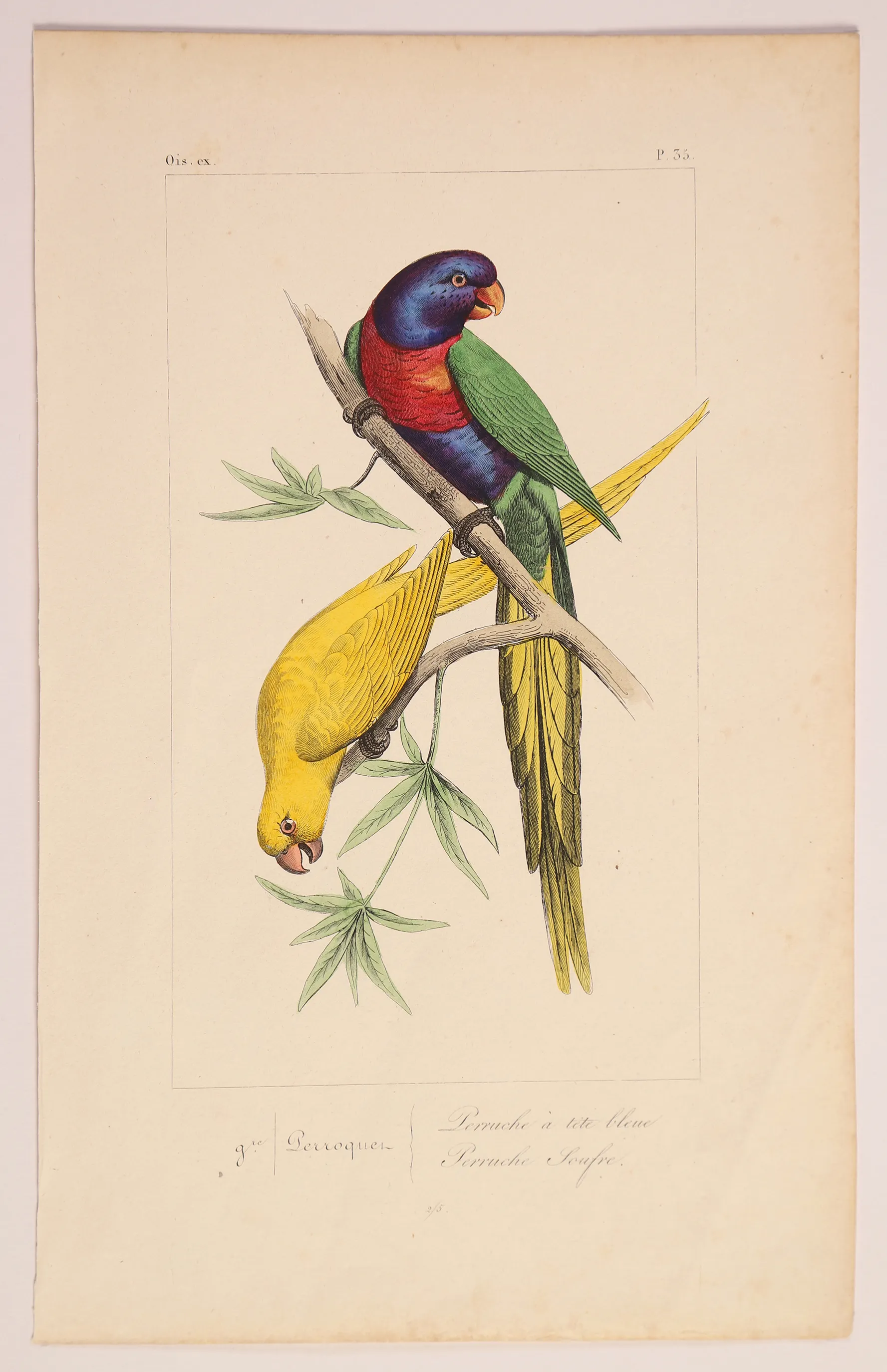
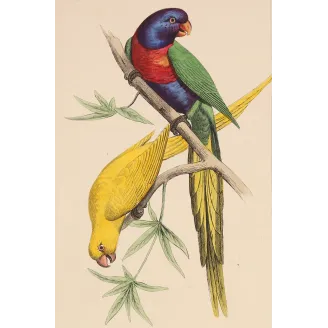
A striking 19th-century engraving depicting two vividly colored parakeets in a dynamic composition. The intense contrast of blue, red, green and yellow creates a highly decorative work, ideal as a focal piece in refined interiors.
 Delivery policy
Your print will be carefully prepared and shipped worldwide via trusted couriers (UPS or similar).
 Authentic antique prints
Original engravings from the 17th–19th century.
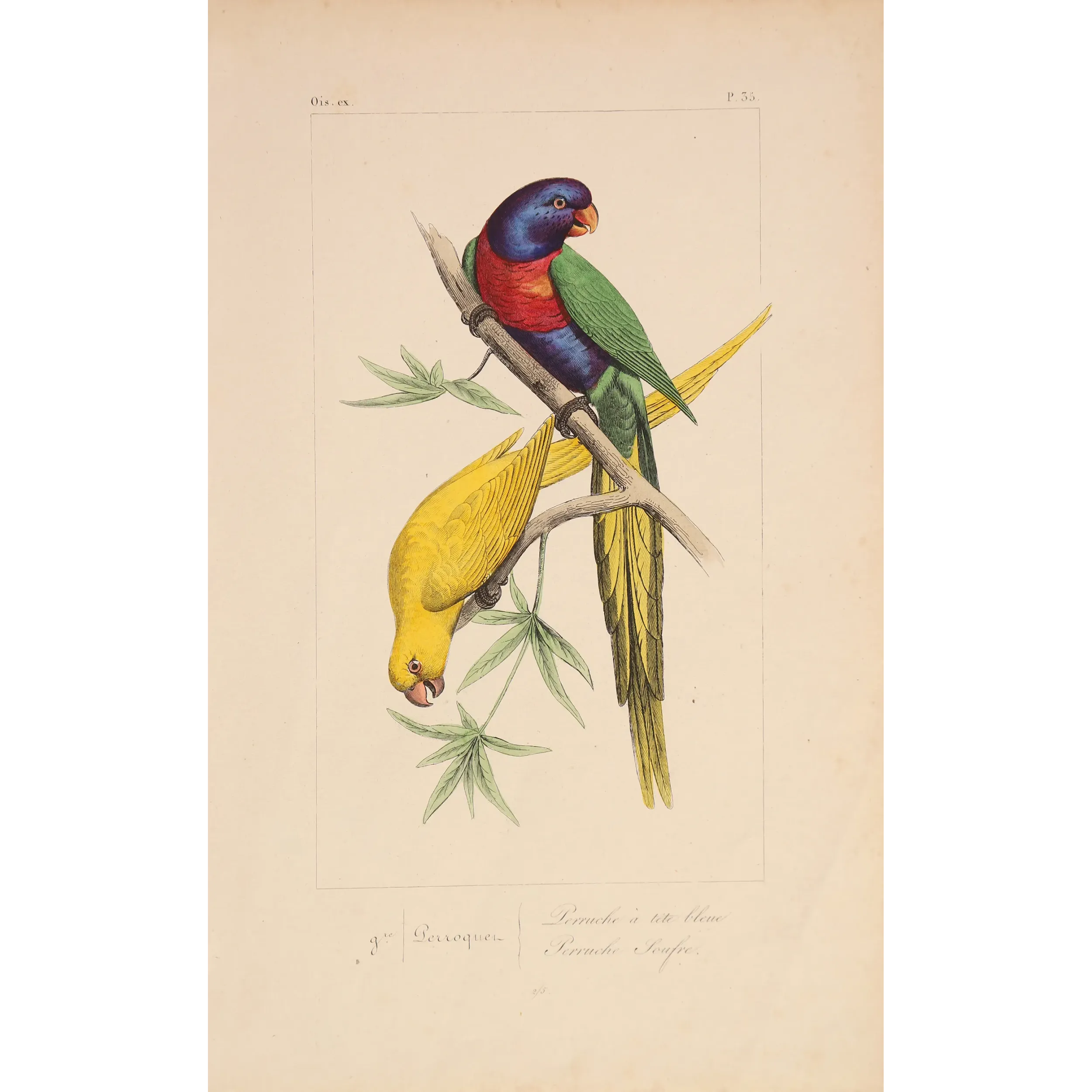
This refined original first-edition plate depicts two brilliantly coloured exotic parakeets from C. L. Lemaire’s Histoire Naturelle des Oiseaux Exotiques, published in Paris in 1836. The historical titles printed directly on the sheet identify the subjects as Perruche à tête bleue and Perruche Soufré. The figures were created by Pauquet, described in the original publication as peintes d’après nature and engraved on steel.
Plate P.35 is built around a striking opposition of posture. The upper bird remains upright and visually concentrated, while the brilliant yellow subject below pivots downward around the branching perch. Their bodies move in different directions, yet the crossing branches bind them into a single controlled composition.
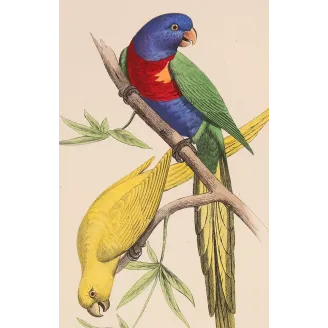
The original hand colouring is exceptionally refined, particularly across the blue passages of the upper bird, where subtle tonal transitions create an almost metallic chromatic depth. Direct examination also reveals selective gum arabic on the blue areas and green wing of the upper subject and across the body of the yellow bird, excluding its tail. These limited glossy passages introduce points of luminosity that animate the entire composition without overwhelming its predominantly matte surface.
The composition is organised around intersecting branches that create both support and directional tension. The upper bird sits almost vertically along the principal branch, its long body and tail descending through the centre of the image. Below, the yellow bird turns sharply downward, introducing an opposing movement that immediately disrupts any possibility of static symmetry.
Pauquet uses this contrast with remarkable economy. The upper subject appears physically composed: the body is gathered around the perch, the head turns gently and the long tail establishes a strong downward axis. The second bird behaves very differently. Its body rotates beneath the branch and its head descends towards the lower left, creating the impression of an action momentarily arrested.
Colour amplifies this opposition. The upper bird concentrates deep blue, crimson, green and violet into a complex chromatic mass. Particularly sophisticated is the hand-colouring of the blue head and breast, where layered tones shift between blue, violet and darker metallic-looking passages while allowing the engraved structure beneath to remain visible.
The lower bird works almost as a chromatic counterstatement. Its predominantly sulphur-yellow plumage creates a broad field of light against the more complex colours above, while the delicate green foliage prevents the surrounding space from becoming visually empty.
One bird concentrates colour; the other releases light.
The original plate identifies the upper subject as Perruche à tête bleue and the lower bird as Perruche Soufré. These designations belong to nineteenth-century zoological nomenclature and are retained here exactly as part of the historical evidence carried by the sheet.
Historical vernacular bird names do not always correspond unambiguously to present-day taxonomy. Rather than impose a modern identification where the correspondence requires further verification, Prantique preserves the original nomenclature alongside the descriptive English titles Blue-Headed Parakeet and Sulphur Parakeet. This allows the object to remain anchored to its original scientific context while keeping the subjects immediately intelligible to a contemporary reader.
Plate P.35 demonstrates how Pauquet could generate vitality through opposition rather than direct interaction. The birds do not face one another and do not participate in an obvious narrative. Instead, their relationship is constructed through orientation, gravity and the architecture of the branches.
The visual sequence can almost be read as:
branch → grip → rotation → contrast → light
The upper bird establishes the stable axis of the composition. Its body follows the branch while the long tail extends downward. The yellow bird then rotates beneath the intersecting support, reversing the physical direction of the first subject and generating a controlled sense of instability.
Direct examination reveals an equally selective material strategy. Gum arabic is visible across the body of the yellow bird, excluding the tail, and on the blue passages and green wing of the upper subject. These areas are comparatively limited in scale, yet their reflective surfaces function as concentrated points of luminosity within the composition.
The effect is particularly sophisticated on the upper bird. The already complex hand-coloured blue passages acquire additional depth when viewed under changing light, producing subtle shifts between blue, violet and darker reflective tones. The surface treatment does not simply make the bird brighter; it gives selected areas greater visual intensity.
Rather than illuminating every colour equally, the glossy passages punctuate the image. Small areas of reflected light are sufficient to increase the perceived luminosity of the whole plate — a restrained material intervention with considerable visual effect.
Published in Paris in 1836, C. L. Lemaire’s Histoire Naturelle des Oiseaux Exotiques brought together natural-history knowledge, brilliant hand colouring and Pauquet’s remarkable ability to suggest the physical presence of the living bird. Our dedicated Historical Perspective explores how observation d’après nature, gesture and composition combine throughout the work.
Histoire Naturelle des Oiseaux Exotiques: Art, Observation and the Living Bird →
The Pauquet name also belongs to a broader world of nineteenth-century natural-history illustration. Across different zoological subjects, the artists adapted their visual language to very different scientific and editorial purposes — from the animated presence of Lemaire’s birds to the precise, specimen-like presentation of exotic butterflies.
Excellent condition. Direct examination of this impression shows a clean and highly luminous first-edition sheet with beautifully preserved original hand colouring and crisp engraved detail throughout.
The hand colouring is particularly refined across the blue areas of the upper bird, where subtle tonal variations create exceptional chromatic depth while preserving the engraved structure beneath. Selective gum arabic remains clearly visible on these blue passages and the green wing, as well as across the coloured body of the yellow bird, excluding its tail.
The sheet shows only minor signs of natural age and handling consistent with an original work of 1836. The central image remains fresh, sharply defined and visually luminous, with generous margins and no significant defect affecting the composition.
Original plate titles: Perruche à tête bleue / Perruche Soufré
Modern identification: Blue-Headed Parakeet / Sulphur Parakeet — historical designations retained pending secure modern taxonomic identification
Work: Histoire Naturelle des Oiseaux Exotiques
Author: C. L. Lemaire
Figures: Pauquet
Publication: Paris, Pauquet Éditeur / Debure Libraire
Edition: First edition
Date: 1836
Plate: P. 35
Technique: Original hand-colored steel engraving
Colour: Contemporary hand colouring
Surface enhancement: Selective gum arabic on the body of the yellow bird, excluding the tail, and on the blue areas and green wing of the upper bird, observed by direct examination
Paper: Fine period paper
Watermark: None observed
Sheet size: approx. 23 × 14 cm
Photography: Detailed professional photographs of this individual impression are provided; additional photographs are available upon request.
Specific References
A vibrant 19th-century hand-colored engraving depicting two exotic parrots with striking red and yellow plumage contrasted by softer natural tones. A dynamic and decorative composition with strong visual presence, ideal for collectors and interior display.
A refined 19th-century engraving depicting two parakeets arranged in a fluid and harmonious composition. The dominant green tones, enhanced by delicate red and violet accents, create an elegant and highly decorative natural history print.
Vivid 19th-century hand-colored engraving depicting two parakeets in dynamic interaction, with striking green plumage and contrasting red and violet accents. A highly decorative exotic bird composition.
A striking 19th-century engraving depicting two exotic parrots with vivid red, pink and green plumage. The composition combines strong colour contrast with elegant vertical balance, creating a highly decorative and visually impactful antique print.
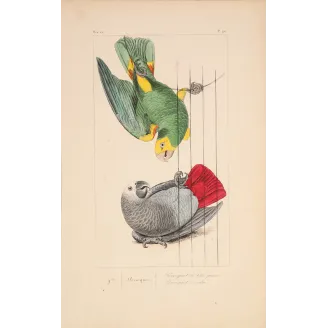
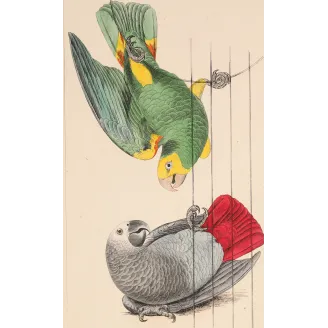
A distinctive 19th-century engraving depicting two parrots in an unusual composition, including one shown suspended upside-down. The presence of cage elements adds historical character, creating a unique and visually engaging natural history print.
Highly decorative 19th-century engraving of exotic parakeets with vivid blue, red and yellow plumage. A striking and colorful antique bird print.
A striking 19th-century hand-colored engraving depicting two exotic parrots in a composition of vivid chromatic contrast. The brilliant red lory and the grey-headed, yellow-breasted parakeet create a highly decorative image of strong visual presence, ideal for collectors of antique ornithological prints and refined interiors.
A highly dynamic 19th-century engraving depicting a tricolour lory in flight above a contrasting parakeet. The vivid interplay of red, yellow, green and blue creates a striking decorative composition with exceptional visual energy and presence.
Elegant 19th-century hand-colored engraving depicting two sulphur-crested cockatoos, rendered with refined detail and soft tonal harmony. A balanced and decorative exotic bird composition ideal for sophisticated interiors.
A vivid 19th-century engraving depicting two exotic parakeets in a dynamic vertical composition. The intense red plumage contrasts beautifully with green and yellow tones, creating a striking decorative work with strong visual presence.
This vivid 19th-century engraving depicts two exotic aracaris, showcasing striking contrasts of green, red and yellow plumage. A highly decorative composition combining scientific observation with strong visual appeal, ideal for collectors of tropical ornithology and refined interior spaces.
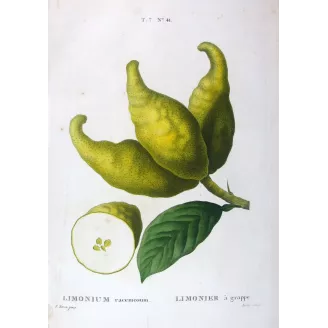
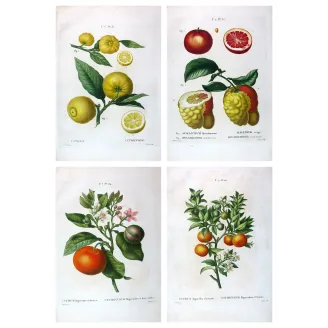
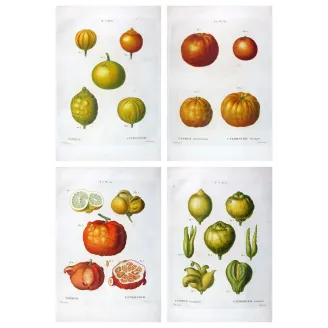
A coherent ensemble of eight original orange and bigarade engravings by Pancrace Bessa, reflecting the cultivated discipline of French orangeries in the Napoleonic era. Botanical precision and architectural composure unite in a refined citrus portfolio preserved as a complete series.
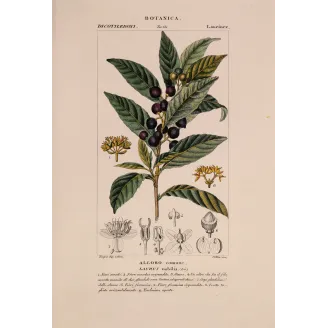
Graceful composition of bay laurel with fruits, blossoms, and internal flower structure.
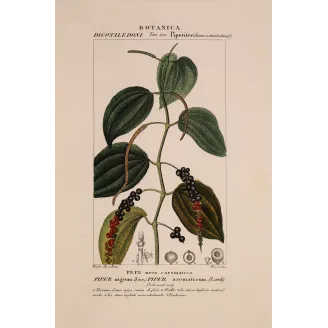
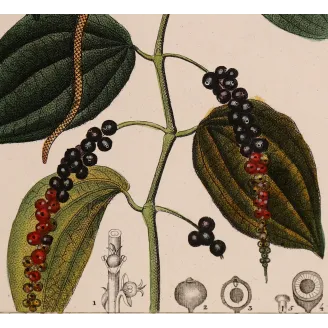
Detailed depiction of the black pepper vine with fruiting spikes and leaves.
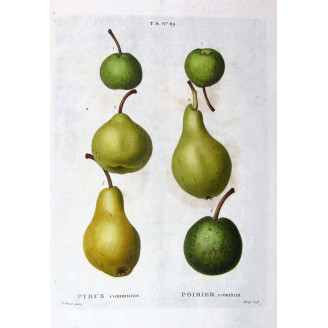
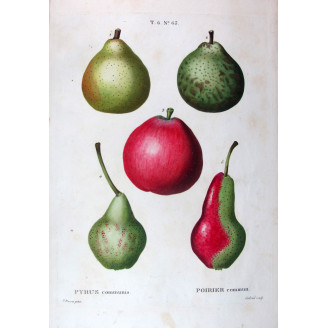
A refined study of French cultivated pear varieties, distinguished by subtle chromatic contrasts and carefully modelled forms. This hand-colored engraving reflects Pancrace Bessa’s ability to elevate orchard subjects through balance, restraint, and quiet visual authority.
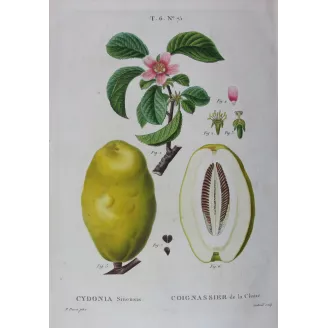
Chinese Quince Coignassier de la Chine Original hand-colored botanical engraving by Pancrace Bessa.
A striking 19th-century engraving depicting two vividly colored parakeets in a dynamic composition. The intense contrast of blue, red, green and yellow creates a highly decorative work, ideal as a focal piece in refined interiors.