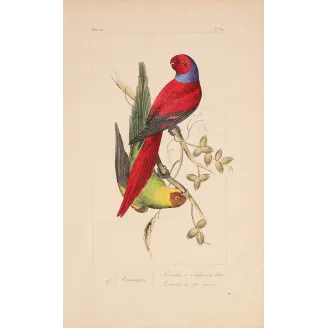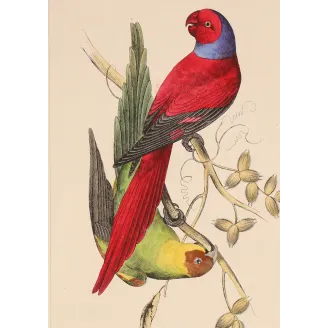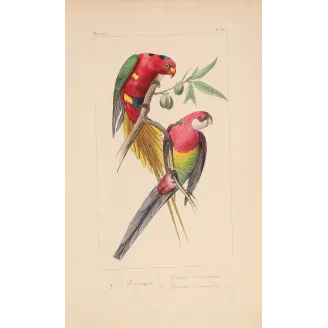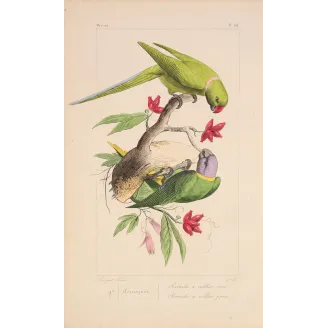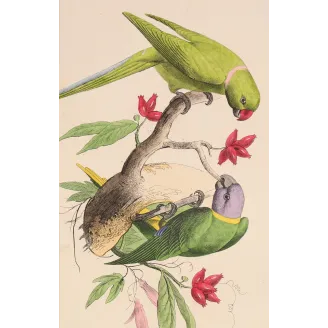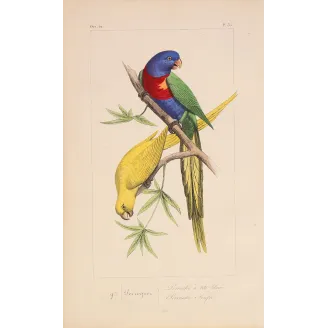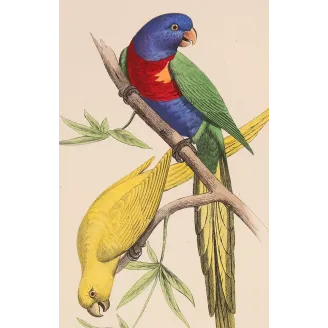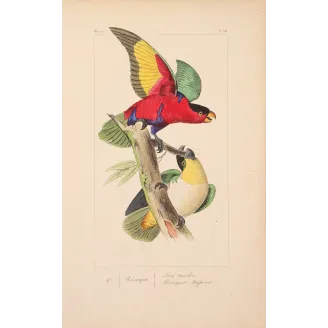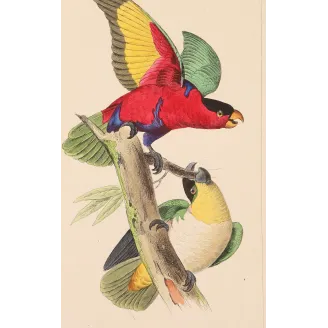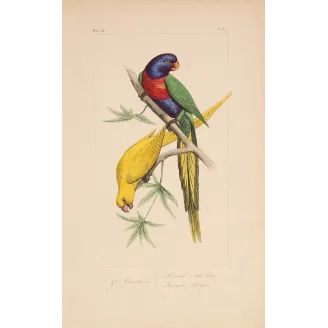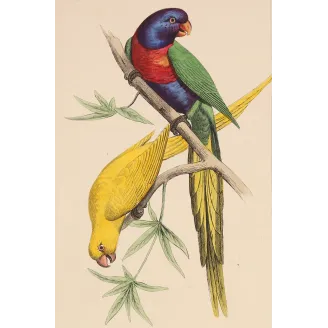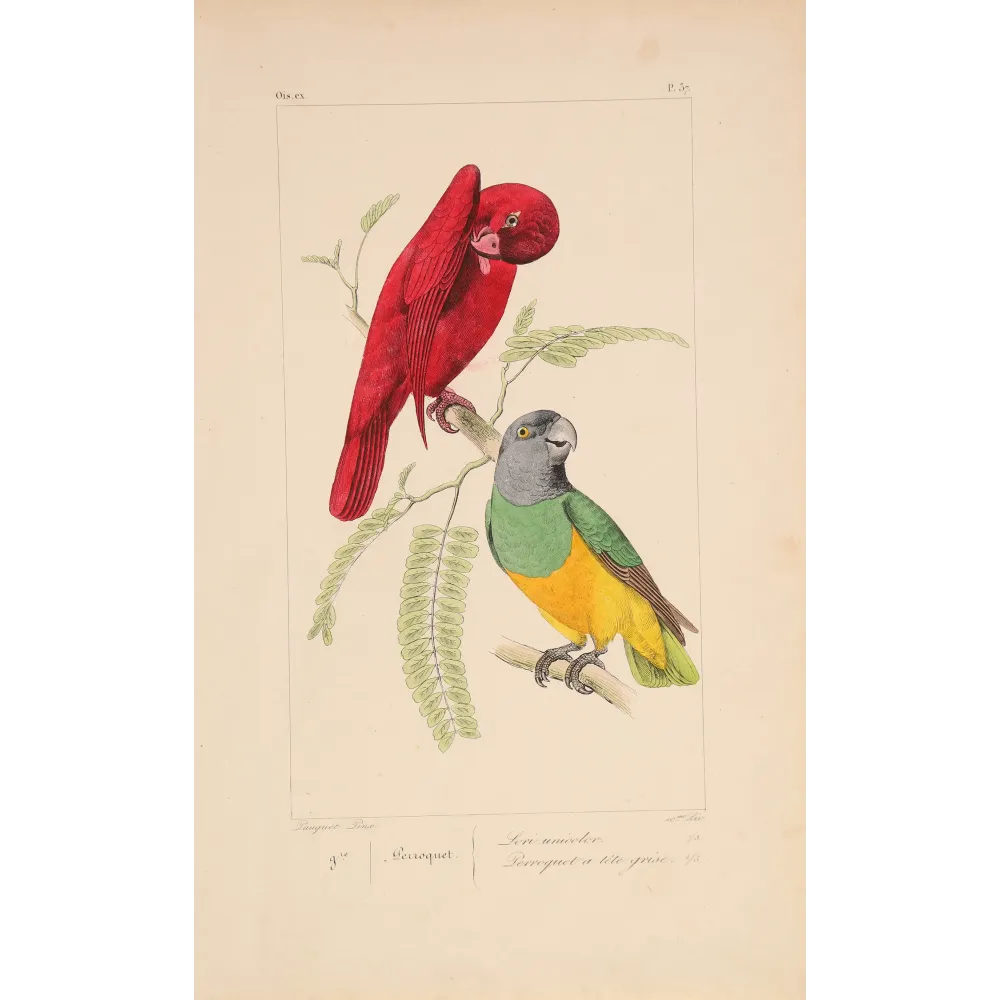
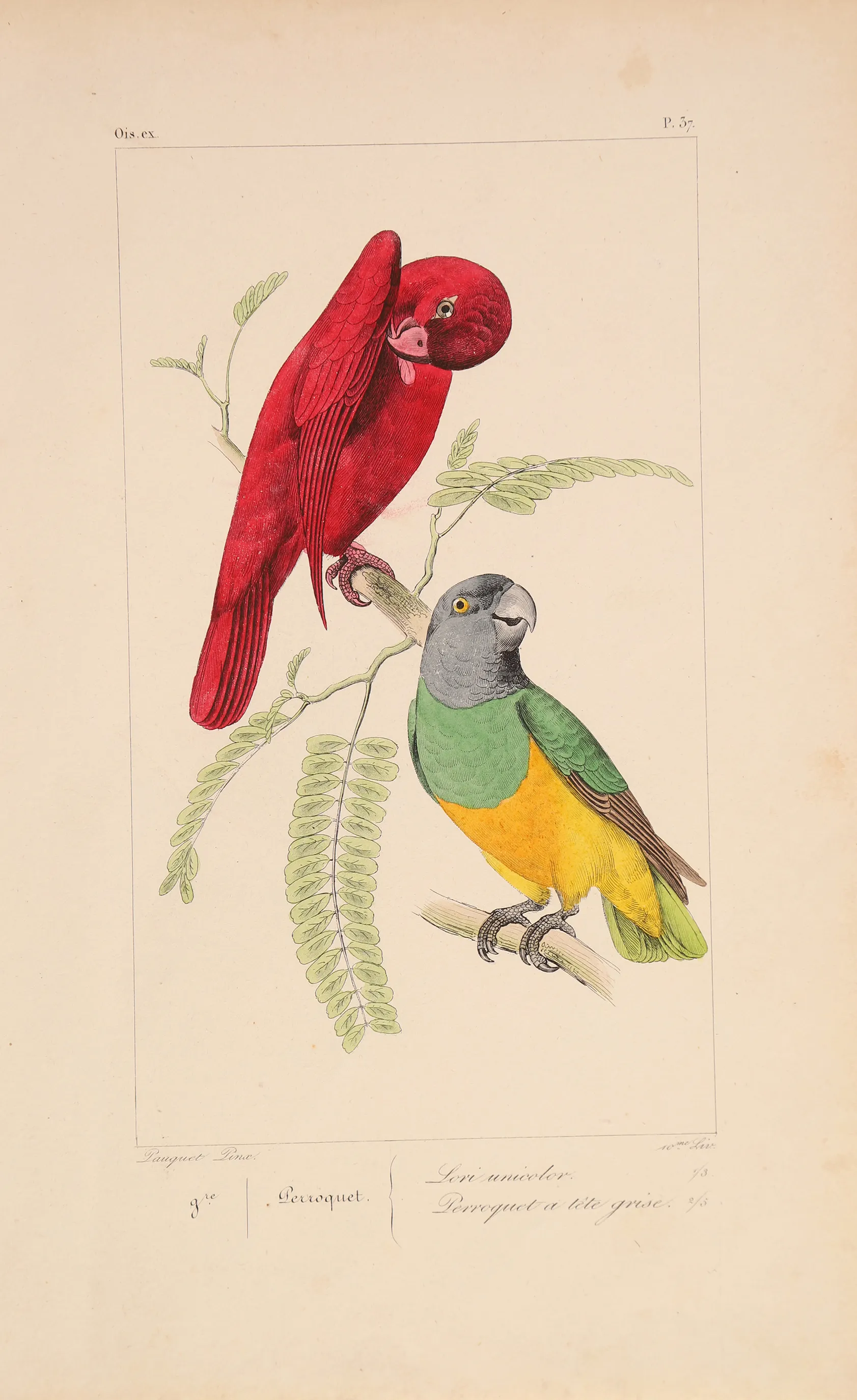
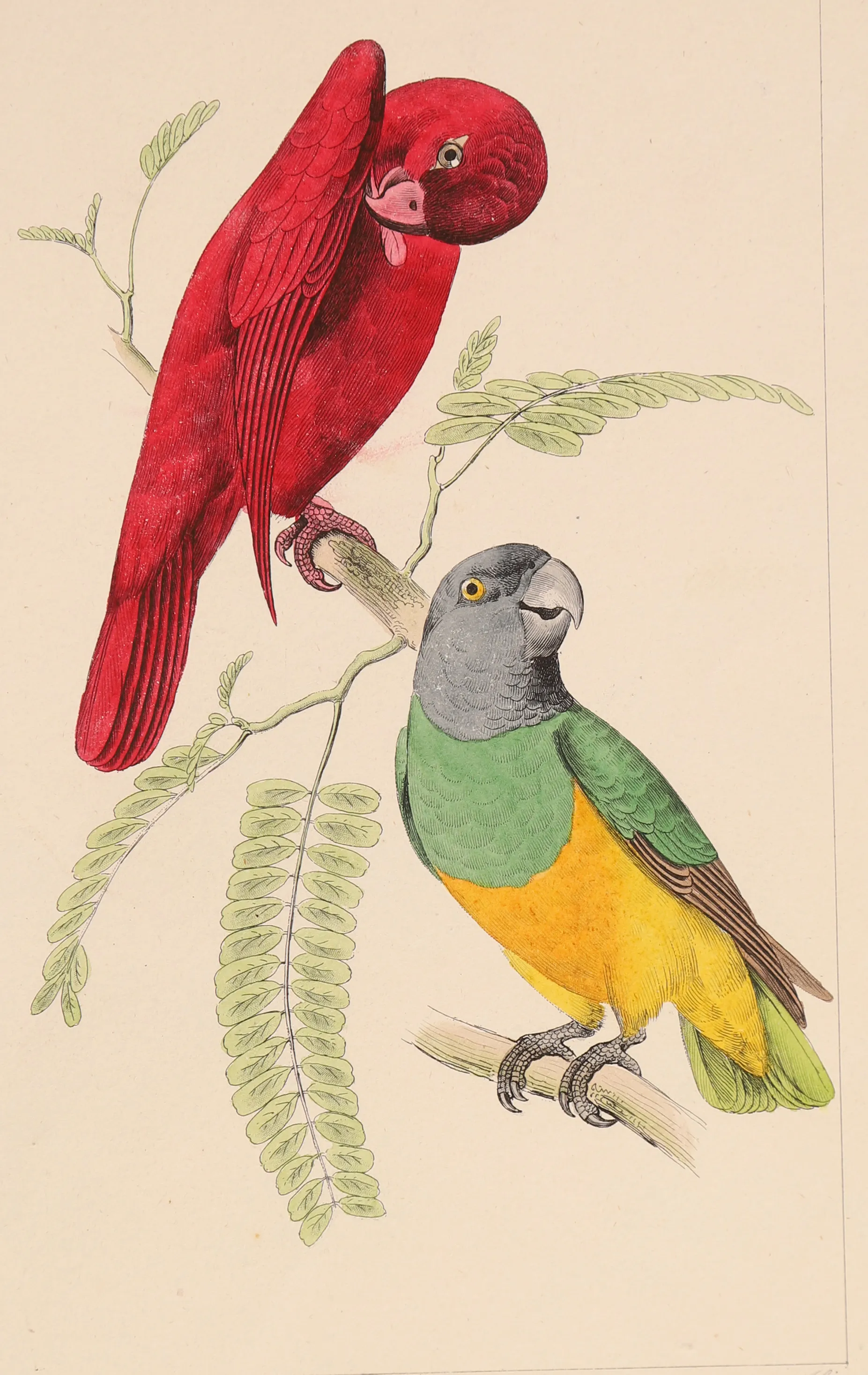
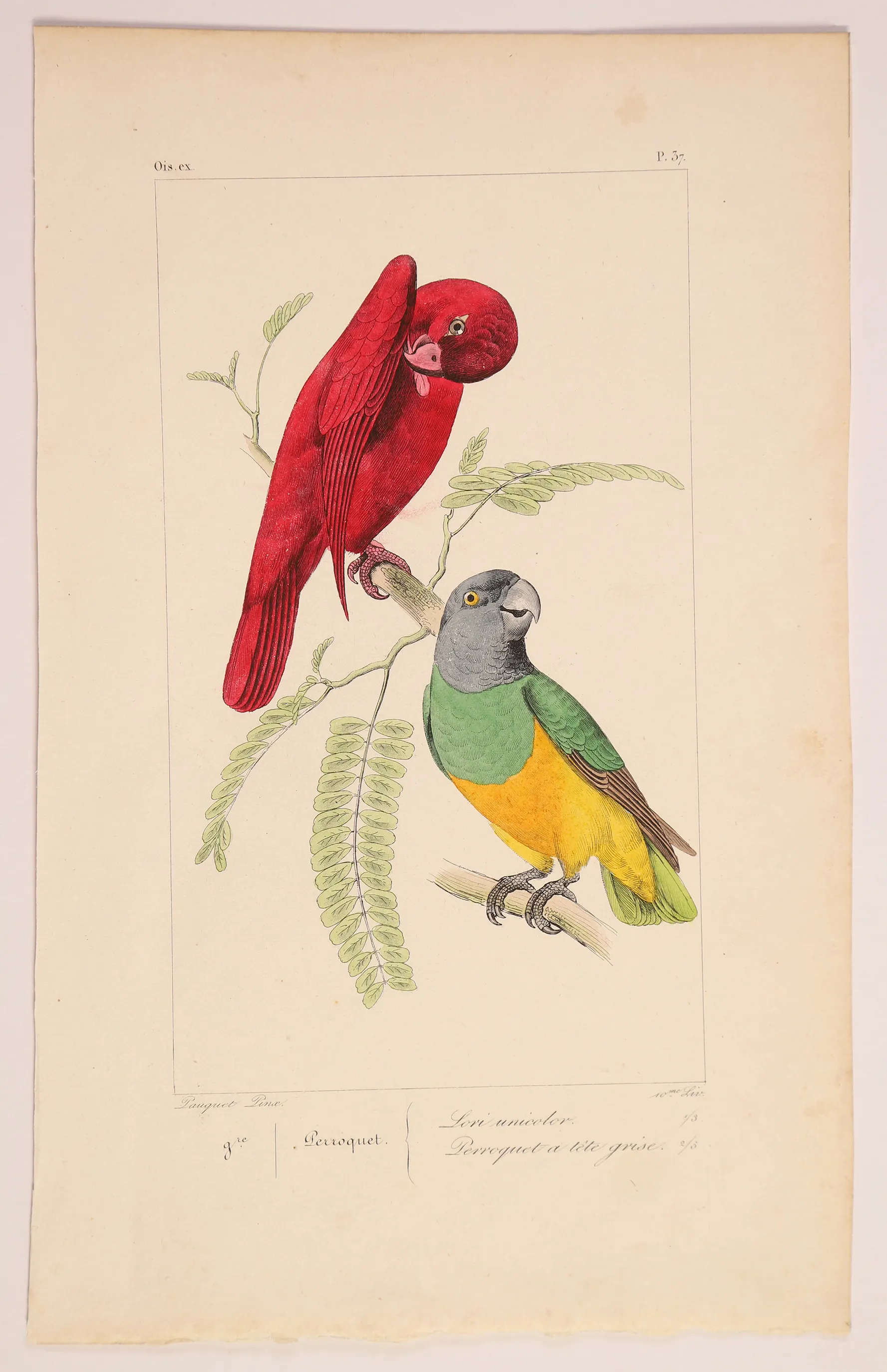
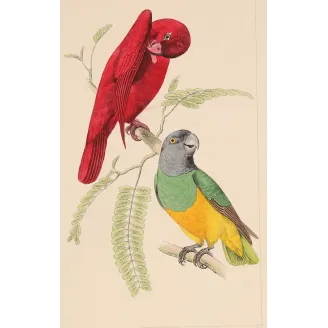
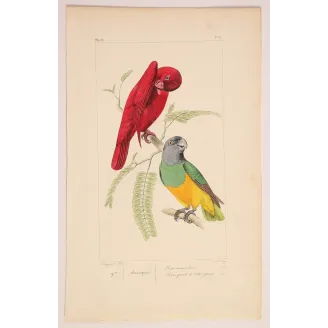
A striking 19th-century hand-colored engraving depicting two exotic parrots in a composition of vivid chromatic contrast. The brilliant red lory and the grey-headed, yellow-breasted parakeet create a highly decorative image of strong visual presence, ideal for collectors of antique ornithological prints and refined interiors.
 Delivery policy
Your print will be carefully prepared and shipped worldwide via trusted couriers (UPS or similar).
 Authentic antique prints
Original engravings from the 17th–19th century.
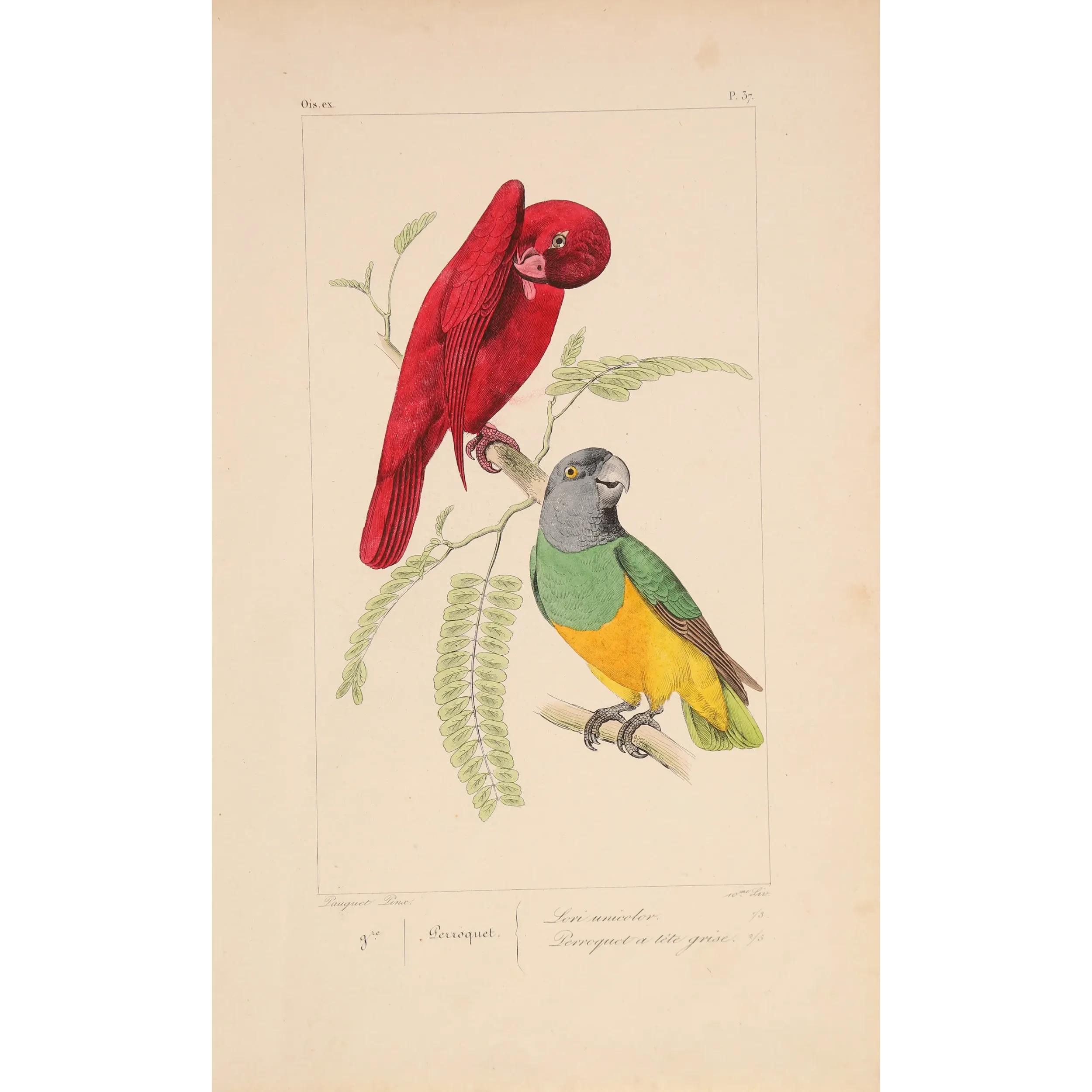
This refined original first-edition plate depicts two exotic parrots from C. L. Lemaire’s Histoire Naturelle des Oiseaux Exotiques, published in Paris in 1836. The historical titles printed directly on the sheet identify the subjects as Lori unicolor and Perroquet à tête grise. The figures were created by Pauquet, described in the original publication as peintes d’après nature and engraved on steel.
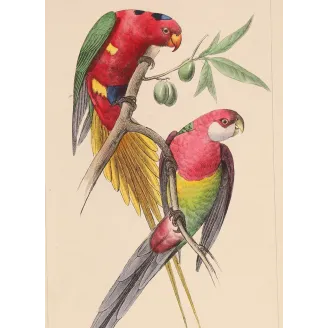
Plate P.37 is built around a striking contrast between two very different visual presences. The upper bird forms a concentrated mass of intense red, its body slightly curved inward and its head turned back towards the viewer. Below, the grey-headed parakeet is more open and stable, its green and yellow plumage introducing a calmer chromatic counterweight.
The original hand colouring remains exceptionally fresh and vivid. Direct examination reveals selective gum arabic only across the yellow plumage of the lower bird. This highly restricted glossy passage creates a concentrated point of luminosity within an otherwise predominantly matte composition, subtly balancing the visual dominance of the red subject above.
The composition develops vertically through two separate perches connected by delicate foliage. The upper bird occupies the left side of the sheet, while the lower subject shifts slightly to the right, creating a gentle diagonal relationship rather than a strict stacked arrangement.
The red lory is unusually compact in attitude. Its body curves inward, the raised wing follows the line of the torso and the head turns back, creating a sense of self-contained movement. The effect is almost sculptural: the bird appears folded around its own axis rather than projected outward into space.
The lower bird provides the opposite sensation. Its posture is more open and grounded, with the body aligned vertically over the perch and the head held upright. This stability gives the composition a visual anchor and prevents the intense red mass above from dominating the entire sheet.
Colour reinforces the distinction between the two subjects. The upper bird is almost monochromatic in its crimson intensity, with engraved modelling creating depth within the red plumage. The lower bird is divided into clear chromatic zones of grey, green and yellow, producing a more articulated and measured visual structure.
One bird concentrates energy; the other stabilises the composition.
The original plate identifies the upper subject as Lori unicolor and the lower bird as Perroquet à tête grise. These names belong to the zoological vocabulary of the nineteenth century and are preserved here as part of the historical evidence carried by the sheet.
Because historical vernacular and scientific names do not always correspond directly to modern taxonomy, the original designations are retained rather than forcing a contemporary identification where the correspondence has not been securely established. This distinction allows the plate to remain faithful to its 1836 context while preserving the possibility of future taxonomic refinement.
Plate P.37 demonstrates how Pauquet could create animation without dramatic wings, extended bodies or strong directional movement. Here the vitality of the image depends on contrast: compact against open, red against green, curved posture against upright stability.
The visual sequence can almost be read as:
curve → concentration → contrast → stability → light
The upper bird establishes the emotional and chromatic intensity of the composition. Its inward-curving posture and backward turn of the head create a contained, almost introspective gesture. The lower parakeet then introduces compositional calm through a more frontal and balanced stance.
Direct examination reveals a particularly restrained use of gum arabic. The glossy surface is confined to the yellow plumage of the lower bird, while the intense red, green and grey areas remain predominantly matte.
Because this reflective passage is so limited, it functions almost as a concentrated source of visual light. The yellow area becomes brighter without overwhelming the surrounding colours, and its luminosity helps counterbalance the much larger crimson mass above.
The result is a composition in which material treatment, colour and posture work together with remarkable economy. Pauquet does not need to animate every element: a few carefully differentiated visual decisions are sufficient to give the two birds distinct presence and character.
Published in Paris in 1836, C. L. Lemaire’s Histoire Naturelle des Oiseaux Exotiques brought together natural-history knowledge, brilliant hand colouring and Pauquet’s remarkable ability to suggest the physical presence of the living bird. Our dedicated Historical Perspective explores how observation d’après nature, gesture and composition combine throughout the work.
Histoire Naturelle des Oiseaux Exotiques: Art, Observation and the Living Bird →
The Pauquet name also belongs to a broader world of nineteenth-century natural-history illustration. Across different zoological subjects, the artists adapted their visual language to very different scientific and editorial purposes — from the animated presence of Lemaire’s birds to the precise, specimen-like presentation of exotic butterflies.
Excellent condition. Direct examination of this impression shows a clean and luminous first-edition sheet with fresh, well-preserved original hand colouring and crisp engraved detail throughout.
Selective gum arabic remains clearly visible only across the yellow plumage of the lower bird, producing a concentrated reflective brilliance. The red, green and grey areas of the composition retain a predominantly matte appearance, preserving the visual contrast created by this restrained surface treatment.
The sheet shows only minor signs of natural age and handling consistent with an original work of 1836. The central image remains bright, sharply defined and visually striking, with generous margins and no significant defect affecting the composition.
Original plate titles: Lori unicolor / Perroquet à tête grise
Modern identification: Red Lory / Grey-Headed Parakeet — historical designations retained pending secure modern taxonomic identification
Work: Histoire Naturelle des Oiseaux Exotiques
Author: C. L. Lemaire
Figures: Pauquet
Publication: Paris, Pauquet Éditeur / Debure Libraire
Edition: First edition
Date: 1836
Plate: P. 37
Technique: Original hand-colored steel engraving
Colour: Contemporary hand colouring
Surface enhancement: Selective gum arabic confined to the yellow plumage of the lower bird, observed by direct examination
Paper: Fine period paper
Watermark: None observed
Sheet size: approx. 23 × 14 cm
Photography: Detailed professional photographs of this individual impression are provided; additional photographs are available upon request.
Specific References
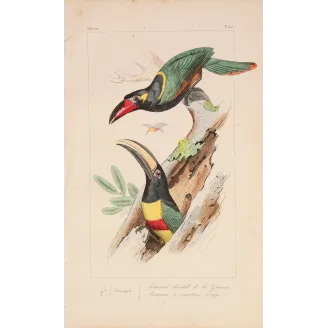
This vivid 19th-century engraving depicts two exotic aracaris, showcasing striking contrasts of green, red and yellow plumage. A highly decorative composition combining scientific observation with strong visual appeal, ideal for collectors of tropical ornithology and refined interior spaces.
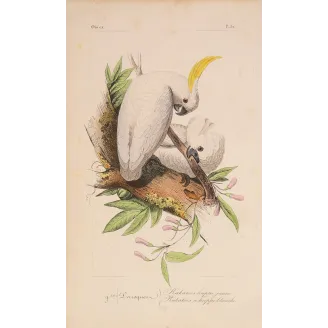
Elegant 19th-century hand-colored engraving depicting two sulphur-crested cockatoos, rendered with refined detail and soft tonal harmony. A balanced and decorative exotic bird composition ideal for sophisticated interiors.
A vivid 19th-century engraving depicting two exotic parakeets in a dynamic vertical composition. The intense red plumage contrasts beautifully with green and yellow tones, creating a striking decorative work with strong visual presence.
A refined 19th-century engraving depicting two parakeets arranged in a fluid and harmonious composition. The dominant green tones, enhanced by delicate red and violet accents, create an elegant and highly decorative natural history print.
A striking 19th-century engraving depicting two exotic parrots with vivid red, pink and green plumage. The composition combines strong colour contrast with elegant vertical balance, creating a highly decorative and visually impactful antique print.
A distinctive 19th-century engraving depicting two parrots in an unusual composition, including one shown suspended upside-down. The presence of cage elements adds historical character, creating a unique and visually engaging natural history print.
Vivid 19th-century hand-colored engraving depicting two parakeets in dynamic interaction, with striking green plumage and contrasting red and violet accents. A highly decorative exotic bird composition.
Highly decorative 19th-century engraving of exotic parakeets with vivid blue, red and yellow plumage. A striking and colorful antique bird print.
A highly dynamic 19th-century engraving depicting a tricolour lory in flight above a contrasting parakeet. The vivid interplay of red, yellow, green and blue creates a striking decorative composition with exceptional visual energy and presence.
A vibrant 19th-century hand-colored engraving depicting two exotic parrots with striking red and yellow plumage contrasted by softer natural tones. A dynamic and decorative composition with strong visual presence, ideal for collectors and interior display.
A striking 19th-century engraving depicting two vividly colored parakeets in a dynamic composition. The intense contrast of blue, red, green and yellow creates a highly decorative work, ideal as a focal piece in refined interiors.
Fine 18th-century hand-colored engraving of Euphorbium by Elisabeth Blackwell, a striking botanical study ideal for collectors.
Borage Plant (Borrago sp.) – Antique Hand-Colored Engraving by Ehret (1756).
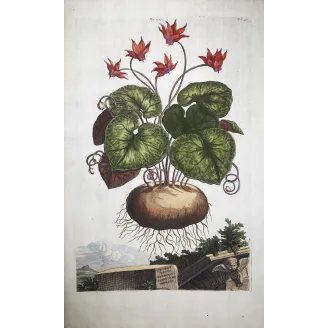
Original 17th-century hand-colored engraving of Cyclamen (Cyclamen europaeum) by Abraham Munting, featuring exposed root structure and elegant botanical composition.
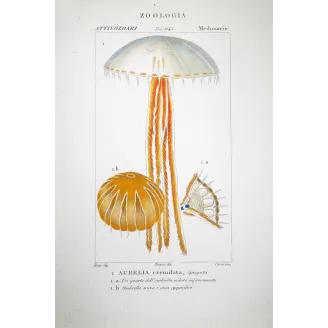
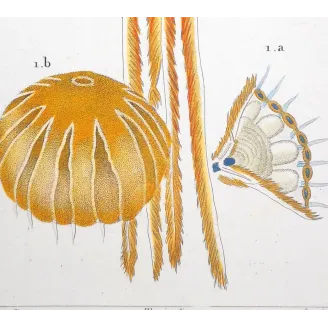
Hand-colored engraving of Aurelia crenulata, with detailed anatomical illustrations.
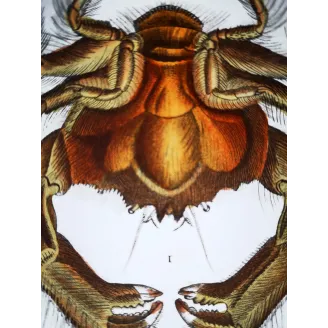
19th-century hand-colored engraving of *Dromia invadissima*, a rare crab with rich orange tones, illustrated by Prêtre with refined marine detail.
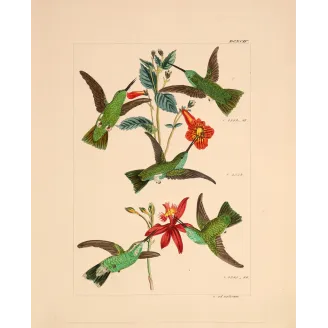
An exceptional original hand-colored engraving from Ludwig Reichenbach's Trochilinarum Enumeratio, depicting five brilliant hummingbirds feeding among scarlet tropical flowers. Featuring Esmeralda, Euchloris and Maculicollis, this dynamic nineteenth-century composition beautifully combines botanical richness with the elegance of Victorian ornithological illustration.
Vivid 19th-century hand-colored engraving depicting two parakeets in dynamic interaction, with striking green plumage and contrasting red and violet accents. A highly decorative exotic bird composition.
A striking 19th-century engraving depicting two vividly colored parakeets in a dynamic composition. The intense contrast of blue, red, green and yellow creates a highly decorative work, ideal as a focal piece in refined interiors.
A striking 19th-century hand-colored engraving depicting two exotic parrots in a composition of vivid chromatic contrast. The brilliant red lory and the grey-headed, yellow-breasted parakeet create a highly decorative image of strong visual presence, ideal for collectors of antique ornithological prints and refined interiors.