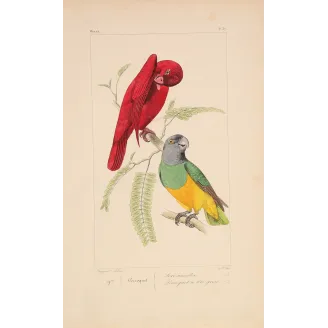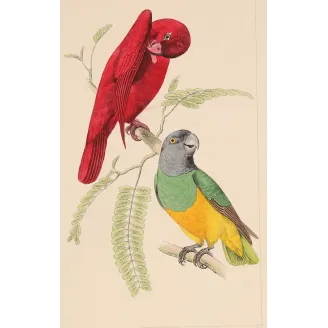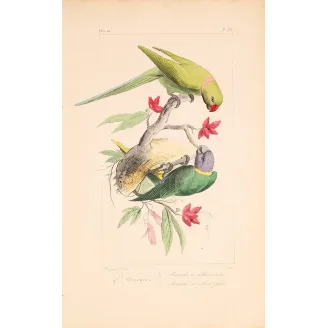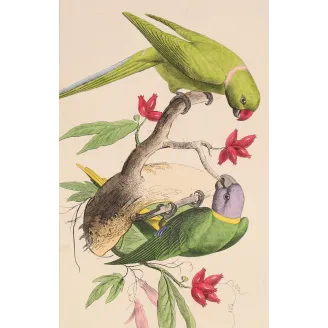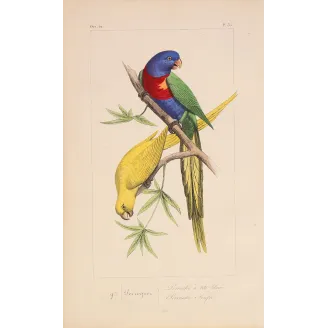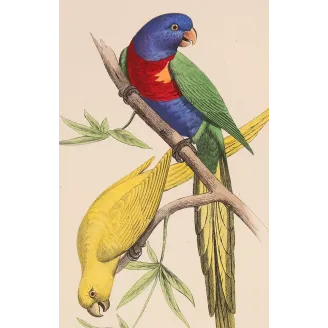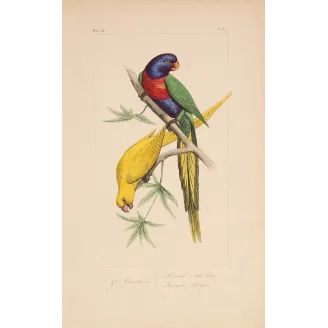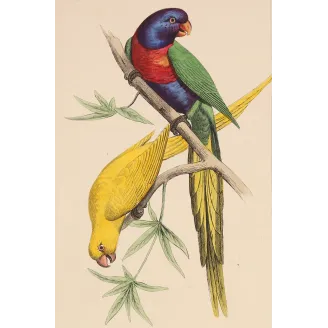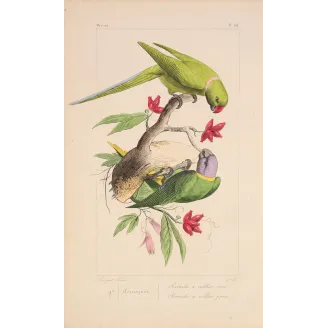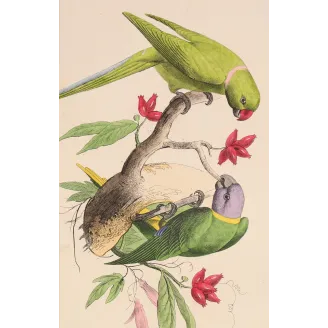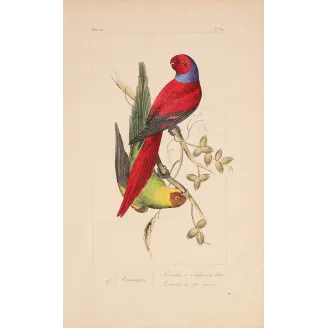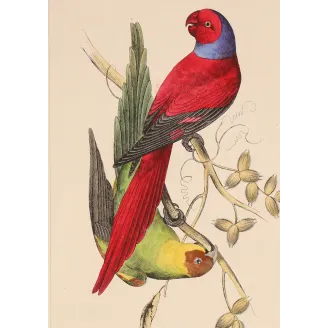
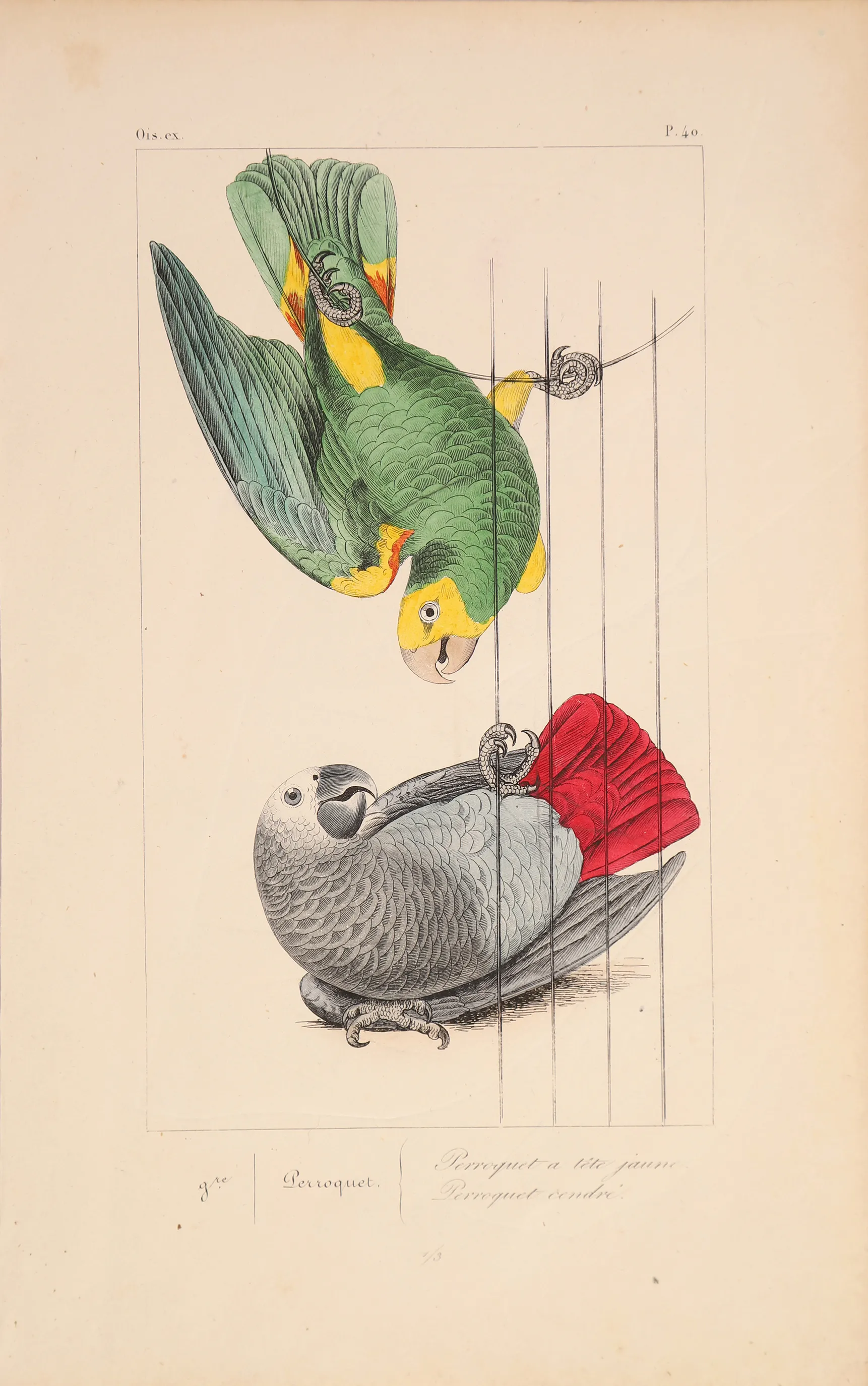
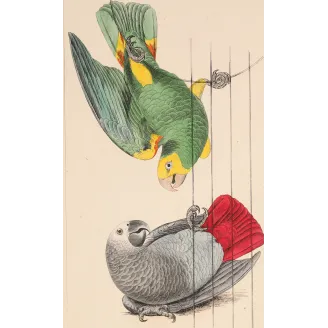
A distinctive 19th-century engraving depicting two parrots in an unusual composition, including one shown suspended upside-down. The presence of cage elements adds historical character, creating a unique and visually engaging natural history print.
 Delivery policy
Your print will be carefully prepared and shipped worldwide via trusted couriers (UPS or similar).
 Authentic antique prints
Original engravings from the 17th–19th century.
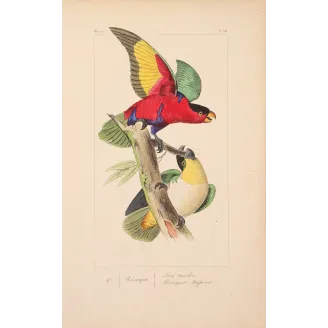
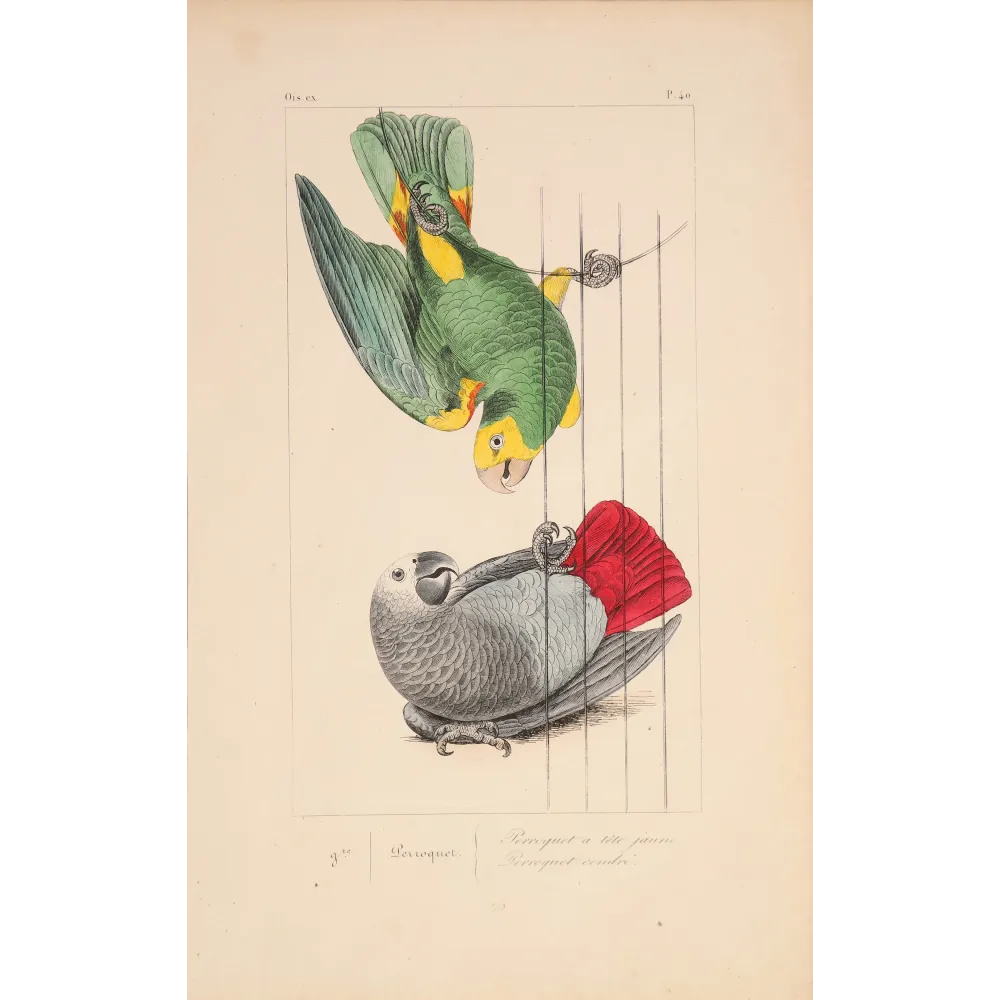
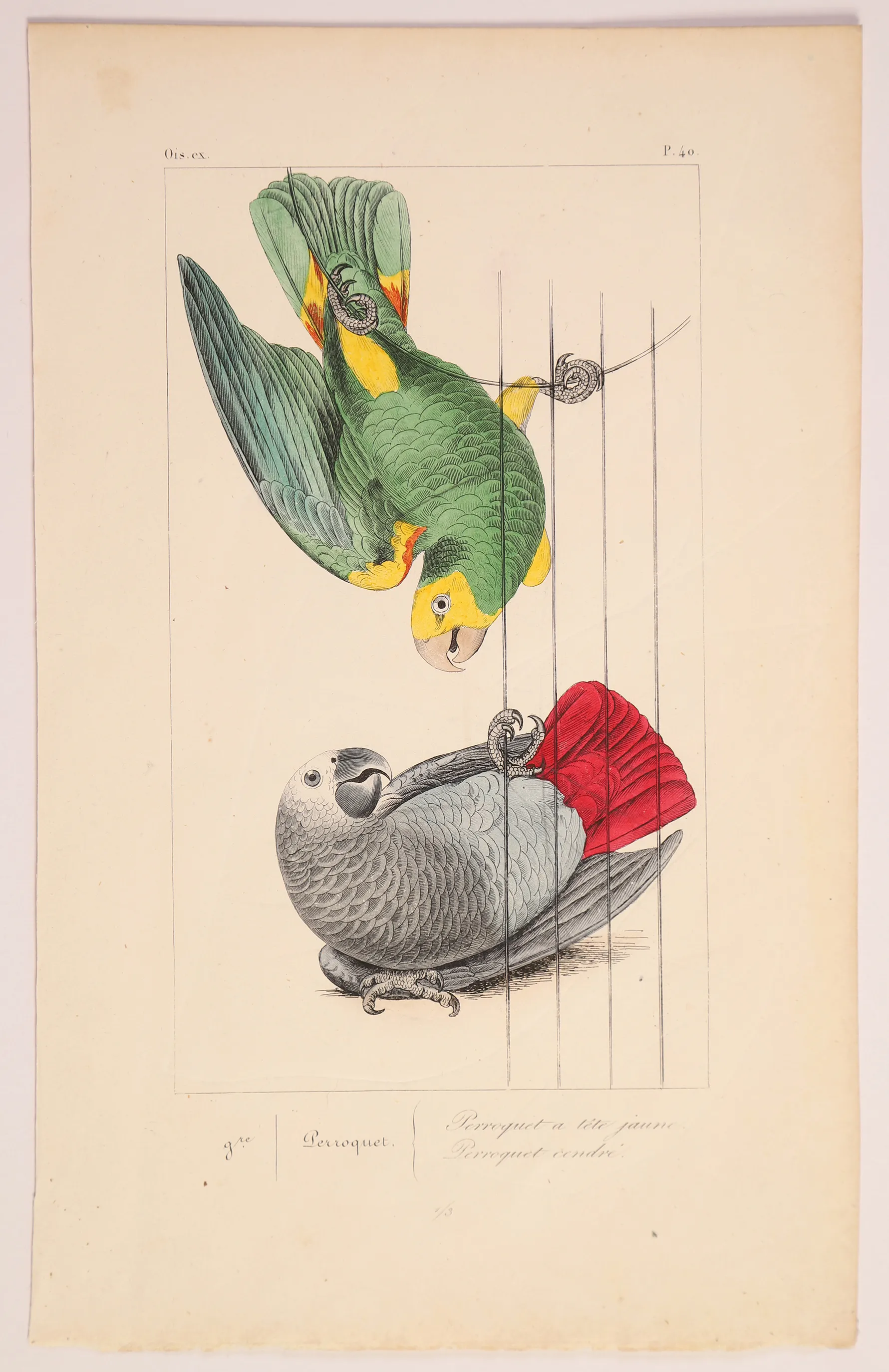
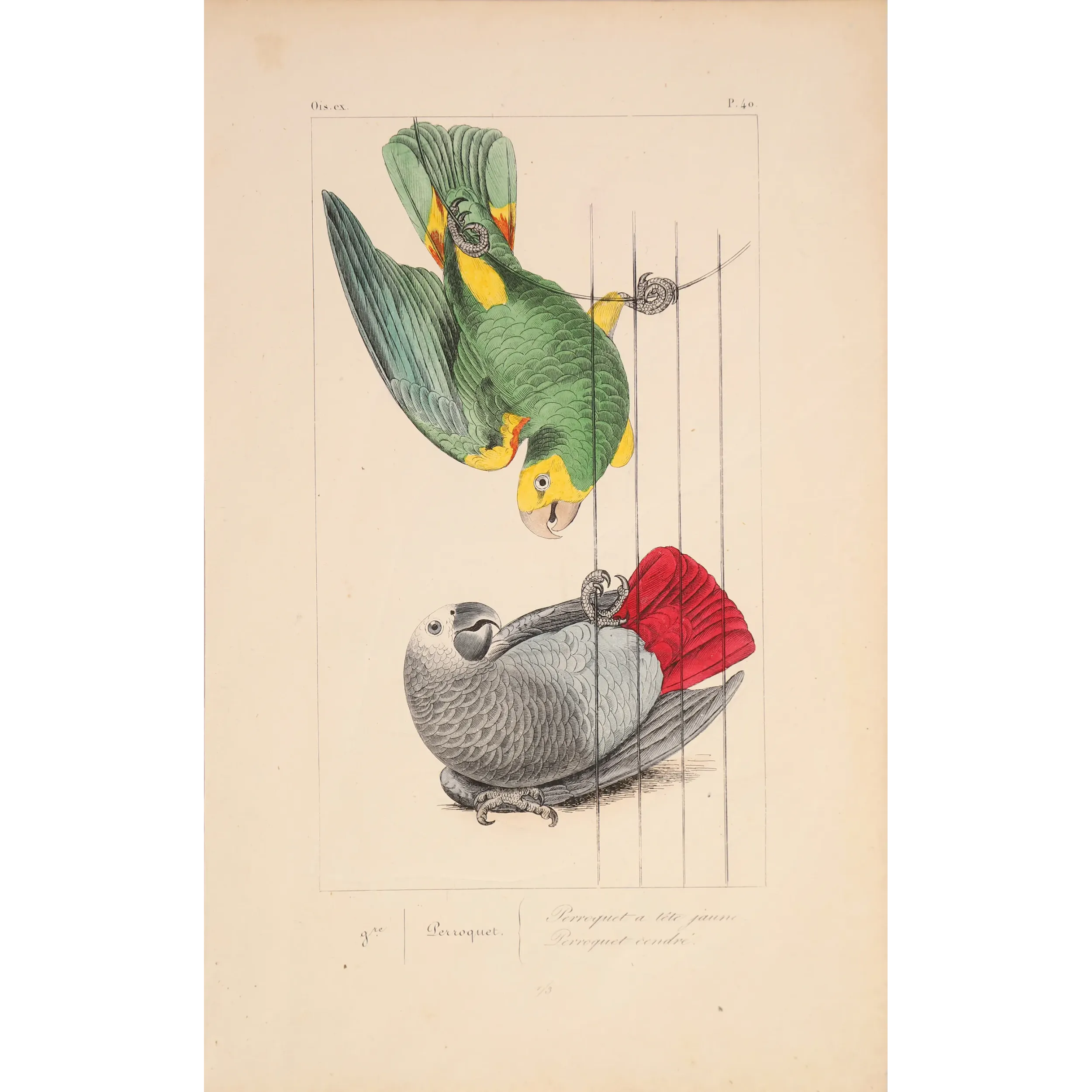
This exceptional original first-edition plate depicts two exotic parrots from C. L. Lemaire’s Histoire Naturelle des Oiseaux Exotiques, published in Paris in 1836. Identified on the plate as “Perroquet à tête jaune” and “Perroquet cendré”, the birds were created by Pauquet, described in the original publication as peintes d’après nature and engraved on steel.
Unlike many plates in the work, where exotic birds inhabit lightly constructed botanical settings, P.40 presents its subjects in an explicitly observed environment. The narrow vertical elements, gripping feet and contrasting positions suggest birds encountered in captivity rather than reconstructed within an idealised landscape. Their behaviour becomes part of the image.
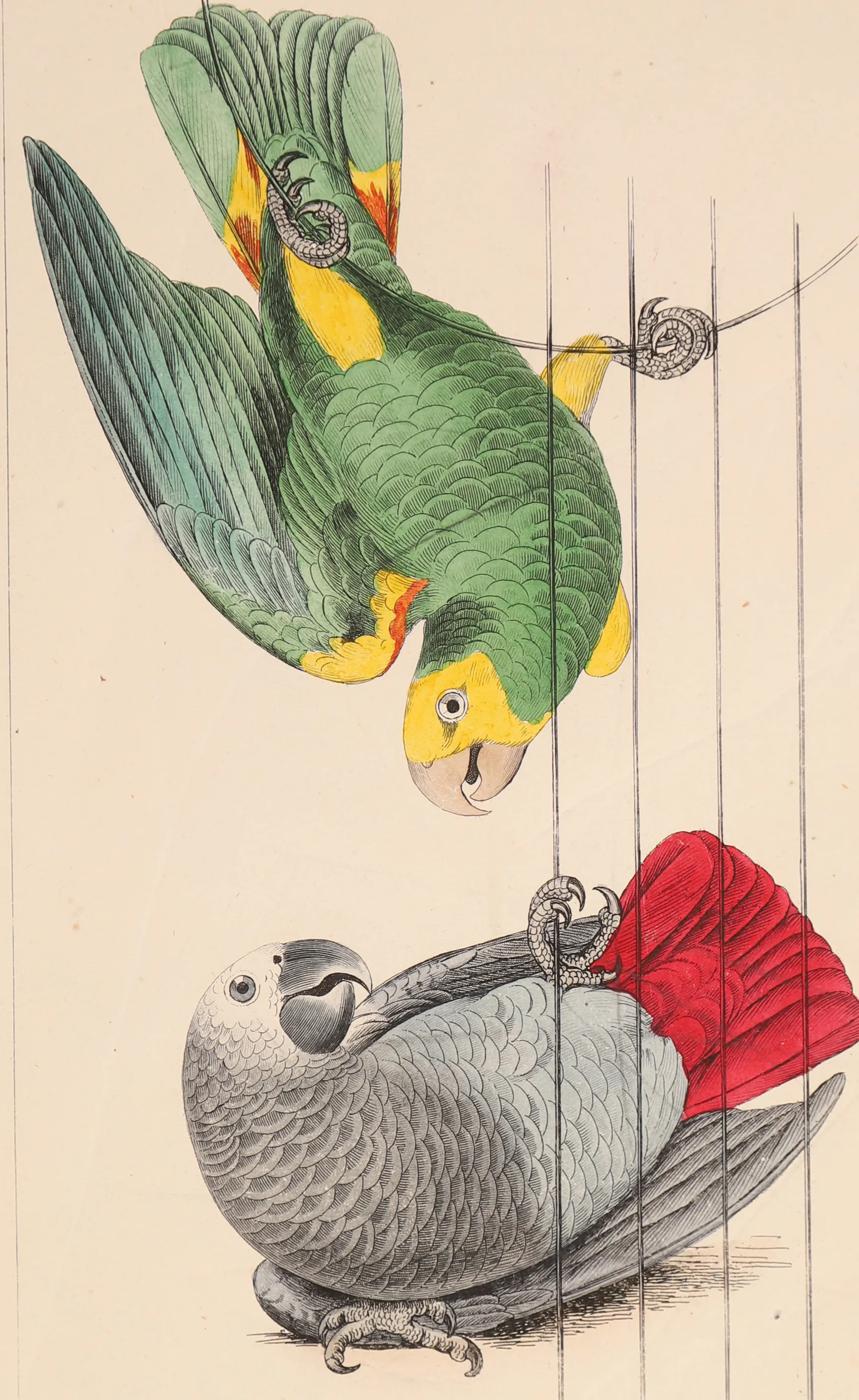
The original hand colouring remains exceptionally fresh. Selective gum arabic, observed by direct examination, enhances the dark green body of the upper bird and the brilliant red tail of the grey parrot below. Rather than covering the entire composition, these concentrated areas of gloss create controlled points of luminosity within an otherwise predominantly matte surface.
P.40 is one of the most unusual compositions within this group of Lemaire bird plates. Instead of arranging the subjects around a conventional branch, Pauquet constructs the image through a sequence of strong vertical lines. Against this almost abstract framework, the bodies of the parrots become dramatically expressive.
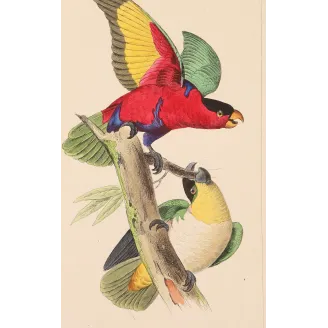
The upper bird is shown inverted, gripping its support while turning its yellow face downward. Its large green body describes a powerful curve across the upper half of the composition, with the extended wing and raised tail creating a broad fan-like silhouette. The pose conveys agility, weight and physical tension rather than the static presentation of a specimen.
Below, the grey parrot provides an extraordinary counterpoint. Its compact rounded body rests horizontally, while one foot rises to grasp the vertical support above. The restrained grey plumage is suddenly interrupted by the intense scarlet tail, creating one of the strongest chromatic accents in the composition.
The relationship between the two birds is therefore constructed through opposites: green against grey, suspended movement against grounded weight, vertical tension against horizontal stability. The repeated lines passing through the composition bind these contrasting attitudes together and give the plate an unusually modern graphic structure.
Surface treatment reinforces this hierarchy. Gum arabic on the dark green plumage of the upper bird gives its body additional depth and luminosity, while the same treatment on the lower bird’s red tail intensifies a comparatively small but visually decisive area. The gloss is not used indiscriminately: it directs light towards selected chromatic masses and allows those passages to animate the entire sheet.
The result is a remarkably characterful image in which colour, posture and physical behaviour are inseparable. Pauquet does not simply show what these birds look like; he suggests how they occupy space.
The historical captions identify the two subjects as Perroquet à tête jaune and Perroquet cendré. These names belong to the zoological vocabulary used in nineteenth-century French natural-history publishing and preserve the classifications through which contemporary readers encountered exotic parrots.
The lower bird is immediately recognisable in visual type as an African grey parrot, characterised by its predominantly grey plumage, powerful dark bill and brilliant red tail. Its representation is particularly effective because Pauquet allows the characteristic scarlet tail to emerge as an isolated field of colour against the otherwise restrained body.
Beyond identification, the plate records something equally important about nineteenth-century ornithology: exotic birds were increasingly known in Europe not only through preserved specimens and earlier illustrations, but also through living individuals kept in collections and aviaries. Their characteristic posture and behaviour could therefore become part of natural-history representation itself.
The exceptional quality of P.40 lies in the relationship between zoological description and observed behaviour. Neither bird is arranged in the conventional profile pose traditionally associated with scientific illustration. Instead, Pauquet records two highly individual physical attitudes.
The upper parrot hangs and rotates around its support; the lower bird remains grounded while reaching upward with one foot. Claws, weight and balance are therefore not secondary anatomical details. They are the mechanisms through which the composition itself is constructed.
The image can be read through a simple sequence:
grip → balance → weight → posture → character
This emphasis is especially significant within a work whose figures were presented as peintes d’après nature. P.40 suggests an illustrator interested not simply in reproducing plumage and anatomical features, but in observing the physical behaviour through which a living bird becomes recognisable.
The selective application of gum arabic adds a second level of interpretation. Gloss is concentrated on two chromatically important areas — the dark green body above and the scarlet tail below. Under changing light these surfaces become more prominent, subtly reinforcing the visual opposition already established by Pauquet’s composition.
Seen in this way, the plate occupies an intriguing position between scientific image and portrait. The species remain the subject of natural history, but posture gives the individual birds something approaching personality.
Published in Paris in 1836, C. L. Lemaire’s Histoire Naturelle des Oiseaux Exotiques belongs to a period when European natural history was increasingly attempting to communicate not only the anatomy of distant species, but the appearance and vitality of living birds. Pauquet’s illustrations are remarkable for precisely this quality: bodies possess weight, feet actively grip their supports, and individual postures become essential parts of the image.
Our Historical Perspective explores this transition from the classified specimen towards the observed living bird, examining how composition, gesture and direct observation transformed nineteenth-century ornithological illustration.
Histoire Naturelle des Oiseaux Exotiques: Art, Observation and the Living Bird →
The Pauquet name also belongs to a broader world of nineteenth-century natural-history illustration. Across different zoological subjects, the artists adapted their visual language to very different scientific and editorial purposes — from animated birds to the precise presentation of exotic insects.
Excellent condition. A remarkably clean and well-preserved first-edition impression, retaining fresh original hand colouring and crisp engraved detail throughout. The principal image remains bright and exceptionally attractive.
Selective gum arabic has been observed by direct examination on the dark green body of the upper bird and on the brilliant red tail of the lower grey parrot. These limited glossy passages remain well preserved and create subtle changes in luminosity as the sheet is viewed under different light.
Under close examination and in the detailed professional photographs, extremely faint dry-point pressure traces can be observed across limited areas of the sheet. They appear as shallow, colourless surface impressions rather than drawn marks and carry no visible ink or graphite.
These traces are not perceptible in normal viewing with the naked eye and do not interfere with the image or its overall presentation. They are recorded here for complete transparency and can be examined in the high-resolution photographs provided.
Original plate titles: Perroquet à tête jaune / Perroquet cendré
Work: Histoire Naturelle des Oiseaux Exotiques
Author: C. L. Lemaire
Figures: Pauquet
Publication: Paris, Pauquet Éditeur / Debure Libraire
Edition: First edition
Date: 1836
Plate: P. 40
Technique: Original hand-colored steel engraving
Colour: Contemporary hand colouring
Surface enhancement: Selective gum arabic on the dark green body of the upper bird and the red tail of the lower grey parrot, observed by direct examination
Paper: Fine period paper
Watermark: None observed
Sheet size: approx. 23 × 14 cm
Condition: Excellent; extremely faint dry pressure traces detectable in detailed photography but not perceptible under normal viewing
Photography: Detailed professional photographs of this individual impression are provided; additional photographs are available upon request.
Specific References
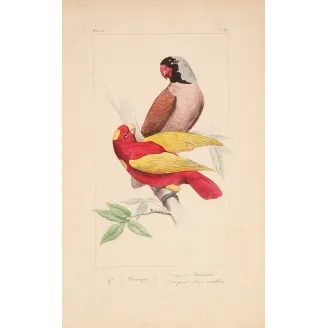
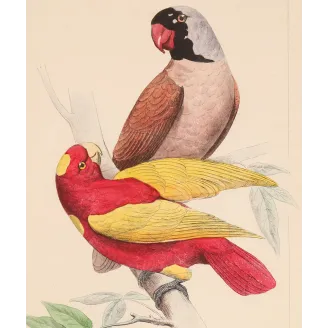
A striking 19th-century hand-colored engraving depicting two exotic parrots in a composition of vivid chromatic contrast. The brilliant red lory and the grey-headed, yellow-breasted parakeet create a highly decorative image of strong visual presence, ideal for collectors of antique ornithological prints and refined interiors.
A refined 19th-century engraving depicting two parakeets arranged in a fluid and harmonious composition. The dominant green tones, enhanced by delicate red and violet accents, create an elegant and highly decorative natural history print.
Highly decorative 19th-century engraving of exotic parakeets with vivid blue, red and yellow plumage. A striking and colorful antique bird print.
A striking 19th-century engraving depicting two vividly colored parakeets in a dynamic composition. The intense contrast of blue, red, green and yellow creates a highly decorative work, ideal as a focal piece in refined interiors.
Vivid 19th-century hand-colored engraving depicting two parakeets in dynamic interaction, with striking green plumage and contrasting red and violet accents. A highly decorative exotic bird composition.
This vivid 19th-century engraving depicts two exotic aracaris, showcasing striking contrasts of green, red and yellow plumage. A highly decorative composition combining scientific observation with strong visual appeal, ideal for collectors of tropical ornithology and refined interior spaces.
A vivid 19th-century engraving depicting two exotic parakeets in a dynamic vertical composition. The intense red plumage contrasts beautifully with green and yellow tones, creating a striking decorative work with strong visual presence.
A striking 19th-century engraving depicting two exotic parrots with vivid red, pink and green plumage. The composition combines strong colour contrast with elegant vertical balance, creating a highly decorative and visually impactful antique print.
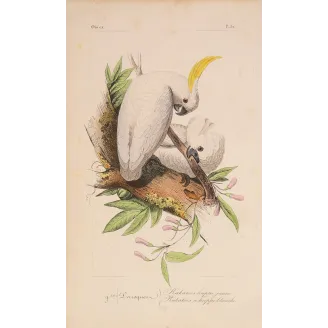
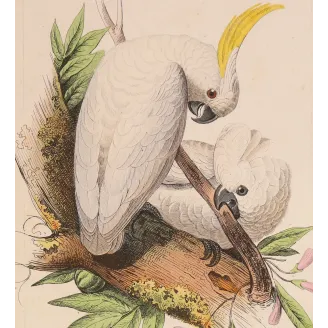
Elegant 19th-century hand-colored engraving depicting two sulphur-crested cockatoos, rendered with refined detail and soft tonal harmony. A balanced and decorative exotic bird composition ideal for sophisticated interiors.
A vibrant 19th-century hand-colored engraving depicting two exotic parrots with striking red and yellow plumage contrasted by softer natural tones. A dynamic and decorative composition with strong visual presence, ideal for collectors and interior display.
A highly dynamic 19th-century engraving depicting a tricolour lory in flight above a contrasting parakeet. The vivid interplay of red, yellow, green and blue creates a striking decorative composition with exceptional visual energy and presence.
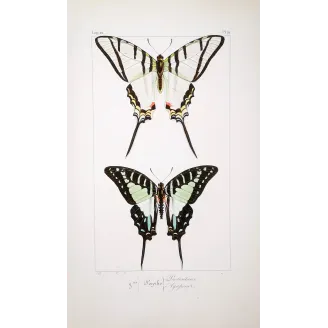
A refined 19th-century hand-colored engraving depicting two elegant kite swallowtails: Eurytides protesilaus and Eurytides agapenor. Published in Hippolyte Lucas’s Exotic Butterflies (1835), the plate highlights their distinctive elongated tails and delicate translucent wings.
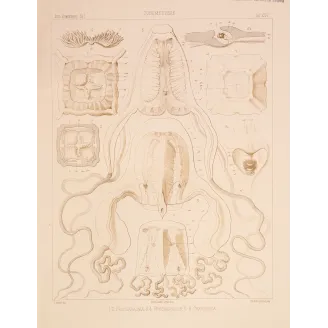
An original 1879 lithograph by Ernst Haeckel from Das System der Medusen, depicting the remarkable anatomy of Cubomedusae (box jellyfish). Combining scientific precision with striking architectural symmetry, this authentic nineteenth-century plate reveals the hidden biological structures behind one of the ocean’s most fascinating marine organisms.
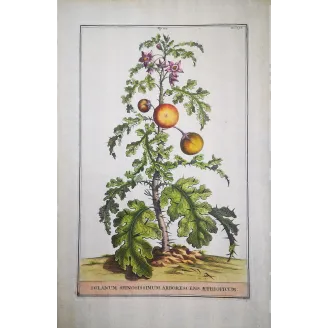
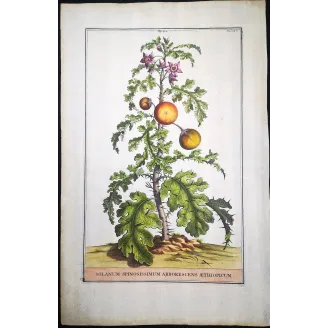
Original 17th-century hand-colored engraving of a spiny Solanum (Solanum aethiopicum) by Abraham Munting, featuring thorned stems, vivid fruit and striking botanical contrast.
A striking 19th-century engraving depicting two vividly colored parakeets in a dynamic composition. The intense contrast of blue, red, green and yellow creates a highly decorative work, ideal as a focal piece in refined interiors.
A coherent ensemble of eight original orange and bigarade engravings by Pancrace Bessa, reflecting the cultivated discipline of French orangeries in the Napoleonic era. Botanical precision and architectural composure unite in a refined citrus portfolio preserved as a complete series.
A distinctive 19th-century engraving depicting two parrots in an unusual composition, including one shown suspended upside-down. The presence of cage elements adds historical character, creating a unique and visually engaging natural history print.