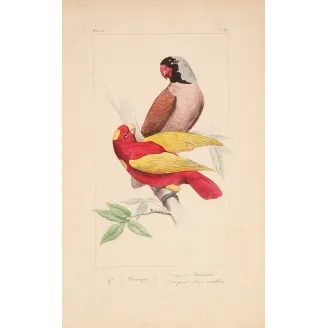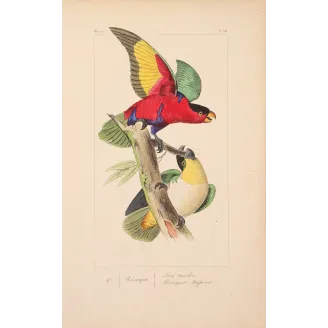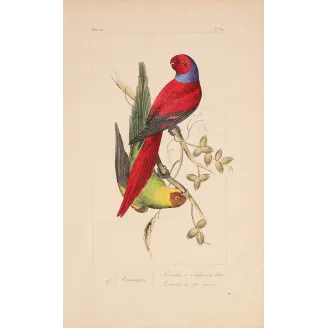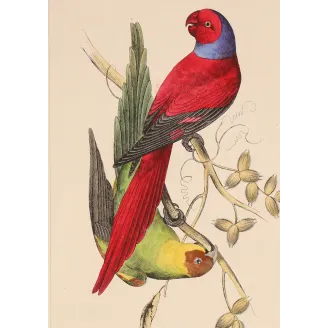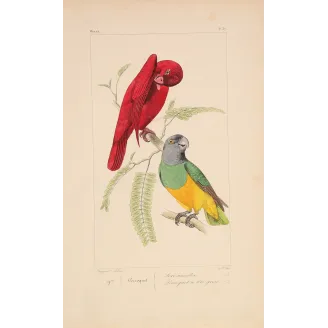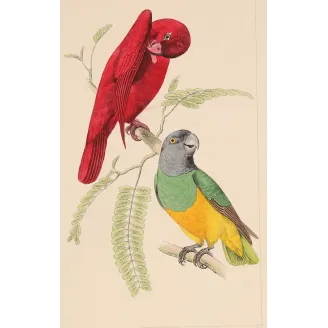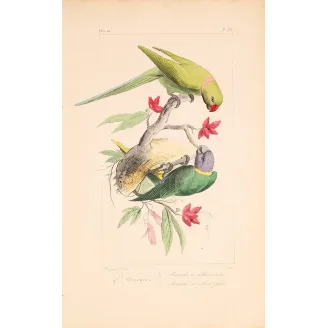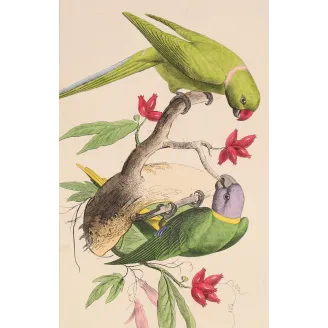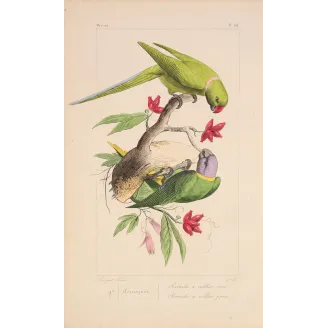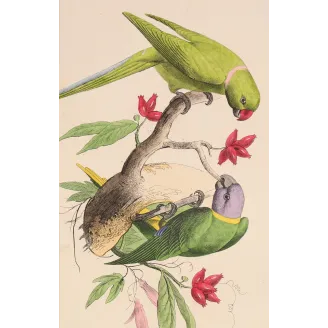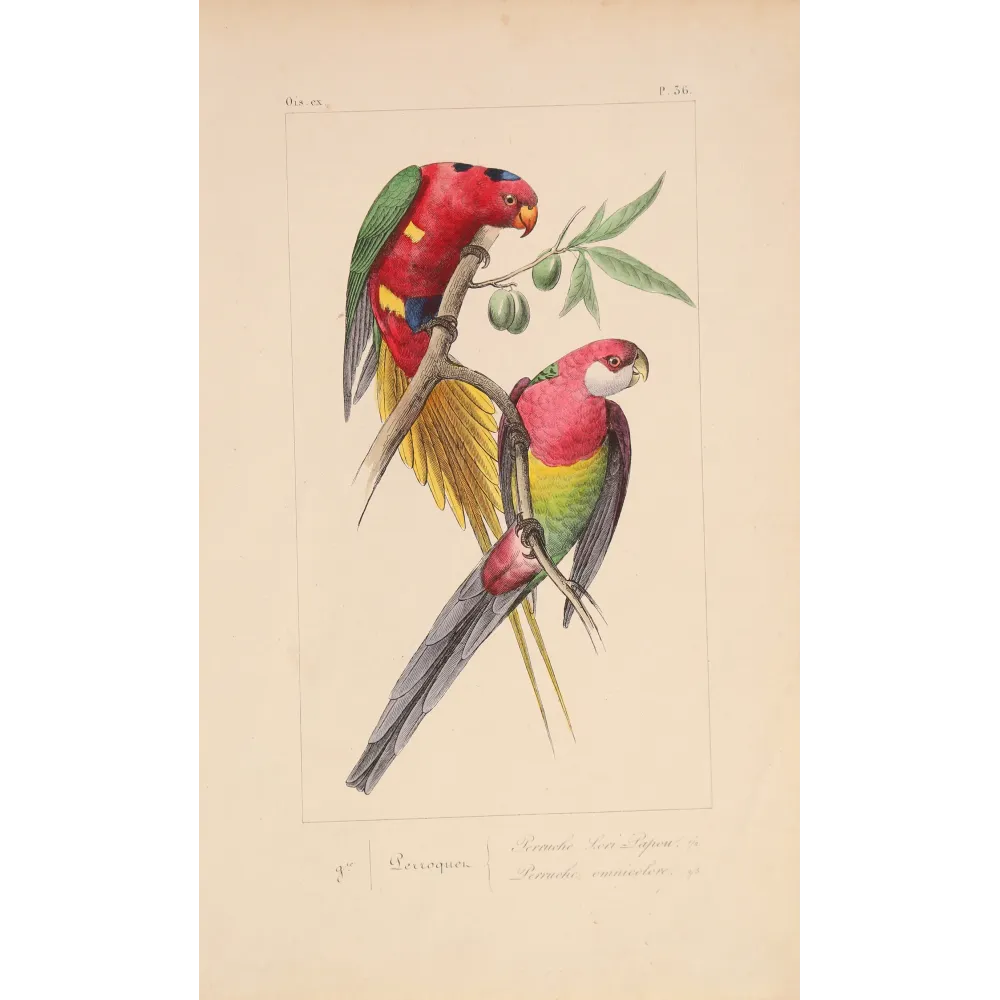
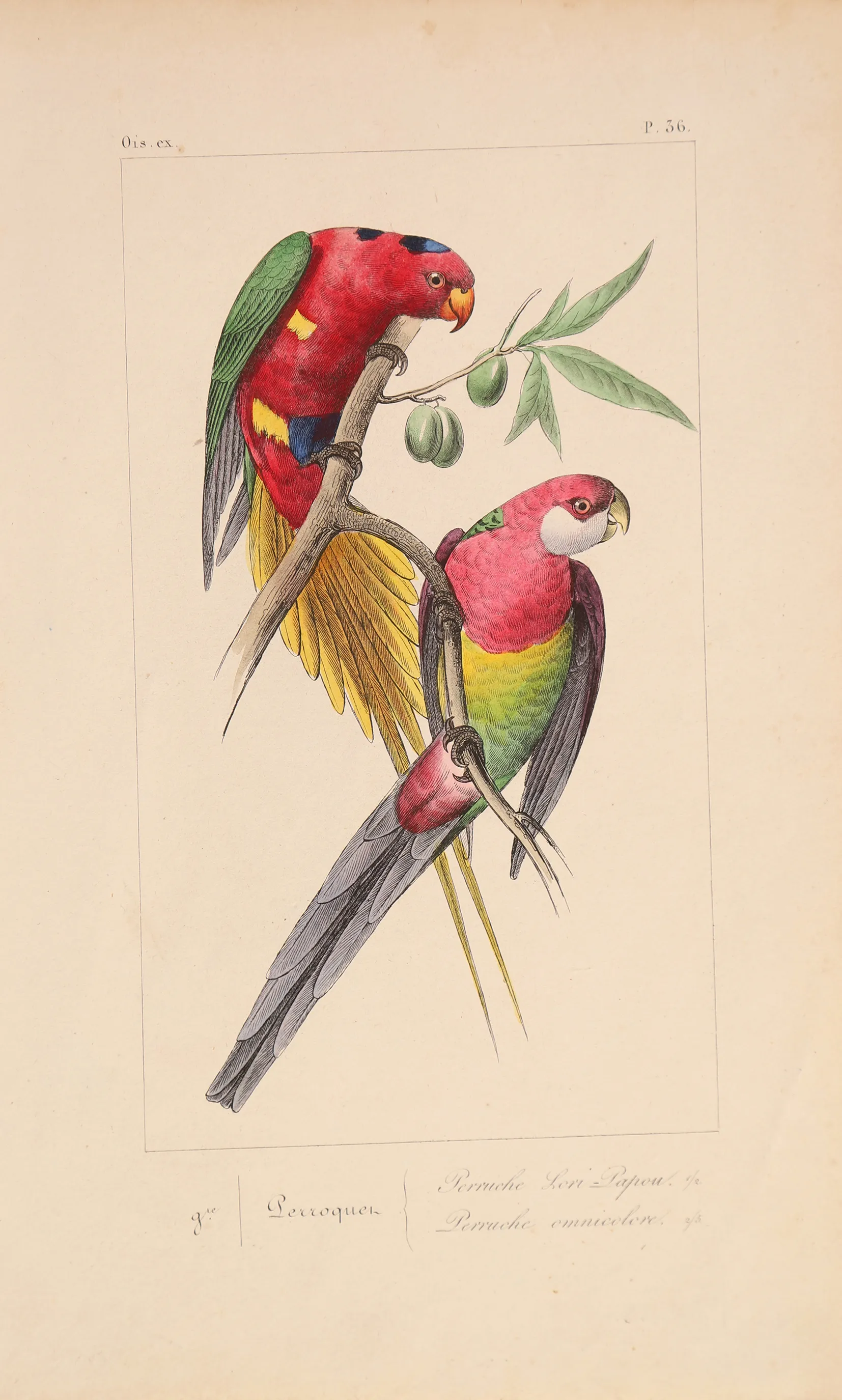
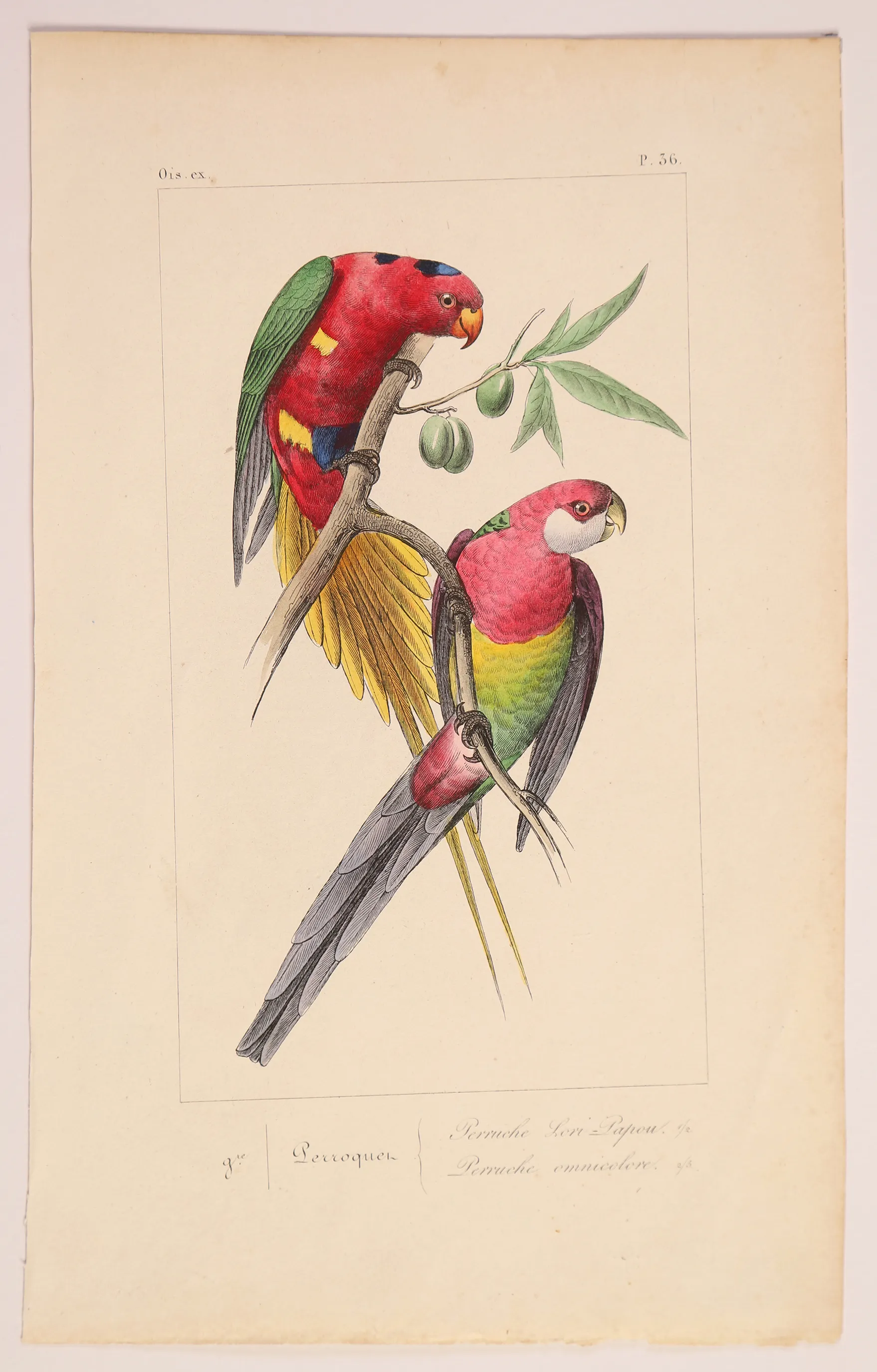
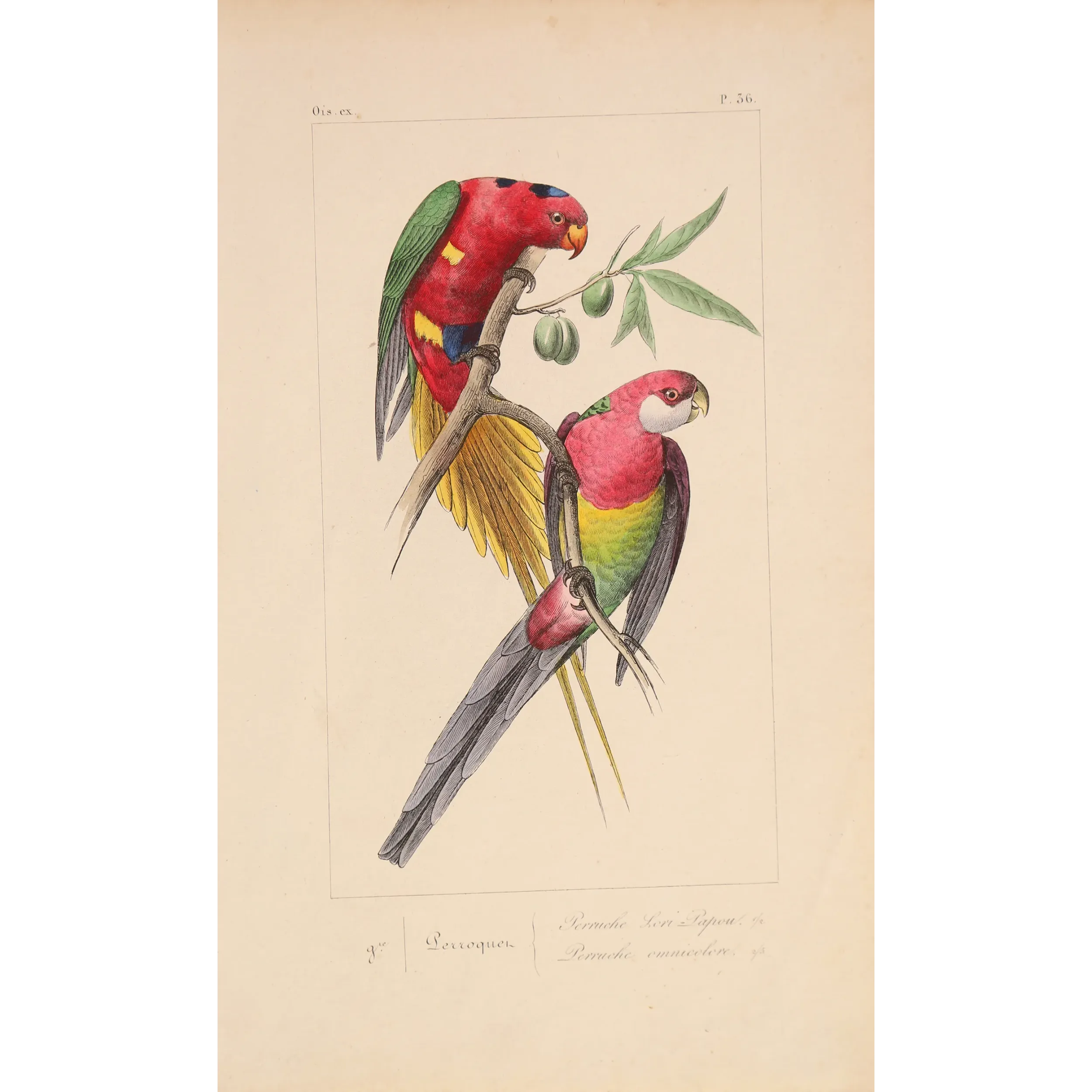
A striking 19th-century engraving depicting two exotic parrots with vivid red, pink and green plumage. The composition combines strong colour contrast with elegant vertical balance, creating a highly decorative and visually impactful antique print.
 Delivery policy
Your print will be carefully prepared and shipped worldwide via trusted couriers (UPS or similar).
 Authentic antique prints
Original engravings from the 17th–19th century.
This refined original first-edition plate depicts two brilliantly coloured parrots from C. L. Lemaire’s Histoire Naturelle des Oiseaux Exotiques, published in Paris in 1836. The historical titles printed directly on the sheet identify the subjects as Perruche Lori-Papou and Perruche omnicolore. The figures were created by Pauquet, described in the original publication as peintes d’après nature and engraved on steel.
Unlike the dramatic suspended action of some plates in the series, P.36 creates vitality through a quieter visual mechanism. Both birds remain securely perched, yet their bodies, heads and tails participate in a continuous directional movement across the sheet. Their shared orientation gives the composition an unusual sense of attentiveness, as though both subjects had responded to something beyond the visible field.
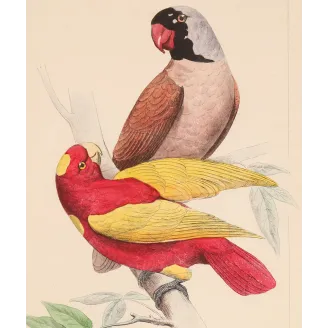
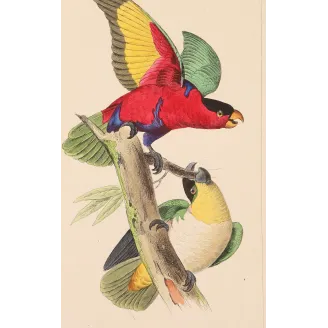
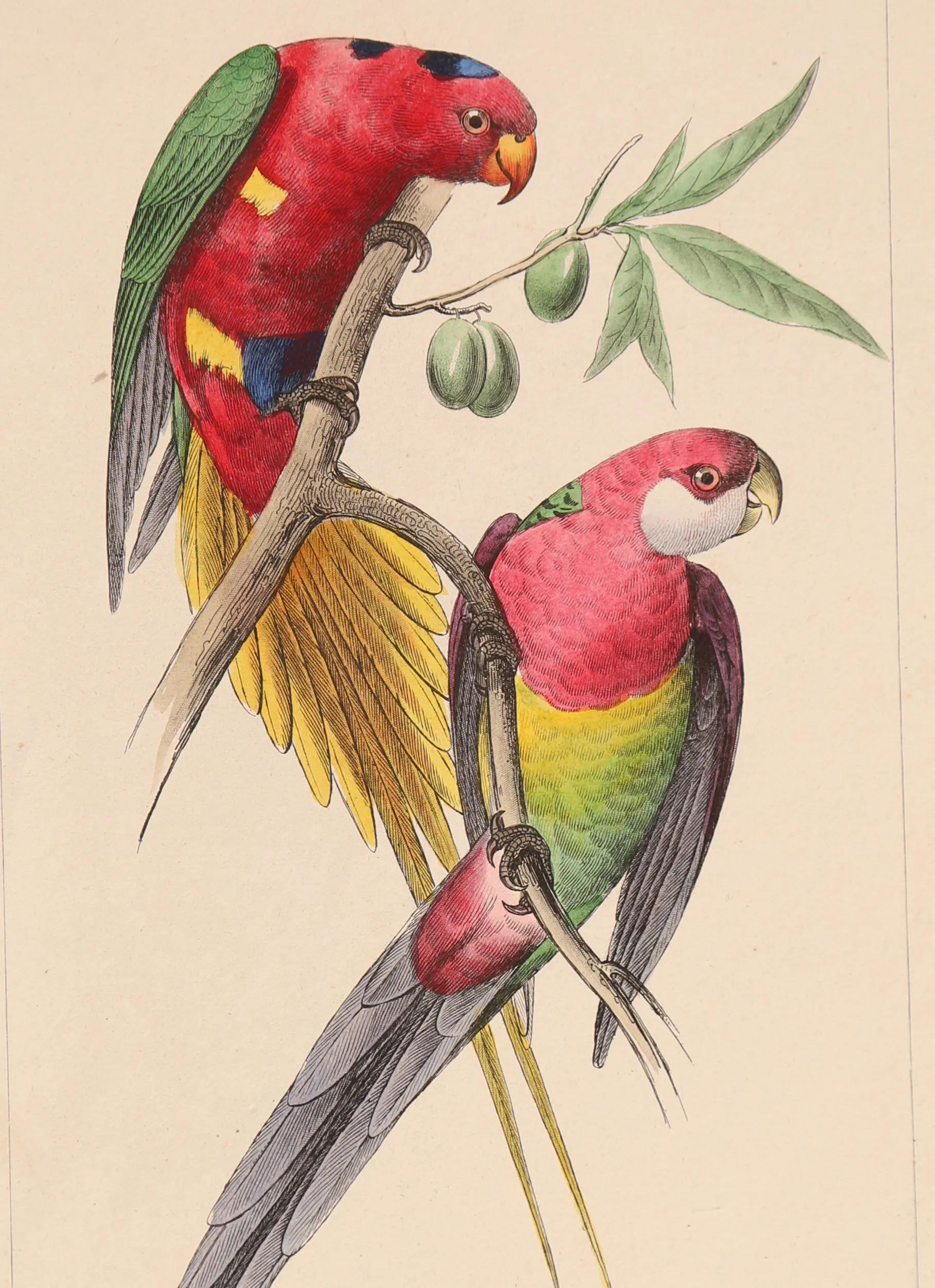
The original hand colouring remains exceptionally vivid. Direct examination of this impression reveals selective gum arabic on the magnificent yellow tail and green wing of the upper bird. These glossy passages introduce controlled points of luminosity within otherwise predominantly matte plumage, increasing the visual depth of the upper subject without overwhelming the composition.
The composition develops along the branching perch that descends through the plate. The upper bird adheres closely to this structure, its deep red body forming a compact vertical mass enriched by green wings and flashes of yellow and blue. Below, the second bird introduces a softer and more varied sequence of rose, yellow, green and grey.
Pauquet avoids a symmetrical pairing. The upper bird occupies the left side of the branch while the lower subject rotates around it, shifting the visual weight towards the right before its exceptionally long tail carries the eye diagonally back towards the lower left. The result is a composition that remains balanced while never becoming static.
Particularly striking is the relationship between the heads of the two birds. They do not turn towards one another. Instead, both orient their attention broadly in the same direction. This shared gaze creates a subtle connection between the subjects without converting the scene into an artificial narrative.
Colour reinforces the distinction between their physical forms. The upper bird is dominated by a concentrated red mass interrupted by clear areas of green, yellow and blue. The lower bird distributes colour more gradually across the body, moving from rose through yellow into green before resolving into the darker grey of the wings and long tail.
Two different bodies, one shared direction.
The historical designation Perruche Lori-Papou belongs to the zoological tradition surrounding the Papuan lorikeet, now recognised as Charmosyna papou. Native to New Guinea, the species is distinguished by its extraordinary combination of intense red plumage, green wings and elongated tail feathers.
The lower bird is identified on the plate as Perruche omnicolore, the historical French name still associated with the Eastern Rosella, Platycercus eximius. Its strongly differentiated areas of red, yellow, green and darker wing feathers explain the enduring appropriateness of the name “omnicolore”.
Preserving the original terminology alongside modern taxonomy allows the plate to be understood on two levels: as an object recording nineteenth-century zoological nomenclature and as a representation of species identifiable through contemporary ornithology.
Plate P.36 demonstrates how Pauquet could suggest animation without resorting to open wings or dramatic physical action. Here the sense of life emerges through continuity: branch, posture, rotation, gaze and tail establish successive directions that guide the viewer naturally through the sheet.
The upper bird creates the first visual anchor. Its body follows the principal branch almost vertically, while the head turns outward. The lower subject then rotates around the same support, producing a second orientation before its long tail extends the composition diagonally downward.
The visual sequence can almost be read as:
branch → posture → turn → gaze → tail
The two heads introduce the most subtle element of the composition. Instead of facing each other, both birds direct their attention towards the same side of the sheet. Their relationship is therefore constructed through a shared direction rather than direct interaction.
Direct examination reveals an equally selective material treatment. Gum arabic is visible on the broad yellow tail feathers and green wing of the upper bird, creating small reflective surfaces within the otherwise matte image. Particularly across the yellow tail, the gloss enhances the sensation of layered feathers and gives additional luminosity to an area partly concealed beneath the body.
The effect is characteristic of the sophistication of these plates: anatomical clarity, chromatic contrast and physical gesture remain distinct elements, yet Pauquet allows them to operate together as a single visual structure.
Published in Paris in 1836, C. L. Lemaire’s Histoire Naturelle des Oiseaux Exotiques brought together natural-history knowledge, brilliant hand colouring and Pauquet’s remarkable ability to suggest the physical presence of the living bird. Our dedicated Historical Perspective explores how observation d’après nature, gesture and composition combine throughout the work.
Histoire Naturelle des Oiseaux Exotiques: Art, Observation and the Living Bird →
The Pauquet name also belongs to a broader world of nineteenth-century natural-history illustration. Across different zoological subjects, the artists adapted their visual language to very different scientific and editorial purposes — from the animated presence of Lemaire’s birds to the precise, specimen-like presentation of exotic butterflies.
Excellent condition. Direct examination of this impression shows a clean and highly luminous first-edition sheet with exceptionally vivid original hand colouring and crisp engraved detail throughout.
Selective gum arabic remains clearly visible on the yellow tail and green wing of the upper bird. The reflective treatment is confined to these specific coloured passages, while the remaining plumage and botanical elements retain a predominantly matte surface.
The sheet shows only minor signs of natural age and handling consistent with an original work of 1836. The image remains fresh, sharply defined and visually vibrant, with generous margins and no significant defect affecting the composition.
Original plate titles: Perruche Lori-Papou / Perruche omnicolore
Modern identification: Papuan Lorikeet (Charmosyna papou) / Eastern Rosella (Platycercus eximius)
Work: Histoire Naturelle des Oiseaux Exotiques
Author: C. L. Lemaire
Figures: Pauquet
Publication: Paris, Pauquet Éditeur / Debure Libraire
Edition: First edition
Date: 1836
Plate: P. 36
Technique: Original hand-colored steel engraving
Colour: Contemporary hand colouring
Surface enhancement: Selective gum arabic on the yellow tail and green wing of the upper bird, observed by direct examination
Paper: Fine period paper
Watermark: None observed
Sheet size: approx. 23 × 14 cm
Photography: Detailed professional photographs of this individual impression are provided; additional photographs are available upon request.
Specific References
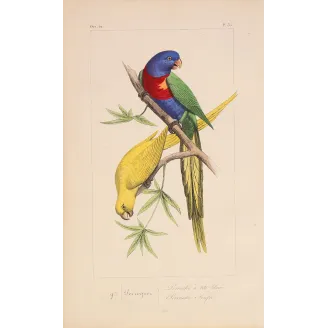
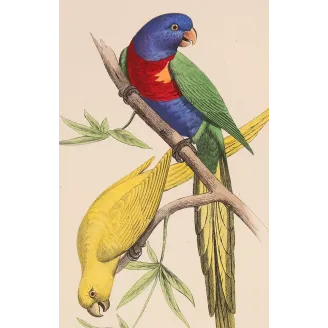
A striking 19th-century engraving depicting two vividly colored parakeets in a dynamic composition. The intense contrast of blue, red, green and yellow creates a highly decorative work, ideal as a focal piece in refined interiors.
A vibrant 19th-century hand-colored engraving depicting two exotic parrots with striking red and yellow plumage contrasted by softer natural tones. A dynamic and decorative composition with strong visual presence, ideal for collectors and interior display.
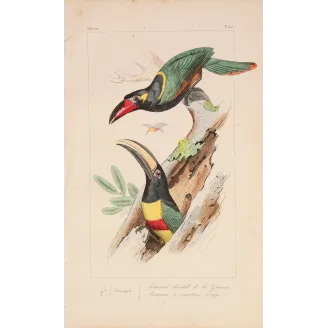
This vivid 19th-century engraving depicts two exotic aracaris, showcasing striking contrasts of green, red and yellow plumage. A highly decorative composition combining scientific observation with strong visual appeal, ideal for collectors of tropical ornithology and refined interior spaces.
A highly dynamic 19th-century engraving depicting a tricolour lory in flight above a contrasting parakeet. The vivid interplay of red, yellow, green and blue creates a striking decorative composition with exceptional visual energy and presence.
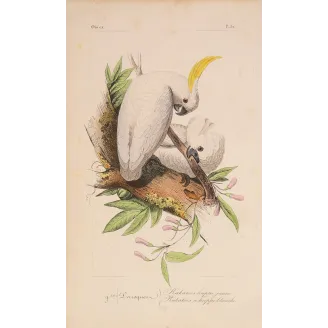
Elegant 19th-century hand-colored engraving depicting two sulphur-crested cockatoos, rendered with refined detail and soft tonal harmony. A balanced and decorative exotic bird composition ideal for sophisticated interiors.
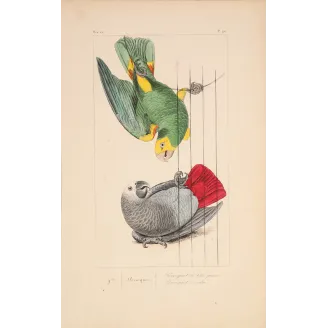
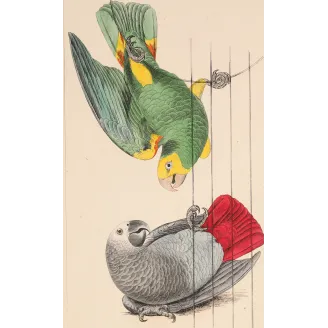
A distinctive 19th-century engraving depicting two parrots in an unusual composition, including one shown suspended upside-down. The presence of cage elements adds historical character, creating a unique and visually engaging natural history print.
A vivid 19th-century engraving depicting two exotic parakeets in a dynamic vertical composition. The intense red plumage contrasts beautifully with green and yellow tones, creating a striking decorative work with strong visual presence.
A striking 19th-century hand-colored engraving depicting two exotic parrots in a composition of vivid chromatic contrast. The brilliant red lory and the grey-headed, yellow-breasted parakeet create a highly decorative image of strong visual presence, ideal for collectors of antique ornithological prints and refined interiors.
Highly decorative 19th-century engraving of exotic parakeets with vivid blue, red and yellow plumage. A striking and colorful antique bird print.
A refined 19th-century engraving depicting two parakeets arranged in a fluid and harmonious composition. The dominant green tones, enhanced by delicate red and violet accents, create an elegant and highly decorative natural history print.
Vivid 19th-century hand-colored engraving depicting two parakeets in dynamic interaction, with striking green plumage and contrasting red and violet accents. A highly decorative exotic bird composition.
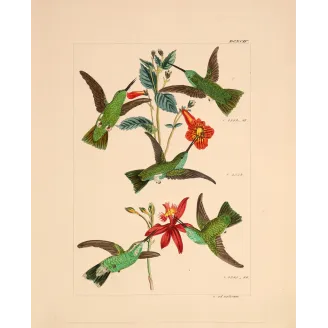
An exceptional original hand-colored engraving from Ludwig Reichenbach's Trochilinarum Enumeratio, depicting five brilliant hummingbirds feeding among scarlet tropical flowers. Featuring Esmeralda, Euchloris and Maculicollis, this dynamic nineteenth-century composition beautifully combines botanical richness with the elegance of Victorian ornithological illustration.
Vivid 19th-century hand-colored engraving depicting two parakeets in dynamic interaction, with striking green plumage and contrasting red and violet accents. A highly decorative exotic bird composition.
A striking 19th-century engraving depicting two vividly colored parakeets in a dynamic composition. The intense contrast of blue, red, green and yellow creates a highly decorative work, ideal as a focal piece in refined interiors.
A coherent ensemble of eight original orange and bigarade engravings by Pancrace Bessa, reflecting the cultivated discipline of French orangeries in the Napoleonic era. Botanical precision and architectural composure unite in a refined citrus portfolio preserved as a complete series.
A striking 19th-century engraving depicting two exotic parrots with vivid red, pink and green plumage. The composition combines strong colour contrast with elegant vertical balance, creating a highly decorative and visually impactful antique print.